Yellowman
Young Vic Theatre, 29th November 2017
From what I can see American playwrights don’t like to arse about too much with the play, either in terms of dramatic form or the subject, the family history in one form or another. Why not, given the history of American gifts to the theatrical world, and if that’s what the punters want. From this apparent straightjacket have emerged some cracking plays, from the C20 masters as well as in recent years. It would seem that a recommendation from the journos and academics which make up the Pulitzer judging panel is as good as recommendation as any as to what to see. And that basically is all I had to go on prior to booking Yellowman.
Dael Orlandersmith’s two hander was a Pulitzer finalist from 2002 which tells the story of Eugene and Alma, from childhood into adulthood, from rural South Carolina to New York and back again, through the 1960s, 1970s and 1980s. Most importantly, as the Yellowman of the title, Eugene is tall and light skinned, like his grandfather and mother Thelma, though not his father Robert, whilst Alma is large and dark skinned like her mother Ophelia. The actors play all the male and female characters (including Alton and Wyce, Eugene’s friends), with rapid, though sharply delineated, shifts between these characters.
The relationship between Eugene and Alma moves from simple childhood friendship, through mutual dependence, to teenage love then sex, engagement and pregnancy. This, on its own, would be enough to enjoy given the quality of the writing, but over the 100 minutes or so we get an incisive dissection of “blackness”, beauty, gender, domestic violence, generational division and abuse, inheritance, poverty and class. Very, very occasionally. Ms Orlandersmith’s writing lapses into saccharine cliche, but more often that not, this serves a colouristic purpose and can be forgiven. The deliberate repetition reinforces the deep-rooted identity conflicts that lie at the heart of the play and ensures the six characters as well as the two principals truly come to life.
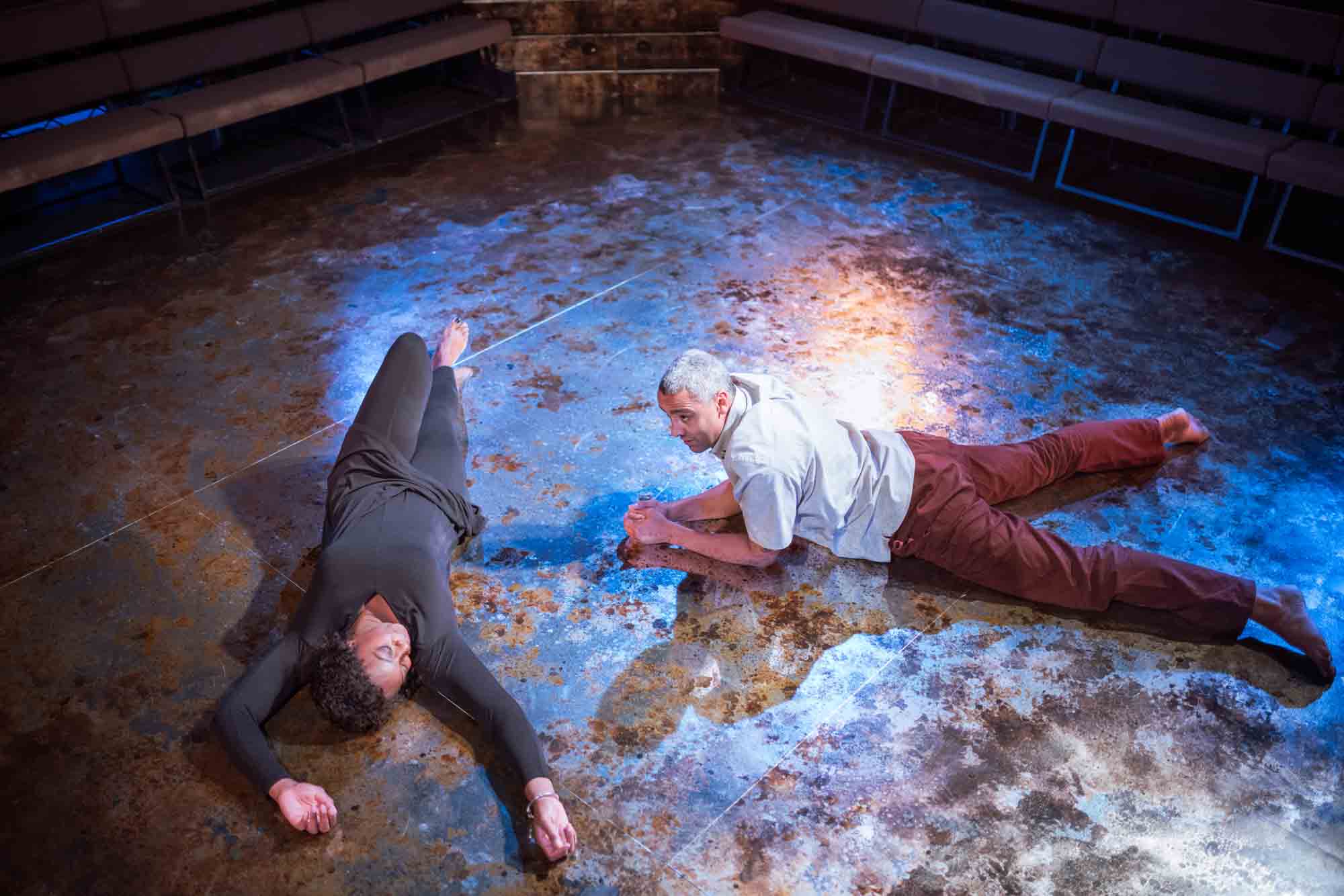
About from a mottled, mirror floor and some subtle but effective lighting from Nao Nagai, the Clare studio space in the Young Vic had nothing else to work with for the two actors, bar script and audience. So they needed to be good, very good. They were. Christopher Colquhoun, (a long way from Weatherfield), brought an awkwardness and innocence to Eugene which heightened the tensions in key scenes with Alma, his father, Wyce and, latterly, grandfather. Nicola Hughes, if anything, was even more striking, turning Alma into a woman of power and dignity who rises above the self-hate others would have her internalise, and eliciting pity for Ophelia. One of the fiercest performances I have seen this year. I would dearly love to see her in more “straight” drama roles beyond the musicals she is renowned for.
It is easy to see why Yellowman has been so frequently revived since its premiere and why the talented young director Nancy Medina would choose to take it on. Its setting may be specific in terms, of time, place and community, but its insights are universal and the humanity of its love story is palpable. Yet this, if I am honest can be found elsewhere on screen, stage or page. What makes this really, really special for me is Ms Orlandersmith’s gift for dialogue and image. The five sections of the play are distinct by chronology, but is the skill with which the author paints in the detail that made going to see this one of the best decisions I have made this year. And all for £15.


 At Home He Feels Like A Tourist