
Antony and Cleopatra
National Theatre Olivier, 11th December 2018
Simon Godwin is a director who has shown he has a bit of a way with the sprawling masterpieces in the dramatic canon in recent years. Especially from the Bard. His recently opened Timon of Athens at the RSC, albeit with the force of nature that is Kathryn Hunter in the lead, seems to have gone down well with the criterati. Previously at the National his Twelfth Night, (OK so that’s not really sprawling but it is stuffed to the gills with characters all wanting time to shine), was a belter, his excellent African inspired RSC Hamlet announced Papa Essiedu to the world, and further back the Tourist can bear witness to the success of his interpretations of Farquhar’s The Beaux Stratagem, Shaw’s Man and Superman and O’Neill’s Strange Interlude, none of which falls into the snappy, straightforward category.
He doesn’t go in for the flashy, but neither is he by any means “conservative”, here being resolutely modern-dress. What I think he does do is think carefully about every single character’s attributes and motivations, and how they fit together, and ensures they have enough “space” to show those attributes and motivations. So even the most far fetched plot seems eminently reasonable. He is at it again with Antony and Cleopatra. You can see that from the string of 4* reviews and the gongs already handed out to the incomparable Sophie Okonedo (who has also I see now bagged a CBE from Her Maj) and the redoubtable Ralph Nathaniel Twisleton-Wykeham-Fiennes (who I believe has never been so honoured though he is, as you might expect with that moniker, a distant relative of our beloved Royals).
So you probably don’t need me to tell you this is probably about as good an interpretation of the still flawed A&C as you are ever likely to see. (And you can still see it if you are crafty, and lucky, with the returns that invariably pop up a day or so ahead). Still, redundancy, and/or sluggishness, have not prevented me venturing an opinion in the past so here goes.
The problem with A&C, which was readily apparent in the last, somewhat unconvincing, RSC offering, lies in the flamboyance of the language, the articulation between the “great events” which provide its context and the domestic “at home with the … ” drama of our ageing lovebirds, and the potentially wearing effect of seeing the celeb couple always “showing off” to real, and imagined, audiences. Simon Godwin however has chosen to take these challenges head on.
First up he takes his time. At near 3.5 hours with the interval, across 42 scenes, this does mean there are one or two moments where audience concentration will waver but, with little in the way of cuts (though I am not expert enough to be sure), it means that the historical big picture is unclouded and that all the characters, and not just the power couple, get the chance to show themselves fully. Moreover the lines themselves are given air to breathe and the detail of the domestic exchanges has been rigorously thought out, especially the comic and ironic inflections. Interestingly only the final suicide scenes feel a little rushed with the snake being a bit of an indulgence. We had come this far so I would have been happy to see a more measured take on Tony’s botching and Cleo’s scrupulous choreographing of her own demise.
Obviously it helps that the acting is so strong. And not just from our Sophie and our Ralph. Tim McMullan as Enobarbus, especially shaven-headed for the part, is as wonderful as everyone says he is. It helps that Enobarbus is gifted with some of the best lines in the play but even so he brilliantly walks the tightrope of truth and cynicism (central to the whole play) in his capacity as detached observer and explainer of events and as the embodiment of corrupted honour. And he does all of this whilst barely appearing to try. Now I am pretty sure that Mr McMuillan doesn’t want for work, so good an actor is he, but I would like, no I demand, a Richard II and an Iago from him in the relatively near future. And a lead role in a new play at the NT.
The other standout was Fisayo Akinade as Eros, given full rein to ramp up the comedy but also squeezing a ton of emotion out of a character that normally is just a bit part. The smart money already knows this young man is going places. Re-gendering Agrippa definitely worked, especially with Katy Stephens stepping up, I really enjoyed the performances of Gloria Obianyo and Georgia Landers as Chairman and Iras, more put upon bessies than intimidated hand-maidens, joining Eros and Enobarbus as the conflicted confidantes required to soothe and distract their nominal bosses.
Hannah Morrish did her steely, vulnerability thing again as Octavia. Nicholas Le Provost did his Nicholas Le Provost voice to perfection as a slightly feeble Lepidus, though Tim McMullan’s impersonation might actually improve on the real thing, and Sargon Yelda was an adept Pompey. In fact the only slightly jarring performance came from Tunji Kasim (who is a fine actor make no mistake) whose Octavius seemed overly stilted compared to the naturalistic verse and prose delivery on show elsewhere.
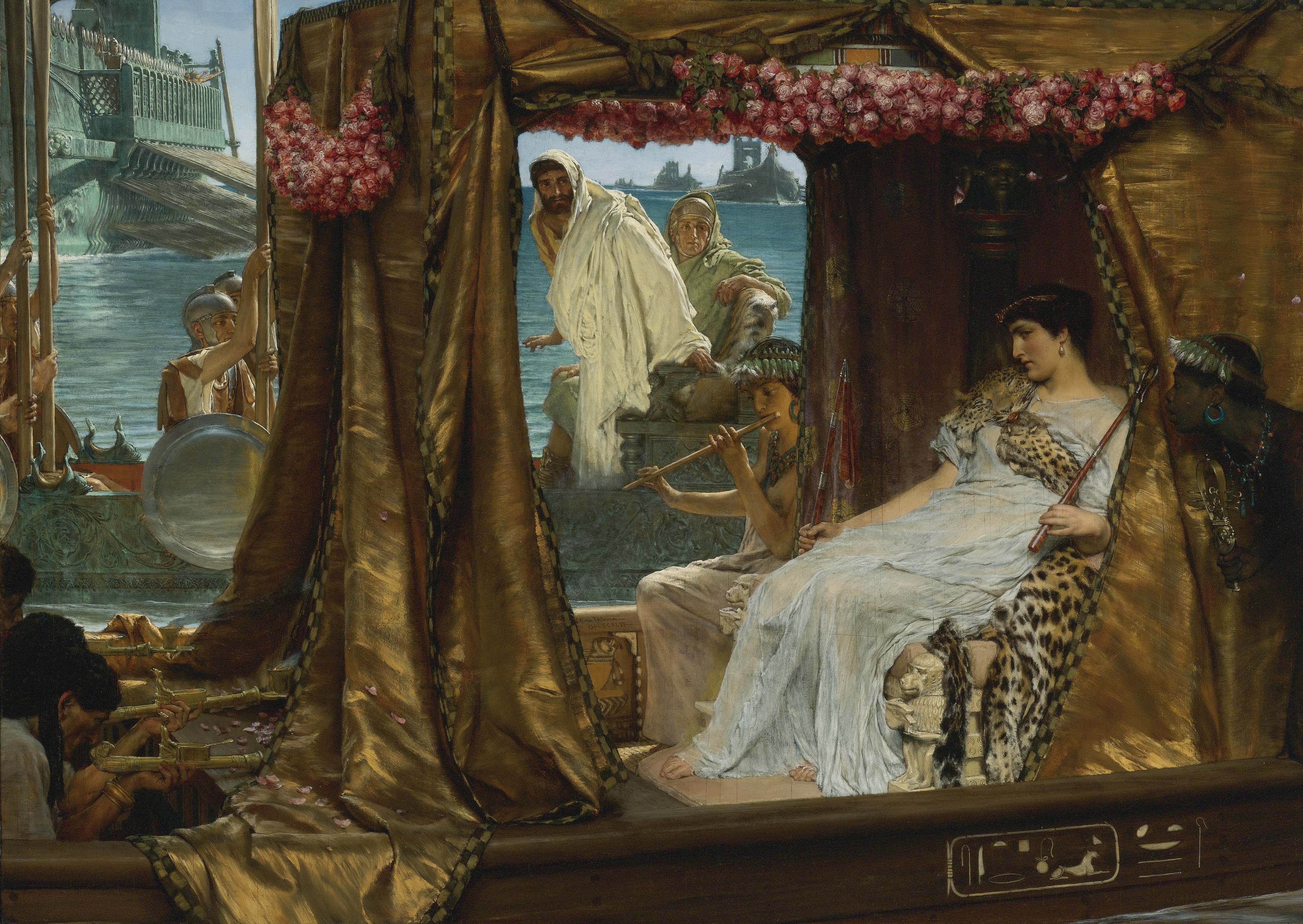
This delivery and the afore-mentioned deliberate pacing also meant that the “performances” of A&C were foregrounded. A&C were the hammed-up actors in their own blockbuster, not just in terms of the ludicrously over the top way they voice their love but also in the way they inject this passion, this risk-taking, into their behaviour in the political arena. Whilst also knowing they are a bit too old and tired for all this display and that it is unlikely to end well. But there egos can’t help themselves. This is also perhaps what has made the story, and especially the “idea” of Cleopatra, so alluring to subsequent generations. (Though as the preposterous flummery of Dutch/British Victorian artist above shows most of these generations preferred their Cleo to look like she had come from Surrey).
Making sense of the “epic” in the tale whilst still permitting us to make a personal, emotional, connection is Mr Godwin’s, and his casts’, smartest achievement here. Hildegard Bechtler’s revolving set (note to designers: always use the revolve on the Olivier to avoid the “acres of space” illusion) is sumptuously minimal, or minimally sumptuous, making the delineation between efficient Rome (modern war room with split screen conflict footage), sultry Egypt (Alexandrian palace with complete with pool – only slightly Vegas) and all places in between, including a submarine, clear without being fussy. Once again it does slow down proceedings but, like I say, that gives time to process what we learn from each of the sometimes rapid-fire scenes.
I’ve no doubt that Anthony Hopkins and Judi Dench did it better but this was the first time the play properly worked for me. Sophie Okonedo, dolled up in slinky ballgowns (Evie Gurney and the costume team can certainly tailor), breezes through Cleo’s caprice, wit, quick temper, self-obsession, but still manages to make her exposed, needing her soldier-boy especially when he is not there. The bickering is patently borne of adoration and mutual dependence, as well as their individual self-regard.
Ralph Fiennes brings a little of the faded rock star from A Bigger Splash as he dons baggy salvars when relaxing with his lady love. Yet he also, as you might expect, nails military bearing when required. Throughout he does seem troubled, burdened if you will, shoulders hunched, as if he knows how the picture will end. As do we particularly given Simon Godwin’s decision to show us the end at the beginning (and the end, obvs). I had forgotten how many wonderful lines Shakespeare gives Antony to grapple with his failure, his fading from view. Loved it.
Eternity was in our lips and eyes …. ‘fraid not Cleo as this excellent production shows. It will never be the Tourist’s favourite Shakespeare but finally I see the attraction.
 At Home He Feels Like A Tourist