

Mother Courage and her Children
Royal Exchange Theatre Manchester, 28th February 2019
Brecht. Royal Exchange. Headlong (This House, People, Places and Things, Labour of Love, Common, Junkyard, 1984, The Glass Menagerie, American Psycho and Enron – and that’s just what I can vouchsafe), Anna Jordan adapting, Amy Hodge, the Associate Director alongside Jeremy Herrin at Headlong and Julie Hesmondhalgh as Mother Courage (“MC”) herself.
Strap yourself in. This was bound to be an exhilarating theatrical ride. And so it was. Full of great visual moments. Even if the transposition of the story to a future (2080’s) European war, Reds against Blues in a continent divided up by grids, probably subtracted from, rather than added to, its contemporary relevance. Brecht finished Mother Courage in 1939 and he pointedly set it in the Thirty Years War of 1618 to 1648, proportionately the most destructive conflict in human history, as a message of the forthcoming horror. The greatest “anti-war” dramatic statement of all time? Probably, though it is more analysis than fulmination. One pf the greatest plays of the C20, and all time? Certainly. So f*ck about with it at your peril.
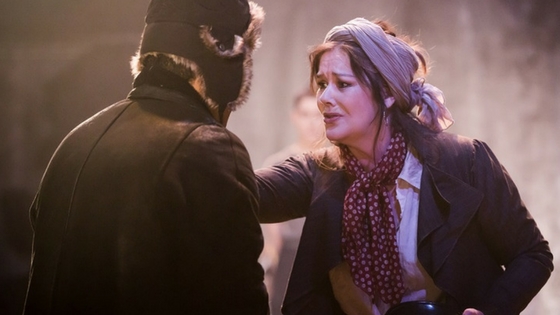
On the other hand the whole point of BB’s epic, Verfremdungseffekt, theatre is to set the audience on its toes and get the grey matter working overtime, and to let the theatre makers create their own take. Which they certainly do here. With the utmost respect to Ms Hesmondhalgh who is predictably a mighty presence, the star of the show is a repurposed ice cream van, standing in for the cart of the original text. Not something I expect to write again on these pages. Joanna Scotcher’s design looks like it came from it was sneaked out of a forgotten storeroom at a Hollywood studio marked “Vietnam War/Mad Max for charity”, right the way down to Yvette’s (Hedydd Dylan) pink plastic “catsuit”. There isn’t much in the way of fixed bric-a-brac as it should be in Brecht and as is warranted by the Royal Exchange’s in-the-round space. Which left the van, sans engine but still with its jingle intact, free to perambulate across the stage, pulled, before their respective early demises, by each of MC’s three kids, Eilif (Conor Glean), Swiss Cheese (Simeon Blake-Hall) and Kattrin (Rose Ayling Ellis). Foods, drink, water, shirts, uniform, clothes, guns, furniture, you name it, MC stocked it in the ramshackle van. Everything you need to profit from a prolonged war. It even doubles up as a nightclub.
Music (Jim Fortune), which nods back to Weill, sound (Carolyn Downing) and lighting (Lizzie Powell) was similarly pimped up to match the setting and aesthetic. Musician Nick Lynn, positioned in the circle, served up, often at MC’s request, a barrage of sound at times to set alongside some of the gentler, folksy numbers. And Movement Director Raquel Meseguer put the hours in to marshal the nine strong cast through the 12 scenes (covering 12 years of the conflict).
Now the Tourist knows from Anna Jordan’s other recent, superb, work with Frantic Assembly, The Unreturning, that she is the doyenne when it comes to ambitious, physical theatre. And so it proves here. This adaptation comes in at a couple of hours. It can drift closer to three. With the on-stage intros to each scene and some fairly direct exposition it is easy enough to follow even for the uninitiated, and all the narrative elements are intact, but it scampers along at a heck of a lick and, with all the visual stimulus, the constant motion, the soundscape, the dizzying array of accents, there just isn’t much time to think about what is going on and what Brecht is telling us.
Not a complaint. The production looks and sounds so good that this is easily forgiven but don’t come here looking for any gestural detail in the main relationships, between MC and the children, or between MC and respectively the Cook (Guy Rhys), the Chaplain (Kevin McMonagle) and Yvette. Julie Hesmondhalgh and the rest of the cast, notably these three, are too good for Brecht’s messages not to sink in but the true horrors, the deal with the Recruiting Officer to conscript Eilif, Swiss Cheese’s torture, MC’s denial of her son after the botched ransom, Kattrin’s rape, Eilif’s execution, the Cook’s rejection of Kattrin and Kattrin’s sacrifice don’t always register as strongly as they might. Mind you the bleak conclusion certainly does: MC taking up the van’s harness as a single fire burns out.
MC’s determination, even desire, to profit however from the war, despite the damage it does to her and those around her, does ring clear. Julie H is a ballsy, artful fiercely protective but, ultimately wary and realistic, MC. As she should be. This isn’t Hollywood – we are supposed to engage emotionally with the characters but not be emotionally manipulated by them. Ultimately we aren’t really supposed to sympathise with MC, just to understand why she has to act as she does, to see the damage that war does to those at its periphery as well as the fighting protagonists. MC thinks that her business is the way to safeguard her children. Manifestly it is not. We see that. She cannot.
And to see how war, when churned through the prism of difference and ideology, is an integral part of the economic sub-structure, orchestrated by the powerful. One day perhaps Brecht’s lesson will have no relevance. No sign right now though we should remember that the global and supra-national institutions which were built post WWII to rein back our worst excesses have largely succeeded in restricting conflict to the national, or intra-national, level, though still often as proxies for economic accumulation.
Which is why MCAHC will go on being restaged and re-imagined (Lynn Nottage’s Ruined for example) for new audiences to watch and learn. At the matinee performance the Tourist attended there were, as is to be expected, throngs of school students. They seemed to be all over it. I assumed it was still some sort of set text for drama students. Apparently not. Only Brit playwrights good enough for the Government when it comes to reaching GCSE drama. Interesting in the context of the breakdown of the political order in Europe that this adaptation presages. Still we should be grateful that this shower of a Government hasn’t interfered with syllabus and teaching for, what, all of a couple of years. And, unless the nutters back down, they won’t be able to for many years to come as they sort out the never-ending shower of sh*t that is coming down the tracks once we have “Brexited”. It’s only just begun folks. And not in a nice, Karen Carpenterish kind of way.
Got me to thinking about what our proud youth study for drama at A level. Faustus, Lysistrata, Woyzeck, Antigone, Much Ado About Nothing, A Servant to Two Masters, Hedda Gabler, The Caucasian Chalk Circle, Accidental Death of an Anarchist, Jerusalem, Yerma, The Glass Menagerie, Metamorphosis, Cloud Nine, Our Country’s Good, Bronte, Earthquakes in London, Stockholm, The Crucible, The Visit. Across the various boards. Bloody Hell. If they master that lot then I have nothing to fear for they will know everything there is to know about the human condition. Drama is integral to democracy and citizenship. Ask Aeschylus, Sophocles or Euripides.
 At Home He Feels Like A Tourist