Rachel Podger and VOCES8 at Kings Place review ****

voces8_17feb2017

Rachel Podger, VOCES8 – A Guardian Angel

Kings Place, 28th March 2018

  • Orlando Gibbons – Drop, drop slow tears
  • Plainchant – Pater Noster
  • Heinrich Ignaz Franz Biber – Rosary Sonata No 16 Passacaglia “A Guardian Angel”
  • Jonathan Dove – into thy hands
  • Nicola Matteis – Passaggio rotto, Fantasia, Movimento incognito (from Other Ayrs, Preludes, Allemandes, Sarabandes
  • Mendelssohn – Denn er hat seinen engeln befohlen uber dir
  • Rachmaninov – Bogoroditse Dyevo
  • Tallis – O nata lux
  • James Macmillan – Domine non secundum peccata nostra
  • Thomas Tomkins – When David heard
  • Bach – Partita for flute in A minor BWV 1013
  • Monteverdi – Adoramus te. Christe
  • Orlando Gibbons – Hosanna to the Son of David
  • Giovanni Gabrielli – Angelus Domini descendit
  • Owain Park – Antiphon for the Angels

Blimey. It took almost as long to write out the programme as to listen to some of these pieces.

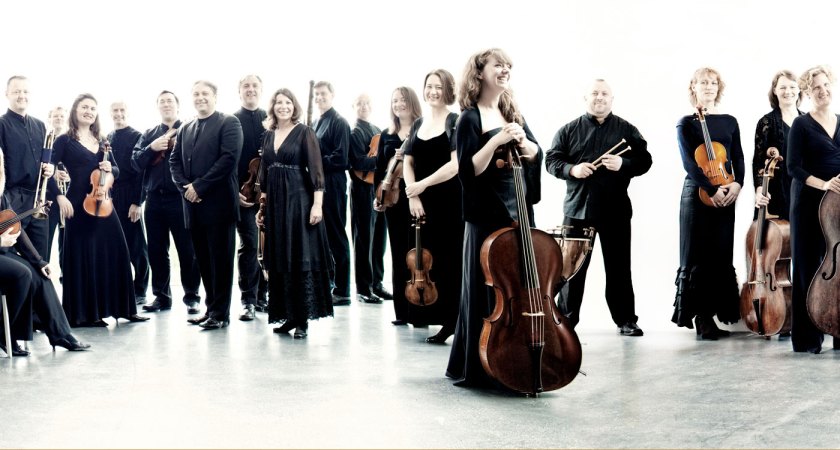
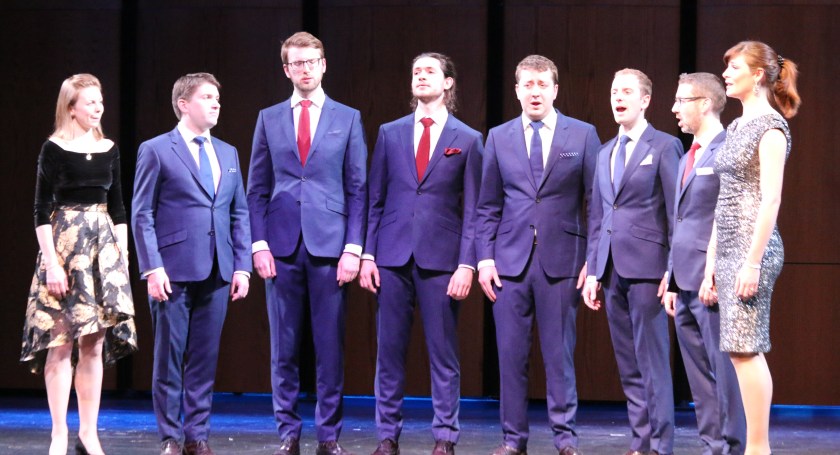
What do we have here then? Well the undisputed queen of the Baroque violin, (OK maybe not given Isabelle Faust, Monica Huggett, Elizabeth Wallfisch and no doubt a few more I don’t know), has teamed up with the English vocal group VOCES8 to create a programme of violin and vocal works from across the ages all themed around “A Guardian Angel”. Some of these pieces appear on Ms Podger’s 2013 CD of the same name. Rachel Podger creates a big, clear sound with vigorous rhythm which makes it a joy to follow the line of the music. Yet when virtuosity is required, (not so much on this evening), she doesn’t hold back.

Angels being angels in Christian religion they turn up a fair bit in music notably Renaissance, Baroque and the modern composers who seek inspiration from their forbears. Here we have pieces for solo violin, (or flute transposed for violin in the case of the Bach sonata which formed the backbone to the second half), for choir alone and for a combination of the two. Angels watching over you is obviously anathema to my carefully constructed rationalist self-image though maybe all this music and my penchant for early Renaissance art and architecture might cumulatively start to rub off. I was reminded of the world (other-world?) that Annie Baker explored in her latest play John (John at the National Theatre review *****).

The plainchant with the choir perched in the balcony was as meditative as you like and was followed by the Baroque violinists party piece de jour from Biber which seems to be following me around everywhere. It’s title provided the stepping off point for Ms Podger. If you don’t know it, and the genuinely ground-breaking Sonatas that precede it you should. It still sounds cutting edge today. It doesn’t skimp on the bass notes which is probably when it floats my boat. Ms Podger’s recording is the best place to start.

I can take or leave the Mendelssohn, Rachmaninov and Dove pieces though VOCES8 were more convincing than I expected, the Matteis violin extracts were immediately invigorating in that typical Italian baroque way and the MacMillan piece was as spare (echoes of Part) as you might expect from this committed composer. The Tallis was my favourite with Ms Podger’s violin taking the highest line as the Jesus to the choir’s Elijah and Moses and alongside Andrea Halsey’s spellbinding soprano. Her voice is about as good as you will ever hear (says some-one who knows absolutely nothing about singing!!).

The biggest surprise of all was the Thomas Tomkins. New to me, I will need to seek this out. The Bach was obviously wonderful, Ms Podger has made this her own and proved that it could as easily been scored for violin as flute. The Monteverdi, Gibbons and Gabrielli pieces were relatively short but very welcome. Owain Park’s new work was commissioned especially for this collaboration and amalgamates texts by St Ambrose and Hildegard von Bingen sticking to the angel theme. Like so many commissions for choirs it is immediately attractive, it is a real thrill hearing accessible music for the fisr time.

Throughout the concert we had well constructed antiphonal exchanges between violinist and pure toned choir which brought out the best of the exceptional acoustic at Hall One of Kings Place. No clapping between the pieces, a rapt audience, (no phone glows as far as I could see), and discreet but appropriate lighting all combined to maintain the magic.

I can’t pretend I understand the music that was put in front of me. I can’t read music and I am steadfastly failing to learn its language. If you are like me, and I reckon there are a lot of you who are, (obviously I say this in full knowledge of the fact that no-one reads this), then I cannot recommend the combination of Early and/or Baroque music and voices highly enough. Food for brain, heart and soul (not that there is one, but like I say earlier, faith may yet surprise me).


My favourite classical concerts of 2017

623x512xrattle625_2-pagespeed-ic_-clbnppbu_4_0

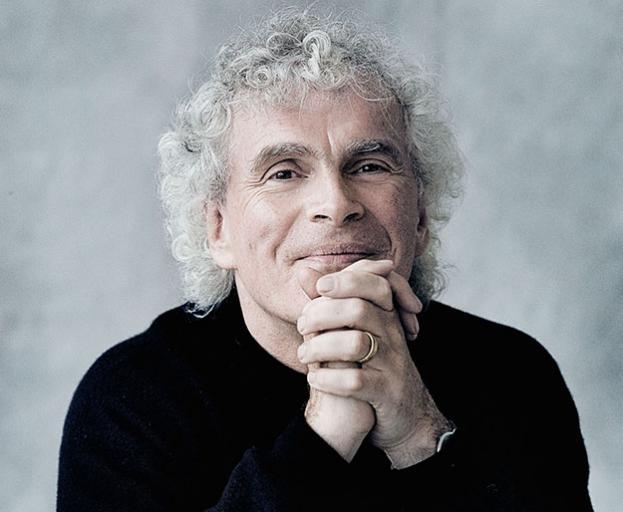
Right I know it is a bit late in the day but I wanted to make a list of the concerts I enjoyed most from last year. So everything that got a 5* review based on my entirely subjective criteria is ordered below. Top is Sir Simon and the LSO with their Stravinsky ballets. Like it was going to be anything else.

Anyway no preamble. No waffle. Barely any punctuation. Part record, part boast. Comments welcome.

  • LSO, Simon Rattle – Stravinsky, The Firebird (original ballet), Petrushka (1947 version), The Rite of Spring – Barbican Hall – 24th September
  • Colin Currie Group, Synergy Vocals – Reich Tehillim, Drumming – Royal Festival Hall – 5th May
  • Isabelle Faust, Akademie fur Alte Musik Berlin, Bernhard Forck – JS Bach Suite No 2 in A Minor BWV 1067a, Violin Concerto in E Major BWV 1042, Violin Concerto in A Minor BWV 1041, Concerto for Two Violins in D Minor BWV 1043, CPE Bach String Symphony in B Minor W 182/5 – Wigmore Hall – 29th June
  • Jack Quartet – Iannis Xenakis, Ergma for string quartet, Embellie for solo viola, Mikka ‘S’ for solo violin, Kottos for solo cello, Hunem-Iduhey for violin and cello, ST/4 –1, 080262 for string quartet – Wigmore Hall – 25th February
  • Britten Sinfonia, Thomas Ades – Gerald Barry Chevaux de Frise, Beethoven Symphony No 3 in E Flat Major Eroica – Barbican Hall – 6th June 2017
  • Nederlands Kamerkoor,Peter Dijkstra – Sacred and Profane – Britten Hymn to St Cecilia, Gabriel Jackson Ave Regina caelorum, Berio Cries of London, Lars Johan Werle Orpheus, Canzone 126 di Francesca Petraraca, Britten Sacred and Profane – Cadogan Hall – 8th March
  • Tim Gill cello, Fali Pavri piano, Sound Intermedia – Webern 3 kleine Stücke, Op. 11, Messiaen ‘Louange à l’Éternite du Jesus Christ’ (‘Praise to the eternity of Jesus’) from Quartet for the End of Time, Henze Serenade for solo cello, Arvo Pärt Fratres, Xenakis Kottos for solo cello, Jonathan Harvey Ricercare una melodia for solo cello and electronics, Thomas Ades ‘L’eaux’ from Lieux retrouvés, Anna Clyne Paint Box for cello and tape, Harrison Birtwistle Wie Eine Fuga from Bogenstrich – Kings Place – 6th May
  • Britten Sinfonia, Thomas Ades, Mark Stone – Gerald Barry Beethoven, Beethoven Symphonies Nos 1 and 2 – Barbican Hall – 2nd June
  • Academy of Ancient Music, Robert Howarth – Monteverdi Vespers 1610 – Barbican Hall – 23rd June
  • Academy of St Martin-in-the-Fields, Murray Perahia – Beethoven Coriolan Overture, Piano Concertos No 2 in B flat major and No 4 in G major – Barbican – 20th February
  • London Sinfonietta and students, Lucy Shaufer, Kings Place Choir – Luciano Berio, Lepi Yuro, E si fussi pisci, Duetti: Aldo, Naturale, Duetti: Various, Divertimento, Chamber Music, Sequenza II harp, Autre fois, Lied clarinet, Air, Berceuse for Gyorgy Kurtag, Sequenza I flute, Musica Leggera, O King – Kings Place – 4th November
  • Maurizio Pollini – Schoenberg 3 Pieces for piano, Op.11, 6 Little pieces for piano, Op.19, Beethoven, Piano Sonata in C minor, Op.13 (Pathétique), Piano Sonata in F sharp, Op.78 (à Thérèse), Piano Sonata in F minor, Op.57 (Appassionata) – RFH – 14th March
  • Britten Sinfonia, Thomas Ades, Gerald Barry – Beethoven Septet Op 20, Piano Trio Op 70/2. Gerald Barry Five Chorales from the Intelligence Park – Milton Court Concert Hall – 30th May
  • Bavarian Radio Symphony Orchestra, Mariss Jansons, Yefim Bronfman – Beethoven Piano Concerto No 4, Prokofiev Symphony No 5 – Barbican Hall – 24th November
  • Britten Sinfonia, Helen Grime – Purcell Fantasia upon one note, Oliver Knussen, George Benjamin, Colin Matthew, A Purcell Garland, Helen Grime Into the Faded Air, A Cold Spring, Knussen Cantata, Ades Court Studies from The Tempest, Britten Sinfonietta, Stravinsky Dumbarton Oaks – Milton Court Hall – 20th September


Opera: Passion, Power and Politics exhibition at the V&A review ****

320

Opera: Passion, Power and Politics

V&A, 13th November 2017

You can’t seem to navigate on t’Internet, (all right, the bit that isn’t hate, porn or celebrity, which doesn’t leave much), for confessionals from opera lovers telling you how they came to love the “queen”, or is it “king”, of art forms. Alongside this are guides on where to start and how to enjoy your first opera. All this tends to come with an undercurrent of pleading though. The rare opera reviews here from the Tourist always seem to start with a diatribe about how bad opera can sometime be. I have tried with limited success to convert the SO, MS, BD to the cause though BUD, given his admirable lust for life, has responded magnificently. 

The fact is that opera can be hard work and that all of us inside the tent, by trying to appear welcoming and non-patronising, often come across as the exact opposite. Like evangelical Christians. The other problem is, despite what some of us want to believe (“it’s for everyone”, “you can pitch up in shorts”, “there’s tons of tunes”), there is always a proportion of the audience, especially at the ROH, who are there because they, (or someone else on their behalf), can afford it and not because they love it. And whisper it, some of it is unadulterated shite with preposterous plots, silly costumes, designers and directors craving kudos over interpretational vision, under-rehearsed divas who can sing for sure but can’t act and don’t care what happens beyond their arias. Yet when it works the “state of grace” you enter cannot be matched, even in my beloved “straight” theatre or from music alone.

It’s an utter mystery to me how this works for those who get off on Wagner (I’d rather have an enema), Verdi or Puccini but, as Aretha would have it, Doctor Feelgood has pitched up for me during Britten, Mozart and Monteverdi to name but a few.

So how were the curatorial boffins going to make this work. A minority art form, which may have a visual component but is primarily aural, which spans hundreds of years. Surprisingly well as it turns out. Through the simple device of picking a few specific works, premiered (though not the Wagner) in specific European cities in specific years, usually periods of immense social, political and economic change. And by not going in too deep. And with the use of those natty headphones which have worked so well since the ground-breaking David Bowie Is exhibition.

Now there are proper reviews bleating about what is “missing” in terms of composers and/or locations. Or saying the “wrong” works have been chosen. Or saying there isn’t enough musical content. Doh, it’s an exhibition not a performance and all this carping comes across “as I know better” elitism, the very thing this exhibition should eschew. For my money, given the obvious limitations. the team has done a terrific job in pulling together all manner of material and relating it to the contexts they have chosen to highlight.

You will get a sense of how the chosen operas reflect the societies from whence they came, the themes that each engaged with and the process of their creation and performance. All spiced up with lots to stimulate eye and brain. I accept that the soundtrack, with excerpts from the seven chosen operas, is a bit limiting but I didn’t care. I got to see lots of lovely objects, maps, paintings, scores, costumes, props, posters, programmes, models and instruments. I got some well chosen video footage of performance. I got a recreation of a set for Handel’s Rinaldo in booming London and of Shostakovich in his study banging away on his piano. I got all sorts of spurious feminist interpretations of Strauss’s still horribly ropey Salome in Dresden backed up with some dirty pictures from Kirchner. I got a sense of just how much ducking and diving Dmitry had to do to create his two premieres of Lady Macbeth of the Mtensk District in Leningrad. I saw why the Italians are proud of the boy Giuseppe V, here with the big chorused Nabucco in Milan. I could hear how Monteverdi changed the Western musical world, albeit all for the decadent few of La Serenissima. I could see and hear how the Enlightened Mozart and Da Ponte stuck two figures up to the Viennese elite. The exhibition even has a swing at equating Wagner’s dodgy Medieval comic book warriors with the genius rebellion of Manet. Yeah, right.

Now I admit sometimes the urge to capture the big picture, and the need to make exhibits relevant, leads to some overly imaginative treatments from the curators. I would also have liked a bit more hard information on the handful of post 1945 productions we were treated to at the end. The footage was all well and good, (and the selection suited me), but might have left the uninitiated a bit bemused. Which is a shame because, for my money, the stories, plots, acting, productions and ideas which contemporary operas encapsulate are far easier to stomach than some of the “classics”, and the music no more challenging than the soundtracks to many big budget cinema releases.

Still mustn’t grumble. This is another blinder from the V&A and the new gallery is nice and airy (I know it’s underground). It isn’t going to pack ’em in Pink Floyd style and I have to say that my attendance, admittedly on a weekday afternoon, only served to reduce the mean average age. If you have some interest in opera, and are not too snobby, you will definitely be rewarded. Perhaps more importantly I would say that, if you have any interest in European social, economic and cultural history, even if opera isn’t your bag, over the last 500 years, this is also for you. Which frankly should include everyone who goes through the doors of the V&A.

Right there’s my puff. Now can I have my Punk and Post Punk 1977 to 1985 exhibition please Mr V&A.


Monteverdi Vespers at the Barbican Hall review *****

orchestra

The Academy of Ancient Music, Choir of the AAM, Robert Howarth, Louise Alder, Rowan Pierce, Thomas Hobbs, Charles Daniels

Barbican Hall, 23rd June 2017

It was the Academy of Ancient Music and its choir performing Monteverdi’s 1610 Vespers. It was bound to get 5 stars.

If you have spent your life blissfully unaware of Monteverdi’s Vespers then I implore you to take a listen. I can see that a few people have accidentally stumbled upon this blog, normally when looking for reviews of plays that proper critics and bloggers haven’t bothered to see. So they had no choice but to read my nonsense. If you are one of these people and you happen to open this post by mistake, PLEASE PLEASE PLEASE find a way to listen to the Vespers of 1610.

I don’t care what bag of music you are into. I don’t care if you think classical music is a load of nonsense. This is different. I promise. It does go on a bit I admit. Hour and a half. But it is broken up it to lots of different chunks. And it is divine. In both the sacred and secular sense.

Now if you or I wanted a new job we would ask around. Probably scan the press, specialist and general. Contact an agency or if you are an important sort, tap a headhunter. You would dust off the CV and hawk it around. Not our Claudio though. When he wanted to escape from his overbearing employer the Duke of Mantua, feeling overworked and under-appreciated, he wrote this and sent it off to the movers and shakers in the rest of Italy (though it wasn’t Italy then of course) with a particular eye on a job with the cashed up Pope. He was well known largely for his madrigals, where he was the bees knees, the Ed Sheeran of his day. But he wanted a more prestigious position where he could churn out more weighty stuff – like what happens to all talented pop stars when they “want to be taken seriously”. In the end he got the top gig at St Mark’s in Venice.

This explains why Monteverdi mixed up the various styles of church music, some taken from tunes he had already written, to create this Vespers. The title says it all: “To the Most Holy Virgin: a Mass for four voices, for Church chorus, and Vespers to be sung by several voices, with a few sacred songs”. All of the elements of the standard Catholic Vespers are there but interspersed with other elements which make for a masterly mash-up. The piece is unique for its time in the way it looks back to the Renaissance with plainchant melodies anchoring the structures in the five psalms, the hymn (Ave maris stella) and the choruses of the Magnificat, that make up the Vespers. Yet it also looks forward into the Baroque of Bach, and even some proto-Classical homophony, in the four “concertos” and sonata which are more “secular” in sound despite still praising the Virgin Mary to the hilt. All of the contrasting textures, both for voices and instruments, also show why Monteverdi effectively invented opera.

The performance by the AAM and chorus under the guiding hand of Robert Howarth at the harpsichord was excellent I think. Of the soloists we, (BUD wasn’t going to be allowed to miss this one), were most taken with Thomas Hobbes (tenor) and Louise Alder (soprano) but it almost seems churlish to say so. The twenty strong choir was on top form and the AAM (which is made up of some of the finest period music interpreters anyone) was magnificent.

Now you will find smartarses who reject this way of performing the Vespers – several voices to a part, two tenors and two sopranos, step out soloists, “echo’ effects meaning soloists whizzing around the building and so on – but trust me, they can safely be ignored. A perfect Vespers might need a Cathedral and candlelight rather than the Barbican stage but the music is just so amazing that I strongly recommend that you just add this to your bucket list and get on with ticking off. I cast iron guarantee you won’t regret it.