
Our Lady of Kibeho at the Theatre Royal Stratford East review *****

Our Lady of Kibeho

Theatre Royal Stratford East, 31st October 2019

Old Billers, now set to enjoy retirement as he steps down from his job as chief critic at the Guardian, knows a thing or two about theatre. So, when he identified, with his colleagues, OLOK as one of the best original plays of the C21, it reinforced the need to see it. There are plenty of other crackers on the list. I would concur with the likes of The York Realist, Escaped Alone, King Charles III, The Ferryman, Enron, The Watsons, Sing Yer Heart Out For The Lads, Caroline, or Change, One Man Two Guvnors and the Lieutenant of Inishmore, some of Billers’ other choices, but would be tempted to add Oil, Hangmen, John, Sweat, Love and Information and A Number to the list.

Anyway I missed OLOK at the Royal and Derngate so was very pleased to see it pop up in Stratford and, correctly as it turned out, ventured that this would be something which would pique the SO’s interest. For OLOK is an extraordinary story based on “real” events. Kibeho is a small village in SW Rwanda, home to a Catholic convent secondary school where, in the early 1980s, apparitions of the Virgin Mary appeared to three of the students, Alphonsine Mumureke, Anathalie Mukamazimpaka and Marie Claire Mukangango. The Virgin specifically warned in August 1982 of a Rwanda descending into hated and violence, seen as a premonition of the war and 1994 Genocide, though tensions between Hutu and Tutsi were already escalating. The school itself was destroyed in 1995 with the girls involved, (there were other claimed visionaries), themselves fleeing or dying at the hands of the Hutu militia.

In 1988 the local bishop, Augustin Misago, who was subsequently accused and acquitted of involvement in the Genocide, approved devotion at the site and the Catholic Church eventually sanctified the visionaries. Kihebo is now a place of pilgrimage. Katori Hall’s play, which was first produced in New York in 2014, pretty much cleaves to the story, with this much dramatic material to work with why wouldn’t you, and works not just because it examines the horror of what happened in Rwanda in those dark years, but also the nature of faith and the workings of the Catholic Church. And it does this not with clunky exposition, exaggerated dialogue or blundering censure, but with compassion and through concentrating on these very human characters.

Against the backdrop of Jonathan Fensom’s straightforward but effective set, a room in the hermetic convent, paint faded on the mud and plaster walls, we meet the three girls at the centre of the visitation, played by Taz Munya, Liyah Summers and Pepter Lunkuse, as well as their classmates, actors Aretha Ayeh, Michaela Blackburn, Perola Congo and Rima Nsubuga. The girls display the usual cliquey rivalries exacerbated by Hutu/Tutsi division. All of these young actors convinced, helped by voice and dialect coach Hazel Holder, though Taz Munya as Alphonsine, the naive newcomer and “first” of the visionaries, and Pepter Lunkase, as Marie-Claire, the bullying leader of the Hutu girls who initially mocks Alphonsine, before herself succumbing to the full on Marian experience. Movement director Diane Alison-Mitchell, as well as magic and aerial consultants, John Bulleid and Vicki Amedume when it comes to the end of act I coup de theatre, deserves immense credit for making the ecstatic visitations very real, even a little bit disturbing, though of course I wouldn’t actually know what it is to be called upon by VM.

The tolerant Father Tuyisheme, (a fine performance from Ery Nzaramba), a Tutsi whose wife has already been murdered, initially is the only one who believes the girls who fawn over him, but gradually the evidence of their own eyes persuades the domineering and envious Hutu Sister Evangelique (Michelle Asante), the lofty bishop Gahamanyi (Leo Wringer) and, when he is sent from the Vatican to asses the evidence, the sceptical Father Flavia (Michael Mears). Though their reasons for back-pedalling are not always pure and holy as the hierarchy sees the potential financial benefits of having a pilgrimage site in the middle of Africa, and even the increasingly uncomfortable good Father Tuyisheme plays along with the Church’s testing conditions. The credibility of what the visionaries claimed to see only became clear in retrospect of course, recognised “officially” in 2001, and the rebuilt church in Kibeho now is a magnet for tens of thousands visitors from across the Catholic world. (Anathalie Mukamazimpaka now lives on the site: Marie Claire Mukangang was murdered there).

Now, if, like the Tourist, you think all this visitation and Virgin Mary cult stuff is all nonsense, don’t worry, it won’t stop you enjoying the play. I haven’t seen Katori Hall’s previous feted play, The Mountaintop, set the day before Martin Luther King’s assassination, but she entrusted its direction at the Theatre 503 where it first appeared in the UK, to James Dacre, now the AD at the Royal and Derngate, and she has done the same here. I can see why. There are, of course, obvious parallels with classic plays such as The Crucible and Saint John (and, if you will forgive the re-location, Lynn Nottage’s Ruined), but this is very much an original. The value of faith against such a harrowing backdrop is questioned, as are the motives for the acceptance of the miraculous, but always in a modest and equivocal way, which Mr Dacre is attuned to, as is Charles Balfour’s lighting, Claire Windsor’s sound and Orlando’s Gough’s composition.

A thought-provoking subject and production, full of fine detail, that never loses sight of plot or character. And by occupying a time, before, and a place, apart, from the war to come Ms Hall succeeds in amplifying her message. It is no surprise then that MB rated it so highly and that we concurred. Whilst I can’t pretend that Tina the Musical, for which Katori Hall wrote the book, is on my list of must sees, I confessed to being intrigued by the premise of the TV show she has created, P-Valley, (though, as usual, I will rely on LD and BD to explain how and where to access it), and will keep a weather eye out for any new or revived theatre work from her.

All About Eve at the Noel Coward Theatre review ****

All About Eve

Noel Coward Theatre, 15th March 2019

Bloody West End theatres. The Noel Coward Theatre is by no means the worst offender, and we went early and cheap in terms of booking, which was probably the right strategy, but even this VFM perch was uncomfortable, tight, too hot and with a trek to the bogs which near required a satnav. Still at least the sight-lines were up to snuff, for me, if not so much the SO.

With this story, this cast and this creative team this was never going to fail though even as I occasionally yearned for the comfort of the Lyttleton. If you can’t, or won’t, pay up (£175 for a premium ticket!!) to get along in person then this is definitely worth seeing when it is broadcast live to cinemas on 11th April. It is, even with the back-stage insight and obligatory on-stage video, a surprisingly naturalistic take on the classic Joseph L. Mankiewicz film from 1950. I can see why some of the proper reviews say it is overly focussed on the theme of ageing to the detriment of the other insights into the sourer side of the human condition, and Gillian Anderson wisely reins in her inner Bette Davies, (there is the mighty BD above), as Margo Channing, but this is still a very smart piece of theatre craft where the 2 hour straight through run time never drags.

Highlights? Monica Dolan as Karen Richards. Now Ms Dolan, even if she turned it down to say 30 watts, just can’t help outshining everyone else on stage. Here she is magnificent. In the scenes at the party, captured on live video, when everyone has abandoned the drunk, maudlin Margo, she continues to build her character whilst others are “rhubarbing” – there is no sound in these scenes bit it matters not a whit to our Monica. Or take the scene in the car where Karen reveals how she has betrayed Margo to give Eve her big break. Not entirely convincing in the hands of Celeste Holm in the film but here you feel Karen’s remorse at what she has done, and see in her eyes the consequences that will flow from it. You will most likely have seen Ms Dolan on the telly but if you ever get the chance to see her self penned one-woman play The B*easts, about the sexualisation of modern culture, do not, repeat do not, turn it down.

Who else? Well Rhashan Stone as Lloyd Richards, Karen’s playwright husband who also falls under Eve’s spell, also turns in a winning performance. As does the twinkly-eyed Sheila Reid as Margo’s droll, and jealous, retainer Birdie and a booming Stanley Townsend does ample justice to the critic, and Eve’s eventual Svengali, Addison DeWitt, the part made famous by Oscar winner George Sanders. (I am surprised that the OED definition of the word acerbic doesn’t contain reference to the said Mr DeWitt). Indeed all the supporting actors turn in sparkling performances, Ian Drysdale as Margo’s producer Max Fabian, Julian Ovenden as her boyfriend Bill Sampson, debutant Jessie Mei Li as the vacuous Claudia Caswell, (the part played in the film by another newcomer who went by the stage name of Marilyn Monroe), and even Tsion Habte who plays Phoebe the apparent ingenue who pitches up in Eve’s dressing room at the end to repeat the story. Ms Habte is, of course, Lily James’s understudy as Eve. What price Ivo van Hove gets tempted to play that particular meta-dramatic card and shove her into the limelight.

The set and lighting design of Jan Versweyveld is predictably memorable. Mid- and side-stage panels move up to reveal the back-stage workings, this is, after all a play based on a film about the theatre, in turn based on a play The Wisdom of Eve by Mary Orr, in turn based on her own short story which she based on the real life experience of actress Elizabeth Bergner. The design allows slick set changes to conjure up Margo’s dressing room in the opening scene where super-fan Eve Harrington first sneaks in and tells her sob story, Margo’s glitzy apartment, front of stage at Aged in Wood, the Stork Club, back-stage at the Shubert Theatre where Eve gets her premiere in Footsteps on the Ceiling, Lloyd’s new play, the awards banquet and finally Eve’s own apartment. There is a sickly pink tinge to much of the design which I shall henceforward imagine is the dominant colour in the film, and which nails the forced grandeur of old-school theatre, set in this grand old-school theatre.

The understated period costumes and the score by PJ Harvey, (finally delivering after a few false starts on other plays recently), with on stage pianist Philip Voyzey, and amplified by Tom Gibbons sound design, complete the ensemble. And this being Ivo van Hove each detail has been thought through and there are some divine moments, not least of which is the, admittedly sledgehammer, video “ageing” of Margo on the projected screen. Of course if one or other, or both, of the leads, were to fall short then so would the whole confection, but Gillian Anderson, with her trademark drawl, is as predictably secure as you might imagine as a tragic heroine despite the bantz and the limpid-exterior-masking-steely-interior of Lily James’s sly Eve is the perfect foil.

So great performances, it looks and sounds spot on and no glaring games played with story or text. But, for me, it doesn’t quite scale the heights of the film. Producer Darryl F. Zanuck famously reined in some of the more excessive characterisation in Mankiewicz’s original script, but there is still a hefty dose of melodrama and the sound of tongue pushing against cheek in many of the lines. No-one comes out well and everyone looks after number one first. There is artifice in life as well as art. Anne Baxter’s Eve is recognisably cut from the same cloth as Bette Davies’s Margo. If anyone of these characters pitched up as plus ones at your party, and I include Karen in that, you would probably be looking to wind things up early. Yes the film is about the primacy of youth and looks for women on stage and screen but the message never subsumes the entertainment. The touch is light and, for good or bad, the creators plainly loved their characters. Ivo van Hove’s version, with all the technical wizardry, is decidedly more serious. Maybe too serious. Network at the NT, even if it did miss out some of my favourite bits, was thrilling theatre that eclipsed the film it was based on. This, like other film adaptations by this creative team, does not.

If I may quote from Billers’s review in the Guardian – “this feels more like a Ingmar Bergman movie than a Mankiewicz satire”. The old boy sums it up perfectly as always, especially since it is Bergman that Mr van Hove is continually drawn to as he seeks out films he can react for theatre. (I imagine, based on his brilliant writing, a couple of interviews, his appearance on University Challenge and the fact that he has been theatre critic for nearly 50 years on the world’s greatest newspaper, that the genial Michael Billington is as far removed from Addison DeWitt as it is possible to be. If this were not true the Tourist may well suffer a kind of total psychic collapse).

Even with these caveats, which frankly any half-interested theatre goer familiar with director and film, might reasonably have seem coming well in advance, this is an event and needs seeing. Next up in London, unless I am very much mistaken, from the van Hove factory, is his take on the Janacek song cycle The Diary of One Who Disappeared with added recitals, music and meaning, at the Royal Opera House, and then, hot on its heels, The Damned at the Barbican, based on Visconti’s coruscating 1969 film, in collaboration with Comedie Francaise, which sounds like in is slap bang in the core of van Hove’s curriculum.

The Plough and the Stars at the Lyric Hammersmith review ***

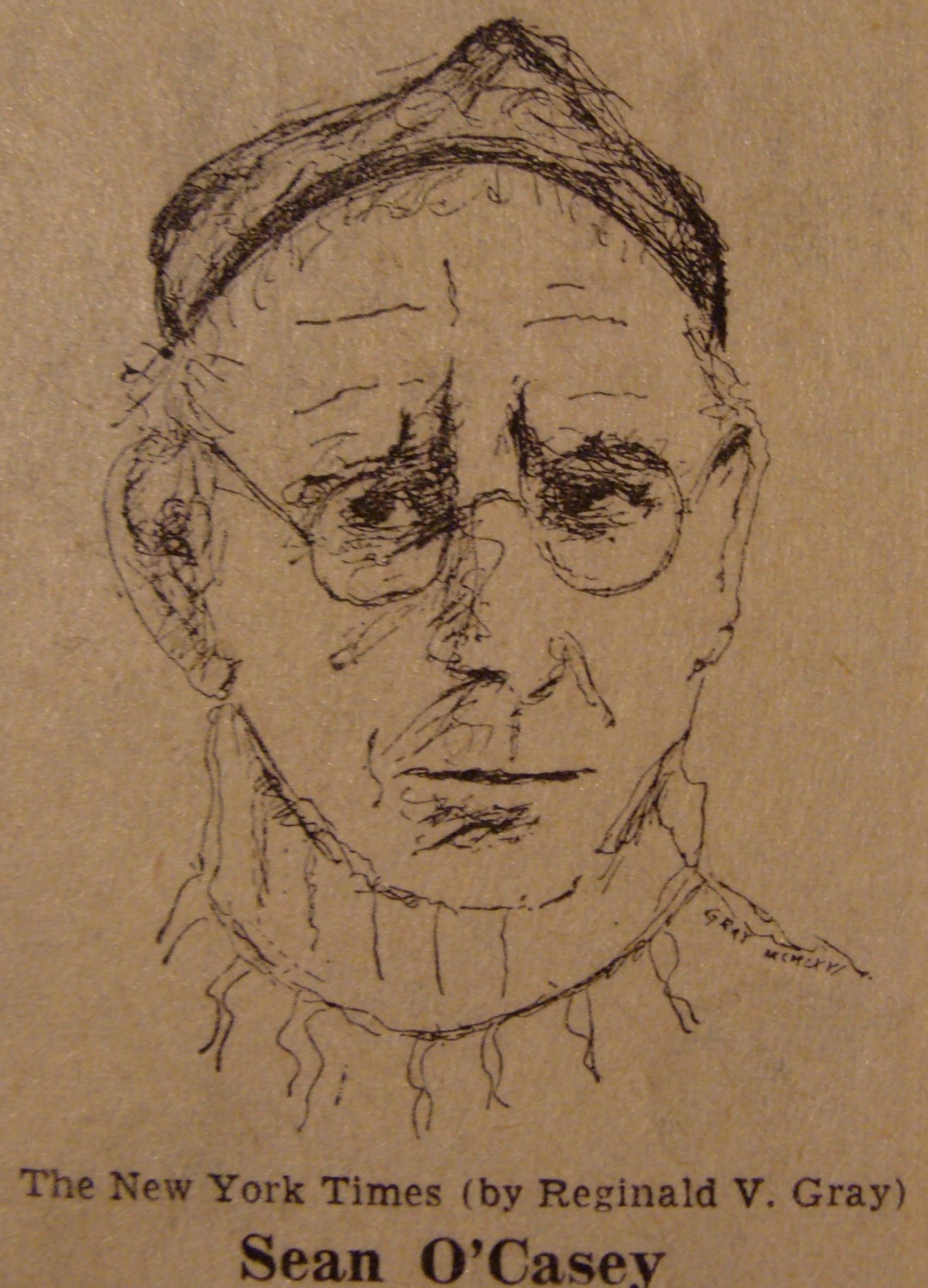
sean_o27casey_by_reginald_gray

The Plough and the Stars

Lyric Hammersmith, 26th March 2018

One way or another I see a fair amount of theatre. Making up for lost time I guess. Anyway this requires a reasonable degree of organisation. Nothing a small child couldn’t cope with but I do need to be on top of the diary. Very occasionally there is a system error. I say system. Obviously it’s my stupidity. One casualty was the National Theatre’s revival of The Plough and the Stars in summer 2016. It never got into the diary, I failed to check the fail-safe lists and ended up in Sicily en famille before I realised the mistake. Reviews weren’t great, Sicily was, (even if we found ourselves once again on top of a very steep hill despite strict instructions to the booker, me, to avoid this). And I had only paid £15 for the ticket thanks to that nice Mr Dorfman who uses his Travelex fortune to support the NT. Even so it irked me. Still does. It’s always the little things isn’t it?

Anyway that meant postponing my first exposure to the renowned Irish playwright Sean O’Casey until this production, That’s right. No Juno and the Paycock or The Silver Tassie yet, (though I am signed up for the concert performance of Mark-Anthony Turnage’s opera based on the latter at the Barbican in November).

So I have some catching up to do. First impressions? Well I can see why Mr O’Casey’s work might divide opinion. The mixture of trenchant politics, (all sides come in for a walloping from socialist SO’C), comedy filtered through working class Dublin lives that, with hindsight, teeters perilously close to Oirish cliche, and melodramatic tragedy, takes a bit of getting used to. I see from Michael Billington’s review of the 2016 NT production that it took him a bit of time to get into the swing of things that time round. Same thing happened to me in this production. I also, shamefacedly, have to admit my ears had to adjust a bit to the vernacular accents on display, the drift of SO’C’s prose. Yet once it all got going, and subsequently having thought about, and done a bit more work on, the play, I am starting to see where the advocates of SO’C are coming from. (The programme contains a pair of fine articles on the way in which the Easter Rising, and women’s role in Irish independence, have been interpreted over the years). If it is good enough for the mighty Mr Billington, who should be knighted and canonised for his services to the theatre illiterati like me, then it is good enough for me to sit up and take notice.

This production in its original “anniversary” incarnation at the Abbey Theatre Dublin has a very fine Irish cast which has been brought over to West London largely intact. Now it wouldn’t be Sean Holmes, (don’t be deceived by the name – he’s English), as director if there wasn’t a bit of “auteristic” subversion instituted into proceedings and so it is here. Jon Bauser’s set is low budget but ingenious with scaffolding creating the Dublin tenements, or maybe now tower blocks, and graffitied plywood standing as walls. A fair amount of cheap (I assume) lager spills out on to the stage. Paul Keogan’s lighting is similarly severe. Catherine Fay’s costume design is resolutely modern-day, particularly striking when the British soldiers first appear. This means that the setting, 1916 Dublin at the time of the Easter Rising, can echo across subsequent years in the island of Ireland. I see the point. Patriotism, whether derived from a line on a map or a different shade of god, is an ugly f*cker. And it’s always the least advantaged that lost the most.

The everyday humour which fuels the first act in the living room of the Clitheroe’s flat, and in the pub in the second act, is confidently delivered. Remember this is November 1915, the Nationalists including the trade unionist Irish Citizens Army, are organising. The relationship between Ian Lloyd Anderson’s Jack and Kate Stanley Brennan’s Nora is believably tender, and then strained, when Jack is re-recruited to the cause despite Nora’s desperate intervention. On the other hand whilst individually, Niall Buggy’s buffoonish veteran Uncle Peter, Phelim Drew’s lovable drunkard carpenter Fluther Good, Janet Moran’s effervescent charwoman Mrs Gogan, Ciaran O’Brien sanctimonious Marxist Young Covey, are all individually fine performances they don’t always seem to naturally occupy the same space.

This slightly stilted tone continues through into the pub with Nyree Yergainharsian forthright prostitute Rosie Redmond. However, once the fight between Mrs Gogan and Hilda Fay’s bitter Protestant Bessie Burgess breaks out, the tone shifts, for the better in my view. Now the way external events catch up with the individual characters starts to add texture. SO’C’s critique of the “heroic” telling of this passage in Irish history is manifest even if you know very little about it. The compassion of the women in the play is highlighted, especially Bessie Burgess, the best role here. The fear that violent struggle precipitates, as the soldiers break into Bessie’s attic, is palpable.

I think it might just become a much better play in the second half. I can see that the brazen looting, young Moliser’s death from TB, (some convincing coughing on demand from Julie Maguire decked out in tribal footie shirts), Nora’s stillbirth and delirium and Bessie’s sacrifice create a tonal shift into something as bleakly overblown as the first half was comically pigeonholed. Yet is feels more sedulous, certainly in this production.

It is a hard thing to bring out the complexity of ordinary people living on the periphery of historical change. Weaving a drama from this, whilst still setting out to upset just about everyone involved in creating the narrative which idealised this change, is surely doubly difficult. You can see why the play had such an impact when first performed at the Abbey in 1926. I can also see why its status as “canonic” theatre also makes it a tricky piece to get right. This might not have been the perfect production on first viewing but I suspect I will grow to like SO’C with more exposure.

I took the wrong route home, (bus not tube since you ask), which meant that an earnest  young chap, I suspect gently in his cups, politely asked for my programme lying on the seat. He carefully asked my opinion on the play. I was a little sniffy. I now regret that. I do hope he went.

Final aside. Apparently SO’C lived in Totnes. And died in Torquay. I didn’t know that. Seems like there is more to the Tourist’s birthplace than he ever realised. The more you learn the more the more the connections build.