Beckett Trilogy at the Jermyn Street Theatre review ****(and some other at-home Beckett stuff)

Beckett Trilogy: Krapp’s Last Tape, Eh Joe, The Old Tune

Jermyn Street Theatre, 4th February 2020

Fragments: Beckett by Brook – Rough for Theatre I, Rockaby, Act Without Words II, Neither , Come and Go – VIMEO, Bouffes du Nord – 26th March 2020

Endgame/Rough for Theatre II – Digital Theatre, Old Vic – 9th April 2020

Having put in countless theatre hours over the last few years the Tourist feels ready to get to grips with another of the “writers who changed theatre” in the form of one Samuel Beckett. Anyone with a passing interest in culture generally, and theatre particularly, is going to have encountered the great Irishman, but, to the uninitiated like me his reputation is fearsome. Still no time like the present.

Especially when the equally fearsome Peter Brooke, similarly ascetic and similarly a Parisian expat, has kindly posted up a recording of his (and Marie-Helene Estienne’s) production of Fragments: Beckett by Brook from the Bouffes du Nord in 2018 (and last in London in 2008). I have had a couple of cracks at Mr Brooke and Ms Estienne’s oeuvre with mixed success, Battlefield at the Young Vic, their take on The Mahabharata, and The Prisoner at the NT, both works of elongated, and exacting, beauty. Fragments comprises five short pieces by Beckett, Rough for Theatre I, Rockaby, Act Without Words II, Neither and Come and Go, performed by, drum roll please, Kathryn Hunter, Jos Houben and Marcello Magni. Jacques Lecoq alumni, and all round stage acting royalty, especially when it comes to the tough, avant garde-y stuff.

Now it doesn’t take a genius to work out that Beckett, in addition to posing questions about language, memory, purpose, mortality, despair, isolation, confinement, observation, connection, indeed, the whole futility, with tenacity, of human existence and nature-of-the-self gig, liked a laugh, especially of the mordant, and/or gallows absurd, kind. Which is what PB and the three actors mine in Fragments. It isn’t too much of a leap from this to Python. Honestly. Of course it helps that Belgian actor Jos Houben is peerless as a physical comedy theatre actor, that Kathryn Hunter is the very definition of “shape-shifter”, (whatever you do do not miss an opportunity to see her on stage, most recently in the RSC Timon of Athens), and that Marcello Magni was a founder member of Complicite, (the other two are regular collaborators), about as innovative a theatre company as it gets. Oh, and he was also the voice of Pingu.

Rough for Theatre I is probably the trickiest customer on the bill. A blind beggar, busking on his fiddle, teams up with another chap who has lost a leg. Both reference past lovers/carers/family. They might be abandoned. They search for food. Mutual support turns to annoyance and, maybe, violence. A lot of the classic Beckett stuff is on show, a couple of cranky fellas bound in uneasy interdependence. But it doesn’t quite persuade and turns into a long, old 20 minutes.

Rockaby, with the archetypal old woman, W, in a rocking chair, the ghostly vibe, the simple, pre-recorded, dimeter verse echoing a lullaby, the hypnotic stresses and repetitions, (each of the four sections begins with “more”), the gradual withdrawal of W from the world, and her eventual death, is a work that most definitely does work. Especially in the hands, and eyes, and mouth, of Kathryn Hunter. There isn’t much here to express, but express she does, packing all manner of emotion into less than 10 minutes. Fuck life as W says. But do it gently.

Act Without Words II, like its companion piece, and the likes of Waiting for Godot, Endgame and Krapp’s Last Tape was written ion the 1950s, but unlike them it is a mime piece. Two fellas, of course, emerge consecutively from sacks on stage after being prodded by a large pole, before engaging in their, presumably daily, routines. One is chaotic, a hypochondriac, the other fastidious, a clock-watcher. A recipe for audience bemusement? You might think so from the sound of it, but, in the hands of Messrs Houten and Magni, it is hilarious, Laurel and Hardy-esque, one of the funniest things I have seen on stage. With Rockaby and now this I think I can see the attraction of Beckett.

And Come and Go only added to the attraction. Three middle-aged women, Flo, Vi and Ru, friends since childhood, Houten and Magni decked out with coats, hats and a bit of rouge, sit on a bench, natter, and then, as each moves away in turn, a whispered secret something is exchanged between the remaining pair. At the end they link hands in the “old way”, a Celtic knot. I can imagine this scenario might come across as foreboding, a reference to incipient illness or death, we don’t actually hear the secrets, but in this production it is comic, the whispers more gossipy or bitching. More Cissie and Ada (google it) than “staring into the void”. After all we all like to chide our friends behind their backs with our other friends in the guise of concern.

Neither is a poem of sorts, just 87 words, in ten lines, with apparently just 3 commas. That’s minimalism for you. It is some kind of dialectical journey, maybe to death, who knows. Kathryn Hunter can’t make its meaning clear but blimey does she make every word count.

All in all then highly recommended (it’s still on Vimeo). How all the little tragi-comic stuff can shed a light on all the big stuff which rattles around in our heads. Not, as Peter Brooke says, wall to wall despair and pessimism as Beckett reputation dictates. And showing how the best actors can reveal, even to the dubious like the Tourist, that there is more to Beckett than initially meets the eye, and ear.

On to Endgame. Or to be more precise Rough for Theatre I and then Endgame. From the Old Vic. Now my scheduled performance was a casualty of you know what but the nice people at the Old Vic offered up a filmed version of the production which I snapped up. Now, before the interruption, the draw of Daniel Radcliffe and Alan Cumming, had ensured brisk business for something relatively challenging judging by the wait it took me to secure my favourite perch. For Endgame, Fin de partie in the original French, (the language Beckett always initially used), does jog on a bit coming in at 80 minutes. It is bracketed up there with the likes of Waiting for Godot in the Beckett canon, and, whilst the critics response to the production was decidedly mixed, there was enough to make me gently expectant.

I have to say didn’t really get on with it though. Whether this was down to play or to performance, it is difficult to say. Having now see what PR and M-HE could do with Beckett in Fragments, (and, as you will see below, what Trevor Nunn was able to serve up in his Beckett trilogy), I think the director, here Richard Jones, might have been culpable. True the director’s freedom to interpret is proscribed by the still vice-like grip exerted by the Beckett estate, demanding compliance with the great man’s stage directions, and by the stripping away of realist anchors, the lack of plot, the minimalist aesthetic and so on. Even so I still think the thematic repetition, this really is about four troubled souls going round in circles, and the skill of certain the actors, left Mr Jones only really scratching the surface.

Alan Cumming played Hamm, confined to a chair, (with a rather distracting pair of fake stick-thin beanie legs on permanent display), with a splenetic camp which at first amused but soon curdled. And Daniel Radcliffe, who to his credit, seeks out acting challenges in an almost penitent way since the screen Potter juggernaut was wound up, is similarly one-dimensional as restless servant/foundling Clov. I am afraid he does’t really seem to get with the profundity, opting for a superficial humour in word and deed. The two don’t feel that they have spent an eternity locked together. Contrast this with Karl Johnson and Jane Horrocks, (with facial prosthetics which really do convince), as Magg and Nell, Hamm’s parents, living in wheelie bins downstage left. Much less to say, but by not trying to grasp for comedy that isn’t there, both convey far more .

In order to get under the surface of “life is absurd”, and “in the midst of death we are in life”, (or maybe it’s the other way round), I think I can see that creatives need to delve a bit deeper. If all we see is the outward character, like a realist play, here Hamm as childish despot “actor” doing a turn primarily for himself, or Clov as mild-mannered extra from the Ministry of Silly Walks, it just become too much hard work to listen to what Beckett was saying. I am guessing the existential bitterness at the core of Endgame really is the deal but having the confidence to see that through feels like a big ask. As Hamm says “nothing is funnier than unhappiness” but only I guess if you don’t try too hard to make it too funny in the first place. I will need to try again with the play to test the theory or to accept that it could just be that I simply don’t have the patience to see it through in which case, mea culpa.

As it happens I preferred Rough for Theatre II. Two bureaucrats, Bertrand and Morvan, are in a room assessing the evidence as to whether would be suicide Croker, (Jackson Milner standing stock still for half an hour with his back to us – bravo fella), should jump or not. There is a contrast between the two, Cumming’s Bertrand is sweary, impulsive, keen to crack on, Radcliffe’s Morvan, more measured, though indecisive. The scenario is milked for gags as it echoes the likes of It’s A Wonderful Life, Here Comes Mr Jordan and A Matter of Life and Death from the 1940s. Croker might have been rejected, he might be ill, he might be a tortured artist. The comments of the various witnesses from Croker’s life are mostly banal, only occasionally poignant or profound. The banter between B and V edges towards Shakespearean wordplay, as well as the more visible vaudeville. The end is ambiguous. It could be Pinter, which is probably why I much preferred it

Right finally to the Jermyn Street trilogy. Sorry that took so long but this is how I learn. Firstly the intimacy of the JST served these plays very well especially Krapp’s Last Tape and Eh Joe. Secondly the cast. David Threlfall, James Hayes, Niall Buggy and, even if in voice only, Lisa Dwan have the measure of Beckett. It is rare to see Lisa Dwan’s name in print without the words “foremost Beckett interpreter/scholar” appended, (Not I, the one with the mouth, is her particular Beckett party piece), though she has plenty of other heavyweight acting credits to her name in Ireland and elsewhere, as does fellow Irish actor Niall Buggy. David Threlfall is just an all round top geezer, last seen on stage as the RSC Don Quixote, who has played Beckett on screen, albeit in the hit and miss comedy series Urban Myths. James Hayes has been treading the boards for as long as the Tourist has been mortal, and collaborated with Trevor Nunn at the JST in radio play All That Fall in 2012 with Eileen Atkins and Michael Gambon.

Understandably the Beckett estate rates Trevor Nunn, now 80. He is, after all, pretty much the Father of the House when it comes to theatre direction. Unlike Richard Jones whose USP is showy, scatter-gun, (though often brilliant), opera. Max Pappenheim is able to conjure up a sound design with real impact in a space he knows well and I assume David Howe, normally to be found lighting up the West End, said yes straight away when he got the Nunn call. The monochrome world, specified for Krapp’s Last Tape, persists throughout. Old age and memory is what links the three works. What four old men remember and what they forget.

Krapp’s Last Tape, from 1958, the year after Endgame, was big draw here, with James Hayes, literally, in the chair. Krapp on his 69th birthday, and sporting a natty pair of snakeskin shoes, sets out to make a tape (reel-to-reel kids, ask Grandad, though make sure it is by phone) documenting the last year and to review a similar tape he made when he was 39, made after he had returned from celebrating that birthday in the pub. This tape mocks the commentary of another tape he made in his mid twenties. He is more interested in the definition of the word “viduity” than the death of his mother. (The table is piled up with tapes, a ledger and the dictionary). Some memories annoy him, others, notably a romantic tryst in a punt, enchant him. The 39 year old is confident in the choices he has made, the 69 year old full of regret, notably in his writing. Is this his “final” tape?

Beckett was 52 when he wrote it. You can read whatever you want into it but it seems easy to just take it as autobiography and revel in the power and construction of memory. Failures in love, in work and in drink. It went through many drafts, much like our memories I suppose. The Wiki page is very helpful in fleshing out the characters, real and fictional, mentioned in the monologue and in describing Beckett’s own position at the time of writing.

I can’t pretend I was hanging on every word of James Hayes’s mesmerising performance. but that is because I ended up revisiting my own past in my mind. What better praise can I offer?

Eh Joe is pretty scary. It was SB’s first play for television, first performed in 1966 by Jack MacGowan, for whom it was written, with Sian Philips as The Voice. Joe, in his fifties, is sitting alone on his bed in dressing gown and slippers, with a camera trained on him. He gets up to check windows, curtains, door, cupboard and bed as if in fear. The camera cuts to a close-up of his face from just a metre away which slowly zooms in, nine times, through the remaining 15 minutes or so. Joe is relaxed, though confined, staring at, though not into the camera. Then the voice, here Lisa Dwan, starts hammering away at him, the recording heavily miked, accusatory, recalling their relationship and his abandoning of another woman who attempts suicide. She is the guilt-ridden voice inside his head I guess, the feminine judge of his masculine sin. He has excised the voices of his mother, father and others who may have loved him. The Voice’s words brim with violence. There is Catholic and sexual guilt aplenty. Niall Buggy, for a man who doesn’t speak, is riveting and now I get why Lisa Dwan is so well regarded. Once again it is all about the getting the rhythm and melody of the language to convey interiority.

Lisa Dwan was 12 when she saw Eh Joe on the telly. It stayed with her. I’m not surprised.

Fortunately we were then given a break before The Old Tune, which compared to the two previous plays, was a breeze. Rarely performed, it is a free translation by Beckett of a 1960 radio play, La Manivelle (The Crank) by his Swiss-French mate Robert Pinget. Niall Buggy and David Threlfall are a couple of Dublin old-timers, Gorman and Cream, shooting the breeze on, of course, a bench. They share memories, all the way back to early childhood, but can’t always agree on exactly what. It’s got some laughs.

So that’s that then. No doubt I will be back to Beckett. But for the moment, at least when the performers are on song, memories are made of this ….

The Last Temptation of Boris Johnson at the Park Theatre review **

The Last Temptation of Boris Johnson

Park Theatre, 31st May 2019

Alexander Boris de Pfeffel Johnson is probably going to be your next Prime Minister, chosen by a hundred thousand or so duffers average age in the 70s. Sovereignty? Democracy? If that doesn’t make you laugh nothing will. Anyway the rise of the tousled haired, Latin mangling, philandering, fustian journalist/politician, even without the gift of his impending premiership (his aim at Eton was to become “king of the world”) should, you would think, provide fertile ground for a satirical comedy.

After all this is a bloke who had both British and American citizenship, has Turkish, French and Russian ancestry, was born into an educated family, whose Dad worked for the EU, (I know hard to believe), overcame deafness as a nipper, speaks French fluently, had all the advantages, yet still takes a dig at Johnny Foreigner whenever he can like the godfather of gammon that he is. I see he won a scholarship to Eton where he worked on his eccentricity, changed his religious affiliation, (a harbinger of flip-flopping things to come), excelled in classics despite a somewhat indolent attitude and edited the school rage. At Oxford some have alleged that he toyed with the SDP in oder to secured the position of president of the Union, though, like so many other things, poor old BoJo has no memory of this. (I actually believe Boris when he says a line of coke had no effect on him: even this being insufficient to stimulate a full days’ work from him). Apparently he was mightily cheesed off he didn’t’t get a First.

He lasted a week in management consultancy, before the family got him into the Times, where he was promptly sacked for making stuff up. Then placed in the Telegraph where his career as liar in chief about the EU began. In some ways it is the ultimate irony that the man who is likely to preside over the final collapse of the Conservative and Unionist Party over something that really shouldn’t matter to it is the man who was largely responsible for fuelling the division between Europhile and Eurosceptic in the first place. After receiving a small dose of liberalism from his marriage to Marina Wheeler, and time spent in Islington, he cracked on with delivering some of his most offensive apophthegms in his Telegraph column. “Piccanniny”, “watermelon” or, more latterly, “letterbox”, I can’t decide which is the most unpleasant. Though one of the less remembered, his reference to gay men as “tank-topped bum-boys”, runs them close. This whole thing, Fartage does it as well, where some privileged, rich, straight, white, middle-aged bloke pretends to be taking on the Establishment, and saying “the things that can’t be said”, in a world where “political correctness has gone mad”, just drives me potty.

Not getting sacked when he was asked to divulge the address of a journalist so that his bessie from school, convicted fraudster Darius Guppy, could have the hack beaten up, was another low point I had forgotten about. On to the Spectator and GQ where he regularly filed his copy late, (which, given its quality, is hard to fathom), and then all his TV turns. Convicted fraudster, though now I see pardoned by the whiter than white Donald Trump, (himself only having been involved in the 3.500 or so court cases), Conrad Black, then promoted him to editor the Spectator turning it into the self-parody of Conservatism that it is today.

Finally parachuted into the safe seat of Henley when the principled Michael Heseltine retired, as a journalist with a sideline as an MP, he pitched up to a few votes in the House, and gave, in his own words, a few “crap” speeches. He did support Ken Clarke, of all people, in the leadership campaign that IDS won, a random act of good judgement, but also got reprimanded subsequently by Michael Howard for letting though the infamous Spectator article which trotted out the filth about the victims of Hillsborough which The Sun had so evilly kicked off. Next up he refused to resign as Arts Minister when he was caught lying about his affair with Spectator columnist Petronella Wyatt, so Michael Howard was forced to sack him.

Still no matter. His mate from Oxford, “call-me Dave” Cameron, installed him as shadow higher education minister ( a job his principled younger brother Jo also held), but then another alleged affair, booted off the Spectator by Andrew Neil, but still raking in half a million a year from his media work, he then got the gig as London mayor in a campaign masterminded by Lynton Crosby (the Aussie evil genius behind his current job application).

Still keeping his “chicken-feed” £250K salary from the Telegraph column (and failing to make promised donations), he pitched up late for a few early meetings, failed to get a planning permission, might have had a further affair, over claimed on expenses, denied London’s pollution levels, recruited cronies and came up with hare-brained vanity schemes. Still he was always a “laugh” which remains his key qualification for high office it seems and he occasionally said and did the right thing to confound us liberal metropolitan elite lefty types, though he could just as easily revert to type moments later. And London felt proud.

Back to the House of Commons, kept at a distance by Cameron and then his fateful decision to throw in his lot with the Vote Leave campaign. And all that bollocks on the bus, about Turkey (subsequently denied), that face he pulled the morning after when Leave won, and then, after Cameron walked, the political assassination by Michael Gove and his missus which put paid to BoJo’s ambition that time round. This is roughly where Jonathan Maitland’s play kicks off, with a dinner party given by Boris and Marina Wheeler attended by Gove, Sarah Vine and, somewhat bizarrely, Evgeny Lebedev, the owner, with his Dad, of the Evening Standard and The Independent.

Before we get on to the play though let’s wrap up on the real Boris. That nice Mrs May thought it would be a good idea to make him Foreign Secretary. To neuter his threat some thought. That didn’t turn out too well did it. But surely, even at a time when a Government is literally paralysed but its inability to deliver the undeliverable in Brexit, the way in which BoJo conducted himself in this position of high office should disqualify from the top job. Support for Erdogan, the House of Saud (in contravention of Government policy), his intervention in the case of Nazanin Zaghari-Ratcliffe, the gaffe quoting Kipling in Myanmar, his advice to the Libyan city of Sirte, his reprimand by UK Statistics Authority, his nonsense on the Irish border, that missed vote, breach of the Ministerial Code, his lusty support for British business, and finally, his flounce out, alongside the loafer’s loafer, David Davies, when Brexit turned just that little bit tricky, unicorn-delivery wise. All achieved in a couple of years.

Since then plotting, ramping up the racism for the benefit of Conservative members, failing to declare earnings on nine occasions, the “suicide vest” comment, flirting with Bannon and Trump, the “spaffing” remark in the context of child abuse allegations, another Europe lie confirmed by the Independent Press Standards Office. and the idiot flirting with no-deal. For remember even if the Tory party goes all spineless and worried about preferment when it comes to the inevitable no-confidence vote which will follow Boris’s coronation, or he gets tempted by prorogation, (yes people, in the country that “gave democracy to the world”, we actually have candidates for Prime Minister who wish to emulate Medieval kings), we will still be tied in negotiations with Europe for the rest of most of our natural lives. Yep even BoJo the clown can’t make it all go away.

Right that’s off my chest. So what about this play. Well I am afraid that, with all this material to play with, and the gift of relevance, Mr Maitland’s play didn’t really come across as much more than a few, admittedly quite good, impressions by the assembled cast, Will Barton as Boris, Dugald Bruce-Lockhart as Gove (and parliamentary agent Jack), Davina Moon as Marina Wheeler and spad Caitlin, Tim Walters as Lebedev, Huw Edwards and Tony Blair, Arabella Weir as Sarah Vine, Leila, a Tory Chair and, intriguingly, Winston Churchill and finally, Steve Nallon, doing his Thatcher routine.

Now as you might gather there are plenty of blasts from the past who appear to help guide BoJo as he lurches from wannabe Winston, inheritor of Mrs T’s monetarist/household economics and social authoritarianism, and then back to one-nation liberalism courtesy of Blair. Good idea. Not brilliantly executed. The second half throws us forward to 2029 with BoJo plotting a comeback on a platform of “Brentry”. Again shrewd set up but not enough is done with it. The first half takes place at a dinner party, with the Goves and our name dropping Russian publisher, (as I speak the Standard has just come out for Johnson – not sure what George Osborne’s game is there), when MG bounces BoJo into supporting Vote Leave. There is a ton of tired exposition which makes the repeated gags pall even more.

So some intriguing ideas, and a target that could hardly been more topical or richer in opportunity, but I am afraid Jonathan Maitland’s lines don’t really match his ideas. There are a few good jokes but it is just not barbed enough as satire. In fact it edges close to playful hagiography at times. At our performance the edgiest moment actually came when one audience member, to the chagrin of her partner, enthusiastically applauded at a Make Britain Great Again peroration that the real Boris tosses off in perfunctory fashion, (see how easy it is to talk like the peroxide prat). Not a good look in liberal, Metropolitan elite North London. Director Lotte Wakeham and designer Louie Whitemore have both delivered better than this.

In the real world I see the coppers have turned up to an altercation at the latest incarnation of Chez Johnson. No doubt the Tory membership, whose response to “no deal” economic chaos is apparently “bring it on”, will see this as further confirmation of his “man of the people” status. You literally couldn’t make this stuff up. In retrospect maybe I have been a little unfair on Mr Maitland. Reality here is beyond satire.

Creditors at the Jermyn Street Theatre review ****

Creditors

Jermyn Street Theatre, 27th April 2019

I am still tiptoeing my way into Strindberg. A long history of ignoring him after an early dismissal many years ago was corrected with the companion piece to this, a version of Miss Julie, also translated by Howard Brenton, also directed by JST AD Tom Littler and also co-produced with The Theatre By The Lake which seems to serve the good people of Cumbria very well and probably needs a visit. There was also Polly Stenham’s version, simply Julie, in 2018 at the NT, a variation on her usual style. Neither were completely convincing, the former because of the play, the latter because of the production, but I recognise there is food for thought here, though far less than with Ibsen and Chekhov where I am now properly in the swing after some similar false starts many years ago.

It’s the underlying misogyny, even when old August may well be confronting it, and the violent swings in emotion which seem to be more necessitated by plot than character, which put me off. That is not to say that the grumpy Swede had nothing to say about the nastier side of love and passion just that the way he tackles it feels artificial to me. Now I know. It’s theatre. It isn’t real and doesn’t have to look like. Except that this is intended to be naturalistic and, like his contemporaries, offer an insight into the human condition, and specifically that thing that gets bound up in the phrase “love/hate relationship” or, more lazily I think, “the battle of the sexes”.

Mind you I have to say that this Creditors was a more engaging experience than Miss Julie. Maybe I am getting better at this theatre viewing lark, which would be heartening given the time and money invested, or maybe the way in which Creditors approaches the three way romantic tussle, here MFM rather than FMF, was more “relatable” (ugly word) to me, though I hasten to add I have never been caught up in such a scenario. The benefit, (or maybe curse), of being dull and painfully inept when it comes to matters of the heart.

What it can’t be, obviously is the creative approach. Like I say its the same team. Even down to the set where Louie Whitemore employs the same basic structure to create the seaside hotel reception room in which the sensitive, would-be artist, Adolf is convalescing with his fervent wife Tekla, that she employed to create the Scandi period kitchen for Miss Julie. Maybe the cast here was a little more to my taste though it is the same James Sheldon playing Adolf here in Creditors as the sexy servant Jean in the Miss Julie. I have a lot of time for Dorothea Myer-Bennett most of whose recent performances I have seen (Rosenbaum’s Rescue, Holy Sh*t, The Lottery of Love, The Philanderer) and she always stands out even if the play isn’t entirely convincing. Here she captured Tekla’s independent spirit, her devotion to Adolf and her still unresolved passion for the third character in this conflicted trinity, Gustaf.

He was played by David Sturzaker, another very fine theatre actor as it was my pleasure to discover recently in the multiple parts he mastered in the RSC’s excellent Tamburlaine. Here he shows how Gustaf’s insistent charm first cast doubts in Adolf’s mind about Tekla’s history, fidelity and ambition and then, as it is revealed that his presence in the hotel is no coincidence, he attempts to “win back” his ex-wife whilst Adolf eavesdrops from the room next door. These two scenes sandwich that between Tesla and Adolf where Adolf’s suspicions are angrily voiced despite her attempts to reassure.

Pretty straightforward huh and maybe not an especially original subject for drama you might think. But it is the way that Strindberg explores the motives and psychologies of his three protagonists, and the the way their emotional ambiguity is expressed, that turns it into something compelling. Why is Adolf so weak and open to persuasion? Tekla has expanded his artistic horizons and the marriage has been happy so why does he fall so easily for Gustaf’s Iago-like duplicity? She is intelligent, educated, sophisticated and worldly so why just WTF is Adolf’s beef? What is driving Gustaf to wreak this emotional havoc? Revenge, love for Tesla, wounded pride at the way Tekla, thinly disguised, ridiculed him in her autobiographical novel, toxic masculinity? Are Adolf and Tekla hiding something about their own history? Who is dependent on whom? Is Tekla still attracted to Gustaf’s “stronger” character? Is this just a game for Gustaf? Why the melodramatic ending?

Howard Brenton, like so many theatre types, is fascinated by the interiority, (yep it’s a real word), questions that Strindberg poses. As he is with other literary greats – see my forthcoming attempt to pick the bones of his latest play Jude inspired by Hardy (and, somewhat bizarrely, Euripides). As with Miss Julie this seemed, at least to this novice, an admirably forthright adaptation but then I know no better. It certainly, like the Miss Julie, serves up contemporary dialogue and caustic humour to set against the period setting and it comes in at a crisp 80 minutes or so. Same goes for Tom Littler’s direction and the unfussy lighting of Johanna Town and sound of Max Pappenheim. Howard Brenton has written a play, The Blinding Light, about Strindberg’s drift into madness, his “Inferno” period, which was directed by Tom Littler, and they have also combined for AS’s dances of Death, so you have to think they know what they are about here. So I am guessing this is about as good as it gets when it comes to modern interpretations of our August. Especially in the very intimate surroundings of the JST.

There is a lot more to Strindberg than the early, naturalistic plays which deal with that are most often performed. There are the the later more ambitious, symbolist works (A Dream Play, Ghost Sonata and The Dance of Death). Various history plays. Theatre director and producer. Novels. Poems. Essays. Scientific investigations. Painting, (his symbolist landscapes, example above, tick the boxes for the Tourist). Also dabbled in theosophy, though this was very trendy in fin de siecle artistic circles, occultism and alchemy. Not surprising he went a bit bonkers. A social/anarchist with a strong antipathy for all forms of authority but also an anti-semite. A campaigner for women’s rights who helped transform the role of women in drama who was also an ugly misogynist in print and whose wives where decades younger than him.

When you read about his him, his plays and his place in Swedish culture it is easy to see whay he holds such an important place in world drama. Am I persuaded? I’ll let you know in a few more years, and after a few more productions.

The Hound of the Baskervilles at Jermyn Street Theatre review ****

image322-700x455

The Hound of the Baskervilles

Jermyn Street Theatre, 10th December 2017

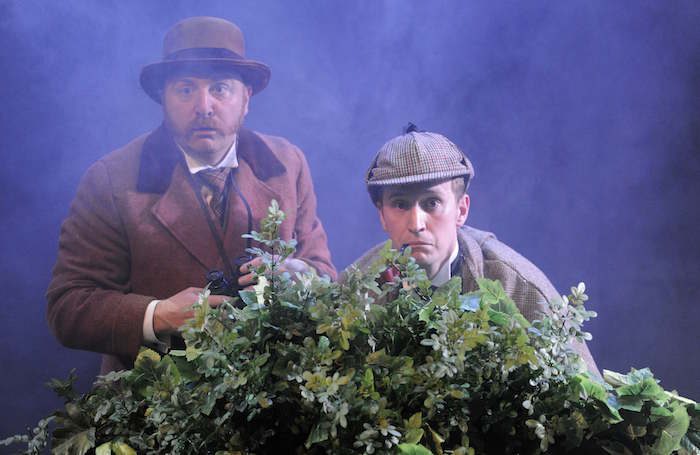
Everyone likes Sherlock Holmes right. And everyone can see that the stories are ripe for comic treatment. Indeed you have probably seen this done on numerous occasions. Even the amazing Cumberbatch/Freeman/Moffat/Gatiss Sherlock, which is regarded with reverence in the Tourist’s household, mines the humour in Conan Doyle’s stories. So if a comedy version of Holmes takes your fancy then you simply must get along to this. A Christmas treat. Take the kids. Any age will do.

It is adapted by Steven Canny and John Nicholson. Mr Canny writes and produces for the Beeb and has worked with Complicite. Mr Nicholson is part of theatre company Peepolykus, which specialises in this type of comedy, though he has plenty of other comedy writing and directing credits to his name. This Hound of the Baskervilles was first performed in 2007: this version is a co-production with the English Theatre Frankfurt. (I’ve been there, its great, who says Frankfurt is dull, not me). The creative team of Lotte Wakeham (director), Derek Anderson (lighting) and Andy Graham (sound) have done a marvellous job in bringing this to life but my hat goes off to Louie Whitemore who has adapted David Woodhead original design to fit the tiny JST space. If you go and see this you will understand just how clever Ms Whitemore has been here. This comes on top of her fabulous design for Miss Julie in the same space recently.

Now you will know the plot, or you can find out. A few liberties are taken to make this work but most of the key scenes remain. Suffice to say a fair few characters pop up along the way and one of the biggest joys in this production is seeing how writers, director and the three strong cast cope with getting them on and off the stage. It is acted at a furious pace: now wonder they needed an interval. Simon Kane plays bumbler Watson and is a moreorless continuous, and very amusing, presence. Around his bluff, dull-wittedness, Max Hutchinson plays Holmes in mordant fashion, and Shaun Chambers is an ebullient Sir Henry Baskerville. However, on top of this, Mr Hutchinson plays Stapleton, sister/wife Cecille (with frightful wig and dress), and the servants, Mr and Mrs Barrymore. All I can say is he must be knackered at the end of each performance. Mr Chambers enters as Sir Charles Baskerville, does a fabulous turn as Scottish Mortimer as well as a Cabbie. All three have various stints as Yokels of some description. And, if the logistics are stretched too far, then a couple of dummies appear.

Like I say the comedy derived from movement, props, costumes and accents, (even the ones that don’t appear), is delicious. So is much of the script. In particular the occasions where the fourth wall is broken, especially at the beginning of Act 2, are hilarious. I laugh out loud when I find something funny. BD and the SO who came along, (LD had to bail out which is a real shame as this was right up her Baker Street), are less animate but there was many a chuckle and smile from both. There are a few knowing lines, mostly to do with the bromance between Holmes and Watson, but there was enough for the youngsters in the audience as well.

So if you find the forced entertainment of panto at Christmas a bit wearing but you still yearn for something to do with all the family, I heartily recommend this. It is on this week (to 20th December) and then again from the 8th to the 13th January. There are tickets available as I write.


Miss Julie at the Jermyn Street Theatre review ***

46a5b8be00000578-5112853-image-a-52_1511489566004

Miss Julie

Jermyn Street Theatre, 27th November 2017

Grinding my way through the classics of naturalistic drama. Actually not grinding, that makes it sound like too much of a slog, but I can’t pretend it is all unalloyed joy. Turns out that Chekhov is likely the man for me and Ibsen works only intermittently. This was my first Miss Julie, so early days for Sweden’s finest, but based on this, and a past The Father and Creditors, I don’t think I am going to be his greatest fan. I am conscious that the critics across the spectrum lapped this up, and I can’t fault the acting, direction or staging, so any misgivings must lie in the play or possibly the adaption, here newly minted by Howard Brenton. I won’t have the latter though, since a) Howard Brenton is the gold standard in other adaptions, b) he is at pains to tell us in the text that he wanted to stay as close to the original based on the literal translation from Agnes Broome, and c) his play Pravda was the thing that turned me on to the theatre.

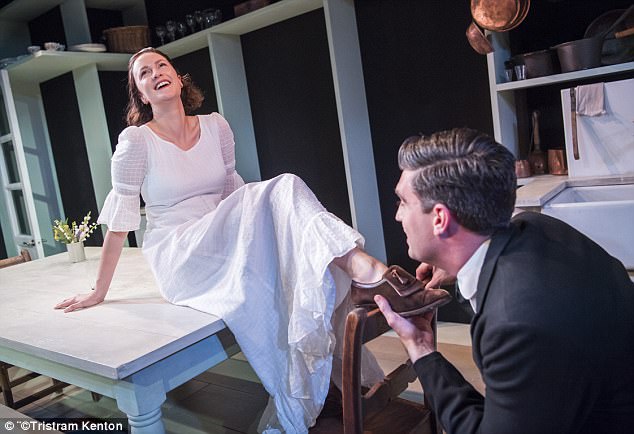
Now it strikes me that, for a claustrophobic play set solely in the kitchen of a Swedish manor house, want you want is a claustrophobic theatre and a set which captures said kitchen. Which is precisely what you get from Louie Whitemore. In immense detail. With kidneys frying on the stove. Director Tom Littler, now in the hot-seat at JST, is happy to let Izabella Urbanowicz who plays cook Kristin prepare and cook the meal before James Sheldon’s valet Jean bounds in after having dropped into the Midsummer’s party we can hear going on in the background (courtesy of Max Pappenheim’s sound design). So a confident start. A bit of gentle banter about Miss Julie’s erratic behaviour and some gentle exchanges between the couple and we’re all set for the arrival of the eponymous flirt. I think Izabella Urbanowicz nailed Kristin’s cautious conservatism, (we see it later with references to her faith), and her utilitarian approach to her choice of husband to be. James Sheldon in contrast exuded a kind of boyish restlessness that served him well in the dialogue with each of the women. There was affection between the servant couple, no doubt, but also, I sensed a slight distance.

So all looking good for Charlotte Hamblin’s white-dressed Miss Julie to set the ball rolling towards the sex, anger, imagined disgrace and disappointment which follows. I gather Ms Hamblin is famous for being some-one in Downton Abbey, so this upstairs/downstairs stuff was presumably a breeze for her. I have seen a few bios which include everyone’s favourite period drama, and it has so far proved to be a mark of quality for the stage performance. Which therefore makes it mystifying as to why Downton Abbey itself is so unbelievably bad. Anyway Ms Hamblin was suitably bored, sexy, desperate and rash and Mr Sheldon was suitably horny, angry, boorish and rash to make the attraction very believable. She gets to lash out at the way she is shackled by class and status. So does he. But we are also acutely aware from the off that the distance between is not as great as it seems and, at the societal level, is starting to close. So it’s all there.

My marginal unease comes as we move into the “what are we going to do now” bit. Miss Julie’s collapse into nervous panic and Jean’s swinging mixture of motives are all part of the fun I guess but it tested my patience and I started to drift away from proceedings. Passion can veer from love to hate in an instance, and passion across class barriers is never going to end well for one, or the other or both. AS however seems to want to have his cake and eat it, then whip out another cake and have another go, as the couple ride their emotional rollercoaster. Miss Julie is the victim in this production but that only serves to heighten Strindberg’s not so buried misogyny.

As you can see I am confused and need to think a bit more about this. Must try harder. At the end of the day though I can’t pretend I was gripped throughout and, if this production is as adept as the critics have said, then I may have to conclude that AS is out of my limited reach. Never mind, there’s lots more theatre to explore.