Please can you persuade Maxine Peake and Andrew Scott to come together on stage in a naturalistic two hander about a normal couple who have something extraordinary happen to them. Manchester, London or Timbuktu. I don’t care where. Subject TBD. As long as there is bucketloads of emotional pain which has to be worked through whilst stoically carrying on with their daily lives.
Yours respectfully,
The Tourist
There is nothing actually that innovative about this monologue based on Australian writer Julia Leigh’s memoir about her experience of IVF. There is no need for it. A bit of symbolism from an avalanche and a pair of imagined kids. Otherwise it charts the fractured relationship of a film-maker, her overwhelming need to conceive and the grief that follows from the failed treatments. Anna-Louise Sark’s staging, a three sided, clinical, white space which rises slowly through the 90 minute production, a table and chairs that collapse, from designer Marg Horwell, some, occasionally, overly forthright lighting and sound from Lizzie Powell and Stefan Gregory, may give a hint of art-theatre. It doesn’t really add anything though to the performance.
Which is, in the least surprising surprise since we were apprised of the fact that His Holiness is of the Roman persuasion, just brilliant. It isn’t just the fact that Maxine Peake makes the movement of face, hands and body look entirely natural, (even when awkwardly directed to shift stage positions to break up the monologue), or the easy conversational style that projects, on on one, even up to us cheapskates in the gods. It is the fact that whilst remaining entirely Maxine Peake throughout – vowels, grins, wry knowing asides, pauses, reflections, repetitions, pointing, pawing – she becomes the woman whose harrowing story she is telling. This is not, forgive me, and thankfully, a story that I can relate and yet, pretty much throughout, I was there with her.
In anyone else’s hands the slight drawbacks in the adaptation would probably have been laid bare. It is too long, you can, an hour in, practically hear the pages turning, with too much emphasis on the how and what of the journey and not enough on the why, and this is too big a space for any monologue, (and robs the end of much of its theatricality). It does though get into the joyless mechanics and desperate economics of IVF treatment, six rounds in total, and captures the loneliness of the Woman’s quest. As it happens IVF treatment played a small part in Out of Water, the new play by Zoe Cooper, on my next night’s viewing. And this was, by comparison with the other stage work I have seen prompted by this experience, the weak Genesis Inc, a resounding success. And the Fertility Fest at the Barbican, of which this was a centrepiece, deserves everyone’s praise.
To my mind the only actor who can match Maxine Peake when it comes to force of personality and stage charisma is the aforesaid Andrew Scott. As was apparent to anyone lucky enough to see Simon Stephens’s monologue Sea Wall at the Old Vic last year (or in its previous outings);
Royal Exchange Theatre Manchester, 28th February 2019
Brecht. Royal Exchange. Headlong (This House, People, Places and Things, Labour of Love, Common, Junkyard, 1984, The Glass Menagerie, American Psycho and Enron – and that’s just what I can vouchsafe), Anna Jordan adapting, Amy Hodge, the Associate Director alongside Jeremy Herrin at Headlong and Julie Hesmondhalgh as Mother Courage (“MC”) herself.
Strap yourself in. This was bound to be an exhilarating theatrical ride. And so it was. Full of great visual moments. Even if the transposition of the story to a future (2080’s) European war, Reds against Blues in a continent divided up by grids, probably subtracted from, rather than added to, its contemporary relevance. Brecht finished Mother Courage in 1939 and he pointedly set it in the Thirty Years War of 1618 to 1648, proportionately the most destructive conflict in human history, as a message of the forthcoming horror. The greatest “anti-war” dramatic statement of all time? Probably, though it is more analysis than fulmination. One pf the greatest plays of the C20, and all time? Certainly. So f*ck about with it at your peril.
On the other hand the whole point of BB’s epic, Verfremdungseffekt, theatre is to set the audience on its toes and get the grey matter working overtime, and to let the theatre makers create their own take. Which they certainly do here. With the utmost respect to Ms Hesmondhalgh who is predictably a mighty presence, the star of the show is a repurposed ice cream van, standing in for the cart of the original text. Not something I expect to write again on these pages. Joanna Scotcher’s design looks like it came from it was sneaked out of a forgotten storeroom at a Hollywood studio marked “Vietnam War/Mad Max for charity”, right the way down to Yvette’s (Hedydd Dylan) pink plastic “catsuit”. There isn’t much in the way of fixed bric-a-brac as it should be in Brecht and as is warranted by the Royal Exchange’s in-the-round space. Which left the van, sans engine but still with its jingle intact, free to perambulate across the stage, pulled, before their respective early demises, by each of MC’s three kids, Eilif (Conor Glean), Swiss Cheese (Simeon Blake-Hall) and Kattrin (Rose Ayling Ellis). Foods, drink, water, shirts, uniform, clothes, guns, furniture, you name it, MC stocked it in the ramshackle van. Everything you need to profit from a prolonged war. It even doubles up as a nightclub.
Music (Jim Fortune), which nods back to Weill, sound (Carolyn Downing) and lighting (Lizzie Powell) was similarly pimped up to match the setting and aesthetic. Musician Nick Lynn, positioned in the circle, served up, often at MC’s request, a barrage of sound at times to set alongside some of the gentler, folksy numbers. And Movement Director Raquel Meseguer put the hours in to marshal the nine strong cast through the 12 scenes (covering 12 years of the conflict).
Now the Tourist knows from Anna Jordan’s other recent, superb, work with Frantic Assembly, The Unreturning, that she is the doyenne when it comes to ambitious, physical theatre. And so it proves here. This adaptation comes in at a couple of hours. It can drift closer to three. With the on-stage intros to each scene and some fairly direct exposition it is easy enough to follow even for the uninitiated, and all the narrative elements are intact, but it scampers along at a heck of a lick and, with all the visual stimulus, the constant motion, the soundscape, the dizzying array of accents, there just isn’t much time to think about what is going on and what Brecht is telling us.
Not a complaint. The production looks and sounds so good that this is easily forgiven but don’t come here looking for any gestural detail in the main relationships, between MC and the children, or between MC and respectively the Cook (Guy Rhys), the Chaplain (Kevin McMonagle) and Yvette. Julie Hesmondhalgh and the rest of the cast, notably these three, are too good for Brecht’s messages not to sink in but the true horrors, the deal with the Recruiting Officer to conscript Eilif, Swiss Cheese’s torture, MC’s denial of her son after the botched ransom, Kattrin’s rape, Eilif’s execution, the Cook’s rejection of Kattrin and Kattrin’s sacrifice don’t always register as strongly as they might. Mind you the bleak conclusion certainly does: MC taking up the van’s harness as a single fire burns out.
MC’s determination, even desire, to profit however from the war, despite the damage it does to her and those around her, does ring clear. Julie H is a ballsy, artful fiercely protective but, ultimately wary and realistic, MC. As she should be. This isn’t Hollywood – we are supposed to engage emotionally with the characters but not be emotionally manipulated by them. Ultimately we aren’t really supposed to sympathise with MC, just to understand why she has to act as she does, to see the damage that war does to those at its periphery as well as the fighting protagonists. MC thinks that her business is the way to safeguard her children. Manifestly it is not. We see that. She cannot.
And to see how war, when churned through the prism of difference and ideology, is an integral part of the economic sub-structure, orchestrated by the powerful. One day perhaps Brecht’s lesson will have no relevance. No sign right now though we should remember that the global and supra-national institutions which were built post WWII to rein back our worst excesses have largely succeeded in restricting conflict to the national, or intra-national, level, though still often as proxies for economic accumulation.
Which is why MCAHC will go on being restaged and re-imagined (Lynn Nottage’s Ruined for example) for new audiences to watch and learn. At the matinee performance the Tourist attended there were, as is to be expected, throngs of school students. They seemed to be all over it. I assumed it was still some sort of set text for drama students. Apparently not. Only Brit playwrights good enough for the Government when it comes to reaching GCSE drama. Interesting in the context of the breakdown of the political order in Europe that this adaptation presages. Still we should be grateful that this shower of a Government hasn’t interfered with syllabus and teaching for, what, all of a couple of years. And, unless the nutters back down, they won’t be able to for many years to come as they sort out the never-ending shower of sh*t that is coming down the tracks once we have “Brexited”. It’s only just begun folks. And not in a nice, Karen Carpenterish kind of way.
Got me to thinking about what our proud youth study for drama at A level. Faustus, Lysistrata, Woyzeck, Antigone, Much Ado About Nothing, A Servant to Two Masters, Hedda Gabler, The Caucasian Chalk Circle, Accidental Death of an Anarchist, Jerusalem, Yerma, The Glass Menagerie, Metamorphosis, Cloud Nine, Our Country’s Good, Bronte, Earthquakes in London, Stockholm, The Crucible, The Visit. Across the various boards. Bloody Hell. If they master that lot then I have nothing to fear for they will know everything there is to know about the human condition. Drama is integral to democracy and citizenship. Ask Aeschylus, Sophocles or Euripides.
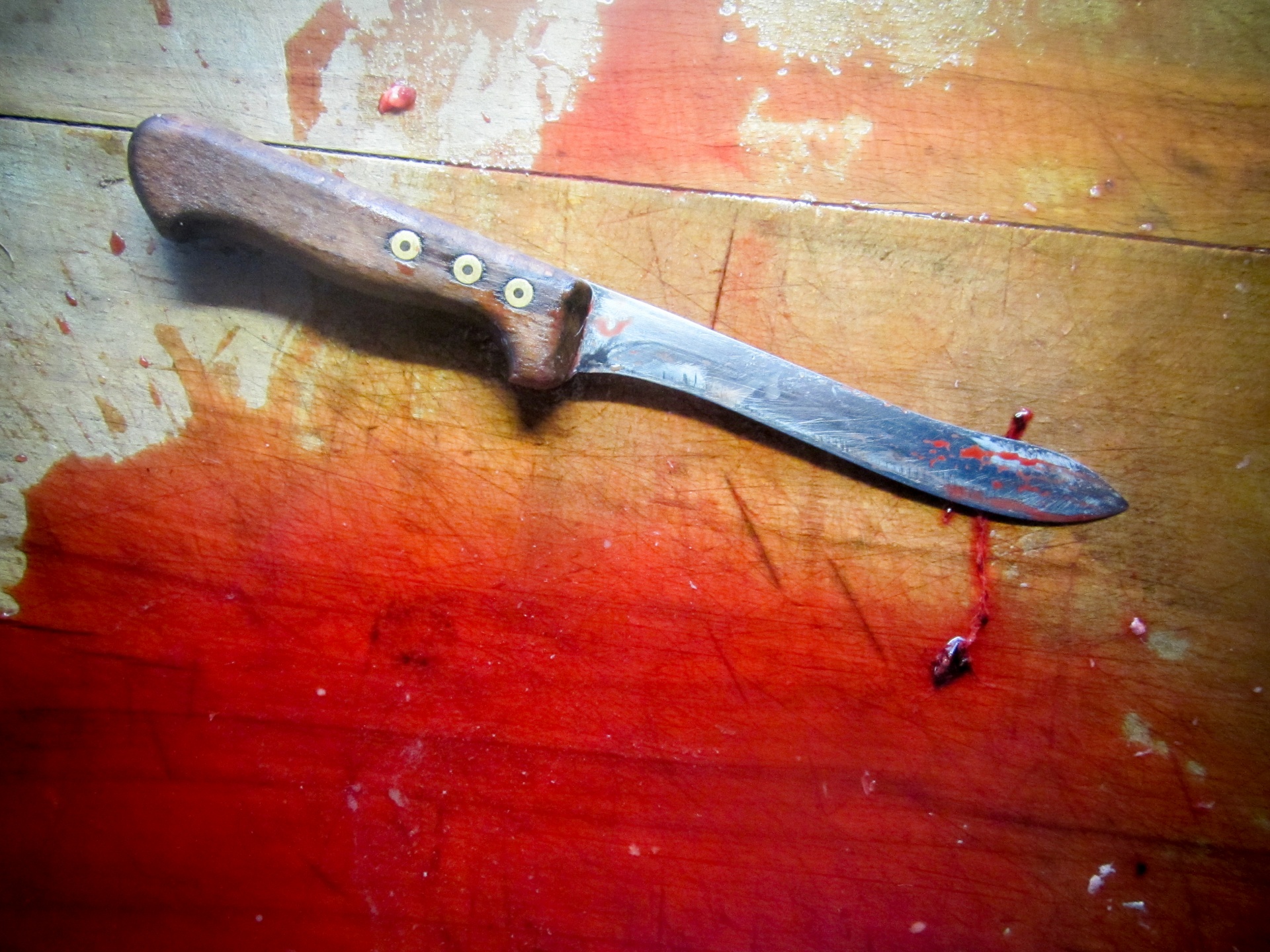
Is this a dagger I see before me … well maybe more of a kitchen knife …
It is pretty tightly plotted (at least if you pare it down). It is quick by comparison to a lot of the Bard – half the length of Hamlet, though that always needs a few nips and tucks – in part perhaps because Thomas Middleton adapted the text that has come down to us. It wastes no time at all in getting going – if anything it is a bit too abrupt at the start I reckon. Other than Macbeth and his lady wife most of the characters don’t get much air time to reveal themselves. It’s language is direct, often shockingly so. It is eminently quotable. There is no welter of arcane classical references. Most interested people know it or know of it (it’s a GCSE set text after all). The themes are easily defined and understood – ambition and patriotism, moral disorder and inversion, violence begetting violence, childlessness and legacy, gender roles and masculinity, the suppression of feeling and equivocation, the supernatural.
It might be built on an edifice of contemporary (when written) conventions, verse speaking, soliloquies, quibbles, audience asides, witches, ghosts, a dumb show, severed heads, but it is the supernatural that gives plenty of scope for coups de theatre. It may also have been intended to massage a royal ego, the patron of the company that first performed it, Jimmy I (of England, No 6 of Scotland) being an expert in the magic field with his best-seller Demonology, and coming just after the failed Roman Catholic plot to blow him up. Yet the supernatural also works on our imagination, (as it works on the power couple), always a good idea in a play, which, together with big Will’s acute psychological insight, and repetitive language – blood, blood and more blood, time, darkness, man – explains why it is so popular.
So why then is it apparently now so difficult to get right? Search me though if I take this somewhat disappointing version, alongside the similarly underwhelming recent NT production, (and plenty more in the last decade), the problem might lie in trying to hang too much on the play. No problem with a clear overarching creative vision but keep it simple. Don’t add all sorts of frills – there are enough interpretative and visual choices to be made from the text itself. Make sure the two leads nail the verse. No mumbling. Ensure they can explain their motivations – remember they are travelling in opposite directions, from normative revulsion to nihilistic emptiness in the case of Macbeth and vice versa for the Lady. The other characters can play it straight. Duncan is a symbol of kingship, Banquo matters because he doesn’t fall for all that weird sister sh*t. (And he can scare us later). The Porter is there to offer ironic commentary, warn against those who say one thing and do another, and, here in this production, very successfully mind the time. Everyone else is pretty much plot collateral.
It works best when we the audience are dragged into the couple’s nightmare. Small space, simple staging, like the landmark Dench/McKellen/Nunn RSC version. Or the Walter/Sher/Doran apparently, which kicked off in darkness. The recent Ninagawa version, though it is different, worked because the Samurai backdrop leant contextual clarity and the age of the couple a desperate poignancy. The 2015 Justin Kurzel film, if you can forgive the accents, also has a clear aesthetic and some very smart interpretative choices. You can add your own to the list.
In this version however, director Deborah Findlay, seems to have focussed on the details of the visual, and on the “horror” to the exclusion of the themes. Some of this works, notably Michael Hodgson’s Geordie Porter, always present, tapping his watch, chalking up the body count, hoovering incessantly, disturbing in his ordinariness, as well as the digital clock countdown, even if it is a big of a cliche, which links to the theme of time passing. Niamh Cusack as Lady Macbeth, clawing and pawing, also has the measure of most of her key lines and David Acton’s Duncan, whilst a little fruity, is what you expect from a man born (rather than compelled) to rule. However Christopher Eccleston, whilst capturing Macbeth’s military bearing, doesn’t, for me, vary the verse sufficiently, such that he comes across as insufficiently tortured by events. The same is true of the Edward Bennett’s Macduff who comes across as more geography teacher than grief stricken revenger. Mr Bennett is an outstanding Shakespearean, especially in comedy, but he looked lost here. Rafael Sowole’s hefty Banquo was more convincing, especially as ghost.
Having the witches played by three girls, dressed in red, Don’t Look Now/Shining style and signifying blood, is initially striking but the novelty soon palls. The jump cut fizzing/flickering lighting from Lizzie Powell, and the “spine-chilling” score from Rupert Cross and sound design of Christopher Shutt leans a little heavily towards the cinematic. Fly Davies’ set, with de rigeur upper level, accommodates the interpretation but doesn’t really wow or command the front of the vast Barbican stage.
Having said all this the production doesn’t drag, it squeezes out a few laughs, not all intended, and its pinball of ideas craves attention. Maybe I should try some of the other current London Macbeth’s, the NYT at the Garrick, or the Michelle Terry/ Paul Ready at the Sam Wanamaker (if it wasn’t so bloody uncomfortable, and more problematically, sold out). Or maybe I’ll just wait. Something wicked will this come again soon.



 At Home He Feels Like A Tourist