
Translations
National Theatre Olivier, 6th June 2018
At the end of the day it is all about the words. That’s theatre. The power of language. Which is exactly what Brian Friel’s play is all about. A modern classic, first seen in 1980, in Derry (with Stephen Rea, Liam Neeson and Ray McAnally no less in the cast), to set alongside Philadelphia Here I Come, Aristocrats, Faith Healer, Dancing at Lughnasa and The Home Place, as masterpieces from his hand. All set in the fictional town of Baie Beag (Ballybeg). All exploring the particularities of Irish history, society and culture but all offering up universal insight. The Irish Chekhov as some would, with very good reason, have it.
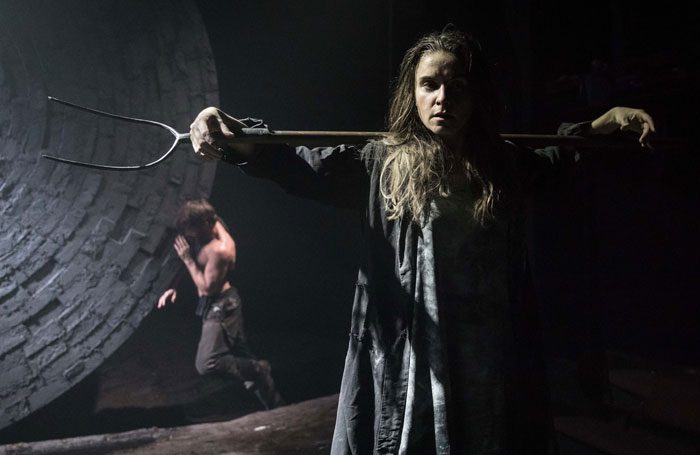
So I wasn’t going to pass this up and I was going to insist the SO attend. I have no truck with those currently giving Rufus Norris and the NT a kicking. There have been some absolute belters over the last couple of years which more than compensate for a couple of missteps, so you haters can STFU. Anyway this is a marvellous productions. Rae Smith has conjured up another evocative, organic, set, the “hedge” school in which the play is set is foregrounded, leaving the rest of the Oliver stage as moorland which stretches to a backdrop of rolling mist and clouds. It is 1833 in Ballybeg and embittered Manus, (superbly played by Seamus O”Hara), lame in one leg, is setting up the school run by his father Hugh. He is joined by the voluble Jimmy Jack Cassie whose shambling manner and fondness for a tipple belies his classical education. He and Hugh are equally at home in Latin and Greek as their native Gaelic. Dermot Crowley and Ciaran Hinds offer up a par of towering performances. The hedge schools which were the source of their learning are about to be replaced by a free national school system. Sarah movingly played by Michelle Fox, whose speech is impaired, is joined by Maire (Judith Roddy who was also marvellous in the recent Donmar Knives in Hens), Doalty (Lawrence Kinlan) and Bridget (Aoife Duffin) in the school.
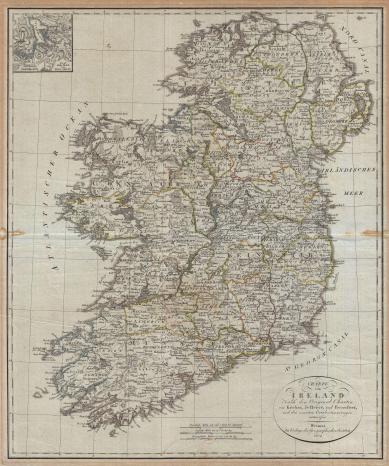
Through their interchanges we quickly become immersed in their domestic worlds, lives that may lack material plenty but are rich in many other ways. The Great Famine is still a decade away but the threat from potato blight is addressed. Translations is not an overtly political play, Brian Friel determined to avoid that commenting that “the play has to do with language and only language … and if it becomes overwhelmed by that political element, it is lost”. However when Hugh’s other, prodigal, son, Owen, returns after a several year absence, the clash of culture between British coloniser and Irish colonised, is revealed. Owen (Colin Morgan, TV’s Merlin) has returned with two English soldiers, the ruthless and patronising cartographer Captain Lancey (accurately represented by Rufus Wright) and the more sympathetic orthographer Lieutenant Yolland (Adetomiwa Edun). Owen is a translator: the soldiers have been tasked with renaming the Irish place names into English. This was initially it seems a virtuous undertaking but the metaphor is clear and, eventually, as you might guess, the army seeks retribution when one of their number goes missing.
Now Mr Friel’s brilliant central conceit is to have both the English and Irish characters speaking in English. The two English officers speak no Gaelic, though Yolland as he falls in love with both country and Maire, tries to learn. Owen, initially misnamed Roland by the officers, picks his way carefully through his translations. And, it transpires, that a number of the Irish contingent know a great deal more English that they are letting on.
Hopefully my brief description should persuade you just how elegantly, and cleverly, constructed Mr Friel’s play is. But it doesn’t stop there. In scene after scene and line after line, he patiently, but insistently, drives his points home. Even so these characters are no mere ciphers; there is plenty of emotion too. The love scene, ostensibly in two different languages, between Maire and Yolland, is very affecting, Sarah’s yearning for Manus which echoes it, Manus’s flight when he realises there is nothing left for him in Ballybeg,, Hugh’s demons fuelled by drink, Owen’s cultural ambivalence; everyone has a story to tell, and not just in words.
Ian Rickson is as sure-footed in his direction of the marvellous cast as you could wish for though there are moments of over-deliberation. Neil Austin’s lighting, Ian Dickinson’s sound design and the music of Stephen Warbeck all stand out, and a big hurrah for the voice work of Charmian Hoare and Jeanette Nelson and to dialect coach Majella Hurley, this being a play about language.
 At Home He Feels Like A Tourist