

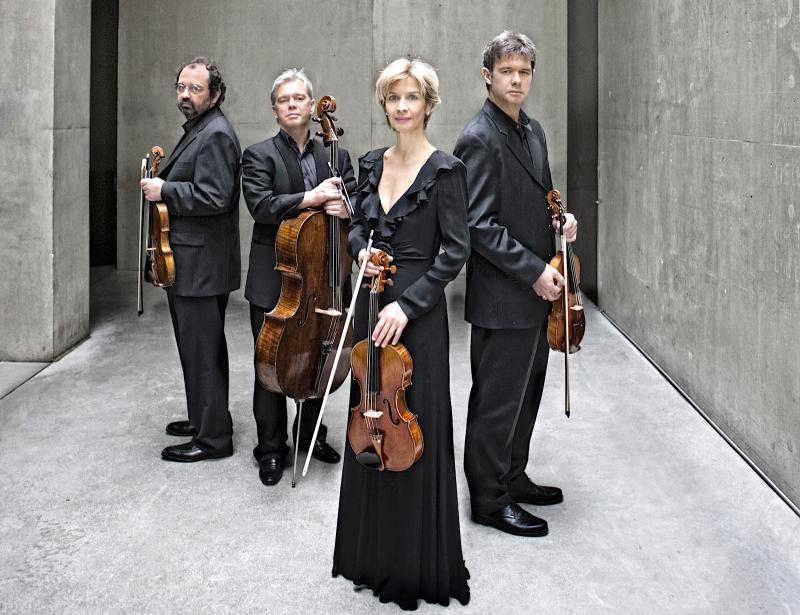
The Emerson String Quartet
Milton Court Concert Hall, 8th November 2018
- Britten – String Quartet No 3, Op 94
- Shostakovich – String Quartet No 8 in C minor, Op 110
- Beethoven – String Quartet No 7 in F major, Op 59 No 1, “Razumovsky”
You still see some venerable rock (and pop) bands unwisely soldiering on in their 60’s and even 70’s, sometimes with only one original member still in the line-up. Outside of disposable pop the creative force/s, the composer/s if you will, in contemporary popular music are invariably also the performer/s. Not so generally in classical art music, though that isn’t to say that many canonical composers weren’t, or aren’t, also adept performers. Just that composition and performance are more often separated, and that performance is often as important to composition in terms of audience enjoyment or appreciation.
So when rock musicians die, so does the band, if it has managed to get that far without breaking up due to musical differences, substance abuse or fist-fights, in the established rock’n’roll manner. Leaving the audience with a ropey tribute band and recordings to keep the tunes alive.
In the classical world though, with its much longer back catalogue, legacy is the name of the game. And not just in composition. Performers live on. Not just in recordings but also in the name, and sound, of the band. Easy enough to envisage in the context of the orchestra with its link to place and with a constant turnover of personnel. The Royal Danish Orchestra in Copenhagen can trace its lineage back to a bunch of regal trumpeters from 1448 (!), the venerable and still very highly regarded Leipzig Gewandhausorchester to 1743.
The idea that string quartets outlive their members might be a little trickier to get your loaf around though. Yet this is how it works. Members may come and go but the best quartets stick together for life, such is the dedication of performers to their art, and, when one of the four can no longer perform, pearly gates or otherwise, a replacement is drafted in. But this cannot be any old violinist, viola player or cellist. For the sound of a top notch string quartet, is a very particular thing, and continuity, as well as chemistry, needs to be guaranteed.
Now as is normally the case with the development of classical music, form followed technology and demand in bringing the string quartet to the fore. Once modern instruments had been perfected in the C18, notably the viola, (which is tuned a perfect fifth below the violin and an octave above the cello), and with enough patrons who liked the string quartet groove to pay up, composers were all set. As with so much else in classical music it was Papa Haydn who set the ball rolling in the 1750s. His massive output for the ensemble (68 named, 77 or so in total) is still amongst the best ever written IMHO.
The string quartet, in the opinion of the Tourist, is about as “pure” as classical art music gets. Not easy to get right; any paucity of imagination is ruthlessly exposed. Four parts is enough to fashion an argument but not enough to take the foot off the intellectual or aesthetic gas. Plenty of opportunity to vary pitch but only the colour and texture of strings at the composer’s disposal. All of which might explain why not every big name has embraced the genre and why even those that have sometimes don’t always get beyond one effort or a brace.
After Haydn, Mozart obviously churned out a fair few, 23 I think, though they are not all up to snuff. Still as ever with Wolfgang when he nails it he nails it. Then Beethoven with his 16 (and the Grosse Fuge) which, as with the symphonies and piano concertos, have never been bettered. Schubert also walked the talk with his 15 and a few assorted bits and bobs. (Note to Tourist: more work to do on these).
As the fashion for showy-off, Romantic, bullsh*tty bombast gained traction in the C19 so the string quartet took a back seat, but returned with a bang in the C20. For the Tourist’s money the best of the bunch since 1900’ish are Janacek’s pair, Nielsen’s 6, Ravel and, (in a rare thumbs up from me), Debussy’s single shots, Stravinsky’s various musings, and, best of all, Britten’s haunting treble, Bartok’s virtuoso 6 and Shostakovich’s acutely personal 15. Oh and Glass’s 7 (and counting), Reich’s Different Trains, Crumb’s Black Angels, Nyman’s 5, Ligeti’s 2 and Xenakis’s 4. You might have some others to add. Tell me.
The Emerson String Quartet was formed in 1976, and still has two of its founder members in violinists Eugene Drucker and Philip Setzer, alongside the viola of Lawrence Dutton, with cellist Paul Watkins the last in, having joined in 2013. I have recordings of their arrangement of The Art of Fugue and their renowned Bartok cycle. The Bartok is superbly recorded and is very, very precise and very, very intense. This is what they are famous for. Exact and technically brilliant interpretations. Which maybe lack a little emotion. That tends to be my preference but I can understand why others may take a different line (and there are occasions when I would agree).
Anyway this is what the Emersons are famed for. And this is exactly what they delivered at Milton Court. Britten’s Quartet No 3 was pretty much the last thing he composed appearing in the year he died, 1976. With its call-back to the music of his last opera, Death in Venice, in the final passacaglia, and the recitative quotes that precede it, it really is immensely moving. BB was very ill at this time, only able to work in short bursts following a heart bypass operation, and this seems to be reflected in the four condensed movements which precede the final “La Serenissima”. The opening “Duets”, in sonata form, is also haunting and, by virtue of its various permutations of the quartet personnel, as sparse as its title suggests, even when the duets are accompanied. The Ostinato second movement, like the Burlesque fourth movement, is very short, and taken at a fair lick even where it is played pizzicato. The parodic Burlesque could have come from the pen of Shostakovich in one of his more caustic moments, with its weird central spiccato passage. The central Solo is marked very calm with the first violin line, heading higher and higher, seemingly lifted from the mists, and mystery, of Curlew River. Or maybe Aldeburgh Beach, Or Snape. Anyway as with the rise and fall of the Passacaglia it sounds like BB was set to go home. Blub blub.
The Emersons certainly got the measure of BB’s still extraordinary imagination and technique. But it felt a little less haunting than the recording I have from the Endellion Quartet. This was even more true in the Shostakovich. The Eighth was written when DSCH was in a very dark place, contemplating suicide. He went on in his final quartet, 15, to offer up a genuine personal elegy but this comes pretty close. He was supposed to be written a score to accompany a documentary about the bombing of Dresden but, after just a few days, he came up with this, “an ideologically deficient quartet nobody needs”. It was 1960 but DSCH still wasn’t “free” now being forced to join the Party. It has his trademark initial motif in the opening of the Largo on the cello, which is developed, before the main theme from his First Symphony pops up, before this in turn gives way to a repeated rocking motif.
This rocking motif is then pumped up and speeded up to form the basis for the second movement scherzo. This is, even by Dmitry’s high standards, pretty scary stuff. The DSCH motif also crops up again, in contrasting tempi, As it does in the middle movement Allegretto, here transformed into a Waltz which then proceeds to quote his First Cello Concerto. A violin solo links to the first of the final two slow movements. This contains the tune to a Russian song about the victims of fascism, to whom DSCH eventually dedicated the quartet, but which might be aimed at totalitarianism more generally. The final Largo comes full circle with a return to the rocking motif.
The quartet is taken unbroken and with these powerful and dramatic ideas, and stirring emotion, it is easy to see why it is Shostakovich’s most famous and oft-performed quartet. It would be hard to imagine a more expertly crafted and sharp interpretation, these chaps leave nothing to chance, but, as I discovered a couple of weeks later, courtesy of the Brodsky Quartet, it is possible to wring a fair bit more gut-wrenching angst out of the piece. I have recordings by the Borodin Quartet, now in its eighth decade, constantly refreshed by the best of the Moscow Conservatoire, and the original dedicatees for most of DSCH’s quartets, and the English Fitzwilliam Quartet (founded in 1968) who also worked with the composer and were the first to record a complete cycle.
As it turned out it was the Beethoven first Razumovsky which actually showed the Emersons at their very best. Count Razumovsky was an important Russian aristo and diplomat in Naples and then Vienna but his name has gone down in posterity for the three quartets he commissioned from Beethoven in 1806. All are magnificent but the first might just be the best of the bunch. This is altogether jollier music than the two pieces that preceded it, with its intriguing dissonance and implied repeat in the first movement, the rapid passing of the baton from one player to another, underpinned by the one note cello motif in the Allegretto second, the tragic F minor Adagio and then the ebullient finale with its bouncy Russian theme, (as in the other two Razumovsky pieces). The drilled-to-perfection understanding of the Emersons, and the more upbeat tone of the Beethoven was, for me, at least more satisfying.
That is not to say that overall I took very great pleasure in listening to this famous quartet. They are up there with the very best of their peers, some of which I have already mentioned. When it comes to Beethoven I think the Takacs Quartet (founded 1975) might have the edge of those I have heard live, though the Belcea Quartet (1994), who might just be my favourite string band, run them close. As for recordings of the Beethoven quartets have a sniff around the Alban Berg, Quartetto Italiano (for the middle quartets) and unparalleled Vegh (for the mighty last four).
While I am at it, should anyone care, add the Hagen Quartet (1981) to the bucket list when it comes to Mozart, the Quatuor Mosaiques (1987, HIP specialists) for Papa Haydn and the Kronos Quartet (1973), on the rare occasions they leave the US, in contemporary repertoire.
 At Home He Feels Like A Tourist