
Hogarth’s Progress: The Art of Success and The Taste of the Town
Rose Theatre Kingston, 21st October 2018
South West London was a popular place for the cultural, liberal, metropolitan elite in the first half of the C18. It still is. Hogarth, Horace Walpole, David Garrick, Henry Fielding, Alexander Pope, Henrietta Howard (the King’s mistress no less), Lord Burlington, Richard Steele, Paul Whitehead, Lady Mary Montagu, John Beard, Kitty Clive, Peg Woffington, James Thomson, John Moody, GF Handel (for one summer), Stephen Duck, John Stuart, Thomas Twining, Augustin Heckel. Oh, and early on in the period, no less than the Queen herself, Anne, at Hampton Court, following in the footsteps of William and Mary. Royalty and the Thames is what made it desirable,
OK so I can’t pretend I had heard of all of these luminaries but some of the big names, Walpole, Garrick and Fielding, play a big part in Nick Dear’s brace of plays about one of the area’s most famous residents, Hogarth himself. The first play, The Art of Success, premiered at the RSC way back in 1986, with Michael Kitchen and Niamh Cusack starring (seen last year on this very stage in the marvellous adaptation of Elena Ferrante’s Neapolitan Novels (My Brilliant Friend at the Rose Theatre Kingston review ****). This tells the story of Hogarth’s early years carousing his way through Georgian London with Henry Fielding and their mates, Frank and Oliver. The new, companion, piece, The Taste of the Town, revisits Hogarth, now in Chiswick, at the end of his life (1697-1764). His house is now supported by the Hogarth Trust, owned and run by LB Hounslow and can be visited most afternoons. Worth a peak especially if you take in he neo-Palladian beauty that is the recently refurbished Chiswick House just round the corner. And, once in your life, you have to see the flamboyant spectacle that is Strawberry Hill House. This is why interior designers are best avoided.
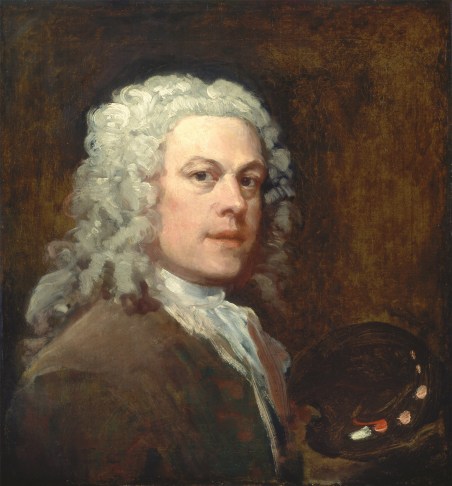
Now for those who aren’t familiar with William Hogarth, he was a painter, printmaker, social critic and cartoonist in the first half of the C18. This period saw a huge increase in the wealth of Britain, (in full union with Scotland from 1707), built on trade, specifically trade in people, specifically slavery. With this came the rise of the liberal Whigs who took power from the Tories in 1715 and drew their support from the new industrial and merchant classes. It was a period of vigorous political debate. At least it was if you were rich. If you were poor …. well you were still f*cked over as always. Anyway Hogarth and his mates were dead centre in this cultural maelstrom, specifically in criticism of the great and good. Journals, newspapers, pamphlets, clubs, all mushroomed. And these boys were bad to the bone.
Hogarth himself came from a less privileged background, enough to get an apprenticeship as an engraver, but precarious enough to see his teacher Dad have spels in the debtors prison. This is where his satirical edge was sharpened. His morality tale “comic strips”, such as A Harlot’s Progress and A Rake’s Progress, were dead popular at the time and have remained so ever since, and sort of defined the entire genre. Yet he was also a renowned painter, largely society portraiture that being the mode at the time, and the tension between his “popular” and his “high” art is one of the themes that Nick Dear explores in the plays.
Dear also doesn’t hold back on portraying the seedier side of Georgian life. The Art of Success kicks off with Hogarth (Bryan Dick), Fielding (Jack Derges), Frank (Ben Deery) and Oliver (Ian Hallard) lashed up after a meeting of the Beefsteak Club and contemplating their next move, which is going to involve sex for money I am afraid. There is a lot of this sort of thing going on in the first play set in the 1730s. Indeed Hogarth’s relationship with prostitute Louisa (Emma Cunniffe), and its discovery by his wife Jane (Ruby Bentall) forms a major part of the plot of this play, such as it is. Alongside his encounter with murderess Sarah Sprackling (Jasmine Jones) who was the subject of The Harlot’s Progress and who seeks to wrest control of her image back from Hogarth after he draws her in prison. This question of who “owns” a representation in art, the observer or the observed, is another central theme of the play.
In the hands of Antony Banks as director, alongside period costumes and a striking, if s;lightly unwieldy, set from Andrew D Edwards, some fine video work from Douglas O’Connell, lighting from James Whiteside, sound from Max Pappenheim and music from Olly Fox, scene after scene unfolds with distinctive verisimilitude. The Queen, Caroline of Brunswick (Susannah Harker complete with comedy German accent) gets a look in, and reveals herself ken to get inside Hogarth’s britches, as does Prime Minister Robert Walpole (Mark Umbers) who reveals himself keen to see a liaison between Sarah and Jane (it’s a long story). Walpole indeed cuts a deal with Hogarth to push through the copyright deal that WH craves to stop his work being ripped off. Yet, alongside Fielding he rails against the political censorship that Walpole introduced to the theatre, a process that persisted until 1968.
This personality parade though gives an inkling into the plays’ problems. The comedy smut becomes a little wary after a while and the crowbarring into the script of biographical and historical fact after fact leaves little room for any change of pace or tone. There is the vulgar, which is fun, or there is the art history lecture, which is a little less so, once you know what is coming. The repellent power of men over women in the Georgian booms out through both plays but to no great end, as the strands are never pulled together..
The second play with Hogarth now retired to Chiswick, and railing against rivals like Sir Joshua Reynolds feels even slighter in some ways. Hogarth is now played by Keith Allen. One word. Irascible. Perfect casting. Jane Hogarth, now played by Susannah Harker, puts up with his grumpiness and abuse, but is a little tired of the suburban life. Hogarth and his mother-in-law, Lady Thornhill, the majestic Sylvestra Le Touzel initially in full on Lady Bracknell mode, do little to disguise there dislike. Things perk up for Hogarth however when old chum, near neighbour and charming egoist David Garrick (Mark Umbers) comes to call and the two go on a road trip. Of sorts. On foot. Down the Thames. Drink intervenes and Hogarth swans off to visit another local celeb, the ostentatious Horace Walpole (Ian Hallard, who seems to be having a lot of fun) who has dissed Hogarth’s painting skills in his stab at classicism Sigismunda (which is. to be honest, pretty limp). They argue, they make up. More misadventure etc, etc.
It’s not that I didn’t appreciate the history lesson. I really did. It’s not that I wasn’t impressed by the acting, notably Bryan Dick, (who impressed in Great Apes and Two Noble Kinsmen recently on stage and as Joe Orton on the box), and Keith Allen, as the main event. And many of the scenes are, of themselves, striking and entertaining. It’s just that the plot, and the arguments it seeks to explore, seem to have been welded together from the events and the personae that are portrayed, and the bawdy and the pedagogic never quite gel.
There is a book, which we seem to have acquired, which you can find in most National Trust shops. Scenes From Georgian Life by Margaret Wiles. It is a collection of period caricatures and cartoons, including some from Hogarth. From the tamer end of his oeuvre for sure. We wouldn’t want to upset the gentle, middle classes. Nick Dear’s two sketch plays are muckier and cleverer but ultimately not that much more impactful.

 At Home He Feels Like A Tourist