
The Prime of Miss Jean Brodie at the Donmar Warehouse review ****

24795636677_646fd86a04_o

The Prime of Miss Jean Brodie

Donmar Warehouse, 19th July 2018

The SO obviously is a big fan of Muriel Spark’s novel. We are both big fans of Ronald Neame’s film version, (only the other day I revisited this director’s magnificently cheesy The Poseidon Adventure), though let’s face it that is largely because Maggie Smith delivers a technicolour Maggie Smith performance. No less than David Harrower, (Knives in Hens, Dark Earth, Blackbird and some classic adaptions), was turning book into text here and Polly Findlay was directing. We have actors of the talent of Angus Wright, Sylvestra Le Touzel and Edward MacLiam and I was particularly keen to see Rona Morison again, who was so good in Orca at the Southwark Playhouse in 2016).

But, more than all of this, the big draw was Lia Williams in the title role. I believe Ms Williams is one of our finest stage actors, most recently seen in the Almeida’s Mary Stuart and Oresteia, (alongside Angus Wright as it happens), and, earlier in her career, Oleanna and Skylight. She is also a mean Pinterite, (if that is the word), and I am looking forward to her directing the opening salvo of plays in the upcoming Pinter season alongside Jamie Lloyd.

Now I had not remembered, from the film, just how ambiguously complex a character Ms Brodie is. An inspiration to the girls, (with Grace Saif, Emma Hindle, Nicola Coughlan, she who brilliantly told a twat of a critic where to get off in his insulting review, and Helena Wilson, all superb alongside Rona Morison’s Sandy), who genuinely wants to help then break free of stifling convention, but also manipulative, desperate, unfulfilled with a nasty undercurrent of fascist sympathy. David Harrower’s adaptation makes all this plain, without any need for histrionics, artfully augmented by Polly Findlay’s methodical direction and Lizzie Clachlan’s pared back design. His subtle inclusion of sub-plots involving Nicola Coughlan’s Joyce Emily, who is spurned by Sandy (and belittled by Miss JB) and goes to fight in the Spanish Civil War, and the framing device of Sandy’s book, worked for me.

Angus Wright as the long suffering, and increasingly frustrated music teacher Mr Lowther, and Edward MacLiam as the more volcanic, and damaged art teacher Teddy Lloyd, were admirable foils to Lia William’s Brodie as they vied for her complex affections. Miss Brodie affects to the aesthetic but real human connection seems to scare her. She provokes rebellion but is actually intellectually conservative. Maybe the guilt of Sandy, as the pupil who betrays Miss Brodie and enters a convent as penitence, (which we see in flash forwards through interviews with Kit Young’s journalist), was a little too forward in Mr Harrower’s adaptation, you know she is Miss Brodie’s nemesis from the off, but it does draw out the darkness in Miss JB’s psyche.

Lia Williams is up against some pretty stiff competition when it comes to theatrical Brodies even if we put Dame Maggie to one side. Vanessa Redgrave, Fiona Shaw and Patricia Hodge, as well as Geraldine McEwan on the telly, have all had a stab. I can’t comment on any of these performances but I can’t imagine they were any better at capturing Miss JB’s dichotomies than this.

With a bit of luck this will end up a run out in the West End. If so I heartily recommend you see it.
 

Knives in Hens at the Donmar Warehouse review *****

christian-cooke-pony-william-and-judith-roddy-young-woman-in-knives-in-hens-at-the-donmar-warehouse-directed-by-yael-farber2-700x455

Knives in Hens

Donmar Warehouse, 21st September 2017

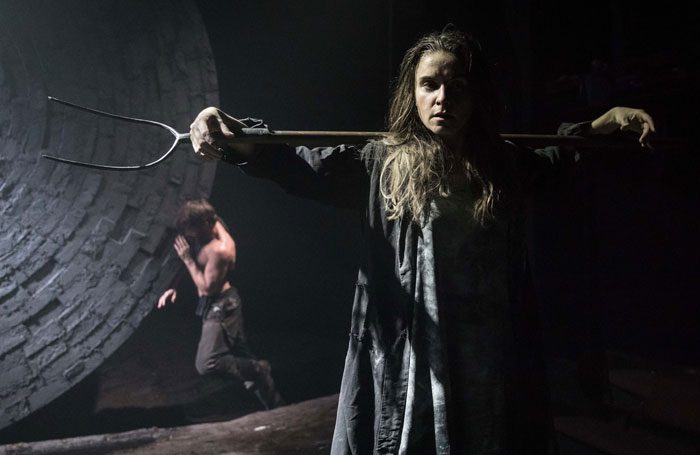
Now I guessed I was going to like this. All the clever folk who know about plays and stuff had raved about it. Written in 1995 by David Harrower it is considered a classic of British modern theatre. Its ostensible subject matter, the power of language, and its setting, an imagined English medieval past, is right up my street (thanks in part to the vicarious interest generated from MS’s journey).

But I had no idea just how brilliant this was going to be. Easily joins my top 10 all time best plays. It is staggeringly good and director Yael Farber’s production could scarce be bettered I would think.

For those like me who weren’t up to speed on Knives in Hens, it goes like this. The Young Woman, an outstanding performance from Judith Roddy, is married to ploughman Pony William, a brutal but fearful, Christian Cooke, in a village somewhere up North. Her knowledge of the world is bounded by her role as wife, the work she has to do, by language and by location. Husband sends her with their grain to the Miller, Gilbert North, played by Matt Ryan with profound depth. His wife has died, he is alone, and the village has cast him out, in part because they are dependent on him. But he can write and he can think and see beyond the everyday. She is wary of the Miller but their relationship develops. Pony William betrays her. There is a dramatic denouement. That is basically it.

The language is spare. The lighting is monochrome. The set, with a giant grindstone, behind a muddied, brickstone floor, is austere. We have a mournful cello and a near unbroken drone. There is even some flour drifting through the air at one point. For those familiar with Yael Farber’s work, including the somewhat unfairly maligned Salome at the NT, (Salome at the National Theatre ***) all this is likely familiar. But in this play these directorial tropes were bang on.

So what is so special about the play? Well for me the text perfectly captures the world in which it is set. The medieval mind was very different from the modern mind. Knowledge was largely derived from immediate experience or dictated by the Church. The supernatural was very real. Nature informed existence. Language for this class was largely spoken not written. Writing was the medium for power, the word of God and contract. The schism between the rural and the urban. David Harrower’s text inhabits this world. No nostalgic arcadia here.

But this is only the starting point for more universal questions. How do we gain knowledge? Why are we scared of knowing? How does language define what we know? How does the written word differ from the spoken word? What do people invent gods to explain the world? How do women secure agency (one of Ms Farber’s vital themes, and, as in Salome, we have a nameless woman here)? What actions can be justified in the pursuit of freedom?

Now I appreciate that I am getting quite carried away here but this is where the play took me. An epistemological triumph if you will, woven out of the most mythic of threads. I can fully appreciate that others might just see a rather bleak, love triangle, fable but this floored me. In fact I had to sit down and have a cup of tea before heading home just to think about what I had seen. And I am still thinking about it.

So thank you Mr Harrower. Thank you Donmar. Thank you Ms Farber. And thanks to our three actors.

“All I must do is push names into what is there the same as when I push my knife into the stomach of a hen”. Indeed.