All Too Human: Bacon. Freud and a Century of Painting Life
Tate Britain, 15th March 2018
I love paint. I love painting. I love paintings of people. I love Britain (though I appreciate that is a loaded statement). I love London. I love paintings of London. So, surprise, surprise, I loved this exhibition.
Don’t listen to the whingeing critics ….
As usual a whole bunch of critics are moaning about what was missed out, and in some cases, what was put in. Ignore them. If your only definitional constraints are a country, (of production, not, wisely, artist’s origin), a time period and “painting from life” then you are, ahem, taking a pretty broad brush approach. What the curators, led by Elena Crippa, have done is assembled a marvellous collection of powerful paintings by top drawer artists, many of which you won’t get to see in public collections, and then carefully spelled out the links between them.
There are links of style, substance, location, outlook and subject and there is enough for the numpty like me to learn without a load of contextual guff being rammed down your throat and getting in the way of the pictures. So by all means think about who you might have added, (and maybe taken away), but not to the exclusion of the bounteous display which has been carefully set out in front of you.
The School of London
Now the backbone of the exhibition is the so-called School of London, the term that RB Kitaj coined retrospectively, to identify a group of painters who were a) defiantly figurative, b) worked and/or taught in London and c) were bloody good. At least that’s my take. So that covers RB himself, Lucian Freud, Francis Bacon, Frank Auerbach, Leon Kossoff, Euan Uglow, Michael Andrews and one or two others who don’t get as much of a look in here. This starting point gives more than enough to get going on but the curators have additionally highlighted the contributions of two significant teacher/mentors to this group of painters in the late 1940s and early 1950s; firstly William Coldstream at the Slade School and secondly David Bomberg at the Borough Polytechnic.
All that was then needed was a stab at exploring some precedent influences, which is what we see in the first room, some contemporary figurative painters, and voila, the exhibition is complete. All makes sense to me so I am not really sure why some critics are blubbing.
Spencer, Bomberg, Sickert, Soutine
So to the first room which showcases Stanley Spencer, David Bomberg, Walter Richard Sickert and Chain Soutine. Let me just say that again. Spencer, Bomberg, Sickert and Soutine. You could have just stopped there and I would have been happy. All offering up subjects which the School of London generation would explore and all painters of immense confidence when it came to capturing life whether in portrait or landscape.
I reckon David Bomberg is the best British painter of the C20. If it hadn’t been for a certain Joseph Mallord William Turner that would make him the greatest British painter ever. If you don’t believe me, and you are anywhere near Newcastle, you can go see for yourself at the Laing Gallery which is now showing the 60 year anniversary retrospective that kicked off at Pallant House (Bomberg at Pallant House Gallery review *****). Here we get to see a dandyish self-portrait with echoes of van Gogh and a pair of landscapes, one of Toledo and one of Ronda, which act as the expressionist bridge into the abstract Cornish landscapes of his latter years. This is a very long way from the modernism and vorticism of his early years and the inter-war scenes of London Jewish life. It is also a step on from the more restrained Palestinian landscapes. This is Bomberg grappling towards his idea of spirit in the mass. It is easy to see the traces of Sickert, who taught him early on, and even easier to see his influence in turn on Kossoff, Auerbach and Dorothy Mead who attended his classes at Borough Polytechnic.
The two Spencer portraits date from 1933 and 1935 and are both of Patricia Preece. Now if you want the definition of a f*cked up relationship you need look no further than Stan and Pat. As is plainly portrayed in these two pictures. The paintings are here because this is the well from which Lucian Freud drank deeply. If you are going to take a cold, hard, honest and realistic look at the person you know well sat in front of you, and you have no fear of what the outcome might say about the relationship between you and the sitter, then these paintings, and those in the Freud room later on, are what you might end up with. Assuming you can draw. Really draw. Our Stanley did end up churning out a fair bit of landscape junk for money towards the end, and he was a bona-fide fruitcake, but how he ever became viewed as an artistic embarrassment is a mystery. Just shows how far the rejection of figurativism went. Anyway his reputation is restored now. I had a very fine day out in Wakefield at the Hepworth seeing the last major Spencer retrospective in 2016, Of Angels and Dirt, and if you ever need a Sir Stanley fix then head out to Cookham. Or the Tate which is loaded with Spencers. Or the Fitzwilliam ditto. BTW if any budding theatre directors are reading this please could you revive Pam Gems’s play Stanley. I would love to see it.
Now Sickert is the grandaddy of British figurative art in the C20, Another oddball, who cared deeply about how the paint was applied to the canvas, he didn’t really paint too much from life, preferring drawings and latterly photos. His imprint is all over the later artists in the exhibition. The everyday subjects, the detached gaze, the oddish angles, the materiality of the paint, (for a man who professed to hate thick paint he wasn’t shy of slapping it on). Here we get two of his disconcerting surveilled nudes and a music hall number.
Now including Chaim Soutine in this room might be seen as a bit of a stretch. He is usually viewed as the fulcrum between the European masters of the past, Rembrandt, Chardin and the like, and Expressionism toppling into Abstraction. But he did get involved in some London shows, and the detached eye, the desire to capture what was in front of him and the everyday subjects are all present and correct in the later rooms. Let’s face it, if you want a direct painting link to Francis Bacon, Chaim is your man, along with Picasso, Velazquez, Goya and Titian. If you want a bit of meaty, carcasse action though, look no further than Soutine’s butchery studies, here represented by the Butcher Stall from 1919 as well as a landscape and a portrait from the period when Soutine was holed up in Ceret. And if there was ever an artist who liked to mess up his subject’s facial features then it was Soutine. So no wonder Bacon liked his work.
Francis Bacon I
So job done we can move on to room 2 and a room full of Bacons. And, curiously a Giacometti sculpture, a Woman of Venice from 1956. I can see why Giacometti is here though. His way of capturing the essence of his subjects chimed with these British artists. Working and reworking to capture his subjective interpretation of the objective reality in front of him. The horror that was unleashed by WWII. Art critic David Sylvester linked Bacon and Giacometti, and the way they captured the individual’s messy experience of the world, with the existentialist philosophies that were intellectually prominent in post war years. Bacon backed this up in his captivating interviews. Not sure you would get all that from just the one Giacometti though, and maybe a couple of Giacometti’s own ghostly portrait paintings might have better made the link with Bacon. Still musn’t grumble.
Especially when you have seven early(ish) Bacons to get to grips with, the earliest being Figure in a Landscape from 1945, the year after the revolutionary Three Studies for Figures at the Base of a Crucifixion, (just along the corridor in the permanent Tate collection). I defy anyway not to have an immediate and extreme reaction to the work of Bacon. Raw, frightening, thrilling, they stop you dead in your tracks. I find it very difficult to tear myself away from them. There is a Study after Velaquez with screaming mouth and “trapped” in a “cage” of red blinds. The foreground seems to me to be rushing towards us, the cross-legged pose the normality behind which lies this terrible angst. You might have seen Dog before. It always brings to my mind Dill the Dog from the children’s TV series The Herbs (for those old enough to remember). Daft huh? The demented cur, running round and round in circles, against the background of, absurdly, the Monte Carlo sea front. Study of a Baboon, from the MoMA collection, is an absolutely extraordinary painting. Here Bacon shows another primate, screaming, which they do, and somehow equates this to our own existence. What is going on in this fella’s head? The Study or Portrait II is another Tate regular and is based on the life mask of William Blake, which Bacon had photographed and even cast. The pink, mauve and white marks build up to create an amalgam of flesh and wax, It might just be the best picture in the exhibition.
FN Souza
I know nothing about Francis Newton Souza who came to London from his native Goa in 1949. I gather his work has become increasingly regarded in recent years but I can’t say I was bowled over though his ideas are interesting. I can see the energy in the graphic brush strokes and the coruscating critique of religion and commerce in his subject matter, as well as the eroticism, but I had no definite aesthetic reaction. The curators make a case for linking his portraits back to the early Renaissance and to the fears and anxieties of the post war era, (though these works are a little later in vintage), and thus to Bacon, but it isn’t that convincing. I was actually more interested in the pair of smaller, Expressionistic, almost Chagall-like, landscapes. Anyway see what you think.
The influence of William Coldstream
The next room highlights the work and philosophy of William Coldstream, who taught Euan Uglow and Michael Andrews at the Slade School in the late 1940s and early 1950s, and influenced, and gave a job to, the young Lucian Freud. Coldstream was all about recording the reality of the subject through exact measurement, intense scrutiny and spending lots of time with the model. Now I am not sure that this technical obsessiveness was married with existential insight in the nudes and still-life on show here from Coldstream himself, but it leaps off the canvas with the Uglow paintings, the Still lIfe with a Delft Vase (hello Chardin) and, especially, his portrait of Georgia Georgallas from 1973. Apparently he had her hair cut, chose the exact colour of the tights she wore, chose the fabric for the sofa she reclines on and dressed her in a football shirt, (don’t know which club mind you). You can see the measurement marks on the canvas, the passage of time in creating the picture is palpable. It is still pretty disturbing though.
Lucian Freud I
As are the Lucien Freud figures in this room, Girl With a Kitten from 1947 and Girl with A White Dog from 1951, both depicting his first wide Kitty Garman. Freud would stare intently at his subject for hours, a form of “visual aggression” which created the tension visible in the paintings. He even scared the cat. These delicate, chalky,, hyper-real portraits always take me back to the Northern Renaissance and, specifically, Memling’s portraits, but with a few centuries of “progress” chucked into the mix. Freud abandoned the delicate sable brush strokes in the later, fleshier works, (in Room 7), but this also meant forfeiting the uneerie “otherness’ of these early works. Now I gather LF was a bit of a misogynist control freak and he famously came from a family unhealthily preoccupied with matters sexual . It shows.
Bomberg and the Borough Polytechnic
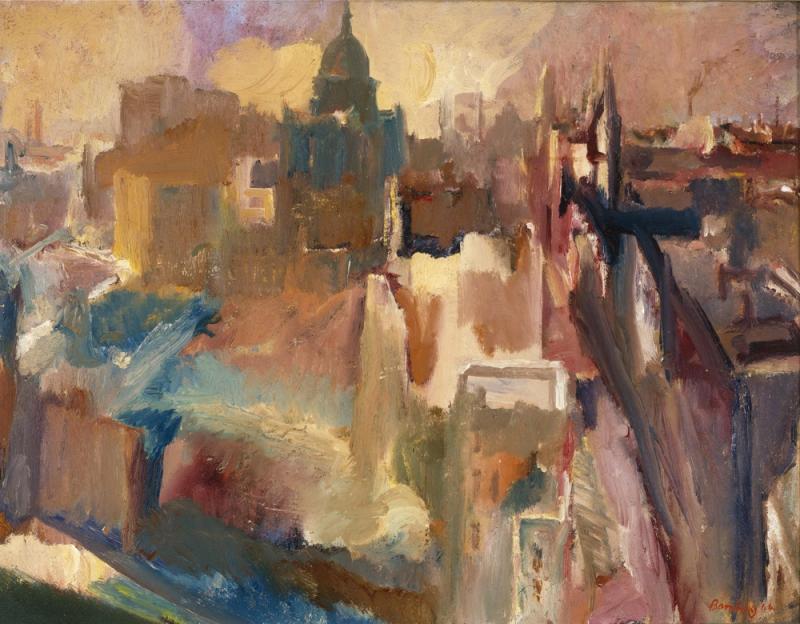
The next room, which tracks the influence of David Bomberg during his time teaching at the Borough Polytechnic, (the antithesis of the art establishment represented by the Slade), explores a very different way of looking at the world. Bomberg was critical of traditional observational methods in painting, the “hand and eye disease”, preferring to highlight the visual experience of objects and their mass, so as to get to the structure underpinning the observed; “the spirit of the mass” as he termed it. Drawing from life was fundamental to his process. The influence on students Auerbach and Kossoff is unmistakeable. Neither were members of the Borough Group which was formed in Bomberg’s wake but both were inspired, like Dorothy Mead, by his methods as they went on to more formal training. Bomberg had painted London cityscapes, notably St Paul’s Cathedral, during the war, (we see one here) but his prime interest in his later years, alongside portraiture, was elemental landscape. The near abstract renderings of Cornwall painted in his last years, whilst not represented here, seem to me to bear the most similarity to the dense, detailed London cityscapes that Auerbach and Kossoff went on to paint, although they both use a lot more paint (!).
Auerbach and Kossoff’s London
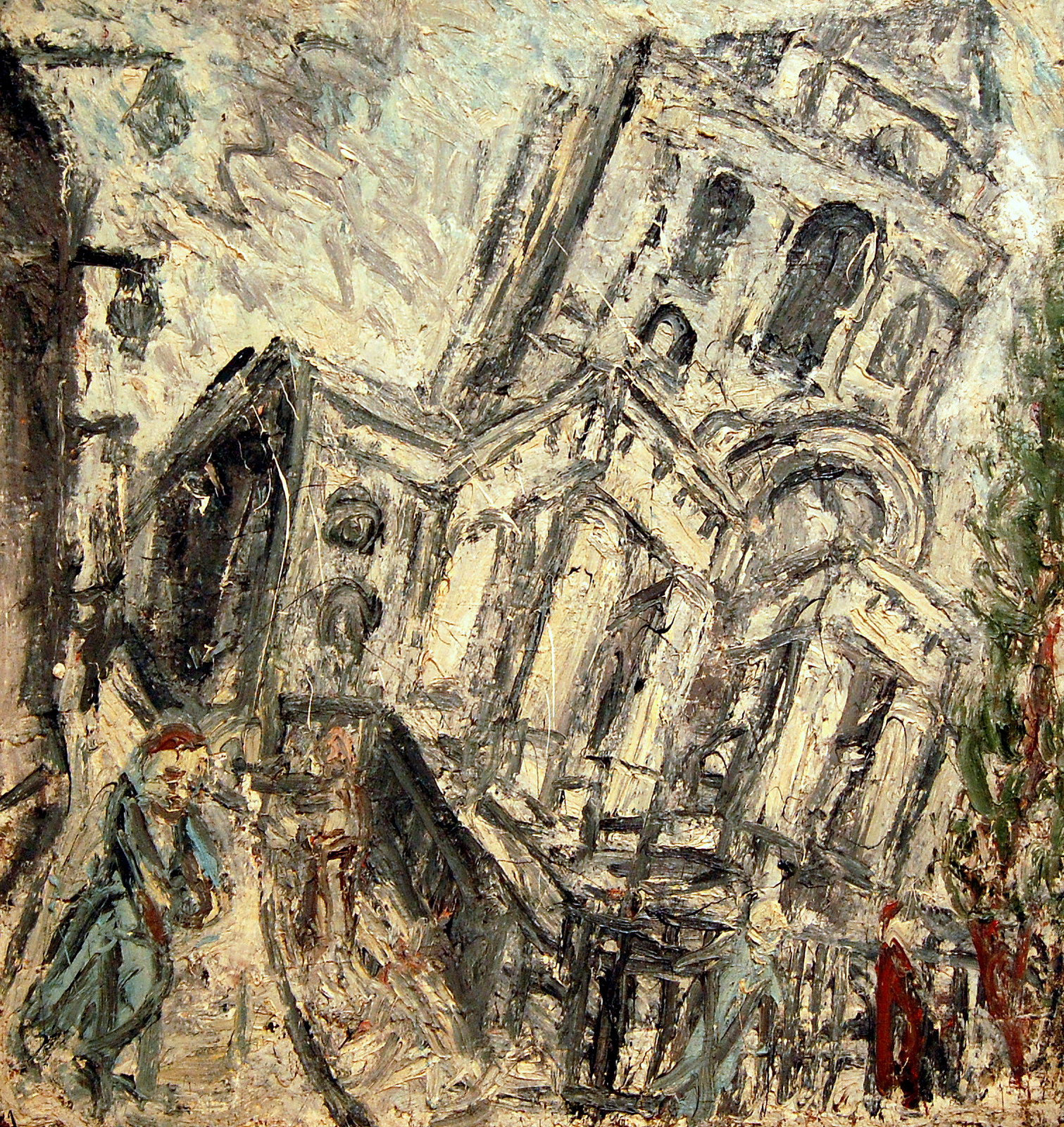
The cityscapes from both which appear in the following room, with a couple of portraits, are easier to read that their earlier works in the prior room, as is evident from the image of Kossoff;s near monochrome Christ Church, Spitalfields above. Yet, in some ways, the thrill of all that thick impasto on the canvas, Kossoff Early Morning Willesden or Auerbach’s Rebuilding the Empire Cinema, Leicester Square, is hard to beat. This is where the over-painting which characterises many of the paintings on show across the exhibition reaches its apogee. Whilst the geographic range of, particularly Auerbach, may be narrow, the expressive sweep is endless. Forgive the aside but there is a song by Madness off the much under-rated The Liberty of Norton Folgate album, We Are London, which popped into my head. Same emotional territory. Camden boys as well.
Lucien Freud II
Back to the body with a bang in Room 7 with wall-to-wall “classic” Freuds. There is a lot of painted flesh on show, rendered in the style LF first adopted in the early 1960’s and which he carried through to his death in 2011. He had picked up a hog-brush and moved back from the sitter by now, painting standing up, leading to a higher viewpoint and more elongated foregrounding. These portraits are set predominately in the familiarity of his studio. There are more full figures and more full nudes. There is real weight to the bodies, and more psychological depth, and less intimidation than in his earlier works. The call back to Sickert’s nudes struck me. The room is a bit overwhelming at first so I opted to focus on a handful of paintings: the Baby on a Green Sofa from 1961, (his daughter Bella), the portrait of Frank Auerbach from 1976 and the portraits of Leigh Bowery from 1991 an Sue Tilley from 1996. (The latter two are asleep: no great surprise given how slowly LF painted). These paintings emphasise how LF used lead white paint to build the contours of the flesh and create that astounding impression of sculpted volume on the canvas. Of course it only works with pale, white people, as it did for Stanley Spencer, but it is, even if you know these paintings, jarring to see unflattering depictions of naked bodies in the context of an art canon that does the exact opposite and a culture that only permits airbrushed “perfection”. Like them or not, this is what paint can do.
Francis Bacon II
Room 8 shows how Francis Bacon used the photographs of buddy John Deakin, notably those with unnatural poses and double-exposed, as the starting point for a number of his paintings. And the paintings here need to be savoured as you won’t see some of them every day of the week, in particular the Study for Portrait of Lucien Freud, with its sickly mint green sofa, incandescent light bulb and stuff coming out of LF’s head, and the Triptych completed in 1977, showing three images of FB’s lover George Dyer who committed suicide in 1971, on a beach referencing Degas and Picasso, the very definition of alienation. The former hasn’t been seen in public since 1965, the latter sits in a private collection since it last sale in 2008.
By the 1970s FB had given up on painting from life and the motifs, popes, besuited captains of industry, screams, cages and screens, had been replaced by the grotesque, but inordinately powerful, portraits of his mates, at least those that could keep up with him. These violently distorted chunks of people may look like they bear no resemblance to their subjects but see Deakin’s photos and you get exactly what FB was driving at. The way in which FB showed the life of his subject bursting out beyond the confines of the body reaches a peak in the Three Figures and Portrait from 1975. A death-mask like portrait is pinned to the back wall, a memory seeming to watch over the the two dynamic human figures and a bird like creature, with snarling human mouth, on a cube twisting and writhing in the foreground. The head on the left hand figure is George Dyer once again, his spine pushing out of his back. Scary stuff.
Michael Andrews and RB Kitaj
The next room, luckily, offers a bit of respite from FB’s assault on the senses. Michael Andrews and RB Kitaj aped Bacon by drawing on photographs as sources for their portraits, as well as their own imaginations. Andrews shared the existentialist outlook of some of his peers but was more interested in the interaction between people, friends, families, groups, than with the individual. Here we see one of MA’s oils depicting the Colony Room, Soho haunt of Bacon, Freud, Deakin and assorted bohemian hangers-on, and the Deer Park which impossibly brings together a intellectuals and celebs. But the most wonderful painting here is the much later Melanie and Me Swimming showing him tenderly teaching his 6 year old daughter to swim in a rock-pool. By this time MA had switched to quick drying acrylic paint sprayed on to the canvas. This gives a smooth, unbroken fluidity to the paint, and, as here, creates some captivating effects, the splashing, the refraction of the water, the contrast between skin colour in face and body. If you like this picture, and I am sure you will, then you need to search out more of Michael’s Andrew’s works in acrylic, especially the landscapes, the “hot air balloon series” and the fish paintings. You are in for a treat. The extensive retrospective at the Gagosian a couple of years ago was one of the finest I have seen (Michael Andrews and Richard Serra at the Gagosian Galleries London review *****). Unfortunately the Tate collection only holds one depiction of Uluru (Ayers Rock) which rarely gets an outing.
RB Kitaj, born in America but working in London from the early 1960s after studying at Oxford, also examines relationships but his was a more critical eye with a discernible message. His subjects were friends, especially artistic, as in The Wedding here, and family, especially the history of his family as part of the Jewish diaspora. Now he may have been the architect of the exhibition, The Human Clay in 1976, which proposed The School of London, but, for me, he is the least interesting painter.
Paula Rego
That cannot be said of Paula Rego whose works using live models dominate Room 10. Now you might legitimately ask yourself what Portugal’s greatest living, scrub that, greatest ever, artist is doing in this company. Well she studied under William Coldstream at the Slade School, alongside Michael Andrews, Euan Uglow and her future husband Victor Willing, in the mid 1950s. With that link established we are permitted to see some of her finest, and most intriguing paintings, from the 1990s. There is no better story teller, specifically women’s stories, in paint. These are no simple stories though, presenting multiple viewpoints and multiple insights. Take a look at The Family from 1988. At first glance it might appear a disturbing scenario . Take a closer look. This is a family undressing the helpless invalided father, a very personal exploration of Paula Rego’s own life, and that of their daughters, caring for Vic Willing.
Contemporary women figurative artists
On the day I went this room and the following room, the last room in the exhibition, got a bit piled up with punters so I wasn’t able to devote enough time to really looking at these works. No matter. I’ll be back and will cunningly start at the end. I got a bit beaten up by all that male existential angst in the preceding rooms. Whilst the artists in this final room, Celia Paul, Cecily Brown, Jenny Saville and Lynette Yiadom-Boakye are concerned with the human form, they do not, (with the exception of Celia Paul), necessarily paint directly from life and the identities they explore are a long way from the ferocity of, say, Francis Bacon. Celia Paul may have been a contemporary, (and lover), of Lucian Freud but her portraits of women, in supportive groups or individually, seem more concerned with internal vitality than external authority. Jenny Saville’s striking and frank close-up self portrait Reverse harks back to the meaty flesh of Soutine, as well as Freud. Lynette Yiadom-Boakye paints black characters from her imagination, with enigmatic titles, who seem caught up in their thoughts.
Off you trot
So a marvellous exhibition bringing together some of the best figurative artists who have worked in this country over the last few decades. Forget about agonising over what might have been included, or what should have been excluded. There is more than enough here to savour and the connections the curators have made are both valid and interesting. Above all the exhibition shows that painting in Britain never went away and that there is nothing quite as thrilling as looking at ourselves in paint.
All Too Human runs until 27th August 2018 so there is absolutely no reason at all not to see it.
and ===Bacon rarities – Lucien Freud study – Peter Lacy = beach trip


 At Home He Feels Like A Tourist