
Bach St John Passion: OAE at the Royal Festival Hall review ****

Orchestra of the Age of Enlightenment, Simon Rattle (conductor), Peter Sellars (director), Choir of the Enlightenment

Royal Festival Hall, 2nd April 2019

JS Bach – St John Passion

  • Camilla Tilling (soprano)
  • Christine Rice (mezzo-soprano)
  • Andrew Staples (tenor)
  • Mark Padmore (tenor, Evangelist)
  • Roderick Williams (baritone, Jesus)
  • George Nigl (baritone)

The Tourist, along with chum for the night TMBOAD, was recently blindsided, in a good way, by the staging of Britten’s War Requiem at the ENO which was far more theatrical than he had anticipated. Well blow me if if didn’t happen again with this St John Passion. I had not really clocked the presence of Peter Sellars on the list of creatives so had only anticipated a semi-staged version, a bit of movement, some subtle lighting, that sort of thing. However, from the moment we saw the OAE lined up on one side of the stage, it was clear something more was on the cards. What we didn’t expect was a full blown, punch to the gut emotional, acted out Passion, complete with modern dress costumes, (red and blue for the Marys, monochrome for the rest), occasional props, an immensely atmospheric lighting design courtesy of Ben Zamora, musical solos from memory, (my favourite was Simone Jandl and her viola d’amore and Katharine Spreckelsen and her oboe da caccia), and even walk-on contributions from Sir Simon Rattle himself.

The St John Passion is a powerful work of act even without the dramatisation, reflecting the subject, (even for those of us who have no faith), and the direct, even simple, way that JSB chose to set it. I can imagine that there will be those who would prefer, in theory, to be left to focus on the music, the voices and the text, but I would defy them not to be bowled over by the extra dimension that Peter Sellars staging brings to the work. This is not the first large scale Bach vocal work that the Tourist and BUD have shared in recent years, we have a B Minor Mass and a Christmas Oratorio under our belt, and the Tourist has a number of independent Bachian choral sojourns on top of this. The Tourist may have waited until his middle ages before he “got” Bach but now he consumes with the zeal of the convert.

Now as it happens Bach himself was reproached by some in the 1720s and beyond for the theatricality of his Passion settings and the fact that he revised them on multiple occasions in later years partly reflected this as well as a more realistic approach to the logistics of the piece and to tighten it up musically. So those who might initially object to this Sellars/Rattle ritualised version as liturgically inappropriate or offensive are in “good” company. There will have been a time after all when staging the Passion in the concert hall rather than the Church will have provoked the ire of some.

Whilst there are some belting chorus parts and chorales in the SJP the thing that really strikes me is the starkness of the settings with minimal instrumental accompaniment to many of the arias and with much use of recitative, and not just from The Evangelist’s narration. A lot of the first two parts is told from the perspective of those around Christ, and, assuming this translation is accurate, the text is very immediate and shorn of ornamentation. JSB cleverly creates a symmetrical structure, centred on the chorale Durch dein Gefangnis, as Pilate seeks to release Jesus, either side of which is the same pattern of choruses, some fugal, solos and chorales but in reverse order. This creates a musical order and narrative structure which informs the “drama”. It is not, as Sir Simon observes in the programme, a very melodic piece even if it does have some very arresting, and surprisingly experimental, musical passages. In short, with these forces, six soloists, a choir of 32 and the OAE numbering 30, it very much has the feel of opera, putting aside its subject. It certainly has emotional clout.

So easy to see why Sir Simon and Peter Sellars long cherished the idea of staging it in this way, finally realised in 2014 in Berlin when Sir Simon was head honcho at the Berlin Phil. The soloists here, led by the very deliberate Mark Padmore, who is pretty much the go too Evangelist, and the superb Roderick Williams as a visibly suffering Jesus, as well as Camilla Tilling, Christine Rice, Andrew Staples and George Nigl, were on top form and all can act as well as sing and the chorus brought real drama to their turns. The fact that the latter four soloists take multiple “roles” creates a texture and an audience empathy that a straight concert hall performance can lack. Contemporary resonance abounds with George Nigl’s equivocating politician Pilate yielding to the “will of the people” and the blindfolding and torture of Christus under investigation.

OK so occasionally some of Mr Sellar’s choreographic tropes grated a little, the hand gestures, the just-so re-creations of classic Renaissance paintings, the singing from prone positions, the pauses to get everyone in the right place, and the sur-titles, whilst a necessary part of the staging, were a bit too curt at times, and, whilst I don’t know where to take the interval the second half, as is usual, is a bit long compared to the first. Overall though this definitely ticked the box for BUD and myself.

Mind you we are, contrary to all appearances a couple of avowed modernists where it comes to our dramatic preferences. And so, I am willing to bet, are the vast majority of punters. Two hours plus of Bach and the story of Christ’s death may not float the boat of many outside us classical music buffs but I doubt there could be a better way to spread the word. Which ultimately is why the old fella wrote this masterpiece in the first place.

Ligeti, Bartok and Haydn choral works at the Barbican review ****

London Symphony Orchestra, London Symphony Chorus, Francois-Xavier Roth (conductor), Camilla Tilling, Adele Charvet, Julien Behr, Christopher Purves, William Thomas

Barbican Hall, 11th November 2018

  • Gyorgy Ligeti – Lontano
  • Bela Bartok – Cantata profana
  • Haydn – Nelson Mass

Three composers I like. Three works I did not know. A slightly earlier start. A fine end to a fine day.

When I say I don’t know Liget’s Lontano that isn’t strictly true. In fact, even if you are a Ligeti virgin, there is a fair chance you have heard Lontano. For this is the music famously used to signify Jack Nicholson’s descent into full-on barking psychomania in The Shining film. Lontano, along with Atmospheres, is therefore still probably Ligeti’s most famous work, even though, in the five decades that followed their composition, GL went on to explore many other styles and musical ideas. 

Lontano, in Italian, means “far away” or “distant” as a performance instruction which about sums it up. For this is as “other worldly” as it gets, from a composer synonymous with the term. It is built up from layers of very quiet sound, initially cellos and flutes, from the smallish orchestra. These lines move in different tempos and to different rhythms but they combine, legato, to create Ligeti’s trademark micropolyphony. The crystallisation of these sounds brings out sustained, but shifting, harmonies that are very different from traditional or atonal composition but the overall effect is ravishing. And something for which horror and sci-fi film composers ever since should be eternally grateful. It is eerie, mysterious but utterly compelling. Take the bit where the high violins, barely audible, pulse against the throb of the low brass and wind. Given the score doesn’t really offer any metre as such Francois-Xavier Roth could only really prompt the orchestra. No matter. All the LSO had to do was trust Ligeti’s ear and F-XR’s experience with the piece. How GL knew all of his innovations, not just in these micropolyphonic pieces, would work is an utter mystery to me. Genius.

It was performed by the National Youth Orchestra at this years Proms so its a fairly frequent concert hall visitor. Don’t let it pass you by. 

Bartok’s Cantata profana, which was published in 1930, rarely gets an outing. Lasting only 20 minutes yet still requiring a full chorus and orchestra as well as a bass, (here William Thomas standing in for the indisposed Matthew Rose), and a very challenging high tenor part which pushed Julien Behr close to his limit. It is based on a slightly creepy, coming of age, folk ballad about nine brothers who go out hunting, turn into stags, (which I hope is a rare occurrence even in Transylvania), and then refuse to come home when Father asks them. Heady stuff which Bartok pitches somewhere between his more overtly derived folk driven orchestration and the lusher sound-world of his earlier stage works. The LS Chorus seemed entirely at home with the tricky Hungarian idiom of the text and the awkward contrapuntal textures of Bartok’s score, which divides into 8 parts in the second of the three movements..

That’s the thing with Bartok. It normally takes a few listens for me to get the gist of his music. Like Prokofiev I know there is something there worth working on but it doesn’t always reel me in immediately. I can’t always grasp the line and architecture of the whole work but the rhythms and melodies individually are often arresting. I have more work to do on the popular orchestral pieces, am close to cracking the string quartets, think the solo piano collections are fascinating and would love to see Duke Bluebeard’s Castle. The piano concertos and the rest of his chamber music are bit of mystery. Whether Cantata profana on this listening will be added to the to do list is a moot point. 

As an aside if you want a quick burst of Romanian folk filtered through an orchestral lens, look no further than the Concert Romanesc. By none other than Ligeti. A perfect pastiche of a C19 nationalist Romantic tribute. It is really hard to believe this is the same composer as Lontano. 

Not knowing the Nelson Mass, as with any Haydn piece, is no handicap. It’s a mass, sung in Latin, so that’s the text nailed down, it is a relatively small orchestra, (just 4 double basses in the strings, trumpets, timpani and a small pipe-organ here played by Bernard Robertson), and, as usual, Papa keeps his textures homophonic and easy to follow. The Gloria ends with a mighty fugue and the Credo kicks off with an extended canon. What’s not to like? That is not to say it isn’t without drama, the LS Chorus letting fly in the Kyrie and Gloria. Julien Behr was persuasive, as was replacement bass, the ever excellent Christopher Purves. Mozart specialist Camilla Tilling’s soprano lost a little of its silky subtlety though newcomer Adele Charvet’s mezzo more than held its own. Even so there might have been a case for reigning in the 130 strong Chorus a little to offer a little light and shade. 

The Nelson Mass is the third of six that Haydn composed between 1796 and 1802, appearing just after The Creation in 1798. He titled it Missa in Angustiis, “Mass in difficult circumstances”, a reference to Napoleon’s march across Europe. There is a martial quality about some of the music, in the Kyrie and Benedictus for example, but, as usual Haydn can’t suppress his jolly nature throughout. As it happens a few days before its first performance Admiral Nelson (there he is above) secured a famous victory against the French fleet at Aboukir. A couple of years later Nelson went to visit the Esterhazy court and this was performed for him; hence the nickname. 

Beethoven’s Missa Solemnis at the Barbican Hall review ***

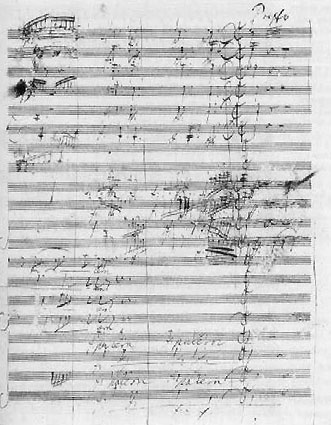
beethoven-missasolemnis-manuscript

London Symphony Orchestra, London Symphony Chorus, Michael Tilson Thomas, Camilla Tilling (soprano), Sasha Cooke (mezzo-soprano), Toby Spence (tenor), Luca Pisaroni (bass-baritone)

Barbican Hall, 20th May 2018

Beethoven – Missa Solemnis

Hard to believe that the scruffy scrawl above is from the hand of the greatest ever composer in one of his greatest ever works. At least he thought so. And so does Michael Tilson Thomas, Conductor Laureate of the LSO, judging by the number of times he has taken it on.

I am not so sure though and find myself siding with Adorno on this. This will probably be the one and only time I can make this absurdly pretentious claim since, however hard I try, I cannot understand a word of what the Frankfurt School of Marxist critical theory was about, though the intellectual posturer in me dearly wishes I did. I would love to know a lot about a lot, or even a lot about a little bit of what there is to know. Instead I am doomed to know a little bit about very little.

The thing is there isn’t much of the theme and variation repetition thing than Beethoven took to unparalleled heights (at least until The Fall and Wire came along) in the Missa Solemnis. The giant fugues at the end of the Gloria and Credo provide me with some structural understanding, and connect with other late works like the piano sonatas and string quartets, but otherwise there is quite a lot of, well, Romantic meanderings.

Now it is Beethoven with massed choral forces offering up a Mass on a scale comparable with the Choral Symphony so it can’t all be bad. And it isn’t. There are stills scraps of cracking tunes which are explored in imitation to conjure up the goose-bump feel that the earlier masters of polyphony managed. Especially in the second half of the Gloria, the middle of the Credo and the beginning of the Sanctus. But there just isn’t the overarching structure to help my little head stay happy. LvB intended to complete the MS for his patron and mate, Archduke Rudolph, who was receiving some honour or other in March 1820. He missed the deadline so didn’t actually complete it until 1823 just ahead of the Ninth. Maybe that changed it.

The LSO chorus is now so bonkersly brilliant that it sort of didn’t matter when they were belting it out. Especially in the soprano section. And, like I say, MTT knows his way around the score. The soloists seemed well matched to me, though I would marginally take Sasha Cooke’s mezzo and Toby Spence’s tenor over Camilla Tilling’s soprano and Luca Pisaroni’s bass-baritone.

I will keep trying but I don’t think I will ever fully succumb to the MS. Whisper it but I am happier listening to the Mass in C which, as Beethovian experts will tell you, leaves me on the nursery slopes and forever banished from the pistes. So be it. Vita summa brevis.