London Concert Choir, Counterpoint, Mark Forkgen (conductor), Rachel Elliott (soprano), Rebecca Outram (soprano), Bethany Partridge (soprano), William Towers (countertenor), James Way (tenor), Peter Willcock (baritone)
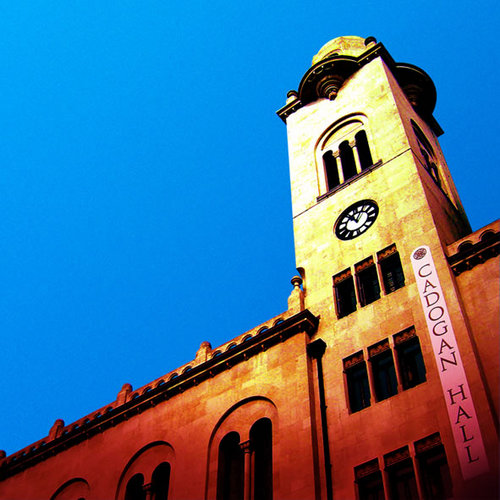
Cadogan Hall, 7th November 2019
Henry Purcell – King Arthur
Early afternoon spent in the company of Joaquin Phoenix in Todd Phillips’s Joker before an evening listening to a semi-staged (is there any other) performance of Purcell’s semi-opera. I can categorically state that no-one else in the world will have thus spent their day.
You don’t need to hear from me as to Joker. Suffice to say that I am on the side of those who consider this bleak, referential, origin story to be a stone-cold classic.
As is, in it’s own way King Arthur. A classic I mean. Not bleak. Old HP didn’t have that in him. Though, famously, stone cold, per the famous chattering strings in the Frost Scene in Scene 2 of Act 3. HP just couldn’t help himself when it came to programmatic music, word painting as we arty farty types call it, and, when it comes to combination of music and voice he has rarely been surpassed, ever, though he always stayed in his comfortable, and successful, groove during his all too short 36 years.
Now King Arthur, like must of his theatrical oeuvre isn’t really an opera. The main characters don’t sing, to hat is left to the gods, fairies and peasants, of which there are a fair few here. The Britons and the Saxons, of which there are also a fair few, are spoken roles for actors. The libretto is by none other than John Dryden, superstar Restoration poet, imagine him and Purcell as a compositional supergroup, and the first performance was at the Queen’s Theatre on the river in London in 1691. Of course by then the royal patronage that both basked in under Charlie and Jimmy Twos was over, (Dryden had even converted to Catholicism to keep the commissions rolling in), and we had a Dutchman on the throne. After his success of Purcell’s Diocletian, promoter Thomas Betterton, who had written its libretto, took a punt on King Arthur, which also went down very well.
It is very silly. It tells the tale of the battles between King Arthur and the Saxons, specifically Arthur’s mission to rescue his betrothed, the blind Cornish princess Emmeline, stolen away by the dastardly King Oswald of Kent. Merlin, his Saxon equivalent, Osmond, and various right hand men and women also get a look in, as do Cupid, Venus, Grimbald, various other fairy types and a chorus of shepherds and shepherdesses. I think you can get the picture. The entertainment was intended to look as good as it sounded, with a masque in Act 3 and and variously, a sacrifice, an off stage battle, peasants dancing in a pavilion, an enchanted wood, a castle and the seas around our very own sceptred isle. Dryden used all manner of sources for his text and it shows. And, at its heart, it is shameless jingoism.
As you can see, written more for spectacle than sense, and to allow the stage-makers of the time to show off their skills. Even with a rudimentary synopsis and the explanations of our two narrators for this performance, Aisling Turner and Joe Pike. Best just to sit back and relax and let the tunes roll over. Which they did, though I have to say this didn’t really catch fire in the way I had expected. Purcell and Dryden crammed a lot in in terms of mood and message, as well as genre, so bringing it all together is tricky and maybe a bit beyond conductor Mark Forkgen. Moving choir and soloists on and off stage and to different parts of the hall, added drama but the logistics proved a little distracting. If I am honest I lost track a bit somewhere in Act 2 and never really caught up.
Which meant the focus was music and singers. IMHO the pick of the soloists was bass baritone Peter Willcock with some of the others occasionally getting lost against the muscly sound of fine scratch HIP ensemble Counterpoint. Which suited me since it is that, “oh isn’t that clever”, or “isn’t that lovely” reaction to so many of Purcell’s musical ideas, that makes it such a pleasure to listen to. Whether elaborate counterpoint, or direct homophony, invariably against the chugging ground bass continuo, with frequent arpeggios, dotted rhythms, wide spread chords, with minimal dissonance, always different, always the same, with simple structures subjected to continual reinvention.
English Chamber Orchestra, Jessica Cottis (conductor), Ben Johnson (tenor), Ben Goldscheider (horn)
Cadogan Hall, 16th March 2019
Ravel – Le Tombeau de Couperin
Britten – Serenade for Tenor, Horn and Strings, Op.31
Purcell/Britten – Suite of Six Songs from Orpheus Britannicus
Stravinsky – Pulcinella Suite
I love Britten’s Serenade, first performed in 1943. It might be one of my favourite ever pieces of classical music, up there with Beethoven’s Seventh Symphony, Bach’s Violin Sonatas and, I am not ashamed to admit, The Four Seasons. I am not alone. There was a delightful senior in the lift at Cadogan Hall who concurred. But it needs a tenor and, especially, horn player, of the highest rank, to pull it off. The ECO of course has it in its genes, Benjamin Britten having been its first patron and founding musical influence.
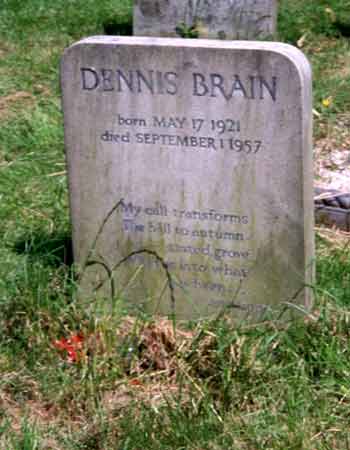
Now there are many fine recordings, (I assume based on the artists involved), but as ever in Britten’s music the best bet is to have the great man conducting and, in this, if not in all, cases, Peter Pears, singing. I can see why the experts reckon the recordings with the mercurial Dennis Brain, for whom the part was written, on horn are definitive, but the first, from 1942 a year after the piece premiered, is a bit period scratchy for my liking, emotional as it is, and the second, a decade later, falls a bit short musically. Dennis Brain might just have been the greatest horn player of the C20 coming from, and there can’t be too many of these, a veritable dynasty of horn players. He died far too young, in rock’n’roll style, by wrapping his sports car round a tree. If he had lived longer who knows what the next generation of modernist composers, the likes of Ligeti and Berio, might have conjured up for him.
As for the Serenade though I actually prefer the later Britten/Pears recording on Decca with the LSO and Barry Tuckwell on horn. More musical, and Pears less comedy toff sounding, even if the horn is a tad less mysterious. I also love the second Bostridge with the BPO and Rattle and their principal horn Czech Radek Baborak. After all Ian Bostridge is surely better than Pears in most of Britten’s supreme vocal music. On that note make sure not to miss his Madwoman in Curlew River with the Britten Sinfonia at Milton Court next March. The staging in 2013 for Britten’s centenary, directed by Netia Jones at St Giles Crippplegate, with players from the BS, and IB in the same role, was extraordinary. One of the best “opera” experiences of the Tourist’s life.
So tenor Ben Johnson and Ben Goldscheider on horn had a lot to live up to. And by and large they did. The Serenade is not performed as often as it should be IMHO which perhaps reflects the combination of small string ensemble, a skilled horn player and a dramatic tenor. Ben Johnson certainly has the flair for the dramatic, he was an ENO Harewood artist, and his clear, if not overwhelming voice, fitted the piece and hall well. Ben Goldscheider, a BBC Young Musician finalist, who is now studying with the aforementioned Radek Baborak, left a deeper impression, adept in the more virtuoso passages and capturing the mystery and thrill of the more striking passages, even if the more lyrical settings lacked a little emotion.
The six movements, (book-ended by solo Prologue and Epilogue for the horn eschewing valves to create natural harmonics), comprise settings of poems by Charles Cotton (Pastoral), Tennyson (Nocturne), Blake (Elegy), a C15 Anonymous Dirge, Ben Jonson (Hymn) and Keats (Sonnet). Serenade literally means “an evening piece” and the poems combine to take us through nightfall from dusk to midnight. The dark heart of the work is the Black “O rose thou art sick” and the scary, pounding march of the Dirge that follows, “This ae night”, but the tunes and, typically with Britten, the atmospheres, by turns haunting, comforting, placid, dancing, of the outer settings, are exquisitely rendered. As usual Britten uses all sorts of clever and arresting techniques, the lilting string chords in the Pastoral, the echoing horn in the Nocturne, the semitone infection in the Elegy shifting the key from major to minor, the vocal repetition in the Dirge against the sinister string Fugue, the hunting horn in the Rondo hymn straight out of Mozart’s playbook and the string sustains in the Sonnet as we drift off to sleep, (not literally of course, and in any event, BG’s off stage Epilogue reprise would soon wake you up).
I see that Australian-British conductor Jessica Cottis played the French horn and trumpet in her youth which perhaps explains her confident way with the Serenade. I intend no offence but, physically, there isn’t much to Ms Cottis, I estimate 3 of her to 1 Tourist. She has a heck of a presence on the podium though. The ECO numbers on the night may only have maxed out in the Stravinsky, but Jessica Cottis teased out plenty of energy and power when required in this and in the rather more phlegmatic Ravel. I see she has had a couple of recent chamber operatic gigs with the Royal Opera House for Mamzer and The Monstrous Child and has appeared as a regular guest conductor after roles as Assistant at the BBC Scottish SO and Sydney SO under Ashkenazy. On the strength of these interpretations if I where looking for fresh musical leadership I would give her a job.
My last exposure to Le tombeau de Couperin was from Angela Hewitt in the solo piano version at the RFH with MSBD and MSBDD. No review on these pages as, thanks to collective misunderstanding, we managed to miss the star turn, Bach’s Partita No 4, which was, to saw the least, bloody annoying. Still the Ravel was superb and MSBDD was particularly chuffed, this being one of his favourite pieces. Now Ravel was a dab hand at lushly orchestrating other composers’ piano works but for his own he was a little more restrained. That isn’t to say that LTDC isn’t brimful of “colour”, that being the standard word to describe Ravel’s gorgeous ideas, just that you can feel the sombre tones which come from the work’s inspiration as a memorial to the close friends Ravel had lost in the Great War. This version of LTDC takes four of the piano’s six movements: the Prelude, where the traces of harpsichord ornamentation, this was after all inspired by the Baroque harpsichord genius Francois Couperin, is most apparent in strings and oboe; the Forlane, a Venetian dance which the Pope at the time had tried to re-introduce to replace the smutty tango, (is there no end to Catholic sex guilt), but which Ravel spices up with some dissonant notes; a courtly Menuet that goes a bit Scottish jig and ends up with a bit of that Ravelian jazz vibe; and finally a Rigaudon which is a medieval Provencal dance with central processional. The whole piece gives woodwind and, especially, brass a good workout which the respective members of the ECO seemed to thoroughly enjoy. I don’t have a recording of this. Clearly I should.
Apparently Henry Purcell composed over 250 songs and vocal works in his short 36 year life with three volumes being published posthumously as Orpheus Britannicus. BB, like so many subsequent British composers, loved HP, as would anyone in their right mind. Indeed they have a lot in common: inventive harmony, matchless word painting and transparent and direct melody in their music for voice. BB, along with Michael Tippett, was instrumental in bringing the near forgotten HP back into the mainstream, in part through settings of songs from the OB volumes. HP had only provided figured bass lines as accompaniment to the vocal parts but that is all BB needed, along with his preferred chamber orchestral forces, to bring the songs to life. Peter Pears, in editing the vocal lines, foregoes any frilly ornamentation and together the lads created some cracking numbers, modest in sound even if the lyrics are a bit British bulldog patriotic. It doesn’t look like they crop up on the Last Night of the Proms. They should. I see that BB himself writing about his and PP’s arrangements hoped to capture “something of that mixture of clarity, brilliance, tenderness and strangeness which shines out in all of Purcell’s music“. Could just as easily have been his own manifesto.
Having literally changed the course of music with those ballets Stravinsky, and Diaghilev as the promoter needed to come up with a new trick after the War. Diaghilev, in yet another inspired move, presented IS with a collection of music by Giovanni Battista Pergolesi, he of the Stabat Mater, (and some criminally ignored operas and unrecorded orchestral pieces), and a book of stories about the stock commedia dell’arte character Pulcinella, or wife-beater and all round yob Mr Punch to us Brits. (BTW Pergolesi, like Purcell died way too young, though he only managed to get to the very rock’n’roll age of 26). From this IS conjured up the ballet Pulcinella which premiered in Paris in 1920 conducted by maestro Ernst Ansermet with choreography by Leonid Massine and designs by some bloke named Pablo Picasso. And so began IS’s neo-classical phase. Oh yessss.
The suite, written in 1922 and subsequently revised, (as IS was wont to do). is scored for chamber orchestra like the full ballet but the vocal parts are dumped and the material is condensed into 8 movements. I have recordings of the full ballet from Abbado and the LSO and Marriner and the ASMF, (unsurprisingly, given its genesis, Baroque specialists love having a go at this). In this performance Jessica Cottis and the ECO trod a nice line between the kind of crisp, HIP influenced, neo-classical Stravinsky now commonplace and the older, lusher, vibrato-ey style, though it didn’t quite make enough off the off-kilter chords and bouncy rhythms, after all most of the movements are based on dances. This is core repertoire for the ECO and it shows.
Next up from the ECO at Cadogan Hall on April 16th a brighter affair, the Mendelssohn VC with some Schubert, Suk and the cinematic Bartok Divertimento, led by the, er, ECO leader Stephanie Gonley and then. on May 22nd, some Mozart, Beethoven and Stravinsky’s Concerto in D, from the other end of his neo-classical period. Looking forward to the former concert but will miss the latter. Clashes with the Stockhausen Donnerstag aus Licht. What have I let myself in for.
Raphaela Papadakis (soprano), Lotte Betts-Dean (mezzo-soprano), Stephanie Gonley (violin), Caroline Dale (cello), Harry Winstanley (flute), Michael Collins (conductor)
Antonio Vivaldi
Gloria in D RV 589
Concerto for Violin in F minor, ‘Winter’ from The Four Seasons, Op 8 No 4, RV 297
Concerto for Violin in E flat major (La tempesta di mare), Op 8 No 5, RV 253
Concerto for Violin and Cello in B flat major, RV 547
Concerto for Flute in D (Il gardellino), Op 10 No 3, RV 428
Vivaldi now is generally the preserve of the specialist Baroque ensembles. With audiences to match. Don’t get me wrong. If you want to hear a performance of the Four Seasons in London and aren’t too sniffy about who performs it you won’t have long to wait. Gloria may not be up their with the Faure or Mozart Requiems or Allegri’s Miserere in the popularity stakes but it still gets a fair few outings. Beyond that though if you, like me, crave repeated fixes of Vivaldi then you normally need to wait for the experts to visit. I can see why Vivaldi’s vast and exquisite output has been hijacked by a just a handful of his pieces. And I can also see why, a la Stravinsky, there are so many classical music buffs who airily dismiss Vivaldi as a lightweight, one-trick pony, before they return to their Wagner or some such other turgid dross.
Well let me tell you they are wrong. I can’t pretend an encyclopaedic knowledge of the RV’s and anyway life, literally, would be too short to “know” all of AV’s music, (even now that so much has been recorded by specialists). The cantatas, much of the sacred music outside the familiar and of course the operas, (with their risibly stereotypical plots) are unknown to me. None of this matters though since Vivaldi’s music is so immediate, so deceptively, but rarely actually, simple that even on the first listen it can be enjoyed. Which means all you need to do, (look away now buffs), is grab some cheap, web regarded collections and switch on your shuffle. Result. Life enhanced. Simple really.
So this all Vivaldi bill by the ECO, under conductor Michael Collins, caught my eye. A Gloria, a Winter, a couple of the best concerti, for respectively violin and flute, outside of you-know-what and then a comparative rarity, one of the handful of double concerti scored for violin and cello. From a chamber ensemble with a fine pedigree; remember their first Patron was Benjamin Britten and some of Britten’s finest recordings of his own music were made in partnership with them. They are not though, and this is in no way intended to be disparaging, experts in the Baroque. In fact they are one of the most versatile of orchestras anywhere on the planet. Look at their immense list of recordings. They will even do weddings. Though it helps if your names are Harry Windsor and Megan Markle.
The Choir of the C21 led by Max Barley is a similarly broad, though still top drawer, church. Our soloists for the Gloria were well matched soprano Raphaela Papadakis and mezzo Lotte Betts-Dean with ECO principals Stephanie Gonley and Caroline Dale taking the instrumental leads along with young flautist Harry Winstanley. Now I can’t pretend that these performances were up there with the best of the Vivaldi interpreters I have heard, La Serenissima under Adrian Chandler, the Concerto Italiano, the Venice Baroque Orchestra, Brecon Baroque and Gli Incognito, but they were still very enjoyable. Especially in the Gloria.
I was particularly taken by the double concerto where Stephanie Gonley and Catherine Dale’s familiarity paid dividends, This is one of only four concertos for this coupling of which one is incomplete. The Allegro comprises arpeggio figures which begin in the ripieno before being taken up by the soloists, offset with more lyrical passages. The slow movement is a conversation between the soloists a la Bach and the final pacey allegro offers more virtuoso opportunity against a triple rhythm accompaniment.
The flute concerto, No 3 of the six which make up Op 10 was likely published in 1728. A cardellino or gardellino is a goldfinch, a popular caged bird in Vivaldi’s Venice, (and in Golden Age Holland, as you will no doubt know from Carel Fabritius’s exquisite painting in the Mauritshuis in The Hague and which inspired Donna Tart’s ambitious novel). The goldfinch often crops up in Renaissance paintings of the Madonna and Child, the little fella symbolising the foreknowledge that mum had about her son’s eventual gory death. No such iconography here though, for Vivaldi the relevance was the wee bird’s song. The tweeting is most obvious in the last movement which allows the flautist to develop ever more extravagant virtuosic tweeting. The first movement isn’t quite so ornithological with the flute offering trills, runs and staccato repeats more in counterpoint to the bouncy riternello dance. The fast movements sandwich a lilting cantabile into which tousle-haired Harry injected a surprising quote of lyricism.
Vivaldi was quite keen on stormy seas. RV 433 is a La tempesta di mare for flute and RV 570 a Concerto grosso with the same sub-title. RV 253 is the violin concerto equivalent, part of the Op 8 twelve titled the Contest Between Harmony and Invention of which the first four are the Seasons. No surprise I guess for a Venetian with a view from the Ospedale della Pieta out over the lagoon to the Lido and beyond to the Adriatic. Now I happen to think that there is as much in the other 8 concertos as there is in the Four Seasons, certainly in terms of tunes, if not in pure rock ‘n’ roll theatricality. An original score for 253 survives in Dresden, probably brought by JG Pisendel the violinist when he returned from studying with Vivaldi. Pisendel was the man who introduced Vivaldi’s music to JS Bach. Diamond geezer.
253’s fast movements are marked Presto not just Allegro so they need to be quick. The central Largo is the three minutes or so of relative calm though even at the end the storm is plainly on its way back. Both storms call for seemingly never-ending (well a few minutes) of descending figurations, the last set against a sort of dotted fanfare rhythm, the first even more frantic arpeggios against a scrubbing ritornello. I enjoyed Stephanie Gonley’s rendition but you probably also need to hear this played at more extreme tempi from one of the big-boned Italian outfits with, say, Federico Guglielmo or Giuliano Carmignola in the hot seat. Same is true of 297 Winter (which has that bit of summer in it just like Summer often feels a bit wintry).
Before the Gloria we were treated to a burst of medieval carol arrangements to beef up the festive quotient. At least those of us not underneath the gallery, where the choir was located, were treated. Still a nice touch. (Now as it happens I have a jolly collection of medieval carols, songs and chants from Pro Cantione Antiqua and the English Medieval Wind ensemble on CD I can recommend). It was as much as MSC and I could do to stop MS popping upstairs and joining in for he is the expert on all things Black Death to the end of the War of the Roses.
I am not actually sure if MS and MSC had heard a recording of the Gloria before but this was certainly their first Vivaldi gig. It is simply not possible for anyone raised in the culture of Western musical tonality not to like Vivaldi’s Gloria. Unless they are dead. And even then it will be on most of the playlists in heaven I would guess. Were that, Pascal’s Wager style, to actually exist. Anyway MS and MSC seemed to like it unless there were being their usual polite selves when it comes to their overly solicitous Dad/Future-Father-In-Law.
The Gloria was composed around 1715 for the residents of the Ospedale. They probably drafted in a few blokes for the tenor and bass lines. The young women of the Ospedale were prodigiously talented, after all Vivaldi composed music for them that even today taxes the very best of musicians (especially for violin), but they probably couldn’t quite get to the gruffer end of the vocal scale. After Vivaldi died in 1741, impoverished after the failed attempt to set up shop in Vienna, the score of Gloria was lost and forgotten until being rediscovered in Turin in the late 1920s. It is a setting of the eponymous section of the Latin Mass divided into twelve sections, all mercifully short and it is resolutely upbeat even as it contrasts keys, moods, tempi, instrumentation and voices.
SWR Symphony Orchestra Stuttgart, Sir Roger Norrington, Francesco Piemontesi (piano)
Cadogan Hall, 16th March 2018
Ludwig van Beethoven
The Creatures of Prometheus Overture, Op 43
Piano Concerto No 3 in C minor, Op 37
Symphony No 3 in E flat major “Eroica”, Op 55
I guess the fashion for all Beethoven programmes began with LvB himself. Perhaps one of you clever musicologist types can tell me if this continued through the C19 and C20. In any event it is commonplace now. Makes sense really. Why would you want to dilute the maestro’s perfect work with the burblings of lesser mortals.
That master of Beethoven performance, Sir Roger Norrington, knows that and programmed accordingly as he brought the SWR Symphony Orchestra Stuttgart to the Cadogan Hall as part of the Zurich International Orchestra Series, Sir Roger was made Conductor Emeritus of the Stuttgart Radio Symphony Orchestra, which merged with the SWR Symphony Orchestra Baden-Baden and Freiburg in 2016, having led them from 1998 until 2011. This means that a fair few of this orchestra know him and his methods very well and it shows. And this is a fine orchestra make no mistake.
For those that don’t know Sir Roger made his name at the Kent Opera, and then his own London Classical Players, at the vanguard of historically informed performance. Minimal vibrato, strings not allowed to overwhelm the woodwind and strict adherence to the composer’s metronome marks, characterise his exquisite performances of Beethoven. That happens to be the way I like my Beethoven too. Not that syrupy, wobbly stodge filtered through the Romanticism of the second half of the C19 and the bombastic conducting of the first half of the C20. That means picking up the pace and pumping up the rhythm. His long association with the Stuttgart orchestra, and peers in Salzburg and Zurich, means that this is a modern orchestra fully in tune with his approach, able to deliver accurate “pure tone”. Mind you the fact that he still guest conducts at the ripe old age of 84 (this was his birthday – many happy returns) with some of the world’s most famous orchestras shows just how far the “right” way of playing has seeped into the mainstream for Beethoven and other Classical composers.
Now I am not going to lie. I can take or leave the Prometheus Overture. Beethoven churned out a fair few, 11 to be exact, Overtures for money, to accompany theatrical performances, with 4 linked to his only opera Fidelio and its first incarnation Leonore. Some get more of an airing than others, (anyone ever heard the Zur Namensfeier Overture?), and the general consensus is that a fair few are decidely ropey. The Creatures of Prometheus is Beethoven’s only ballet composed in 1801. I am not big on the ballet so I don’t know if this gets a regular airing but the Overture holds its own in the concert hall in part because it contains material that was later recycled into, yep, the Eroica Symphony and the Eroica Variations for piano. Delivered here with a bit of oomph which makes me a little less dismissive of this piece.
Our soloist for the PC3 was Swiss Francesco Piemontesi, protege of Alfred Brendel, who I confess was a new name for me. He has worked with this orchestra and Sir Roger before though and it showed. His piano was turned in, just like in 1800, with Sir Roger and his stool, (no score, no baton obvs), behind this which made for a different experience. In the Eroica we had the brass and wind players standing, outside the antiphonal strings and the double basses growling away at the back with the timp. Just another sign of Sir Roger rethinking the familiar. Anyway Mr Piemontesi was compelling especially in the faster, outer two movements. The pace at which the conductor takes this movements, and this layout, served him well and lent an interesting “slippery” quality to the concerto which was exciting. The Largo was maybe a bit too long on the power and short on the poetry but not annoyingly so. Encored with a bit of Brahms which furthered showcased his easygoing style.
The PC 3 was a great leap forward for Beethoven, (though maybe not quite as much as the Eroica), composed at the same time as that interesting but still “nice” Symphony No 2 and when he was still twiddling about with (admittedly still perfect) chamber pieces. Here is all that massive musical imagination bursting out, though still with some structural debt to Haydn and Mozart and specifically the latter’s C minor concerto No 24. The contrast with the weirdy E major in the slow movement is what makes you sit up and take notice.
The Eroica was similarly taken at a fair lick, even in the second movement funeral march. Crispy punchy strings acted as the perfect foil for woodwind detail and the horns especially in the scherzo and the trio. Is this Beethoven’s greatest work? Not sure, I still prefer Symphony No 7, but it doesn’t matter how many times you hear it still punches you in head, heart and gut. It is long yes, but the orchestral forces, as this orchestral layout reminds us, are no greater than normal for the time, just an extra horn. Yet from the off, in the first movement, LvB conjures up all manner of dissonances, surprises, syncopations and stresses to create drama and energy. Pop in a new tune halfway through like never before. Let the horn jump in too early. A timpani that cracks like wood on wood. Yet, in all this expectant momentum, even a non-musical person like the Tourist never loses the line, and when the resolutions come, its blessed relief. Even if it is just the woodwind really as we still have three more movements to come. I just can’t see how this mighty first movement makes sense played too slowly and without repeat.
A funeral march which basically defines all orchestral funeral marches, all grave and ominous, and then the switch to C major from minor for that jaunty episode telling us whoever died didn’t do so in vain. Always have to stop myself jumping up and saluting. Then after the second wave of death and glory the squeaky violins. Fade out. Under starters orders and we are off with the horsey scherzo with that lollop into 4/4. Another one of those brilliantly perfect ideas that no-one before would ever contemplate. Straight into the intro of the final movement with its opening tease, through about 6 symphonies inside one movement, until, bosh, the best ending to any LvB symphony.
This is a piece of cake for Sir Roger. Thomas Ades’s Eroica last year in the Barbican, as part of the cycle with the Britten Sinfonia, followed a similar template in terms of pace, power and animation but you definitely felt you had been in the ring for the full twelve rounds after that. Here Sir Roger was still able to unfurrow the brows of music and performers as it were, to leave me skipping off with a smile not a scowl. (Had to leave early to catch a train so missed the Mozart encore – doh).
As it happens the SO has seen Sir Rodger conduct on a couple of occasions, maybe 50% of her entire classical musical education. Still no reaction. If he can’t persuade her no-one can.
A diary clash prevents me from hearing Sir Rodger’s next outing with the OAE at the newly restored Queen Elizabeth Hall on 11th April. All Mozart. Mind you it’s sold out. No surprise there.
Regular readers of this blog (remember chums, the best clubs are exclusive) will be aware that the Tourist doesn’t really do “gigs”. It is all a bit loud for his aged ears. The number of bands/artists he would pay money to see is severely limited and dwindling in number thanks in part to the Grim Reaper. Many venues are beyond the pale on the grounds of comfort, excessive booziness (the Tourist has taken a vow of abstinence following many happy years of excess) or claustrophobia. Festivals need friends and time, both of which the Tourist seems unable to cultivate.
Here though was a rare, and, as it turned out, wonderful exception. Even the most casual observer of the pop panoply will know that, to paraphrase the immortal JP, “the boy Gedge has written some of the best songs of the Rock n Roll era”. He has also written some of the best tunes, and created some of the greatest guitar melodies. The latest Wedding Present double album, Going, Going …, is, I admit, maybe not their finest work, but it is still, like the albums The Fall and Wire churn out, light years ahead of anything the youth can create. I pray Gedge has finished yet.
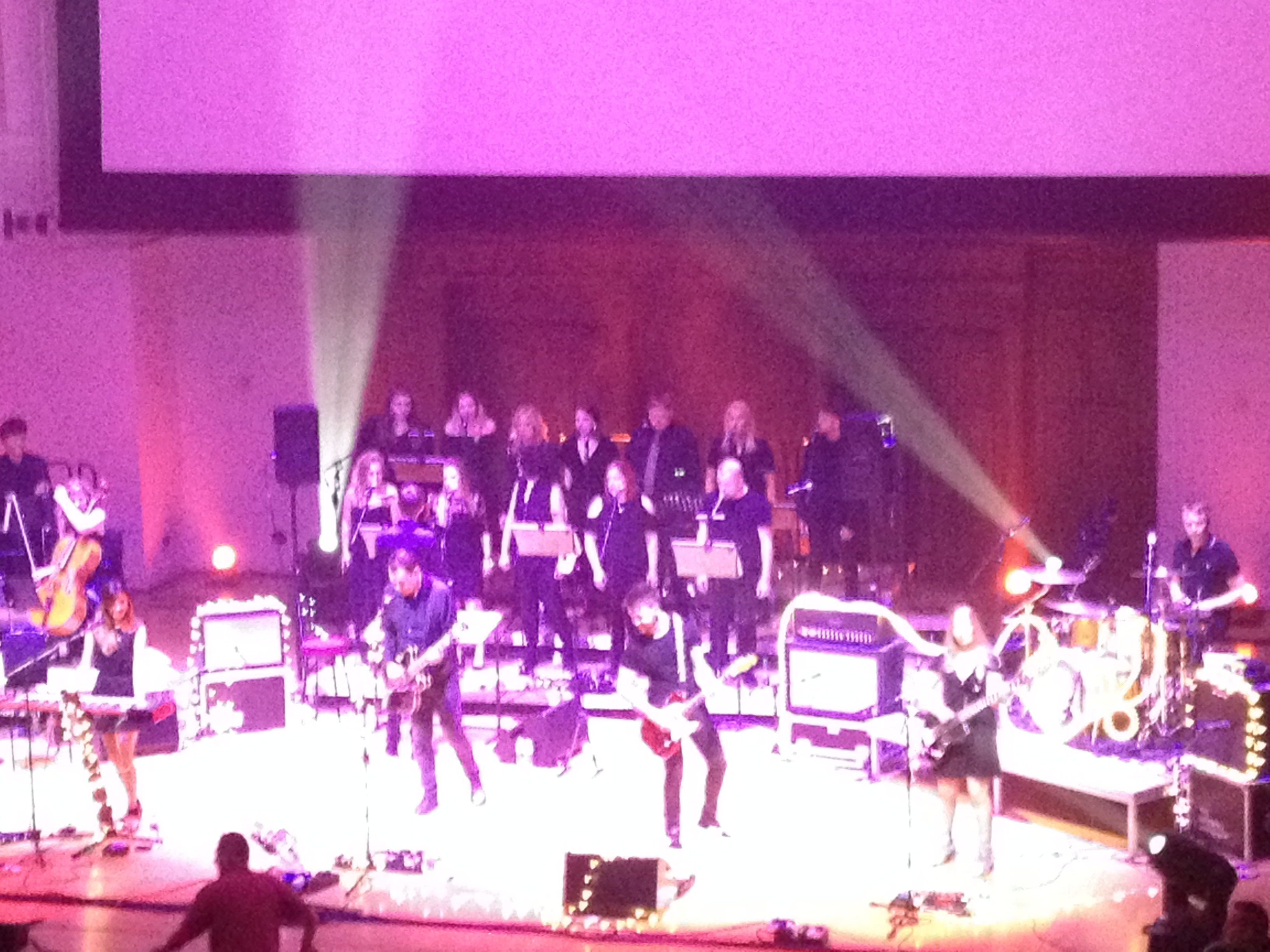
It does begin in a strange vein with four post-rock instrumental tracks, Kittery, Greenland, Marblehead and Sprague, with slower tempi and expansive dynamics. A small choir and a classical ensemble (strings and a trumpet) are used to grand effect. Given that this concert was a run through of the album, said choir and players were up there on stage with the band. The contrast between Dave Gedge’s and Marcus Kain’s driving guitar rhythms, Charlie Layton’s thumping drums and Danielle Wadey’s swirling bass, and the wordless choir and soaring strings, maybe works a bit better on the recording than live but it is still a worthwhile departure. The good news is that from Two Bridges onwards, we get back firmly into classic WP territory, with professional Yorkshireman Gedge muttering the usual maudlin, but somehow still intensely moving, poems on failed relationships and unrequited love over the pumping (less jangling) rhythms we know and love.
Smashing stuff. A few pretentious black and white landscape films to add to the mix, some proper cranking up to 11 of the guitars in parts, and even a couple of encores, Perfect Blue from Take Fountain, and, as the reward for the patient enthusiast, the classic fugal Bewitched from Bizarro. What a racket at the end. Now I have to say of all the varied material from Going, Going …, which looks back to a lot of Gedge’s previous songs, my favourite is Rachel, which is a preposterously catchy, innocent pop masterpiece. I am also partial already to Little Silver, Birdsnest, Bells, Broken Bow and Santa Monica (the final track which culminates with some painful but exquisite chord progressions).
Best of all it was at the Cadogan Hall. One of my favourite venues (though my last visit was to hear some Shostakovich Preludes and Fugues and a capella Poem settings – pick the bones out of that contrast). Nice little perch in the balcony. Loud enough but not deafening. Lots of room around me. And what seemed like a nice crowd with just enough distinctive quirkiness and maturity.
Now there was a time kids, in 1990 I think, when the Wedding Present churned out Top 40 hits at breakneck speed. I appreciate that is likely pre-history to you, but if you were to listen to Grandad’s ravings, (me not Gedge though the vintage is comparable), here are 10 you might start with. (Hopefully they are on that Spotify).
Alexander Melnikov (piano), Latvian Radio Choir, Sigvards Klava
Proms Chamber Music No 5, Cadogan Hall, 14th August 2017
Dimitri Shostakovich – Preludes and Fugues Op 87 – Nos 1, 2, 3, 4, 7. 8
Dimitri Shostakovich – Ten Poems on Texts by Revolutionary Poets, Op 88 – Nos 5,6,7,8,9
Previous posts will have revealed my passion for Shostakovich’s music despite, or maybe because of, its sometimes disturbing crassness. So what better way than this to spend a birthday. Off I toddled for this lunchtime chamber Prom of which there have been a few this year at Cadogan Hall. An excellent innovation. Oh, and before I get down to business, don’t worry birthday boy’s day turned more social thanks to a welcome surprise from the SO, BD and LD.
Now these pieces are interesting because of their chronology, in the middle of his oeuvre, but still in the uncertain (for DSCH) period before Stalin popped his clogs, and also because of their form. The Ten Poems are a capella for choir, though DSCH makes sure there are proper tunes to be heard, which is a form he used sparingly. He also produced some other weighty piano compositions, notably the Op 34 Preludes and the Sonata No 2 Op 61, but the rest of the piano works are more lightweight (though still interesting). The Op 87 Preludes and Fugues are a full blooded exploration of the piano’s range across 3 hours or so. The recorded version I have is by dedicatee Tatiana Nikolayeva and is an old favourite. Alexander Melnikov’s recording is judged by some as better so I was looking forward to this.
Since the Ten Poems on Texts by Revolutionary Poets are exactly that it is tricky to cast around for the usual DSCH subtext here. These poems are straight up and down descriptions of the suffering of the people at the hands of the Tsarist authorities at the time of the first failed 1905 Revolution. Similarly the structured format of the Preludes and Fugues also precludes too much navel gazing about the “meaning” of the works. So we can just concentrate on the sounds. Now I don’t know the Poem settings as well as I should but this seemed to me a very well crafted performance by the Latvian Radio Choir under director Sigvards Klava (who had been in town primarily to deliver a Rachmaninov Vespers the night before). The five settings on show only run to a few minutes each and the syllabical structures are very straightforward but the delivery was as crisp as you like and sung across the board with real fervour. The programme notes a similarity to Mussorgsky’s operatic choruses: I get it.
However Mr Melnikov was even more convincing. The six Preludes and Fugues he played were very convincing and performed with real authority. In particular those Fugues with fortissimo passages really struck home. I was dead impressed. I think this work is somewhere near the top of the best piano music ever written. I reckon Mr Melnikov agrees. Time to add his version to the collection.
Royal Philharmonic Orchestra, Martyn Brabbins, Jan Mracek
Cadogan Hall, 16th June 2017
Berio – Sequenza V for solo trombone
Prokofiev – Quintet in G Minor
Debussy – Prelude a l’apres-midi d’un faune,
Beethoven – Violin Concerto,
Shostakovich – Symphony No 5
A welcome innovation from the RPO at its Cadogan Hall home. As a prelude to the main concert a short chamber concert was served up. In this case, an intriguing pairing of one of Berio’s Sequenzas, here for trombone, alongside Prokofiev’s infrequently programmed (at least in my experience) Quintet. The main concert was a triptych of favoured warhorses which can usually tempt me in.
The Berio piece is the usual exploration of musical technique that these sequenzas demand. There is a healthy dose of humorous novelty at work here in the techniques employed and some of the directions in the score, best of all, the fact that the soloist, has to dress up as a clown (I’ll let you look up Berio’s reasons for this!). The Principal Trombone of the RPO, Matthew Gee, didn’t disappoint, either in his rather elegant outfit (shoes and bald bloke wig being the main concessions) or in playing. The piece is fascinating but smartly doesn’t outstay its welcome.
The Prokofiev Quintet is scored for oboe, clarinet, violin, violin and double bass which gives plenty of opportunity for the quirky invention that our Sergei seemed to revel in. The six movements have plenty of dynamic colour and the derivation of the piece, originally a commission for a chamber ballet, is very clear, I was reminded once again that I need to pay more attention to Prokofiev’s chamber music. So I will.
As for the main orchestral pieces, well the Debussy washed over me as it always does so I am afraid I am no real judge of Mr Brabbin’s interpretation nor the RPO’s performance. The Beethoven however took me back to familiar ground and this was a stirring performance by all concerned. Jan Mracek was making his debut with this orchestra having established a growing reputation in his native Czech. His playing is certainly idiomatic of his homeland which made for an interesting contrast with Mr Brabbin’s very deliberate reading. It livened up for finale though I confess I have heard more uplifting endings.
The Shostakovich was the meat course for me though and here Mr Brabbin’s careful phrasing and cool incision paid dividends. This was a performance that really drew out the Mahlerian parallels especially in movements 2 and 3. No irony in the ending here. This was definitively the response to “just criticism” that Shostakovich claimed it was (probably to save his own skin) and could easily be digested by those partial to a bit of C19 romanticism. The pounding Russian rhythms and banal folksy melodies were in evidence but this was more Autumnal middle Europe than Siberian winter. Stalin would have been made up with this first movement. I am not sure this is how I want my DSCH 5 to always sound but it was satisfying to hear this approach given a full airing.
Lars Johan Werle – Canzone 126 di Francesco Petrarca
Britten – Sacred and Profane
Another bit of a catch up here. This was so good though that I thought I better say something about it.
This was the latest in an ongoing stroll through the best choirs that pop up in London with BUD who knows where he is at with this sort of caper. Any sensible consumer of classical music will likely eventually conclude that the most versatile and approachable instrument of all is the human voice, with a smallish choir the optimal way to hear it. And the genius composers of the past for such limited, but pure, forces, the likes of Taverner, Tallis, Palestrina, Byrd, Gibbons, Monteverdi and Allegri, are now augmented by some greats from the mid C20 and from the ranks of contemporary composers.
Anyway this outfit, conducted by Peter Dijkstra, were outstanding. The likes of The Sixteen, The Tallis Scholars, The Cardinal’s Musick and so on are a delight to hear but somehow these guys seemed even better to my ear (Cadogan Hall, along with Wigmore Hall and Milton Court are perfect venues for choirs I think). They just had such extraordinary control both individually and collectively.
Now I know the Britten pieces pretty well but it was in the second of the Lars Johan Werle pieces, and especially Berio’s the Cries of London, that the dazzling virtuously of our Dutch friends really came to the fore. The Berio piece takes the sounds of a Medieval market and turns it into a quite extraordinary piece, challenging and beautiful. And the Lars Johan Werle Canzone somehow manages to sound both contemporary and an eerie take on Monteverdi at the same time. I was just blown completely away by this. The Gabriel Jackson piece was not quite of the same quality and had a bloke playing a few licks on an electric guitar harmonising with the choir which didn’t entirely work for me.
So I gather these guys are keen to expand the contemporary repertoire and are keen to commission new works. Sounds like the Dutch government rightly invests in them as well. For sure they now have a couple of 50+ blokes as groupies eagerly awaiting their return to London.
For those of you that are not familiar with contemporary or indeed Renaissance choral music I would strongly urge you to take the plunge. I guarantee that within a few seconds of one of these outfits opening their lungs all the s**t that swirls around your head thanks to modern life being rubbish will evaporate. You really don’t need to know anything about the music.
On my radar there are a few Monteverdi Vespers coming up (including 23rd June Barbican Academy of Ancient Music), The Tallis Scholars at St John’s Smith Square on 30th June, The Cardinal’s Musick 18th July Wigmore Hall and an Estonian Choir next January 30th at Milton Court with a bit of Arvo Part action. Go on treat yourself.




 At Home He Feels Like A Tourist