Right even by the standards of the drivel that the Tourist usually posts on this site this is an utter waste of your and my time. Weeks too late, built on flaky foundations of understanding and appreciation and precious little use to anyone. Except maybe me that is, as an aide memoire. You can find my thoughts on these shows elsewhere on this site, if you can be arsed.
I have also appended a list of the top ten plays, so far announced, that I am looking forward to seeing this year in a desperate attempt to beef up the content. Some marginal utility in that maybe. Or maybe not.
BTW you can, and should, see The Lehman Trilogy at the Piccadilly Theatre from May through August. You can, and really should, see Caroline, or Change at the Playhouse Theatre right now. The good people of Edinburgh can see Touching the Void and it will go to Hong Kong, Perth and Inverness before coming back to Bristol. I bet it pops up in London. And, if you are in NYC, and haven’t yet seen Network, jump to it.
Network – National Theatre
John – National Theatre
The Wild Duck – Almeida Theatre
The Lieutenant of Inishmore – Noel Coward Theatre
The Writer – Almeida Theatre
The Lehman Trilogy – National Theatre
Touching the Void – Bristol Old Vic
Julius Caesar – Bridge Theatre
Death of a Salesman – Manchester Royal Exchange
Caroline, or Change – Playhouse Theatre
Near misses? Girls and Boys at the Royal Court, Cheek By Jowl’s Pericles, The Phlebotomist (now coming back to the main stage at Hampstead – do not miss), Nine Night (at Trafalgar Studios from February), Quiz, Love and Information at Sheffield’s Crucible Studio, Copenhagen at Chichester, Henry V from Shakespeare at the Tobacco Factory, The Jungle (support the two Joes in their plan to put this in front of the Home Secretary !!) and The Madness Of George III at Nottingham Playhouse.
What about this year? Take your pick from these if you trust my judgement. Which would be a surprise. No particular order BTW. There’s a few big tickets missing from this (When We Have Sufficiently Tortured Each Other, All About Eve, Betrayal, All My Sons). Like I said it’s what I am most looking forward to.
Sweat – Donmar Warehouse. Too late to get in now except for returns but this may well pop up elsewhere.
Mother Courage and Her Children – Manchester Royal Exchange. Julie Hesmondhalgh as Brecht’s survivor.
A Skull in Connemara – Oldham Coliseum. For my fix of McDonagh.
Cyprus Avenue – Royal Court. Finally I will get to see this.
Medea – Barbican Theatre. Internationaal Theater Amsterdam bring Simon Stone’s Euripides to London with best female actor in the world Marieke Heebink.
Berberian Sound Studio – Donmar Warehouse. How the hell are they going to make this work?
Top Girls – National Theatre. Caryl Churchill. Enough said.
Three Sisters – Almeida Theatre. Best of the Chekhov offerings.
Death of a Salesman – Young Vic. Miller, Elliott, Pierce, Clarke, Kene. Best play of 2019?
Blood Wedding – Young Vic. Lorca given the Farber treatment.
Oh and Antipodes, Annie Baker’s latest. Obviously.
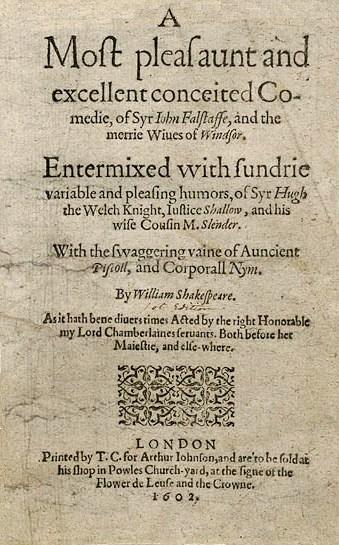
Confession. This was the first time I had ever seen a production of The Merry Wives of Windsor. The Tourist can’t remember there being an opportunity, RSC or otherwise, in those few periods of his intensive theatre-going in the past, and I don’t think there was a production of sufficient quality over the more fallow years to drag him away from the reality of life, work, kids, drink and the like.
Also, I have to admit, TMWOW has always sounded a bit limp, with the Shakespeare industry being a bit sniffy about its worth, dubbing it “the first sit-com”, compared to the other comedies, Twelfth Night, Dream, Much Ado, As You Like It, Errors, Shrew ….. in fact only The Two Noble Kinsmen of the “pure” comedies seems to get a worse rap. (Well maybe The Taming of the Shrew with its impossible to mitigate misogyny without some dubious directorial device). The other criticism seems to centre on the disappointment of taking one of WS’s most “rounded” characters, analytically as well as literally, out of the history plays and plonking him into a class-based farce as the butt of the comedy.
Well just as Barrie Rutter made a case, albeit not entirely convincing, for WS’s (with John Fletcher) last contractural obligation with his Two Noble Kinsmen at the Globe, so director Fiona Laird has served up a peach for the RSC, (though it is just about to end its run at the Barbican). All I can say is that if TMWOW is normally this funny then all those naysayers who are supposed to know their onions when it comes to the Bard need their heads examined.
If it isn’t normally this funny then Ms Laird is to be further congratulated for making it so to a contemporary audience. Shakespeare’s humour comes from plot – usually will they/won’t they romances and unlikely assignations, from – word-play – badinage, punning and bawdiness – and from physical comedy – which, obviously, is not something made explicit in a text. To make a modern audience laugh it usually makes sense to trust Will and let the plot do what it will, play down the anachronistic, and not always easy to follow, wordery and massively ramp up the caricature, mannerism and visual gags. Which is exactly what this production does. With plenty of new interpolations.
If the audience reaction at the performance the Tourist attended was anything to go by, and it seems this has been supported by critics, professional and amateur alike, this definitively worked. I laughed. A lot. In fact as much as I can ever remember for a Shakespeare comedy. It is not as all round satisfying as the best Much Ado or Twelfth Night production but it was still a revelation.
The plot is contrived. And daft. No question. One theory alleges that Will only had 14 days to come up with it after the Queen requested an entertainment for the Order of the Garter festival in 1597 to feature her favourite of his comic creations, Sir John Falstaff. Now, as I sure you all know, Falstaff is way more than just a comic buffoon, as we see in Henry IV Parts I and II, and as Mistress Quickly explains in her eulogy in Henry V. He may be vain, boastful, corrupt, cowardly, a drunk and petty criminal, but he is charismatic and he embraces life and we, and Prince Hal, therefore love him despite his faults. And he is, of course, fat and as everyone knows us fat people, with our seeming inability to control our appetites, and our apparent physical limitations, are just funny.
Humour invariably validates superiority. It takes what the group or society has deemed as unsettling, threatening or just different and turns it into something safe and tolerable. Falstaff, because the genius Shakespeare created him, is doubly funny because he is both the object of our laughter and also, because of his wit and intelligence, the source. Tricky business humour. I am sure that there are plenty of people who would be happy to make a joke at my expense because I am fat. In the same way it would probably make me happy to make a joke at their expense because they are stupid. Like I say tricky business.
Anyway I suspect big Will didn’t waste too much time mulling over the psychology of humour and just got on with the task, knowing which way the Elizabethan bread of patronage was buttered. Which explains the oft observed “lack of subtlety” in the plot and character. Yet, as all students of the situation-comedy know, the best characters in the genre have one, or more, personality traits amply exaggerated. And the best sit-com plots begin with a plausible set-up that gets incrementally ever more ridiculous. Which, give or take, is what happens in TMWOFW.
Falstaff is on his uppers. He pitches up in Windsor, or, in this production a place that feels suspiciously like Chigwell. He resolves to woo a couple of wealthy married women, Mistress Alice Ford and Mistress Margaret Page. He commands his servants, Pistol and Nym, to deliver the ladies identical love letters. They refuse and tell the ladies’s husbands. Page (Paul Dodds) isn’t too bothered but Ford is the jealous type, and he is introduced to Falstaff by the Host(ess) of the Garter Inn masquerading as a Master Brook in order to unveil Falstaff’s plans. Meanwhile, (yep there is always a meanwhile or two in these plots), three other chaps are trying to woo the Ford’s daughter, Anne; absurd French doctor Caius, asinine youth Master Abraham Slender, cousin (here nephew) to Justice Robert Shallow and young Fenton (Luke Newberry), a gentleman now bereft of his fortune.
Cue confusions, set-ups and comic revenges. By the three suitors on the Host(ess), by the two Mistresses on Falstaff, by “Brook” on Falstaff, by Ford on his wife, by everyone on Falstaff, and by Page and his wife on Slender and Caius, and by Anne and Fenton on the parents. It all ends happily though.
These farcical set pieces, replete with disguise and concealment, offer plenty of opportunity for clowning, which the cast, directed by Spymonkey specialist Toby Park, relish and have perfected over the run in Stratford and now London. David Troughton is a brilliant Falstaff, decked out in “fat suit” and priapic codpiece, and booming out his perfectly timed lines. Rebecca Lacey and Beth Cordingley are sensational as the conspiratorial and true friends, Mistresses Page and Ford, with exaggerated TOWIE accents and hamming up their humiliations of Falstaff, both in the laundry basket scene, here a wheelie-bin, and in the Woman of (now) Brentwood scene. Vince Leigh, who I remember pulled off a similar trick in Propellor’s all -male Taming of a Shrew as Sly/Petruchio, manages to make Ford’s jealousy palpable, and not a little pungent, but still amusing, and even gracious, when his suspicions prove unfounded. It is possible to believe that he and Beth Cordingley could be a couple who care beneath the mutual scorn.
Tim Samuels and Tom Padley make a fine double act as Shallow and Slender. All the servants, Ishia Bennison as Mistress Quickly, here housekeeper to Caius, Steve Basaula as his man Rugby, Nima Taleghani as Falstaff’s pageboy and John Macaulay as Simple, offer wry indulgence to the whims of their “betters”. Charlotte Josephine, Afolabi Alil and Josh Finan are also able to inject at least some of the personalities of Bardolph, Pistol and Nym, though these are more developed in the history plays. TMWOW is, at its heart, a satire on the pretensions and affectations of the “middling” class, their preoccupations with wealth, marriage prospects and position in society. Aristocracy is conspicuous by its absence, other than Falstaff and his young doppelgänger the spendthrift Fenton, though Shakespeare chucks in enough references which gently mock his Court audience, and the servants are generally enablers rather than protagonists. This then is obviously immediately recognisable territory for the modern audience, “we are all middle class now”, made more so here by the Essex milieu.
The comedy also takes a swipe at that staple of “English” comedy, foreigners, and specifically their funny accents. No obviously progressive way to do this so best wade right in. David Acton does exactly that with loquacious Welsh parson Sir Hugh Evans, another from the Shakespeare school of Welsh windbags, but Jonathan Cullen goes even further with Dr Caius, offering a Gallic strangling of the English language which goes well beyond the simply Clouseau-esque. A couple of deft retouches create some priceless, and filthy, moments, one of which I fear I might have made up in my own dirty mind as no-one else seemed to laugh. I particularly enjoyed the addition of the East Europeans who come to remove the wheelie-bin, who are snootily looked down on by the assembled throng whilst they, it transpires, are chatting about the scene’s resemblance to Proust.
The final theme of TMWOW seems to me to lie in the power executed by the women. By casting Katy Brittain as the Hostess of the Garter pub she too, along with the Mistresses, Anne, (another fine performance from Karen Fishwick to set alongside her Juliet in this season), and Mistress Quickly, run rings around the lads. They get their own way, and get revenge on the sexual predators, not through compromise, simpering or abasement but through their own agency, and they have a right laugh in the process. Switching the denouement to the town square, rather than Windsor Great Park, with Elizabeth’s statue towering over it, may slightly invalidate Falstaff’s Herne the Hunter garb, though Epping Forest isn’t too far away I’ll warrant, but it does, finally, leave the women on top. I wonder if Liz I herself would might been pleased with this ending.
Lez Brotherston’s set, turning seamlessly to reveal the skeletal interiors and exteriors of the half-timbered houses, is as ingenious as his hybridised costumes, which mix modern and Elizabethan fashions. There is plenty of blingey accessories on show, particular favourites for the Tourist were the blow-up flamingos, Mistress Page’s all in one cerise pink throne and foot-bath, Anne’s fluffy pooch, the f*ck-off massive gas barbecue, the remote-control golf cart and the white leather bar stools. Caroline Burrell has recreated Tim Mitchell’s lighting design particularly effective when the houses turn neon. Gregory Clarke’s sound design didn’t intrude and Fiona Laird’s own composition completed the jolly mood.
OK so there are a couple of occasions when my snob-o-meter vibrated. The Bread of Heaven chorus and the Dick Emery reference might have been steps too far but that is my problem not Ms Laird’s and the RSC’s. Overall this is a cracker of a show, very funny, easily digested and with a few points to prove. Carry On.
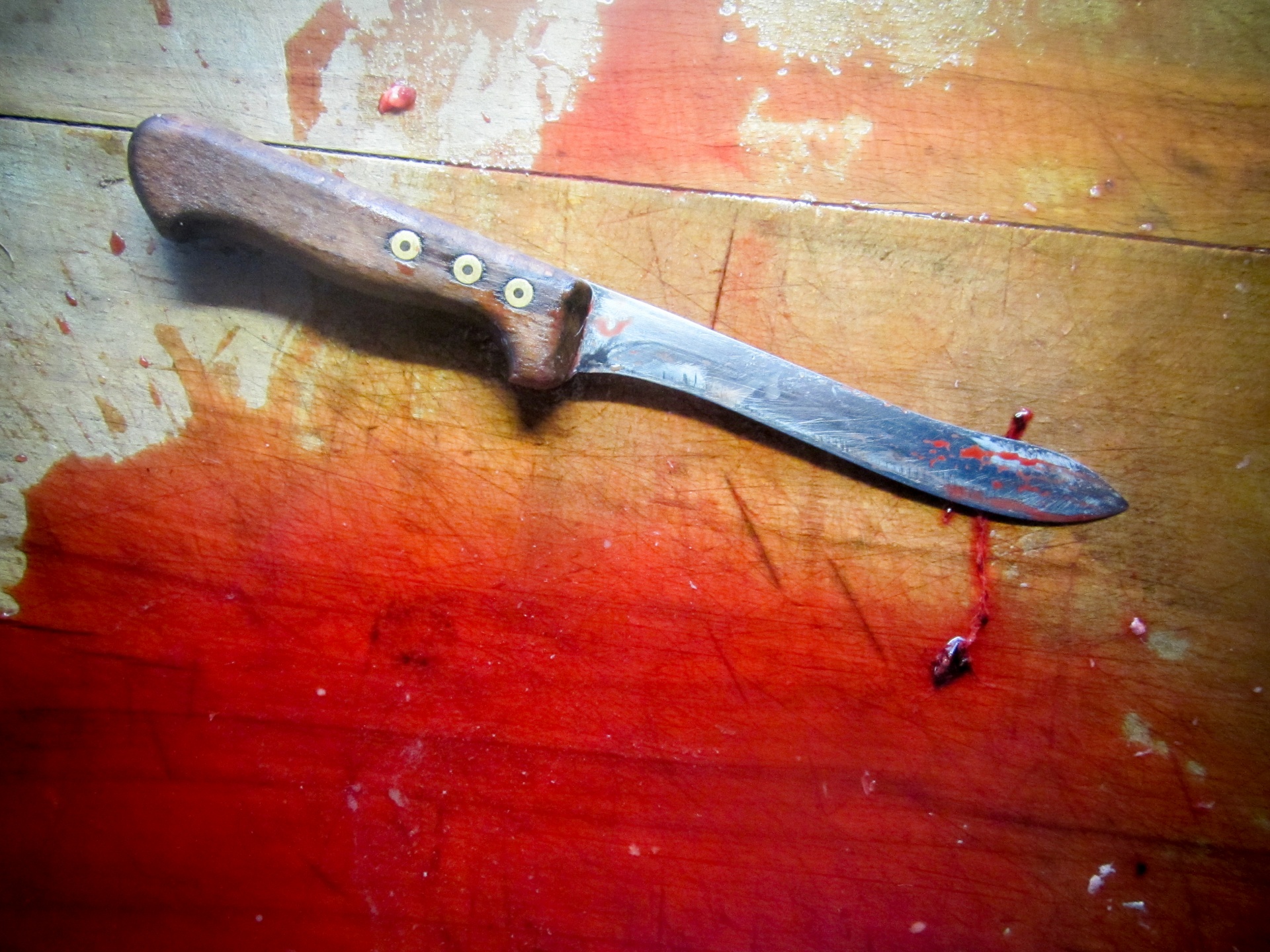
Is this a dagger I see before me … well maybe more of a kitchen knife …
It is pretty tightly plotted (at least if you pare it down). It is quick by comparison to a lot of the Bard – half the length of Hamlet, though that always needs a few nips and tucks – in part perhaps because Thomas Middleton adapted the text that has come down to us. It wastes no time at all in getting going – if anything it is a bit too abrupt at the start I reckon. Other than Macbeth and his lady wife most of the characters don’t get much air time to reveal themselves. It’s language is direct, often shockingly so. It is eminently quotable. There is no welter of arcane classical references. Most interested people know it or know of it (it’s a GCSE set text after all). The themes are easily defined and understood – ambition and patriotism, moral disorder and inversion, violence begetting violence, childlessness and legacy, gender roles and masculinity, the suppression of feeling and equivocation, the supernatural.
It might be built on an edifice of contemporary (when written) conventions, verse speaking, soliloquies, quibbles, audience asides, witches, ghosts, a dumb show, severed heads, but it is the supernatural that gives plenty of scope for coups de theatre. It may also have been intended to massage a royal ego, the patron of the company that first performed it, Jimmy I (of England, No 6 of Scotland) being an expert in the magic field with his best-seller Demonology, and coming just after the failed Roman Catholic plot to blow him up. Yet the supernatural also works on our imagination, (as it works on the power couple), always a good idea in a play, which, together with big Will’s acute psychological insight, and repetitive language – blood, blood and more blood, time, darkness, man – explains why it is so popular.
So why then is it apparently now so difficult to get right? Search me though if I take this somewhat disappointing version, alongside the similarly underwhelming recent NT production, (and plenty more in the last decade), the problem might lie in trying to hang too much on the play. No problem with a clear overarching creative vision but keep it simple. Don’t add all sorts of frills – there are enough interpretative and visual choices to be made from the text itself. Make sure the two leads nail the verse. No mumbling. Ensure they can explain their motivations – remember they are travelling in opposite directions, from normative revulsion to nihilistic emptiness in the case of Macbeth and vice versa for the Lady. The other characters can play it straight. Duncan is a symbol of kingship, Banquo matters because he doesn’t fall for all that weird sister sh*t. (And he can scare us later). The Porter is there to offer ironic commentary, warn against those who say one thing and do another, and, here in this production, very successfully mind the time. Everyone else is pretty much plot collateral.
It works best when we the audience are dragged into the couple’s nightmare. Small space, simple staging, like the landmark Dench/McKellen/Nunn RSC version. Or the Walter/Sher/Doran apparently, which kicked off in darkness. The recent Ninagawa version, though it is different, worked because the Samurai backdrop leant contextual clarity and the age of the couple a desperate poignancy. The 2015 Justin Kurzel film, if you can forgive the accents, also has a clear aesthetic and some very smart interpretative choices. You can add your own to the list.
In this version however, director Deborah Findlay, seems to have focussed on the details of the visual, and on the “horror” to the exclusion of the themes. Some of this works, notably Michael Hodgson’s Geordie Porter, always present, tapping his watch, chalking up the body count, hoovering incessantly, disturbing in his ordinariness, as well as the digital clock countdown, even if it is a big of a cliche, which links to the theme of time passing. Niamh Cusack as Lady Macbeth, clawing and pawing, also has the measure of most of her key lines and David Acton’s Duncan, whilst a little fruity, is what you expect from a man born (rather than compelled) to rule. However Christopher Eccleston, whilst capturing Macbeth’s military bearing, doesn’t, for me, vary the verse sufficiently, such that he comes across as insufficiently tortured by events. The same is true of the Edward Bennett’s Macduff who comes across as more geography teacher than grief stricken revenger. Mr Bennett is an outstanding Shakespearean, especially in comedy, but he looked lost here. Rafael Sowole’s hefty Banquo was more convincing, especially as ghost.
Having the witches played by three girls, dressed in red, Don’t Look Now/Shining style and signifying blood, is initially striking but the novelty soon palls. The jump cut fizzing/flickering lighting from Lizzie Powell, and the “spine-chilling” score from Rupert Cross and sound design of Christopher Shutt leans a little heavily towards the cinematic. Fly Davies’ set, with de rigeur upper level, accommodates the interpretation but doesn’t really wow or command the front of the vast Barbican stage.
Having said all this the production doesn’t drag, it squeezes out a few laughs, not all intended, and its pinball of ideas craves attention. Maybe I should try some of the other current London Macbeth’s, the NYT at the Garrick, or the Michelle Terry/ Paul Ready at the Sam Wanamaker (if it wasn’t so bloody uncomfortable, and more problematically, sold out). Or maybe I’ll just wait. Something wicked will this come again soon.
You can stay right next to Juliet’s balcony in Verona. Le Suite de Giulietta. The Tourist, SO, BD and LD can vouch for the lovely decor, the sizeable rooms and the delicious breakfast. The courtyard is closed at night so it is very tranquil and, in the day, it is quite fun watching the crowds do a double take when you exit from the hotel. And Verona itself is a very fine city.
Now I am not a berk. I know it was a window not a balcony. And that this is a story which Will S nicked from William Painter via Arthur Brooke via numerous Italian medieval raconteurs, including Dante, and then all the way back to Ovid and Xenophon. But even this cranky curmudgeon can get swept along by the definitive tale of young love dashed. Though Shakespeare being Shakespeare there is a lot more too it than that, what with the examination of gang violence, pointless vendettas, family loyalty, sexual freedom the curious nature of Mercutio, the expanding eloquence of Romeo, the precocity of Juliet (she’s supposed to be coming up to 14 remember), the constancy of Benvolio, the comic good-naturedness of the Nurse and the misguided and hare-brained intervention of Friar Laurence.
It’s easy to see why R&J is so popular and has been presented in so many ways. The denouement with our two dead teens is always, or should be, a tearjerker, even as we know the outcome, the idiocy of Friar John – all you had to do was deliver a letter, how hard is that numbnut – is always a reason to shake your fist, the reconciliation of the families, (even as you know it won’t last), always stirs, there are some good, often dirty, jokes and some fine, sweet verse.
It can endure a lot of textual and/or directorial abuse, (though it is hard to fathom the happy endings of previous centuries), and, even with the sub-plots is a breeze to follow, even without the Friar’s helpful “brief” summary at the end. What it doesn’t like though, in my book, is less than clear delivery of the verse. You need to hear the clever way WS matches language and form to character, you should clock the sonnets, you ought to grasp the filter of metaphor and religion through the language of love, and hate, you should be left to decide for yourself whether the narrative is driven by “fate”, by “chance” or by character “flaws” or “humours” and you need time to ponder on Shakespeare’s preoccupation with, well, time.
In this respect I wasn’t entirely convinced by director Erica Whyman’s gung-ho interpretation. The youthful cast, in the relevant roles, certainly brings to the fore the recklessness of their behaviours, their strutting self-absorption, their need for peer validation, and the brings out the parallels to contemporary knife crime. Bally Gill’s impetuous, swaggering yet still sensitive, Romeo and Karen Fishwick’s animated, “mature beyond her years”, Juliet could live in any city near you right now. They certainly have the chemistry. Charlotte Josephine brings a whole new dimension to Mercutio’s complexity, his/her relationship with Romeo and exaggerated masculinity. To me there was almost a rap like quality to Mercutio’s wilder flights of linguistic fancy. Josh Finan’s Benvolio offered counsel to Romeo which maybe also sprung from a deeper admiration. The gender fluidity in the Houses of Montague and Capulet also extended to Donna Banya’s timid Gregory.
In the adult roles casting Beth Cordingley as Escalus pays off especially when she spits out “you men, you beasts” and Michael Hodgson is a severe Daddy Capulet who pushes his daughter into disobedience. Ishia Bennison’s Nurse also delivers, offering up her deceptively “simple” verse complete with funny accent. Andrew French’s Friar L relished every syllable. Tom Piper’s set, with oxidised cube, doesn’t really add much, then nor does it detract, (well maybe a bit at the end), and Ayse Tashkiran’s movement seems more in tune with Erica Whyman’s vision than some of the other creatives. As well as time, Will S bangs on about light and dark, night and day, sun and moon/stars, incessantly through the play, and the whole tone lurches to the minor post Mercutio’s slaying by Tybalt, but this contrast didn’t fully emerge. Sophie Cotton’s score similarly veered towards the murky.
Overall then, in trying to explore the “tragedy of youth” and the intricacy of passion in a fresh and recognisably modern setting, to get to the root of “feelings”, the words sometimes ended up grating. The chopping of text wasn’t always helpful. And the delivery was uneven. I want to believe that this unlikely chain of events really could happen, to see the “if-onlys” as exactly that, and not to watch some swooning melodrama, but I also want to hear and digest exactly what everyone is saying. So big picture, this works, in some of the details, it is a little less cogent.
I took a bit of persuading (of myself, by myself, this was never going to be an easy sell to any of the usual companions) to pitch up to this. No doubting the pedigree of the creative team. Alice Birch, (Lady Macbeth, Anatomy of a Suicide, Ophelia’s Zimmer, Revolt She Said Revolt Again), adapting Marguerite Duras’ 1982 novella which tells the story of a man who pays a woman to spend weeks with him so that he can “learn” how to love. Directed by Katie Mitchell, no introduction needed. Under the auspices of the legendary Theatre des Bouffes du Nord. And which came to London, via Edinburgh, with some fulsome reviews.
Of course the subject, a “provocative” dissection of the male gaze, complete with nudity, live video and on-stage narration from French acting royalty in the form of Irene Jacob (Au Revoir Les Enfants, The Double Life of Veronique, Three Colours Red), screams controversial. Nick Fletcher was The Man, holed up in a hotel room by the sea, watching pornography, desperate to “feel” something, and motivated, by the “malady of death”, I guess his own empty alienation, to “use” Laetitia Dosch’s The Woman, who has her own childhood trauma to excise. By examining the narrative of the story from both perspectives, literally using the video projection, we get to ponder just who has agency here in an intimate relationship between man and women. Alice Birch has re-written The Woman as a sex worker and single mother, (M. Duras reveals nothing of her background), to open out the correspondence and, as the nights progress, there is a clear shift in power even though She can offer no resistance or make no sound. When she finally does it is to goad and diagnose him.
Now there is no denying that this is an impressive technical achievement as the two camera-people (one man, one woman) and stage managers, as well as the actors, shift balletically through Alex Eales’ set (he also designed the costumes, such as they were). The live video was mixed seamlessly with pre-recorded footage (the sea, flashbacks of the Woman’s childhood) in Ingi Bekk’s design under Grant Gee’s direction. Paul Clark’s composition, Donato Wharton’s sound and Anthony Doran’s detailed lighting all added to the sense of clinically polished auteurship. Unfortunately for me this triumph of style, together with the narration and sur-titles, (the production is in French natch), only served to add distance to this indeterminate story. For such an intense subject it all felt curiously lifeless and maybe just a little, dare I say it, passe. These techniques can illuminate, here they served to obfuscate. Of course this idea of how the Man and the Woman “see” each other in an intimate, here transactional, relationship, is expanded through the use of video. A series of screens and compartments on stage push the audience into making choices about what to watch. At one point The Man using his phone to film the Woman in turn filmed by the cameras. Points made though there feels like there is nowhere else for us to go.
I suppose this inauthenticity, the absence of true emotion, the detachment, the sense of voyeurism, (a parody of art-house porn), exactly reflects what M. Duras was trying to say, but it does make for un-involving theatre. In stark contrast to Alice Birch and Katie Mitchell’s last outing, Anatomy of a Suicide at the Royal Court, one of last year’s best, and most emotionally involving, plays (Anatomy of a Suicide at the Royal Court Theatre review *****). It could be that my own identity leaves me entirely unequipped to understand the narrative here. Certainly worth a look. After all if I don’t challenge myself then how will I be, er, challenged.
Ok so I bought a ticket here on a bit of a whim and because it garnered some awards on its premiere in Ireland. Now I know from past experience that the playwright Enda Walsh is not a man who likes to give audiences an easy night out. Disco Pigs is a belter of a play (and film) but, in trying to unravel the darker psychology and psychoses of the everyday, he sounds to me like the sort of dramatist who can be guilty of putting himself above the audience. All well and good if you like that kind of modern Expressionism but if it fails to connect what’s the point.
Still YOLO. What I hadn’t bargained for is just how good a composer Donnacha Dennehy is. This has all the trappings of a chamber opera. Except that there is a fair bit of spoken word, long periods of neither speech nor singing, though plenty to attract the eye and a main character who never opens his mouth. Which means the score has a lot of work to do and doesn’t always precisely articulate with the drama. But it is a fabulous score. Strains of post-minimalism (he studied with Louis Andriessen) with lots of sustained strings, micro-tonality galore, overtones, buckets of dramatic orchestration, hefty percussive rhythms, electronics, nods to Irish folk heritage, odd harmonies. As a rule of thumb if contemporary classical music grabs me by the throat on first listen for me there is something worth investigating. If there is no connection it can be safely discarded. No idea why or what lies behind that decision but this chap is definitely going to have to be listened to.
Now as for the play/drama/libretto I am less sure. Martin (Aaron Monaghan), emerging from the pit, is a violinist currently rehearsing (badly) a chamber opera with an unhealthy interest in bad-boy Carlo Gesualdo, the Renaissance prince and composer who mastered dissonance (please listen) but was a bit unhinged to say the least. (there he is above). Martin is not a happy bunny it seems and there is plenty of evidence in his drinking, movement, his calls, game-playing and his digital footprint to show it. But he doesn’t show us directly. Instead we get a drunken night in from Matthew (Benedict Nelson), wife Hannah (Maire Flavin) and her friend Amy (Sharon Carty) who Matthew makes a move on. It doesn’t end well. Presumably this is an acting out of the events that got Martin into the pickle he is in. Or maybe they are the neighbours from hell that Martin really doesn’t need. At the end, in a wood, Martin meets Scarlett (Kimani Arthur) a Tinder chum. Oh and there is a chorus to vocalise some things and to shuffle across the stage.
Though frankly I didn’t really have a clue what was going on. For someone who was effectively a mime artist Aaron Monaghan, apart from some suspect writhing, caught Martin’s dissolution brilliantly. The three singers were crystal clear though their texts were prosaic. The set (Jamie Vartan), lighting (Adam Silverman), video (Jack Phelan) and sound (David Sheppard and Helen Atkinson), all seemed to have a lot to say. I just don’t really know what they were saying. If it was just the breakdown of a life then I suppose it delivered but since I couldn’t find a way in I couldn’t really care. Maybe Martin was looking for beauty in an ugly world, a creative mind that is constantly disappointing himself, (this seems to be what Enda Walsh is driving at in the programme), but any meaning was too impenetrable for me. Past, present and, maybe, future frustratingly elided.
Plenty to look at and a ravishing score but as a work of drama … hmmm. No matter. The score, which really did make the link back to Gesualdo, and the playing of Crash Ensemble under conductor Ryan McAdams alone was enough.
Was I the only person in the audience who knew nothing about Neil Gaiman’s 2003 cult children’s fantasy novella from whence came Mark-Anthony Turnage’s opera Coraline? It certainly felt like it. To be fair the provenance had dawned on me some time before the performance, but when I booked my perch it was the composer which drew me in not the subject. I guess if I had known more I might not have taken the plunge for fear of feeling a bit odd amongst this very youthful, in parts, audience. I am glad ignorance prevailed for I can report that this was a very fine entertainment indeed.
Music first. It isn’t MAT’s most inventive composition that is true though there are more than enough surprises to hold the attention of the musicophile. What it does do is fit Rory Mullarkey’s bracingly direct libretto, and Mr Gaiman’s pleasingly dark fable like the proverbial glove. It is through-composed, retaining MAT’s trademark spiky, jazzy, Stravinskian, often dissonant, tonality, with very little accommodation to its intended audience. Yet the musical ideas are plain enough even to the untutored ear (including mine). Our ageing actresses singing across the melody in their big number, their waltzes shifting to tangoes as we jump the house “divide”, the mouse orchestra, the close harmonies when ghosts are abroad and the way the Mother’s music darkens as we move from Good to Bad. Sian Edwards is an outstanding advocate of smaller scale new opera music, (she conducted the premiere of MAT’s debut opera Greek). The Britten Sinfonia are about the best advocates of new music in this country. Put them together and the results are unsurprisingly sublime, bringing life to the score even when it flagged a touch. And Britten, whose Noye’s Fludde might be the best opera involving children because it, er, involves a lot of children, feels like he was an influence here.
Coraline, sung on this occasion by Robyn Allegra Parton, is a bolshie tween, who has just moved in to a new home with overbearing Mum, Kitty Whately, and kindly, inventor Dad, Alexander Robin Baker. The neighbours, Mr Bobo (Harry Nicoll), and the Misses Spink (Gillian Keith) and Forcible (Frances McCafferty), are a bit odd to say the least. The former directs a mouse orchestra and the latter were one time, fruity thespians. The front room of the flat has a door; Coraline walks through it to discover …. a mirror image of the room and parents with sown-up eyes, and another mother bent on evil. You can guess the rest even if you don’t know it. And even if you can’t guess there are plenty of people who could tell you.
If I am honest the couple of hours ex-interval running time could have been squeezed down to 90 minutes straight through, though I guess this might have tested the patience of some of the younger members of the audience. I have to say the youngsters were impeccably behaved throughout, reflecting the quality of what they were seeing and hearing, and putting to shame many an older audience what with their coughs, fidgeting, phone screens and snacking. Having just wrestled with a couple of excitable nephew/nieces the prior weekend I can appreciate just how well-behaved this audience was.
I can see why Rory Mullarkey felt the need to labour the story with excess exposition to ensure everyone knew where we were, but there was the odd time when the recitative might have been condensed. This too might have focussed the ear more on the best of MAT’s invention, and the fine stagecraft marshalled under Aletta Collin’s direction. The magic in particular was a tad underwhelming. On the other hand Giles Cadle’s claustrophobic revolving set, at the front of the otherwise blacked-out cavernous Barbican Theatre stage, was a marvel
The cast though was terrific, especially Robyn Allegra Parton as our heroine, who has a lot of singing to get through, and Kitty Whately as Bad Mum/Good Mum. Apparently Ms Whately had a bit of a sore throat for this performance. Only just about audible and it certainly did not inhibit her performance in any way. I recently saw her Sesto in Giulio Cesare, where she also stood out. Even with my ropey ears I heard most every line, which I can’t always claim is the case when the RSC treads the boards here.
Now this is a fair distance from Mr Turnage’s shocking breakthrough opera Greek, based on Stephen Berkhoff’s play, in turn drawn from Sophocles’s tragedy, Oedipus Rex. To this day that remains one of the finest pieces of musical theatre I have ever witnessed, at the ENO in 1990. His last full length opera, Anna Nicole, wasn’t too kid friendly either. I have never seen The Silver Tassie, based on Sean O’Casey’s anti-war play, though there is a concert performance in the diary.
I see MAT has indicated he may call it a day on opera after some critical muppets have had a pop at the score for Coraline, berating its relative simplicity. That would be a great shame IMHO. There is no doubt the audience was thoroughly bowled over by MAT’s family opera, even if these critics, who presumably never were, or never had, kids, are too blinkered to appreciate its appeal.
I don’t doubt a fair few of these critics get off on the gross, uber-mensch, toddler fantasies of racist, anti-semite Richard Wagner. Hmmmm…..
When I was a young teenager I took to making up some very odd games. I wasn’t lonely, with a handful of very good friends as I remember, and my very earliest encounters with the ladies were amongst my most successful, since my true nature, an awkward mix of the needy and the misanthropic, had yet to be revealed. I was something of a swot, what you might call bookish and then, as now, was sometimes a little confused by what others did or said in social situations. But definitely not on any sort of spectrum I reckon, beyond that of the awkward 16 year old lad with lank, long hair, (despite the advent of punk), robust flares, bumfluff and the ability to make a pint of lager last a whole evening.
But enacting an entire Subbuteo World Cup, sixteen teams, (these were the days when FIFA could just about control its financial appetites – if you want to see what the future, actually present, of human “governance” looks like, like no further than the masters of the beautiful game), then quarters, semis and a final. All stats carefully recorded in a special notebook. All done on my own. That’s right. I played with myself, (no titters at the back please). Which meant that, whilst pretending to myself that this was an entirely objective exercise exercise, I got to see England play Holland in the final. England because that’s the fiction that is most deep-rooted in my psychology. But Holland won. Retribution for the injustice meted outed in the “real” World Cup final in 1974, (and, though I did not know it, but somehow feared it, again in 1978), and an early indication of my rabid pro-Europeanism.
Sounds a bit weird right. Except that PlayStations hadn’t been invented. So I like to think of myself as an early adopter, not a sad adolescent.
Anyway responsibility, albeit of a most shrunken kind, has meant I have had to let go of such childish things but I still like a good list, dictated by me, which purports to be based on “facts” but is in fact nothing of the kind. Though, as you know, (tautology alert), there are no such things as facts, only theories yet to be unproven, and “information” is mediated, and mutilated, by both provider and consumer. Do not believe anything, least of all if it comes out of your own head. Proud to be a sceptic.
So you can safely ignore what follows.
Since theatre is my current passion, I thought I would tot up the ratings that I had given the entertainments I had enjoyed over the past three years, derive some averages, adjust for frequencies and thereby show what London theatres reliably put on the best work. Thereby confirming my own biases, with my own biased ratings, mashed through a filter of spurious statistical analysis. Just the kind of woeful shite that organisations, opinion formers and your governors do everyday apparently on your behalf.
So here’s my top ten (well eleven actually). Turns out that it is a proven fact (!) that the Almeida under Rupert Goold is the best of the bunch, the Royal Court is a thing of wonder, especially when you reflect on the fact that the work is almost entirely new, and the National Theatre under Rufus Norris is not, repeat not, undergoing any sort of existential crisis, despite what some would say. The trouble with all those right-wing cultural commentators is that they are only happy when they have something to moan about; they can only argue the negative. I hope the Theatre Royal Haymarket continues its more enlightened programming under the new owners. The Young Vic remains the most exciting major theatre, even if that means a few misfires, and the one where I learn the most. The Barbican benefits from the RSC and the International companies that come through the door. The Donmar rarely drops a bollock but here you really have to be quick at the gate to get a seat. The Arcola and The Orange Tree get my vote for best of the fringe, and the Gate for those with more adventurous tastes. The Old Vic doesn’t always belt it out of the park but is pretty reliable.
In fact overall I doubt there is anything here that would surprise the seasoned theatre-goer. thus adding a nice line in utter pointlessness to the sins of commission I have already committed in compiling, and worst still, writing up this list.
There are a couple of lessons though for the more casual consumer of drama. Firstly, do not think for one moment that watching a film or series on a tiny screen can in any way match the thrill of live theatre, and secondly, if you want to avoid being the sap who comments that “I would liked to have seen that but it was all sold out before the reviews appeared … ” or end up paying three times the price for a painfully uncomfortable seat in some West End mausoleum, then sign yourself up to the Almeida, Royal Court and National lists and take the plunge as soon as you seen something half-interesting.
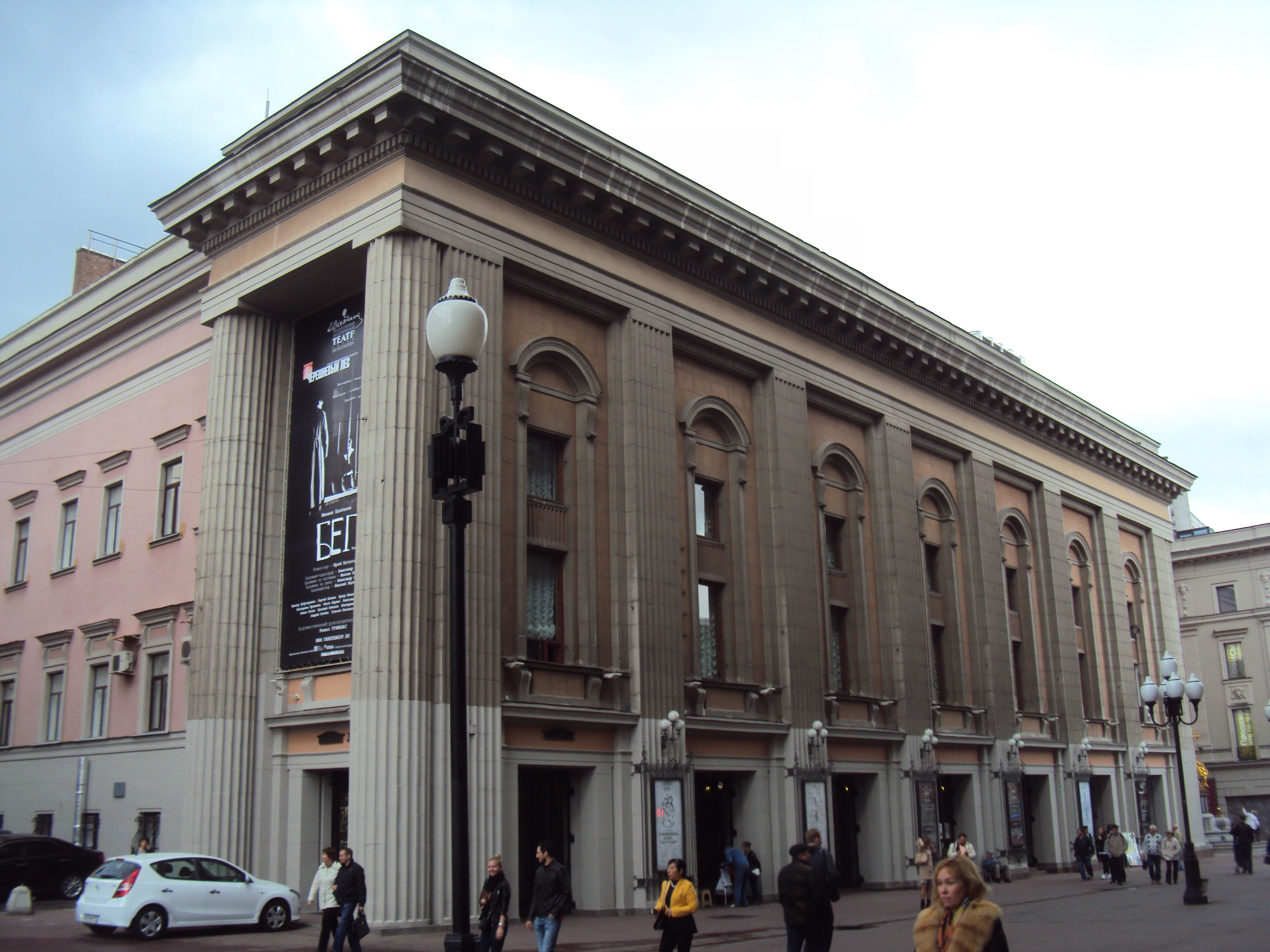
Vakhtangov State Academic Theatre of Russia, Barbican Theatre, 1st March 2018
OK. Sometimes you just have to accept that an artistic endeavour is a bit beyond your reach. For whatever reason it just doesn’t click. That is what happened here with Smile Upon Us, Lord. There was much to enjoy visually, there was the bones of an interesting story and there was the rare opportunity to see some of Russia’s finest stage actors perform. But there just wasn’t enough there for me to really engage with so ultimately I was unmoved. Not indifferent. Just unable to fully grasp what I was being shown. No matter.
Turning up to productions at the Barbican performed by renowned theatre companies from around the world, the Netherlands (Toneelgroep Amsterdam), Australia (Malthouse), Germany (Schaubhne Berlin), Japan (Ninagawa), has proved a profitable strategy recently. The Vaktangov State Academic Theatre of Russia was hugely acclaimed last time they popped over to perform an adaption of Pushkin’s Eugene Onegin and, prior to that, an unconstrained Uncle Vanya. Well maybe not popped over given the huge ensemble and tons of kit that comes with them. Anyway I missed both of these because a) I am an idiot and b) it all sounded a bit intimidating. Armed with greater knowledge, more time and a new-found enthusiasm for all things theatrical I wasn’t about to make the same mistake twice/thrice. The house was packed with a welcome contingent of Russian speakers, Russophiles and students of Russian culture, and, maybe, expat Lithuanians as well.
For, as it happens SUUL is actually based on two novels, A Kid for Two Farthings and Smile to Us, O Lord by the pre-eminent Lithuanian writer Grigory Yaakov Kanovich. He was born into a traditional Jewish family in Lithuania. escaped with his parents in WWII seeking refuge in Kazakhstan then Russia, before returning to Vilnius. He has written more than ten novels which document the history of Jewry in Eastern Europe from the C19 through to the present day., as well as stage works and screenplays. He has been awarded numerous prizes, medals and prestigious awards in Lithuania and he now lives in Israel.
Now it transpires the Artistic Director of VSATR is also Lithuanian, Rimas Tuminas. The germination of SULL began in the 1990s with a plan to shoot a film. Presumably the theatrical potential was recognised as certain of the story lines were drawn out and as Mr Tuminas and his creative team worked with his Russian cast to create what we now see. The story starts in a shtetl, “small town” in Yiddish, a part urban, part rural Jewish community which was largely wiped out by the Holocaust. Efraim Dudak, an irascible stone-cutter played by Sergey Makovetskiy on the night I saw it, receives a letter informing his son is to be tried and potentially executed for an attempted political assassination in Vilnius. He resolves to go to see him leaving behind his beloved she-goat played by Yulia Rutberg (yep, that’s right, she played the goat like a slow-waltzing Miss Havisham). He is joined by water-carrier Smule-Sender Lazarek, (Evgeny Knyazev), and eccentric depressive Avner Rosenthal, played by Viktor Sukhorukov, (the pick of the seasoned cast), who has been reduced to penury after his shop burned down. The journey is hazardous, there are wolves, bandits and soldiers, and unpredictable and they meet a fair few rum characters along the way, including a “blind” con-man (Victor Dobronrarov) and an enigmatic “Palestinian” Grigory Antipenko
A kind of jaunty Beckettian road-trip if you will. Without maintained roads, and just a horse and cart, conjured up in a hugely imaginative way by designer Adomas Jacovskis. Now early C20 Jewish life in Lithuania is, it will come as no surprise, a world that is unfamiliar to me, and it was intriguing to see this conjured up on stage. This was overlain with a lyrical, poetic story with much philosophical musing from our heroes. There is humour tinged with despair, magic and banality. It is meandering, discursive and there is not much in the way of plot. Some of this connects, some of it, frankly, does not, there may well have been allusions that went right over my head, but there is just about enough impetus to keep the whole thing trundling on, much like the cart.
Am I glad I saw it? I think so. Would I see it again? I’m not sure. Did I really understand it? No. Is it worth getting wound up about it? Certainly not. Life is too short for low-level regret.
The last instalment, for me, of the Rome season at the Barbican, and so late in the run that it has been and gone. Sorry. Anyway I have to say this was my least favourite of the four productions, though there was still much food for thought.
I think the reason for this is simple. I prefer the other three plays. Titus Andronicus for its over the top, knowing black comedy, Coriolanus for its astonishing insight into pride, the democratic ideal, the mother-son relationship and homo-eroticism and Julius Caesar for, well, everything you will ever need to know about the use and abuse of political power.
The language in these three is flintier, more muscular, more direct. The drama is played out across a broader backdrop even if this is still measured across individual psychology and the relationships between friends, enemies and family. In A&C the language is way more florid, despite the similar source material as JC (Plutarch via Thomas North), and the focus is firmly on the mature lovers. High Baroque not Early Renaissance if you will.
There is a curious ironic, detached quality to our observation of A&C. I am not saying I identify with unhinged sadist and novelty pie maker Titus A, by way of example, but I can sort of see where he is coming from. Elsewhere in Shakespeare the thrill of recognition is never exhausted, no matter how many viewings, but with A&C I can’t escape the performance, the spectacle. That may well be the whole point. There are times where the pompous grandiosity of these two entitled mid-lifers sets me spluttering, internally and, embarrassingly, externally. Certainly Will S has the right words and right scenes to skewer them. But all the poetry and “look at me” gets a smidge wearying. I know that complaining that Shakespeare sometimes has too many words is like saying Mozart has too many notes but the platitude applies.
Of course it could just be that I haven’t come across the right A&C yet. I see the NT is set to stage a production with Simon Godwin at the helm, (who sucked all the meat off the bones of Twelfth Night and Man and Superman at the NT), with Ralph Fiennes and Sophie Okonedo. If those two get fired up sparks can fly. Let’s hope so.
Designer Robert Innes Hopkins here chooses to go with a look straight out of Cecil B DeMille. Josette Simon as Cleo has more frock changes than I have underpants, including, at one point, sporting her birthday suit. Costume supervisor Sian Harris, and all the unsung heroes who cut and stitch, must have thought Christmas came early, just in greaves alone (google it). There is a big black cat. natch, and I hear Southall high street is now short of kohl. There are even some steamy Roman baths and an impromptu harbourside bar on display. I bet they only ruled out the incense sticks at the first rehearsal. Mind you I get it is tricky to take A&C out of its historical context.
Ms Simon captures Cleo’s unpredictability, grace and caprice but maybe not the extremes of cruelty and vulnerability. Some of her vocal delivery, to use football commentator parlance, “takes the wrong option”. She does have stage presence though, even when brooding on the sidelines. Workaholic Antony Byrne, who knows his way about the Shakespearean stage, has a cursive way of delivering lines and character and a grizzled, martial look about him. Yet, at times, he felt a bit mechanical and MA’s intense fear of shame was not fully realised.
I was never entirely persuaded of the couple’s passion or plotting. There was none of the seemingly spontaneous physicality that Hans Kesting and Chris Nietvelt brought to the parts in the TA Roman Tragedies. That really stank of sex, with Marieke Heebink’s Charmian the …. well I better stop there as I am getting hot and bothered. Alexandria never looked so decadent, and the cropping of action and lines, as well as the translation process, seemed to help me overcome my objections to the play.
I am not sure if Ben Allen’s Octavius here was intended to be quite so limp, and the contrast with David Burnett’s roister-doister Pompey, quite so sharp. Andrew Woodall swapped Caesar for Enobarbus, taking world-weary to a previously untested level. When it comes to ironic commentary on what is going on around him, Enorbarbus has some of the best lines in the play and these were delivered with relish by Mr Woodall, though he does have an uncanny resemblance to my brother-in-law. I am much taken with James Corrigan here playing Agrippa as upright conciliator. Amber James as Charmain and Kristin Atherton as Iras provide sterling support as ego-masseurs-in-waiting to Queen Cleo.
Director Iqbal Khan offers a straightforward account of the play, in line with the staging, and somewhat of a contrast to his previous Shakespeare, where he has mixed it up a bit. That means that each line is pretty clear but the overall rhythm a little baggier than Angus Jackson’s Julius Caesar. There comes a point in many a Shakespeare history play, when the to-ing and fro-ing between locations, and the long line of messengers bearing news, can distract. A&C, nominally a tragedy, can fall into the trap. If your head is filled with contemplation of motive or poetry you won’t see the joins. Here, once or twice, I did.
So there you have it. It seems I was far more taken with Angus Jackson’s Coriolanus and Julius Caesar in this season than consensus, reckon Blanche McIntyre fully got to grips with the uncertain tone of Titus Andronicus and agreed with most that this Antony and Cleopatra was more stately than seductive.







 At Home He Feels Like A Tourist