Glass and Reich: LSO at the Barbican review ***

Divine Geometry: London Symphony Orchestra, Kristjan Jarvi, Simone Dinnerstein (piano)

Barbican Hall, 29th November 2018

  • Charles Coleman – Drenched
  • Charles Coleman – Bach Inspired
  • Philip Glass – Piano Concerto No 3
  • Kristjan Jarvi – Too Hot to Handel
  • Steve Reich – Music for Ensemble and Orchestra

Funny one this. As part of our project to embrace the classics of minimalism the Tourist, MSBD and MSBDB schlepped off to the Barbican. Primarily to hear the new(wish) Reich piece in its UK premiere, and to catch up with the Glass, similarly making its UK debut. Didn’t really have a Scooby about the other pieces I am afraid.

Now somewhere in Estonia, (actually it relocated to the US) there is a factory which produces conductors. It is family owned and goes by the name of Jarvi and Sons, (in Estonian obvs). For Kristjan, along with older brother Paavo, is son to the veteran, and oft recorded, conductor Neeme. Sister Maarika plays the flute though I have no doubt she too is a dab hand with a baton.

Anyway young Kristjan, who has the gig as the AD of the Baltic Sea Philharmonic which he founded, sees himself as a bit of a musical chameleon and genre-buster. Having got his hands on the LSO again he wasn’t about to waste the opportunity to showcase one of his own works, Too Hot To Handel, nor a couple from his mate Charles Coleman. Drenched takes Handel’s Water Music as its starting point, and Bach Inspired, er, a string-only snatch from the Mighty One’s Well-Tempered Clavier and his “Nun common Der Heiden Helland” chorale, plus a couple of his own movements. Too Hot …. you can work out for yourself. Suffice to say it has pretty much undigested chunks of GF’s Concerto grossi mashed up with KJ’s own Stravinskian, post-minimalism, as well as a lot of running around for the LSO’s three percussionists, Neil Percy, Sam Walton and Jake Brown, and a starring role for Chris Hill on bass guitar (I kid you not).

Worshipping at the altar of the Baroque Gods and drawing the parallels with the Minimalists is self evidently “a good idea” but always better done with the C17 and C18 originals. These pastiches, whilst certainly not dull, and played with gusto by the LSO, ended up as classic classical “classic rock” if you get my drift. Not quite Smashie and Nicey, but skirting awfully close. The Coleman pieces, especially Bach Inspired had a bit more heterogenous invention, and wit, about them but even so it was all a bit weird to be honest. At near 40 minutes and over 13 movements, Jarvi’s own work I am afraid outstayed its welcome, was shown the door but still came back again.

As for the main events, well the Piano Concerto No 3 was a little too close to the pleasant warm waves of swirling arpeggios that Philip Glass can presumably churn out in his sleep and the Steve Reich piece was, guess what, just amazing.

The Concerto was written for this evening’s soloist Simone Dinnerstein and premiered in Boston in 2017. Glass, now 81, has moved a long way from the “hard-core” rhythmic minimalism (“repetitive processes” in his argot) of the 1960s and 1970s. His music now is much more melodic, chromatic, even romantic. When he composes for piano, as with the three concertos, the lovely Etudes and Metamorphosis and the film music transcriptions, he is a right old softie and gets all emotional. It can be moving and occasionally stirring stuff but it is mostly like being immersed in a nice warm metaphorical bath with Brahms and Rachmaninov.

You could be forgiven for thinking popular art-house film soundtracks, which have been, after all, a fair contributor to the old boy’s estate in the last few decades. And one of the reasons, perhaps along with his generosity in collaboration, why his music has been so influential. In fact it is pretty difficult to think of another composer of music in the second half of the C20, and into this millennium, his musical ideas have been quite so pervasive. It will be interesting to see whether Glass’s legacy, like much of post-modernist culture, survives. Whilst love for Schubert, another compositional production line, who I suspect Glass would most liked to be identified with, has pretty much continued to increase year in, year out since his early death, other comparable piece-work composers from the Baroque itself, Bach say, or Vivaldi, spent hundreds of years being ignored. Mind you in the age of digital junk it will be hard to forgot anything ever.

Yet amidst all the familiarity Glass is still capable of surprises and here it comes in the final movement, which is simplicity itself, being a homage of sorts to Arvo Part, he of the “holy minimalism”, with a simple, chiming melody over a bass drone. The introspective concerto, which is essentially three slow to medium paced movements, begins with soft oscillating chords against a processional base-line, which drifts in and out of the similarly paced orchestra. Crotchets become quavers then triplets, rising to a swell and then subsiding. The second chaconne-ish movement is all repeated arpeggios which ends with the unflashiest of cadenzas.

As its dedicatee, and given she is an acknowledged interpreter of Glass’s music, Ms Dinnerstein, who is what you might call a “self-made” performer, more in line with the You Tube pop generation, was unsurprisingly accomplished in her playing, technique, emotion and understanding all present and correct, and if it didn’t wow then that is more the fault of the music than her or the LSO strings. She encored with a Glass Etude. I would have liked more of those.

In less than a month’s time Philip Glass’s 12th Symphony will be premiered in LA under the baton of fellow “minimalist” grandee John Adams. You can’t fault his work ethic.

Music for Ensemble and Orchestra, premiered earlier this year in NYC, is Steve Reich’s first large scale orchestral work for 30 years, following The Four Sections in 1987. Reich is of course as much performer as composer and his ostensible reason for avoiding the orchestra genre was that performers were not really up to the task. Fair enough, but, as he admits, that is no longer true as there are now orchestral players, notably percussionists, but also specialists in the other sections, as well as the latest generation of conductors, who are more than up to the task, and who love and relish the challenge of creating his stunning sound-world. Mr Reich is a year older than his peer Mr Glass but they are chalk and cheese when it comes to productivity, as well as, despite the “minimalist” label, musical style.

SR can go a couple of years without a new piece. This is is no way a criticism for when they do arrive his compositions continue to be works of staggering genius. This, of course, assumes you are predisposed to his marrying of pulse, rhythm and process. Here he has contrasted an “ensemble”, lead strings, principal woodwinds, tuned pianos, vibraphones and keyboards, with an “orchestra” which adds a full string section and brass, in the form of four trumpets, to that ensemble.

The work is made up of five sections/movements, in typical Reich style simply numbered 1 to 5, which together form a Bartokian arch. the tempo is fixed across the sections but the speed varies according to note value: 16ths, 8ths, quarters, then 8ths and 16ths again. The key similarly changes across the movements, a minor third each time, from A to C to E flat to F sharp and back to A. All this remains moreorless gobbledygook to the Tourist but I reckon, as and when a recording appears, the structure that can be felt on first listening, will be understood by this musical dummy after repeated exposure. That is the big picture: second by second though it is the magical intricacy of melodic fragments repeated, echoed, chased and overlapped by different paired members of the ensemble with the rhythmic backbone provided by the rest of the orchestra. A Concerto grossi to match Handel though maybe not quite the Daddy of the form, Corelli.

Mr Jarvi, who likes a lively workout on the rostrum, seemed to have the measure of the piece, though I wouldn’t mind hearing the LSO take it on again under, say, their Conductor the Laureate Michael Tilson Thomas. He is, after all, the expert on great American music of the C20 and there was, I’ll warrant, a Coplandian/Ivesian twinkle in some of Reich’s invention. I see he will be premiering it in San Francisco next year as it revolves around the remaining or the six orchestras that co-commissioned it.

Ligeti, Bartok and Haydn choral works at the Barbican review ****

London Symphony Orchestra, London Symphony Chorus, Francois-Xavier Roth (conductor), Camilla Tilling, Adele Charvet, Julien Behr, Christopher Purves, William Thomas

Barbican Hall, 11th November 2018

  • Gyorgy Ligeti – Lontano
  • Bela Bartok – Cantata profana
  • Haydn – Nelson Mass

Three composers I like. Three works I did not know. A slightly earlier start. A fine end to a fine day.

When I say I don’t know Liget’s Lontano that isn’t strictly true. In fact, even if you are a Ligeti virgin, there is a fair chance you have heard Lontano. For this is the music famously used to signify Jack Nicholson’s descent into full-on barking psychomania in The Shining film. Lontano, along with Atmospheres, is therefore still probably Ligeti’s most famous work, even though, in the five decades that followed their composition, GL went on to explore many other styles and musical ideas. 

Lontano, in Italian, means “far away” or “distant” as a performance instruction which about sums it up. For this is as “other worldly” as it gets, from a composer synonymous with the term. It is built up from layers of very quiet sound, initially cellos and flutes, from the smallish orchestra. These lines move in different tempos and to different rhythms but they combine, legato, to create Ligeti’s trademark micropolyphony. The crystallisation of these sounds brings out sustained, but shifting, harmonies that are very different from traditional or atonal composition but the overall effect is ravishing. And something for which horror and sci-fi film composers ever since should be eternally grateful. It is eerie, mysterious but utterly compelling. Take the bit where the high violins, barely audible, pulse against the throb of the low brass and wind. Given the score doesn’t really offer any metre as such Francois-Xavier Roth could only really prompt the orchestra. No matter. All the LSO had to do was trust Ligeti’s ear and F-XR’s experience with the piece. How GL knew all of his innovations, not just in these micropolyphonic pieces, would work is an utter mystery to me. Genius.

It was performed by the National Youth Orchestra at this years Proms so its a fairly frequent concert hall visitor. Don’t let it pass you by. 

Bartok’s Cantata profana, which was published in 1930, rarely gets an outing. Lasting only 20 minutes yet still requiring a full chorus and orchestra as well as a bass, (here William Thomas standing in for the indisposed Matthew Rose), and a very challenging high tenor part which pushed Julien Behr close to his limit. It is based on a slightly creepy, coming of age, folk ballad about nine brothers who go out hunting, turn into stags, (which I hope is a rare occurrence even in Transylvania), and then refuse to come home when Father asks them. Heady stuff which Bartok pitches somewhere between his more overtly derived folk driven orchestration and the lusher sound-world of his earlier stage works. The LS Chorus seemed entirely at home with the tricky Hungarian idiom of the text and the awkward contrapuntal textures of Bartok’s score, which divides into 8 parts in the second of the three movements..

That’s the thing with Bartok. It normally takes a few listens for me to get the gist of his music. Like Prokofiev I know there is something there worth working on but it doesn’t always reel me in immediately. I can’t always grasp the line and architecture of the whole work but the rhythms and melodies individually are often arresting. I have more work to do on the popular orchestral pieces, am close to cracking the string quartets, think the solo piano collections are fascinating and would love to see Duke Bluebeard’s Castle. The piano concertos and the rest of his chamber music are bit of mystery. Whether Cantata profana on this listening will be added to the to do list is a moot point. 

As an aside if you want a quick burst of Romanian folk filtered through an orchestral lens, look no further than the Concert Romanesc. By none other than Ligeti. A perfect pastiche of a C19 nationalist Romantic tribute. It is really hard to believe this is the same composer as Lontano. 

Not knowing the Nelson Mass, as with any Haydn piece, is no handicap. It’s a mass, sung in Latin, so that’s the text nailed down, it is a relatively small orchestra, (just 4 double basses in the strings, trumpets, timpani and a small pipe-organ here played by Bernard Robertson), and, as usual, Papa keeps his textures homophonic and easy to follow. The Gloria ends with a mighty fugue and the Credo kicks off with an extended canon. What’s not to like? That is not to say it isn’t without drama, the LS Chorus letting fly in the Kyrie and Gloria. Julien Behr was persuasive, as was replacement bass, the ever excellent Christopher Purves. Mozart specialist Camilla Tilling’s soprano lost a little of its silky subtlety though newcomer Adele Charvet’s mezzo more than held its own. Even so there might have been a case for reigning in the 130 strong Chorus a little to offer a little light and shade. 

The Nelson Mass is the third of six that Haydn composed between 1796 and 1802, appearing just after The Creation in 1798. He titled it Missa in Angustiis, “Mass in difficult circumstances”, a reference to Napoleon’s march across Europe. There is a martial quality about some of the music, in the Kyrie and Benedictus for example, but, as usual Haydn can’t suppress his jolly nature throughout. As it happens a few days before its first performance Admiral Nelson (there he is above) secured a famous victory against the French fleet at Aboukir. A couple of years later Nelson went to visit the Esterhazy court and this was performed for him; hence the nickname. 

The Silver Tassie at the Barbican review *****

The Silver Tassie

Barbican Hall, 10th November 2018

  • Mark-Anthony Turnage (composer)
  • Amanda Holden (libretto)
  • Ashley Riches – Harry
  • Sally Matthews – Susie
  • Brindley Sherratt – The Croucher
  • Claire Booth – Mrs Foran
  • Marcus Farnsworth – Teddy
  • Alexander Robin Baker – Barney
  • Louise Alder – Jessie
  • Susan Bickley – Mrs Heegan
  • Mark le Brocq – Sylvester
  • Anthony Gregory – Dr Maxwell/Staff Officer
  • Andre Rupp – Corporal
  • Finchley Children’s Music Group
  • BBC Singers
  • BBC Symphony Orchestra
  • Ryan Wrigglesworth – conductor
  • Kenneth Richardson – stage director

B*gger. B*gger. B*gger. B*gger. B*gger. I never saw Mark-Anthony Turnage’s second full scale opera when it was first performed in early 2000 at the ENO. On the basis of this semi-staged performance from the BBCSO as part of the In Remembrance weekend this was a terrible omission on my part for it is an extraordinary work both musically, and, given the strength of Amanda Holden’s libretto, dramatically. It is intensely powerful and moving even without a full set and staging. It beggars belief that it has not been revived since 2002, (and that it missed out on a run in Dallas thanks to political sensitivities). 

It is constructed as a symphony in four acts, Home, War, Hospital and Dance. Harry Heegan is about to return to the family flat after a football match with his best mate Barney and girlfriend Jessie. Mum and Dad are intensely proud of their son who is about to head off to the war. Next door neighbour Susie joins the party, banging on about God. Mrs Foran from upstairs also turns up escaping abusive husband Teddy. The Silver Tassie, a cup with much significance appears, the men go to war full of optimism. The War act is primarily choral preceded by the mythic Croucher, representing, I think, the war dead and intoning Old Testament-ish doom. An officer complains at the doctors in the Red Cross station. A football game is delayed as the battle begins. The story then switches to the Hospital where an angry Harry is now paralysed, Teddy blinded and Jessie, who refuses to see Harry, is now coupled up with Barney, who saved Harry’s life. The final act sees Harry and Teddy spit out their pain and bitterness at those who still have their futures at the communal dance. 

The opera is based on Sean O’Casey’s eponymous plan and it is therefore we who have to thank for the gripping drama. Whilst it is never made explicit, O’Casey intended that the Heegan family, and the rest of the community, should hail from the East Wall, a working class district of Dublin, adding further pungency to the message of the play (and opera) because, at that time, Ireland was still part of the UK and the republican movement was divided on whether the country should be involved in the war. So as some young men like Harry, Barney and Teddy headed off to war others prepared for insurrection at home. 

O’Casey’s play was rejected by WB Yeats, then head honcho at the Abbey Theatre in Dublin, when it was submitted in 1928, reflecting its political sensitivity. This was after the success of his first three major plays, The Shadow of a Gunman, Juno and the Paycock and The Plough and the Stars. So it premiered at the Apollo in London’s West End. There have been a fair few plays which rail at the futility of war and its consequences on the individuals who fight in it, but I doubt many match the raw power of The Silver Tassie. 

So Amanda Holden, (to be clear not the airhead judge on BGT), and M-AT had something monumental to work with. Even so, and in no way intending to downplay Ms Holden’s contribution which provides M-AT with multiple opportunities to show off his trademark stylistic jagged juxtapositions, it is the score that takes the breath away. M-AT had already shown his dramatic flair in his first opera Greek, and his compositional skill with orchestral pieces such as Three Screaming Popes, Momentum, Drowned Out, Dispelling the Fears and Silent Cities, especially when it came to percussion and brass, but The Silver Tassie is on another level.

The symphonic structure is inspired by mentor Hans Werner Henze’s The Bassarids, with the first act setting out the main ideas and themes, the second the Adagio slow movement, brought to life by the large scale choral scenes (echoing the more Expressionist feel of the act in SO’C’s play), the third a Scherzo and the last act a “dance” finale with “off stage” band. This structure offers rhythmic backbone and plenty of tunes derived from song, (including Robert Burns’s own Silver Tassie), and dance, as well as repeated motifs, which make it easy to follow and show off MA-T’s uncanny ability to capture the emotional interior of the characters. There are episodes of rich orchestral colour but there are also plenty of more economic orchestration.  The score should give the singers plenty of space, but just to make sure the cast were miked, (though M-AT, a couple of rows in front of me, needed to dash up to the sound desk to get the balance right early on).  The second and fourth acts are up there with the best I have ever heard on an opera stage. Even allowing for the fact that this wasn’t an opera stage. 

Sometimes this semi-staging lark can leave singers looking a little awkward unsure of how much to commit to performance versus voice. Costuming can also, sometimes, appear incongruous. Not here though, at east once the first act go going. There were some outstanding vocal performances, notably for me from Sally Matthews and Claire Booth, and Marcus Farnsworth as Teddy was very persuasive. But baritone Ashley Riches as Harry, even from my two perches (side stalls first half, back of circle second), was bloody marvellous not just in his singing but also in the way, pre and post wheelchair, he projected Harry’s exuberance and then his pain into the whole auditorium. 

Now I have nothing to compare it to but, given just how amazing this was, I have to assume that Ryan Wrigglesworth and the BBCSO, and the BBC Singers and Finchley Children’s Music Group (complete with ensemble writhing) got as close as possible to the heart of the music. 

You can listen to it for a couple more weeks on BBC Radio Opera on 3. Do yourself a favour and do so. 

And can I beg the ENO to find a way and time to revive this. With Mr Wrigglesworth on the podium. I will chip in a few quid if it helps. 

LSO at the Barbican: Kodaly, McMillan and Shostakovich review ***

peter_moore_28musician29

London Symphony Orchestra, Gianandrea Noseda (conductor), Peter Moore (trombone)

Barbican Hall, 1st November 2018

  • Zoltan Kodaly – Dances of Galanta
  • James MacMillan – Trombone Concerto
  • Dmitry Shostakovitch – Symphony No 4

Now it might be the fact that I was a bit poorly for this performance that accounts for this lukewarm response. No need for any of you to worry. I am in fine fettle now but whatever bug it was prevented me from seeing the evening devoted to the electronic and chamber work of Iannis Xenakis at Kings Place a couple of days later, which was REALLY BLOODY ANNOYING since I am much taken with the composer and the performers, (London Sinfonietta with cellist Tim Gill who was in the hot seat for solo piece Kottos and Phlegra for 11 musicians). There is nothing quite like the sound world of Xenakis. Give him a whirl. YOLO.

Anyway back to the LSO gig. Now LSO guest conductor Gianandrea Noseda, who is recording a symphony cycle wth the LSO of which this evening will be a part, has a way with Shostakovich, witness his fine account of the Eighth earlier in the year (Beethoven and Shostakovich from the LSO at the Barbican review ****). At least I thought he did. This Fourth was quite a bit less convincing. Not up there with the interpretation of Vladimir Ashkenazy and the Philharmonia also earlier this year (Shostakovich from the Philharmonia and Ashkenazy review ****).

The Fourth is a tricky customer. In complete contrast to the more conformist, (though still painful howl of protest), that is the Fifth, this symphony has DSCH still messing around with his avant-garde roots. That is not to say that it isn’t recognisably his voice, just that it is a long way away from the inventive Stravinskian juvenalia of the First and the awful, garish, empty patriotic posturing of the Second and Third. The Fourth is chock full of brilliant, if eccentric, ideas but isn’t too bothered with the usual rules of symphonic structure. It was written in 1936, when he was 30, the year DSCH got his telling off from Stalin. It was rehearsed but then withdrawn to be finally premiered in 1961 when Stalin and Zhdanov were safely in their graves. It has two massive movements embracing a scherzo, a giant 100 plus orchestra, lots of distorted songs and dances, excesses of aggression and pathos. Mahler removed from the mountains and marched at gun-point into the factory.

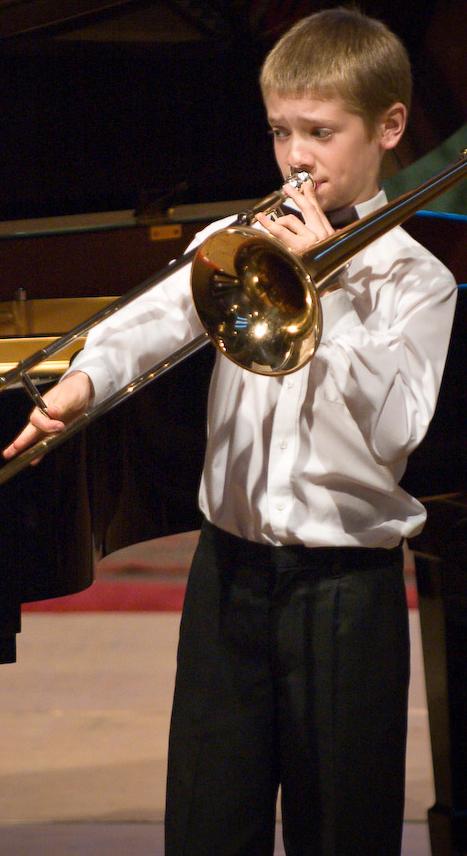
It is very tricky for conductor and composer to knit all of the twist and turns, (and musical cul-de-sacs, of which there are many), together and Mr Noseda didn’t quite find his compass on this evening. This, together with my man-flu, meant I drifted in and out a bit through the 70 minutes of performance, despite the volume. Not so with James MacMillan’s Trombone Concerto. This is the first time I have heard any of his music. surprising given that he is a favourite commissionee with British orchestras. This was the UK premiere of this work with Peter Moore, the Co-Principal trombone in the LSO, as the soloist. Now young Mr Moore, just 22, is something of a prodigy, haven’t taken his chair at just 18. His breakthrough came when he won the BBC Young Musician competition aged just 12, and in a few short years he has become a renowned soloist and is a visiting prof at the RCM. There he is above, winning the BBC contest. Awwh sweet.

Now I am no expert on the trombone, (or on any instrument come to think of it), but I have ears so can tell you that Mr Moore knows what he is about trombone-wise. Wind soloists are generally remarkable people as their technical prowess and control reveals just what their instruments are capable of playing. Mr MacMillan’s concerto is a single movement work which alternates between frenetic activity and “ghostly” passages drawn from the seven note theme which is set out at the start. The soloist’s line is set against this through the slower first passage and again, in bursts, as the pace hots up. A “waltz” of sorts follows, then a rush forward punctuated by the three orchestral trombones joining Mr Moore in a blast alongside, of all things, a siren. There might have been a wind machine as well. A slower, more lyrical swell follows then a kind of mad gigue before a jam from the four trombones again.

As ever, all you can do on hearing a piece of contemporary classical music for the first time is see if it grabs you, and this most certainly did. Maybe it was the novelty of hearing what was possible with a trombone, though Daddy Mozart and Brother Haydn, alongside Berio, Xenakis, Turnage and, of course, Christian Lindberg, have all shown me this in other works, or maybe it was just Peter Moore’s amazing skill, but I do think there was enough here to mean I should look into Mr MacMillan’s back, and in future, front catalogue.

The other piece on the menu was Kodaly’s Dances Of Galanta, a kind of augmented string suite, written in 1933 and based on Hungarian dance tunes. It has its fans I gather but I can now say I am not one of them. Having not really connected with Kodaly’s string quartets I think I can safely say that he is not for me even as his mate, Bela Bartok, especially in his 6 string quartets, most certainly is.


BBC Symphony Orchestra at the Barbican review ****

20150227_150301ae-spco_frost

BBC Symphony Orchestra, Sakari Oramo (conductor), Martin Frost (clarinet)

Barbican Hall, 17th October 2017

  • Dmitry Shostakovich – Symphony No 9 in E flat major Op 70
  • Aaron Copland – Clarinet Concerto
  • Sergei Prokofiev – Symphony No 6 in E flat major Op 111

Vikings, stave churches, Celsius, Bohr, Angstrom, Ibsen, Strindberg, Laxness, Kierkegard, Nielsen, Sibelius, Greig, Munch, Balke, Olafur Eliasson, ABBA, Bjork, Bergman (x2), Lars von Trier, Ullman, Sofia Helin, Mads Mikklesen, Kim Bodnia, the laconic Kimi, Schmeichel (P), Salonen (EP), Lego, IKEA, SAAB, zips, mobile phones, seat belts, loudspeakers, Alvar Aalto, Arne Jacobsen, art glass, Georg Jensen, BIG, arket, meatballs, herring, saunas, Gamla Stam, Djurgarden, Tivoli, that Bridge, Roskilde Cathedral, Uppsala Cathedral, Copenhagen Opera House, Temppeliaukio Church. There’s a few of my favourite Scandi  people and things. And that’s before anything from the natural world. And doesn’t include those Scandinavians I would count as friends. There are good reasons why Scandis are generally pretty pleased with themselves, though not in a wanky kind of way. They have much to be pleased about.

Anyway it turns out that there is an organisation for promoting the Scandinavian countries and their culture. CoScan. The Confederation of Scandinavian Societies. And every year since 1994 it has given an award to recognise the contribution of an individual. body or group on the international stage. Previous winners have included Sandi Toksvig, Magnus Carlsen (the best chess player in the world), Hans Blix, The Nordic Optical Telescope, that Bridge and Mika Hakkinen. This year was the turn of Finn Sakari Oramo, the Finnish Conductor of (amongst others) the BBC Symphony Orchestra. Presented on this very evening. Good on you Sakari. He seems like a thoroughly decent bloke and we here should be eternally grateful for the musical contribution he has made, especially to the Proms (five this year alone). He is a whizz across much of the Scandi composer repertoire, but especially Carl Nielsen, whose symphonies and, especially string quartets, don’t get enough of an airing IMHO.

in this programme he also wheeled out three works that should be performed more often. DSCH’s 9th may not be down there with the weird and whacky modernism of Nos 2 and 3 and the overly patriotic, fim-scorish 12th, but it does get neglected. Copland’s jazzy Clarinet Concerto is one of his favourites and was written for Benny Goodman but is pretty tricky so needs a top-notch soloist to do it justice. And Prokofiev’s 6th Symphony is rated by enthusiasts of his work but it is 1 and 5 that get trotted out most often.

So this seemed to me to be well-worth the effort. Which it certainly was. All three works come from the immediate post WWII era, and a scary time personally for DS and SP, but they are far from completely gloomy, at least in places.

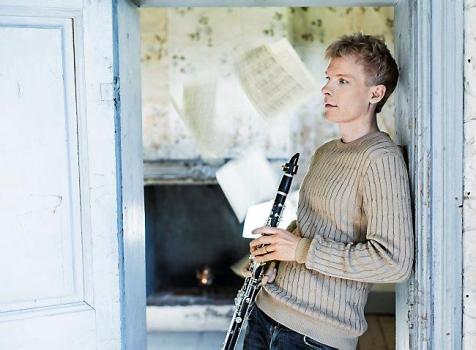
Copland’s concerto is genuinely untroubled, and was premiered by Goodman in 1950. The slower opening drops straight out of Copland’s Americana, specifically Appalachian Spring, kicking off with low strings and harps, against which the clarinet meanders, with the violins then following. Just like the sad scene when the love interest dies in a Western. It then jumps into what seems to me to be a fiendishly tricky cadenza, fully written out, which Martin Frost, doing that curious Pied Piper jig that woodwind soloists seem to adore, made look simples. Of course maybe it is. What would I know. I got booted out of recorder practice at school on the grounds of persistent ineptitude. It ends with a fortissimo scale from one end of the clarinet range to the other. Amazing. Straight into the faster, final section, with all sorts of string effects like a sort of mega Bartok quartet. More showing off from Mr Frost with a jazz jam to finish. He encored with a klezmer arrangement from his brother Goran which near brought the house down. There he is above looking suitably impish. Frost is a good name for him.

DSCH initially promised a big splash for his Ninth, with soloists and chorus, just like you no who. Shostakovich being Shostakovich though what he actually served up was a five movement, small scale (by his terms) joke, which barely gets over the finish line. Obviously he has form with odd, almost embarrassingly jejune structures, and musical satire, as much as he could get away with, witness the Sixth, but here we have what I read as an entire flippant f*ck you across a whole symphony. Maybe not just to his political masters but also to the music world in general. Everything he is routinely accused of is there but recast in a sort of Haydn-esque jollity. Scurrying strings, whistling woodwind, boy soldier drums, farting brass fanfares, an abrupt “I’ve done enough” concluding chord. And that’s just the first movement. The second movement is one of those desolate stalking Moderatos but never plumbs the depths and the screaming strings never come. The scherzo lollops along but with no repeat slows into the regulation Largo with doomy fanfare and bassoon lament which as always for me at least conjures up the battlefield dead. But again it is on a tiny scale. This is the sort of movement DSCH can crank up to 20 minutes plus. This is all over in four. The symphony ends with a quick movement which kicks of with a folksy little lick which builds up and eventually dashes over the line to the close. The whole thing is like some child’s Toy-town version of a DSCH symphony. Oramo and the BBCSO, correctly, didn’t attempt to make a case for profundity, taking it straight. I loved it.

Once again I found myself being really taken with a major Prokofiev piece that I had dismissed previously. It is the most symphonic of his symphonies, the most expansive and the most, dare I say Shostakovich-ian. It does occasionally start to go a little too C19 Romantic on your ass but there are enough of the trademark SP lurches and new twists to forestall tedium. So, like DCSH, got himself into a lot of bother with Stalin’s “realist” henchman by being a sarky, modernist clever clogs. The difference is SP actually came back to Russia to face this, er, critical music. He liked to satisfy his customer but the iconoclast in him could never be entirely suppressed. The Sixth, as a commemoration for the war dead was initially OK’d by the authorities but then, in 1948, censured.

The first movement kicks off with a couple of lazy themes led by strings then oboes before snapping into gear with a third, more forthright chanting theme, set against a tick-tock rhythm, which revives the first theme and sets up a massive tutti climax. A mixture of Mahler, Shostakovich and Saint Saens, it collapses into horn squeals, then all three themes are reprised. As usual with SP it lurches around a bit but has some great colours and sounds. It can probably turn into a bit of a grandiloquent mess in the wrong hands but I reckon Mr Oramo, by cracking on, get it about right.

The second movement Largo starts off with a series of big, chromatic gestures, but with some swinging brass, a bit like Wagner loosened up and had a nice long toke. Then we move into a kind of dreamy, lyrical reminiscence, all Hollywood love story, which breaks back into the tick-tock march of the second theme, before the first is reprised, in size. Overall this movement is genuinely unsettling.

As, in some ways, is the final movement marked Vivace, but only because it kicks off in perky neo-Classical vein. Though the bass line is anything but gallant, thumping away angrily, and backed up with percussive piano. The second idea is another jolly scamp led by woodwind, then rising strings, but this time with the tuba doing its best to create havoc. Gradually the dance starts going off-kilter, the fun peters out, and nasty stuff jumps out. The chant from the first movement returns now over the percussive thuds and deep brass fanfares. A major triad to conclude. Happy and triumphant it ain’t.

Very convincing. I have subsequently revisited the work listening to a couple of Russian orchestra performances. It wasn’t just Sakari Oramo and the BBCSO who nailed this. It really is a terrific piece of music. I think I am properly converted to SP’s world. That’s the thing with “high” art. You just need to put the hours in.


Britten’s Spring Symphony from the LSO at the Barbican review ***

spring-awakening-1197602_1920

LSO, LSO Chorus, Tiffin Choirs, Sir Simon Rattle, Philip Cobb (trumpet), Gabor Tarkovi (trumpet), Elizabeth Watts, (soprano) Alice Coote (mezzo-soprano), Allan Clayton (tenor)

Barbican Hall, 17th September 2018

  • Harrison Birtwhistle – Donum Simoni MMXVIII
  • Gustav Holst – Egdon Heath
  • Mark-Anthony Turnage – Dispelling the Fears
  • Benjamin Britten – Spring Symphony

Now here was an object lesson in not doing one’s homework. Benjamin Britten’s music was my first introduction to the classical world and remains one of my all time fave composers, (mind you the list is pretty short). However, I am not persuaded by all of his work, including, I remembered just that tiniest bit too late, the Spring Symphony. So always check that the piece you think you are going to hear is exactly that at the time of booking and always, especially if it is a work of substance as here, listen to it before attending. Both rules ignored on this occasion in the most spectacularly cavalier fashion.

Still it was the LSO. Under the baton of Sir Simon with the LSO Chorus and the combined Tiffin Choirs, Girls’, Boys’ and Children’s. (BD sadly, saddled with tone deaf parents, was never a contender for the first of these crews). And, in the Spring Symphony, three excellent soloists, two of who I knew, Alice Coote and Elizabeth Watts, and one only by reputation, Allan Clayton. All the voices were superb, there are some tricky vocal pyrotechnics required in certain of the poetic settings, and the logistical challenges of getting everyone on stage (or just in front) were adroitly handled. At points the Barbican Hall stage was stuffed to the gills. Sir Simon really does need that bigger stage.

The Spring Symphony was commissioned by Russian emigre conductor Serge Koussevitsky, who had earlier sponsored BB’s breakthrough Peter Grimes. As so often, writing it took a lot out of BB, three years from start to finish, on and off. He originally intended to set Latin texts against a symphonic backdrop but, as was BB’s wont, he persuaded himself that English poetry would be bettered suited. When BB sets canonic English poetry on a smaller scale the results can be astonishing, Les Illuminations, the Serenade, the Nocturne, Phaedra and, I reckon, the Cantata misericordium. And obviously the War Requiem shows he was a dab hand with large scale forces. But the Spring Symphony doesn’t quite hang together IMHO, choruses and orchestra sometimes at odds with each other.

It is (just about) discernibly a symphonic structure, a la Mahler, the first part made up of five sections (Spenser, Nashe, Peele, Clare and Milton, with various ideas laid out, the second a slow movement with three settings (Herrick, Vaughan and Auden), the third a scherzo again with three poems (Barnfield, Peele and Blake) set to music and the rousing finale, setting Francis Beaumont and John Fletcher’s Elizabethan paean to the month of May, London, to thee I do present. There is lots of invention, texture and tone throughout, BB avoids throwing the kitchen sink at everything, with many passages of light orchestration, and percussion, harp, certain woodwind and brass, especially trumpets, (a theme throughout the programme), all get a good look in. Since all the poems reference Spring, doh, there are plenty of Spring-ey tunes, but also some darker material; this was a message of hope in the aftermath of War but BB recognised not all was rosy in the European garden. It just isn’t an entirely satisfying whole for me.

Sir Simon has always been a dab hand with BB, even from his days with the CBSO, though this was at the more portentious end of his interpretative spectrum. Still everyone really does seem to be having fun at the LSO and the Chorus now that he as at the helm. So maybe I need to cheer up, raise my game and work a bit harder on this particular piece.

The concert opened with a new brass fanfare from Sir Harrison Birtwhistle, a gift to Sir Simon. It was, literally a blast, with a laugh at the end from the sole tuba. This was followed by an excellent reading of Holst’s Egdon Heath. I have always liked Old Gustav’s second most famous orchestral piece after you know what, (which the BBCSO is trotting out soon accompanied by Prof Brian Cox – interesting). That heady mix of Englishness, Ravellian orchestration and a hint of Eastern mysticism draws you in but it takes a conductor of Sir Simon’s insight to really persuade. It is a bit scary, even from the off, with the growling double basses, I for one wouldn’t want to go anywhere near Hardy’s heath based on this music. An elusive string melody is set alongside a sad processional in the brass and some meandering oboe. It never really lands anywhere despite the echoes of a dance, a simple stepwise, siciliano, and it can appear to go on a bit. Not here though.

Dispelling the Fears written by Mark-Antony Turnage in 1995 creates an atmosphere of urban, rather than rural, unease, led by the two trumpets of the LSO’s principal Philip Cobb and the Berlin Philhamonic’s Gabor Tarkovi. The two played pretty close together for much of the piece, creating some stunning harmonies, especially lower down the register, against the usual MAT cloth of Stravinsky, jazz, a whiff of blues, some earlyish Schoenberg. It is quite furtive, never really breaking out, with constant dissonance emerging from clashing semi-tones. There are a few passages of relative peace but mostly it prods and pokes. Like most of MAT’s work it really works though you are not always initially sure why.

So there we go. The LSO and Sir Simon once again showing off the Best of British. With the slight caveat that this may not actually be the best of the best British composer (with apologies to Purcell and Byrd).

LSO play Ravel and Mussorgsky at the Barbican review ***

mussorgsky_repin

London Symphony Orchestra, Gianandrea Noseda, Yefim Bronfman (piano)

Barbican Hall, 3rd June 2018

  • Ravel – Rapsodie Espagnole
  • Beethoven – Piano Concerto No 3
  • Mussorgsky arranged Ravel – Pictures at an Exhibition

It has been a few years since I have heard Pictures at an Exhibition live, and I have thoroughly enjoyed Mr Noseda’s way with Shostakovich and Beethoven recently, so I reasoned now was the time to reacquaint myself. Moreover Mr Bronfman’s account of the PC 4 last year, admittedly under the exacting eye and ear of Mariss Jansons and the Bavarian RSO, was pleasurable enough if not earth-shattering (Bavarian Radio Symphony Orchestra at the Barbican review *****). And I thought it right to risk another chapter in my ongoing love/hate relationship with Ravel.

The Rapsodie espagnole is a pastiche, of sorts, of Spanish music, in contrast to the rather more rooted offerings of the likes of de Falla, Albeniz and Granados, though Ravel is not the only French composer to have been seduced by all that sultry dance. Indeed when this was composed, in 1907, Maurice was immersed in all things Iberian what with his opera L’heure espagnole and the songs of the Vocalise-Etude. And his particular favourite was that familiar habanera rhythm – which turned into, amongst other things, the cha cha cha we now today. Mind you his mum was Spanish and he was born just over the border in the Pyrenees so it was in the genes/memes.

This was Ravel’s breakthrough orchestra piece and actually pretty much his only full force work that didn’t start in another form or from the piano. Whilst it isn’t based on any specific Spanish melodies there is no doubting where you are. Ravel, of course, was the master of musical and emotional coloration. Yet he doesn’t always surprise. When he does, for me mainly in the chamber, piano and piano concerto works, he can dazzle. When he doesn’t, often as not for me in the vocal works, he can be just a bit too diddly to no purpose. Not as diddly as Debussy who mostly really tries my patience, but still a triumph of style over substance.

Overall, given the material, this was reasonably enjoyable though I wouldn’t seek it out. There is a distinct descending four note ostinato motif that recurs through three of the four sections, with the Habanera being the exception. This helps it all hang together. The LSO was on top of the score, of course, but Mr Noseda’s reading felt a little forced, but not unpleasantly so, until the final Feria where the band cut loose.

This spilled over into the Beethoven where the quiet string theme that opens the C minor concerto shuffled into, rather than glided into, the room to set up the extended orchestral intro of the Allegro. Last time round in Beethoven I felt Mr Bronfman’s precise, delicate playing meant he got a bit bullied by the orchestra. I feared a repeat. As it turned out he was given enough room to breathe and the LSO, especially in the woodwind and lower strings, was on top form, with the Largo the standout. I have heard more convincing overall interpretations, and a bit more whoosh in the Rondo, but this was satisfying enough.

Hendrix, Morrison, Cobain, Vicious, Bonham, Curtis, Johnson, Buckley (x2), Cooke, Gaye, Coltrane, Parker, Parsons, Bolan, Tosh, Lynott, Nelson (PR). Some of my musical “heroes’ who died of unnatural causes, often with a fair bit more left to give, But if you want real rock’n’roll, nearly a century before any of these punters were doing their thing, then Modest Mussorgsky is your man. Obviously, like so many of the above, he was a f*cking idiot to waste his talent mashed up on booze, but, having chosen this course, and he did choose it seeking artistic freedom in this “bohemian life”, he got properly stuck in. Which meant he failed to complete vast swathes of work and didn’t get much beyond the piano and a bunch of songs and the completed opera Boris Godunov. He was a rubbish musician barely caring or knowing about structure or texture but boy could he capture a mood. and in BG he basically captures the essence of Russia.

Anyway there he is above in close up, in Repin’s famous portrait from 1881, which appeared in the marvellous Russia and the Arts collection at the National Portrait Gallery a couple of years ago. He looks a bit rough for sure. Worse still when you realise he was just 42 and died a few weeks later.

Easy to see what the colourist Ravel, as many others have done subsequently, was smitten with MM’s big ideas and couldn’t resist the temptation to smooth off the rough edges. The original piano suite of Pictures at an Exhibition was inspired by a posthumous retrospective of the work of artist Victor Hartmann, MMs mate who died aged 39. Mind you MM’s musical images, as you might expect, went way beyond whatever Hartmann envisioned, but the concept of the exhibition, with the repeated Promenade being us the viewer, holds the whole thing together and adds an ironic, detached air to the bombast. On the piano it doesn’t entirely work but in Ravel’s hands something magical emerges. Ravel used Rimsky-Korsakov’s edition of the piano original so a few changes were made but you get the feeling that MM would have been happy with the result even if he may not have known how Ravel got there.

It might all be very familiar but it the right hands, and the LSO and Gianandrea were the right hands, it can still be thrilling. Bydio, Baba-Yage and the Great Gate of Kiev didn’t disappoint. Boom. If you are a classical virgin and want to find a way into live performance there is no better way. You won’t stay there as you move on, and you may end up thinking it is all a bit daft, but the hairs on the back of your neck will still stand on end whenever you return to it.

Rock’n’roll. Sort of.


Nicola Benedetti and the Academy of Ancient Music at the Barbican review ****

Vivaldi (1)

Academy of Ancient Music, Nicola Benedetti (violin), Richard Egarr (director and harpsichord)

Barbican Hall, 31st May 2018

  • Antonio Vivaldi – Concerto for Violin in D major RV 208 “Il Grosso Mogul”
  • Antonio Vivaldi – Concerto for Harpsichord RV 780
  • Mystery Composer – Sinfonia in D first movement
  • Georg Philipp Telemann – Concerto for Violin in A major TWV 51:A4 “The Frogs”
  • Georg Philipp Telemann – Alster Overture-Suite TWV 55:F11
  • Georg Philipp Telemann – Concerto for Four Violins in C major TWV 40:203
  • Antonio Vivaldi – Concerto in F major RV 569

Time to take BUD to a purely orchestral evening, no voices, albeit in the ostensibly easy on the ear form of the two Baroque masters Vivaldi and Telemann. In the company of KCK who was, rightly, keen to hear the prodigious talent of Nicholas Benedetti. And all of us trusting to the capable hands of Richard Egarr and the Academy of Ancient Music.

Now to accommodate Ms Benedetti some virtuoso music was required. Even by the Red Priest’s breathless standards the D Major Concerto “Il Grosso Mogul” fits that particular bill with its two written out cadenzas in the outer fast movements. I think this showed NB off to best effect with a sharper delineation between soloist and ripieno than some of the subsequent pieces in this well programmed concert, especially in the stunning slow movement. No-one knows where the name grosso mogul comes from but JS Bach was sufficiently impressed to arrange it for organ, BWV 594.

RV 780 is Vivaldi’s only concerto for harpsichord, though only because he noted on the front page of the score that it could be, having originally specified violin and cello. This meant that there was a greater balance across the register than with the double violin peers which AV often wrote and this is what allows for the harpsichord arrangement. Richard Egarr has painstakingly recreated the solo passages, largely with arpeggios and broken chords, which made for fine decoration though I am not sure the Barbican Hall cavern showed this off as well as a smaller more sympathetic space might.

Before the first Telemann piece, the Frogs, Mr Egarr and the AAM had a bit of fun by playing the first movement of a Sinfonia in D by an unnamed composer who we were invited to identify. No answer given but it was plainly Italian so maybe Sammartini (GB) for the simple reason that he churned out a ton of them.

The Frogs is structured in the Italianate three movement fashion, not the Germanic four, and does everything you expect Telemann to do. It is laced with humour, is effortlessly easy on the ears and doesn’t let the soloist hog too much of the limelight. With plenty of riternello and suspension, it made a fine partner to the opening Vivaldi. Not bad for someone, GPT, who never set foot in Italy. The eponymous frog sound on the NB’s first entry is apparently created trough the use of bariolage, the rapid alternation of the same note between fingered and open strings (which Vivaldi was also partial to). There you go. NB was grace personified here, as she was throughout, stepping back into the band when required.

GPT churned out a fair few of his programmatic overture-suites, 600 to be exact, and it is pretty easy to see why the toffs he wrote them for lapped them up. This particular one takes as its inspiration the River Alster which joins the Elbe in Hamburg where GPT was director of its five main churches from 1721 until his death in 1767. (GPT stayed in Paris for a few months during this tenure where he was exposed to the French operatic style – with its dances –  which he incorporated into these suites). In this particular example he serves up an intro followed by eight subsequent movements each of which does exactly what it says on the tin. The “echo” of the third movement, oboes serenely imitating swans in the fifth, the chromatic crows and frogs of the seventh, the lyricism of the strings in the eighth, “Pan at rest” and the joyous winds and horns in the finale as the nymphs and shepherds leave the party. It is “lightweight” I suppose but when it is this much fun who cares.

GPT’s next contribution was one of a set of four concertos each for four violins. And nothing else. No continuo. No other instrumentation. Moreover it is in four movements – slow/fast/slow/fast – like the sonata di chiesa of old. There is plenty going on through its total ten minutes or so and all four violinists get time to shine, Ms Benedetti being joined by three excellent AAM regulars, I wish I could tell you who. Sorry.

The final piece was Vivaldi’s F major RV 569 which has pairs of horns and oboes, and a bassoon, added to the continuo and violins. Here NB took the lead in the outer two fast movements though the horns and wind also have a lot to say. The middle slow movement is the very model of brevity, even by Vivaldi’s economical standards, lasting just 20 bars. I loved it. Mind you I love every note of every concerto that AV ever wrote for violin (and most other instruments). I would it suspect take a lifetime of devotion and an acute and scholarly ear to “know” every one of AV’s five hundred-odd concertos. No matter. With music this immediate it doesn’t matter. Indeed Ms Benedetti encored with a chaconne-like slow movement from a Vivaldi concerto I think but no idea which.

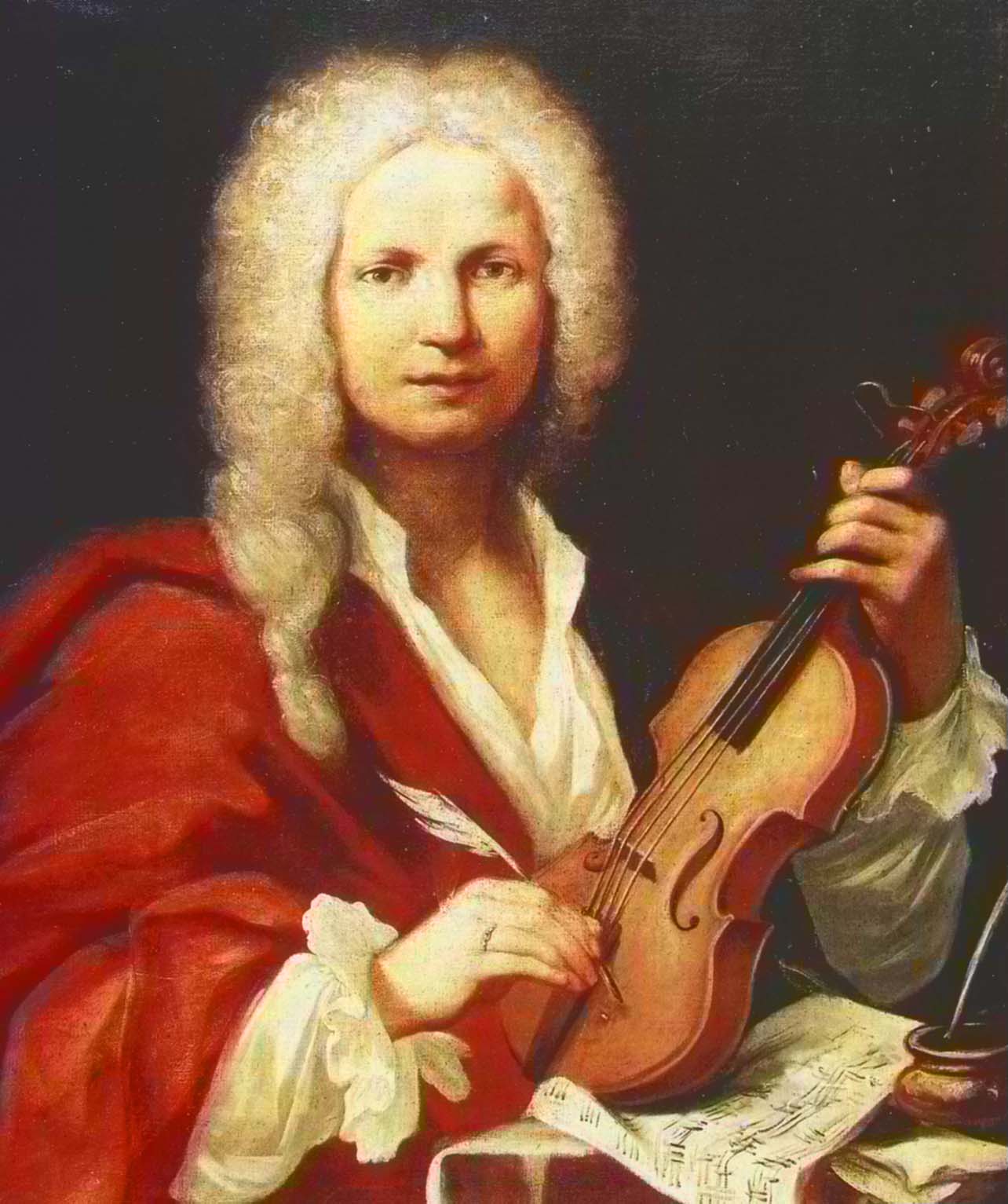
Overworked in his lifetime I reckon, despite his devotion to the education of the orphans in the Ospedale in Venice, underpaid, never given a proper contract, and buried as a pauper in Vienna where he went to get a job when he fell out of fashion. Then ignored for one hundred and fifty years. Always a bit poorly as well. And a ginger, though you wouldn’t know from the stinky wig he is wearing above.

Still no Vivaldi, no Bach. And imagine how much poorer Western art music would have been without Johann Sebastian. GP Telemann, for me, is now quite as satisfying, though BUD and KCK probably disagreed on the night, but he is musical elegance, flair and invention personified. And his music, like Haydn’s later on, will make you happy. As, on every outing, do the AAM. The venue may not be ideal for the intimacy of Baroque even at this scale, but I hope the AAM were able to turn a few quid here because of that. Well deserved.


Beethoven symphony cycle from Britten Sinfonia and Thomas Ades at the Barbican review *****

beethoven_sym_6_script

Britten Sinfonia, Thomas Ades (conductor), Nicholas Hodges (piano), Joshua Bloom (bass)

Barbican Hall, 22nd and 24th May 2018

  • Beethoven – Symphony No 4 in B flat major Op 60
  • Gerard Barry – Piano Concerto
  • Beethoven – Symphony No 5 in C minor Op 67
  • Gerard Barry – The Conquest of Ireland
  • Beethoven – Symphony No 6 in F major Pastoral Op 68

The latest instalments of the Britten Sinfonia’s Beethoven cycle under the baron of Thomas Ades, (alongside the valuable accompanying survey of Gerard Barry large-scale compositions) ,was as superb os the two concerts last year. (Britten Sinfonia and Thomas Ades at the Barbican Hall *****) (Britten Sinfonia and Thomas Ades at the Barbican Hall *****). That Mr Ades, and his friend Mr Barry, adore the music of Beethoven was never in doubt. That Mr Ades understands it, and can conjure up performances of the symphony that are as good as any that I have ever heard, is what makes this cycle unmissable in my view. I urge you, no I beg you, to come along to the final concerts next year of the last three symphonies. The Hall was no more than half full which is near criminal. If Gustavo Dudamel and his well upholstered LA Phil can fill the house with a big, if not particularly insightful, version of the Choral Symphony, then the Britten Sinfonia and Thomas Ades deserve at least the same. If you hate all the bombast that others bring to Beethoven please look no further: conductor and orchestra have binned all that sickly vibrato, endless repeats, glum grandiosity, and started afresh.

If you can’t go then look out for the recording of the cycle which should appear,God and finance willing. This is how Beethoven should sound. The right orchestral forces, the right tempi, to my ears at least, every detail revealed, and every detail in exactly the right place. Strings never thick and slushy, woodwind given enough room to breathe, brass precise, timpani rock hard. It is the difference between the way you might see an Old Master, badly hung, in the wrong room, of some C19 artistic mausoleum, centuries of filth accumulated on varnish, cracked, colours faded,  and the way you might see the same work, restored rehung, with space and light aplenty, and notes which illuminate not patronise. The joy of rediscovery. The difference between a mediocre and a great performance in a concert hall is easily to tell even if you know nothing about the music. The audience will be still and silent. Sometimes though there is something more, a connection between music, performer and audience that fills the very air.

I felt this here. Or maybe it was just there were fewer people with more invested in the performance. Either way it was a triumph. The Fourth, like the Second last year, couldn’t be dismissed as a happy-go-lucky, lithe cousin of the muscular, growling, Eroica hero that they sandwich. The first movement, marked Adagio-Allegro vivace, is, for my money, one of the finest passages of music Beethoven ever wrote. The painful opening, the booming timpani and giant string chords which conclude it, the uneasy Adagio which follows punctuated by more big chords, the double repeated scherzo theme, a dance but with something lurking in the woodshed, and then the perpetuum mobile finale, which is almost too jolly. Indeed Beethoven scores it that way, a palpable sense of anxiety pervades the whole symphony. It needs a conductor alive to the Goth inside the symphony’s Pop, and its subtleties cannot contemplate too big a sound. Mr Ades is that man. The slow movement Adagio was, and I didn’t expect to use this word about these interpretations, sublime.

I get why 2, 4 and 8 are see as lightweights compared to 3, 5, 7 and 9, the keys, the structures, the moods, the context, but I think it is a shame to get caught up in this convention. The Fourth symphony in particular is as great as its more famous peers. So how would this conductor and the BS render the Fifth anew. Remember the Fifth, (once it got over the infamous disastrous first night, alongside the Sixth, and a whole bunch of other stuff), changed the face of Western art music. Composer, and the performer from now on could be Artists. Everything would be bigger. More emotional. More, well, Romantic. Audience and commentators were now at liberty to hear, think and write all manner of the over the top guff about “serious” music. For that we should probably throttle LvB but the Fifth is just so extraordinary, however many times you hear it, that we’ll permit him the excess.

I expected the BS and Thomas Ades to absolutely nail this and they did. Familiarity can breed contempt. Or it can, as here, promote shared understanding. Everyone on and off stage was able to revel in Beethoven’s astounding invention. If I ever hear a better interpretation I’ll be as a happy a man as I was here. The opening allegro, four notes, infinitely varied, needs no introduction, tee hee, it being the most famous introduction to a piece of music ever. I suppose some might tire of the repetition. Not me. Especially with no unnecessary repeat. The double variation of the Andante, which fits perfectly together ying and yang style, was ever so slightly less impressive but the Scherzo and the magnificent finale were glorious. As in the prior performances you hear everything, no detail is obscured, nothing is too loud or two soft. This means that, along with the “classical-modern” sound of the BS and the “right” calls on repeats that the architecture of Beethoven’s creation is fully revealed, from micro to macro scale.

With Mr Ades and the BS having nailed the detail, shape and rhythm of the symphonies to date, I wondered how they would cope with the Pastoral. Maybe this, with its plain programmatic elements, wrapped its more gentle cloak, expressing all that utopian, Arcadian, rural idyll fluff that art conjured up as a salve to assuage guilt about industrialisation and urbanisation, would be the symphony where Mr Ades’s precise, vigorous approach might come unstuck.

Nope. For choice this might have been marginally less exciting than the rest of the cycle, the precision and heightened differentiation between instruments robbing a little of the warmth from LvB’s narrative. I’ll take the trade though when it results, for example, in the most thrilling storm I have ever heard, double basses thrumming, timpani thwacking. It also means the opening Allegro, which can doodle on a bit, saw variety emerge from the repetition. Nature untroubled by Man. Messaien would have purred at the birdsong emerging from woodwind in the Andante. And, in the finale, we heard the relief of real shepherds, not a bunch of embarrassed house servants dolled up by their lords and masters. Most Romantic plastic art is as schmaltzy as the Neo-Classical flummery that proceeded it, but there is some which sees the world for what it is, not want artist and patron wanted it to be. And some of it, Constable, in his sketches and watercolours, and, in his own darker way, Goya, could eschew history, violent nature and dramatic landscape, and showed more of the working reality of rural life. This Pastoral was in a similar vein. I now this all sounds like a load of poncey bollocks, but hopefully you get the gist.

Moving on. You remember those nights out in the pub, with your mates, talking sh*te and putting the world to rights. Of course you don’t. You were hammered. But you do remember it was a bloody good night out and things might have got a bit raucous and out of hand. Argument and love. Well Gerard Barry’s Piano Concerto, here receiving its London premiere, is the musical equivalent of one of those nights. Nicholas Hodges was basically asked to man-handle, (at one point literally, playing with his forearms), the piano and to get into a scrap with the orchestra. As the punches swung it got funnier though 20 minutes was probably enough. Some of the piano passages were more conciliatory but only in the way a drunk bloke (the woodwind) tries to calm his even more drunk mate (the brass) down a bit. It ends with some childish tinkles. It isn’t in Romantic concerto form, played straight through with no obvious structure, it has two wind machines, (here not amplified as expected, a shame), there is no real interplay between orchestra and soloist, just opposition, it is abrasive, chromatic and gets pretty loud. I reckon Vivaldi might have come up with something like this if he were around today.

In short it is a piece of music by Gerard Barry. I am sure he is nothing like this is reality, and I am being borderline xenophobic, but I see him as the musical equivalent of Samuel Beckett, the very definition of cussed. I am going to have to find a way into recordings of his music, probably after this time next year, as it is just too funny and punk to ignore. Mr Hodges is an expert in this dynamic modernism, having recording and performed the likes of Birtwhistle, Rihm, Carter and, indeed, Thomas Ades himself.

Mind you if I thought the Piano Concerto was a bit in-yer-face bonkers I was in for an even bigger surprise with The Conquest of Ireland. This is set to a text from Expugnatio Hibernica by Giraldus Cambrinus translated by A. Scott and F.X. Martin. Cambrinus was a Welsh writer and cleric in the twelfth century who hooked up with the army which invaded Ireland. The piece is marked quaver = 192 which I gather is pretty enthusiastic but Mr Barry then marks it “frenetic” and “NOT SLOWER” just in case we missed it. The brave soloist, here Joshua Bloom, is nominally a bass but he gets up to all sorts of pyrotechnics as he sings/speaks/growls/squawks the entirely unmusical words. It is basically detailed descriptions, written in a somewhat pompous style, of the bearing and appearance of seven Welsh soldiers. There is just one short throw-away line which dismisses the native Irish as barbarians. Mr Barry has composed intense, passionate, exuberant music to contrast this prosaic prose (!). Bass clarinet, marimba, winds and brass in combination, percussion, all got a work out. It is sardonic, in the way that I now see that so much of Mr Barry’s music is, but it certainly provokes a reaction and makes you think.

Anyway back to the performers. The Britten Sinfonia are my favourite musical ensemble. The others I regularly get to see, the LSO, the LPO, London Sinfonietta, the AAM and the OAE, are all, of course, excellent, and there are international orchestras that can blow my socks off when they visit, but it is the BS which consistently educates and surprises me. And Thomas Ades, IMHO, is now the closest thing to the immortal Benjamin Britten, that I can think of. Composer, performer, conductor. Equally gifted.

Oh and a final plea. This time to the ROH or ENO. A Fidelio. With Thomas Ades conducting. And Simon McBurney directing. I’ll wait.


Beethoven’s Missa Solemnis at the Barbican Hall review ***

beethoven-missasolemnis-manuscript

London Symphony Orchestra, London Symphony Chorus, Michael Tilson Thomas, Camilla Tilling (soprano), Sasha Cooke (mezzo-soprano), Toby Spence (tenor), Luca Pisaroni (bass-baritone)

Barbican Hall, 20th May 2018

Beethoven – Missa Solemnis

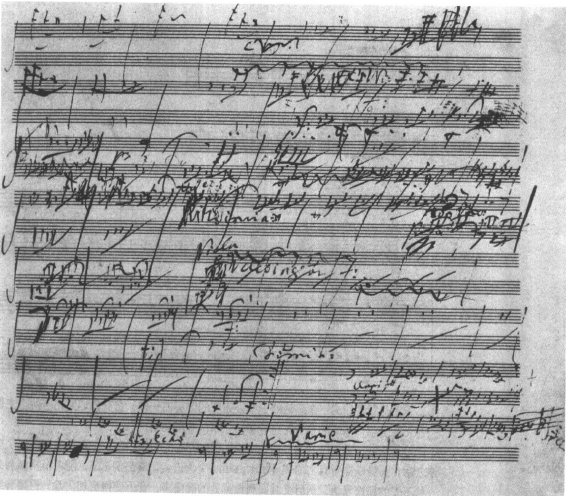
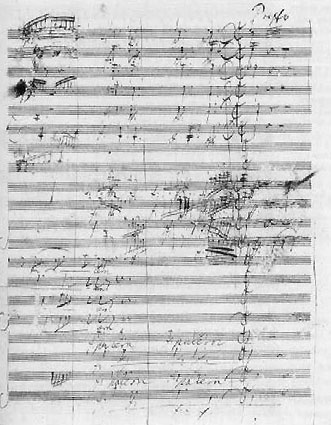
Hard to believe that the scruffy scrawl above is from the hand of the greatest ever composer in one of his greatest ever works. At least he thought so. And so does Michael Tilson Thomas, Conductor Laureate of the LSO, judging by the number of times he has taken it on.

I am not so sure though and find myself siding with Adorno on this. This will probably be the one and only time I can make this absurdly pretentious claim since, however hard I try, I cannot understand a word of what the Frankfurt School of Marxist critical theory was about, though the intellectual posturer in me dearly wishes I did. I would love to know a lot about a lot, or even a lot about a little bit of what there is to know. Instead I am doomed to know a little bit about very little.

The thing is there isn’t much of the theme and variation repetition thing than Beethoven took to unparalleled heights (at least until The Fall and Wire came along) in the Missa Solemnis. The giant fugues at the end of the Gloria and Credo provide me with some structural understanding, and connect with other late works like the piano sonatas and string quartets, but otherwise there is quite a lot of, well, Romantic meanderings.

Now it is Beethoven with massed choral forces offering up a Mass on a scale comparable with the Choral Symphony so it can’t all be bad. And it isn’t. There are stills scraps of cracking tunes which are explored in imitation to conjure up the goose-bump feel that the earlier masters of polyphony managed. Especially in the second half of the Gloria, the middle of the Credo and the beginning of the Sanctus. But there just isn’t the overarching structure to help my little head stay happy. LvB intended to complete the MS for his patron and mate, Archduke Rudolph, who was receiving some honour or other in March 1820. He missed the deadline so didn’t actually complete it until 1823 just ahead of the Ninth. Maybe that changed it.

The LSO chorus is now so bonkersly brilliant that it sort of didn’t matter when they were belting it out. Especially in the soprano section. And, like I say, MTT knows his way around the score. The soloists seemed well matched to me, though I would marginally take Sasha Cooke’s mezzo and Toby Spence’s tenor over Camilla Tilling’s soprano and Luca Pisaroni’s bass-baritone.

I will keep trying but I don’t think I will ever fully succumb to the MS. Whisper it but I am happier listening to the Mass in C which, as Beethovian experts will tell you, leaves me on the nursery slopes and forever banished from the pistes. So be it. Vita summa brevis.