Not Talking at the Arcola Theatre review ****

see-1019991_1920

Not Talking

Arcola Theatre, 5th May 2018

Not Talking is, in his own words, Mike Bartlett’s first “proper” play. It won prizes when first aired on BBC Radio, (with Richard Briers and June Whitfield no less), but it was written for the stage and, here. courtesy of production company Defibrillator, it has it first theatrical outing.

You may well know Mr Bartlett from his TV outings, Doctor Foster, Trauma or maybe the TV adaptation of his play King Charles III. (It always tickles me that the TV critic of the execrable rag the Daily Mail gave this a 0* review whereas the sharp-witted theatre critic gave it 5*). Or maybe you have seen one of his other plays, Albion (Albion at the Almeida Theatre review ****), Wild, Game, An Intervention, Bull, 13, Earthquakes in London, Cock, the adaptation of Chariots of Fire or his brilliant version of Medea with Headlong. His writing is innovative and fearless, and full of colour. If a big dramatic concept or twist is required he will jump in with both feet, and the quality of his writing is so good that he always gets away with it.

All this is visible in Not Talking. We have four characters, James, Amanda, Lucy and Mark. James and Lucy have been married for many years but have drifted apart. They don’t talk to each other. Mark and Amanda are soldiers at the same barracks who fall for each other. Something happens that neither one of them can really share. It turns out that there is a connection between the couples.

I’ll stop there. The plot is too absorbing to reveal and there are still plenty of tickets up for grabs through to 2nd June. You would be a mug not to see this.

David Horovitch who plays James is a top drawer stage actor, last seen by me in All My Sons at the Rose Kingston alongside Penny Downie. Kika Markham who plays Lucy is similarly theatrical royalty. She played Lena in Caryl Churchill’s magnificent Escaped Alone and her mate, Tony Kushner no less, wrote a one hour monologue for her in his play Homebody/Kabul. You would be hard pressed to see two finer actors on the London stage and here they are at the Arcola for 20 quid. Gemma Lawrence and Lawrence Walker who make up the quartet are less experienced but equally as good as they renowned colleagues. This is the first time I have seen any of James Hiller’s work, the AD of Defibrillator. Nothing he does gets in the way of Mr Bartlett’s riveting plot, which is equally well served by Amy Jane Cook’s simple set.

Now you might argue that Mr Bartlett is a little too ready to pump up the dramatic volume, or that his message, don’t bury secrets, is a little too patent. Who cares when it is this involving and this well presented.

Take a friend. You’ll have someone to talk to afterwards.

Great Apes at the Arcola Theatre review ****

Chimpanzee,_Kibale,_Uganda_(23022998774)

Great Apes

Arcola Theatre, 31st March 2018

I sort of lost track with Will Self the author after The Book of Dave. His sprawling, satirical fantasies with a lot of big words, unreliable narratives and narrators, drugs, mental dislocation, is never short of imagination and ideas, but aren’t always that easy, or pleasurable, to read. He is very clever and very funny, and he knows it, and really likes to show it. His influences are many, and obvious, Ballard, Burroughs, Heller, and then back through Kafka, Joyce, Voltaire and Swift. I gather he too has given up on the novel, all of them, not just his.

I did enjoy Great Apes however and its successor How the Dead Live. Our protagonist, artist Simon Dykes (Simon/simian geddit), whose prime artistic concern is, surprise, surprise, perspective, wakes up after a bender to find his girlfriend, Sarah, is a chimpanzee. And so is everybody else. His human “delusion” means he is taken in by psychiatrist Zack Busner, Will Self’s stock character, here an alpha male chimp. From this transparent inversion Self shines a light on human, and chimpanzee behaviours, we’re not so different, and on the nature of mental illness and reality. Because the satire is so primitive, as it were, and has been done to death in those wretched Planet of the Apes films, Self has to concentrate his powers on the narrative and the characters in a way that sometimes escapes him in the other novels. By colliding chimpanzee and human society and culture, Self sheds light on our own behaviours, fears and dysfunctions. It is also adroitly pokes fun at our own human exceptionalism. London, drugs, mental illness, “false” narratives are all explored, as you would expect, but there also some affecting exploration of relationships, which you don’t really expect from the lugubrious Mr Self.

In short its is clever yes, but with a purpose, and it has a proper plot. How then to put it on stage. Well first break it down into the key scenes. Mr Self’s detailed imagining of this alternative society has to run alongside the story of Simon’s journey from human “reality” through “delusion” and eventually to explanation, and Dr Busner’s rise and fall. To get it on to the Arcola stage needed some perspicacious work from adapter Patrick Marmion, which we have. It also needed the creative team of director Oscar Pearce, designer Sarah Beaton, lighting designer Matt Haskins, sound designer Dan Balfour, movement director Jonnie Riordan, costume supervisor Kate Hemstock and the puppetry team of Tom Espiner and Mala Kirkman-Richards, to combine to reveal enough to allow our imaginations to do the rest. In this they succeeded, a remarkable achievement given limitations of space and budget.

Perhaps the most important technical contribution however came from chimpanzee physicality and vocalisation consultant Peter Elliott. Now I will stake a wild guess that there aren’t too many people with that particular job title. His bio shows that he has worked on a number of major films involving primates, real and imagined, and, most remarkably, it says he became the first ever person to integrate with the colony of chimps at the University of Oklahoma.

I am also guessing the cast has down too much auditioning for primate work in the past. The way they combined voice, body and the simple props, benches, ladders and specialised crutches, (not sure if they have a special name), to simulate chimpanzee movement, sound and behaviour, was really impressive. Whilst Bryan Dick playing Simon and Ruth Lass playing Dr Zack, that’s right, in a piece of inspired casting we had a woman playing the alpha male here just to mess up our heads a bit more, the other five actors doubled up, or more. Yep they had to take on the character of not just one but several different chimpanzees. I was particularly struck by the performance of Ruth Everett as Busner’s assistant Jane Bowen, artist Tabitha Buckfast and Eve Knight, a film-maker.

Now I will admit with so much to pack in there were times when ambition overreached execution. Some of the plot had to be chivvied along especially towards the end. To have covered everything in the book would have been technically and dramatically impossible, and some of the intelligent subtleties and artistic allusion of the book gets a bit lost along the way.

Still you will end the evening definitely entertained, in awe of the technical achievement and with plenty to think about even if you may not entirely connect to the characters. Then again they’re chimps aren’t they? How would you connect to them? They’re animals aren’t they? They’re not as special as us are they what with out technology, language and civilisation?


A (flawed) guide to London theatres

5082213817_08e9837e3f_z

When I was a young teenager I took to making up some very odd games. I wasn’t lonely, with a handful of very good friends as I remember, and my very earliest encounters with the ladies were amongst my most successful, since my true nature, an awkward mix of the needy and the misanthropic, had yet to be revealed. I was something of a swot, what you might call bookish and then, as now, was sometimes a little confused by what others did or said in social situations. But definitely not on any sort of spectrum I reckon, beyond that of the awkward 16 year old lad with lank, long hair, (despite the advent of punk), robust flares, bumfluff and the ability to make a pint of lager last a whole evening.

But enacting an entire Subbuteo World Cup, sixteen teams, (these were the days when FIFA could just about control its financial appetites – if you want to see what the future, actually present, of human “governance” looks like, like no further than the masters of the beautiful game), then quarters, semis and a final. All stats carefully recorded in a special notebook. All done on my own. That’s right. I played with myself, (no titters at the back please). Which meant that, whilst pretending to myself that this was an entirely objective exercise exercise, I got to see England play Holland in the final. England because that’s the fiction that is most deep-rooted in my psychology. But Holland won. Retribution for the injustice meted outed in the “real” World Cup final in 1974, (and, though I did not know it, but somehow feared it, again in 1978), and an early indication of my rabid pro-Europeanism.

Sounds a bit weird right. Except that PlayStations hadn’t been invented. So I like to think of myself as an early adopter, not a sad adolescent.

Anyway responsibility, albeit of a most shrunken kind, has meant I have had to let go of such childish things but I still like a good list, dictated by me, which purports to be based on “facts” but is in fact nothing of the kind. Though, as you know, (tautology alert), there are no such things as facts, only theories yet to be unproven, and “information” is mediated, and mutilated, by both provider and consumer. Do not believe anything, least of all if it comes out of your own head. Proud to be a sceptic.

So you can safely ignore what follows.

Since theatre is my current passion, I thought I would tot up the ratings that I had given the entertainments I had enjoyed over the past three years, derive some averages, adjust for frequencies and thereby show what London theatres reliably put on the best work. Thereby confirming my own biases, with my own biased ratings, mashed through a filter of spurious statistical analysis. Just the kind of woeful shite that organisations, opinion formers and your governors do everyday apparently on your behalf.

So here’s my top ten (well eleven actually). Turns out that it is a proven fact (!) that the Almeida under Rupert Goold is the best of the bunch, the Royal Court is a thing of wonder, especially when you reflect on the fact that the work is almost entirely new, and the National Theatre under Rufus Norris is not, repeat not, undergoing any sort of existential crisis, despite what some would say. The trouble with all those right-wing cultural commentators is that they are only happy when they have something to moan about; they can only argue the negative. I hope the Theatre Royal Haymarket continues its more enlightened programming under the new owners. The Young Vic remains the most exciting major theatre, even if that means a few misfires, and the one where I learn the most. The Barbican benefits from the RSC and the International companies that come through the door. The Donmar rarely drops a bollock but here you really have to be quick at the gate to get a seat. The Arcola and The Orange Tree get my vote for best of the fringe, and the Gate for those with more adventurous tastes. The Old Vic doesn’t always belt it out of the park but is pretty reliable.

In fact overall I doubt there is anything here that would surprise the seasoned theatre-goer. thus adding a nice line in utter pointlessness to the sins of commission I have already committed in compiling, and worst still, writing up this list.

There are a couple of lessons though for the more casual consumer of drama. Firstly, do not think for one moment that watching a film or series on a tiny screen can in any way match the thrill of live theatre, and secondly, if you want to avoid being the sap who comments that “I would liked to have seen that but it was all sold out before the reviews appeared … ” or end up paying three times the price for a painfully uncomfortable seat in some West End mausoleum, then sign yourself up to the Almeida, Royal Court and National lists and take the plunge as soon as you seen something half-interesting.

  1. Almeida Theatre 4.33
  2. Royal Court Theatre 3.87
  3. National Theatre 3.81
  4. Theatre Royal Haymarket 3.80
  5. Young Vic 3.79
  6. Barbican Theatre 3.78
  7. Donmar Warehouse 3.75
  8. Arcola Theatre 3.71
  9. Orange Tree Theatre 3.67
  10. Old Vic 3.60
  11. The Gate Theatre 3.60

Napoleon Disrobed at the Arcola Theatre review ****

Jacques-Louis_David_-_Napoleon_Crossing_the_Alps_-_Kunsthistorisches_Museum

Napoleon Disrobed

Arcola Theatre, 7th March 2018

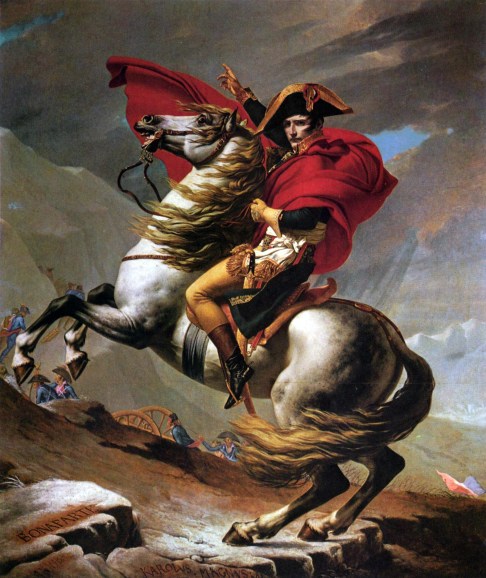
Here is JL David’s preposterously heroic painting of Napoleon Bonaparte Crossing the Alps. The Napoleon of Simon Ley’s alternative history The Death of Napoleon, is of a somewhat different hue. Ley’s novella, his real name was Pierre Ryckmans and he was a Belgian academic specialist based in Australia, imagines NB is smuggled out of St Helena, returns to Paris via Antwerp, and attempts to hook up with the faithful in order to mount a comeback. It all ends rather more prosaically.

This novella forms the basis for this play-ful diversion from Told By An Idiot. co-produced by Theatre Royal Plymouth. Told By An Idiot exists to put the fun into theatre so it is easy to see why this story, about an extraordinary man rendered ordinary and having to deal with the consequences, attracted them. When I say them I mean two gifted Hunters: Paul Hunter co-founder and driving force behind TBAI, and here our Napoleon, and director Kathryn Hunter, theatre’s acting chameleon, last seen in the Emperor at the Young Vic.

The final, and, for me, most valuable contribution however, came from Ayesha Antoine, who plays … everybody else, including Ostrich, the young woman who proves NB’s salvation. The play kicks off with some gentle, and very funny, Napoleon related banter with the audience from Paul Hunter. We cut to the escape from St Helena, NB masquerading as Eugene Lenormand, brought to life with a few well chosen props, the first of a dizzying number of costume changes from Ms Antoine, and the unpinioning of Michael Vale’s raised platform set to create the swelling sea. Sight gags, aural interruptions, wordplay and anachronisms a plenty, take us energetically through NB’s missed meeting with the Bonapartistes in Bordeaux, his train journey from Antwerp and his rendezvous with widow, single mum and melon shop owner Ostrich. The tone then shifts from the affectionately comic to the comically tender as NB abandons his ambitions and his destiny, his double on St Helena having pegged it early, to settle down with Ostrich, whoever she might be.

This is a piece that revels in the artifice and wonder of theatre which delivers more than you might expect or deserve. It might not quite deliver the contemplations on identity and freedom that the director might have imagined, is NB really who he says he is?, but you would have to be a serious miserabilist not to be won over by this. Plainly I am not as miserable as I think I am.

Insignificance at the Arcola Theatre review ****

insignificance-arcola-700x455

Insignificance

Arcola Theatre, 21st October 2017

Regular readers of this blog (don’t be shy) will know that I adore the work of Terry Johnson. As do a lot of proper theatre critic types. I also have a very soft spot for the Arcola. With this revival of Insignificance the combination delivers.

However, I see from some other reviews that not all are persuaded. This is par for the course with Terry Johnson. I think the way he mixes high and low culture, and the multiplicity of meaning he inserts into his texts can leave some audience members a bit cold. He is, as my mum would have said, a “clever clogs”  and his humour is “knowing” with a capital K. In this play he is happy to trade ideas and words for the dramatic arc. The comedy, which often leavens Mr Johnson’s work, is less prominent in Insignificance and is downplayed by David Mercatali’s measured direction.

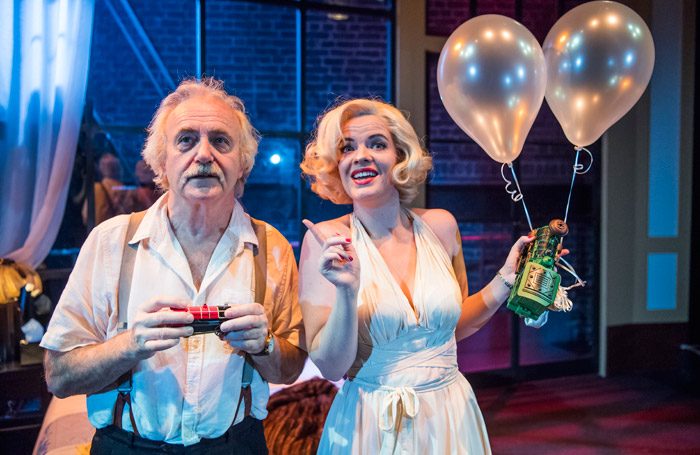
The Professor, played stoically by Simon Rouse, is in a hotel room, (Max Dorey’s utilitarian design copes with the Arcola space), working on the nature of space-time. He is interrupted by the Senator, played by Tom Mannion with increasing venom, who tries to bully him into testifying before the House Committee on Un-American Activities. The Professor refuses. The Senator leaves. The Actress (an excellent Alice Bailey Johnson who just happens to be the playwright’s daughter) appears in a recognisable white dress and, initially, trademark breathless voice. She and the Professor discuss the nature of fame and celebrity, she demonstrates, in ecstatic fashion, the theory of relativity using toy props in the room and then she attempts to seduce the Professor. They are interrupted by the Ball-Player played by Oliver Hembrough, who is not best pleased. The Professor leaves. The Ball-Player sleeps through the Actress’s announcement that she is pregnant. Next morning the Senator returns, mistakes the Actress for a prostitute and hits her. The Professor returns, chucks his work out of the window to thwart the Senator who leaves. the Ball-Player returns. The Actress miscarries and tells the Ball-Player their marriage is over. The Actress and Professor remain. The time approaches 8.15pm. The Professor visualises his recurring nightmare of nuclear destruction.

Now when you put it like I appreciate it doesn’t sound like a barrel of laughs. No so. Also it seems to me there is plenty going on in the play, it is just that it is confined to the one room. (Nic Roeg’s famous film version is obviously less claustrophobic). These characters are, of course, Albert Einstein, Joe McCarthy, Marilyn Monroe and Joe DiMaggio. None of this happened. But it might have done. That is the whole point. I never understand why people get worked up by drama which “strains credulity”. It is a play. It’s not real.

We see the world of science, politics, film and sport collide. These people were about as famous as it was possible to get in 1954 when the play is set. They still were in 1982 when the play was premiered at the Royal Court. And they still are today, notably in the case of Monroe and Einstein. The influence of fame and celebrity on the cultural superstructure is arguably even more profound. There was an actor in the White House when the play was written, there is a clown now. As Mr Johnson observes in a world which worships at the altar of celebrity society will fail to “question the power of the invisible”.

First and foremost the play is a meditation on the nature of fame, as many of Mr Johnson’s plays are. We think we know the public personae of these people and what they represent but we see very different identities in private. The Professor has sexual urges (Ms Monroe allegedly wanted to sleep with him). The Actress reveals a prodigious intellect in sharp contrast to Ms Monroe’s screen image. The Senator is an aggressive ideologue, as we liberal types would presuppose, but we shouldn’t forget that he mobilised an entire legislature to let him pursue his grotesque witch-hunt. The Ball-Player expresses his own renown in the most banal way through the greater number of bubble gum cards with his image when compared to peers. He too is more intelligent than the jock he presents but he sees little advantage in revealing this.

Mr Johnson also has some fun with other mind-bending scientific ideas with an off-stage cat belonging to a certain Mr Schrodinger and the Uncertainty Principle of Heisenberg. Science plays are ten a penny these days, not surprising as dramatists are creatures of wonder, but Terry Johnson was an early protagonist. He also squeezes in a Crucible gag. More moving are the Actress’s sorrow at her own objectification, the Ball-Player’s yearning for domestic normality and an heir and the literal cloud that hung over the Professor’s head in the latter years of his life as he reflected on the destructive power his science unleashed.

So there you have it. I would get it if this doesn’t float your boat but if any of this sounds remotely interesting please give it a go. You might be a convert.

Angel at the Arcola Theatre review ****

angel5-copy

Angel

Arcola Theatre, 4th October 2017

I had been hoping to get an opportunity to see Angel after reading a review of the premiere at the Edinburgh Festival last year. I had read of the very sad death of the actor, Filipa Branganca, who had played the role of the eponymous Angel of Kobane, Rehana Ghazali, in that original production. So I am glad it was able to transfer eventually to the Arcola with a new lead in Avital Lvova.

The play is largely set in Kobane, a small, sleepy town, in the far north of Syria on the border with Turkey. In mid 2012 the Kurdish YPG took control and declared independence for West Kurdistan. In mid 2014 the town came under siege from ISIS as Syria collapsed and the legend of the Angel of Kobane was born. She was a law student who became a crack sniper. Not much else is known but writer Henry Naylor takes the story as the basis for an hour or so play which examines through her story, the conflict in the region and the role of women in that conflict and in Kurdish society. Angel is part of a quartet of plays (The Collector, Echoes and Borders alongside Angel), named Arabian Nightmares, which Henry Naylor has written about the “war on terror”. They have won multiple Fringe First awards at Edinburgh. It is pretty easy to see why.

We see fragments of Angel’s childhood and meet her parents. Angel wants to be a lawyer but her schooling is disrupted by the Kurdish uprising. Her father, who I understood to have fought in the Kurdish uprising in 1991, teaches her to shoot and, in another important scene, faces down some local hoodlums. The family eventually has to flee but Angel’s Dad stays behind. She decides to return to find him and this is what eventually leads to her joining a group of women fighters to take on ISIS in her home town.

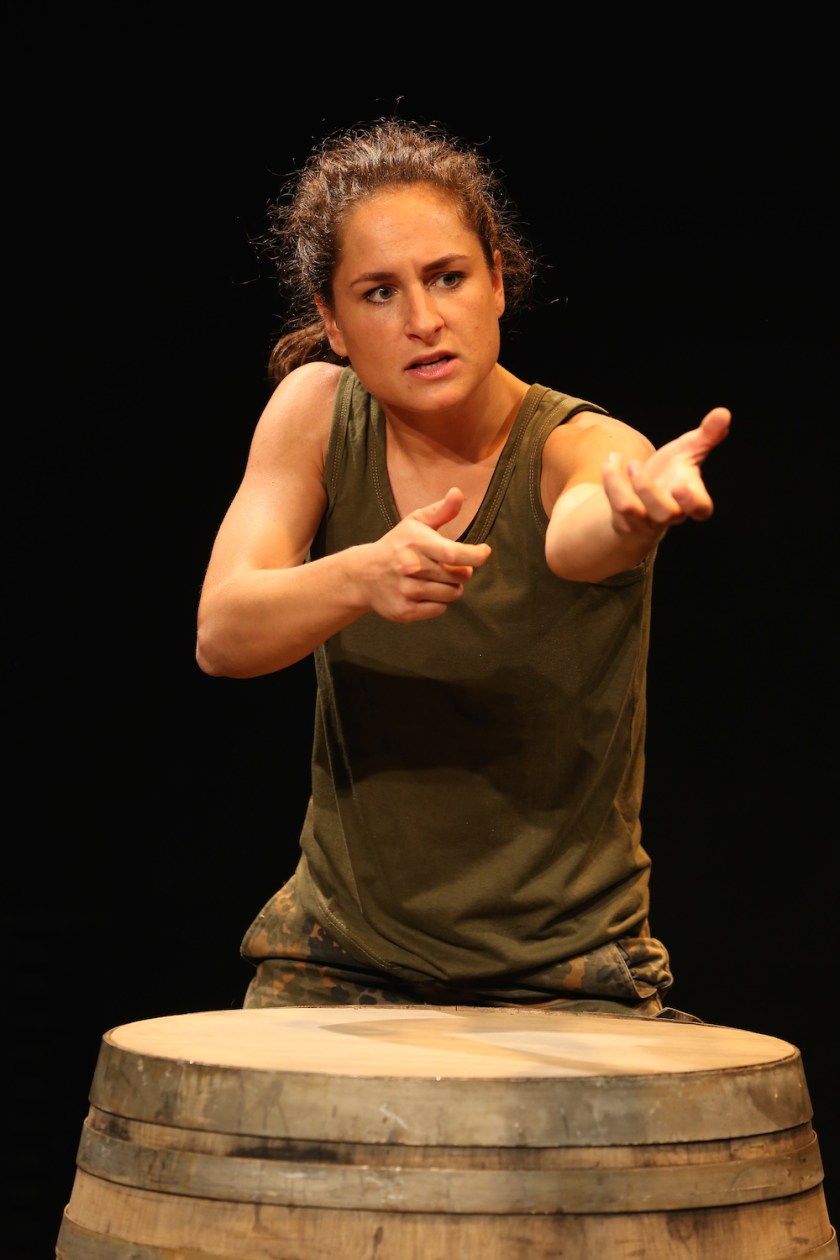
Avital Lvova assumes all the parts, her parents, and the various characters she meets on her journeys. The text is nimble and immediate (and at times surprisingly amusing) allowing Ms Lvova to paint a very vivid picture of these characters and her adventures. The lighting design by Andy Grange in the smaller Arcola space is brilliant. The props are minimal, just a barrel, and the brick wall at the back of the stage. What is most striking however is the sheer physicality of Ms Lvova’s performance: this is what draws you into her story and adds realism to the scenes.

This is a powerful piece of theatre with a performance and staging from director Michael Cabot of real passion. You will be drawn in and you may, like me, learn a little more about the conflict it portrays. I have no doubt it will pop up elsewhere. If it does, take a look. I am keen now to see the sister plays which accompany Angel.


Judith at the Arcola Theatre review ***

howard-barkers-judith-a-parting-from-the-body-credit-nick-rutter

Judith: A Parting from the Body

Arcola Theatre, 7th September 2017

I am guessing they don’t watch Bake-Off in the Barker household.

Howard Barker does not write easy plays. By his own admission he wants each of us to experience his plays as an individual: none of that namby-pamby rush of joy in the realisation that we are all sharing in the theatrical experience. His “Theatre of Catastrophe” will always try to make themes more complex and ambiguous. He has created his own company, The Wrestling School, to produce his work in Britain. Obviously he is adored in the rest of Europe where there like a challenge. Oh and he doesn’t backslide on the subjects for his plays, taking historical or literary stepping off points to create works with multiple viewpoints which explore the darker side of the human condition. Mischief Theatre it ain’t.

Judith: A Parting from the Body was originally produced by RENO Productions at the Arcola in 2015 as part of a double bill with the premiere of The Twelfth Battle of Isonzo. This is the same cast but just a workout for Judith which clocked in at an hour or so. Now you arty types will know the Old Testament story of Judith beheading Holofernes like the back of your hand. It was a Renaissance and Baroque art staple based on a story which I understand is itself a common subject in the so called Power of Women topos, “heroic or wise men dominated by women”. Through time the depiction of Judith became more sexualised and titillating. On the face of it antifeminist claptrap but there may be scope for more complex readings and this is what Mr Barker succeeds in doing with his play.

Liam Smith as general Holofernes expounds on the nature of power and sacrifice demanded by war. But his philosophising gives way to loneliness and vulnerability. Judith, a beautiful widow played by Catherine Cusack, with her plebian maid (Kristin Hutchinson), enters the enemy Assyrian camp on the eve of the battle and gets to his tent. There is much enigmatic chat and sexual frisson  between the three before Judith does the deed to save her city of Bethulia. Yet Judith and the maid become fascinated with Holofernes and his motives and Judith’s emotions become conflicted.

Now I am not saying this was an comfortable night out. Mr Barker is not interested in simply getting us from A to B in the standard way. The language veers abruptly between mellifluous poetry to profane banality. These characters are full of contradiction. Love and violence are intertwined. Nothing is made easy to grasp. I can’t pretend I was bowled over but it was intriguing and as I whizzed through the script on the way home, I started to get more out of it. I will add Mr Barker to my list of challenging playwrights where I must do more work.

The three strong cast were faultless, they know this inside out. Same was true of director Robyn Winfield-Smith and the set of Rosanna Vize was perfectly imagined. The small space at the Arcola was also a perfect fit. So no better advocates than these I think. Yet is is still a hardcore offering. So if you fancy a bit of dramatic pummelling take the plunge. I see the production is off to Poole and Colchester.


Some forthcoming London theatre ideas

image

So we have had a few new season announcements over the past few weeks so here is a wrap up of what I think looks interesting in terms of stuff coming up on various London stages.

To spare you crawling through all this guff here is my top ten, including the best of these recent new season announcements in my view, and some other incumbent recommendations.

  1. The Ferryman at the Gielgud Theatre. So I know the decent seats are exorbitantly priced and this has come in for a bit of “paddywackery” backlash but it is still a towering play and is a must see.
  2. Hamlet at the Harold Pinter Theatre. Ditto. This is just a brilliant Hamlet from Andrew Scott and must be seen whatever you view on Will S.
  3. Network at the National Theatre. Should be a cracker – more details below
  4. Macbeth at the Barbican. In Japanese (with surtitles) but this is a classic production which I am very excited about.
  5. I Am Rachel Corrie at the Young Vic. Erin Doherty in the lead in this revival.
  6. Gundog at the Royal Court Theatre. I have a feeling this will be good.
  7. Albion at the Almeida Theatre. The next hit from the Almeida?
  8. Young Marx at the Bridge Theatre. I have banged on about this before but all is in place for the Bridge’s first offer.
  9. Insignificance at the Arcola Theatre. Revival of Terry Johnson brainy classic.
  10. Poison at the Orange Tree Theatre. I think this will be another triumph of discovery at Paul Miller’s Orange Tree.

More detail below.

Young Vic

New season is up. Best of the bunch for me is a revival of I Am Rachel Corrie based on the eponymous activists diaries with Erin Doherty in the lead. I have said before that I think Ms Doherty will become a stage legend and this should support that idea. The Jungle also caught my eye, with a whole bunch of tip-top creatives weaving stories from the Calais refugee camp. This is the sort of thing the Young Vic excels at. I am also looking forward to Wings with Juliet Stevenson in the lead and the Suppliant Women.

Royal Court Theatre

A whole bunch of goodies in the new season with three takes on the impact of war, Minefield, Bad Roads and Goats, and a US transfer, Grimly Handsome which has already sold out. My money is on My Mum’s a Twat a debut play from Anoushka Warden which RC’s Artistic Director Vicky Featherstone is directing, Girls and Boys, a relationship drama from Dennis Kelly (who writes for the telly) and directed by Lyndsey Turner, and, sounding best of all, Gundog, which has a nice ring of folk horror about it in the blurb. As usual with the RC there is not much to go on but I have a very good feeling about this. Ms Featherstone also directing.

Almeida Theatre

The Almeida can’t put a foot wrong under Rupert Goold with Ink the latest hit (sold out at the Almeida but go see it in the West End Transfer – you won’t regret it). I am booked for all 3 of the new season productions.

Mr Goold himself will direct Albion, Mike Bartlett’s new play. This has “state of the nation” written all over it but Mr Bartlett is a terrific writer so no need to fear. His last outing Wild at the Hampstead was good if not outstanding but this seems to have all the ingredients including a rareish outing for Victoria Hamilton on stage (you will have seen her in numerous period dramas).

Also intriguing is the Twilight Zone a world premiere from Anne Washburn based on, you guessed it, the Twilight Zone TV series from the 60’s. Now I can’t pretend I was bowled over by Ms Washburn’s Mr Burns but you have to admit this sounds quite exciting especially as it will be directed by the reliably controversial opera director Richard Jones.

After all this excitement the last play in the new season is a bit more classical in Tennessee Williams’s Summer and Smoke directed by Rebecca Frecknall (who has taken on this relative rarity before at the Southwark Playhouse) and with Patsy Ferran seemingly perfectly cast in the lead.

Donmar Warehouse

There are still a few tickets left for the new version of Ibsen’s Lady from the Sea and more for the Knives in Hens revival which should show director Yael Farber in her best light after the tricky Salome at the NT. Knives in Hens is a spare, poetic love triangle that gets regular revivals because, er, it is very, very good.

Old Vic 

Tickets now on sale for The Divide the new dystopian drama from the pen of Alan Ayckbourn. It is in two parts and I have no idea how it will pan out. It will be premiered at the Edinburgh Festival so probably worth waiting to see how it is received. It does have my favourite Erin Doherty (see My Name Is Rachel Corrie) above so I have already taken the plunge to get my favourite seats but I might have gone too early.

Arcola Theatre

A slew of interesting stuff in the new season including the Grimeborn opera offerings, but the standout plays for me look like the revivals of Terry Johnson’s Insignificance (his new play Prism is also coming up at the Hampstead Theatre) and Howard Barker’s Judith: A Parting from the Body with Catherine Cusack in the lead.

Orange Tree Theatre

Everything in the new season looks interesting to me including productions of Duncan Macmillan’s Every Brilliant Thing, Elinor Cook’s Out of Love and Brad Birch’s Black Mountain, but I think the UK premiere of Poison by Dutch writer Lot Vekermans may turn out to be the best of the bunch.

National Theatre

I am seeing Angels in America shortly (always seem to end up near the end of the run) so review will follow. Common is still trundling on – I didn’t think it was too bad but others were less forgiving (Common at the National Theatre review ***). No official reviews for Mosquitoes by Lucy Kirkwood which kicked off recently but I am looking forward to this immensely. Unfortunately the run is sold out so queueing on the day is the only way in.

Coming up are Follies, the Sondheim musical with Imelda Staunton belting out the tunes, Oslo, the sold out Broadway transfer which already has a West End transfer, St George and the Dragon, which I would take a punt on as a “modern folk tale” (expect Brexit allusions) written by Rory Mullarkey and directed by Lyndsey Turner, and Beginning, which I am guessing is a relationship drama (I assume with twists) written by David Eldridge and directed by the inestimable Polly Findlay.

My highest hopes are reserved for Network, based on the mid 70s Oscar winning film satire on the media, to be adapted by Lee Hall, directed by Ivo van Hove and with Bryan Cranston in the lead. Now film adaptions and Ivo van Hove disappointed on the last outing (Obsession at the Barbican – Obsession at the Barbican Theatre review ***) but I still would take the risk. This isn’t going to work if it follows the minimal, psychological insight route so I am assuming it will look more like Mr van Hove’s relentlessly busy Shakespearean efforts. There are tickets left for later in the run.

Barbican Theatres

Mr van Hove will also be bringing his Tonnelgroep Amsterdam team to the Barbican for After the Rehearsal/Persona and the main theatre will also show all the RSC Roman Shakespeares transferring from Stratford. I am signed up for the marathon Smile On Us Lord (I hope he/she does) from Russia’s Vakhtangov State Academic Theatre though I recognise this might be a bit hardcore for most. I do think the Ninagawa company’s Macbeth will be worth the £50 though. This is a revival was the production that first brought this innovative visual feast to the “West” so it really is a “once in a lifetime” theatrical experience.


Richard III at the Arcola Theatre review ****

tn-500_greghicksandsarapowellinrichardiiidirmehmetergencalexbrenner

Richard III

Arcola Theatre, 10th June 2017

I have had a surfeit of Dickie IIIs over the last few years. Mind you I am not complaining.

Mark Rylance on his return to the Globe found a vulnerable, despairing Richard who didn’t seem to care about his actions. Ralph Fiennes was a ruthlessly efficient c**t which left next to no room for audience complicity. Lars Erdinger was the narcissistic showman, even in the buff, in the Schaubuhne Berlin production at the Barbican. Benedict Cumberbatch, in the Hollow Crown II version (just get this on DVD if you “don’t like Shakespeare” and then change your mind), upped the comedy quotient which I enjoyed but was ingratiating for others. Robert Sheehan (the pretty boy off the telly’s Misfits) was one of the best things in Trevor Nunn’s marathon, “proper Shakespeare” War of the Roses at the Rose Kingston (yep all in one day for me) with his youth offering up a more bolshie Dickie. Best of all was Hans Kesting in Toneelgroep Amsterdam’s Kings of War. Like the War of the Roses this had the advantage of providing the back-story for Richard’s tale that the standalone productions don’t have, which ensures the other characters are in the flow of the action from the off. Kesting, with his tight fitting suit and birthmark but with no limp or withered arm, created a Richard with physical presence and superior intelligence who is able to bully all those around him. His actions almost seem reasonable such was his charisma making the final “I am a villain” monologue, when his loneliness is laid bare, here delivered to a mirror, even more disturbing.

I have to say though that Greg Hicks, in this Arcola production directed by its inestimable head honcho Mehmet Ergen, tops the lot. This is because he captured all of the facets of what it is to be a Richard III in my view. Now remember this is a piece of Tudor propaganda as filtered through Will S’s imagination so no need to get too hung up on the “reality” of the body count or the misogyny. A bloody route to kingship was par for the English course through most of history. What matters is how the performance and production seeks to balance the contradiction between the audience’s repulsion and attraction to our leading man and the dialectic between the thirst for power and the self loathing that torments him. The best plays obviously feast on contradiction and big Will serves these up in spadefuls in this play.

Greg Hicks was not setting out to play the joker here, though the delivery of some of the classic asides to audience served that purpose. His crystal clear delivery of the lines, together with changes of tone and phrasing, and the masterful use of pauses, revealed intent in ways that had not been clear to me before, notably in the “group’ scenes with Rivers, Hastings and Stanley. His constant movement of face and body (with leg permanently chained to arm) and habit of getting right in the face of the other characters emphasised the desire to twist events to his advantage. This was a Richard in a hurry. The crown was the payback for the hate meted out to him in the past. The unhidden misogyny and careless manipulation was simply the means to this end. Not “pure evil”, not a charming pantomime villain, not solely motivated by self hate and a desire to avenge, self-aware but still consumed by the deception of rightful inheritance. This is when an intervention by a trained psychotherapist in childhood might had saved a whole lot of bother later on.

The compact Arcola space with its steepish seating, the sparse staging and costumes, sympathetic staging and lighting, all served to focus attention on the actors. The support from this medium sized cast (there was a bit of doubling) was admirable, particularly Paul Kemp as Clarence/Stanley, Sara Powell (so good in the recent The Plague on this very stage) as Elizabeth and Matthew Sim as a full-on psycho henchman Catesby, but matching Mr Hicks proved a big ask.

We know Greg Hicks is an outstanding Shakespearian actor having been and done it with the RSC and NT and I hope there are many more to come. But I would love to see him revisit some Pinter, create a hard-arsed Volpone or have the lead role in a future Martin McDonagh play.  For the moment though I have this performance to savour.

The Plague at the Arcola Theatre review ****

956380d6df

The Plague

Arcola Theatre, 27th April 2017

I booked this not knowing quite what to expect. I couldn’t really visualise how this was going to be staged but was intrigued at the idea. Well more fool me. Neil Bartlett and the cast have done a wonderful job in bringing Camus’s parable, written in 1947 after the Nazi “plague” that had engulfed Europe in the Second World War, to life. Given Mr Bartlett’s previous work I should probably have never doubted it would be a success.

Five of Camus witness characters, Dr Rieux (Sara Powell), Tarrou, an unspecified businessman/official (Martin Turner), Rambert, a journalist (Billy Postlethwaite), Gotthard, an unstable petty crook (Joe Alessi) and Grand, a widowed clerk (Burt Caesar) begin reciting their “objective” testimony through microphones in the manner of a Select Commttee appearance. This testimony is returned to throughout the 90 minute play, but is overtaken with “subjective” individual narratives that track the emergence of the mysterious plague, the reaction of the authorities, the quarantining of the unspecified city, the devastation wrought by the contagion and the eventual and surprising disappearance of the plague and the return to normality, a sort of triumph of good over evil.

With a non-naturalistic bare set (and just a handful of props), it is left to the words (and some deft lighting and sound), and the way in which they are delivered, (with some effective use of the actors combined in a chorus at key points), to very effectively conjure up the images (the death of the rats, the nature of the deaths, the increasing desperation and panic in the city, the failure of a serum, the attempted cover up by authorities, the arbitrary nature of the plague). It is not to hard to spot the influence of Mr Bartlett’s early days in Complicite.

So a very smart piece of work both in presenting the still relevant allegory of Camus’s novel and in creating a sense of unease and foreboding which resonants beyond the play itself. I purchased the text and a quick whizz through it shows just how clever Mr Bartlett has been in adapting the novel and concisely delivering a parable for our own times. I have a feeling that when I come to look back at this year’s theatre-going this will rank very highly. After all the most effective drama is that which sticks in your head, and this is already doing exactly that. It has deservedly sold out I think but worth keeping on the radar should it ever re-appear.

And a reminder. For £50 you can buy an Arcola passport which gets you 5 tickets. That is just bonkersly good value. A tenner per trip for work of the quality that is turned out here. Just buy one. Now.