

Uncle Vanya
Hampstead Theatre, 12th January 2019
Should you be tempted to follow the Tourist into a life of excess …. theatre-going … then I have a warning. These luvvies do put on a lot of Shakespeare. No surprise there I guess. But they also really, really love their Chekhov. As will you after prolonged exposure. But I had not realised just how much there is lurking about. Particularly when you remember there are only really five full plays to choose from. There are a also handful of one-acters and “Platonov”, but basically you are going to get to know these five pretty quickly, particularly when you consider that, whisper it, they all explore similar themes in similar settings. Mind you, given the day-job as a doctor and the billions of short stories he wrote you could never say our Anton was an idler.
It’s the tragic-comedy thing I think. That’s what the directors, casts and, obviously, us audiences are attracted to. And the fact that there are so many layers. And that the characters, even if they are of a certain class at a certain time in a certain place, grapple with the real stuff of life. In short they spend a lot of time basically f*cking it up in one way or another, as we all do. The misery of dashed expectation.
The Chekhov industry also benefits from the seemingly unquenchable desire of other playwrights to adapt his dramas. Not just new works in some way drawn from or inspired by the great man, but countless new adaptations generally now taken directly from literal translations, which the dramatists have then stamped their own ideas, idiom and style on. And I am only talking about the English versions. Samuel Adamson, Torben Betts, Ranjit Bolt, Martin Crimp, Michael Frayn, Brian Friel, Pam Gems, Peter Gill, Christopher Hampton, David Hare, David Harrower, Robert Icke, David Lan, Mike Poulton, Carol Rocamora, Simon Stephens, Tom Stoppard and Nicholas Wright. That’s just the playwrights I have heard of. A very illustrious list I am sure you will agree.
This diversion was sparked by an interesting essay in the programme which looks at the translation and adaptation process and, in particular, how necessary or desirable it is to stay close to the language and/or spirit of Chekhov’s original text. Given AC’s ability to capture the universal, as well as the very particular, I can see why this continues to be a source of immense fascination to these clever and talented people.
Particularly when you consider the fact that this play, Uncle Vanya, is itself based on AC’s own earlier play The Wood Demon. This was written in 1889 though never published but sufficient manuscripts survived and many patient Russian theatre companies have given it a go. AC was pressured into writing it by his publisher Aleksey Suvorin who also contributed plot and even some text. By all accounts he was a bit rubbish but when he lost interest AC kept going and, after it was rejected by three theatres, The Wood Demon eventually got a showing only to be crucified by critics and (small) audiences alike. AC though didn’t give up on it, retaining two-thirds of the text but cutting the cast back to 9 main characters, (previously many of these had “doubles’ of one sort or another), upping the autobiographical contribution, (prevalent in all the plays), reworking Suvorin’s nepotistic bequest and stripping out a load of poncey literary references. And changing a crucial bit of plot, from a successful to a failed, suicide. Result? Well not quite overnight success,Uncle Vanya had a few provincial outings and a bit of a run in with the censors before the triumphant opening in Moscow, but it is, arguably, his most perfect work.
It was probably then only a matter of time before Terry Johnson joined the roll call of other very clever playwrights listed above and had his own shot at Chekhov. Here he upped the interpretative stakes by taking on the role of director as well, (and casting daughter Alice Bailey Johnson as Sonia). My regular reader will know that I am more than favourably disposed to the work of Mr Johnson, despite being a relatively late-comer, with his last original outing, Prism, in this very house, turning into one of those plays that continues to pop up in the memory.
Well he unashamedly opts for the traditional when it comes to the setting, though Tim Shortall’s design cleverly morphs the interior and exterior of stylised dacha with silver birches, and Ben Ormerod’s lighting attractively rings the diurnal and seasonal changes. And there is some mighty fine tailoring on show. The production thus continues the HT’s long run of exquisite sets. (Mind you, having set up the look of fin de circle rural Russia, the soundscape of Emma Laxton doesn’t do much to offer an aural equivalent). TJ has no truck with any of, for example, the modish Anglicisation of Robert Icke’s Vanya at the Almeida. The language is simple, direct and idiomatic. “Modest” is what Terry Johnson, in his own words, set out to achieve and a modest production is what he delivers.
Whilst this might, at times, leave a little bit of the characters’ complexity of motive of the table it does make for a beautifully crisp plot development. Who does what to whom is very easy to grasp and this leaves plenty of headspace to ponder why they do what they do. AC famously said he was better at writing middles than ends and beginnings and this straight reading emphasises that and doesn’t encourage too much in the way of contextual or historical analysis. It is though very funny. Mr Johnson is alert to the humour in Chekhov and, as director, he can, er, direct us towards it. Whilst still showing up the vulnerabilities and venoms that lie behind it.
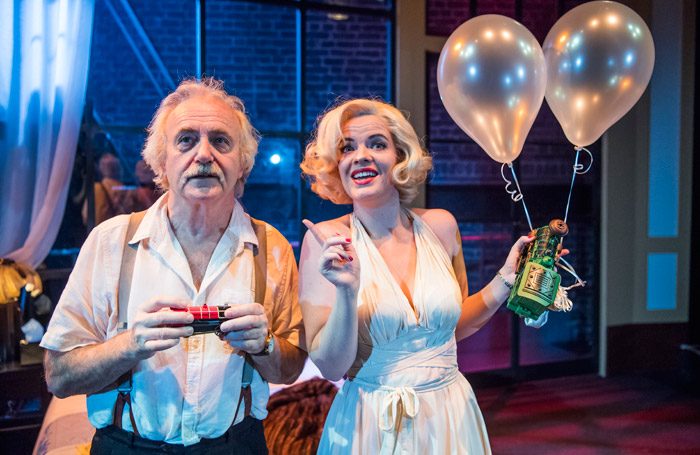
Alan Cox is a perky, self-aware Vanya. He can’t resist conspiratorially pointing out the failings of others though he well knows his own. He could have been a contender but now he is mordantly shuffling towards …. nothingness. Robin Soans as Serebryakov is fall of flatulent entitlement and Kirsty Oswald, who stepped in at the last minute to replace debutant Abbey Lee, is an unusually sensitive Yelena. (Apparently she kicked off with script in hand in which case she has come a very long way very quickly. Bravo). Alice Bailey Johnson similarly gives us a Sonya who is more assertive than normal, completing, with June Watson’s Marina, a triumvirate of women who bear the burden of supporting their various menfolk. Kika Markham also turns in a solid performance as Maryia, blindly in thrall to her son-in-law’s feeble academic reputation, as does Alec Newman as pickled idealist doctor, and babe magnet by geographical isolation, Astrov, and David Shaw-Parker as the permanently chipper hanger-on Telyeghin.
The Tourist caught one of the last performances, which, in a classic as richly textured as this, is normally not a bad idea. which means it’s gone now. However, if you are still a Vanya virgin don’t despair, (at least not at all you see it). Just like the 38 bus there be another one along shortly.
 At Home He Feels Like A Tourist