
Seraglio at the Hackney Empire review ****

Seraglio

Hackney Empire, 4th October 2019

Or to give it its full name Die Entfuhrung aus dem Serail or The Abduction from the Seraglio. Here though Seraglio, not just to reflect the fact that this English Touring Opera production is sung, (and spoken), in English following a colloquial translation by Andrew Porter of Gottlieb Stephanie’s original German libretto, but also to deflect away from the abduction and attempted rape which lies at the heart of the story.

And that’s not all. The setting, the seraglio, (where wives and concubines were confined), of Pasha Selim, reflects the fascination in late C18 Austria with an exoticised Ottoman Empire which had recently been decisively defeated by the Hapsburg forces. A story of racist superiority is what patron Emperor Joseph II expected to see at the premiere in Vienna in 1782 and this is, broadly, what he got, notably in the character of the Baddie henchman overseer Osmin. But Mozart being Mozart, with his quirky Enlightenment sensibilities, he took something of an axe to audience preconceptions by, eventually, showing the Pasha as selfless in relinquishing his claim on Konstanze and passing her to our hero Belmonte. Put like that it doesn’t sound much more palatable. Yet this twist is what directors in the modern age have clung on to fuel their interpretations. Stephen Medcalf, the experienced director here, was no exception.

If you want to enjoy Mozart’s operatic genius you are going to have to take the historically conditioned plotting rough with the many-noted, (this is the piece about which Emperor Joe made his famous, though apocryphal, comment), smooth. This is not the best of Mozart by a long way. Gottlieb Stephanie’s libretto relies on spoken word to advance the plot, and was not built for recitative, and some of the tunes are a little bit too pastiche Turkish. Even so there are some very fine arias however, which hint at emotional depth, and are some of the most challenging the boy Wolfgang ever penned, and there are plenty of comic sparks. For Seraglio is, despite its dubious content, a comedy which pivots on two “love” triangles.

As usual then the Tourist has to get comfortable with the idea of a Mozart “comic” singspiel opera rooted in anachronistic tropes before he can sit back and enjoy, but also, as is usual, eventually the music takes over. Mind you when I say sit back that is a bit of an exaggeration. At just £15 the side of the Upper Circle at the Hackney Empire is a steal. Sight-lines are fine and you are close enough to the pit for the acoustic not to be an issue. These are not the comfiest of chairs. On the other hand they are no worse than the equivalent cheapest seats at the ROH and the ENO. And there you need oxygen and 8×40 binoculars. So I will take this option every time, (and so should you with a Cosi and a slimmed-down version of their Giulio Cesare to come in ETO’s spring season).

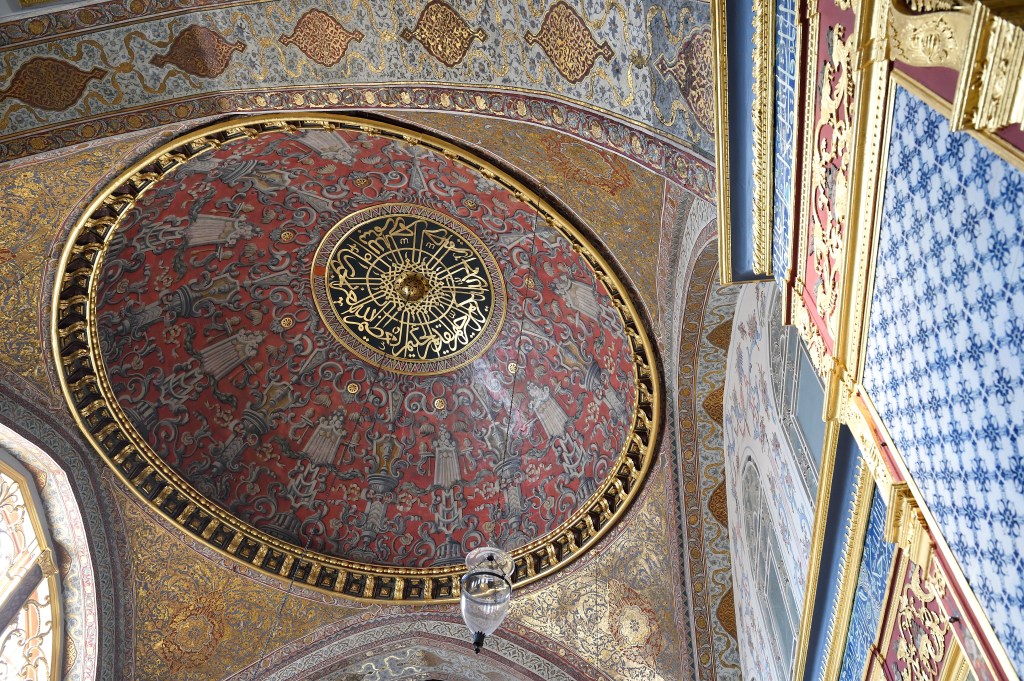
The sets in the handful of ETO productions I have seen have always impressed. Not too abstract but not too conservative. Touring plainly focusses the creative mind. Adam Wiltshire has devised a collection of gilded bird cages to symbolise the seraglio which swivels to provide Osmin’s Moorish gatehouse cum workshop, all framed by David W Kidd’s colourful lighting design. Costumes are faithful to the early C17 setting. Though it takes a little time before the big reveal given the perky extended orchestral intro that Mozart scored to show off his skills and introduce his themes. The Old Street Band orchestra, on top form under conductor John Andrews, was the standard 29 strong HIP Classical set up with a bit more percussion and wind (particularly convincing) to beef up the “Turkish” passages.

Enter Spaniard Belmonte in the form of John-Colyn Gyeantey who has come looking for his betrothed Konstanze (Lucy Hall), her maid Blonde (Nazan Fikret) and his steward Pedrillo (Richard Pinkstone). The two ladies have been captured by pirates and sold to Pasha Selim (Alex Andreou) who keeps perving the still virtuous Konstanze, with Blonde given to Osmin (Matthew Stiff, a well upholstered fellow much like the Tourist), as a slave. Osmin badmouths Belmonte, and then Pedrillo, prior to the two lads reuniting and hatching a plan to spring their lady loves. Pedrillo persuades the Pasha to give Belmonte a job as, er, an architect.

Act II. Blonde and Konstanze rebuff the advances of Osmin and the Pasha in turn. Pedrillo challenges Osmi to a drinking game. The two couples happily get together though only before, usual opera sexist nonsense, the fidelity of the ladies is confirmed.

Act III. Ladders. Distraction. Capture. An unfortunate bribe by Belmonte when it turns out his uncle Lostados is Pasha Selim’s sworn enemy. Likely torture and death until the Pasha’s extraordinary switchback as he decides he can make his point better by showing clemency. Happy ending.

Daft eh. Well yes. And torn, as was the Western intellectual and political fashion at the time, and maybe since, between admiration for “Oriental” culture and fear of the brutish “Muslim” other with sexual corruption a barely concealed sub-text. Mozart wasn’t the only composer of an “abduction/escape” comic opera. Audiences lapped them up. But whilst it takes a little time, the Pasha’s sensitivity and dignity, is eventually revealed, and Belmonte and Konstanze both explicitly voice their respect for him at the end. The finale may be a cheesy six way encomium, which puts Osmin back in his box, but the message of tolerance still shines through.

This doesn’t mean a get out of jail free card, (the pun is deliberate), for the comic shenanigans that precede this, even if there is more to the Pasha and even Osmin than meets the eye. And this is where the translation, the performances and Mr Medcalf’s clear-sighted direction persuaded. The acting, choreography and singing of the scenes between Pedrillo and Osmin (“Solche hergelaufne Laffen” and “Vivat Bacchus! Bacchus lebe!”), Osmin and Blonde (“Durch Zärtlichkeit und Schmeicheln” and “Ich gehe, doch rate ich dir”) and Konstanze and the Pasha (“Martern aller Arten” which is about as good as it gets Classical soprano wise), are tender and funny largely because they are the tussles of equals. Osmin’s amazing aria, (“O, wie will ich triumphieren”) where the bass part descends to a low D, is an empty triumphalism. Conversely there is a sense in Belmonte’s set pieces (“Konstanze, Konstanze, dich wiederzusehen … O wie ängstlich” and later, “Wenn der Freude Tränen fließen” and duet  “Welch ein Geschick! O Qual der Seele…. Weh, du soltest für mich sterben”) that he isn’t just going automatically win back Konstanze. In a plot built on rash negotiation the women here are definitely more in control.

It is still built on disconcerting premises but with acting and singing of this quality, especially from the feisty soprano Nazan Fikret, the dextrous light tenor Richard Pinkstone and plaintive Matthew Stiff, and the secure voices of John-Colyn Gyeantey, (bar a few wiggly vibratos), and Lucy Hall, it was impossible not to get carried along and I ended up thoroughly enjoying this production. Mozart wrote the parts for specific, and very talented, singers of the day, and Lucy Hall and Matthew Stiff particularly, were up to the task of navigating them. Alex Andreou was able to bring an air of thoughtful grandeur to the non-singing Pasha despite limited opportunity and a few shouty moments, especially when describing how he was so wronged by Belmonte’s uncle. And the small chorus of four, two guards, two concubines, (Rosanna Harris, Holle-Anne Bangham, David Horton, Jan Capinski) gamely mucked in with prop moving alongside their vocal duties.

So there you have it. A thoughtful production where director and designer simply nudge the material into the c21 and then allow the talented cast and well drilled orchestra to highlight the comedy in Mozart’s music and in the plot. And, for once, I didn’t really need the sur-titles. In my still far too limited experience opera either works or it doesn’t. Sometimes you can stake high and lose big. Not here though. A massive beat to expectations as I might have said in a past life.
English Touring Opera at the Hackney Empire review ****

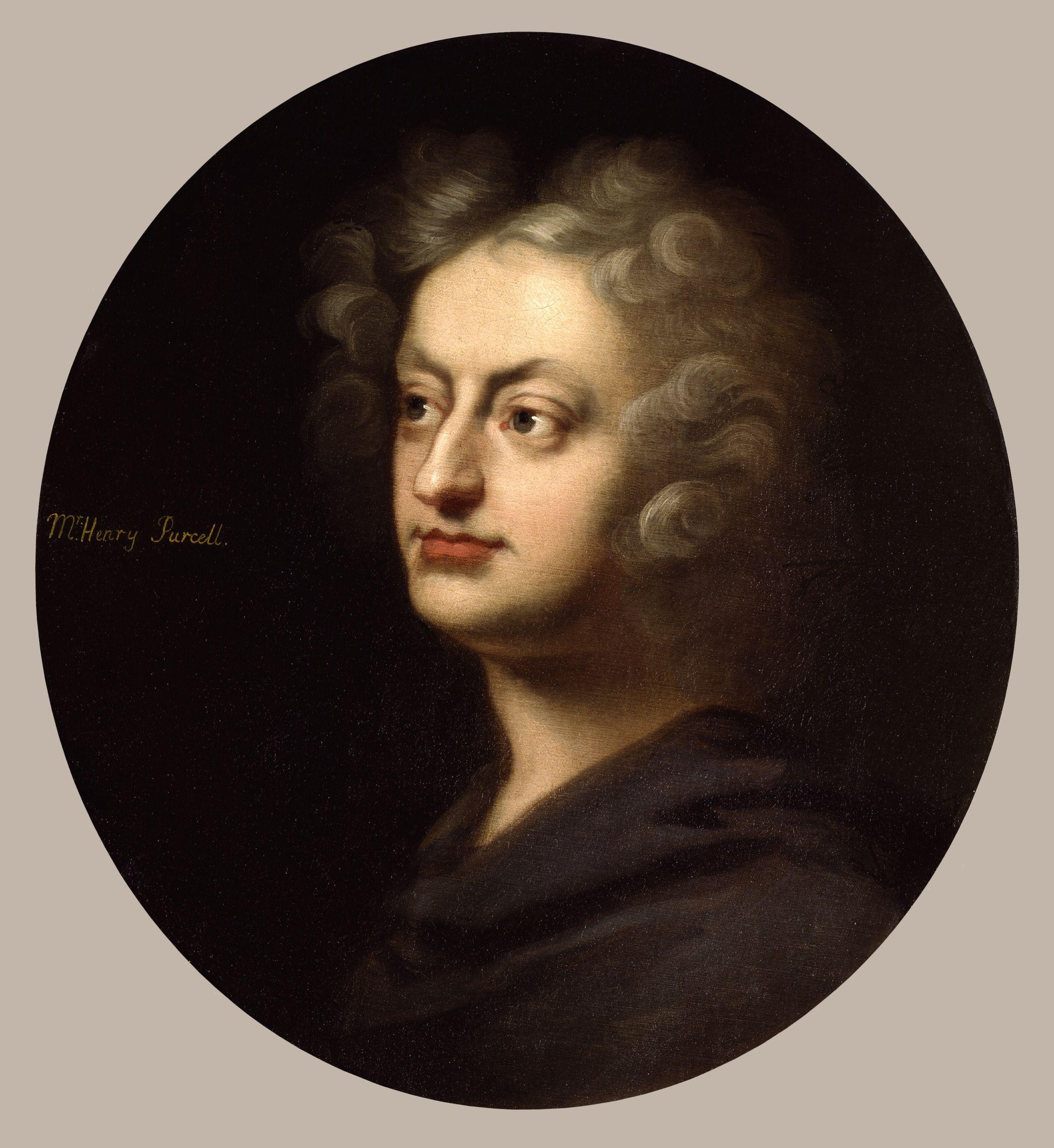
Henry_Purcell_by_John_Closterman

English Touring Opera

Hackney Empire, 12th October 2018

  • Purcell – Dido and Aeneas
  • Carissimi – Jonas
  • Gesualdo – I Will Not Speak

I am partial to English Touring Opera’s productions. The repertoire tends to be up my street, with a bias to smaller, chamber and Baroque works, reflecting resources and logistics. Suits me. I can’t be doing with all that C19 showy stuff. Last year’s Giulio Cesare went on a bit, but that’s Handel for you, their take on Monteverdi’s Ulysses in 2016 was a corker, and I recall a Coronation of Poppea and Albert Herring a few years ago (before I kept track of stuff). And the Hackney Empire is like a favourite old aunt, if I had been born into circles that had such things.

This also was another opportunity to expand BUD’s opera education after the very successful Mozart forays, and the rather more muted reception to Britten. Now spare a though for the poor chap who is, like all the other economically productive people around me, working far too hard. When capitalism had the bright idea of separating work and leisure time, thereby ensuring we worked harder to make more money to spend in our ever decreasing leisure time, it cannot have foreseen just how clever the wheeze would be. Especially when so many of us are both labour and capital simultaneously. Anyway it meant that he was a little bushed and, with the Empire not too sure where to pitch the internal temperature in these climatic tipping point times, it was a bit close in the auditorium. I have put myself through many hours of training in London’s less comfortable venues so this was water off the proverbial, but even so I have to admit to skirting with drowsiness, notably in the Gesualdo.

Which is a shame, as in some ways, this was the most interesting of the three part programme. Director James Conway, and the eight soloists on stage on this evening (see below), tell the story of Gesualdo’s life, interspersed with various of the responses from his Tenebrae setting, a handful of relevant madrigals, poems by Southwell, Donne, Herbert and some other religious stuff. Now as you no doubt know Gesualdo had a bit of a temper on him and got himself in a bit of a tizzy with pain, agony, ecstasy, love, death, passion, blood, honour, violence, sorrow, religious fervour, torment, being forsaken and the like. And above all by guilt. That’s Catholicism for you. These texts captured all of that and more, being helpfully relayed through sur-titles. A dark, reflective set, atmospherically lit by candles, black costumes and some prudent choreography all helped the mood of the piece. Gesualdo, a dark presence in another, somewhat perplexing, recent entertainment I attended (The Second Violinist at the Barbican review ***), seems to exert a powerful hold on us devotees of early music.

I had bigged up all of the strange dissonances, out-there chromaticism and dark intensity which pervades the prince’s compositions, but as it turns out, BUD took it all in its stride. As did the Old Street Band, here under Jonathan Peter Kenny. Maybe they could have been a little wilder and more sympathetic to the text, and they seemed to me to be more comfortable in the Purcell and especially the Carissimi, but overall, this “I Will Not Speak” is not to be missed if Gesualdo floats your boat.

Giacomo Carissimi was an important chap in the development of vocal music in Europe in the early Baroque, and the dominant player in Rome. He was all over motets and cantatas but he really excelled in the oratorio, basically inventing the form. He was to religious choral music what Cavalli was to opera. (I appreciate that only in very limited circles will that mean anything at all). His big break came when he was appointed chapel master at Collegium Germanicum, a Jesuit bastion of the Counter-Reformation, in his early 20’s where he stayed for the rest of his life.

Now think of an oratorio as a biblical opera without action. Mind you here we got a bit of staging courtesy of designer Adam Wiltshire and the excellent lighting of Rory Beaton and some stylised choreography. You probably know Jonas by his more common moniker of Jonah, so I won’t bore you with the detail of the story. Naughty Niveveh-ians up to no good. God to Jonah “sort them out”. Jonah runs away. Storm. Sailors chuck him overboard. Unpleasant fish/whale belly short break gets just one star on TripAdvisor. Big belch. Washed ashore. God sends him back to Nineveh. This time they promise to be better. Thanks merciful God. Jonah throws a hissy fit and he and God have some sort of “my job is worse than yours” tiff.

So all the standard “behave yourself or else” merciful/vengeful God parable stuff. What is interesting is the way Carissimi employs really quite simple musical structures, (and dumps the last part), to bring the words to life and to convey the silly/substantial story, (depending on your point of view). And he really doesn’t hang about. It’s all over in 20 minutes. Put this, and his more famous Oratorio Jepthe, on one CD and there’s still space for a filler. Now it is made up of some fairly dryish recitative, but there is enough solo melody, some duets and trios, and small chorus, as well as instrumental breaks (sinfonias)  to add flavour, and to show why he became such an influence on later composers notably Charpentier. Don’t expect the funky mash-ups and luscious chromaticism of Monteverdi, this is straight-laced by comparison, but it is very effective and very moreish. It shows just how the voice and instruments could be combined in the service of drama in a way that the barrage of sound that was the polyphony of the previous century never could.

Of course this all went up a notch, actually well past 11, three decades later when the boy wonder Purcell gifted the world the score of Dido and Aeneas, the ill-fated lovers from Carthage and Troy. There is his cherubic little boat at the top. It is an undeniable fact that Purcell’s opera, with Nahum Tate’s libretto, lacks a bit on the plausibility front. Dido works herself up into a right lather, for no good reason, at the prospect of her bloke going off to war. I guess you could argue she is emotionally damaged, maybe even depressed, from the off, but that requires an awful lot of intellectual back-filling.

For this we probably have to thank the forces of anti-Catholic propaganda. No camp sorceress in Virgil’s original remember so Tate fiddled with plot in his play, The Enchanted Lovers,  on which the libretto is based to curry favour with the Court. And why not? They had to earn a corn.

There are also a fair few tonal shifts, with plenty of upbeat numbers amongst the tragedy and an ambivalent approach to Dido’s virtue. All of this perhaps reflects its genesis in a country where the masque, and plays, pre and post the Restoration (for which HP wrote lots of music), were been the dominant dramatic forms. Merrie Olde England, always wary of those suspect Continental innovations, like opera. This ETO production, which I have to say looks superb, thanks to the aforementioned Messrs Wiltshire and Beaton, is set in Jacobean times, think Dowland and later Shakespeare, several decades before the opera was first performed and a time when melancholy (cue our mate Gesualdo) and magic (James I wrote books on it) were all the rage. Worked for me. The staging I mean, not the belief in the spirit world.

Who cares about the structure though with music as ravishing and so perfectly matched to the voice as this. Which is after all what Purcell was all about. Now I can’t lie. I can only take so much singing in classical music. So all those odes, anthems, hymns and songs, whilst attractive enough on first listening, do fade a bit from memory. And, to be fair, I couldn’t tell which suite, fantasy, trio sonata, overture, air, minuet, blah, blah, blah is which in HP’s oeuvre. But what I do know is pretty much anything you will hear by Purcell will provoke an immediate, and very direct, response. I cannot be doing with the “genius touched by God” theories of artistic accomplishment but it is hard to deny some composers just “had it”. Everything just makes sense from the first listen of the first bar. HP was one of them. (Mind you living just down the road from Westminster Abbey and having a musically well-connected uncle probably came in handy). There are those who would have you endure a world of maximalist complexity in order to render you worthy of “appreciating” “Classical” music. Ignore them. Rhythm and the dance is where it’s at.

So this, his only “proper” opera, was his finest hour, literally. Like I say don’t dwell too much on the clunky dramatic devices and half-baked classicism and just listen to those amazing sounds. HP’s music can make fake emotion seem real. There are a few operas that people who have no interest in opera should go see and listen to. Dido and Aeneas is one of them. No need to change your view on the art form, I that a lot of opera is piffle, just don’t spend a life without this one. Without the music it is just nonsense, (though don’t blame the Greeks, it is the Renaissance trivialisation and prettification that is to blame). With the music it is transformed.

HP’s opera didn’t come out of nowhere, owing something to his bestie John Blow’s D and A and, more obliquely, Cavalli’s Didone (which also has a lament for dizzy Dido). HP may have delivered up what his conservative patrons demanded but he was aware of musical developments across the Channel even if he didn’t study there. After all, post Restoration, England was awash with French and Italian musicians, who brought us the Baroque bug. (You see Brexiteers, we have always benefitted economically and culturally from them furriners, even importing a few to sit on our throne if we didn’t fancy the home-grown alternative). Here Dido and Aeneas kicks off with your standard two part French overture and its best known tunes, including you know what with its stepping ground bass, are Italian style arias. HP delighted in gentle dissonance, splashes of chromaticism, sighing falls and minor thirds, all audible in Carissimi, amongst others. Yet he also favoured one of Tallis and Byrd’s gifts to the world, false relations, a “natural” note and its “sharps” played simultaneously.

HP, as far as I can tell didn’t live fast, but he did die young, maybe through TB or maybe, in a slightly more rock’n’roll way, after being locked out by his missus following a night on the lash. We in GB have always been convinced of his greatness, and our American cousins agree, but this may reflect the fact that we came up short on the composer front until, IMHO Benjamin Britten came along. BB obviously worshipped HP. So should you.

  • Susanna Fairbarn – Soprano
  • Alison Manifold – Soprano
  • Sky Ingram – Soprano
  • Benjamin Williamson – Countertenor
  • Jorge Navarro-Colorado – Tenor
  • Richard Dowling – Tenor
  • Nicholas Mogg – Baritone
  • Frederick Long – Bass