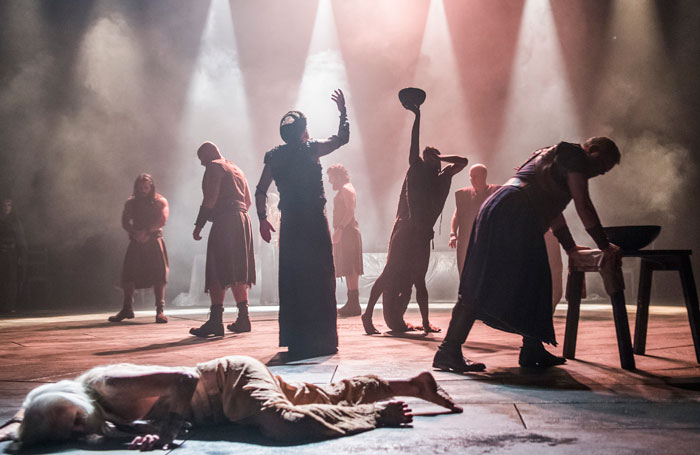
Leopoldstadt at Wyndhams Theatre review ****

Leopoldstadt

Wyndham’s Theatre, 29th January 2020

A new play from the venerable 82 year old Sir Tom Stoppard. Not our greatest living playwright. That is Caryl Churchill, but he does know his way around a text. So booked early, for early in the run and before knowing too much about it.

You will likely know by now that Sir Tom has chosen to delve into his family’s own history and his Jewish heritage for this play, which I can see would be a fitting swansong, if swansong it is. He was born in Czechoslovakia, but escaped to Britain with his family ahead of the Nazi occupation, and was educated in India and then Yorkshire. Whilst he had become aware in the 1990s of the full extent of his roots, (which his mother had chosen to shield him from), as well as the fact that many of his relatives had died in Nazi concentration camps, and he had indicated that he would likely write a play based on this history, he had been ambivalent about making it too personal.

I don’t know how much of the plot, and specifically the key events which punctuate it, are drawn from TS’s own family history, nor indeed how closely the characters resemble his own forebears, (though the character of Leo is surely autobiographical), but there is no doubting his emotional investment in this grand saga. Particularly at the end, in an epilogue which is as moving as anything you might ever see on stage.

We kick off in Vienna in 1899 at a gathering of the Merz and Jakobovicz families at Christmas (and later passover). Bullish businessman Hermann Merz (Adrian Scarborough, on his usual top form) is married to gentile Gretl (Faye Castelow), having, pragmatically, converted to her Catholicism. They have one son Jacob. Hermann’s sister Eva (Alexis Zegerman) is married to obsessive mathematician Ludwig Jakobovicz (Ed Stoppard, yes, he is) who has two sisters, Wilma (Clara Francis), married to Ernst (Aaron Neil), and Hanna (Dorothea Myer-Bennett, continuing the Tourist’s fortunate habit of seeing everything she does on stage), who is married to Kurt (Alexander Newland, who we meet later on). With their various kids, cook Poldi (Sadie Shimmin), parlour maid Hilde (Felicity Davidson), nursemaid Jana (Natalie Law) and all presided over by Grandma Emilia (Caroline Gruber). Thank goodness for the family tree in the programme which the Tourist furtively turned to early doors.

With this many characters, and to set the contextual and didactic balls rolling, and because this is what Sir Tom does best, there is a lot of serious chat going on, as we learn how these well-to-do, educated and largely assimilated Jewish families see themselves, their faith, culture and economy, at a time of great change in Europe’s still premier metropolis. And, inevitably in the first act, bucketloads of exposition. The Merz family doesn’t live in Vienna’s Leopoldstadt district but its status as the centre of Jewish life in the city looms large. The anti-semitism is subtle as well as overt, but its deep historical roots are unmistakeable. Hermann tries and fails to join the jockey club, Ludwig’s hopes of a professorship are far-fetched, and ugly truths are revealed, along with the superb Luke Thallon’s cruel Aryan officer, Fritz.

The play really gets going then after the interval, as we move first to 1924, another family gathering for a circumcision, meeting the cosmopolitan children of the four couples, and then, momentously 1938, and the grandchildren. This is the cue for high drama, for example, the forced repossession of the Merz family home, and eviction, Kristallnacht (vividly realised through Adam Cork’s brilliant sound design), the memory of Pauli (Ilan Galkoff) lost in the WWWi trenches. Then, finally to 1955, when Leo (Luke Thallon), the English emigre son of Nellie (Eleanor Wyld), daughter of Eva and Ludwig, and Nathan (Sebastian Armesto, also doubling), son of Sally (Ayve Leventis), daughter of Wilma and Ernst, are brought together by Nathan’s sister, Rosa (Jenna Augen). This, or something like it, is, I’d like to think, how Sir T first encountered his own history, and planted the seed for Leopoldstadt.

The dialogue is direct, even during the debates on, variously, identity, assimilation, prejudice, Zionism, the recurring history is familiar and there is none of the intellectual trickery that powers Sir T’s back catalogue though there is a bit of heavy lifting from a recurring cat’s cradle metaphor. The family’s beliefs in science, justice and rationality are crushed by the rise of Nazism, but it is the personal loss more than the collective that, eventually strikes home, with Hermann’s descent the most affecting. It is a slow burn mind you, and Patrick Marber’s direction is perhaps a little too respectful. Richard Hudson’s painterly design. together with Neil Austin’s lighting and Brigitte Riefenstuhl’s costumes ooze period detail, but further hinder any opportunity for many of the 26 strong cast (not including the kids) to make a distinct mark.

Still if this is to be Sir T’s last play then why shouldn’t he tell his story his way, given his immense contribution to British and World theatre across his career. At our early viewing (the SO was a more than willing accomplice) the audience was engrossed throughout, if nor utterly captivated, and I suspect many will have been grateful to have had their emotions, perhaps even more than their intellects, engaged. The story of this horror has been told in many ways before, and should continue to be told, but Sir T has found a way to tell it that, whilst not theatrically radical, is profoundly moving, as well as stuffed with learning.

I have no doubt it will be back when we reach the other side, and it is not hard to see it being repurposed for the small screen.
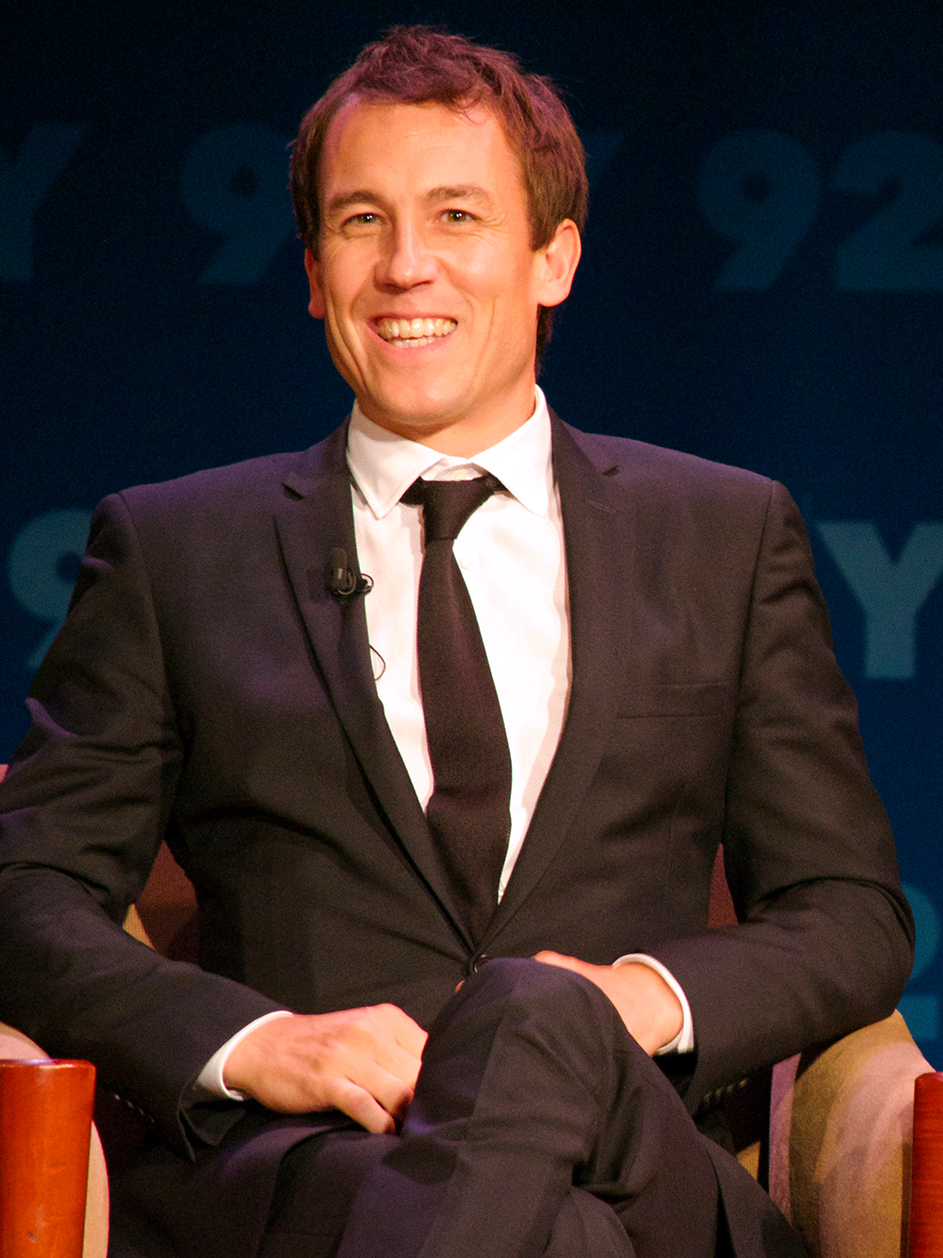

The Hunt at the Almeida Theatre review *****

The Hunt

Almeida Theatre, 1st August 2019

I am not sure where I stand on the films of director, controversialist and misogynist Lars van Trier. I guess if you venture into dark territory you are going to make the audience that follows you uneasy. Which is how I feel about the likes of Breaking the Waves, Dancer in the Dark, Dogville, Melancholia and Nymphomaniac. Brilliant film-making if not always brilliant films. 

Fellow Dogme 95 founder Thomas Vinterberg is a much more palatable director however. More interested in social rather than individual psychology, more polis than eros, and less prone to stylistic innovation. Festen (The Celebration) is a work of unsettling, tonally ambiguous, tragi-comic genius, Submarino somehow extracts redemption from the unremitting pain of the brothers’ lives at its centre, Far From the Madding Crowd is better than the original, (Schlesinger’s and, I regret to say SO, Hardy’s), I’ve just seen the intriguing The Commune and I have Kursk on the watch list. But his best film for me is The Hunt, though it is helped by an outstanding central performance by the coolest actor on earth Mads Mikkelsen. 

All of his “original” films seem to be to be intrinsically dramatic, focussed on character, plot and idea, rather than spectacle, and not expansive in terms of time or place. Which makes them eminently suitable for theatrical treatment. It is a matter of some regret that the original Almeida production of Festen in 2004, which cemented the reputations of both Rufus Norris, now NT head, and playwright David Eldridge, who adapted the script of Vinterberg and his regular co-writer Tobias Lindholm, coincided with a theatrical “dry” period for the Tourist. Hopefully one day it will return.

This time it is Almeida AD Rupert Goold directing, following on from his string of hits , Shipwreck, Albion, Ink, Medea, King Charles III and American Psycho. We should never forget that it all starts with the writer, and that in this regard the Almeida has been lucky. More over the theatre is, I assume, now flush with enough cash and kudos to pull in any actor and creative team that is desires. Even so, and maybe forgiving a few recent misfires, the last few years have been a purple patch for the house even by comparison to its very high historical standards. Simple rule. Just buy a ticket for everything they put on. Even now that Robert Icke is on his way since Rebecca Frecknall looks to be a very capable replacement as Associate Director. (Next up her version of Webster’s The Duchess of Malfi. Any playwright good enough to inspire a Bunnymen song gets my vote).

A story of a man or woman wrongly accused and shunned by a small community is obvious theatrical catnip. Reference the film where teacher Lucas returns to his Danish hometown and a job in a primary school after redundancy and the break-up of his marriage in the city. After a misunderstanding in the school with Clara, the daughter of Lucas’s best friend Theo, that we, but not the community, see, Lucas is accused of paedophilia. The set-up, the investigation that follows and the violent fall-out is all painfully realistic. The story though ends with neither forgiveness or banishment as you might expect. There is plenty of symbolism along the way as Lucas’s relationships with colleagues, friends, son Marcus, church members and hunting pals is dissected. A thriller with a moral message, rich in ambiguity, taking a potshot at Danish society’s complacent view of its own tolerance. Like I say. Theatrical catnip.

But it still needed adapting. Enter David Farr. I don’t know any of Mr Farr’s original writing or adaptations in the theatre but I, and probably you, will know his work for television, particularly his adaptations of John Le Carrie’s The Night Manager and, less successfully maybe, Misha Glenny’s McMafia. For The Hunt he has stuck pretty closely I think to the plot and chronology of the film, though he has made Lucas more solitary by removing girlfriend Nadja and friend Bruun, altered his relationship with Marcus and cleverly updated the schoolroom set-up. The deer hunts, and the ritualistic machismo that pervades them, have also been highlighted and provide some intense theatre assisted by the costumes of Evie Gurney, lighting of Neil Austin, sound of Adam Cork and movement of Botis Seva. Lucas is, graphically, turned into the prey.

I have said before that Rupert Gould strikes me as a generous director who brings out the best in the creatives around him and The Hunt is no exception. This is a gripping story but could have been delivered in a predictable enter/dialogue/exit, scene after scene fashion, as literal as its source. Instead, as in the string of his other plays mentioned above, the play is replete with movement, symbolism and visual diversion. The tone is set by, er, Es Devlin’s set. Yes it is another of her trademark glass boxes, set on a blond wood circular stage, but, whether as school, house, church, hunt meeting hall or, brace yourself, deer enclosure, switching from transparent to opaque, from place of safety to place or threat, it still works to brilliant effect.

Tobias Menzies is set to play Phil the Greek in Series 3 and 4 of The Crown but he has already decorated TV and film with distinction, though looking at his bio I haven’t seen nearly enough of him. On stage he was excellent as Mikhail/Michael in Robert Icke’s underrated Uncle Vanya at, yep you guessed it, the Almeida, but other than that, again, I haven’t seen him perform. Here though he was perfectly cast. Lucas is innocent, of the crime of which he is accused for sure, but also in a broader sense. This story is not an attempt to create false parity or deny the victim. It is about the hypocrisy and anger that can infect a small community when threatened. Lucas is neither good nor bad, simply the catalyst for the reaction, though we can sympathise with his plight. This doesn’t mean that the play dodges the uncomfortable truths it confronts, just that it doesn’t go in, as is the Dogme 95 way, for an overt moral stance.

For this to work requires Tobias Menzies to present Lucas as self contained, curiously restrained, almost withdrawn, in the face of what happens. This he does. To devastating effect. Justin Salinger as the feckless Theo and Poppy Miller as his unhappy wife Mikala, the three of them have baggage, are equally convincing, torn between believing their daughter or their friend. Around this trinity, Michele Austin as head teacher Hilde, Stuart Campbell as the gawky, raging Marcus, Danny Kirrane as the hyper-aggressive Gunnar and Howard Ward as the investigator Per also stood out. And Abbiegail Mills as young Clara should definitely stick with this acting lark (though not to the exclusion of her other studies of course).

Adaptations of films for the stage don’t always work. Witness many of Ivo van Hove’s creations. Though Network was a recent triumphant exception. This was in large part though thanks to the unsung adaptation of Lee Hall. In the same way we must thank David Farr for his smart contribution here. As good as the film? Maybe not quite. But still something remarkable to set alongside it.

Exit the King at the National Theatre review ****

15512-illustration-of-a-king-of-diamonds-playing-card-or

Exit the King

National Theatre Olivier, 15th August 2018

My first Ionesco play, albeit in a version adapted by ubiquitous wunderkind Patrick Marber, (one day the image of Peter O’Hanraha-hanrahan that pops up at the mention of his name will pass), and, all things considered I liked what I saw and heard. I gather Exit the King is the least absurdist of his major works but there is nothing existentially impenetrable about this production. Apparently too this was the National Theatre’s first ever production of this playwright.

Maybe, over its 100 minutes or so running time, its theme, forgive the pun, was done to death. And maybe there was a bit too much “one character at a time”, comic-strip style declamation but overall I was hooked. Rhys Ifans, who I cannot lie, can annoy me, (I wasn’t bowled over by his fool in the Glenda Jackson Old Vic Lear), was perfectly cast as King Berenger; his movement, stature and delivery were expertly marshalled to great effect as the King went through the various stages (denial, anger, bargaining, depression) on the way to accepting his death. Indira Varma was imperiously forthright as Queen Marguerite, as you might expect, and Amy Morgan as Queen Marie, the King’s pandering favourite was a fine foil, even if I have to assume she was more Breton than Ile-de -France given the Welsh twang in her Gallic accent. Adrian Scarborough as The Doctor has added another notch to his long list of comedy side-kicks, the under-rated Debra Gillett squeezed a lot of laughs out of the maid/nurse Juliette as did childhood hero Derek Griffiths as the Guard, (I only realised it was him halfway through), with his pithy Brechtian pronouncements on the action.

Patrick Marber once again showed what a clever fellow he is, not just in the way he understands and interprets classic texts, but in the way he makes them relevant and lucid to contemporary audiences, (After Miss Julie, Don Juan in Soho, Three Days in the Country, Travesties). That I guess is what makes him so bankable as a writer/director though I would like to see him conjure up another original play to rival the heights of Dealer’s Choice and Closer. Anthony Ward’s set design is a triumph, showing it is possible to fill the vast Oliver barn with just six characters, and the coup de theatre delivered at the end, with the assistance of High Vanstone’s lighting and Adam Cork’s sound design, is worth the ticket price alone. No hyperbole here. I literally think it is worth paying £15, for there are plenty of the cheap Travelex tickets left, to see this technical wonder.

King Berenger has reached the grand old age of 483. His kingdom is on its knees but the despotic old boy doesn’t seem to care. He discovers he only has an hour or so to live. There’s nothing the Doc can do. Welcome to the surreal world of French-Romanian playwright Eugene Inonesco. We are in a fairy tale though one that seems to obey Aristotelian real time. KB isn’t happy about the news. His Queens alternatively coax him into denying or accepting this reality. There’s is a deal of metaphysical and psychological insight, some game-playing and a few good one-liners, even if there is no real surprise in the narrative arc. But it does make you think and you do identify with the humanity inside these fabulous characters and there is an energy or, for want of a better term, a life-force, in the play which draws you in, despite the dramatic inertia. As someone who has veered rather too closely towards the guard-rails of mortality in recent years I could see what Ionesco was driving at. He does sound like a bit of a eeyore who spent too long pondering the big questions in life, (and here death), but we need people like that to spare us having to grapple with all this mind-f*cking stuff.

Exit the King is a tragedy played as a comedy and there is, as we know, a lot of fun to be had in that. It isn’t difficult to spot the parallels with the central concern of Lear say, albeit big Will shoves in a few other themes, (and Lear obviously has a fair dose of the absurd), as well as your man Beckett. I have to say though I found this easier to digest than Beckett, though I am no expert. Maybe that reflects the quality of the production but I think I would be keen to see this chap Berenger again, (apparently he crops up in other EO plays Rhinoceros, The Killer and A Stroll in the Air). I suspect that I won’t have too many opportunities to realise this dream, as this is not the sort of theatre to guarantee bums on seats, so I had better crack on with it.

Lurking behind this one-key morality tale Mr Marber does try to draw out a broader message. Just as when we individually die, we die – that’s it folks – and our lives don’t really matter, so it is the same for our species. Homo Sapiens will end with a slow whimper not a bang (technology I’m afraid is the enabler, not the saviour, of our destruction), and there will be no consciousness left to care or mourn. A combination of cynicism and stoicism is the only solution.

Have a nice day.


Salome at the National Theatre ***

salome-olivier-285

Salome

National Theatre, 5th July 2017

Salome, much like Common also currently residing on the Olivier stage, has been given a bit of a pasting by the criterati. Not utterly trashed but its obvious flaws have been highlighted. And much like Common I have to say I think the criticism is a little misplaced (Common at the National Theatre review ***.

The text is ponderous, with a strange mix of bombastic Biblicality, overwrought imagery and sometimes vague, paradoxical didacticism but the themes are still revealed and once you adjust to the style and pacing it exerts a sort of spell. Yael Farber has directed some cracking theatre, not least the NT’s Les Blancs on this very stage last year. She is not afraid of bashing you over the head with the messages she whats to convey and is the antithesis of theatrical reserve. Having set out to direct Wilde’s version of the Salome “story” she found that the truth of that “story” had been revised, reviled and distorted at the hands of the unholy trinity of history, religion and patriarchy. So, following a bout of impressive scholarship, she set out to write her own version.

Nameless (our Salome in her dotage), played with sonorous venom by Olwen Fouere, acts as our “narrator” as we are introduced to Judea c. AD 26. Cue flashback. Pontius Pilate is whinging about getting the gig here, the Pharisees are getting all orthodox and hanging on to their cash. Herod (there were a few of them) is swanning about as vassals do and getting all lathered up about his niece who may be Salome. John the Baptist pitches up, berating everyone in Aramaic (I assume) for being insufficiently hairshirt. Authorities decide to lock him up rather than crucify to stop the hoi-polloi turning nasty. Dance, head, plate, end. But the crafty Salome/Nameless and John B have outwitted the Roman occupier for martyrdom and revolt are the consequence.

Ms Farber, through the shouty stuff, shows that the whole Salome myth was laid on top in subsequent centuries and gives a flavour of these fervent times when monotheistic religions was developing. And it looks and sounds spectacular courtesy of Susan Hilferty and Adam Cork respectively. Renaissance art comes to life. I know that set, sound, movement. lighting, costume and other visual flummery is not enough on its own to justify a trip to the theatre but this comes mighty close. The singing of Yasmin Levy and Lubana Al Quntar was spell-binding. And the multi- nationality cast largely gives a full-throated bash at delivering even the most pretentious twaddle. In particular I was taken with Lloyd Hutchinson’s Pilate, the aforementioned Olwen Fouere, and especially Ramzi Choukair’s Iokanaan (the Baptist to you and me). 

So yes it is all a bit elliptical, it is trying too hard to be good for you and the text is undeniably orotund (I bloody love that word) but it has a hazy, mystical quality which I think suits the “action” such as it is. Myth and ritual are central to any conception of art and the ideas here do eventually penetrate the fog, particularly the tragedy of occupation and the masculinisation of history through the metaphor of the female body. So I say good on ya, Yael and don’t let the bastards grind you down.