Darkest Hour film review ****

darkesthour

Darkest Hour, 30th January 2018

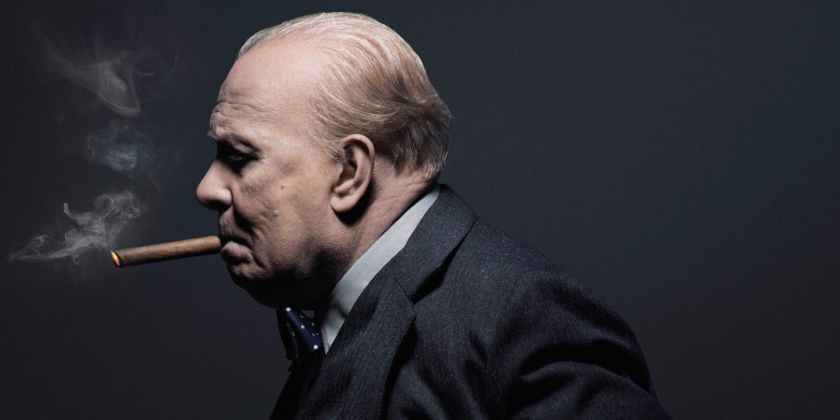
I wonder when they decided? Is it what the producers demanded at the outset? Was it always there in Antony McCarten’s script? Did director Joe Wright, (who has shown in his stage work at the Young Vic with Life of Galileo and A Season in the Congo that he can do innovation), see this as the only way? Whatever the case somewhere along the line Darkest Hour went full on lachrymose. Now this isn’t necessarily a bad thing. I just wasn’t quite prepared for quite such a mawkish, tear-jerker.

Now I have confessed before that I am a sucker for a bit of Churchill and Dunkirk spirit having been roped in against my subsequent better judgement by Christopher Nolan’s extravaganza (Dunkirk film review ****) and even tolerating Brian Cox in last year’s other eponymous biopic (Churchill film review **). Most everyone of a certain age who professes some sort or attachment to “British” identity is going to have  strong emotions about Winnie, whether swivel-eyed Brexit loon, or dismissive, metropolitan elitist, and everything in between. For good or bad Churchill is intricately bound up with our idea of this country. Nation-states are lines on a map bound up with largely fictional shared histories and Churchill is integral to “our” story. Unfortunately his myth also contributes to the heady exceptionalism that has got us into the pickle we now face.

So how to bottle this powerful cocktail? Well as it turns out in a surprisingly orthodox way. First up get an everyman character actor of unparalleled class. How was Gary Oldman going to be anything other than brilliant in the role? Especially when loaded up with state of the art prosthetics, fattened up like a Christmas turkey and fed copious brandies and cigars. The bookies can’t even be arsed to take your money on the Best Actor Oscar. Whether you want your Winnie showing why oratory and rhetoric can still shape the direction of human progress, or riven with self-doubt, or consumed with hectoring bluster, or being a p*ssed baby or delivering exquisite bon-mots, then Mr Oldman is your man. Kristin Scott-Thomas is the perfect Clemmie, devoted no-nonsenseness personified, Ben Mendelsohn turns in a thoughtful portrayal of George VI (until he becomes Winnie’s bessie), Lily James is the mandatory plucky Lizzie Layton and Ronald Pickup as Chamberlain and, especially, Stephen Dillane as Halifax excel as the deluded appeasers. Cinematography, sound, music, sets, costumes, are all perfectly drilled.

And to cap it all we even get the daft scene in the tube. Why not? Who says you need absolute fidelity to the “truth” given we cannot really know what the “truth” was in the minds of these people in those fateful days. But having Winnie surprise, and then canvas the views of, a carriage full of diverse yet indomitable, “gor-blimey” Londoners, really does ratchet up the blub quotient, at least for this old fella. And he would still have been quicker walking.

I know I should be snarky here. I know I should be whingeing about the playing fast and loose with events. I know I should be pretending not to be moved or reminding you that Churchill was, in so many ways, a bit of a c*nt. But I won’t. Because with his direct story, marvellous cast and clever camera-work, (spiced up with the occasional visual treat), I reckon Joe Wright has ended up telling a cracking story. Which gets to the heart of why we need leaders who know right from wrong and why they need words to speak truth. Powerful words. For that surely is why, despite all his human faults, Churchill’s myth is grounded in a reality.


The Open House at the Print Room Coronet review ***

greg-hicks-and-teresa-banham-in-the-open-house-at-the-ustinov-studio-theatre-royal-bath-credit-simon-annand-1024x706

The Open House

The Print Room Coronet, 27th January 2018

Arthur Miller, Tennessee Williams, Eugene O’Neill, August Wilson, Lorraine Hansberry, Sam Shepherd, Lillian Hellman. All succeeded at writing a Great American Play, or in some cases Plays, about dysfunctional families. In an entirely naturalistic way. It is the meat and drink of American drama.

I am no expert but I suspect there have also been multiple attempts to subvert this staple. That is what writer, Will Eno, is about here. Open House is another collaboration with Bath Theatre Royal’s Ustinov Studio, which has proved fruitful to date. I was reeled in by the Bath reviews, by the concept, but most of all by Greg Hicks, who is a marvellous actor IMHO. His Richard II at the Arcola was one of my favourite turns of last year. And, all things considered, I am glad I went along, though I have to confess this is a play that delights rather more in its central idea and its structure, than in its characters.

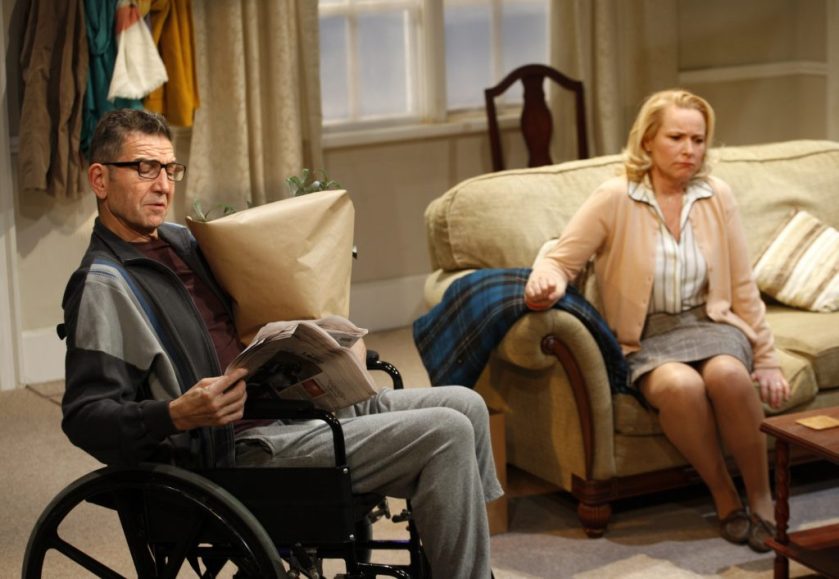
Father, (yes it is one of those trendy no-name jobs), played by the aforesaid Mr Hicks, is a cantankerous, misanthropic, sarcastic bully. Confined to a wheelchair post a stroke he pokes, probes, belittles and demeans the family that has gathered to celebrate a wedding anniversary. Long suffering wife and Mother Teresa Banham (last seen by me in the rash Dessert at the Southwark Playhouse) tries hard to blunt his barbs and smooth things over but her heart isn’t in it anymore. Son (Ralph Davies) and Daughter (Lindsey Campbell) make nervous family small talk but are constantly shot down by their irascible Dad. Finally Uncle (Crispin Letts) seems lost in his own world, still grieving from the loss of his wife. So far so miserable. It is on occasion very funny, in that cringey, lemon-sucking way, Mr Eno has an ear for the rhythms of this painful family gathering and the cast lap it up. Tom Piper’s set along with Madeleine Girling’s costumes, Oliver Fenwick’s lighting and Andrea J Cox’s sound all contrive to create an atmosphere of utter blandness. Colour is absent.

Food is needed and Daughter volunteers to head out to the deli. And one by one, for various reasons the family leaves. And one by one the family returns, but in a different guise. Daughter is now a realtor who is set to sell the house. Son is a handyman come to fix a couple of things, Uncle a prospective buyer, Wife his partner. Father is last to leave and is mystified by what is going on, (despite prompting the shift by revealing he wanted to sell up), until he returns as the buyer’s friend and lawyer. And, with all this coming and going, colour and light seep in. The conversations more from pained recrimination to upbeat geniality, focussed on the here and now and the future, not the past. In short from pessimism to optimism. It is a gratifying watch, replete with clever touches to support the inversion, but it doesn’t seem to say much beyond the central conceit and doesn’t really interrogate the characters.

Mr Eno is apparently a one for formal innovation and that is no bad thing. But he also seems to have the comic touch and in some ways the satire on family life here may ironically have been more acute if this had been structured in a more straightforward way. Still, it intrigued and made me laugh, and Michael Boyd’s direction, is, as you would expect, entirely sympathetic to the project.


Glengarry Glen Ross at the Playhouse Theatre review ****

glengarry-new-ctt-480wx280h-1510060918

Glengarry Glen Ross

Playhouse Theatre, 25th January 2018

I am wary of West End productions that import a big American movie star to embellish a revival. And, like most ill thought out prejudice, this invariably turns out to be wrong. Still the only person harmed by this ignorance is me.

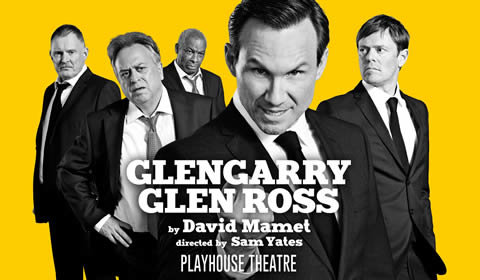
In this case though I was far more optimistic. This is, arguably, David Mamet’s finest play. A Pulitzer prize-winner no less. It was to be directed by the talented Sam Yates. The supporting cast, Robert Glenister, Kris Marshall, Daniel Ryan, Oliver Ryan, Stanley Townsend and Don Warrington was top drawer. And the Hollywood star in question was Christian Slater. Now I admit he may not be peak A list, he has been in such unutterable dross, I have never seen the West Wing, The Forgotten and Mr Robot, (I don’t have the patience for these TV series), and I can see he is a bit of a tit in real life. But when I have seen him he has munched his way through the scenery in that mini-Jack Nicholson way of his and I figured he was born to play Ricky Roma.

And so it proved. A dazzling performance. Cocksure, brash, manipulative, aggressive, dismissive but vain, hollow, deceiving himself as much as others. Ricky is about as good a character as modern drama has created but Mr Slater still delivers. The scene with Daniel Ryan’s cowed James Lingk, ably abetted by Stanley Townsend’s Shelley, was delicious, as good as I have seen on the West End stage. You could feel Ricky’s brain going through the gears so as not to lose the sale. Prodding, patting, probing, putting his arm around Lingk, not letting him get away. Superb.

Watching Stanley Townsend shift from desperation to euphoria, and then back again, as he pleaded for leads, pulled in a big sale and then realised he had been taken for a ride, was also exquisite. Kris Marshall’s portrayal of John Williamson, the office manager who eventually relishes the power he wields over the salesmen, was a revelation. Don Warrington played George Aaronow as a broken, lost figure, so easily manipulated and Robert Glenister was wonderful as Dave Moss, a man whose cunning is only matched by his belligerence.

This is as good an ensemble as you are going to see on any West End stage. Mind you I bet that is the reaction of anyone who sees it anywhere whenever it is revived. I first fell in love with GGR in, I think, 1985, the revival of Bill Bryden’s world premiere National Theatre production, staged at the Mermaid Theatre, (which is a lovely space and it is bloody criminal what has happened to it). The 2007 revival, with Jonathan Pryce and Aiden Gillen, directed by James MacDonald, near matched this. Not quite so sure about the film, what with the extra character and the softening of Jack Lemmon’s Shelley, but it should still be on your film bucket list for sure.

The salesman in the US is an iconic figure, even in a world of Amazon, internet disintermediation, telesales and the like. The skill of building a relationship with a customer or client, of identifying and fulfilling a need or want, (or manifestly not as is the case here), will always be with us. It is a potent subject for drama: the Tourist and LD remain addicted to the Apprentice, and America chose to elect an ersatz salesman as its leader. The attraction for playwrights lies in the insight the salesman offers into the human condition, particularly its uglier side, and the resonant metaphor it offers for society and economy. Hard to believe but the same subject gave us an even better play than this. In fact the greatest ever American play in the form of Death of a Salesman.

Of course the real beauty of the play is Mamet’s dialogue. And it is beautiful make no mistake. The boy Aristotle, who knew a thing or two, said drama needed heightened language, which you certainly get here, but also rhythm. a kind of music, to the interaction of the plot, characters, lines and the overall spectacle, and this is what Mamet delivers in spades. And he doesn’t hang around. Act 1, in the Chinese restaurant, is a little over half an hour here, (always fun watching the GGR virgins looking a bit nonplussed at the speed with which the interval arrives). Yet, in its three perfect scenes, we learn everything we need to know about Levene, Williamson, Moss, Aaronow, Roma and victim Lingk. In my book Roma’s soliloquy, masked as sales patter, is up there with the best ever written for the stage. And we see that pathetic combination of male aggression, false certainty and “firing from the hip” which infects modern political economy. Too often the plausible bully wins and rises to the top. And if he can’t win he throws a tantrum or cheats. It is always a he.

Chiara Stephenson’s set (and costume) design strove, as it should I think, for absolute realism, which meant a fair bit of carpentry in the interval to turn the atmospheric restaurant into the claustrophobic office where the overnight robbery barely upsets the chaos. And so on to the perfectly plotted second act. I guess the first performance I say was the best precisely because I didn’t know what was going to happen, but knowing the plot, as with all the best plays, leaves more headspace to relish the language and marvel at how Mamet captures this cocktail of virility and vulnerability without ever losing our connection with the characters. For ultimately our problem, surely, is we sort of admire Roma and we sort of pity Levene

Sam Yates as director lets the text sing and, unsurprisingly, leaves the cast to do their thing. So why not a perfect 5 stars. Well this reflects my now oft repeated aversion to West End theatres. To fund my theatrical habit means I can’t go splashing sixty quid plus, or even three figures, for the best seats in the house, willy-nilly,  so I went tight here and opted for the balcony (upper circle as they term it), having stupidly ignored the advice of simian experts. View and sound commensurate with price but the seats themselves up here in the Playhouse are ridiculous. I couldn’t fit in. Not I was a bit uncomfortable. I mean I couldn’t fit in. Moving to a smaller neighbour option and shuffling around helped in Act 2 but it was still about the worst I have ever experienced. Let’s hope they never put a Hamlet on here. I know there ain’t much they can do, and that ATG has to earn its corn, but a clear indication of just how tight legroom is would be appreciated, Anyway I found out the hard way.


Dry Powder at the Hampstead Theatre review ****

drypowderlistupdatefinal2

Dry Powder

Hampstead Theatre, 29th January 2018

At last a play about the world of “high finance” which does not wade in with both feet in some ham-fisted (I know, mangled metaphors), didactic attempt to explain to the audience why it is “evil”. Actually that is a little unfair as most plays I have seen in recent years which tackle this subject have been more nuanced. But none has taken the impartial, but ultimately more insightful, stance here adopted by Sarah Burgess.

We are all complicit in the fiction of money, or, more exactly, credit. No money, no exchange. No credit, no growth. For every transaction there is a buyer and a seller. Fear, greed, supply, demand, the price mechanism. All tricky to avoid. You can argue long and hard about the distribution of the “benefits” that flow from capitalist economic organisation, and debate whether the externalities, or excesses, that it promotes are a price worth paying, (there I go again), but no-one seems to have found a viable alternative.

The people who work in high finance are pretty much the same as the people who don’t. Even at the very top of the tree the only difference, generally, is that they worked harder at school. There is no secret initiation ceremony that turns them into rapacious c*nts. Daddy’s job is not paramount. The are’t all card carrying Republicans or Tories. They have lives, of a sort. They aren’t capitalists with top hats. The capital they manipulate is often your pensions or investment, or has been created by governments on your behalf, so that you can have the things you want when you want them. Most of what they do isn’t shady or clandestine. It is just really, really dull.

Once they get to the top, or near the top, of the tree though it is difficult for them not to be sucked into the drug of self-importance. Being paid big bucks drives, and distorts, behaviours of course. But it is not the reason why these people do what they do. It is simply the scorecard. One house, two houses, three houses. One car, two cars, three cars. One painting, two paintings, three paintings. This is not what brings pleasure. What drives them is a combination of perceived power and self importance, and, most importantly, intellectual satisfaction. Thinking fast about a lot of things and betting on outcomes is what makes the game addictive.

This, I think, is what Ms Burgess seeks to explore in the play. And she does it, most effectively, through witty comedy. The play is by no means perfect but it does, through its four characters, show what can happen to those who get sucked into this bubble. Rick, played by Aiden McArdle, is the founding partner of a smallish private equity firm. He, and the firm, are attracting press opprobrium, thanks to his forthcoming, lavish, wedding (“only one elephant” at the engagement party), which leaked out on the same day as mass redundancy at one of the firm’s investments. He has set his two junior partners, Seth (Tom Riley) and Jenny (Hayley Atwell), to compete. Seth has brought a deal, Californian icon Landmark Luggage, to the table. The price is very attractive because Seth has persuaded the seller, via the CEO Jeff (Joseph Balerrama), that the firm will invest, grow the business online and preserve jobs. A press friendly “America First” proposal. Rick though asks Jenny to look at the case for relocating production across the border. Jenny comes back with a full on asset-stripping, outsource to Bangladesh, squeeze out cash, lever up to pinch a dividend, private equity caricature scenario.

From this set up flows some accurate, if not entirely, surprising paybacks. What makes it work is Sarah Burgess’s attention to the dialogue. Yes, she peppers the scenes with the technical language of private equity, (but is careful to provide context and explanations so if you don’t get it you’re not trying), and there is plenty of swearing. She does though capture the direct, combative, intense but often petty, point-scoring, smart-arse rhythm of this world. Everything here is about winning the argument. Consequences are often abstract. Everyone is very clever but argument tends to the reductive.

You might hear a bit of Mamet in the dialogue. I was reminded of the intent of the City comedies of Jonson and the Restoration, (and not just from the, I think, copious use of Purcell in Max Pappenheim’s sound design). A subtler tone perhaps. No need to accentuate the venality, hypocrisy and pomposity of the targets as in that era, but the same essential dramatic device. Use wit to illuminate self-interest.

You will be drawn to the performance of Hayley Atwell as Jenny. This is a fascinating study. She is not defined by her gender. Not wife, mother, love interest, victim. That is quite rare even in contemporary theatre. Charmless and devoid of “emotional intelligence”. Driven by the logic of return on capital but failing to see what cannot be measured. Saying sorry with no concept of why she should be. Exaggerated it may be but from this extreme emerges a lot of laughs and no little truth. But brilliant as Ms Atwell is it is not just about Jenny. Seth represents another bundle of personality traits. A charming self-assured salesmen who smoothly secures the trust of his clients. He comes to question the morality of Jenny’s management plan for Landmark, but only because he has “lost the game”. He is certainly not prepared to trade his status and back his own plan. Rick is immune to self-doubt his past success makes him think he is infallible. Aiden McArdle is all controlled, demanding aggression. It comes as no surprise that he will take capital from anyone to prop up his firm. Joseph Balerrama’s Jeff exudes a kind of fragile bonhomie but this, unsurprisingly, masks a ruthlessness that is revealed when his agency and price are tested.

Sarah Burgess has clearly delved deep and understood her research and rightly focussed on where it led her. Her writing is assured, droll and perfectly pitched. Anna Ledwich, (who also directed Beth Steel’s Labyrinth on this stage which came at this world from a different era and different asset class), offered sympathetic guidance. The design of Andrew D Edwards, with its revolving mirrors, and I think video of smoke at one point was maybe a bit overstated but no matter.


Edward II at Greenwich Theatre review ****

ed-ii-more-1-700x455

Edward II

Greenwich Theatre, 24th January 2018

Right then, This is what theatre is all about. Take a cast-iron classic history play from Jacobean bad-boy Kit Marlowe, hack out thematic repetition, wordiness and some characters, pare back set, costumes, sound and lighting, and let a young, hungry cast do its thing. This is not the first time that Edward II has been given this treatment, (there are echoes of Joe Hill-Gibbons divisive NT production a few years ago), and it won’t be the last given the plays themes. Marlowe often proves just too juicy for directors who feel compelled to make their artistic mark. The risible Faustus from Jamie Lloyd a couple of years ago shows just a mess some have made of this opportunity. We walked out at the interval leaving it to those whooping at Kit Harington’s bum and munching on McDonalds (I kid you not).

On the other hand if you let the “actors” get too actorly, and treat every word of Marlowe’s text with solemnity, then it can turn into an impenetrable slog. It shouldn’t. This is a salacious shocker but it also draws out its themes, of homophobia for sure, but also, and more importantly, class division and religious hypocrisy, with brutal clarity. Ricky Dukes as adaptor and director, and his team at Lazarus Theatre, have performed a minor miracle in getting this down to 90 minutes whilst still highlighting these themes, drawing out the characters and their motives and preserving the flavour of Marlowe’s delicious verse. And it is properly thrilling as well. The Spensers and Sir John of Hainault, together with various toffs and hangers-on, are dispensed with. The scenes pre and post the unpleasantness with the poker are all collapsed into one tableaux, replete with scary clown masks, a lot of fake blood, polythene sheets, (practical as well as visually impressive), and, given the Greenwich Theatre air-con is pretty fierce, I should imagine a cold, naked Eddy II. The play ends with tween Eddy III admonishing all over the phone. It is a stunning last 20 minutes.

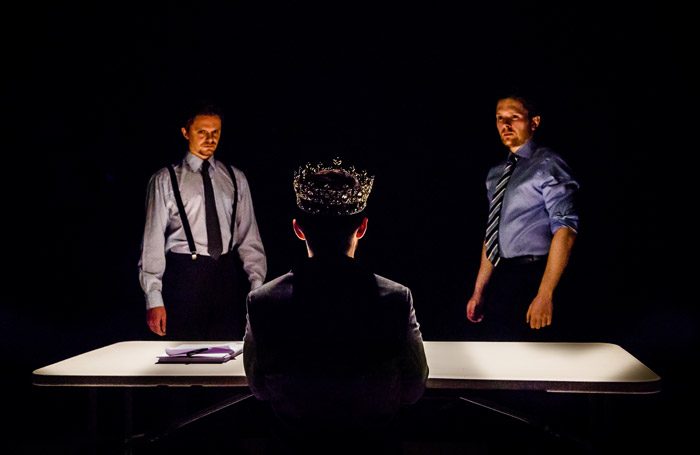
This cut means that the focus is on Eddy II and Gaveston’s relationship and the early manoeuvrings of the nobles, here just Kent, Mortimers pere et fils, Warwick, Lancaster and Canterbury, for and against them. It also gives more focus on Queen Isabella’s stratagems. The staging from designer Socha Corcoran is utilitarian. Cristiano Casimiro costume design sees the men in rolled up shirts and suit trousers looking like they have have been standing outside a City (or Wharf) bar for a few hours on a summer’s evening. (And what with the shouting and arguing they also sound like they might have downed a few). Edward II gets a sparkling, heavyweight crown and a robe, Queen Isabella a simple blue gown. Costumes and props remain on stage as do the entire cast with Eddy II and Gaveston standing on chairs when not involved as the nobles plot against them. Ben Jacobs’s lighting is harsh and Neil McKeown’s sound is aggressive and dramatic. Ricky Dukes and the team have learnt from the best that contemporary theatre direction can offer, (hello Katie Mitchell), but have avoided going over the top, so that the modern dress and stark set serve the play, not overwhelm it.

Best of all the young cast, even when down to the undies at the end, deliver Marlowe’s concrete verse crisply and clearly and ensure that the questions posed by Marlowe, albeit with deliberate ambiguity, are to the fore. Edward II was, by reputation a vain, immature man-child who presided over a period of weak government and fiscal chaos. Just as well son Eddy III came to the rescue and make England great (again?). Timothy Blore captures Edward Ii’s apparent callow sense of entitlement and his supposed infatuation with Oseloka Obi’s more knowing Galveston. The pair show real tenderness in the “love” scenes but Mr Obi makes sure we are uncertain as to Gaveston’s true motives and his manipulative nature. Jamie O’Neill delivers an excellent Mortimer as he orchestrates the others into first banishing Galveston, and later conspiring to see Edward murdered. Getting rid of, replacing or curtailing the powers of flawed kings, (here the Ordinances of 1311), has, after all, been an occupational requirement for the nobility/elite of this country across the centuries. Kings and queens after all are simply symbols to support the fiction of nationhood and underpin the theft of property. But too often they thought they could do what the liked, because, in essence they could.

Alex Zur as the protective Kent, David Clayton as the vengeful Canterbury, Stephen Smith as the Elder Mortimer, Stephen Emery as Lancaster and John Slade as Warwick are, to a man, superb. Topping them however is Alicia Charles as Isabella whose wounded pride cannot get in the way of her own, and eventually her son’s, destiny.

As I understand it homosexuality was tolerated in medieval and early modern society. The act of sodomy was theoretically punishable however, up to, and including, death. This reflects the influence of the church, always obsessed with the mechanics of sex. Such was the context in which Marlowe, regularly accused of blasphemy, (amongst other things), penned the play. He examined homosexual relationships in other plays and poems, notably in the opening of Dido, Queen of Carthage, and in his descriptions of Leander.

Whatever Marlowe’s own sexuality, and whether or not he was avowedly atheist, he presents his themes with provocative equivocation (to use the Jacobean buzzword). Was he tempting his contemporary audience to celebrate, condone or be moved by the central relationship? How critical is he of the social order which sees Gaveston’s real crime as his anonymous upbringing, a “minion”? How playful is Ed and Gaveston’s mocking of Canterbury, (who stands in for the Bishop of Coventry in this condensed production)? How true are Ed II’s emotions, after all he accedes to Gaveston’s banishment and execution? Is Gaveston driven by passion or the pursuit of power and wealth? What is the true relationship between Isabella and Mortimer and how does this influence their actions? Their lust for power doesn’t end well remember. War, pestilence, famine, the Scots and the French sticking their noses in, seizure of lands and possessions, trials, executions. All this followed from this struggle between king and his toffs. On the other hand some good came out of all this as it hastened in the beginning of Parliament as we know it.

There is so, so much more to Marlowe’s play than a some gay clinches, a poker and an arse and Lazarus’s production is an excellent contemporary attempt to capture this richness. This is a play that looks back to the defining philosophies of its setting, but also goaded and asked questions of its contemporary Elizabethan audience, and, because Marlowe’s writing is so wise and we are essentially the same then as now, (bar the technology), it can make us think today.

Short, sharp, brutish it is. Very short given the cut and paste Mr Dukes has taken to the text and action. But sweet too. I can see that other reviews of this productions are mixed to say the least. There are a fair few that seem not to know quite what had hit them. Not saying I did but I was persuaded and will be back to see Lazarus’s take on Golding’s Lord of the Flies. Thanks very much Lazarus.

Britten Sinfonia at Wigmore Hall review *****

jackie-shave-900x900

Britten Sinfonia

Wigmore Hall, 24th January 2018

  • Heinrich Biber – Mystery Sonata No 1 “The Annunciation”
  • Philip Glass – Orbit
  • Leo Chadburn – Five Loops for the Bathyscaphe
  • Arvo Part – Spiegel am Spiegel
  • WA Mozart – Piano Trio No 3 K502

There is something of the spirit of punk about the Britten Sinfonia. They don’t have a principal conductor or director and play with pretty much who they like. They also play pretty much what they like with a refreshingly cavalier attitude to programming. I love them, whether it be a Bach St John Passion, electrifying accounts of the Beethoven symphonies under Thomas Ades, minimalist classics, Stravinsky, Ravel or contemporary British composers, all of which I have heard them perform in the last year or so.

So I was looking forward to this. Leo Chadburn’s new work Five Loops for Bathyscaphe, is scored for piano trio and electronics and runs for 10 minutes or so. So Jacqueline Shave (that’s her above), one of the violin leaders of the BS, Caroline Dearnley, the principal cello, and Huw Watkins, principal piano, had another 50 minutes or so to fill. What to choose? Mozart? Why not. After all his B flat minor trio is pretty much the first piano trio as we know the form, with all three instruments contributing rather than just a piano sonata with a bit of string diddling attached which previously defined the Classical form. And Arvo Part’s Speigel am Speigel? Yep, it’s a slam-dunk crowd-pleaser for violin and piano. But chucking in Philip Glass’s short piece, Orbit, for solo cello. And the first of Biber’s Mystery sonatas? Well as it turned out it all slotted together perfectly.

Now I have been unlucky in my endeavours to hear a performance of Biber’s Mystery, (or Rosary), sonatas for violin and continuo live. There are 15 of these chaps, divided into 3 cycles, Joyful, Sorrowful and Glorious, plus a closing Passacaglia for solo violin. Each one takes as its subject one of the Catholic “rosary”episodes in the life of the Virgin Mary. They were likely written in 1676 but were unknown until 1905 ,and they are one of the earliest and best known examples of “scordatura”, where the violin is tuned in a way that is not standard. This permits all sorts of funky effects. Don’t test me on this but it is pretty straightforward even for a dumbass like me to hear the differences. One of the Vivaldi Op 9 Le Cetra concertos does this, Stravinsky does it at the start of the Firebird and Ligeti’s Violin Concerto is a prime example. Mind you Ligeti chucks so many effects into his concerto I am hard pressed to know where it is.

Biber tests the skill of the violinist to the max so it is a unlikely anyone was up to the job in the C17. What is on the page doesn’t correspond to what hits the ear. Don’t worry it doesn’t get too weird but it does create sounds, chords and harmonies with real drama. Now unfortunately we only got the first instalment here, which is the one which doesn’t arse about with the tuning, but it was still a blinder to open the concert with and Ms Shave delivered. It opens with a virtuoso figuration, being the Angel appearing before  our Mary, and them moves into a gentler sort of theme and variations.

The Glass “sonata” was new to me. The programme notes suggest Glass is referencing Bach’s mighty cello suites. He is. But then again anyone that writes a piece for solo cello is working in the shadow of the master. Even so lots of fancy figuration and double stopping does conjure up Bach’s counterpoint and Glass’s ordered repetitions are redolent of JSB’s own structures. Ms Dearnley is at home here as she is in the Baroque.

Now I have listened to, and seen performed, Part’s Speigel am Speigel, more times than I care to remember. It is one of my favourite pieces of music period. Which probably shows how easily pleased I am. This was one of his first “tintinnabuli” works, along with Fur Alina, from 1978, and it is “minimal” even by his standards. Simple arpeggios in piano and rising, then falling, scales from violin. If you are ever too worked up about anything just pop this on. Hey presto, blood pressure plummets. Now Ms Shave and Mr Watkins seemed to take this at a marginally faster tempo than I am used to, (it is all relative as not much happens), and took a minute of two to get in the groove, but once there it was as good a performance as you will hear.

I tried with the Mozart. Honestly. If I switch off and let it drift around and through me then it is pleasant enough but I still don’t really get it. Just too nice. Obviously there are bits of Mozart, and times when I listen to it, like watching a great Figaro, where it lifts me up and takes me away, but this wasn’t one of them.

Which brings me to the Leo Chadburn premiere, co-commissioned by the BS and Wigmore. I knew nothing about Mr Chadburn but I gather he is one of these new brand of musician/composer who doesn’t give a fig for established boundaries. He writes and performs across genres, releasing three synthpop albums a few years ago as alter ego Simon Bookish, and remixing for the likes of Grizzly Bear. He can certainly sing a bit I gather. This piece takes the classic piano trio instrumentation and hooks in pre-recorded voices from himself and Gemma Sanders, and some sparse electronica. It graphically describes the journey on 23rd January 1963 of oceanographers Jacques Piccard and Don Walsh to the bottom of the ocean. Eleven kms down to be exact in the Mariana trench, in that little ball Bathyscaphe Trieste thing. The idea of the piece is to create a sense of motionlessness in the music, deep and watery I guess, and allow the voices and words to tell the story. It succeeds admirably. There is nothing to scare anyone off in this simple but very effective sound-world. Think eerie harmonics from the strings and muffled chords from both ends of the range for the piano, as well as some theatrical plucking from inside the piano. The whole thing grips from first to last. It deserves a much wider audience. I am sure Mr Chadburn knows how to make that happen.

This whole concert was a joy. Music for everyone. Even if they know absolutely f*ck all about any of it. Still I suppose if they all prefer listening to a little ginger chap who has the temerity to suggest he is the next Van Morrison, then who am I to argue. Just seems a shame. Still that’s your pesky, high/low culture divide in late neo-liberal, capitalist society for you.

Colin Currie Group at Kings Place review ****

colin-currie-group_3_credit-chris-_web-billboard-2000x1125

Colin Currie Group

Kings Place, 20th January 2018

Steve Reich

  • Music for Pieces of Wood
  • New York Counterpoint
  • Mallet Quartet
  • Drumming Part 1
  • Vermont Counterpoint
  • Quartet (2013)

So off to Kings Place for another immersion into the sound world of Steve Reich guided by his finest living advocates (probably), the Colin Currie Group. Having seen the CC Group perform Reich a couple of times in the past couple of years, (at the RFH), I consider myself something of a groupie. I was honoured this time to be accompanied by not one, but two, potential converts to the live, minimalist music cause in the shape of MSBD and MSBDB. And, to emphasise, you really do need to hear this live for the full effect.

I won’t bore you with another hagiography extolling the virtues of Mr Reich. Take a look here if you want that (Steve Reich’s Drumming and Tehillim at the Royal Festival Hall review *****). Suffice to say I urge anyone to give his music a whirl and see what you think. I won’t hold it against you if all that repetition sends you to sleep. Me, I am fascinated by it. Out of apparent rhythmic simplicity emerges music of shimmering and unsettling intensity.

On the subject of repetition in music I promised myself I would not use this blog to eulogise the now departed Mark E Smith. Let’s just say RIP. Hands down the most important creative force in my lifetime.

Anyway this gig kicked off with Music for Pieces of Wood written in 1973. Which is exactly that. Though these are not any old offcuts having been specially selected for their pitches, A, B, C, sharp D sharp and another D sharp an octave higher, and timbre. It is built entirely on patterns of beats and rests over three lengths 6/4, 4/4 then 3/4. That’s it. As so often with Mr Reich the apparent simplicity though belies its careful planning and the subtlety of outcome. There is no place to hide for the players here.

New York Counterpoint from 1985 sees a clarinettist, here Timothy Lines, pre-record ten different parts, including for bass clarinet, which is prominent in the last movement, against which he plays a final, eleventh line, live. Vermont Counterpoint from 1982, here performed by flautist Rowland Sutherland, employs a similar, though to my ear more complex, technique for flute, alto flute and piccolo, across 10 pre-recorded parts and one solo line using each instrument. In both cases, despite the discipline employed in terms of relationships of rhythm, tempo and meter, the effect is of often “melodic” and ambiguous counterpoint, with more than a whiff of Stravinsky’s neo-classical chamber works. Maybe at times in both pieces the solo line could have been brought forward a little “in the mix” but I was persuaded.

Mallet Quartet is a more recent piece from 2009 scored for two vibraphones and two five octave marimbas extending down to cello C apparently. Once again three movements, fast/slow/fast, with some fancy changes of mallets. The marimbas create the rhythmic backdrop linked by a canon structure in the fast movements, with the vibraphones providing the melodies, again largely in canon. In the slow movement it all gets pared back however, and the effect from the vibraphones is of a far more atonal world which I am not sure would be to everyone’s taste and is a fair way from “typical” Reich.

Back on track though with the iconic Drumming, or at least the first of the four movements. This is divided into four clear parts and is for four pairs of tuned bongos. (This makes me think once again of MES with his quip that The Fall was him and your granny on bongoes. Now if your granny could only play bongoes like this ……). Anyway this is quintessential Reich, building from one beat to twelve beats, alternated with rests, and then with the rests replaced with beats until the cycle is completed, and then reversed. This pattern is repeated in the other three movements with the different instruments, and it was a shame not to hear this (see review above), especially the spellbinding third movement with glockenspiels (and whistling !) and the thrilling final movement, where the whole lot gets chucked in. There is so much in the sound created that is it is impossible to believe the structure is so simple. This is Reich at his most hypnotic, made more so in this performance by the strobic effect of the movement of the sticks in the “fastest” passages. MSBD loved it so much he nodded off apparently – trust me that is a compliment. When Reich, (and other minimalist music), succeeds your mind and body can “drain away” leaving just the rhythm. Far out. Sorry for this hippy gibberish but it’s true.

Which brings me to Quartet from 2013. This piece, scored for two pianos and two percussion, which is the building block for many of Reich;s earlier works, shows what he is now up to. This is melodically much more complex than the previous works on show, with multiple key changes, breaks and pauses, frequent gentle dissonance, and shifts into new ideas. In fact more like most contemporary classical music. Fast/slow/fast once again, but the slow movement contains harmonic variety which you won’t find elsewhere in Reich’s compositions, though once or twice it veers towards doodling. Don’t worry, there is still rhythm at the core but this takes the players up a further notch in terms of level of concentration. Which is why is was written for, and dedicated to, this ensemble. I was much taken with it and will need to add it to the list of recordings of Reich’s music I need to lay my hands on. (I see there is one about to be released, And CCG are releasing their own recording of Drumming which will surely be a treat).

Loved it and so did the audience. Kings Place acoustic is terrific, warm and offering up waves of sound, so I doubt I will hear a better treatment of these works.

Next up CCG will play Reich;s Tehillim, based on psalms and reflecting his Jewish heritage, and which uses voices and wide instrumentation to drive melodic invention. Still Reich but this is more minimalism meets Baroque. Annoyingly the BBCSO also takes on Berio’s Sinfonia in this concert but I will be pandering to my new found fascination with Ligeti at the South Bank. Seems like the Barbican and the South Bank are going head to head in competition for the geeks.


Ilya and Emilia Kabakov at Tate Modern review ****

id_024a_1

Not Everyone Will Be Taken Into The Future: Ilya and Emilia Kabakov

Tate Modern, 19th January 2018

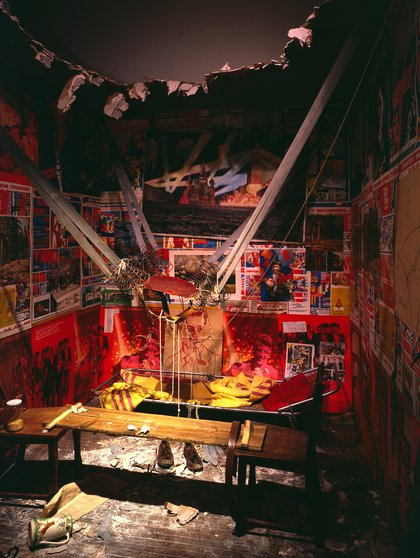
I know it is not easy to make out but take a good peer at the image above. This is an installation created in 1985 by Russian conceptual artist, Ilya Kabakov. The Man Who Flew Into Space From His Apartment. he created it in his studio and it was his first full room, “total” installation. It tells the story of a man living in a communal apartment in Russia who hatches a plan to escape from his oppressive, mundane reality. A suspended catapult chair, a hole in the roof, remnants of the construction, propaganda posters, carefully orchestrated lighting. There are workings from the imagined escape and the testimonies of neighbours. It is both very funny and very sad. Tragi-comic, absurdist biting satire. One man pursuing the Soviet dream of conquering space. Or escaping his miserable reality. Which is the well from which so much art of the C19 and C20, (and into the C21), has drawn from in Russia.

I found the installations of the Kabakovs, (Ilya was joined by wife Emilia in his 60s), absolutely compelling. I left nothing like enough time to fully absorb them, which is really bloody annoying. I blame the complementary Red Star Over Russia exhibition also on at Tate Modern, which was much more interesting than I had bargained for (Red Star Over Russia at Tate Modern review ****), as well as my own woeful lack of planning. And now this exhibition is about to end, (once again this numbnut waited until near the end of the run to see it), and I won’t have time to return. You’d think I would learn.

Anyway what I have learnt about is a pair of brilliantly inventive artists to add to the list, and yet more perspectives on the relationship between art and society in Russia, and indeed beyond. Ilya Kabakov was an unofficial artist which meant his work was not exhibited, was made largely in secret, and often required him to create pseudonyms. He made money from being a children’s book illustrator. Only close friends saw his early work.

A lot of installation art suffers from what I term the “I can’t be bothered” trope. The concept or idea is all, the making subsidiary. A few “found” objects, a bit of cardboard, some wire and some gaffer tape, and, hey presto, an installation, accompanied by some pretentious guff that make no sense even after three or for readings. I am fully aware how Daily Mail, philistine twat this makes me sound. Trust me that isn’t true. The more conceptual and contemporary art installations I see the more I think I understand and the more I am drawn in. But I still want to see that some thought and effort has been put in. The Kabakovs could never be accused of slapdashery. The ideas are clearly expressed, the detail is rich, the craft breathtaking. They tell intricate stories that pull you up, make you smirk and make you think.

The exhibition kicks off with Ilya’s early conceptual works, across an array of artistic styles and, given his status, utilising whatever materials he could lay his hands on. The ideas are sharp from the off and, using fictional characters, parody Soviet achievement. I was particularly struck by Holiday, where banal images have been revisited by their purported artist, and covered with flowers which are in reality sweet wrappers.  Room 2 shows the way in which Illya Kabakov mocked the cliches of Socialist Realism, most effectively in Tested! which purports to be a work by a forgotten artist from the 1930s showing a “celebration” of a woman having her Party membership card returned. It took me a bit of time to realise the blindingly obvious that this, obviously, would never have happened.

Following on from the early installations, including Incident in the Corridor Near the Kitchen with its flying  pans, are works that play with perspective and scale and incorporate tiny, cardboard cut out figures, which, to me, again suggest the struggle of individuals to find meaning and recognition in a social world. The next room has a rather less satisfactory installation where we are invited to look at “nocturnal” paintings through monoculars trained on apertures. The little white figures pop up again. For Ilya this work contrasts the contrast between the experienced and learnt knowledge which is the subject of epistemology, and the mystical revelations which cannot be explained. Hmmm.

The large installation which doubles up as the title of the exhibition, Not Everyone Will Be Taken Into The Future, from 2001, imagines a train leaving a platform, carrying art and artists selected to be part of the future, and leaving behind discarded canvases that represent the work of the forgotten, unpalatable or banned. So a meditation on the history of art, but again, with a distinctive swipe at the Soviet Union. This investigation continues in Room 7 which contains a collection of paintings showing seems from Russian and Soviet history conjoined or layered over each other, or with areas whited out. Interesting but not as memorable as the installations. The model which pretends that apartments have been created out of public toilets was especially cutting however.

Next door is a fascinating installation, Labyrinth (My Mother’s Album), from 1990, which documents the everyday struggle of his mother, Bertha Urievna Solodukhina, to survive and to raise Ilya. A dimly lit, grubby, winding corridor is lined with photographs taken by his uncle alongside disturbing memoirs from his clearly remarkable mother. Revolution, famine, repression, hate, homelessness, all are revealed. At its centre is a recording of Ilya singing songs from his childhood. Whilst this clearly explores the questions raised elsewhere in the work of the Kabanovs the impact is greater because it is so personal and devastating. I didn’t have enough time to read much of the testimony which was a great shame.

Room 9 takes us back to the intimate and hidden, with Ten Characters, a series of narrative drawings, displayed in a room reminiscent of classroom, which documents the lives of solitary, lonely artists in a totalitarian state. It was first exhibited in 1988 after the Kabakovs had themselves emigrated to New York where they now work. Finally there are a series of works which explore the idea of flight or escape with angels as the recurring motif. Angels, obviously, are about as commonplace as it comes in the history of art but here represent a life free from the grind of bureaucracy and routine. As with everything on display here the narratives are enthralling, the ideas provocative and the commentary acerbic.

These works take the personal and specific, artists working in secret under the Soviet regime, and turn them into something universal. And that despite missing, as I am sure I did, the majority of the meaning displayed her.

Red Star Over Russia at Tate Modern review ****

telemmglpict000145225768_trans_nvbqzqnjv4bqypyjo1pwgys_nihur4pqykuep74enkx9bwcmwer2y_a

Red Star Over Russia: A Revolution in Visual Culture 1905-55

Tate Modern, 19th January 2018

I have always coveted a collection. I mean a proper collection. I have a fair few CDs, (I have bought maybe 6 or 7 download only albums in my life – not having a physical copy brings me out in a cold sweat), a bit of vinyl, rather too many books, (the SO and I no longer know where to put them), programmes and exhibition catalogues and some 1960s pottery. But none of this counts. What I really want is a full-on, take over your life, obsessive, world’s leading authority, type of collection.

Mind you I have no idea where the people that do end up doing this find the time, money or space. But I am very glad this people exist. An entirely digital, thingless world where punters consume  everything on screen unsettles me. Aa it happens one such collector was graphic designer David King, and his chosen subject were prints, posters, journals and photos which document the history of Russia and the Soviet Union in the first half of the C20. Unfortunately Mr King did not live to see this remarkable exhibition largely drawn from his collection, but we should thank him for his legacy/.

Now 2017 was the centenary of the Russian Revolution and one of the first posts on this blog recorded my visit to the excellent Royal Academy survey of Soviet Art at the beginning of the year (Russian Art at the Royal Academy review ****). Since then I have been immersed in Chekhov, (a couple more Cherry Orchards, and the early plays), more Shostakovich than is good for my nerves, sundry reading and exhibitions, the Death of Stalin film and, most recently, a play from current Russian dramatist Mikhail Durnenkov. So the way in which art has explored the relationship between people and State in Russia pre and post Revolution and beyond has been a particular source of interest this last year.

What is most striking about this exhibition, at first glance, is the ubiquity of many of the images. In the early years of the USSR many avant-garde, modernist artists saw art and architecture as tools for social change. This vision was propelled by the Constructivists/Productivists, (though there are signs that Suprematism, Futurism and Neo-Primitivism also had a hand in shaping poster art). Room 2 draws together work by artist couples El Lissitzky and Sophie Lissitzky-Kippers, Aleksandr Rodchenko and Varvara Stepanova and Gustav Klutsis and Valentina Kulagina, who embodied these ideals. Forms are simplified, colours are bold and abstraction applied to human endeavour.

Red and black predominate, sharp angles, exhortations to embrace the future and beware the enemy in sans serif type, heroic poses. Even as Stalin’s regime became suspicious, or worse, of modernist art, and the visual language drifted towards the cliches of Soviet Realism, the messages remained unchanged.

Even if you don’t actually know any of these images you will think you do. But even as you marvel at the terrific wall of posters in the first room proper, and before you get to the rooms of smaller images and objects, notably rare photographs, it becomes clear that something else is going on here. For the overriding impression beyond the familiar vocabulary, is of the manipulation and avoidance of truth. Reconstructions of significant events, caricatures of Party enemies, early “photoshopping”. This is most acute in the fascinating photographs where the faces of individuals executed and murdered by the regime are cut or crossed out, or cropped in official publications, notably Trotsky. The vitrine display of photographs of victims of Stalin’s Great Purge is very moving. The execution of military leader Mikhail Tukhachevsky and suicides of renowned poet Vladimir Mayakovsky and Stalin’s own wife Nadezhda Alliluyeva are explored in detail.

Yet even in the early years, after the Revolution, the scale of the effort by the Bolsheviks to win hearts and minds across this vast. largely illiterate, population is laid bare. Many of the messages are multilingual to reflect the diversity of the Soviet Union. Agitprop trains took the message of proletariat emancipation across the land. Monuments were erected. In the 1930’s the imagery of Socialist Realism was exported, as the room devoted to the utopian murals of  Aleksandr Deinaka which were exhibited in Paris in 1937, graphically illustrates.

So we have some absolutely fascinating and striking material, very directly and compactly curated without gimmickry, which maps out the way in which hope turned to despair over the space of a few decades. It gets you thinking long and hard about the way in which art and visual media are used to create and record history, both in the Soviet Union, and dare I say, today.


My top ten films of 2017


Most of the films I see at the cinema are good, often very good, and mostly excellent. That is thanks to the insight of critics and the adopting of a moderately elitist approach in choosing my viewing. As you can see from the below though it isn’t all miserabilist Central European art cinema. Note the list reflects when I saw the film not when it was released. Right off we go.

1. Graduation

Director Cristian Mingiu’s study of endemic, everyday corruption in his native Romania, and the lengths to which a parent will go to secure the future of their child, is an intricate, intelligent masterpiece, with echoes of Haneke. Adrian Titieni plays a surgeon with secrets, and fraught relationships with daughter, wife and mistress. Following an attack on his daughter, (played by Maria Dragus), the day before her British university entrance exam, our surgeon is forced to call in favours to help her get through, but only with her complicity. This tragic set-up permits a queasy, gripping journey through personal and social morality. Astounding stuff.

2. Elle

Another uplifting tale. Not really. This time from the hand of Paul Verhoeven. A rape revenge black comedy with the magnificent Isabelle Huppert in the lead. It is intended to provoke. It succeeds. Ms Huppert is a divorcee who is the unlikely head of a video-game company. She is attacked and raped in her flat but, because of her past, does not go to the police and seeks to track down the assailant herself. Through it all Ms Huppert’s character remains brisk, brusque and unlikeable. Hard to imagine anyone else being capable of, or wanting, to take on the role. The tone is as unsettling and inflammatory as it sounds, and I don’t know how to resolve the ugly contradictions here, but it is one of the single best performances I have ever seen on screen. You’ve been warned.

3. Blade Runner 2049

I know there are many who found this a ponderous, portentous, pretentious bore, and it was a box office “disappointment”, but I loved it. It looks stunning, courtesy of cinematographer Roger Deakins, sounds amazing thanks to Benjamin Wallfisch and Hans Zimmer, the cast, by and large, is at the top of their game, and the story has much to say about the human, no make that, post-human condition and the nature of consciousness. It is way better than the original. The plot, “orphan” sets out on a journey to discover his true identity, is as old as drama itself, so it works, and director Dennis Villeneuve knows it works.. It you just want 100 minutes of CGI crash, bang, wallop with more plot-holes than a warehouse full of Emmenthal, then you have plenty of choice elsewhere. If you want to see what sci-fi cinema is truly capable of, look no further.

4. The Levelling

Now I am guessing that this won’t appear on too many other best of 2017 lists. It should. Hope Dickson Leach had to scrabble around to get the funding for this, her feature length debut. I pray that, given her extraordinary talent, this won’t happen again. Clover, an immensely thoughtful performance from Elle Kendrick, is a vet student who returns home to crusty Dad, veteran David Troughton, after the mysterious death of her brother. Secrets seep out, and the stunted relationship between father and daughter is probed. The film also offers a rare insight into farming life and economics. It is beautifully put together, though this is no Arcadia, more folk horror. Yet still, as with Graduation, ruthlessly naturalistic. Seek it out.

5. Detroit

A vital and fearless polemic from director Kathryn Bigelow and Mark Boal, which pulls no punches in its telling of real life events at the Algiers Motel during the Detroit race riots of  1967. Hand held cinematography from Barry Ackroyd follows the confrontation between racist cope, led by one Philip Krauss, (an extraordinary performance by Will Poulter), seven black men and two white women, that ended with three murders at the hand of the police. The film is bookended with the events that led up to the “incident”, and the court cases and repercussions which followed. It is powerful, gut-wrenching stuff which will make you very angry and leave you wondering how much has really changed in America since those dark days.

6. Mother!

Bonkers stuff from director Darren Aronofsky which somehow works. Home invasion horror meets eco-catastrophe parable with Javier Bardem, as a writer with severe block, and wife, Jennifer Lawrence, doing up his childhood home after a fire, whilst trying for a baby. A knock at the door. Ed Harris turns up followed by his wife Michelle Pfeiffer, then their grown up sons and soon what seems like the whole world ahead of the apocalypse. Unsettling, bewitching, laugh out loud funny, brilliantly shot. I can’t wait to see it again.

7. The Florida Project

Another visual feast. Director Sean Baker has set his tale of America’s dispossessed, literally on the other side of the tracks, just next door to Walt Disney World. Halley, an astonishing debut from Bria Vinaite, does what she needs to to support herself and daughter Moonee (Brooklynn Kimberley Prince). Motel manager Bobby (William Dafoe) does what he can to watch over them. It doesn’t end well. Yet most of our attention is focussed on the brilliant blue skies and pastel pink architecture of their motel block neighbourhood, seen from the point of view of sassy 6 year old Moonee and her friends. This may not look like a damming indictment of the gap between rich and poor in America but that is exactly what it is. Along with Graduation and The Levelling it is the film her that sticks longest in the memory.

8. Manchester by the Sea

Another film that doesn’t shout at you but is no less effective for that. Kenneth Lonergan has written and directed a film about one man’s grief and his opportunity for partial salvation. Just as well that that man, Lee, is played by Casey Affleck whose performance is jaw-droppingly good. To make it really work though, it needed Lucas Hedges, who plays his nephew Patrick, whose guardian Lee becomes after the death of his brother, to act up to his level. The past filters through the present, there are moments of lightness and pathos, but no simple resolutions. Make sure to see it.

9. The Death of Stalin

Satire is the most difficult genre to pull off it film. Especially when you are writing about a country and a time which has been endlessly satirised by its own people. Armando Iannucci is a master of the art but this was still his most ambitious project to date. It is blackly and bleakly hilarious.

10. Toni Erdmann

One more father-daughter relationship to set alongside Graduation and The Levelling. A few more laughs here though not always of the most expected kind. As always the best comedy flows from tragedy. Sandra Huller plays Ines, a high flyer posted to Bucharest. Dad Winfreid, played with relish by Peter Simonischek, follows her. She humours him and sends him on his way. But, with nothing to go home for, he stays and assumes an alter ego as a life coach, Toni Erdmann, with bad wig and buck teeth. Through a series of cringe-worthy, but strangely uplifting scenes, we see Dad and daughter emotionally reconciled. Apparently writer/director Maren Ade whittled this down to a still leisurely 160 minutes. Suggest the DVD extras will require their own disc. Loved it.