City of Glass at the Lyric Hammersmith review **

city-of-glass-final-image1

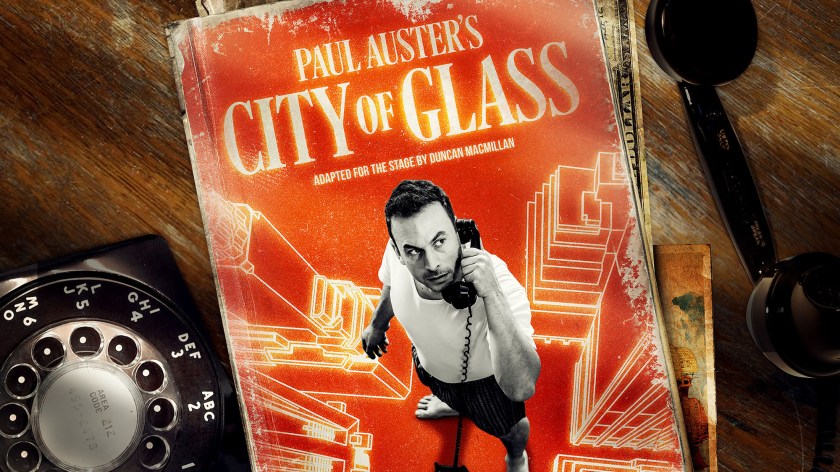
City of Glass

Lyric Hammersmith, May 11th 2017

So I remembered too late. I have thumbed copies of Paul Auster’s New York Trilogy so I think I must have read it, or at the very least City of Glass, when it came out in the 1980’s as any young, trendyish, new-to-theworld-of-work-but-still-able-to-go-out, indie man about town type would have done. I may even have professed to like it. But I’m not sure that I actually did. It is, as this adaptation (of orginal novel and a subsequent graphic novel augmentation) reminded me, a bit silly and a bit pleased with itself. No problem with subverting genres and getting all postmodern meta in books but you have to be very careful that you steer well clear of your own back passage or risk the proverbial disappearance.

So, in my view, this incredibly talented team comprised of Duncan MacMillan who did what he could to adapt the book into a suitable work for the stage, a score by Nick Powell, whose music is a vital part of The Ferryman at the Royal Court as we speak, and 59 Productions, including first time director Leo Warner, maybe just picked the wrong starting point. The staging is extraordinary showing just what can be done using cutting edge technology, but this has been employed to so much better effect in other productions by the 59 team (not the least of which was their contribution to the 2012 London Olympics Opening Ceremony).

The opening gambit is promising enough with the telephone call out of the blue to our hero/narrator/writer, Daniel Quinn, (DQ same as Cervantes original meta hero), conjuring up the expectation of a classic noir detective thriller. He then proceeds to find himself drawn into ever more fracturing realities leading him, and us, to question what is real and what is imagined here and ultimately into questioning his own sanity. The production however relies on heavily a narrator to move the “action” such as it is along and to explain “what” is happening, and the characters are more ciphers than individuals with whom we might want to make an emotional investment. The pace is unvarying which only led me to keep on questioning whether this might all have been better left on the pages of the original novel. And as I say the novel itself is, in my view, ultimately an exercise in pretension, though I freely admit my heart and head will always lie with the modernism daddies and not the post-modernist bastard offspring.

So sorry I couldn’t like this, though I recognise the extraordinary technical skill brought to bear on how this looked, and will definitely keep an eye open for 59 Productions next project (hoping they steer clear of Auster). And I continue to think that the Lyric Hammersmith’s ongoing ambition will be rewarded with a home-grown, or bought in, slam dunker at some point and I want to be there when it happens.



The Ferryman at the Royal Court Theatre review *****

379324_770_preview

The Ferryman

Royal Court Theatre, 11th May 2017

Right then. For once the tourist finds himself not seeing a performance near the end of the run, casting off his usual workshy approach to blog posting and sufficiently motivated to rave about something.

So just to say THIS IS FECKING OUTSTANDING. If anything beats this to play of the year it is going to have to work very hard. I confess (and the SO agrees) to not quite sharing the majority opinion on Jez Butterworth’s play Jerusalem. Yes Mark Rylance was off the scale brilliant as your man Rooster, the wealth and layering of ideas was genius and their were plenty of memorable scenes but we might have liked just a peep more of a dramatic story.

Well people you get that here. The set, sound and lighting are immensely detailed, the performances of the expansive cast without exception perfect (though if  had to pick one performance beyond the mighty debutant Paddy Considine it would be Tom Glynn-Carney) and Sam Mendes’s direction exemplary. But at the end of the day it is all about the the writing – and what writing. Since there is a transfer to the West End no plot details here. Let me just say that the way history, family drama and a cracking story with a powerful conclusion, are intertwined is simply magnificent.  There are the connections with distant, mysterious past events and with the land/seasons, (the stuff that informed Jerusalem), but this time set against the backdrop of the Troubles in Ireland. The Republican cause is examined from all angles and the way in which that affects multiple generations is brilliantly illuminated. This is a real family sketched with precision and humour but there is real insight too. And there are stories of love and longing, in major and minor keys, as well.

In the hands of another writer the play might sink under the weight of the material that is brought to bear or just go off into a world of frustrating ellipsis. Not here though. Mr Butterworth word by word, line by line, character by character, scene by scene (with only the deftest of contrivances) builds the whole thing into an immense structure (even weaving in profound understanding from great writers of the past), whilst at the same time giving you a proper edge-of-the-seat, what-is-going-to-happen-next feeling. There are fleeting nods to the likes of Messrs McPherson, Friel and McGuinness but Mr Butterworth is most definitely his own man.

So, my strong advice to you is that, if you wish to avoid the “past continually haunting your own present” like the Carney family here, then you immediately get a ticket for the West End transfer at the Gielgud. There is some critically acclaimed “unmissable” theatre that is eminently missable. This though is the real deal so believe all those proper reviews. and ignore the griping from the realist fringe about excess paddywhackery. So off you toddle now as I do not want to have to come round to your house to make you see sense.

Madame Rubinstein at the Park Theatre review ****

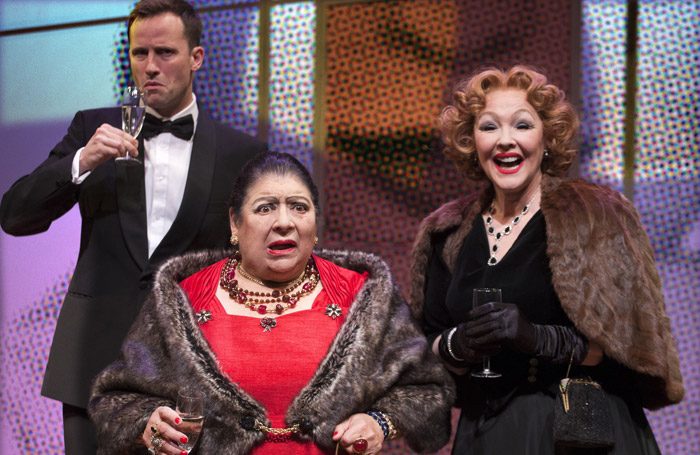
jonathan-forbes-miriam-margolyes-frances-barber-l-r-in-madame-rubinstein-at-park-theatre1-700x455

Madame Rubinstein

Park Theatre, 4th May 2017

Jez Bond and his team at the Park Theatre (with the help and goodwill of assorted North London luvvies I think) are doing an ever more successful job in my view in staging new plays and productions that people want, or should want, to see. Which is ultimately the whole point. If no-one sees a play it is a shame, if people see it but don’t really enjoy it (ponderous Shakespeare or clobber you over the head issue plays spring to mind) then it has similarly failed to deliver.

I am signed up for Twitstorm, Rabbits, Loot, What Shadows, The Retreat and Daisy Pulls it Off in forthcoming seasons here and, in contrast to some of the stuff I get to, have found it a relatively easy task of dragging along a willing chum to many of these. Whether it is the subject, the writer or the cast there is normally a clear hook to make me part with the cash. There is also a nice buzz about the place.

And so it was with Madame Rubinstein. A comedy based on the life of cosmetics magnate Helena Rubinstein, with Miriam Margoyles in the lead, was enough to persuade the SO, BUD and KCK to schlep up to Finsbury Park mid-week. And I think we were all glad we did.

Now it would be pretty easy to knock this play (many of the proper reviews have done just that), written by Australian John Misto and which MM herself was instrumental in bringing to this theatre. There is a sense that Mr Misto has tried to cram all the key events of Ms Rubinstein’s life, biopic style, into a couple of hours to the detriment of any real insight into her character. This also means the messages such as they are –  the barriers that stood in the way of Ms Rubinstein and her rival and nemesis, Elizabeth Arden, their need to re-invent their own pasts in order to sell their dreams to their consumers, the part that cosmetics played in the emancipation or otherwise of women in 1950s America – end up being diluted. And this in turn is not helped by the unrelenting focus on keeping up the gag quotient.

But when it is this funny and entertaining who cares. It is hard to imagine anyone else but Miriam Margoyles delivering the stream of one-liners that she was gifted with. But Frances Barber as Elizabeth Arden and Jonathan Forbes as long suffering assistant, Patrick “Irish’ O’Higgins, gave as good as they got. Yes the jokes are often on the obvious side of stereotypical and yes there is a campiness about the whole affair that some might not welcome. And the multiple scene changes (mostly just shifting of desk and chairs) are distracting. But we laughed. A lot. As did everyone else there.

So a top night out for all. Apparently this is sold out now but if it pops up somewhere else take a look and, as I say, if anything else piques your interest in what is coming up at the Park I think it is worth taking a punt.

Junkyard at the Rose Theatre review *****

junkcast_web1600x542

Junkyard

Rose Theatre Kingston, 30th April 2017

Once again I am writing some thoughts about a play (well musical in this case) which has been and gone. I really haven’t got the hang of this have I. Still this blog is mostly to stop me from annoying the rest of the family so I guess it doesn’t matter.

So Junkyard was/is a co-production between Headlong, the Rose, the mighty Bristol Old Vic and Theatre Clwyd. The book and lyrics come from one Jack Thorne, the creative brain behind the Harry Potter play which garnered all the accolades at the recent Olivier Awards, and who is directing the Woyzeck about to open at the Old Vic with John Boyega in the lead. I know Woyzeck through Berg’s opera and I am looking forward to this big time. Jack Thorne also co-wrote the This is England film series with Shane Meadows which I highly recommend if you have never seen it.

As an aside I cannot bear this Potter stuff. MS loved the books when he was a boy, LD is addicted to the films, we had a wonderful day out at that Potter World thingy (one of those many occasions when I have been forced to eat humble pie) and I think JK Rowling is a marvellous human being. But I still think it is calculated, derivative nonsense.

Anyway Tourist try not to alienate your audience.

So why go to see Junkyard? And worse still why drag BD along? It might have been her turn to “go with Dad to see something otherwise he will moan on about how no-one cares about him despite all he has done for us” but on paper a musical about kids in a playground in the late 1970s is not designed to wow the sophisticated, worldly, WhatsApp-arati

As well as the massive stamp of quality from this being Headlong and directed by Jeremy Herrin (most recently People, Places and Things and This House), the main draw in booking was Erin Doherty. She plays the lead Fiz in this production and it her smiling face in the promotional pic above. And I think she is going to be a massive stage star. This is the second time I have seen her lead a play. First time was in Wish List, the Bruntwood Prize winning debut play by Katherine Soper at the Royal Court. This was a very moving account of a pair of siblings struggling to get by in today’s Britain. Erin Doherty as Tamsin was riveting as she maintained a quiet, optimistic dignity despite the wearying array of pressures she had to bear.

The mark of a great play/production for me is whether in sticks in your mind and you come back to it weeks and months after you have seen it. So far this year Wish List, along with Winter Solstice at the Orange Tree, the Almeida Hamlet, Toneelgroep Amsterdam’s Roman Tragedies and The Kid Stays in the Picture fit this bill. I suspect Consent at the NT will also join the list.

Anyway stop rambling. Junkyard is terrific. I don’t really like musicals but the songs here are short and catchy, and emerge directly from the prose like a kind of West Country singspiel, and the music by composer Steven Warbeck could barely be appear to be any simpler (much trickier to do that it sounds I reckon). The plot is hardly imaginative, a bunch of troubled kids (the “junk”) at a Bristol school in the dark days of 1979 are roped into helping an idealist “youth worker” type, Rick, into constructing an adventure playground out of junk materials. They resist at first, they come round, the school authorities step in to close it down, it mysteriously burns down, but the kids rebuild and it is saved for the next generation. Literally the oldest “look what us kids can do if we really want to” plot in the book.

But OMG it packs an emotional punch. It is very, very funny, the kids are foul mouthed, arch and knowing, and easy to root for. The issues they face, with “chaotic” (as I believe the papers call it) family lives are beautifully rendered with simple brush strokes and the drama very real. The set is a fully paid up member of the cast. The energy and enthusiasm of the cast is infectious – cliche I know but they really did look like they were having a great time – and whilst I singled out Erin Doherty there wasn’t a duff line, note or step in the house

So this old curmudgeon ends up surreptitiously wiping a tear from his eye at the end and BD had to admit, unprompted, that she really enjoyed it. We didn’t quite become as unselfconscious as the play and performers in front of us but it took us mighty close. An absolute joy.


Hysteria at the Greenwich Theatre review ****

iconsquarehysteria1

Hysteria

Greenwich Theatre, 29th April 2017

I will keep this short and sweet. Whilst this production by London Classic Theatre has been and gone from Greenwich it is still touring with dates in Oldham, Yeovil, Newtown, Aberdare, Dunstable and Colchester.

In my view this kind of touring productions deserves your support. These people work very hard doing something they love. I am not saying you should toddle off to anything just because it is on the doorstep. You need an interest in the play on show for sure. But if there is the merest inkling please take a look.

This was not, I fear, a packed house and Greenwich Theatre is in need of a little TLC which I hope will be forthcoming. This is a marvellous play which was very competently delivered and it was a shame there weren’t more bums on seats to see it – mind you it was a Saturday matinee to be fair.

I went with the SO, BUD and KCK last year to see the all-star production of Dead Funny in the West End which was an excellent account of Terry Johnson’s meta-comedy which he also directed. And I am praying that Mr Johnson’s Insignificance will be revived at some point as I am now a firm fan.

Hysteria imagines what happened when Sigmund Freud (played by Ged McKenna) met Salvador Dali (John Dorney) in 1938 in Freud’s London home (just before his death in 1939). Freud is resting but is startled by Jessica (Summer Strallen who I gather normally plys her trade in musicals), who turns out to be the daughter of one of his previous patients, who was the basis for his theories of presexual shock. Jessica gets out of her wet clothes (including Freudian slip obviously), hides in closet (!!), Freud’s doctor, Abraham Yahuda (Moray Treadwell) arrives, followed later by Dali, played in a deliberately over the top way. This is the set-up for a visual farce, which uses language and props to simultaneously examine Dali’s art and Freud’s theories of psychoanalysis. To give you an idea, at the point Dali enters, events have conspired to leave Freud holding a snail infested bicycle, with a bandage on his head which looks like rabbit ears, and his arm in a wellington boot. Geddit.

It is unabashedly a clever play and has Johnson’s trademark veering between low(ish) comedy, high(ish) intellectualism and dark insight often in the same scene. It examines many of the criticisms of Freud’s theories and Dali’s surrealist art – it rams this home through Yahuda’s criticism of Freud questioning the “Moses myth”. It demands attention. You will learn a lot – I had no idea about Freud’s turn on a sixpence on who bears “responsibility” for sexual abuse. But it also has some proper laugh out loud funny bits. And it does go from A to B – or maybe it doesn’t as the ending suggests a dream. It probably helps if you have a tiny bit of insight into the work of the two key characters. But it has a structure (farce) which is constant – which makes it easier to digest than early Stoppard the closest parallel I know.

I am sure there have been, and may well be, higher profile productions of the play but this audience member for one is grateful to LCT for taking it on. Thanks.

The Plague at the Arcola Theatre review ****

956380d6df

The Plague

Arcola Theatre, 27th April 2017

I booked this not knowing quite what to expect. I couldn’t really visualise how this was going to be staged but was intrigued at the idea. Well more fool me. Neil Bartlett and the cast have done a wonderful job in bringing Camus’s parable, written in 1947 after the Nazi “plague” that had engulfed Europe in the Second World War, to life. Given Mr Bartlett’s previous work I should probably have never doubted it would be a success.

Five of Camus witness characters, Dr Rieux (Sara Powell), Tarrou, an unspecified businessman/official (Martin Turner), Rambert, a journalist (Billy Postlethwaite), Gotthard, an unstable petty crook (Joe Alessi) and Grand, a widowed clerk (Burt Caesar) begin reciting their “objective” testimony through microphones in the manner of a Select Commttee appearance. This testimony is returned to throughout the 90 minute play, but is overtaken with “subjective” individual narratives that track the emergence of the mysterious plague, the reaction of the authorities, the quarantining of the unspecified city, the devastation wrought by the contagion and the eventual and surprising disappearance of the plague and the return to normality, a sort of triumph of good over evil.

With a non-naturalistic bare set (and just a handful of props), it is left to the words (and some deft lighting and sound), and the way in which they are delivered, (with some effective use of the actors combined in a chorus at key points), to very effectively conjure up the images (the death of the rats, the nature of the deaths, the increasing desperation and panic in the city, the failure of a serum, the attempted cover up by authorities, the arbitrary nature of the plague). It is not to hard to spot the influence of Mr Bartlett’s early days in Complicite.

So a very smart piece of work both in presenting the still relevant allegory of Camus’s novel and in creating a sense of unease and foreboding which resonants beyond the play itself. I purchased the text and a quick whizz through it shows just how clever Mr Bartlett has been in adapting the novel and concisely delivering a parable for our own times. I have a feeling that when I come to look back at this year’s theatre-going this will rank very highly. After all the most effective drama is that which sticks in your head, and this is already doing exactly that. It has deservedly sold out I think but worth keeping on the radar should it ever re-appear.

And a reminder. For £50 you can buy an Arcola passport which gets you 5 tickets. That is just bonkersly good value. A tenner per trip for work of the quality that is turned out here. Just buy one. Now.


Who’s Afraid of Virginia Woolf at the Harold Pinter theatre review ****

35425_full

Who’s Afraid of Virginia Woolf

Harold Pinter Theatre, 19th April 2017

So I came quite late, as is my wont, to this particular party for one reason and another. There is still a month to go on the run though and this is definitely worth seeing. Though it still looks like you will have to pay an arm and a leg to get a decent stalls seat, and if you go for cheaper options upstairs, you risk losing an arm or a leg in this most uncomfortable theatre.

But it is very, very good. You know the story. Martha and George invite their new neighbour/colleague(s) back to their house after a boozy party and then all four keep drinking. And Martha and George kick seven bells our of each other verbally dragging their new “friends” into the carnage. Everything that is wrong with their lives, and the root causes thereof, pours out in a torrent of dextrous abuse which leaves them and us reeling. Marvellous, and cathartic, stuff.

Now all the reviews harp on about Imelda Staunton’s performance as Martha which is, to be fair, breathtaking – vicious, sexy, vulnerable, sometimes all in the same line. Yet I think the real star of the show is Conleth Hill as George. George and Martha are yoked together by their shared sorrow, fears and frustrations but to watch Mr Hill show this man of immense intelligence reduced to analysing his own vindictive barbs even as he delivers them is a masterclass of acting. Luke Treadaway and Imogen Poots as guests/victims, Nick and Honey, are also superbly on point – it seems only the passage of time separates them from a fate comparable to George and Martha. And there is a reason why Caryl Churchill trusts her treasured texts with director James Macdonald – he knows when to just trust the writer, as he does here perfectly.

There are times I confess where, for the briefest of moments, I wish for a lighter tone/turn, just some salvation, to emerge, but then Mr Albee’s lines are just so delicious that you just keep on willing the slugfest on. As I think do George and Martha. Oh and I can’t really see all this state of the nation parallel stuff that others read into this.

George and Martha. Can’t live with em, can’t live without em. And a reminder to take it easy on the hard stuff.

Next up Mr Albee’s goat.

Consent at the National Theatre review *****

consent_3435_680x297_20161127

Consent

Dorfman, National Theatre, 27th April 2017

Crikey. This is a very fine piece of theatre make no mistake. This was my first exposure to Nina Raine’s writing though I had been really looking forward to it based on what I had read about her previous works and on the proper reviews for this. But that didn’t prepare me for quite how strong a work this turned out to be.

The play explores complex issues of consent, empathy and justice in the context of rape. Kitty (Anna Maxwell Martin) and Edward (Ben Chaplin) are new parents. Edward is a barrister as are their friends, couple Rachel (Priyanga Burford) and Jake (Adam James), and Tim (Pip Carter). They try to set up Tim with Zara (Daisy Haggard), Kitty’s actress friend, without success initially. Cue deft comic writing and unsettlingly direct discussions around the rape (and other) cases that the barristers are prosecuting/defending. We watch Jake and Rachel’s relationship flounder on his infidelity and then recover. Edward too has an affair so that Kitty seeks a sort of revenge through a relationship with Tim, who had been seeing Zara. The break up leads to a custody battle and Kitty seeking  to have Edward prosecuted for marital rape. Edward, perhaps, finally understands. Running through all of this is rape victim, Gayle (Heather Craney), who does not secure justice and, in consequence, takes her own life.

No apologies for laying out the plot but I think this is justified firstly, because the run at the Dorfman is nearly over and is sold out, secondly, because the above doesn’t even get close to capturing just how clever and multi layered this play is and thirdly, because no-one will read this anyway. We get to understand something of how the adversarial justice system works in Britain, notably the emphasis on rhetorical skill in driving the outcome. We see how the necessary fictions which lay behind this system, (such as innocent until proven guilty, the so called “cab rank”, cross examination and the admissibility of evidence), together with the driving need to “win”, leaves the barristers incapable of any empathy with the victims in rape cases. We see how the system fails rape victims and destroys lives. We see how frustration and infidelity sours one marriage and breaks another apart. We see how the need to create a “performance” in work can seep into the home and relationships.

Nina Raine’s writing is exquisite as these insights are layered into believable, but still nuanced characters, and the whole tragedy is leavened with real humour. There are some memorable touches: the play begins and ends with Kitty and Edward prosaically folding a sheet, the witty descriptions of Greek drama, the (I think) symbolism in the shifting positions of the sofas, the early reveals and later call-backs, the multiple lampshades/viewpoints of Hildegard Bechtler’s set.

The research that went into the play is palpable but never obvious or didactic, which given the subject matter is remarkable. The dialogue feels entirely natural and never forced. There are occasions when you can see the joins, when Kitty starts needling Edward at one of the get-togethers, when Gayle gate=crashes the party, when Zara reveals her pregnancy plans, but all are justified to move the stake up to the next level. Overall, the rational and emotional part of your brain will be given a massive workout. Roger Mitchell’s direction is perfect precisely because it lets the text and the actors get on with it.

Anna Maxwell Martin is properly awesome as she charts how Kitty’s need to make Edward understand what he has done becomes overwhelming. Ben Chaplin (who was captivating as the amoral fantasist in Apple Tree Yard on the telly) is also perfectly cast, as his egotistical smugness turns to desperate wheedling. I hope Adam James is not a complete misogynist bully in real life because he is brilliant at playing them (I remember his performance in Bull at the Young Vic). Daisy Haggard (who I only know from TV comedy Episodes where she creates comic genius from one expression) is terrific, as are the rest of the cast. Oh and hats off for the performance of Misha Wakefield Raine as Edward and Kitty’s baby.: nerveless.

So if this doesn’t get a run elsewhere I have absolutely no doubt it will be revived in the not too distant future given its extraordinary quality. And I cannot wait for Nina Raine’s next play which I understand will be … ta dah … a play about JS Bach starring Simon Russell Beale. And if I am not mistaken Mr SRB was viewing this very performance of Consent. I have no idea what on earth Ms Raine will do with this idea but I AM SALIVATING AT THE PROSPECT – repeat it is about the genius Bach starring the genius Simon Russell Beale.

Incident at Vichy at the Finborough Theatre review ****

edwardkillingbackjeremygaganlawrenceboothmanmichaelskellernbrendanorourkeandrocrespowillbryant-thumb

Incident at Vichy

Finborough Theatre, 16th April 2017

I haven’t see that many productions at the Finborough but what I have seen there has been uniformly excellent. This was no exception.

This is an Arthur Miller play which premiered in 1964 and was prompted in part by a visit with his third wife, Inge Morath, to Mauthausen concentration camp near Salzburg and to the trial of some Auschwitz guards. It focusses on a group of male characters who have been rounded up and detained by a local police offer and a German military officer in Vichy France and are awaiting an inspection by a German doctor. Most of the characters are Jewish and they begin to discuss what may be about to happen. As the true horror of their situation becomes clearer their fears, appeals to rationality, desperation, denialism and ultimately their true humanity is explored with Miller’s characteristic incisiveness and intelligence. How was/is this allowed to happen and who was/is complicit in letting it happen?

There is sufficient plot and development to keep the audience gripped and emotionally engaged but the play ultimately revolves around the themes that are explored by this very diverse range of character viewpoints. Director Phil Wilmott and colleagues wisely opted for a non-naturalistic white room set to highlight these themes and the tiny Finborough stage with audience piled up in front was ideal in conveying the increasing desperation of the characters.

Unfortunately this has been and gone but it would be a crying shame if London had to wait another 50 years (for that is how long it took) for this to reappear. But it does lend further credence to a couple of golden rules in theatre – firstly, if anything takes your fancy at the Finborough take the plunge, and secondly, always check out any production of an Arthur Miller play.


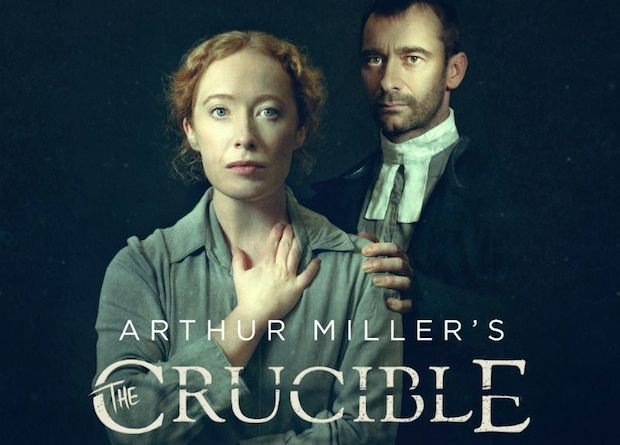
The Crucible at Richmond Theatre review ****

crucible20copy

The Crucible

Richmond Theatre, 15th April 2017

So in the interests of full disclosure Arthur Miller’s Crucible is one of my favourite plays. I know it is not original, I know that it is not historically accurate (doh, it is a play, it doesn’t have to be), I know it is, like most of his work, slyly misogynistic (though here that may reflect the society in which it is set), I know it has all the subtlety of a wrecking ball. But it is powerful allegory, it does illuminate the dangers of groupthink, scapegoating and the politics of hate, both in 1950’s America, and, probably whenever and wherever it has been revived, and it is a cracking story. So yah boo to you Miller haters.

So what does a good Crucible need? Well it does need space and time to get to the boil. In this production it felt like the fear of dragging on too much got to director and cast which meant for a bit of a breathless first act. Motives and jealousies need to be teased out and here there was a bit too much urgency to get through the lines. It also needs to create strong sexual attraction between Abigail and John P but still capture as much ambiguity in action as it can. It needs a constant and deep affection between John and Elizabeth P but there is still a lot wrong in this marriage. Largely I think the three actors playing Abigail (Lucy Keirl), Elizabeth (Victoria Yeates) and John (Eion Slattery) got this right. It needs a Reverend Parris (played by Cornelius Clarke) whose devotion to God and Mammon comes as a package, a Reverend Hale who ends up having his whole world view upended and a Judge Hathorne whose cognitive dissonance at the outcome of his prosecuting is plainly visible but who will not relent. Charlie Condou as Reverend Hale turned in a fine performance whilst Patrick Mackenzie as Hathorne was just a little less convincing.

Overall though this was a strong production. The set was a bit prosaic and greater use of light and sound might have offered a little more dramatic support but this is a great play that was done justice here. I gather this will tour to Brighton, Manchester, Birmingham and Glasgow so if it comes nearby definitely worth a look.

LS, whose business literally is drama, and LN, who tells it like it is, sometimes disconcertingly, enjoyed it. And perhaps even more enjoyed an impromptu meeting with our two Reverends and our John Proctor, as they wolfed down a pizza between matinee and evening performance, in the restaurant to which we had retired. As good a way as any to break the fourth wall I guess.