Angel at the Arcola Theatre review ****

angel5-copy

Angel

Arcola Theatre, 4th October 2017

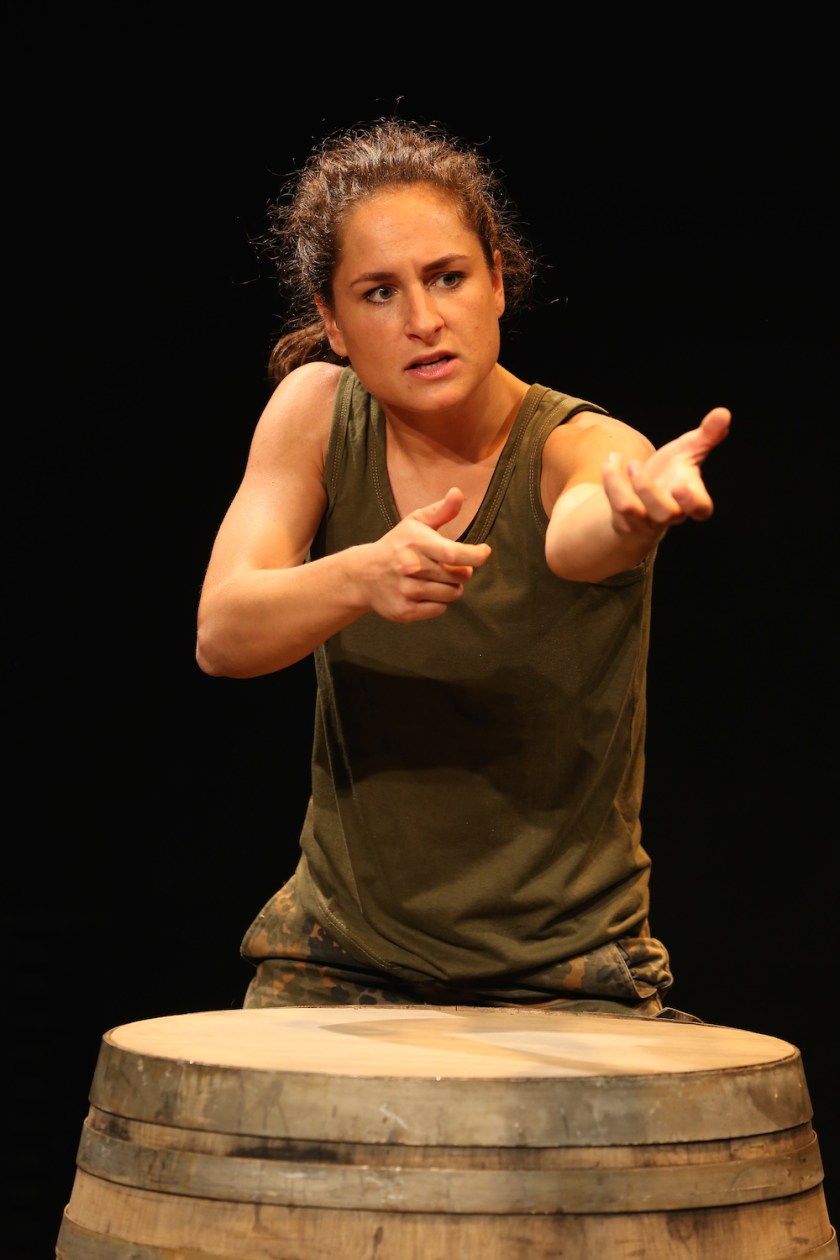
I had been hoping to get an opportunity to see Angel after reading a review of the premiere at the Edinburgh Festival last year. I had read of the very sad death of the actor, Filipa Branganca, who had played the role of the eponymous Angel of Kobane, Rehana Ghazali, in that original production. So I am glad it was able to transfer eventually to the Arcola with a new lead in Avital Lvova.

The play is largely set in Kobane, a small, sleepy town, in the far north of Syria on the border with Turkey. In mid 2012 the Kurdish YPG took control and declared independence for West Kurdistan. In mid 2014 the town came under siege from ISIS as Syria collapsed and the legend of the Angel of Kobane was born. She was a law student who became a crack sniper. Not much else is known but writer Henry Naylor takes the story as the basis for an hour or so play which examines through her story, the conflict in the region and the role of women in that conflict and in Kurdish society. Angel is part of a quartet of plays (The Collector, Echoes and Borders alongside Angel), named Arabian Nightmares, which Henry Naylor has written about the “war on terror”. They have won multiple Fringe First awards at Edinburgh. It is pretty easy to see why.

We see fragments of Angel’s childhood and meet her parents. Angel wants to be a lawyer but her schooling is disrupted by the Kurdish uprising. Her father, who I understood to have fought in the Kurdish uprising in 1991, teaches her to shoot and, in another important scene, faces down some local hoodlums. The family eventually has to flee but Angel’s Dad stays behind. She decides to return to find him and this is what eventually leads to her joining a group of women fighters to take on ISIS in her home town.

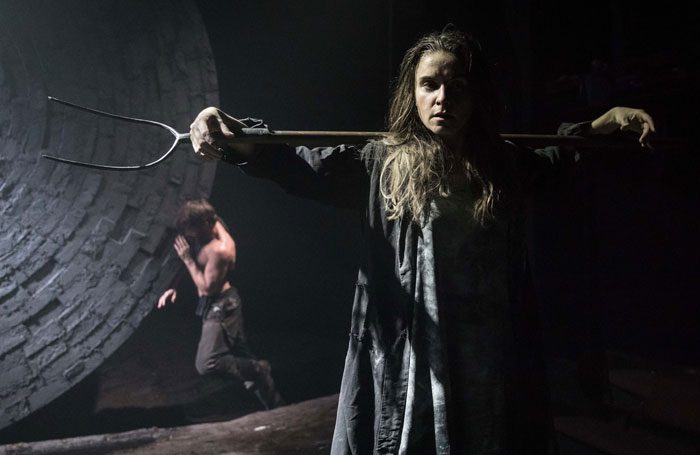
Avital Lvova assumes all the parts, her parents, and the various characters she meets on her journeys. The text is nimble and immediate (and at times surprisingly amusing) allowing Ms Lvova to paint a very vivid picture of these characters and her adventures. The lighting design by Andy Grange in the smaller Arcola space is brilliant. The props are minimal, just a barrel, and the brick wall at the back of the stage. What is most striking however is the sheer physicality of Ms Lvova’s performance: this is what draws you into her story and adds realism to the scenes.

This is a powerful piece of theatre with a performance and staging from director Michael Cabot of real passion. You will be drawn in and you may, like me, learn a little more about the conflict it portrays. I have no doubt it will pop up elsewhere. If it does, take a look. I am keen now to see the sister plays which accompany Angel.


After the Rehearsal at the Barbican Theatre review ***

after-the-rehearsal-barbican-232

After the Rehearsal

Barbican Theatre, 28th September 2017

So what was this going to be? Another flawed, portentous (pretentious?), langourous stroll through a story which might better have been left in its original format, like Obsession here at the Barbican earlier this year in the Toneelgroep Amsterdam Residency? Or a searing, metaphysical psychodrama in the manner of A View from the Bridge? You never quite know what you are going to get from wunderkind director Ivo van Hove although in this case, given the production of After the Rehearsal and its sister play Persona, are already staples of TA’s performance repertoire, it was possible to get a pretty good idea in advance.

Now I have to confess I was not at my best on the night of this performance and probably should have stayed tucked up in bed with my fading man-flu. The draw of the theatre once again proved too strong (the addict always craves stuff like this – the theatrical equivalent of absinthe) so I made a deal with myself: watch After the Rehearsal and then duck out unless you are absolutely riveted. Well I fear I was insufficiently riveted. On the other hand there was more than enough to chew on in After the Rehearsal and, as I have come to expect from TA’s finest, the performances were marvellous.

After the Rehearsal and Persona are based on Ingmar Bergman films, the former made for TB in 1984 and the latter for the cinema in 1966 (when he had refined his technique to the bare minimum). Unsurprisingly, Bergman is one of Ivo van Hove favourite artists. A version of Scenes From A Marriage has been in the TA repertoire since 2004, Cries and Whispers since 2008 and this double bill since 2012. Mind you Bergman’s influence on European theatre (I mean them not us) has been pretty profound. His own productions were apparently as famous for how they looked as the stories they told. Bergman himself worshipped August Strindberg. Both reach deep into Swedish identity. 

In After the Rehearsal, director Hendrick Vogler (I assume Bergman himself) and young actress Anna are discussing their production of Strindberg’s A Dream Play where Anna is playing the godly Agnes. The conversation expands beyond the play taking in their views on life and the lies they tell. Vogler tries to manipulate Anna. She responds. It turns out Vogler had an affair with Anna’s mother Rachel, also an actress, and she appears in on stage (though in his mind). She is broken by drink and depression but still pulls him to pieces. When she leaves Vogler and Anna imagine a future together: is this real or constructed1?

Now as ever with Bergman there are times when you feel like it would have been a good idea for someone to put their arm around him and tell him not to worry, it might never happen. But “it” does  happen and his exploration of what goes on in our heads and how this sets the narratives we create for ourselves and how the passage of time affects our identities is as penetrating as it gets. This in turns links back to the nature of theatre. Are we always acting? What are our real selves? Who are we trying to impress? Why do we lie to ourselves and others?

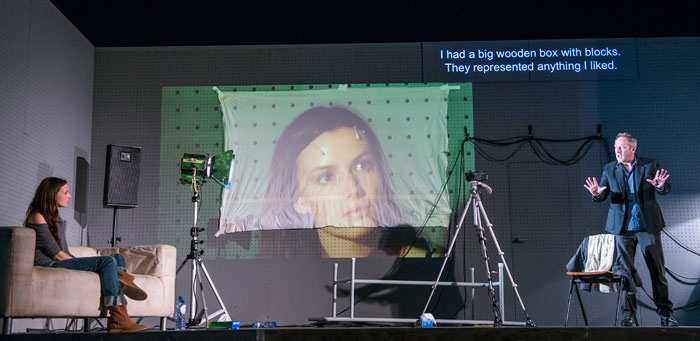
The Dutch text is taut and, as in other TA productions, the act of having to read the sur-titles means the words seem to penetrate deeper. Given the fact that not much actually happens (that isn’t the point) there is an awful lot of movement on the stage and lighting, props, music and sound all inject life into the “action”. Gijs Scholten van Aschat as Vogler, (who was a brilliant Coriolanus in Roman Tragedies though looked a bit lost as Joseph in Obsession), is again a colossal, brooding presence on stage. Gaite Jansen, who is a relative newcomer to TA, presents a calculating Anna. Best of all though was Marieke Heebink as Rachel whose desperation convulsed through her entire body. I still remember her fearsomely sexual Charmian alongside Chris Nietvelt’s haughtily needy Cleopatra in Roman Tragedies.

So why wasn’t I more taken with this play. I think, once again as with Obsession (Obsession at the Barbican Theatre review ***), that the obstacle that I can’t quite get over lies in the transfer of film to stage. Bergman is full of close-ups. The Barbican stage is not. As Vogler says in this play ultimately theatre is text, actors and audience. If plot takes a back seat then character needs to come to the fore, and in a text like this I need to see right inside their heads. And I couldn’t.

Still Mr van Hove’s productions can never be ignored. Next up Network at the NT.


The Wipers Times at Richmond Theatre review **

51gtavrmgyl-_ac_ul320_sr208320_

The Wipers Times

Richmond Theatre, 27th September 2017

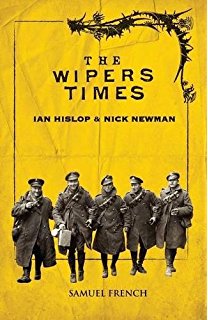
The Wipers Times has been knocking about for a couple of years know having morphed from the TV drama written by Ian Hislop and regular partner Nick Newman (which I didn’t see) into the play version at Newbury and then the Arts Theatre (which I missed) and now a UK tour. So off I trotted with the SO and MIL, hoping for a satirical treat.

Don’t get me wrong. This is an interesting story, the production of a newspaper for the troops in WWI, with some spirited and well drilled performances, led by James Dutton as Captain Roberts and George Kemp as Lieutenant Pearson, and a cunning set. It is just a little bit too monotone and the laughs just a little bit too lazy to really work. The voices of Ian Hislop and Nick Newman (a satirical cartoonist in his day job) come over loud and clear but, after a while, they start to grate. Mr Hislop has many fine qualities but I do find he is sometimes just a little too pleased with himself. And here it just seems that he and his partner have taken the easy way through the story rather than challenging themselves, or us the audience. I was also too often thinking of the antecedents and influences here, notably Oh What a Lovely War during the musical numbers (often brutally short) and Blackadder.

As the sarcastic one-liners bemoaning the futility of war piled up, and the Toffs and Tommies fitted neatly into their assigned roles, I was left hoping for something that might pull me up in my seat and snap me out of the faintly amused torpor into which I sank. I am afraid this didn’t come. A bit more about how these resourceful characters were able to produce the newspaper would have been interesting as would a bit more about the political context in which the newspaper operated. Some of the stiff upper lip gallows humour might have been sacrificed as might the verbatim delivery of extracts from the paper itself. A few interesting asides, for example on the Michelin Guide to the Battlefields and the perils of drunkenness on the front, were introduced but generally the narrative followed a fairly calculated arc.

I wanted to like this so much more than I did and, if your expectations are not set too high, there is enough here to make you laugh and think. Yet I was not moved and even at just a couple of hours it still felt a bit drawn out. I wasn’t alone. SO, and even the MIL who is normally a little more forgiving, were underwhelmed. Sorry. 


The Best Man at Richmond Theatre review ****

38016_full

The Best Man

Richmond Theatre, 2nd October 2017

N.B. The Best Man has, as I confidently expected, found its way to the West End, to wit the Playhouse Theatre where it opens on 24th February and runs through until 12th May. Well worth a visit and not ridiculously priced, though steer clear of the Upper Circle unless you are a very small person.

Gore Vidal is very near the top of my list of invitees for that perfect dinner party. Winston Churchill, Karl Marx, Socrates, David Hume, John Rawls, Alfred the Great, Charlemagne and Nelson Mandela would be there too. (Note this is the politics bash – music, art, drama would follow in subsequent weeks if the caterers were free). He is the quintessential liberal who would be both horrified and amused, and not at all surprised for this is what he expected, by the America of today, as he was by the America of his lifetime.

In my humble opinion he is one of the greatest novelists of the second half of the C20. Whether it be his novels examining the nature of sexuality, The City and the Pillar, Myra Breckenridge or Myron, the fantastical satires of Messiah, Kalki or Duluth, the ancient histories such as Creation and Julian or the American histories of Burr, 1876, Lincoln, Empire, Hollywood, Washington DC and The Golden Age, there is stunning prose and visible erudition on show on every page. Best of all though these are page-turning stories, whether “fact”, fiction or a mixture of the two, with utterly believable characters. (real or imagined). Indeed I would say that the fact that his novels are overflowing with plot is one of the reasons why he is not as highly regarded as he should be – they are just not as hard work as the US cultural elite of the 1950s and 1960s would have liked. Moreover GV himself was the very antithesis of the macho artistic and literary culture of that era. He also chose to p*ss off most of the literary, artistic and political establishment in his native US with his barbed epigrams and constant feuding. Here was a man who thought he was better than everyone around him, because he was better than everyone around him.

Being the very clever fellow he was he turned his hand to screenplays as well as novels and brilliant essays, with one of his best works for film being the re-write of Ben-Hur, in which he mugged off Charlton Heston who seemingly failed to grasp the homosexual sub-text of the movie. He also wrote a handful of very fine plays which reflect the concerns of his novels. The Best Man which premiered in 1960, and was made into a film in 1964, is the most often revived I believe.

So, as you might imagine, I was very pleased when I heard about this latest production since I don’t think this has ever graced a major London (I know, technically Surrey) stage. A very strong cast has been assembled by impresario Bill Kenwright with Simon Evans entrusted with directorial duties after his smashing Arturo Ui at the Donmar (The Resistible Rise of Arturo Ui at the Donmar Warehouse review ****), Alligators at the Hampstead and the exceptional trilogy of miserabilism, Bug, The Dazzle and Fool for Love, at the now defunct Found 111. The liberal, middle classes masses of Windsor, Brighton, Bath and Cambridge have had, or will have, a chance to see The Best Man before, I assume, a West End run.

And you should see it. Every word of every line is as fresh as the day GV wrote it. It is, I admit, locked in its time and place, two hotel rooms at an imagined Democratic convention in the early 1960’s, but this does not mean the issues that GV raises about political culture are not as relevant today as they were then. Simon Evans and designer Michael Taylor have very wisely stuck exactly to the period of the play’s action, and use simple devices to switch between the two rooms.

Martin Shaw, commanding as ever with his gravelly voice and still demeanour, plays Secretary of State William Russell. His rival for the nomination is Senator Joseph Cantwell, a remarkablly bullish performance from Hollywood veteran Jeff Fahey. These two legends of the screen have a bit of form together having played good guy/bad guy before in the London stage version of 12 Angry Men a few years ago. Then, as now, they are perfectly cast as dualistic political opposites. Russell is the archetypal “good’ liberal politician who believes there are limits to what can, and should be done, on the road to power. Cantwell believes nothing should get in his way and is prepared to abandon truth in order to get want he wants. As I think Russell observes in the play there is very little idealogical difference between the two (GV despaired of the lack of real choice in American politics). It is the how, not the what, that distinguishes the political complexion of these two men.

Russell is a philanderer but his wife Alice, another fine performance from Glynis Barber, is prepared to stand by him in public on the road to Democratic nomination and potentially the White House. Mabel Cantwell, played by Honeysuckle Weeks with a little too much of the Southern Belle which made a few lines difficult to follow, is a more “old-fashioned” wife. It would be nice to think that, near 60 years on, these characters would look archaically sexist. Unfortunately I am not so sure they do.

We then have the mighty Jack Shepherd as the Trumanesque Art Hockstader, the outgoing President, whose homespun country boy public persona is matched by ruthless scheming behind the scenes. You may well know Mr Shepherd as Wycliffe off the telly but he can still command a stage, and caper about, even in his late70s. Our cast is completed by Gemma Jones as Mrs Gamadge, the harridan of the Democrat ladies, Anthony Howell and Jim Creighton as respective advisors and Emma Campbell-Jones, Simon Hepworth, Ian Houghton, Craig Pinder and David Tarkenter as the press, various senators and delegates and a pair of accessories for when the fight between our two nominees gets really dirty.

I will refrain from delving into the detail of the plot: suffice to say there was enough of a twisting narrative to keep the pensioners of Richmond on the edge of their seats as we moved through the various paybacks in the second half. As I say GV couldn’t help but write great stories, and he was, after all, a Democrat insider. The characters here are not particularly well hidden proxies for the 1960 Democratic nominees, with Russell as Adlai Stevenson who GV supported, and the Cantwells as the Kennedys, who were oft the subject of GV’s barbs. GV also uses thinly veiled episodes from the life of Joseph McCarthy to inform Joe Cantwell. Subtle it ain’t.

Whilst some of the historic specificity might be lost on a contemporary GB audience the moral arguments which flow from GV’s caustic wit will not. The play is very funny, (OK maybe I laughed a bit more than some), but this does not mask the seriousness of the messages about political culture. There were a couple of timing issues at the performance I attended, (with the SO who has stamped her approval on the endeavour), and a brisker pace might have paid dividends in the second half of Act 1, but all in all, this is a very fine production, with a very fine cast, of a very fine play by a very fine writer.

Highly recommended. And make sure you read some GV thereafter.



Doubt, A Parable at the Southwark Playhouse review ***

doubt-4-web

Doubt, A Parable

Southwark Playhouse, 26th September 2017

Once again a review of a play whose run is over. Apologies. This revival of Doubt, A Parable, by US playwright JP Shanley, was efficiently directed by Che Walker, but turned out to be a little slighter in form and content than I had expected. Its original premiere on Broadway in 2005 led to 4 Tony Awards in that year and the award of the Pulitzer Prize for drama. A film version from 2008, which I had not seen, sported the combined talents of Meryl Streep, Philip Seymour Hoffman, Amy Adams and Viola Davies.

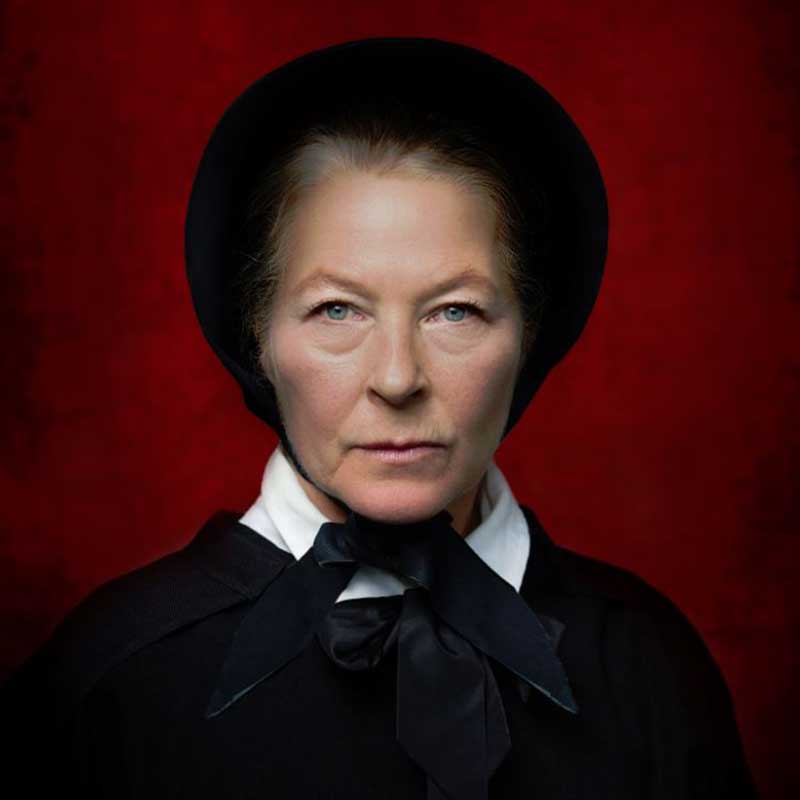
So I had expected big things. And, whilst this is a taut and intelligent exploration of a vital story, which offers scope for fine performances, I was a little disappointed at the strict naturalism of the play, its basic structure and its lack of multiple perspectives. The play is set in St Nicholas Church School in the Bronx in 1964. Father Brendan Flynn played by Jonathan Chambers is an apparently caring and popular progressive parish priest. Arch conservative Sister Aloysius, a suitably flinty Stella Gonet, is the school principal and is concerned that Father Flynn may be abusing his position. She invocates the younger Sister James (a wide eyed Clare Latham) to assist her in confirming her suspicions. They confront Flynn. His denial prompts Aloysius to turn to the mother of Donald Muller, the supposed victim, but she chooses to look the other way. Sister Aloysius refuses to relent and engineers a ruse which eventually pushes Father Flynn out, but through promotion to another school.

We never know whether or not Father Flynn is guilty of the abuse and JP Shanley’s text is meticulous in the way it creates doubt in our minds, as well as the four characters, throughout the 90 minute piece. The confrontations, between the two Sisters, Father Flynn and the Sisters, individually and together, between Sister Aloysius and Mrs Muller, and very well constructed and the language rings true. The sermons that Flynn delivers, on doubt at the outset, and later on gossip, are also sound theatrical devices to advance argument.

Yet it still all felt just a little predictable with characters that were just a little stilted. The tone of the play, exacerbated, by PJ McEvoy’s dark, shadowy set which imagines the space between the school and church buildings, is appropriately stifling but this does make the whole production a little one-paced. Mind you the performances of all four actors were admirable especially Stella Gonet who powerfully rendered Sister Aloysius’s external certainty and internal doubt and Jo Martin (last seen by me in the excellent Rolling Stone at The Orange Tree) who persuaded us why Mrs Muller might be prepared to overlook the possible abuse of her son, who is the only African-American in the school, “in his own interests”.

This a play that is definitely worth seeing as it adroitly explores the issue of abuse within the Catholic Church and it is a fine text, which, as all good theatre should do, embraces ambiguity and interpretation. By leaving us guessing however, to up the dramatic ante, it leaves rather too many loose ends to be truly great I think.

The Unknown Island at the Gate Theatre review ***

slrciwfzkz0knn1res2c

The Unknown Island

The Gate Theatre, 23rd September 2017

Saturday matinees at the Gate Theatre  represent an astonishing bargain by “that London” standards (as do Wednesday matinees though they are limited to us economically unproductive types).

So I could traipse up to Wembley to watch Spurs stuff Bournemouth for just £30 in a couple of weeks. But I would be a mile away from the action, there would be all the hassle of getting there and there would be extra trimmings to be paid for. For just a tenner at the Gate though I get to see epic theatre of the highest quality from around the world right up close (this is, along with the Finborough, the most intimate of the “quality” fringe venues). This formula has been perfected over years, but took a step up under the stewardship of Christopher Haydon, and, on the basis of this offering, should continue now that Ellen MacDougall has taken the helm (she directed Chris Urch’s Rolling STone at the Orange Tree, one of the finest new plays of the last couple of years).

I am not going to pretend that this adaption by Ms MacDougall and dramaturg Claire Slater of a short story by Portuguese writer Jose Saramango was the finest work of theatre I have seen in recent months, but there was more than enough nourishment. And I don’t just mean the olives, bread and wine on offer as the cast fittingly broke character halfway through proceedings. This is a slippery, childlike but not childish, parable with multiple interpretations which was presented very well by the four strong cast of Jon Foster, Hannah Ringham, Thalissa Teixeira and Zubin Varla.

A man comes to the court of a King and will not leave until he is granted a ship to set out to discover the “unknown” island. The aloof King is reluctant at first but the persistent man’s wish is eventually granted and, in the absence of a crew and sufficient provisions, he sets off with the cleaning woman from the Court. They don’t get “there” but the man has a whacky dream along the way. That’s about it.

Except that within the tale are all manner of allusions to the structure of society, individual agency, the power of the imagination and ultimately what really matters in life. I spent the first half wrestling with the idea that there was some long arc of allegory here relating to the history of Portugal and the nature of revolution. Then it seemed to become more of a plea for the value of “self-discovery” but not in the way of the arse-hole, narcissistic blogger (for the avoidance of doubt I am aware of the irony here), but in a more humanistic, reflective way. Anyway wherever Mr Saramango was trying to take us there was value in the journey.

The set design by Rosie Elnile is striking, walls, floor and the benches around the entire space are bathed in a (practical as it turns out) turquoise, rubbery material and the actors are dressed head to toe in crimson. There is a striking red model boat and some comic balloons put in an appearance. The actors switch characters and often overlap. And at the end, in a nod to the end of our story, a window is opened to take us back into the real world of gullible tourists filtering down to the Portobello Road to buy tat.

I suspect that those who prefer their entertainment to be of a more literal or mimetic persuasion may come out feeling a little diddled, but if you are a bit more elastic in your tastes this could be for you. Of the rest of the season Suzy Storck looks most interesting though I have no real notion as to why. Still for the price of a couple of pints in the Prince Albert downstairs I will happily test that notion.


Girl From the North Country review ****

42c1b7d200000578-4738018-image-m-25_1501202623766

Girl From the North Country

The Old Vic, 20th September 2017

(Girl From the North Country is transferring to the Noel Coward Theatre from 29th Dec 2017 through to 24th Mar 2018)

I am afraid there is a bit of a rant coming. If the Old Vic is going to fill matinee performances with teenage schoolkids can it please find a way to get them to shut up during the performance. I can just about deal with the Old Vic’s kettle-ing of the audience into the tiny foyer, the toilet squeezes (and I am a bloke – the ladies queue looks worse), the sometimes loose productions let down by under-rehearsal, the leg-room in parts of the Lilian Baylis Circle, the sound quality in parts of the stalls and the occasionally grasping approach to interval scheduling. Why? Because it is the Old Vic, a commercial theatre with no subsidy that does its level best to bring together the best creatives with classic plays and important new works. And it is a big space to fill. And, to be fair, they are doing something about the layout.

Now pitching up at matinees here and at the Young Vic is going to mean schoolkids. And by and large that is a brilliant thing. Watching some young-uns relax into the Joe Hill-Gibbons’s Midsummer Night Dream earlier in the year was a joy to behold. A bit of cacophony before the curtain rise, some fidgeting, the odd screen flicker, maybe even one or two whispers is normally a fair exchange for the audible gasps or whoops when something really exciting happens on stage. But what I could not stomach here was a trio of show-offs pointedly stage-whispering throughout. Too loud and frequent to ignore. Couldn’t find a teacher/TA to gently vent fury so ended up seething.

And thus my journey to grumpy old man is complete.

Anyway it meant that my enjoyment of Girl From the North Country was compromised. Which is a shame. Because as the remaining full houses and official and audience reviews suggest, it is very very good. I went with the SO as a replacement for BUD, who I had attempted to rope in, knowing full well that he would be enmeshed instead in a world of finance. Now the SO is famed in our house for her dislike of “musical theatre” and for eschewing any information in advance about what she will be seeing in the theatre. So having failed to gauge any reaction during the first half from her usual Sphinx-like gaze (and having myself been focused on the stage itself whilst trying to zone out the offending youths) I waited with bated breath for her verdict. “It is good – I am enjoying it”. I was tempted to insert the word “really” before “good” or “enjoying” in the previous sentence but that would imply a level of rapture that the SO rarely attains. in fact in the last 5 years of theatre going only The Ferryman, Andrew Scott’s Hamlet and Hytner’s NT Othello claimed a “really” good accolade.

Anyway the point is that this play with music really works. It is no surprise that writer Conor McPherson’s text is a delight. This is the man who delights in story-telling from a theatrical culture that does likewise. The setting, a guest house in Duluth, Minnesota (the birth-place of Bob Dylan) in 1934 as the US is emerging from the Great Depression, lends itself perfectly to this tableau of interweaving narratives. The characters are one rung up from the completely dispossessed, and the Crash and the ensuing credit collapse and failed harvests are swinging into the rear view mirror, but these characters still have next to nothing and are scraping around for the means to live.

Sorry another aside. If you ever get a chance read the novel Duluth by Gore Vidal which uses the city as a starting point for a brilliantly structured flight of fancy with layers of meaning and sharp satire. As usual Mr Vidal was decades ahead of the zeitgeist. And now I see there is a revival of his play, The Best Man, about to tour. I hope the production does it justice as the text (and film adaptation with Henry Fonda in the lead) shows a play with real relevance to US politics today, (though at the time of writing Vidal’s acerbic wit was aimed at Nixon, the Kennedys and McCarthy). That nice Martin Shaw will take the lead role and Simon Evans will direct (a wise choice given his recent Arturo Ui at the Donmar). I would definitely gives this a viewing.

Anyway back to the matter in hand. Now there is a big Bob Dylan shaped whole in my life. I have tried half-heartedly to fill it but have never really been persuaded. Seeing and hearing this might have changed my mind, but if it eventually doesn’t that is no judgement on the 20 songs here. For in the context of the production the music and lyrics were a perfect fit. There is no particular attempt to make lyrics echo plot or vice versa. This is a play with songs (some partial, some reprised and most realised with standing microphones) and not a musical. No jazz hands, fisting clenching or “woe is me” ballads. Just a procession of interludes where one or more of the characters plunder Mr Dylan’s back catalogue (across the decades so not just the obvious early folk-y/bluegrass-y stuff) accompanied by a band playing only instruments of the Depression years period. (Hats off to musicians, Alan Berry, Charlie Brown, Pete Callard and Don Richardson). The arrangements from Simon Hale are very satisfying, the lyrics are self-evidently beautiful and the performances pitch perfect (emotionally I mean – obviously some of the cast are better singers than others). Particular favourites for me were Slow Train, Jokerman, Hurricane, You Ain’t Going Nowhere and Make You Feel My Love. And the diminutive Shirley Henderson belting out Like a Rolling Stone.

Mr McPherson, who directs here as well, an eminently sensible decision given the structure of the work, lets the characters emerge with a sparse but emotionally affecting text. The whole play is only just over a couple of hours. Strip out the music and maybe there is 90 minutes of drama. Yet there are 13 named characters. We get to know all of them and their stories though. That alone is a remarkable achievement.

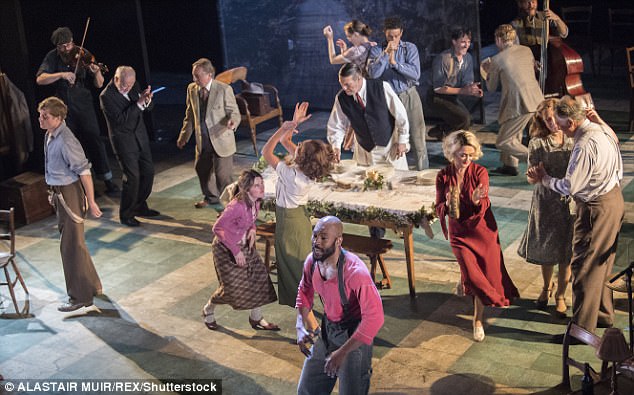
Ciaran Hinds plays the owner of the guesthouse Nick Laine. A big man whose dreams were crushed a long time ago. Last time we saw Mr Hinds he was a curiously lifeless Claudius in the Cumberbatch Hamlet. Here though he is what he should be. Wife Elizabeth has long since retreated into her own world but her delusions do not stop her seeing the essence of what is going on around her. Shirley Henderson (whom I adore) is maybe a tiny bit over the top but her unravelled self works as metaphor for America in these years. Son Gene, played by telly star, Sam Reid yearns to write but likes the whisky a bit much. Again a stock character, true, but not a stereotype. Adopted daughter Marianne, played by Sheila Atim, is black and hugs the guest-house for fear of attack. Nick would like to marry her off to elderly shop-owner Mr Perry (Jim Norton) but she resists, fearing a life of unhappiness and frustration. Katherine Draper (the excellent Claudia Jolly) is passing through and has hopes of an inheritance which will let her set up a business with Nick with whom she is having an affair. Yet Nick will never leave Elizabeth and, anyway, Katherine’s financial salvation vanishes into thin air.

A couple of cons then crash the guesthouse, Joe Scott (Arinze Kene who I need to keep tabs on) a good man, an ex-boxer, who woos Marianne, and “Reverend” Meadows, (a suitably sly Michael Schaeffer), a self-styled preacher and bible seller, who is up to no good. We are also joined by the bankrupt and broken Burke family (moving performances from Stanley Townsend and Bronagh Gallagher) whose son Elias (Jack Shalloo) has an intellectual disability. And to top it off we have the mighty Ron Cook as Dr Walker, who acts as narrator to add context, Mrs Nielsen (Debbie Kurup) and a fine ensemble (Kirsty Malpass, Tome Peters, Karl Queensborough) to add depth to the chorus. Overall all then a busy stage but the scene changes were deftly handled.

Now if I had a small misgiving, (aside from the babbling youth), it would be that the structure and length of the play constrains any real plot development. As I say we get to “know” these characters and understand their dreams and frustrations but, all up, only a few things actually happen. No matter given the sublime spell that the dialogue, music and lyrics help to create, but I think this could actually have done with being a little longer (a rare request from the Tourist) to expand the stories of the Laine and Burke families in particular, and maybe heighten the drama. I also think that when this is revived, (the rest of the run is sold out I think), as it surely will be, an outdoor setting, on a summer’s evening, might turn it into magic.

Anyway,whilst maybe not quite up there with Mr McPherson’s The Weir on the theatrical bucket list, this is a play with music that should be seen. Even, or maybe especially, if you are not a Dylan devotee. Remember it was the recalcitrant Nobel Prize winner who approached Mr McPherson and attached no strings to the project. Clearly he knew that justice would be done to his poetry (though it seems the old curmudgeon hasn’t seen it yet).


Knives in Hens at the Donmar Warehouse review *****

christian-cooke-pony-william-and-judith-roddy-young-woman-in-knives-in-hens-at-the-donmar-warehouse-directed-by-yael-farber2-700x455

Knives in Hens

Donmar Warehouse, 21st September 2017

Now I guessed I was going to like this. All the clever folk who know about plays and stuff had raved about it. Written in 1995 by David Harrower it is considered a classic of British modern theatre. Its ostensible subject matter, the power of language, and its setting, an imagined English medieval past, is right up my street (thanks in part to the vicarious interest generated from MS’s journey).

But I had no idea just how brilliant this was going to be. Easily joins my top 10 all time best plays. It is staggeringly good and director Yael Farber’s production could scarce be bettered I would think.

For those like me who weren’t up to speed on Knives in Hens, it goes like this. The Young Woman, an outstanding performance from Judith Roddy, is married to ploughman Pony William, a brutal but fearful, Christian Cooke, in a village somewhere up North. Her knowledge of the world is bounded by her role as wife, the work she has to do, by language and by location. Husband sends her with their grain to the Miller, Gilbert North, played by Matt Ryan with profound depth. His wife has died, he is alone, and the village has cast him out, in part because they are dependent on him. But he can write and he can think and see beyond the everyday. She is wary of the Miller but their relationship develops. Pony William betrays her. There is a dramatic denouement. That is basically it.

The language is spare. The lighting is monochrome. The set, with a giant grindstone, behind a muddied, brickstone floor, is austere. We have a mournful cello and a near unbroken drone. There is even some flour drifting through the air at one point. For those familiar with Yael Farber’s work, including the somewhat unfairly maligned Salome at the NT, (Salome at the National Theatre ***) all this is likely familiar. But in this play these directorial tropes were bang on.

So what is so special about the play? Well for me the text perfectly captures the world in which it is set. The medieval mind was very different from the modern mind. Knowledge was largely derived from immediate experience or dictated by the Church. The supernatural was very real. Nature informed existence. Language for this class was largely spoken not written. Writing was the medium for power, the word of God and contract. The schism between the rural and the urban. David Harrower’s text inhabits this world. No nostalgic arcadia here.

But this is only the starting point for more universal questions. How do we gain knowledge? Why are we scared of knowing? How does language define what we know? How does the written word differ from the spoken word? What do people invent gods to explain the world? How do women secure agency (one of Ms Farber’s vital themes, and, as in Salome, we have a nameless woman here)? What actions can be justified in the pursuit of freedom?

Now I appreciate that I am getting quite carried away here but this is where the play took me. An epistemological triumph if you will, woven out of the most mythic of threads. I can fully appreciate that others might just see a rather bleak, love triangle, fable but this floored me. In fact I had to sit down and have a cup of tea before heading home just to think about what I had seen. And I am still thinking about it.

So thank you Mr Harrower. Thank you Donmar. Thank you Ms Farber. And thanks to our three actors.

“All I must do is push names into what is there the same as when I push my knife into the stomach of a hen”. Indeed.

Oslo at the National Theatre review *****

maxresdefault

Oslo

National Theatre, 19th September 2017

Well I’ll be damned. I didn’t book Oslo at the earliest opportunity, as is my wont for most of the NT output, and only took a swing at it because of the NYC reviews. And even then I wasn’t sure. I mean how could a near 3 hour, straight dramatisation of the negotiations which led to the signing of the Oslo Accord between the Israeli government and the Palestine Liberation Organisation in 1993, possibly form the basis for a riveting work of theatre?

Well it turns out riveting is exactly what it is. Writer JT Rodgers has understood from the master of such entertainments, a certain Will Shakespeare, exactly how to write a “history play”. Get the context in early and make sure we know who is who and why they are there. Weave this information into the drama, but don’t hesitate to repeat it, in this case through the use of a direct to audience narration from Mona Juul, played by Lydia Leonard. Make the scenes short and sweet. Do not permit long, expository monologues. Show the human side of the people but don’t hold back on the process (we the audience don’t need to be patronised – we will get it). In this case, given that the whole purpose of the negotiations in Oslo was to bypass the confrontational and procedural approach of the formal peace negotiations sponsored by the US, showing the humanity of the key protagonists came naturally through the dialogue. Don’t fret too much about sticking too closely to the exact facts – this is drama after all. Finally give us some ebb and flow, some tension, some heroics and sacrifices and some cliffhanger moments. Oh and stuff in plenty of humorous interludes.

Mona Juul is an official in the Norwegian Foreign Ministry. Husband Terje Rod-Larsen (Toby Stephens) runs an Institute and meets pragmatic Israeli Deputy Foreign Minister Yossi Beilin (Jacob Krichefski). They offer a neutral, and clandestine, forum in Oslo, to the desperate PLO finance minister Ahmed Qurie (Peter Polycarpou), and his Marxist sidekick, Hassan Asfour (Nabil Elouahabi), to meet two scruffy Israeli economics professors played by Paul Herzberg (who also doubled as Shimon Peres no less) and Thomas Arnold, to discuss the route to peace. As progress is made, the Israeli side is upgraded with the arrival of colourful Foreign Ministry senior official Uri Savir, (Philip Arditti) and eventually wary legal big cheese Joel Singer (Yair Jonah Lotan). With the assistance of Howard Ward, Geraldine Alexander Daniel Stewart, Anthony Shuster and Karoline Gable doubling up in the supporting roles, the ensemble is completed.

And what an ensemble. Whilst the writer is possessed of of an impeccably direct, funny and natural style, this was never going to work as well as it did without such perfect casting. Toby Stephens nails Rod-Larsen’s urbane mateyness but also left us wondering over his motives. Lydia Leonard (with whom I am a little bit in love I admit) was all archness and efficient charm You really believed that Peter Polycarpou and Philip Arditti’s characters found a shared bond that could bridge their massive political differences. And you reflect, with Toby Stephens’ final lines, on how uplifting the better side of our nature can be, even if so often, we (and our politicians on our behalf if we choose them), fail to let it shine.

This is a properly gripping and affecting story, expertly told, directed with stonking momentum by Bartlett Sher and with a suitably ambassadorial set from Michael Yeargan. If there is any justice it should fill the house at Harold Pinter Theatre for the transfer. I heartily recommend it.


Mosquitoes at the National Theatre review ****

mosquitoes-v2-2160x2160

Mosquitoes

National Theatre, 18th September 2017

Two sisters. Some sad stuff happens to them. Sciencey backdrop.

There you go. That’s Mosquitoes. Except that is isn’t. Lucy Kirkwood is not the type of playwright to let us off the hook that easily. She chucks a lot into this pot, brings it to the boil and what a tasty stew comes out after two and a half hours or so. It may be a bit rich but, ultimately, is easily digestible.

Mind you without the two Olivias, Colman and Williams, I doubt this would be half as good. You know the thing where you see a play, and the leads are so utterly convincing that you swear no one else could carry it off. Until you see someone else playing the part as well or better and you realise that the actors were just bloody good at their jobs. Well in this case I really doubt the performances could be bettered. They were the two sisters, Alice and Jenny, made more potent because they look like they could be sisters. (I know this leaves me caught in a simplistic, mimetic trap but in this case really helps that they looked the parts).

For at the heart of this play is the relationship between them. Whilst Ms Kirkwood is becoming ever more ambitious in her plays, and the themes that they engage with, what I love about her writing is the portrayal of the relationships. From the moment Alice feels Jenny’s pregnant bump to the last moment, having come full circle, to substantially the same scene, the sisters dilemmas felt vital and real. Indeed the metaphor of the circle is writ large in the play with the set comprising two giant circles, in part to represent Alice’s work as a scientist at CERN (the home of the Large Hadron Collider). The mosquitoes of the title also get a couple of metaphorical look-ins.

Along the way Ms Kirkwood asks some big questions. How should scientists, for whom science is defined by uncertainty, engage with us lay-people, who fervently need science to deliver certainty? What is the value of physics to society and where are we in reconciling the quantum mechanics of the very small with the forces that govern the universe and the physics of the very large? Where does “God” fit in? What will happen at the end of time? What is the nature of intelligence and how does this relate to emotion? What drives the “success” and “failure” of siblings within a family? Why has women’s contribution to science been so undervalued? How to balance work and family? Yet this all sits comfortably inside the boundaries of the drama – even when we go off the naturalistic piste.

I gather Olivia Colman is a bit ambivalent about the stage. She shouldn’t be. We see from her TV performances that she possesses an uncanny ability to create an intense emotional connection with us the audience, even when playing the most “ordinary” of characters. And she repeats the trick here. Jenny isn’t as bright as sister Alice, as Alice and mother Karen, pointedly, patronisingly and repeatedly remind her. And Jenny makes mistakes. Foregoing the MMR vaccine having swallowed the autism connection bullshit from the media, and in spite of Jenny’s protestations, has fatal consequences for her child. She is estranged from her husband. She sells dodgy insurance from a call centre. But when Alice’s life unravels, as her awkward son Luke is bullied and then absconds after engaging in some over-enthusiastic hacking, it is Jenny that Alice turns to. And it is Jenny that is dealing with Mum’s incipient dementia.

Olivia Colman plays Jenny with an earthy, matter-of-factness. There are a lot of laughs from her lines. She says what she feels and takes risks that Alice cannot or will not. The “emotional intelligence” yin to the “academic intelligence” yang of Olivia Williams’s Alice. Olivia WIlliams perfectly captures Alice’s emotional uncertainty. Luke’s father has left and her devotion to work leaves her son even more alone. The absent father pops up as The Boson, who is also our narrator for the big science lessons, a satisfying conceit. Paul Hilton, last seen by us as Peter Pan here at the National, grabs this role with both hands. I was also mightily impressed with Joseph Quinn as Luke, in a role with some similarities to the last time I saw him in Katherine Sopher’s devastating Wish List at the Royal Court. Amanda Boxer’s Karen is also beautifully realised: you can see echoes of her personality in her two daughters. Sofia Barclay, as Luke’s treacherous friend, and Yoli Fuller, as Alice’s beau, turn in skilful performances in vital roles.

Rufus Norris’s direction is as astute as ever. There is a lot packed in her, and even with the excellent performances and stunning set (courtesy of Katrina Lindsay), sound, lighting, music and video, this still required an expert hand at the tiller. If the director’s job is getting people on and off the stage to paraphrase Peter Brook, then Mr Norris can feel well satisfied, for on and off was perfectly executed.

So all in all a hit. I don’t know if it will pop up elsewhere but this is another production that gives the lie to the “NT has gone wobbly” nonsense meme. And, having covered the secrets of the universe and the mysteries of particle physics here, I have no idea where Lucy Kirkwood’s unbounded imagination will leap to next.