Daisy Pulls It Off at the Park Theatre review ***

daisy-pulls-it-off-park-theatre

Daisy Pulls It Off

Park Theatre 200, 16th December 2017

Funny thing the memory. Even more curious is consciousness itself. It used to be that clever folk conceptualised consciousness as a kind of “theatre of the mind”. Apparently now the cutting edge of neuroscience, psychology and philosophy says this dualism is claptrap and tends towards a more functionalist explanation. As the bard said “there are more things in Heaven and Earth, Horatio, than are dreamt of in your philosophy”. A very clever man, and great admirer of Mr Shakespeare, a certain Mr Tom Stoppard even had a crack at writing a play about The Hard Problem.

Anyway the point is that I distinctly remember really enjoying Denise Deegan’s play Daisy Pulls It Off at the Globe Theatre, (now the Gielgud), when it was such a smash hit in the mid 1980s. As did the SO. It was very funny. Or so I thought.

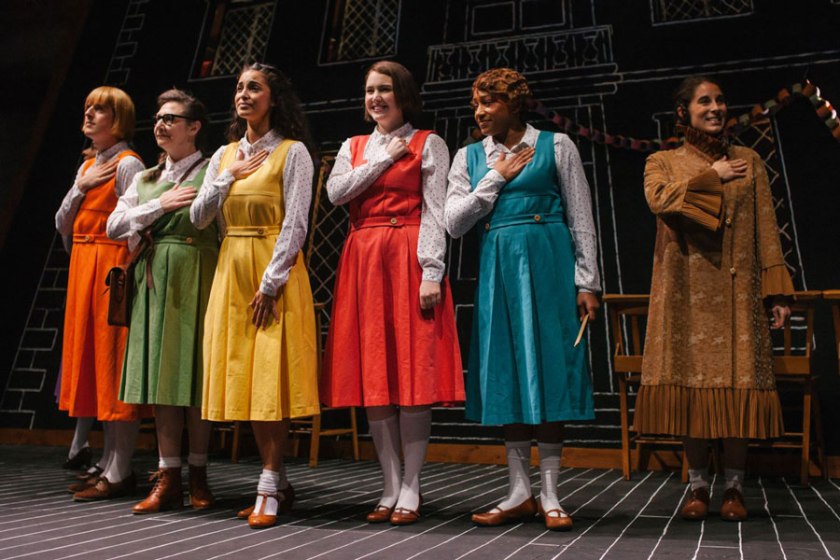
This latest revival at the Park Theatre was OK. Occasionally funny, but quite often a bit of a chore. Daisy Drags It Out. Now as I understand it this production, directed by Paulette Randall, presents pretty much the original script. It reverts to the original seven strong cast, which means some doubling or trebling up for all but two of them. Which, in my view, led to some of the more amusing moments in the play. Ms Randall and her creative colleagues have chosen to cast the production in a largely age, colour and gender blind way. Anna Shaffer, who debuts as Daisy, was most age appropriate. In contrast, Freddie Hutchins doubled up as Belinda alongside his Mr Scoblowski, Pauline McLynn was a plucky Trixie and Claire Perkins revelled in her roles as Monica, Mr Thompson and Mademoiselle. The rest of the cast, Lucy Eaton, Melanie Fulbrook, Shobna Gulati, are all excellent actors, based on other stage and TV performances I have seen, and it was hard to fault their industry or execution here. The production was played moreorless “straight”, as intended, with any hamming up emerging largely from character or costume changes and not from an overly arch, or slapstick, delivery. Libby Watson’s set and costumes were on the money and, in the hockey match and the rescue scene on the cliff-top, the cast conjured up some fine visual drama from inventive movement, using only minimal props.

So why was this such a disappointment, for me, and for LD, who gamely agreed to come along, despite being somewhat suspicious about Dad’s big build up. Well, as I say, I don’t think it was the production, or the cast. I see that some, though by no means all, other proper reviewers got a real buzz out of this. Three possible explanations then. Either it wasn’t as good as I though it was first time around, (though, with the magnificent Lia Williams, alongside Samantha Bond and Kate Buffery, this production did launch some extraordinary acting talent). Or I, and the world around me, has moved on, such that reverent spoofs such as this are no longer novel. Finally it may be that my memory has, to coin the vernacular, “played tricks on me”. This third explanation is likely scientific fact, and not just doddery middle age, the second explanation probably has a great deal to do with it, but I worry that the first may actually bear the bulk of the responsibility. It just may not be as good a play as I thought it was.

I wouldn’t put you off from seeing this if you are new it. There are laughs, (though apparently, to my surprise, there is nothing amusing about the words “frightful muff”), some spirited performances and some fine stagecraft. It does warm up in the second half but never really takes off. The underlying message, snobbery can and will be routed, is so gentle as to be barely perceptible and, it turns out, the whole thing is just a little too in thrall to its sources.  An A for effort, a C for achievement, I am afraid to say.

Titus Andronicus at the Barbican Theatre review ****

screen-shot-2017-07-20-at-15-01-21

Titus Andronicus

Barbican Theatre, 13th December 2017

Titus Andronicus is a comedy right. Yet I see it is customarily bracketed with the other Shakespearean tragedies, and here forms part of the RSC’s latest take on the quartet of Roman tragedies, entitled, er, Rome.

Now I know this comedy/tragedy/history play division is confusing at the best of times, but here, trust me, it is piffle. Big Will packed sad bits and sundry trials for his heroes even in the lightest of his confections. And, even in the most miserable passages of the serious stuff there are plenty of gags, (though sometimes a bit obscure I admit). In this play though all I really see is one long, (it only just about stops short of one scene too many), parodic, black comedy. This kind of thing is ten a penny now, particularly in the world where art-house and horror cinema mix, but big Will was on to this over 400 years ago. Since there has never been anyway to match him, in English at least, in most other forms of dramatic expression, it should be no surprise that he could effortlessly turn his pen to a genre p*ss-take.

After all the revenge tragedy had been a sure-fire box office hit in the previous three decades before Titus Andronicus hit the South Bank in 1594. Jasper Heywood had translated Seneca’s tragedies, Troades, Hercules Furens and, most famously, Thyestes, in the 1560’s. Thyestes particularly spawned a whole host of imitations, not least of which Titus Andronicus itself which draws on elements of Seneca’s gore fest. (I see that the Arcola staged a version of Caryl Churchill’s version of Thyestes directed by Polly Findlay a few years ago. Wish I had seen that). Norton and Sackville’s Gorboduc came out in 1561. First early modern tragedy, first blank verse drama, a veiled commentary on contemporary politics. (Wish I had seen that too. Especially with Lizzie I in the room). And, most successfully, Thomas Kyd’s The Spanish Tragedy had wowed audiences in the 1580s already.

So Will S and chums were keen to meet the public demand for extreme violence on stage. And a few plot holes, (Will was never one to worry overmuch about these), wasn’t going to stand in their way. Lest we forget though young Will wasn’t yet the dominant force he would become in English drama. One farce, The Comedy of Errors, one decidedly dodgy comedy, The Taming of the Shrew, and a few, albeit brilliant, propaganda plays, Henry VI (1,2,3) and Richard III, might not have been enough to guarantee a hit. So Will collaborated with one George Peele, who apparently contributed the busy first Act, (where Titus A, bloody livid after losing most of his sons in the war with the Goths, sets up the cycle of revenge), the scene at the beginning of Act II when the dastardly Aaron goads the Goth brothers, Chiron and Demetrius, into planning their heinous crime, and the beginning of Act IV, the reveal with its classical allusions, specifically Ovid and the rape and revenge of Philomela. Remember dear readers the several hundred year veneration of Classical Antiquity ushered in the patriarchy’s very unhealthy obsession with sexual violence as well as nice pictures of urns.

Anyway it seems to me that Peele’s contributions provide the stout backbone of the classically driven tragedy plot which then leaves Will to engage in the genre twisting anddark humour. Now I admit that a lot of what I thought was funny in the play was not always shared by the entire audience. There were a few other titterers at some of the smutty innuendo and the ludicrous ,cartoonish violence. There may even have been others wryly smiling at Marcus Andronicus’s flowery blank verse when he stumbles across the mutilated Lavinia. For this is the only way I can fathom this bizarre incongruity. He should be hollering for the Roman equivalent of an ambulance not waxing lyrical about her fragrancy and showing off his classical education.

What else? Saturninus suddenly getting the hots for Tamora. The Roman brothers “accidentally” falling into the pit containing Bassanius’s murdered corpse. Titus A thinking it is a good idea to chop his hand off. His chat with that poor fly. Lavinia spelling out the names of the Dumb and Dumber bad boys in the sand. Little Lucius’s knowing asides to us followed by a gag about Horace’s poetry. Aaron taunting us with his “will he, won’t he” dangling of his new baby and then the unsuspecting Nurse talking herself into an early grave. The gruesome pie, of course, and finally the three blink-and-you-miss-them concluding deaths in as many seconds

Others may want to take this all at depressing face value. I can’t. The only way to accommodate the abrupt shifts in tone, I reckon, is to assume that Will was trying to subvert the very thing he had created. I think director Blanche McIntyre is happy to go with the blackly comic flow without over-egging it. Well maybe the messenger on a bike was a bit over the top. Though it got the biggest laugh of the night, proving that nothing works better than a blatant sight gag in Shakespeare.

Make no mistake TA was a huge hit in its first few years but thereafter was confined to the scrapheap by most every commentator until, surprise, surprise, Messrs Brooke and Olivier, worked their magic in 1955. Trying to take this too seriously just want wash in my book. It isn’t a sick pantomime for sure, there is too much stunning rhetoric to allow that to happen, but neither is this a proto-Lear. I don’t see any point in trying to fight against the dramatic conventions which shaped its construction, or in trying to pretend there is some great insight into the human or political condition here. The creative team seem to be suggesting this could be a metaphor for our uncertain political age. Nonsense. Things might look a bit sh*tty out there, and civic discourse is coarsening, (in part because every Tom, Dick and Harry think they can have a view – ah the irony), but government in Western democracies isn’t yet based on vendetta and cannibalism.

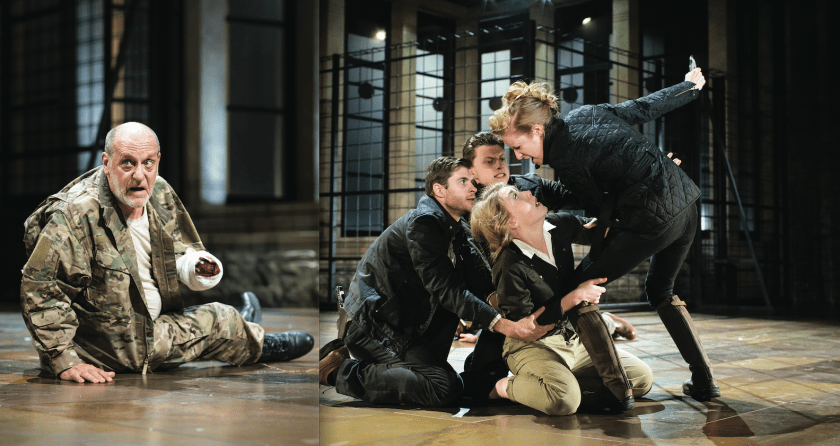
David Troughton as Titus A kicks off his performance as stiff, martial hero, a wizened Coriolanus, wedded to the justice of the battlefield and certain in his pronouncements. A brass band follows him around – a smart touch. Limbs and mind unknot as events unfold so that, by the end, he is as batsh*t crazy as you like in chef’s whites and a nice line in one-armed knife work. Martin Hutson’s toddlerish, paranoiac Saturninus is very amusing, and the similarity with a certain contemporary leader well observed. Attempts to shoehorn in other echoes of a chaotic White House administration, and some street riots signposted “austerity”, are less effective however. Hannah Morrish didn’t get much of a look in as Virgilia in the RSC Coriolanus but here, as a noble Lavinia even when mute, she was excellent. Nia Gwynne’s Tamora was a little underpowered. In contrast Stefan Adegbola as Aaron, once he get to open his mouth after prowling around in Act I, didn’t hold back. Let me say it. Aaron is an ugly, racist caricature which pandered to Will S’s contemporary audience. No Othellian complexity here.

Having guffed on above about embracing the funny side of TA I must say that, when the mutilation comes on stage, this production doesn’t hold back on visceral impact. A couple of nurses, a surgery trolley, a saw and some top-drawer illusion courtesy of Chris Fischer mean TA’s hand-job, (as it were), is the best of the gruesome bunch with the stylised throat-slitting of the two bad boys, suspended upside down, coming a close second. Lavinia’s rape and mutilation was genuinely shocking. 

So a production that, with a few maybe superfluous details, looks (and sounds) the part and delivers unflinching horror realism. A memorable central performance, with some excellent support in large part. A director who is not afraid to go where the words and plot take her, even if this points up the anachronistic structure of the play. Ms McIntyre is also very alert to the nature of our “enjoyment” of the play. Is it a bit sick to laugh at some of this? And if you are horrified then why did you turn up in the first place? Just how far can we go in pretending that Shakespeare is always “for all ages” or should we recognise that, early on at least, he was bound to his own time?

Of course it could just be that the diet of Tarantino and Korean revenge films which brings BD and I together has left me inured to this kind of thing. Anyway go see for yourself. There are a few tickets left for the remaining performances. And don’t forget to insert your tongue firmly into your cheek as you walk in.

 

The Hound of the Baskervilles at Jermyn Street Theatre review ****

image322-700x455

The Hound of the Baskervilles

Jermyn Street Theatre, 10th December 2017

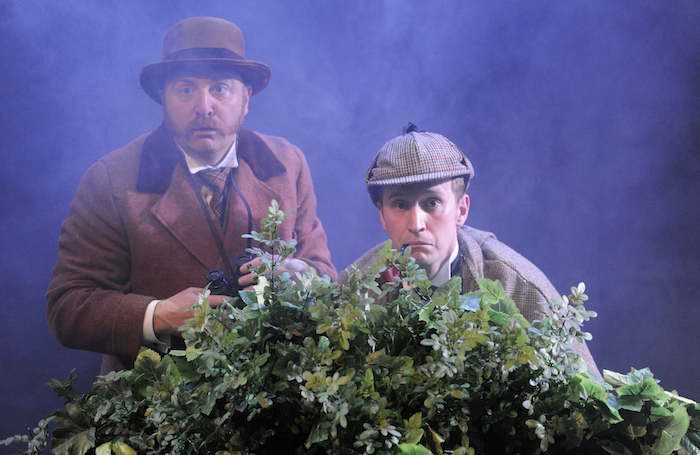
Everyone likes Sherlock Holmes right. And everyone can see that the stories are ripe for comic treatment. Indeed you have probably seen this done on numerous occasions. Even the amazing Cumberbatch/Freeman/Moffat/Gatiss Sherlock, which is regarded with reverence in the Tourist’s household, mines the humour in Conan Doyle’s stories. So if a comedy version of Holmes takes your fancy then you simply must get along to this. A Christmas treat. Take the kids. Any age will do.

It is adapted by Steven Canny and John Nicholson. Mr Canny writes and produces for the Beeb and has worked with Complicite. Mr Nicholson is part of theatre company Peepolykus, which specialises in this type of comedy, though he has plenty of other comedy writing and directing credits to his name. This Hound of the Baskervilles was first performed in 2007: this version is a co-production with the English Theatre Frankfurt. (I’ve been there, its great, who says Frankfurt is dull, not me). The creative team of Lotte Wakeham (director), Derek Anderson (lighting) and Andy Graham (sound) have done a marvellous job in bringing this to life but my hat goes off to Louie Whitemore who has adapted David Woodhead original design to fit the tiny JST space. If you go and see this you will understand just how clever Ms Whitemore has been here. This comes on top of her fabulous design for Miss Julie in the same space recently.

Now you will know the plot, or you can find out. A few liberties are taken to make this work but most of the key scenes remain. Suffice to say a fair few characters pop up along the way and one of the biggest joys in this production is seeing how writers, director and the three strong cast cope with getting them on and off the stage. It is acted at a furious pace: now wonder they needed an interval. Simon Kane plays bumbler Watson and is a moreorless continuous, and very amusing, presence. Around his bluff, dull-wittedness, Max Hutchinson plays Holmes in mordant fashion, and Shaun Chambers is an ebullient Sir Henry Baskerville. However, on top of this, Mr Hutchinson plays Stapleton, sister/wife Cecille (with frightful wig and dress), and the servants, Mr and Mrs Barrymore. All I can say is he must be knackered at the end of each performance. Mr Chambers enters as Sir Charles Baskerville, does a fabulous turn as Scottish Mortimer as well as a Cabbie. All three have various stints as Yokels of some description. And, if the logistics are stretched too far, then a couple of dummies appear.

Like I say the comedy derived from movement, props, costumes and accents, (even the ones that don’t appear), is delicious. So is much of the script. In particular the occasions where the fourth wall is broken, especially at the beginning of Act 2, are hilarious. I laugh out loud when I find something funny. BD and the SO who came along, (LD had to bail out which is a real shame as this was right up her Baker Street), are less animate but there was many a chuckle and smile from both. There are a few knowing lines, mostly to do with the bromance between Holmes and Watson, but there was enough for the youngsters in the audience as well.

So if you find the forced entertainment of panto at Christmas a bit wearing but you still yearn for something to do with all the family, I heartily recommend this. It is on this week (to 20th December) and then again from the 8th to the 13th January. There are tickets available as I write.


Parliament Square at the Bush Theatre review *****

parliament-square

Parliament Square

Bush Theatre, 6th December 2017

As a few slightly unkind people have pointed out most of the “reviews” I somewhat sadly post on this “blog” are worse than useless as, more often than not, they appear after the event. Fair criticism but I can’t be toddling off to everything in the first week and I judge that most plays at least are best seen about two thirds of the way through. If they have flaws by then, they can be corrected where possible, or parts excised if really necessary. Cast can get the full measure of character and interaction, timings, pauses and rhythm honed. So I reckon I will get more for my money. So yah boo to you.

In this case though I am doing you a favour. Parliament Square runs until 6th January having first appeared at the Royal Exchange, Manchester, there are plenty of tickets left and full price is just twenty quid. The main space at the Bush is airy, comfy and sightlines are terrific. Oh and it is a mightily good play, with an excellent cast, skilfully directed by emerging talent Jude Christian. It has an absorbing central concept, just how far will an individual go to protest against injustice, is formally inventive, each of the three sections has some sort of clever conceit, and it is very well written by James Fritz. It is probably fair to say that the ending is a little too calculated. On the other hand the first section, in large part thanks to exceptional performances from Esther Smith and Lois Chimimba, is as exhilarating a piece of theatre as I have seen this year.

The play won the Judges Award for Playwriting in the Bruntwood Prize in 2015 and, like other plays I have seen which have been recognised here, it has that spark of invigorating originality from the outset which characterises the best new writing. Kat (Esther Smith) gets up one morning, skips work, leaves her husband and young daughter behind, gets the train to London, and commits a premeditated, dramatic, act of self sacrifice. Through the first act, Fifteen Seconds, she is, literally, coached by her conscience in the form of Lois Chimimba, (last seen by me in the unfairly maligned Common, in Peter Pan and in the excellent Diary of A Madman at the Gate). Lois Chimimba also doubles up as Jo, Kat’s sullen teenage daughter in the final act, Fifteen Years. I expect she, and Esther Smith, will go on to bigger, (and maybe even better), things as they are both superb actors.

Kat “fails” in her protest thanks to an intervention by Catherine, another excellent performance from Seraphina Beh. In the second act, Fifteen Steps, we see Kat, vividly and painfully, reconstructing her life and explaining why she did what she did to husband (a perplexed Damola Adelaja), mother (a bluntly perceptive Joanne Howarth) and health professionals (a sympathetic doctor in Jamie Zubairi and demanding physiotherapist in Kelly Hotten) as well as, eventually, to Catherine herself. The rest you can see for yourself.

James Fritz’s writing is very spare but very accurate. We never get to know exactly what Kat is protesting against but it doesn’t matter. We do get to contemplate why someone might choose this idealistic course to try to make a difference, why some might be inspired and some revulsed and why some might see this as futile and selfish. Jude Christian’s direction, (along with Fly Davis’s design, lighting from Jack Knowles, sound from Ben and Max Ringham and movement from Jennifer Jackson), is perfectly matched to the text. There is nothing extraneous here but the required ambiguity about the wisdom of such action is brilliantly conveyed.

James Fritz’s previous plays (The Fall, Comment is Free, Ross and Rachel and Four Minutes and Twelve Seconds) have garnered significant acclaim. I can see why. This is great theatre, well executed. You will come out likely annoyed by some of the behaviour of the characters, but, that is kind of the point given the subject. I think you will admire both writing and acting though. So get along to the Bush. Now.

The Red Lion at Trafalgar Studios review ****

the-red-lion-01

The Red Lion

Trafalgar Studios 2, 1st December 2017

Patrick Marber is a talented chap. Directing, adapting, writing screenplays, comedy material. Yet he is at his best when he writes original plays, or maybe even, as in this case, where he remakes his own texts. (Having said that his screenplay for Notes on a Scandal might be his finest work. Zoe Heller’s novel, Judi Dench, Cate Blanchett, Bill Nighy, Richard Eyre directing, a Philip Glass screenplay. Did the producers have pictures of the SO and I when they were discussing their ideal target demographic for this film?)

I didn’t get to see this at the National in 2015 so was delighted to see this relatively rapid revival, courtesy of Newcastle’s Live Theatre, turn up at the smaller space at Trafalgar Studios. I have to confess I am not the biggest fan of the TS generally, too many imprecise productions relying on cast name recognition to pull in the punters, too pricey and not the comfiest seating. Whilst the seating in TS2, at least where I was, is challenging, the value equation here was sound. It will be interesting to see what happens when the spaces are revamped as is the plan.

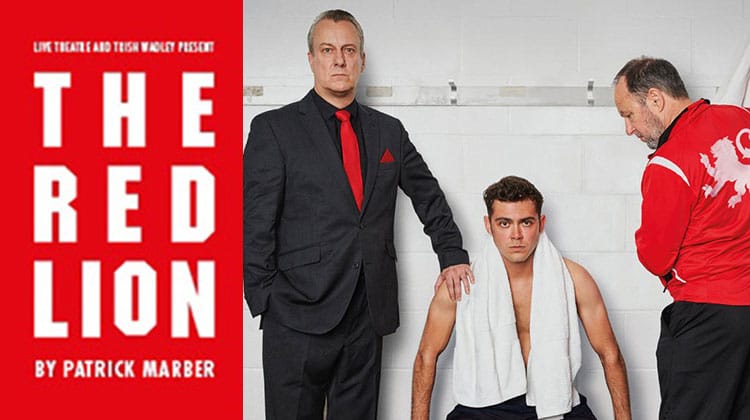
So, not knowing the play from first time round, I cannot be sure what Mr Marber has refined here to get it down to 90 minutes or so (from the original 150) but, whatever it was, it seems to have worked based on a quick perusal of the proper reviews this time vs last time. The TS2 stage, with a design by Patrick Connellan, certainly looks the part, a small, dank changing room, kitted out (literally) in perfect detail, you can practically smell the sweat, the grass, the mud, the liniment (actually you really can smell this), the aftershave. Those in the front row are in danger of being picked for next Saturday’s game they are that close. Patrick Marber based the play on his experiences as a director and saviour, with others, of non league Lewes FC, but anyone who has ever played the game at pretty much any level will know this place.

What Marber is able to do here, I gather more successfully than the original, is to use football as a metaphor for life, as so many writers have down in the past, but to avoid the cliche and melodrama that has cursed so many similar of these endeavours. The dialogue is still alive to the rhythms of football, and to the banality of its expression, and there is ruthless dissection of the ugly underbelly of the “beautiful” game. I am always struck by the romantic yet resigned mythologising, the “sporting ideal’ if you like, that some, otherwise rational, men of my acquaintance reserve for their football obsessions. The notion that this is just a very poorly managed branch of the entertainment industry, prone to the worst excesses of capitalist venality and institutional malfunction, just seems to pass them by.

Marber probes these failings but also, as his wont, explores the complexity of male interaction. Trust and loyalty, hopes and dreams, betrayals and deceptions, bravado and vulnerability, all are displayed. Each of the three characters, Stephen Tompkinson’s desperate manager Kidd, John Bowler’s weary retainer Yates and Dean Bone’s talented youngster Jordan, are all flawed in some way, and have misplaced their moral compasses in the pursuit of footballing glory. All of them need to make grubby compromises in order to survive in the world they inhabit. Like I said metaphors abound.

Stephen Tompkinson always seems to bring out the emotional frailties of the men he plays and this is no exception. Kidd is living alone, divorced, broke. He is also a cynical bully, albeit weak and toothless. Football is all he has. It is the last minute of extra time and he needs a break. Jordan’s skill might just provide it. Jordan though harbours a secret beneath his apparent integrity. Dean Bone is on the ball from the opening whistle, asking what’s in it for him. Yates wants a piece of the glory, his own life having collapsed until the club offered a lifeline. He once lifted the trophies, now all he does is clean them. John Bowler’s lines benefit most I suspect from the relocation to the North East in this production. His body may be broken, but his mind, and his words, are sharp enough. Soon enough all three sense an opportunity,  but all three are doomed to see it slide away, but cannot accept the blame for this lies within.

This may sound like an arduous slog. It is anything but. The moral tragedy is leavened with plenty of humour and, under the sure touch of director Max Roberts, the play rattles along to its conclusion (which may actually have been just a touch too rushed).

So a tightly orchestrated production of a now tightly drawn script with much to say about football, masculinity and life. Let us hope that Mr Marber can find another subject which spurs him to write another original play in the not too distant future. His talent requires it.


The Retreat at the Park Theatre review ***

168d153c-d478-842d-44a382b322622a70

The Retreat

Park Theatre, 30th November 2017

So here is another offering from the Park which, whilst offering a very entertaining night out, didn’t quite deliver a whole commensurate with the sum of its parts. And very fine parts they were too. Sam Bain, with writing partner Jesse Armstrong, is the comic mind behind Peep Show, Fresh Meat and Babylon and the inexplicably “only a pilot, never commissioned” Bad Sugar, which was co-conceived with Julia Davis, Sharon Horgan and Olivia Colman. I’ll say that again for anyone whose job it is to get this stuff on the telly and who is reading this. Bad Sugar is a very funny comedy with three of our greatest comic actresses which has not been turned into a series. Why?

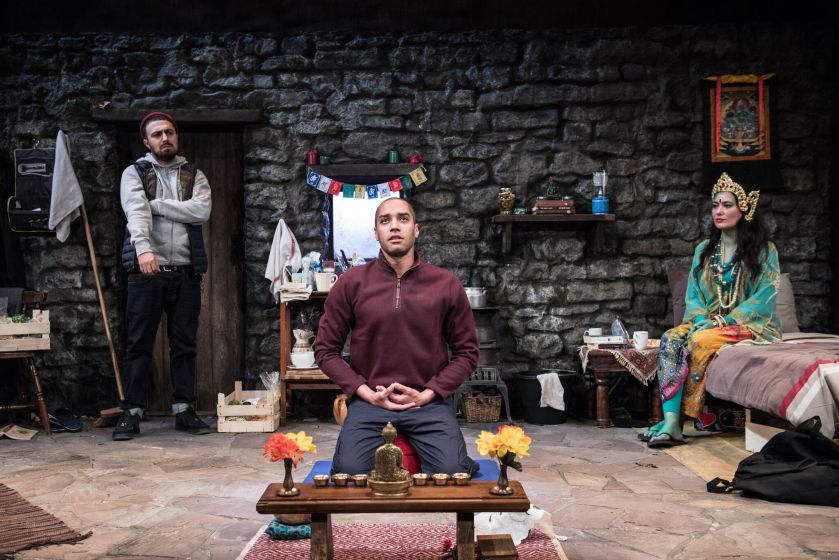
Mr Bain was also involved in Chris Morris’s Four Lions. So we know he can write comedy. And Kathy Burke has a string of lauded directorial credits, (next up she will be taking on Lady Windermere’s Fan at the Vaudeville Theatre), to match her acting roles. She is also clearly a fabulous person. Designer Paul Wills has come up with a convincing set that reflects the details of the setting, a one roomed hut in the Scottish Highlands. And the cast, Samuel Anderson as sanctimonious, hypocrite Luke, Adam Deacon as boisterous, brother Tony and Yasmine Akram as Tara all put in spirited performances.

Luke is some sort of financial whizz-kid, (with very rare exceptions most playwrights have a very vague idea of how the world of finance works), who is burnt out and, having been pushed out of the firm he founded, and dumped by his wife, goes to find himself, and detox, in a Buddhist retreat. This is run by Tara, who begins as a green painted, wide eyed space cadet but gradually comes back to earth, (observe her Hunter wellies), as the reality of her financial predicament is revealed. In fairly short order Tony turns up. He lives with Luke in London, is estranged from partner and child, has a dead end delivery job, likes his drugs and relies on Luke to keep him afloat. He wants Luke back. Luke wants to sell the London flat and support the retreat. Tony is understandably dead set against this course of action. Cue some gentle prodding of the dichotomy between spiritualism and materialism and a very believable, and funny, account of fraternal interdependence.

For it is, in parts, very funny. Adam Deacon in particular, is gifted with a whole string of one liners as the foil to the more serious, uptight Samuel Anderson. The problem is these gags end up taking over much of the drama. The “Tony as an arse” joke tail ends up wagging the “modern life is unfulfilling” plot dog as it were. Which is a bit of a shame because the ideas that sit behind the play are actually quite interesting and it does manage to seriously engage with Buddhist ideas, whilst satirising the narcissism that underpins the contemporary quest for “mindfulness”. Sam Bain’s day job as a sit-com writer is clearly visible in The Retreat, for both good and bad. I also felt that Yasmine Akram’s Tara was a little underwritten, which left her having to rely too much on arch expressions and eye rolling astonishment to react to the male characters and to reveal her true motives.

Still, if you just relax and stop playing the amateur theatre critic, there was much to enjoy here. I am not sure there was much that Kathy Burke could do to divert the one-liner torrent even if she had wanted to. The SO, BUD and KCK all came along and, once again, we all agreed that the evening was a success and that the Park continues to exude a special, friendly atmosphere. So relax, don’t moan, don’t expect too much, live in the moment and stop fretting about what might have been.

Yellowman at the Young Vic review ****

christopher_colquhoun_eugene_nicola_hughes_alma_in_yellowman_at_the_young_vic_c_tatenda_nyamande-7053

Yellowman

Young Vic Theatre, 29th November 2017

From what I can see American playwrights don’t like to arse about too much with the play, either in terms of dramatic form or the subject, the family history in one form or another. Why not, given the history of American gifts to the theatrical world, and if that’s what the punters want. From this apparent straightjacket have emerged some cracking plays, from the C20 masters as well as in recent years. It would seem that a recommendation from the journos and academics which make up the Pulitzer judging panel is as good as recommendation as any as to what to see. And that basically is all I had to go on prior to booking Yellowman.

Dael Orlandersmith’s two hander was a Pulitzer finalist from 2002 which tells the story of Eugene and Alma, from childhood into adulthood, from rural South Carolina to New York and back again, through the 1960s, 1970s and 1980s. Most importantly, as the Yellowman of the title, Eugene is tall and light skinned, like his grandfather and mother Thelma, though not his father Robert, whilst Alma is large and dark skinned like her mother Ophelia. The actors play all the male and female characters (including Alton and Wyce, Eugene’s friends), with rapid, though sharply delineated, shifts between these characters.

The relationship between Eugene and Alma moves from simple childhood friendship, through mutual dependence, to teenage love then sex, engagement and pregnancy. This, on its own, would be enough to enjoy given the quality of the writing, but over the 100 minutes or so we get an incisive dissection of “blackness”, beauty, gender, domestic violence, generational division and abuse, inheritance, poverty and class. Very, very occasionally. Ms Orlandersmith’s writing lapses into saccharine cliche, but more often that not, this serves a colouristic purpose and can be forgiven. The deliberate repetition reinforces the deep-rooted identity conflicts that lie at the heart of the play and ensures the six characters as well as the two principals truly come to life.

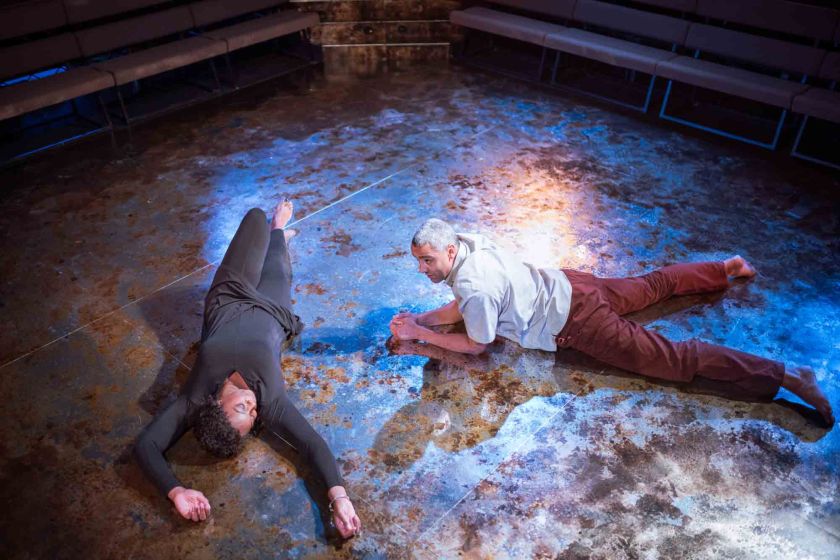
About from a mottled, mirror floor and some subtle but effective lighting from Nao Nagai, the Clare studio space in the Young Vic had nothing else to work with for the two actors, bar script and audience. So they needed to be good, very good. They were. Christopher Colquhoun, (a long way from Weatherfield), brought an awkwardness and innocence to Eugene which heightened the tensions in key scenes with Alma, his father, Wyce and, latterly, grandfather. Nicola Hughes, if anything, was even more striking, turning Alma into a woman of power and dignity who rises above the self-hate others would have her internalise, and eliciting pity for Ophelia. One of the fiercest performances I have seen this year. I would dearly love to see her in more “straight” drama roles beyond the musicals she is renowned for.

It is easy to see why Yellowman has been so frequently revived since its premiere and why the talented young director Nancy Medina would choose to take it on. Its setting may be specific in terms, of time, place and community, but its insights are universal and the humanity of its love story is palpable. Yet this, if I am honest can be found elsewhere on screen, stage or page. What makes this really, really special for me is Ms Orlandersmith’s gift for dialogue and image. The five sections of the play are distinct by chronology, but is the skill with which the author paints in the detail that made going to see this one of the best decisions I have made this year. And all for £15.

Miss Julie at the Jermyn Street Theatre review ***

46a5b8be00000578-5112853-image-a-52_1511489566004

Miss Julie

Jermyn Street Theatre, 27th November 2017

Grinding my way through the classics of naturalistic drama. Actually not grinding, that makes it sound like too much of a slog, but I can’t pretend it is all unalloyed joy. Turns out that Chekhov is likely the man for me and Ibsen works only intermittently. This was my first Miss Julie, so early days for Sweden’s finest, but based on this, and a past The Father and Creditors, I don’t think I am going to be his greatest fan. I am conscious that the critics across the spectrum lapped this up, and I can’t fault the acting, direction or staging, so any misgivings must lie in the play or possibly the adaption, here newly minted by Howard Brenton. I won’t have the latter though, since a) Howard Brenton is the gold standard in other adaptions, b) he is at pains to tell us in the text that he wanted to stay as close to the original based on the literal translation from Agnes Broome, and c) his play Pravda was the thing that turned me on to the theatre.

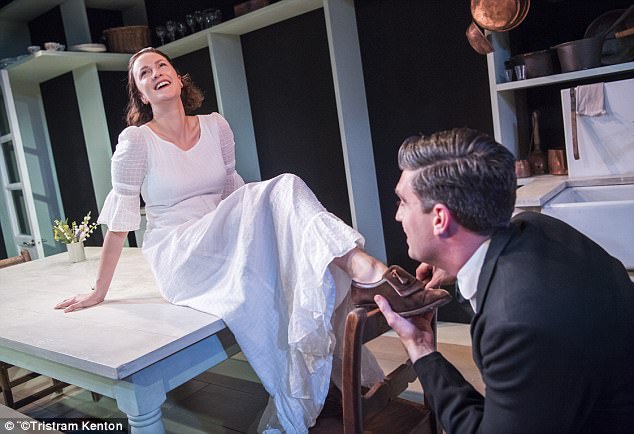
Now it strikes me that, for a claustrophobic play set solely in the kitchen of a Swedish manor house, want you want is a claustrophobic theatre and a set which captures said kitchen. Which is precisely what you get from Louie Whitemore. In immense detail. With kidneys frying on the stove. Director Tom Littler, now in the hot-seat at JST, is happy to let Izabella Urbanowicz who plays cook Kristin prepare and cook the meal before James Sheldon’s valet Jean bounds in after having dropped into the Midsummer’s party we can hear going on in the background (courtesy of Max Pappenheim’s sound design). So a confident start. A bit of gentle banter about Miss Julie’s erratic behaviour and some gentle exchanges between the couple and we’re all set for the arrival of the eponymous flirt. I think Izabella Urbanowicz nailed Kristin’s cautious conservatism, (we see it later with references to her faith), and her utilitarian approach to her choice of husband to be. James Sheldon in contrast exuded a kind of boyish restlessness that served him well in the dialogue with each of the women. There was affection between the servant couple, no doubt, but also, I sensed a slight distance.

So all looking good for Charlotte Hamblin’s white-dressed Miss Julie to set the ball rolling towards the sex, anger, imagined disgrace and disappointment which follows. I gather Ms Hamblin is famous for being some-one in Downton Abbey, so this upstairs/downstairs stuff was presumably a breeze for her. I have seen a few bios which include everyone’s favourite period drama, and it has so far proved to be a mark of quality for the stage performance. Which therefore makes it mystifying as to why Downton Abbey itself is so unbelievably bad. Anyway Ms Hamblin was suitably bored, sexy, desperate and rash and Mr Sheldon was suitably horny, angry, boorish and rash to make the attraction very believable. She gets to lash out at the way she is shackled by class and status. So does he. But we are also acutely aware from the off that the distance between is not as great as it seems and, at the societal level, is starting to close. So it’s all there.

My marginal unease comes as we move into the “what are we going to do now” bit. Miss Julie’s collapse into nervous panic and Jean’s swinging mixture of motives are all part of the fun I guess but it tested my patience and I started to drift away from proceedings. Passion can veer from love to hate in an instance, and passion across class barriers is never going to end well for one, or the other or both. AS however seems to want to have his cake and eat it, then whip out another cake and have another go, as the couple ride their emotional rollercoaster. Miss Julie is the victim in this production but that only serves to heighten Strindberg’s not so buried misogyny.

As you can see I am confused and need to think a bit more about this. Must try harder. At the end of the day though I can’t pretend I was gripped throughout and, if this production is as adept as the critics have said, then I may have to conclude that AS is out of my limited reach. Never mind, there’s lots more theatre to explore.

Poison at the Orange Tree theatre review ****

claire-price-and-zubin-varla-in-poison-by-lot-vekemans-orange-tree-theatre-photo-by-the-other-richard-1024x683

Poison

Orange Tree Theatre, 28th November 2017

Sometimes all you want from a play is for it to do exactly what it says on the packet. No sub-plots, symbolism, pointless characters, formal invention, stilted message. Just a powerful and involving story, well told. This is exactly what renowned Dutch playwright, Lot Vekemans, does in Poison. No wonder it has been translated and performed in multiple locations. Another terrific acquisition by Paul Miller and the Orange Tree team. Here it is translated by Rina Vergano who is the go-to for Dutch and Flemish texts.

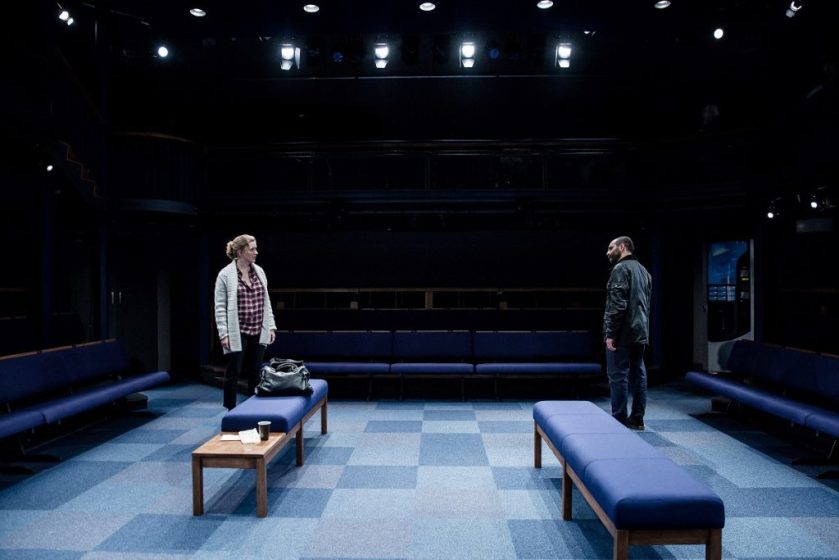
Mind you this doesn’t make this a play that will have been easy to write, create or act in, and, in some ways, it isn’t easy to watch. Its subject, the loss of a child and the impact it has on a couple, is about as painful a subject as it is possible to imagine, for a “domestic” drama. Yet Ms Vekemans, takes us through all the ramifications of this dreadful event, with such a sure and sensitive hand that every line seems to ring true. A divorced couple meet in an unremarkable chapel building in a cemetery in France. (Blue carpet tiles, the designer’s catch-all for the banal, which Simon Daw wisely embraces here, along with those other staples, water-cooler and vending machine). We never get to know there names as, even after a separation of 9 years, they have no need to employ them. They were torn apart by the death of their son, Jakob, in a road accident, which eventually led to the journalist husband walking out on the millennial New Year’s Eve. They are here ostensibly to discuss what will happy to his body given that the land it lies in is contaminated. No one else turns up though (for reasons that become clear halfway through). They talk. There is pain, humour, tenderness, recrimination, jealousy, goading, misconception. In fact there is everything you might imagine a couple in this situation would put themselves through.

Paul Miller seems to have focussed on the “rediscoveries” in the last couple of years at the OT. Here he reminds us he can do contemporary plays standing on his head as well. Not literally. Like I say at the top there is no attempt to get directorially clever with the text here. There is no need. Movement, gesture, pauses, tensions, as well as words, everything worked.

This needed a couple of top drawer performances which, with Claire Price and Zubin Varla (who I have seen a bit of recently), is exactly what we got. Claire Price showed us a woman who could not move forward. Not because she was not trying nor because she was flawed in some dramatic sense. Just because she couldn’t accept what had happened. Which makes sense I think. She could be funny, she could be scathing, she could be analytical but always brittle and nervous underneath. Zubin Varla’s stilted ex husband had tried to moved on, (a new wife, a move to France from Holland), but was struggling with guilt for doing so. I swear I could hear him thinking at times. His intention to write a book about their bereavement is met with anger and incomprehension by her. The pain of their shared past infects this present but will continue into the future unless they can find some way to make it stop. There is some slight hope of redemption to this end at the end, but it is fragile.

Even beyond the bereavement itself though what is really, really striking about the play, in just 80 minutes, is the way it conjures up the whole skein of connections that a parted couple can recreate on meeting up, both comfortable and awkward, in movement, gestures and words. I was watching two real people, intimate strangers if you will, undergoing real experiences in pretty much real time. You’d think that would be easy to dramatise. It isn’t. This really was very, very good. It is one of those plays that gets better as you remember it.

The Lady from the Sea at the Donmar Warehouse review ***

ladyfromthesea600x600

The Lady From The Sea

Donmar Warehouse, 23rd November 2017

I have an uneasy relationship with Henrik Ibsen and this is the first time I have seen The Lady From The Sea, (though I note that plenty of the usual Ibsen obsessions are on show in it). So I may not be best placed to make a reliable judgement. Then again this blog is really only intended for me to process what I have seen so, strictly, if I am both author and reader here, we can both agree that nothing of what follows matters.

Except that the SO was present. And what she thinks does matter. To me at least. And her view echoed mine. We were not completely persuaded that the Caribbean setting of Elinor Cook’s spikey adaption added an extra dimension to proceedings, even if it satisfied the high watery metaphor count, and we felt that Nikki Amuka-Bird’s admittedly full-blooded performance as an unhinged Ellida didn’t entirely articulate with the other characters, especially Finbar Lych’s diffident, decent Wangel. We get that Ibsen doesn’t have to be cold deep fjords, birch trees and not saying what you mean, and that it is beholden on us, the audience, to work with Ibsen and his interpreters to get to the bottom of the drama, but direction and setting just meant this production didn’t suck us in the way the best Ibsen does.

I like it best when I am simultaneously fascinated by, and want to figuratively slap Ibsen’s characters, (not literally obviously, that is worse than eating or arsing about with your phone in terms of theatre etiquette). Ellida is torn between her duty and her desire, to escape for sure, but more importantly to take control of her stultifying life. Bolette is presented with a similar dilemma, duty or desire, albeit without some flash, bad-boy Stranger sailor hanging around. Hilde, as we see when she leads Solness a merry dance in The Master Builder, is free, even if here she is still missing her real Mum. The blokes, in their different ways, have the scales lifted from their eyes, at least Wangel and Arnholm do. Poor Lyngstrand in this production is just a knob, albeit quite funny, as his artistic pretensions are mocked.

That’s the guts of what I see. Ellida, like Hedda, Nora. Helene, Rita and Ibsen’s other women, are not easy to play, but, for me, it is made immeasurably harder if the stifling nature of the society, and, as here, the marriage, they find themselves in, is not foregrounded. We may be a long way from Europe here, in a land built on oppression, but this is never really explored. Reasons for Ellida’s emotional “prisoner’s dilemma” are easy to see, sexual frustration, the loss of a child, an incomplete memory of first “love”, smothered ambition, thwarted intelligence, but solutions should remain knotty and incomplete, even as they appear. At times the production was a little too direct which left some of the intended haunting allusion and symbolism looking pretty awkward.

Kwame Kwei-Armah presents his and Ms Cook’s case with accuracy against the jaunty set of Tom Scutt, but it never really catches fire. Mind you we were both struck with Helena Wilson’s clever Bolette and Ellie Bamber’s pointed Hilde. I reckon both of them could get properly stuck into an appropriate leading role in a new play.