Copenhagen at the Minerva Theatre Chichester review *****

heisenbergbohr

Copenhagen

Minerva Theatre Chichester, 6th September 2018

Michael Frayn wrote the funniest stage comedy of all time. Noises Off. OK well maybe it is only is the funniest of those comedies that I have seen. And maybe the two productions that I have seen, the NT one from 2000/2001 directed by Jeremy Sams, and the 2011/2012 Old Vic revival directed by Lindsay Posner, show it off to best effect. And the fact that Mr Frayn has sharpened it up with re-writes since it first appeared in 1982 helps. It is a farce about a farce about a farce and is brilliantly constructed. For sure the belly aches come from the visual humour and slapstick but real comedy also emerges from the characters “on” snd “off” stage personas and their relationships. Everyone should see this once in their life, (but not the film version – the whole point of this is that it is a theatrical experience and the film is rubbish). LD remembers it as the funniest thing she has seen on stage and she was only 10 at the time.

We also have to thank Mr Frayn for his pitch perfect English adaptations of Chekhov. The magic of Chekhov can prove elusive but a text from MF gives a good chance for a production of walking the tightrope between pathos and comedy. There are his novels as well. I have though, until now, never seen either of his more recent dramatic triumphs, Democracy or Copenhagen.

So thanks to Chichester Festival Theatre for putting on this revival. And to recruiting a cast of the calibre of Charles Edwards, Patricia Hodge and Paul Jesson. And to persuading, if he needed persuading, Michael Blakemore, who directed the NT premiere in 1998 to wave his magic directorial wand over this revival.

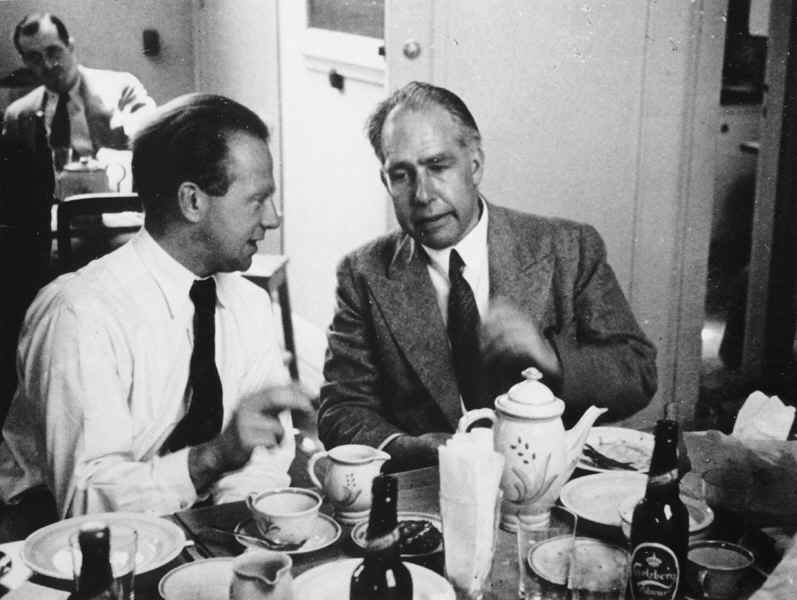
Copenhagen is not quite a perfect play. But it is so close that it barely matters. Mr Frayn is a very, very clever man. So naturally he takes a very, very big subject for Copenhagen. The is the imagined conversation between Werner Heisenberg and Niels Bohr in Nazi occupied Copenhagen during WWII about whether eminent nuclear physicists could or should attempt to prevent the building of a nuclear bomb. The exact circumstances of the meeting in 1941 are unclear from their writings, though Bohr seemed to react angrily to whatever Heisenberg brought to him, and there has been much subsequent debate, in part fuelled by MF’s play, about exactly what happened. Out of this admittedly dramatic conceit MF constructs a play of intense philosophical enquiry, offers us both a science and a history lesson, shows the loving and fraught relationships between the eminent Bohr (then 55), his wife and amanuensis Margarethe and his one time student Heisenberg (39), and. as if that wasn’t enough, reminds us of the tension between the “objective” universe around us and our “subjective” view of that world that our consciousness constructs.

The memories of the meeting between the two physicists are played out in various ways, three times “another draft”. Time is not linear. We see several versions of events. The protagonists do not always occupy the same time and place. It is not always clear if they are talking to each other or to us the audience. This “plot” and the movement of the actors mirrors the behaviour of atomic particles in Peter J Davison’s monochromatic set. Did Heisenberg come to warn Bohr and, by implication, the allies about the Nazi nuclear programme? Or did he just want approval from his mentor? Or was he fishing for technical information on what was needed to trigger the required chain reaction? Did Bohr put him off the scent? How fervent was Heisenberg’s patriotism? Or his morality? Was he oblivious to what his country was doing? Did he help the half-Jewish Bohr and Margarethe escape from Denmark? How “guilty” did the scientists feel when looking back and are they trying to assuage that guilt – it was Bohr who ended up in Los Alamos after all?

MF cleverly uses anecdotes and the past history of the three protagonists to draw parallels with the scientific concepts they discuss. Skiing and table tennis act as metaphors to contrast the two men’s characters and approaches to scientific enquiry as well as a way in to Heisenberg’s uncertainty principle and Bohr’s complementarity principle. A pre-war train journey by Bohr shows how electron spin theory was disseminated across Europe and his movements mirror that of the particles he describes. A card game where Bohr bluffs by mistake points up the risk of nuclear proliferation. Toys and weapons are elided. The death by drowning of one of Bohr’s sons, Christian recurs as a motif for what might have happened if someone or something had intervened. (The video backdrop courtesy of Nina Dunn has a lot of waves, alluding to the drowning and presumably wave theory). There’s probably loads more I missed.

Even with these “simplifying” devices, (which, as the two scientists remind each other to revert to “plain” language for Margarethe’s sake, can sometimes patronise), this is dense stuff. But it doesn’t feel like it. Aside from one tiny slip, Paul Jesson as Bohr and, especially, Charles Edwards as Heisenberg, are utterly on top of the language, and Michael Blakemore’s direction ensures the delivery is perfectly placed. Patricia Hodge avoids smothering Margarethe with an overly haughty demeanour, protective of her husband and suspicious of Heisenberg, the nucleus revealing the human failings of both.

As I understand it, and I don’t, the Copenhagen Interpretation was proposed by Bohr and Heisenberg before the war as a way to reconcile different theories of quantum mechanics. Quantum mechanics can only predict the probabilities of what might happen in physical systems. The act of measurement affects the system to reduce to the one result that is observed. Like what MF is doing with the play. With us doing the measuring. Though we cannot be sure of the result.

Big ideas, and especially big scientific ideas, can often lead to big drama. But dramatists can often overreach themselves or retreat back into the human and not push us intellectually as hard as they should. Copenhagen, like Brecht’s Life of Galileo, doesn’t make that mistake. One of the best plays I have ever seen and, once fizzing, a near perfect production.

 

The Height of the Storm at Richmond Theatre review ****

Vincent_van_Gogh_-_Houses_at_Auvers_-_Google_Art_Project

The Height of the Storm

Richmond Theatre, 5th September 2018

I can’t deny that Florian Zeller is a gifted playwright. I am just not sure his work is for me. I saw The Father at this very house in 2016 with Kenneth Cranham in the lead role. Centering on an old fella with Alzheimers allowed Mr Zeller acres of space to deploy his trademark philosophical musings and play games with time and memory. Mr Cranham was great but all that deliberating about what you could and could not believe got a bit samey after a while.

Well he, and his translator Christopher Hampton, are at it again in The Height of the Storm. The nature of memory, the effects of ageing, the making of self, the cracks in a family, all are confronted again, but here set against a love story. Jonathan Pryce is Andre, a retired writer, who has been married to Madeleine, played by Eileen Atkins, for five decades. They live in a large country house in provincial France. Divorced daughter Annie (Amanda Drew) arrives for the weekend. It looks like she is pushing for the house to be sold. Later on younger daughter Elise (Anna Madeley) also pitches up with current estate agent boyfriend (James Hillier) in tow.  A bunch of flowers is delivered. A neighbour and apparent long-standing “friend” of Andre played by Lucy Cohu pops in. But it isn’t very long before we begin to wonder if Madeleine is really there or whether disorientated Andre just imagines her presence and whether the cosy conversations they are having are simply the memories of his now dead wife. Or maybe it is the other way round?

Mr Zeller quite rightly recognises that theatre is all about suspending rationality and playing games with “truth”. And Height of the Storm certainly messes with your head. He writes beautifully but presenting such uncertainty made me, well, uncertain about whether this was entirely satisfying. However the play certainly creates an atmosphere. The set design of Anthony Ward, the kitchen of the family home, is exquisite. The lighting and sound designs of Hugh Vanstone and Paul Groothuis respectively are equally ravishing. Obviously director Jonathan Kent is exemplary – this sort of drama is his meat and drink. And I could watch Jonathan Pryce and Eileen Atkins all day. Mr Pryce exactly shows us how Andre is lost without Madeleine and Ms Atkins in turn shows Madeleine’s fortitude. Florian Zeller was inspired to write the play when he saw an elderly couple cling together as they crossed a road from the window of a Paris hotel on the day of his own wedding. They had become “one being” and that is exactly what the play conjures up and these two masterly actors portray. The desolation of losing the one you love.

There is something powerful at work here and if you want to see two outstanding stage actors at the top of their game, (supported by excellent supporting performances), effortlessly directed then this is for you. At 90 minutes it doesn’t outstay its welcome. Just be prepared though for that “what was going on there then” feeling as you leave.


The Lieutenant of Inishmore at the Noel Coward Theatre review *****

aidan_turner_28377312040629

The Lieutenant of Inishmore

Noel Coward Theatre, 31st August 2018

My regular reader, (hello), will need no reminding, (OK maybe they will), that I am a massive fan of Mr Martin McDonagh. Hangmen is the best new play I have seen in the last 3 years, indeed one of the best ever, and Three Billboards Outside Ebbing Missouri, amongst the best films. Three Billboards Outside Ebbing, Missouri film review *****). I am massively excited about his new play, A Very, Very, Very Dark Matter, which will open at the Bridge Theatre in October, with Jim Broadbent in the lead as Hans Christian Anderson and Phil Daniels alongside him as Dickens. It sound like it will plough the same dark furrow as 2003’s Pillowman, (which Mr Broadbent originally starred in), where a writer, living in an unspecified totalitarian theocracy, is accused of murders which mimic the plots of his own fairy tales. It is meta, a bit Gothic, it captures the power of literature, there’s some Kafka going on, the ethical dilemma is fascinating if a little forced, of course there is violent imagery and of course there is humour.

Like all of McDonagh’s plays The Pillowman’s morality is slippery, though not really ambiguous; it is normally pretty clear what he is saying, just that its compass is oscillating so rapidly between perspectives of right and wrong that we in turn start to  lose our bearings. That is what makes them thrilling. I would be pretty sure that violence is going to be a theme in the new play, as well as the nature of “story-telling”, based on the intriguing Bridge blurb.

Prior to The Pillowman, The Lieutenant of Inishmore was the last produced of Mr McDonagh’s “Irish” plays, and the second in the Aran Islands trilogy, (named after the three islands in Galway Bay), and was originally produced in 2001 by the RSC. (The final play in the trilogy, The Banshees of Inisheer, is as yet unpublished). Michael Grandage, the director here, revived the first in the trilogy, The Cripple of Inishmaan, to great acclaim, in 2013, at this very theatre, with Daniel Radcliffe in the lead. It is, you guessed it, a black comedy, this time about the impact on the community, and specifically bookish loner Billy, of a Hollywood film crew on neighbouring Inishmore in 1934. The documentary, like the play, was a sort of pastiche on the “remote” west of Ireland, and there are strong echoes of JM Synge’s Playboy of the Western World. McDonagh, with his rapid plot reversals, with his fictions and lies, and with that always slippery morality, again sets out to confuse and offend. Here his target is the whole notion of Irish identity, the creation myths if you will. Set it up, then knock it down, shift it on, that’s the method he employs and that’s why his plays and films are so bloody marvellous.

The ink had been dry for three years or so on the Good Friday agreement when The Lieutenant of Inishmore first appeared on stage. However it was actually written in 1994, and is set in 1993, the year of the Harrods, Warrington, Bishopgate and Shankhill Road bombings. Yet by the end of that year British PM John Major and Taoiseach Albert Reynolds were able to sign the Joint Declaration of Peace, the beginning of the end of the Troubles. Now some halfwit Brexiteers public school jape puts this all at risk, amongst so many other things. Remember it is now near 600 days since the power sharing assembly which forms the Northern Ireland Executive collapsed and the threat of a return to direct rule looms without any agreement. Meanwhile the Northern Ireland Secretary freely admits she knew nothing about politics in the country ahead of being appointed. Anyway, calm down Tourist. Back to the culture.

The Lieutenant of Inishmore, in common with many other of Mr McDonagh’s works, uses extreme violence to show that violence is no solution to argument or injustice, whether personal or political. “A violent play that is whole-heartedly anti-violence” as its author described it. Mad Padraic is a terrorist who is so brutal that he has been booted out of the IRA and even the INLA. We first encounter him torturing a suspected drug dealer until interrupted by the news from back home in Inishmore that his cat Wee Thomas is ill. Let’s just say havoc ensues thereafter. The play is a satire on Irish terrorism, for sure, on political violence more generally, and especially on the kind of beliefs, and the fanatical rhetoric and sanctimonious moral superiority underpinning them, that justify mindless butchery by the believers.

It is brutal, callous but also very funny. The idea of a revenge comedy is hardly new: I think this is the best way to interpret Titus Andronicus and its forebears for example (Titus Andronicus at the Barbican Theatre review ****). Or the films of Quentin Tarantino. To squeeze this many laughs out of the situation though, whilst clearly conveying your message, takes extraordinary writing skill.

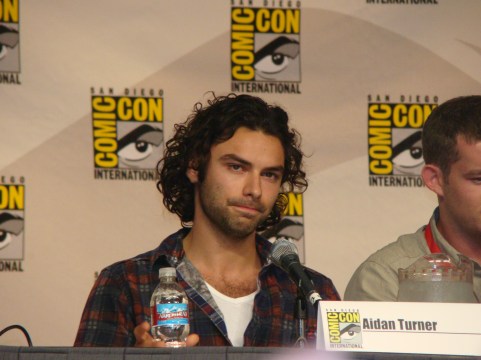
It also needs a skilful cast to strike the right tone and pace. Now I don’t think it will come as much of a surprise when I tell you that I was probably one of the few members of the audience who wasn’t there to gaze upon the undoubted charms of Aidan Turner as Padraic. Indeed, following a late substitution. the SO stood down to be replaced by LD. The LD has not yet been meaningfully exposed to the genius of Mr McDonagh, unlike the rest of the family, nor frankly is she a fan (yet) of that Poldark. But she can see the fella is gorgeous, I assured here it would make her laugh and the political context was right up her academic street. She thought it was brilliant. And that remember from a youth who is very suspicious of both Dad and the “theatre”.

She was right. This is a brilliant production. And that is due in no small part to the charisma of Aidan Turner. Mr Turner’s stage career has been hijacked by the TV roles and this is effectively his first major role outside of Dublin. He is very, very good, toning down Padraic’s sadism and dialling up his childish sentimentality, so I hope we don’t have to wait too long for his next outing. This is not just about him however. Denis Conway as Padraic’s father Donny, Chris Walley in his stage debut as the hapless Davey and Charlie Murphy as Davey’s sister, and budding “freedom-fighter” and Padriac’s soulmate, Mairead, are all mightily impressive. The set from Michael Grandage’s regular collaborator Christopher Oram is revealed to be an exact replica of the family cottage in every detail even as it is splattered with lashings of blood.


Home I’m Darling at the National Theatre review ***

retro-1353267_1920.jpg

Home, I’m Darling

National Theatre Dorfman, 29th August 2018

N.B. Home I’m Darling is transferring to the Duke of York’s Theatre from 26th January 2019 for 11 weeks and then toddles off on tour to Theatre Royal Bath, The Lowry and Theatr Clywd.

Now I have to confess to a slight feeling of disappointment with Home, I’m Darling. Don’t get me wrong. It is a very amusing play, with a fine cast led by Katherine Parkinson, and note-perfect set, costume, lighting and sound designs from Anna Fleischle, Lucy Carter and Tom Gibbons, which, cumulatively makes its points. It’s just that it doesn’t really yield too much in the way of surprises once the initial inversion has played out. It feels like writer Laura Wade, whose work to date has been inspired, notably Posh, had a really good idea and a series of fine scenes in her head, but, in translating them on to the page, some of the fizz seemed to evaporate.

Katherine Parkinson plays Judy, a stay at home housewife, married to Johnny (Richard Harrington), an estate agent. It quickly transpires that they, together, have taken their nostalgic obsession with the 1950s to its logical, (or maybe illogical), conclusion. Their friends Fran (Kathryn Drysdale) and Marcus (Barnaby Kay) share their enthusiasm for the clothes, music and style but not the domestic arrangements, right down to Judy decanting the sugar into 1950s containers and milk into glass bottles. Mum Sylvia, (a trenchant Sian Thomas), who brought up Judy in a commune, finds her daughter’s choice hard to comprehend, this “gingham paradise”. The cast is completed by Alex (Sara Gregory), Johnny’s boss, who Johnny is trying to curry favour with to secure promotion. The set up, with the insertion of an Act 2 flashback, allows Laura Wade to explore all angles of the “debate” about gender roles and choices in contemporary society. What value does that society place on “traditional women’s work”? How to balance “choice” with economic necessity? Who can judge on the choice to stay at home or work? What are the risks in fetishising the past? If this sound like its going to be a dour evening never fear. It is all delivered with the lightest of comic touches as you would expect from this writer and from Tamara Harvey who has directed her work before.

The problem is that having conjured up this admittedly intriguing conceit, and established a sit-com mood, the tone never really wavers, and there are maybe a couple too many plot revolutions jemmied in to cover all the bases, for example when Marcus reveals his true misogynist colours. There are occasions when the play steps out of its self imposed comic straightjacket, when Sylvia delivers an impassioned speech about the sacrifices her generation made to promote feminism in the 1970s and just how materially tougher life was for a child in the 1950s, for example. And Katherine Parkinson, with her ability to convey Judy’s brittle interior nature, (she always sounds the weeniest bit p*ssed to me), shows how she crumples under her own self-imposed contradictions. Having teased out a dramatic explanation for Judy’s decision from her own childhood, the plot seems to go into reverse and the ending is something of a damp squib. We all, the SO, BUD and KCK, came out just a little deflated.

I am thinking maybe I am being a little harsh here, and maybe we were asking too much, but that’s where we came out. There are some priceless lines, (Fran’s “the longest recipe I followed this week was Pierce Film Lid”), and the play will definitely make you think. Given that it has sold out at the NT and, prior to that at Theatr Clywd, and has garnered a slew of 4* reviews, I wouldn’t dream of putting you off but there was just something that held us back. And trust me the 4 of us are usually very easily pleased.

Pericles at the National Theatre review *****

sea_png7

Pericles

National Theatre Olivier, 26th August 2018

So how do you like your theatre? Or more particularly how do your like your Shakespeare? Utterly faithful to the First Folio? Set in the time and place that big Will intended (however baffling)? All blokes in tights? Performed by elite, public school grandees plummily sing-songing the verse?

Of course not. He’s for all time, not just his time, so there’s a million ways to show him off. Yet it seems from some of the reaction to Emily Lim’s three night production of Pericles at the National, the first in the planned large scale, annual, Public Acts initiatives, that some misanthropic types, (who probably weren’t there), have got the right hump with this. “It’s not “proper” Shakespeare”. Well neither is the mangled, reconstructed Pericles text that has been handed down to us with half of it penned by George Wilkins. “Very little of the precious Shakespeare lines make it through the production”. Fair enough but I defy anyone to sit through the whole bonkers story of Pericles without thinking this is a cracking tale that needs fearless pruning to properly emerge. “Adding music and dance scenes cheapens the entertainment”. Who says so. Will Shakespeare was all about entertaining the punters and making money. Chris Bush’s adaptation, with music by Jim Fortune, succeeds admirably in the first aim and, if it were possible, would, I guarantee, deliver on the second. “It is all well and good having these “amateur” types making their family in the audience proud but it gets in the way of the “professionals””. Bollocks. That is not what was intended here and if you can’t grasp that then I respectfully suggest you p*ss off to wherever you think you might find a “correct” performance of this messy play.

So ditch the moaners and pay attention to most of the proper reviewers and, I humbly suggest, me. For this was one of the most uplifting nights I have spent in a theatre. It was a very. very long way from the last Pericles I saw, the Cheek by Jowl production at the Barbican, (in French, heavily chopped, with our Prince of Tyre in a hospital bed, tut, tut, what were they thinking). (Pericles, Prince de Tyr at Silk Street Theatre review *****). But it was just wonderful.

OK so, at first, realising just how far Ms Bush and Ms Lim have deviated from the “original” is a bit of a shock. But once I saw how this allows them, and everyone involved, to incorporate the community performers, whether in dance, in song, in walk-, or wheel-, ons and memorably, in named parts, I just started smiling, and then grinning, so that by the end, (after manfully holding back the tears and trying not to audibly gulp), I was overwhelmed with joy. I know how daft that sounds but I can only offer up my genuine reaction.

The professional cast, led by Ashley Zhangazha as Pericles himself  and Audrey Brisson as daughter Marina, were superb. Mr Zhangazha was as natural as you like, (insofar as you can be natural in such a daft plot), in shifting from the retained verse to the sharper rewrites. This momentum ensured the ensemble set pieces didn’t really get in the way of the story. Not that it would have mattered anyway if they had. Whether it be the marriage scene of Pericles and Thaisa, (here interrupted by a recalcitrant maypole set malfunction which, if anything, made the production even more communal), or transforming the Mytilene brothel into something a bit more family friendly thanks to the ministrations of the effervescently camp Kevin Harvey as Boult, these tableaux were marvellous. All the performances were terrific though, though, and I feel guilty for saying it, the London Bulgarian Choir simply blew me away.

Maybe some of Jm Fortune’s songs were a bit cheesy but who cares when you can clap along within seconds. Maybe the sheer amount of stuff that was thrown at the Oliver stage sometimes bewildered, as one reviewer said, like the biggest am-dram production of all time. Maybe the sheer number of bodies on stage, the cast in total is over 200, occasionally threatened to topple even Robby Graham’s masterly choreography. Yet this was what made it so much shared fun.

If this is what the Public Acts enterprise has kicked off with then I say bring on next year’s. The idea, taken from New York, is to involve an array of community and theatre partners, (here the Queen’s Theatre Hornchurch who will host the next instalment), from the outset in creating a mass participation slice of theatre around the country. Time, patience and, yes all you misery-guts, money will be involved but the benefit to participants, communities and audience surely justify the investment based on this production.

Immense credit must go to NT resident director Emily Lim who has decided in specialise in community productions. To co-ordinate a work of this scale is mind-boggling. To impose a resonant vision, the idea of “finding one’s home”, upon Pericles’s journey, even more so. And to create this much love, (you soppy old git Tourist) deserves our eternal gratitude. I really hope everyone involved gets another opportunity to put this on. If they do please go.

The Silk Road at Trafalgar Studios review ****

the-silk-road-2840198_1920

The Silk Road

Trafalgar Studios 2, 23rd August 2018

The modern day Silk Road was the first major darknet marketplace, closed down in 2013 when the FBI arrested its alleged founder Ross Ulbricht and banged him up for life. I didn’t know that. As far as I was concerned it was the main trading route from West to East through near three millenia until the early 1700’s, (these trade deals can take an awfully long time to set up I fear). I am hoping my confusion poses no surprise to you.

Writer Alex Oates has taken the the modern-day Silk Road as the starting point for his pithy and vivid one-hander, ostensibly a plea for libertarian freedom in a digital world, in reality a sharply observed and very funny coming of age story about Geordie teenager Bruce Blakemore. That it succeeds as well as it does is down to an exhilaratingly dynamic performance by newcomer Josh Barrow. He commits everything, not just in his portrayal of loner Bruce, but in the sweet Nan whose knitting skills he ropes into his ingenious, if illegal, money-making scheme, memorably, the nightclub bouncer and dodgy owner Shaggy who are his, unwitting, accomplices as well as his posh girlfriend who kick starts his habit.

Josh Barrow slips in and out of the distinctive characters in the story, as well as narrating in the first person, at lightning speed. He doesn’t hang about either, constantly on the move in the tiny Trafalgar Studios 2 space. At one point an audience member is briefly press-ganged into the action but, throughout, the constant asides from young Mr Barrow means he engages with all of us. He has bags of charm, natural comic timing and surprising emotional depth. No doubt a lot of hard work went into this performance, along with director Dominic Shaw, but it flows effortlessly. I note that he is not the first actor to take on the role, James Baxter in 2014 in Edinburgh (funded by an anonymous Bitcoin donation it seems, proof that the comedy cryptocurrency can have some value), but I can’t imagine it topped this.

A one hander, coming it at less that an hour, probably didn’t justify the prices that Trafalgar Studios was looking for at the open but, when halved, it became a very attractive proposition. I know everyone involved deserves to be fairly rewarded for their work but I can’t help feeling more realistic pricing at the off would have dragged more punters in to see this excellent play and performance. The SO and I took in a matinee but I can’t help feeling there is a lot of opportunity for a slice of reasonably priced, straight to the point pre-dinner/drinks contemporary theatre in this fair metropolis and TS is perfectly positioned to do it. More like this please.


Imperium at the Gielgud Theatre review ****

cicero

Imperium I Conspirator and Imperium II Dictator

Gielgud Theatre, Royal Shakespeare Company, 18th July and 25th August 2018

I don’t read much. Don’t have the patience or the imagination. Much easier to get my kicks from the theatre, or from film, where other people can do all the hard work. Also suspect years of reading, writing and talking, to no great effect, in an office, for the greater good of neo-liberal capitalism, has shredded what grey matter I once had. Not like the SO. A voracious reader.

All of which means I have no view on the novelist Robert Harris. Never read anything he has written. Always had him down as a writer of pot-boiling political thrillers. Not even seen any of the film adaptions. On the strength of this majestic entertainment, an adaption of Mr Harris’s trilogy of novels about Cicero adapted by Mike Poulton, I think I might have missed a trick. It looks like Mr Harris’s books would be right up my street and he sounds like a terribly good bloke as well.

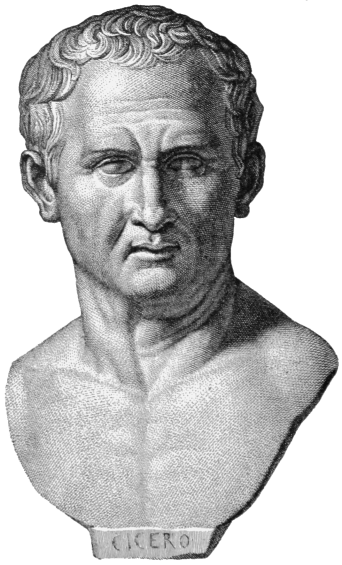
So next holiday reading now nailed down what about this RSC blockbuster? Apparently Mike Poulton had to be fairly judicious with what he took from the book, focussing on certain episodes in the maturity of the great orator’s life, but what he has conjured up, together with RSC AD Gregory Doran, is a fantastic slice of theatre. OK so there are times, as in some of Shakespeare’s weaker sections in the history plays, where the shuffling of characters on and off the stage, and the expository repeats, become a bit cumbersome, but generally Mr Poulton and Mr Doran have, through a variety of devices, ensured that, throughout the 7 hours or so of the two plays, we know exactly who is doing what to whom and, mostly, why. We also get an insight into the mind of one of history’s greatest thinkers, (or at least one of the greatest thinkers in a Western culture still in thrall to the Classical), and some universal lessons about the nature of politics and representation, and the symbiosis of word and deed in history, or at least the history of “great men”.

The plays also succeeds thanks to the casting of the two main protagonists. Richard McCabe is a thoroughly convincing Cicero, principled, courageous, sardonic, egocentric. Joseph Kloska as his secretary and our narrator Tiro, is equally impressive even if he has less to work with. There is more than a touch of the buddy movie about their central relationship. The audience is frequently dragged in to proceedings whether as the imagined Senate that Cicero and others address, the mob, or, breaking the wall, as conspirators in the events on stage. Not formally innovative but very satisfying in this kind of “one thing after another” history play. The political canvas, as we pass through Cicero’s election as Consul, his machinations with Catiline, Clodius, Julius Caesar, Mark Antony and, finally, Octavian (Augustus), all to protect the values of the Republic and, take note, the rule of law, is contrasted with the domestic, Cicero’s dysfunctional relationships with wife, family and proteges. If you know your Roman history and/or your Shakespeare, this is a delight. Even if you don’t the touch is so light that it is a breeze to follow.

The staging, against the steps leading up to a pair of giant. mosaic eyes, in Anthony Ward’s set, is as dramatic as it needs to be when serious stuff is playing out, but there is a thread of humour, largely milked by the two leads which prevents it turning into a slog. Sometimes the laughs, and the delivery, edges a little bit towards the Up Pompeii, but this is a good thing in my book, and much better than the alternative of ponderous epic. Composer Paul Englishby and sound designer Claire Windsor have very adroitly managed to plot a way through this tonal warp and weft, not easy to sustain over this length of time. The same is true for Mark Henderson’s lighting composition. Indeed the entire creative crew should be lauded for their studied concentration. It would be easy to let things slide, or for the pace to ease up, when you have this much to show, but, if at any point my concentration wavered, it was my fault not theirs.

With this size of undertaking, 44 named parts and more walk-ons and crowd scenes beyond that, and spanning four decades, most of the cast were doubled up across the two plays. In addition to Cicero and Tiro, Siobhan Redmond as Cicero’s put upon wife Terentia, Jade Croot as his unfortunate daughter Tullia and Paul Kemp as his bluff brother Quintus all stuck to one role, along with Peter de Jersey imperious, (no other adjective will do), Julius Caesar. When he came on all fake chummy to Cicero he captured exactly the air of a big man who knows he can’t be refused. Oliver Johnstone (after young Rufus in Part I) played Octavian with an air of even greater menace as he seized the opportunity given to him by his adoptive father Caesar Mk I. Joe Dixon seemed to relish the roles of, first, entitled aristo Catiline and then, a boozed up Mark Antony, as did Eloise Secker as the scheming Clodia and then Fulvia. This is, unfortunately, not a story with much to offer in the way of female roles, so it was a bit disconcerting, and unusual, to see so many white men on show. Still that was Rome, except that it wasn’t really.

Turning Cicero’s life, through the device of a biography written by his (originally) slave, mediated through millenia of scholarship, a writer of gripping fiction, and then on to the stage, was bound to throw up all sorts of questions about how we interpret the Ancients and how the “principles” they established still inform the world today, politics, democracy and drama, most prominently. Layer that into a fast moving biography, contemporary resonance, (for once not shoehorned in), and a history lesson, and you can see why the team here was pretty much on the case as soon as the ink had dried on the final part of Robert Harris’s trilogy, also entitled Dictator. History does not repeat itself, nor is there some deterministic arc to human progress, but two-bit, populistic tosspot geezers (always men) are ten a penny. Easy to spot, less easy to stop.

For all of you who get sniffy about the RSC and its contribution to the cultural fabric of this country, and, the world, I respectfully suggest you zip it. Here’s a great story, thrillingly told, neither too high or too low brow. Of course, as usual, by the time the Tourist gets round to seeing it and writing about it, it’s pretty much all over but I would hope this adaptation has an afterlife and I for one would love to see more “history” plays delivered in such confident, ambitious style. Like I say, if like me, you just don’t have the attention span to read a book or devote days to a box-set, then this is the thing for you. Proof positive that anyone who thinks theatre is a dreadful, long drawn out bore hasn’t tried and basically doesn’t know what they are talking about.

Exit the King at the National Theatre review ****

15512-illustration-of-a-king-of-diamonds-playing-card-or

Exit the King

National Theatre Olivier, 15th August 2018

My first Ionesco play, albeit in a version adapted by ubiquitous wunderkind Patrick Marber, (one day the image of Peter O’Hanraha-hanrahan that pops up at the mention of his name will pass), and, all things considered I liked what I saw and heard. I gather Exit the King is the least absurdist of his major works but there is nothing existentially impenetrable about this production. Apparently too this was the National Theatre’s first ever production of this playwright.

Maybe, over its 100 minutes or so running time, its theme, forgive the pun, was done to death. And maybe there was a bit too much “one character at a time”, comic-strip style declamation but overall I was hooked. Rhys Ifans, who I cannot lie, can annoy me, (I wasn’t bowled over by his fool in the Glenda Jackson Old Vic Lear), was perfectly cast as King Berenger; his movement, stature and delivery were expertly marshalled to great effect as the King went through the various stages (denial, anger, bargaining, depression) on the way to accepting his death. Indira Varma was imperiously forthright as Queen Marguerite, as you might expect, and Amy Morgan as Queen Marie, the King’s pandering favourite was a fine foil, even if I have to assume she was more Breton than Ile-de -France given the Welsh twang in her Gallic accent. Adrian Scarborough as The Doctor has added another notch to his long list of comedy side-kicks, the under-rated Debra Gillett squeezed a lot of laughs out of the maid/nurse Juliette as did childhood hero Derek Griffiths as the Guard, (I only realised it was him halfway through), with his pithy Brechtian pronouncements on the action.

Patrick Marber once again showed what a clever fellow he is, not just in the way he understands and interprets classic texts, but in the way he makes them relevant and lucid to contemporary audiences, (After Miss Julie, Don Juan in Soho, Three Days in the Country, Travesties). That I guess is what makes him so bankable as a writer/director though I would like to see him conjure up another original play to rival the heights of Dealer’s Choice and Closer. Anthony Ward’s set design is a triumph, showing it is possible to fill the vast Oliver barn with just six characters, and the coup de theatre delivered at the end, with the assistance of High Vanstone’s lighting and Adam Cork’s sound design, is worth the ticket price alone. No hyperbole here. I literally think it is worth paying £15, for there are plenty of the cheap Travelex tickets left, to see this technical wonder.

King Berenger has reached the grand old age of 483. His kingdom is on its knees but the despotic old boy doesn’t seem to care. He discovers he only has an hour or so to live. There’s nothing the Doc can do. Welcome to the surreal world of French-Romanian playwright Eugene Inonesco. We are in a fairy tale though one that seems to obey Aristotelian real time. KB isn’t happy about the news. His Queens alternatively coax him into denying or accepting this reality. There’s is a deal of metaphysical and psychological insight, some game-playing and a few good one-liners, even if there is no real surprise in the narrative arc. But it does make you think and you do identify with the humanity inside these fabulous characters and there is an energy or, for want of a better term, a life-force, in the play which draws you in, despite the dramatic inertia. As someone who has veered rather too closely towards the guard-rails of mortality in recent years I could see what Ionesco was driving at. He does sound like a bit of a eeyore who spent too long pondering the big questions in life, (and here death), but we need people like that to spare us having to grapple with all this mind-f*cking stuff.

Exit the King is a tragedy played as a comedy and there is, as we know, a lot of fun to be had in that. It isn’t difficult to spot the parallels with the central concern of Lear say, albeit big Will shoves in a few other themes, (and Lear obviously has a fair dose of the absurd), as well as your man Beckett. I have to say though I found this easier to digest than Beckett, though I am no expert. Maybe that reflects the quality of the production but I think I would be keen to see this chap Berenger again, (apparently he crops up in other EO plays Rhinoceros, The Killer and A Stroll in the Air). I suspect that I won’t have too many opportunities to realise this dream, as this is not the sort of theatre to guarantee bums on seats, so I had better crack on with it.

Lurking behind this one-key morality tale Mr Marber does try to draw out a broader message. Just as when we individually die, we die – that’s it folks – and our lives don’t really matter, so it is the same for our species. Homo Sapiens will end with a slow whimper not a bang (technology I’m afraid is the enabler, not the saviour, of our destruction), and there will be no consciousness left to care or mourn. A combination of cynicism and stoicism is the only solution.

Have a nice day.


London theatre recommendations as at September 2018

London Back Street

One or two of you have ill advisedly remarked that I haven’t sent one of these out for a bit. Sorry I am just naturally indolent. 

Details below but for those of you who can’t be arsed to wade through all of that and trying to avoid the outre stuff, not taking any risks and highlighting stuff you could take your Mum to, here is the quick summary. 

Here’s the detail.

  • National Theatre. Some stuff is sold out but there is availability for Antony and Cleopatra, I’m Not Running, Stories, The Tell Tale Heart and Follies. 
    • Now Tony and Cleo is not Shakespeare’s finest hour – language is too flowery for my liking and no-one wants to see old folk getting it on – but with Ralph Fiennes and especially Sophie Okonedo in the leads then it should work but probably best left to Shakespeare nuts. 
    • David Hare always writes cracking state of the nation plays, here the politics of health, but probably worth waiting for the reviews.
    • Stories is the new play from Nina Raine. Looks like it is about IVF and having a baby late. Her last play, Consent, was an absolute belter. I would definitely give this a whirl. 
    • The Tell Tale Heart is the NT’s panto equivalent … but since it is based on an Edgar Allan Poe story and they are warning it is not for the faint hearted expect lots of fake blood and the like. Maybe worth a punt but these things can have a habit of disappointing.
    • Follies. If you haven’t seen Follies and you like musicals then you absolutely must. I hate musicals but was spell bound from start to finish. 
  • Barbican. I wouldn’t normally tried to tempt you to the Barbican with its RSC transfers and European arty stuff but there are a couple of possibilities.
    • The Merry Wives of Windsor. Coming from Stratford. Looks like the critics weren’t sure but the punters loved it. Shakespeare’s broad comedy made broader by being relocated in Essex. You can guess the rest. 
    • Medea. Not yet up on the Barbican website but my favourite company, Toneelgroep Amsterdam, say they are bringing this over in March next year. If you have never seen a classic Greek tragedy look no further. Mandatory viewing.
  • The Wild Duck at the Almeida. Ibsen classic. Probably for those who already know what to expect but the twist is Robert Icke (Hamlet, 1984, Oresteia) directing so probably the subject of a radical rethink. The Almeida pretty much never disappoints so if you want a bit of Nordic tragi-comedy look no further. 
  • Bridge Theatre
    • I have banged on before about A Very, Very Dark Matter, the new play from Martin McDonagh which kicks off in October. He wrote and directed the films Three Billboards Outside Ebbing Missouri and In Bruges to give an idea of his black comedy and his last play Hangmen was the best we have seen in the last 3 years. Please go. 
    • Also Alan Bennett’s new play Allelujah about the NHS is on now. I haven’t seen it you but my spies really enjoyed it. The Bridge is London’s most comfortable theatre so don’t hold back. 
  • Nine Night at Trafalgar Studios. This is a transfer from the NT of Natasha Gordon’s debut play. It is about an extended British Jamaican family. It is superb and very funny. Traf Studios can be a bit greedy with pricing but I think it is worth it. 
  • An Adventure at the Bush Theatre. Always tricky to pick out fringey stuff but this look good. Written by Vinay Patel who did Murdered by My Father on the telly. Post colonial love story across the decades. maybe wait for reviews. Bush is a lovely friendly place and if you don’t mind where you sit (or actively wish to avoid sitting with your guests) then the Count Me In thing they do is only a tenner. Bargain. 
  • Dealing With Clair at the Orange Tree Theatre. There’s a whole bunch of goodies in the new season at the Orange Tree but I am most interested in this a revival of a play by Martin Crimp about estate agents in the 1980s. Crimp is a bit of an acquired taste, not entirely naturalistic dialogue. His new play When We Have Sufficiently Tortured Each Other will come up at the NT (not yet booking) with no less than Cate Blanchett in the cast. 
  • Caroline or Change at the Playhouse Theatre. Transfer from Hampstead Theatre (in turn from Chichester). Musical about a Jewish family and their Black maid in the 1960s by Tony Kushner who is a genius. It is amazing. Sharon D Clarke in the lead is just extraordinary. Like I say I hate musicals but this brought a lump to my throat (and made me think). there are a few odd bits in it (singing washing machines) but that’s why it is so inventive. Avoid the cheap seats at the top in the Playhouse – only midgets will fit there.
  • Pinter at Pinter season. All of Harold Pinter’s one act plays at the theatre named after him. Amazing casts. If you like Pinter or want to find out if you do they are already discounting the first couple of collections. I am so excited about this though I get it if you ain’t. 

The End of the Pier at the Park Theatre review ****

llandudno2c_end_of_the_pier_1

The End of the Pier

Park Theatre 200, 2nd August 2018

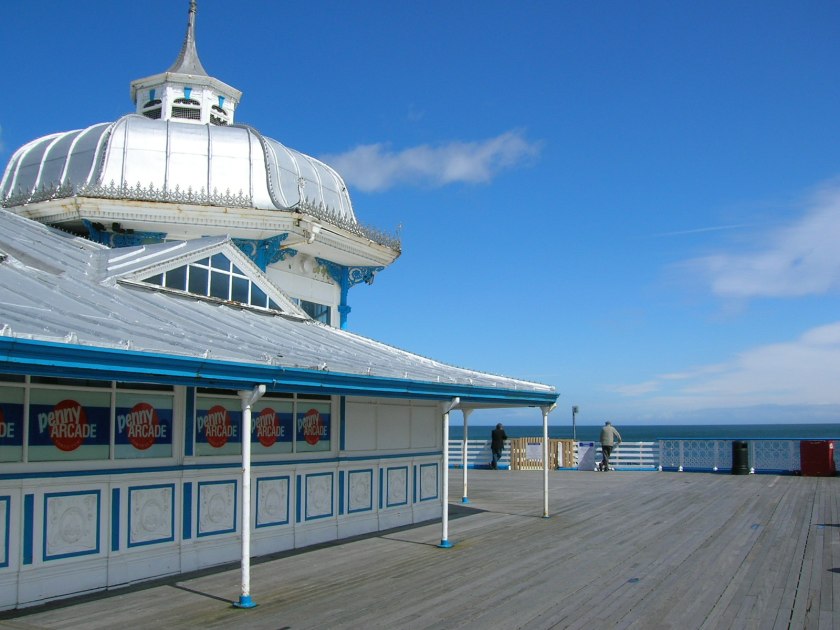
Comic gold is not universal. We all have a different take on what is funny. The casting of Les Dennis in Extras (S1 E4) as a washed up, needy TV star in a pantomime, whose young fiancee is copping off with a stagehand, was a stroke of genius by its creators Ricky Gervais and Stephen Merchant. Specifically the scene where he is literally baring his all to Gervais in the changing room is as funny as funny gets. As it turns out this was a turning point in Les’s life and career lifting him out of a dark period after a marital break-up (visible on the execrable Big Brother apparently). Ironic too that Messrs Gervais and Merchant’s own comedy oeuvres have been largely downhill since then.

Anyway it means that Jolly Les is surely the go to casting choice if you are writing and producing a play about a washed up comedian whose career comes crashing down after making a racist joke. Which is exactly what writer and director Danny Robins and Hannah Price did with The End of the Pier. More than enough to reel me and the SO in to seeing it.

The joy is that this is actually a pretty good play. Funny, insightful, well structured and with some strong performances and not just from Les. His character Bobby was part of an, unsurprisingly, Northern double act, Chalk and Cheese. From working men’s clubs through to Saturday Night TV stardom they had it all into the 1980s. Eddie Cheese, now dead, was an unrepentant racist bully but it is Bobby who ends up telling the (unheard) joke, perhaps against his better nature, which catapults their careers, just when the audience, thanks to alternative comedy, is moving on. The twist is that Bobby’s son, Michael, played by Blake Harrison, (you know Neil from The Inbetweeners), is also now a household name “observational” comedian, with a partner Jenna, (the very talented Tala Gouviea), who is a TV comedy commissioning executive and fully paid up member of the LME.

Now as I write this I can see that the set-up does all sound a bit predictable. But the way in which Mr Robins goes on to develop the set-up is anything but. The politics of comedy, (and race and class), are smartly pulled to pieces, the relationship between father and son is similarly dissected and there is a brilliantly funny ending courtesy of Nitin Ganatra, who plays Mohammed, a schoolmate of Michael who comes back to haunt him. OK so there are a couple of clunky McGuffins to facilitate some plot switchbacks, and Michael’s character turns a little too adroitly on a attitudinal sixpence towards the end, but no matter, as once it gets going this is thoroughly entertaining stuff. Danny Robins is not the only TV/radio sitcom writer to be commissioned for the Park stage but on the strength of this I bet he gets another crack at a full length play. He has an ear for dialogue and could certainly succeed with subtler fare. Mind you I have to admit that some of the funniest lines in the play are Bobby’s cringey old-skool one-liners.

Hannah Price, (who I think worked with no less than John Malkovich on his The Good Canary at the Kingston Rose last year), directs with vigour and does a pretty guide job of patching over the contrivances and James Turner’s set, which shifts from Bobby’s Blackpool flat to backstage at the studio where Michael’s show is filmed, has a real flair for detail. As an aside the designers for productions at the Park seem to me to always be very well served by those who put their sets together so a big shout out to the chippies and the rest of the team. In our performance there was a problem with the sound but the team soldiered on regardless and came up with a couple of belts and braces solutions when it mattered.

There are better plays which address the nature of comedy, Trevor Griffith’s masterful Comedians and Terry Johnson’s Dead Funny for example, but this is a very entertaining, if occasionally overly earnest, addition.