
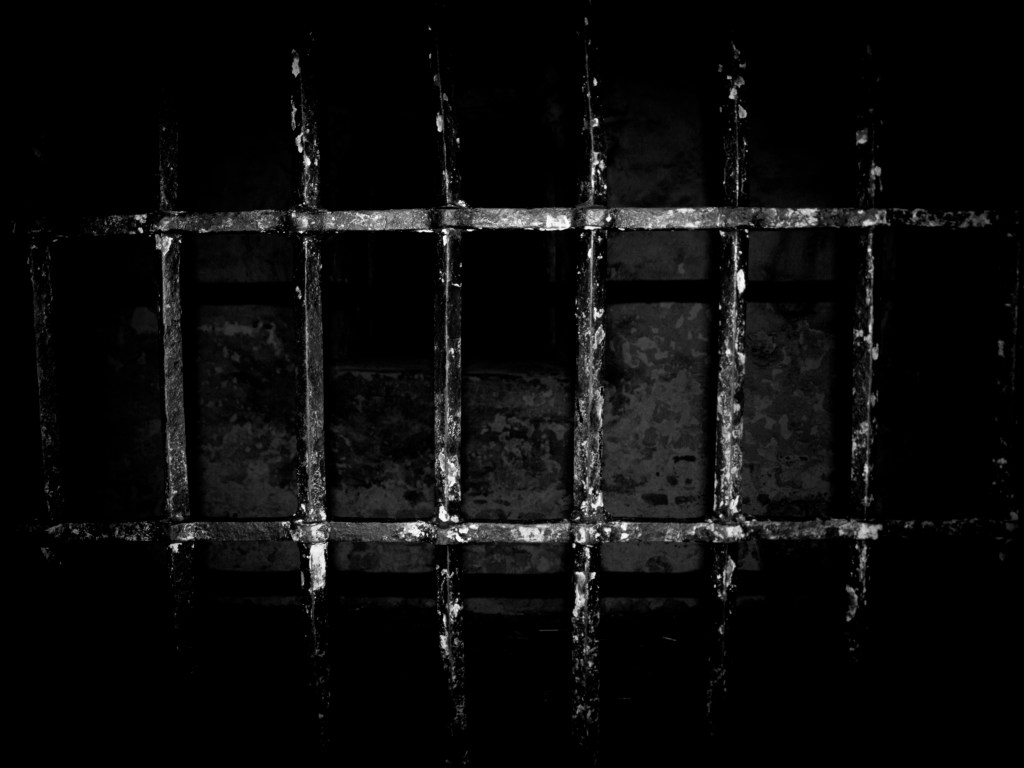
prisoner of the state at the Barbican review ****

BBC Symphony Orchestra, Ilan Volkov (conductor), Elkhanah Pulitzer (director), Julie Mathevet, Jarrett Ott, Alan Oke, Davóne Tines, BBC Singers

Barbican Hall, 11th January 2020

In which American contemporary composer David Lang, co-founder alongside Julia Wolfe and Michael Gordon and probably best known for his Pulitzer prize winning the little match girl passion, offers up his update of Beethoven’s only opera Fidelio, (in its various, protracted, incarnations). And yes he does title his compositions in lower-case.

Mr Lang has come up with some striking and novel ideas in the past to inspire his largely vocal body of work. Comic strips, disappearances, Bach, Death, search engines, the crowd at Highbury, national anthems, autopsies, Glen Gould and broken musical instruments. The whiff of the conceptual, which I like. POTS however focuses on the big themes at the heart of LvB’s opera, liberty, justice, freedom, heroism, sacrifice, as well as the central love story, but jettisons all of the comic padding, glorious as it easy musically if not always dramatically, and compacts the story down to just under an hour. Like a best bits, reworked in the immediate, post-minimalist style, though still with plenty of punch, that characterises the music of DL and his compatriots.

The lead characters become Every-Men, and Women, with Leonara now the Assistant, who inveigles her way into the prion where hubby Florestan is now the Prisoner, watched over by the Jailor and the Governor, as well as assorted guards, and a prisoser chorus which features throughout. This permits a more timeless vibe, for all the prisoners of the state, then and now, highlighted in DL’s own idiomatic and very direct libretto, which borrows from other, relevant texts (Machiavelli, Bentham, Rousseau, Hannah Arendt, and a list of English prisoners about to be carted off to Australia) . OK so maybe the simplification, at least musically, with a regular rhythmic ostinato ebb and flow of build-up arias and big choruses, verges on the repetitive, but there is no denying its emotional impact. Even if at times. especially in the final climax, the sound got a bit messy. DL certainly knows how to handle a chorus.

I have to confess that I do not know Fidelio as well as I should given my firm conviction that Beethoven was the greatest music maker of all time. A couple of productions seen on telly/laptop and a couple of listens through, with less than complete concentration, is plainly insufficient. Failed to secure a ticket for this season’s ROH production from Tobias Kratzer so a cinema viewing will have to suffice. Which means I couldn’t tell you how David Lang has re-interpreted LvB’s key set pieces though I gather they are largely present and correct if concentrated.

The singspiel style opera was semi-staged, as intended by DL, under the direction of Elkhanah Pulitzer, with a simple set design from Matt Saunders to simulate the prison, complete with lighting from Thom Weaver, projections from Yuki Izumihara and costumes from Maline Casta. I could see it working effectively as quasi-oratorio given its simple, though winning, harmonic language and direct story-telling. After all the original is more about ideas and character than convincing narrative The (amplified) vocal parts prioritise power and clarity over intricacy, which favoured the bass-baritone of Davone Tines as the Jailor and elfin soprano Julie Mathevet who convinced as the heroic, disguised, Assistant/Wife. The contrast between the defiant idealist Prisoner, baritone Jarrett Ott, and Alan Okie’s rich tenor as the authoritarian Governor was also effective, though the latter backed down pretty quickly when it cane to the pivotal rescue scene. Mind you at least this avoided the cringey, sexist ending of Beethoven’s original as the townspeople bang on about wifely virtue rather than freedom from tyranny.

This cast, with the the exception of Davone Tines, performed at the premiere of the work by the New York Philharmonic, and it will also be getting airings at co-commisioners, in Rotterdam, Barcelona, Bochum and Bruges. I have no doubt that the BBCSO and BBC Singers (here assisted by some enthusiastic students from the Guildhall) will have more than held their own against the other ensembles during the tour of the work. Once again I was struck by the authority and commitment that the oh so versatile BBCSO brought to the work.

The Animals and Children Took to the Streets at Lyric Hammersmith review ****

The Animals and Children Took to the Streets

Lyric Hammersmith, 23rd February 2019

This took my eye in large part because of the description of its form in the Lyric blurb and in the many reviews that have followed its progress around the world since 2010 following a commission by Battersea Arts Centre, Malthouse Theatre Melbourne and the University of Chichester. Theatre company 1927, made up of writer/director Suzanne Andrade, film and animation designer Paul Barritt, costume designer Esme Appleton and composer Lillian Henley, had a big hit in 2007 with Between the Devil and the Deep Blue Sea at the Edinburgh Festival. This was the follow up. It combines animation and video design with live music and songs, narration and performance, like a “graphic novel burst into life”. It is, technically and creatively, a tour de force even if the story itself doesn’t quite match up.

Bayou Mansions on Red Herring Street, in the Bayou, is a decrepit tenement block in an imagined city, where the poorest members of society are concentrated and the feral kids run riot. Agnes Eaves and little daughter Evie pitch up with an ambition to change things through the power of Blue Peter-ish craft. A reluctant janitor steps in to help. The kids invade the posh neighbourhood. You can guess the rest. The plot, as in most parables, doesn’t stand up to much scrutiny, and the subversive message, let the kids play again in public spaces, with a few nods at wider social and economic injustice along the way, isn’t really developed. Who cares though when this level of visual and musical invention is on show.

Mr Barritt’s animations are stunning. The aesthetic is 1920’s German Expressionism/Berliner cabaret filtered through 1970s kids cartoons with Tim Burton lurking in the background (in my head at least). The way that the three white-faced performers, Genevieve Dunne, Rowena Lennon and Felicity Sparks, integrate their movement, performance, piano music and costume changes with the moving animation, is occasionally breath-taking. The monologue narration of the caretaker, voiced by James Addie, is similarly seamlessly integrated. There is plenty of dry wit from this, and other characters, and a few (not enough mind) sinister undertones.

This wasn’t full on our visit and there are a few tickets left for the remaining performances. It might be that the Lyric is a little on the ample side capacity-wise for such a show, and I am not entirely sure the younger patrons, and indeed LD who I roped in to coming along, were entirely persuaded, but if you are prepared to take a punt and revel in the craft on show the is well with the £20 or so asking price.

Rosenbaum’s Rescue at the Park Theatre review ***

Rosenbaum’s Rescue

Park Theatre 200, 29th January 2018

Not quite sure why this didn’t entirely work for me. Alexander Bodin Sophir takes an intriguing story, the escape of 7500 Jews by boat from Copenhagen to Sweden in 1943 just before the Nazis were about to round them up, and puts it into the mouths of a Swedish historian, his German daughter, his Danish-Jewish friend and the latter’s wife as they are holed up at the couple’s house following a power cut. Mr ABS, in this his first play, has the passion to tell the story, his own grandparents escaped this way, and he has put the hours in research-wise, unsurprising given his day-job as documentary maker. He also contrives a punchy, if slightly overwrought, twist to proceedings at the end.

Actually I think I do know why. In the effort to cover all the contended reasons as to how and why these events happened, and to elide this with dramatic personal disclosures, ABS perhaps asks his text and dialogue to do just a bit too much heavy lifting and makes his characters just a bit too predictable.

It is Hanukkah, 2001 in the Scandi chic interior (courtesy of designer William Fricker) of the house of Abraham (David Bamber) and Sara (Julia Swift). They are preparing for a visit from Lars (Neil McCaul) and Eva (Dorothea Myer-Bennett). Lars is researching the events surrounding the evacuation. Abraham, as an observant Jew, is convinced that it was the result of the heroic resistance of the Danish people, and divine intercession, whilst Lars, an atheist, is convinced there was collusion between the Danish government, which had avoided the excesses of occupation elsewhere in Europe through flexible accommodation, and certain sympathetic Nazi higher-ups. Personal recollection, both men where 8 in 1943 plays a part as their friendship arose from a family connection formed at the time. Memories prove somewhat flawed and events open to interpretation especially when a few McGuffinish momentos are chucked in.

Cue snowstorm to ensure the debate rages and then lay on top some past history between the calm Sara and Lars and the fact that Eva, a novelist, sees her identity stemming largely from her German mother, now divorced from Lars. It isn’t tricky to guess the outcomes but all this intrigue does detract from the historical interrogation, and vice versa. ABS’s dialogue smartly, and comically, undercuts some of the more hyperbolic exchanges, notably from Sara and Eva (I am very keen on Dorothea Myer-Bennett’s no nonsense acting talent – here she did a lot with very little). The versatile David Bamber is always a joy to watch whatever he is doing (last seen by me as Noel in Julia Davies’s gloriously smutty Camping – and indelible memory) and the is no exception. Neil McCaul, as the “truth is everything” academic is maybe asked to turn up the apoplectic dial once too often but this does serve an obvious purpose.

The competing narratives of what actually happened are well articulated in Kate Fahy’s production, but she could maybe have cranked the pace up. The parallels with present day Denmark, and by implication the rest of Europe, get a little lost and the science vs religion arguments are a bit heavy handed. I came out actually wishing ABS hand found a way to simply focus on the arguments about what actually happened, and therefore the “truth of history”, in a much shorter double-hander, and reversed the passive-aggressive relationship of Abraham and Lars. Alternatively the personal drama could have proved the catalyst from which the historical argument obliquely emerged.

Still learned a lot. That’s enough.