Pink Floyd exhibition at the V&A review ***

61309a

Pink Floyd: Their Mortal Remains

V and A, 4th August 2017

Now I have always been slightly suspicious of Pink Floyd. I was only a nipper for the first few “psychedelic” albums pre and post Sid and whilst the classic trio of Dark Side of the Moon, Wish You Were Here and Animals, could and should have featured in the musical palette of me and my friends in the mid to late 1970’s, they just didn’t really. That is not to say we didn’t have diverse musical tastes with, I seem to remember, champions of Genesis, Yes, Hawkwind, Kiss, ELP, Rory Gallagher, Todd Rundgren, and even, through my mate Sparky who always exhibited the most developed musical taste, Krautrock. but the thing that held us together was heavy rock, Black Sabbath, Deep Purple (and the various offshoots) and, best of all, Led Zeppelin. No namby pamby pop or disco for us, or any of that suspicious androgynous stuff like Bowie, and certainly nothing bang-on cool like the Velvets.

As for me, well I was even more devoid of taste. Lank, long greasy hair, velvet loons, cheesecloth shirts and a penchant for the likes of Rush, the Eagles, Barclay James Harvest and Wishbone Ash, with the only saving grace a bit of reggae and soul. Now, of course, in the late 1970’s our salvation came along in the form of Punk and Peel and I was able to selectively erase this woeful past and successfully complete a course of cultural re-education. So, whilst I can’t pretend that some of the 1970s excesses haven’t found their way back into the CD collection, (yes kids, I know, CDs – what are you thinking granddad), I have also filled all the canonic gaps from first time around. Which includes those three classic Floyd albums.

Yet I still don’t really listen to them, nor do I particularly like them. Which is strange as I have a moderate passion for the likes of Porcupine Tree whose architect Steven Wilson has drawn on Floyd in the past, a developing interest in psychedelia from the late 60s and I get fairly excited when I play Genesis (obviously avec Gabriel not the novelty outfit they became after he left) who I couldn’t bear first time around. But Floyd, no, not really.

One more anecdote before some comments on this exhibition. It is August 1980. I seem to remember it was pretty warm. Me and some of the aforementioned mates have come up to London from our lairs in Yokeland. I think by now I am sporting a passable haircut and have ditched the flares but I might still be guilty of re-writing history to hide my shame. Anyway, we have been to a giant record shop (only vinyl kids though obviously you know all about that now). I have purchased two albums, Joy Division’s Closer and Echo and the Bunnymen’s Crocodiles. These will literally change my life. I cling to the bag all through the afternoon and into the evening. As we go to ….. would you believe it, Earl’s Court to see Pink Floyd as part of the Wall Tour. I probably enjoyed it, though the footage from this very exhibition of the start of these very gigs suggest it was all a bit daft what with the inflatables and the like. But I know that the future is in the carrier bag and not the old hippies droning on on the stage.

Please Tourist, enough of the cut price Salinger and tell us about the exhibition. Well it follows the well-tested V&A formula used in the marvellous David Bowie Is from 2013 and the You Say You Want A Revolution which ended earlier this year. Slip on the headphones, hear the music, listen to the interviews and then soak up a wealth of material, posters, album covers, artworks and the like. And in this case an awful lot of instruments and technology and, as the pomposity ramped up, a lot of stuff explaining how the certifiably over the top live performances were created.

Things are, unsurprisingly arranged in rigid chronology and tied to the official albums, studio and live. Now I have to say the first seven albums, the poppy, psychedelic stuff, was of most interest, firstly because I don’t really know it, and secondly because the mythology of Syd Barrett is just so powerful. The period of the three classic albums along with The Wall is given all due ceremony though it does all feel a bit grandiose. The last few albums are as dire as I thought they were so I upped the pace here. It is a mystery to me why progressive rock groups, who were at the forefront of electronic music technology in the 1970s, with Pink Floyd right in the vanguard, then went on to balls it up in so spectacular a fashion when this very technology became more mainstream in the 1980s. Think Genesis, Yes, even Rush as well as Floyd. Especially surprising in their case as, unlike many of their peers, they disdained shifting units (though they certainly possessed that knack. TDSOTM still sells several thousand copies a week even now).

Now to be fair my chum TMBOAD who came with me put in a lot more effort, as is his wont given his intellectual curiosity, but he formed broadly the same opinion with the first part holding his attention more than the rest. There is no doubt that this exhibition gives a comprehensive view of what, when and how PF produced their music though there is a little less insight into the why. And they do come across as anally retentive and sententious as received wisdom demands. If there is one thing I love about all these ancient old bands, it is their ability to hold a grudge. It’s just work lads. You will fall out. Lighten up eh.

Right I can see that sarcasm has got the better of me. Despite my snarkiness there is no doubt you should get along to this if you have any interest in the band or indeed the history of popular music. There is much excellent material to digest and the curation is off the scale superb. It is bloody crowded though, as the other similar exhibitions have been, which can be frustrating. We tried the early evening Friday slot but that didn’t seem to help. I personally think the aforementioned Bowie exhibition (GRHS) was better because he was a way more interesting bloke, as too was the Say You Want A Revolution just because they was way more social and political context to chew than here. Music and performance alone, which is what was being documented here, can only go so far in terms of enlightenment.

One day I am sure the V&A will get round to something major on Punk and its descendants (I don’t think this has happened yet). Then I suspect I really will wet myself with excitement. I note there were a couple of twats jigging around to the music here and generally getting in the way. It would get a bit tasty if we had some “silent disco” pogoists at any future punk retrospective !!

My Top 10 progressive rock albums

Just for a bit of fun and in the spirit of the exhibition I thought I would list my favourites from the genre. Not sure there is anything here (with one exception) that should surprise. This is ranked but only one entry per band/artist. See what you think. If anything.

1. Genesis – The Lamb Lies Down on Broadway

There was a time when when I wouldn’t have been caught dead saying this, but it turns out that Genesis are my favourite progressive rock band. Well at least the Genesis that genuinely were a prog band. Which means Messrs Gabriel and Hackett still alongside Collins, Banks and Rutherford. And The Lamb is Gabriel at his bonkers best with its “conceptual” story of Raul in NYC, plainly made up as Gabriel went along. No matter. Everything about this is terrific, with some tight arrangements, banging tunes, and the minimum of meandering, the classic tic of prog rockers everyone.

2. Rush – A Farewell to Kings

I was terribly keen on Rush when I was a nipper. No one else I knew was. Never fashionable but never properly unfashionable, and one of those outfits labelled “the world’s biggest cult band” of which there are now thousands. They have matured into grand old rockers and ambassadors for Canada and I own, but don’t really care for, quite a lot of the 1980s and 1990s stuff when the synths got too involved. For me though the quartet of 2112, A Farewell To Kings, Hemispheres and Permanent Waves, represent the sine qua non of the boy’s oeuvre with Farewell the best. Obviously Geddy Lee’s squeaky voice takes a bit of getting used to and Neil Peart’s lyrics are very, very dodgy, (all those Ayn Rand references), but his drumming and Alex Lifeson’s guitar playing are about as good as it gets. I know all this muso stuff about just how technically proficient they are is another prog rock tic but it still amazes me just how much sound three badly dressed, dodgy haircutted Canadians can rustle up.

3. Supertramp – Crime of the Century

It would seem I am determined to embarrass myself further for Supertramp, like Rush, were a big favourite before Punk came along and set me on the path to righteousness. It took many years before I allowed them back into my ears and heart but I am glad I did for, at their best, when Rick Davies and Rodger Hodgson weren’t at each others throats (another prog rock tic – the personality clash – true of other pop/rock genres but prog turns it up to 11), they were wonderful. Probably not definitively prog. In fact dangerously close to pop. No matter, just great songs. Once again the mid/late 1970s quartet of this album, Crisis What Crisis, Even in the Quietest Moments, and, just about, Breakfast in America, mark the high point. After that they really did balls it up.

4. Porcupine Tree – Fear of a Blank Planet

Most middle aged blokes with poor dress sense and questionable grooming habits will be all over Porcupine Tree and the brains behind it all, Steven Wilson. Self taught, genius, carrying the British flag for prog for more than three decades with PT and other projects and now his solo work, he is hugely important but largely unknown outside his field. And all kicked off by his listening to Dark Side of the Moon in his bedroom. If you happen to read this because you went to the Floyd exhibition, and are not up to speed on PT, please seek out Fear of a Blank Planet. I guarantee you will love it.

5. Soft Machine – Third

Now I don’t really know what all those bearded, Shoreditch hipster types listen to. But if they really want to impress their mates they should learn to fall in love with Soft Machine. At first all the alarming shifts in texture and doodling around, with the permanent threat or actuality of some jazz jamming, takes a bit of getting used to. You might even be tempted to laugh. It is well hippy. But it will get under your skin and I warn you that repeated listening will eventually lead to a permanent love-in. And it will make you feel so cool. Third is normally taken to be the best of the bunch but there is something in most everything they recorded. Now there have been multiple line-up changes and the latest line is soldiering on but the reality is that Soft Machine proper needs the mighty Robert Wyatt in the band to be the real deal.

6. Robert Wyatt – Rock Bottom

Robert Wyatt is just about the only rock/pop performer I will see live these days. Most music is just too loud so its classical for me now all the way. I don’t believe in God but Robert Wyatt is the closest thing to what I imagine people who do believe think God is. He lies right at the beating heart of prog. Though frankly his music is entirely his own. Just try it. It may take a few listens but once you get it you will never look back.

7. King Crimson – In the Court of the Crimson King

The granddaddys of prog. No list would be complete without this. Still going, still experimenting. Robert Fripp is probably the cleverest man in the history of popular music since the 1950s.

8. Can – Future Days

I saw this in a list of progressive rock best of albums. Obviously it isn’t prog. But I am taking some dodgy punter’s opinion on the web as qualification, so here it is. Without Can and Kraftwerk most modern popular music would be even worse than it is. Simples.

9. Pink Floyd – Dark Side of the Moon

See above. I am still not entirely persuaded but it would be extremely churlish not to include this. And generally I am not churlish. Rude, misanthropic, curmudgeonly, opinionated, yes. But churlish, no.

10. Yes – Close to the Edge

So the final piece of the jigsaw. Once again this appears more because of Yes’s reputation than any real passion on my part. Don’t get me wrong, there are passages of Yes that are wonderful (from the first few albums up to Relayer – after that you take your chances), but equally there is some grim stuff with all those overworked time signature changes. Still it would be churlish once again not to see them on this list and this is my fave of their albums.



Queen Anne at the Theatre Royal Haymarket review ***

aa_qa_home

Queen Anne

Theatre Royal Haymarket, 3rd August 2017

Tricky customers history plays. How to introduce the characters and explain events without slackening the dramatic pace. It’s OK if your Will Shakespeare. He wrote the history. Or at least someone before him wrote something, which he then purloined and turned it into a great work of art with those words, oh those beautiful words. And ever since people have half-believed his stories were based on solid facts. Mind you historical “facts” are a slippery business anyway. Always shaped by the narrator. I’m with the master of wry Alan Bennett: “History is just one f*cking thing after another”. A quote he stole in any event from a distinguished academic, though no-one seems sure which prof. said it first. See what I mean.

Anyway the writer of Queen Anne, Helen Edmundson opts for the direct approach to exposition with characters bluntly announcing their identity and, when necessary, the unfolding key events. This ensures that we the audience can follow the action without the need for intensive background reading but it does mean the first third of the play feels a little disjointed. However once the dramatis personae are established and the various themes laid out we then get a fine story simply told under the direction of Natalie Abrahami.

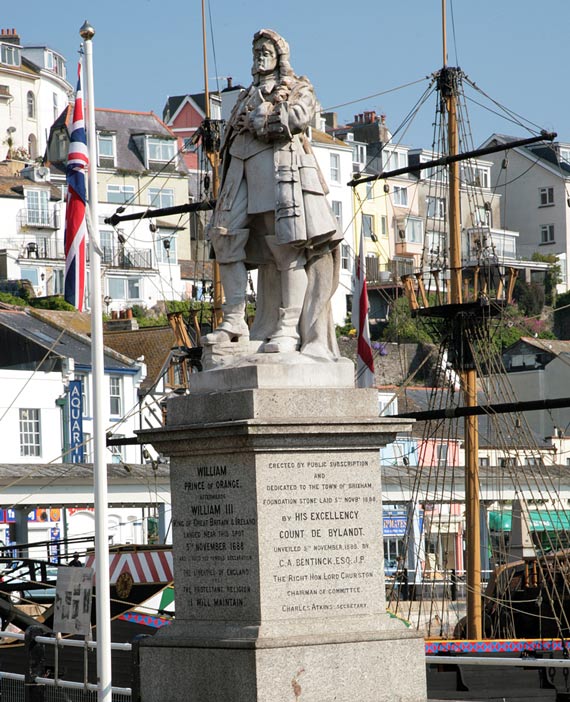
The focus of the play is the relationship between Queen Anne (Emma Cunniffe) and Sarah Churchill, Duchess of Marlborough (Romola Garai). Anne accedes to the throne on the death of her childless brother in law William III (played in barking king mode by Dave Fishley). You know he was the Dutch fella we invited over with wife Mary to keep the Catholics off the throne. He landed at Brixham, also famous as the birthplace of the Tourist. Hurrah. Here he is. Unusually without a seagull crapping on his head.

william-of-orange

Anyway Anne is a Stuart but the right sort as a Protestant. She is also childless despite seventeen pregnancies, a very sorry state of affairs. Her husband, Prince George of Denmark (Hywel Morgan) is a full on booby. Anne is, initially at least, physically and temperamentally, not really up to the job, so her childhood friend Lady Sarah and her circle of Whigs do their best to manipulate her to their own ends. Our Lady Sarah just happens to be the wife of John Churchill, whose rise to become leader of the Protestant forces across Europe in the War of the Spanish Succession against mighty France and Spain, (after a few false starts), brings recognition, wealth and prestige. This was a turbulent time in English (and with the Act of Union in 1707, British) politics and the play does an excellent job in drawing this out, as Anne seeks to make her mark and shifts allegiances towards the Tories led by Speaker Robert Harley (very well played by James Garnon). This was the era when Britain moved into the first division of European powers (though war proved an expensive business) as the Catholic powers were faced down and as capital was accumulated largely on the back of the slave trade (yes all you proud Brexiteers, these are the foundations your glorious country is built upon).

The tempestuous Lady Sarah gets the hump as her influence on Anne dissipates and gets properly jealous of Abigail Hill (played by Beth Park) another scheming ingenue who comes from nothing to become the Queen’s new bosom buddy. Sarah leaks some salacious correspondence but this backfires and she, her husband and her circle are debilitated (though the family has seemed to rub along ever since down the centuries – go see Bleinhem Palace is you don’t believe me).

These events are interspersed with some entertaining song and dance routines. This was after all the period which saw the rise of the popular press, in the form of pamphlets, and the emergence of political satire. The great British public, OK the emergent newly rich grasping oligarch Whigs (land alone no longer being the route to power), had put the monarchy back in its box and weren’t above any ruse to slap down the Tories, high Church and sniff out any whiff of Jacobitism.

So a fascinating time, an important monarch who ruled at a pivotal period in England’s history, and a well realised portrait of an intense relationship. Emma Cunniffe and Romola Garai both give very credible performances as Anne and Sarah and there is real passion in parts of the second half. But this is no Mary Stuart and there were times when I was hoping for a few more twists and turns. On the other hand if this is the sort of thing that floats your boat, and on balance I would say it should, then I see there are plenty of tickets left at very attractive prices, so give it a whirl.

Angels in America at the National Theatre review *****

angels-in-america-cast-portraits-1280x720

Angels in America: Part One Millennium Approaches and Part Two Perestroika

National Theatre, 29th July 2017

That Tony Kushner is an ambitious playwright. This will comes as no surprise to you experienced theatre lovers but, having seen this and The Intelligent Homosexual’s Guide to Capitalism and Socialism with a Key to the Scriptures at the Hampstead Theatre last year, this has come as a revelation to this newbie.

Ostensibly Angels in America is a play about the impact of HIV/AIDS on a handful of characters beginning in mid 1980s New York and the denials that dominate their lives. Into this Mr Kushner weaves an examination of religion (specifically Mormonism and Judaism) and personal salvation, the rise of economic neo-liberalism and fall of communism, national, personal and sexual identity, the nature of responsibility and even the march of history itself – fin de siecle anyone?. The characters generally don’t do much in the way of small talk, yet all the exposition is punctured by genuinely funny humour. These people do not lack self awareness, that’s for sure.

Part One generally remains within the bounds of the naturalistic, Part Two goes into metaphysical overdrive as the curiously ineffectual angels (who themselves have been deserted by God) start to pile up. If I am honest it is all a bit nuts at times but the points that Mr Kushner wants to make more than justify the formal experimentation. And he does make a lot of points as I said. Sometimes repeatedly and with no let up in the erudition.

Now you might think the thick end of 8 hours of this, for those of us who opted for the one day experience, might turn into too much of a good thing. I have to say though that, with the exception of a few longueurs, you would be wrong. Mr Kushner’s writing creates, in me at least, a kind of heightened perception of the themes he is exploring, whilst still delivering a story, or stories more precisely, with forward momentum, and characters that you can love (or hate) despite, or perhaps because of, their intensity. As with all very. very clever people, Mr Kushner is maybe occasionally guilty of mislaying the “less is more” filter but this is a small price to pay to be dazzled on this scale. And whilst the direct impact of HIV/AIDS may have changed in public discourse in the last three decades or so, the questions the play poses directly and indirectly are still painfully relevant.

As for the production, well it is brilliant. Marianne Elliot’s direction is faultless. Meticulous precision has been applied to the combination of Ian McNeil’s set, lighting, sound, and yes, even the angels, which means the rhythm of the play is never impeded. And the cast. OMG. I don’t think I have ever seen as many high level performances as in this production. Andrew Garfield is astonishing as Prior Walter whose campness turns to courage. If anything Nathan Lane is even better as Roy Cohn, whose denial of his illness is as aggressive as his delusional politics. This two performances alone would be enough to justify the ticket price but then you have James McArdle chiming in with an impeccable portrayal of Louis Ironson, Prior’s lover who is riddled with guilt and hypocrisy. And then you have Russell Tovey as Mormon Joseph Pitt whose sexual denial has to crack, and, maybe most memorably for me, Denise Gough, who takes the part of Harper Pitt. Joseph’s pained wife and turns it into triumphant release. On and then you have Susan Brown, Amanda Lawrence and Nathan Stewart-Jarrett, lighting up the stage as they cover most of the remaining parts. Collectively this is acting of the highest order.

So you can see I liked it. A lot. Like I said it does sprawl a bit, and the brain did need a few minutes of time out across the hours, but this is what theatre is all about. So if you are a theatre luvvie stick it on your bucket list. If you are a philistine run a mile.


The Tempest at the Barbican review ****

19919tempeste1

The Tempest

Barbican Theatre, 27th July 2017

Now I would watch Simon Russell Beale read the telephone directory. Particular past favourites of mine include a Brechtian Galileo, a Face in the Alchemist, alongside Alex Jennings and Lesley Manville, his Stalin in Collaborators, a Timon in the Hytner production, which persuaded me this is a greatish play, and his persuasive Lear. So his return to the RSC after a couple of decades was always going to be an event, particularly in the role of everybody’s favourite grumpy polymath/magician Prospero. The Tempest is not my favourite Shakespeare though I thoroughly enjoyed the all female Phyllida Lloyd Donmar production so maybe I am slowly coming round.

Anyway this production directed by Gregory Doran had secured very good if not outstanding reviews from its Stratford run so, one way or another, it had to be seen, Initially I plumped for the cinema option figuring this might prove a better way to soak in the technology on show. However, after a mix up with tickets and me throwing a tantrum (don’t ask), I missed out. So off to the Barbican it was.

Much has been made of the digital technology conjured up by Intel and Imaginarium Studios which has been used to conjure a real-time, holographic avatar of the Ariel played by a physically graceful Mark Quartley. Well there is no doubt this is an impressive spectacle, especially when combined with the striking designs of Simon Brimson Lewis, a set with a shipwrecked hulk with overtones of whale skeleton, and the dramatic lighting of Simon Spencer. And by and large it augments rather than supplants the words of the Bard notably around the storms, imagined drownings and some very dangerous dogs. In particular the masque created for the marriage of Ferdinand (an earnest Daniel Easton) and Miranda (a surprisingly worldly Jenny Rainsford) was spell binding with some beautiful singing from Samantha Hay, Jennifer Witton and Elly Condron and landscape projections which out-garished Hockney.

But the Tempest for me is a play of subtle shifts and meanings and sometimes all the gubbins on show (including the loudish soundscape conjured up by Jeremy Dunn and Andrew Franks) did just detract a little from the magic Shakespeare conjured up through, er, the magic of words. Once you cut out the comedy interludes supplied by Caliban, Trinculo and Stephano (with Joe Dixon, Simon Trinder and James Hayes respectively suitably broad) and the perfidy of the human aristos, you are left with tales of love and forgiveness (father-daughter, Miranda/Ferdinand, Prospero and pretty much everyone else on the Island). For these lessons to, er, work their magic sometimes needs a bit of peace and quiet. Which is why the last 10 minutes or so of this production, largely SRB speaking the verse in a pool of light, turned out to be the most satisfying, and moving.

A fine addition then to the panoply of big name Tempests and well worth a view (there are plenty of tickets left for the remaining performances). But also a reminder that, at the end of it all, it s the text that matters.


Directors’ Festival at the Orange Tree Theatre review

jvudn7az

Directors’ Festival 2017

Even Stillness Breathes Softly Against A Wall ***

The End of Hope *****

Albert’s Boy ***

Orange Tree Theatre, 26th, 27th, 28th July 2017

Now this really is a mighty fine idea. Take five short plays by some of Britain’s finest contemporary playwrights and hand them over to five talented young directors currently completing their MA’s at the local St Mary’s University (just down the road). Assemble fine actors and students to support the enterprise, carve out a week of rep, and charge just £7.50 a ticket to us punters. Everyone’s a winner.

Now I was only able to make 3 of the 5 offers, missing out Enda Walsh’s Misterman and Kate Tempest’s Wasted. But the three I did see where very good, and, in the case of David Ireland’s The End of Hope, outstanding.

Brad Birch has form at the Orange Tree with his The Brink being performed a couple of years ago and Black Mountain coming up. Even Stillness …. has some of the qualities I observed in the Brink. There is an anger and paranoia in the way characters react to contemporary life which is interesting if not entirely satisfying. In the Brink the lead character, teacher Nick, may have stumbled across a conspiracy or may be cracking under the stress of the job. It is funny and sharp but, once the direction of travel was established, seemed to run out of steam a bit for me. Here,  Even Stillness ….. shows a couple, Him and Her, in full on alienation at work mode, who then slowly retreat into each other at home, but whose rejection of their rubbish modern life spells another type of disaster. It is spiky and angry but in some ways lacks surprise. On the other hand it is hard to see how the direction of Hannah de Ville and the acting of Orlando James (last seen by me as a convincing Leontes in Cheek by Jowl’s Winter’s Tale) and Georgina Campbell could have been bettered.

Albert’s Boy is, I believe, the first play from the pen of James Graham. Mr Graham is now the master of the socio-political comedy – witness Ink at the Almeida (Ink at the Almeida Theatre review *****). This two hander sees Andrew Langtree’s Bucky, friend of the family and Korea vet/POW, visiting Robert Gill’s Einstein, in the US in 1953. Einstein is tortured by his involvement in the programme that led to the launching of the atomic bombs, Bucky is scarred by his recent internment. Cue an examination of the big picture political landscape of the times and smaller scale demons of our two leads. Like Mr Graham’s more mature works this has some laugh out loud lines and easy to digest learnings. yet is is a little worthy and static. Once again though I couldn’t fault cast or the direction of Kate Campbell.

Now I have to say I think The End of Hope is a terrific play. I ended up having to cancel Cypress Avenue at the Royal Court last year (bloody kids were up to something) which annoyed me immensely. And I missed Everything Between Us at the Finborough recently. That was stupid judging by this. The End of Hope takes a slightly surreal one night stand and proceeds to mercilessly skewer notions of identity, political, religious, sexual, the nature of fame, high and low culture and pretty much anything else that takes Mr Ireland’s fancy over 50 minutes or so. It is hilariously funny with twists and turns which are not at all forced. As with his other plays sectarian division in his native Northern Ireland acts as the backdrop for the satire. But this is far from geographically bound. Breathless stuff with a real chemistry between Elinor Lawless and Rufus Wright as Janet and Dermot. And hats off to director Max Elton. I suspect getting the pace of performance right here is much trickier than it looks.

So there we have. Three fine plays. Theatre alive and well in the hands of these lovely young people and an urgent need to see more of David Ireland’s plays.

Daniel Kitson at the Roundhouse review ****

86

Daniel Kitson: Something Other Than Everything

The Roundhouse, 25th July 2017

I really can’t be doing with most stand-up comedy and will rarely pay money to go and see it. Most stand-ups are mildly diverting at best and often begin to grate as they default to cheap laughs from tired observational tropes.

LD and I recently went along to the benefit gig at the Hammersmith Apollo for victims of the Grenfell Tower fire. Good cause so well worth it, but, with the exception of that Russell Kane and Rob Beckett, in flashes, it served as a reminder of the above rule. Don’t get me wrong, I will laugh and generally have a good time, but this doesn’t normally do much more for me.

There are some exceptions however. En famille we can still get a lot of pleasure out of the quality punnery of Milton Jones and Tim Vine. And Stewart Lee will likely remain mandatory viewing every year until I die. (See here Stewart Lee: Content Provider review *****). As, probably, will Daniel Kitson.

Now I can’t pretend I have pitched up to everything Mr Kitson delivers but I have seen enough routines over the years to know his gifts and I also have a high regard for his more recent theatrical forays, notably Tree at the Old Vic which was a 2015 Top 10 Theatre pick for me, and the more challenging, but still very rewarding, Analog.Ue at the NT in 2014.

So high hopes going in to this. And by and large Mr Kitson delivered. Several strands woven together, enhanced by sound and lighting effects with the usual mastery of comedy technique. When it works it is still very very funny as well as being reflective to an almost exquisitely painful degree. Comedy self-examination requires discipline and by and large Mr Kitson exhibits this. However he sets such a high standard that, just occasionally here, the edifice wobbled. Two hours with this many paths through the material, with diversions, reversions, checks, balances is asking a lot of us mere mortals. How to be a liberal, how to be good, determinism and free-will, empathy, all this and more, presents an awful of possibilities for Mr Kitson to explore and sometimes I frankly wasn’t up to it.

So a qualified recommendation. It’s Daniel Kitson so if you know what to expect you will be rewarded. and it is only £12 thanks to Mr Kitson’s principled generosity. But I still have this nagging feeling that if he could just rein in the brilliance a bit and revert to a more conventional stand-up format it might have been even funnier.

Still mustn’t grumble. Like I said most stand-up comedy is pants.

Ink at the Almeida Theatre review *****

tony-turner-bertie-carvel-geoffrey-freshwater-richard-coyle-jack-holden-tim-steed_c-marc-brenner

Ink

Almeida Theatre, 24th July 2017

Recipe for a very satisfying night at the theatre.

  1. Choose your company. I spend the vast majority of my theatre going life flying solo. So it is such a pleasure to be joined by some choice chums. In this case the SO, the Blonde Bombshells, BUD and KCK. Lovely.
  2. Have a bite to eat beforehand. Now having a “pre-theatre supper”, (I f*****g loathe the concept of “supper” and all who refer to it – it is called dinner), is sailing perilously close to the limits of poncey stuckuppery as far as I am concerned. But I have to say plate of delicious comestibles at that Ottolenghi realy did hit the spot even if the price/volume interplay was very suspect. I may go again. What a toff I have become.
  3. Go to the Almeida Theatre. This is starting to get silly. As far as I can see the Almeida under Rupert Goold has not put a foot wrong in the last four years and is now, in my humble opinion, London’s best theatre. Mr Goold is blessed with Robert Icke as a wingman and can call on just about any stage acting heavyweight he fancies. And he and his team are fortunate to be well oiled by the cash of the professional and chattering classes of Islington. But what has been most impressive for me is the string of new works that have been showcased alongside the classics. As proof I give you Hamlet, Mary Stuart, Oil, They Drink it in the Congo, Richard III, Uncle Vanya, Little Eyof, Medea, Oresteia, Bakkhai, Carmen Disruption, Game, King Charles III. 1984 and American Pyscho. All great and, in many cases, outstanding works of theatre. Even the misfires have had something of value.
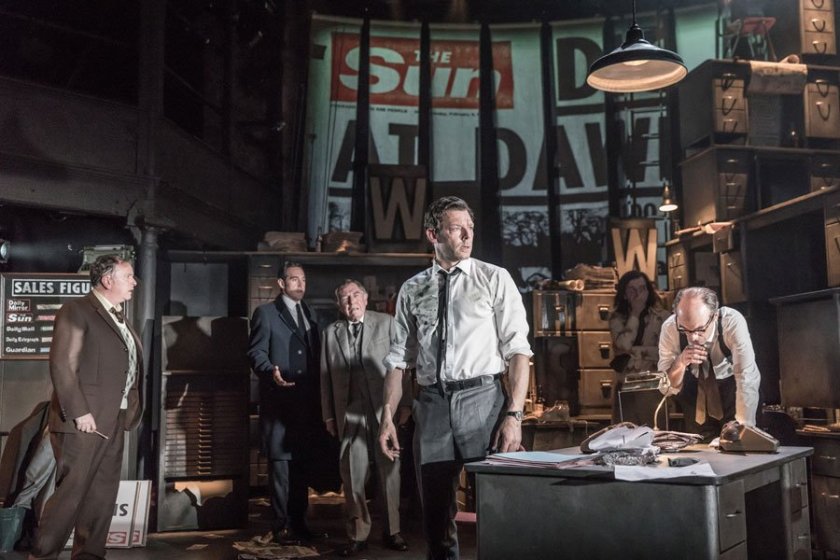
  4. Choose your writer, James Graham. Now it looks to me as if Mr Graham has found his groove and is now busy perfecting it. Dramatising relatively recent socio-political events brings recognition to us, the audience, which means we can ruminate on the parallels with the right now, whilst still being thoroughly entertained. Mr Graham just has the knack of picking and writing a good story. That is not as easy as it sounds. In the case of Ink he has gone one stage further than in This House for me by shining a light on the genesis of the populist tabloid, here the Sun, just at the point when maybe, the power of this particular beast is waning. The story of the first year of the Sun, following Rupert Murdoch’s purchase of the title in 1969, turns out to be theatrical gold. Murdoch’s desire to take on the British establishment and “give the people what they want”. his relationship with editor Larry Lamb, Lamb’s own personal battle with Daily Mirror editor and mentor Hugh Cudlipp, the pulling together of a team of Fleet Street rejects, waifs and strays to create the new style tabloid, the shocking kidnapping and death of Muriel McKay, wife of Murdoch’s lieutenant, the provocation of Page 3: all of this is deftly and pacily explored by Mr Graham in an often acutely amusing way. The motives for recasting journalism and the press in the UK are laid bare: the consequences we know from the intervening decades. Brilliant stuff.
  5. Savour the performances. Unsurprisingly the attention of the critics has focussed on Bertie Carvel’s Murdoch. It’s another bravura performance from an actor who seems to relish “the method” as far as I can see. I thoroughly enjoyed the physicality of his Yank in the Old Vic’s Hairy Ape (which was underrated in my view) and here he captures the awkwardness of Murdoch, his prudishness, his curious accent and his “outsider” psychology perfectly. He is not the caricature demon we “liberal” types need him to be but he is the archetype of “destructive capitalism”. (As an aside I once had a breakfast meeting in Washington. Rupert Murdoch sat down alone on the table next to us. His presence dominated our meeting for the next hour. All he did was eat toast and read the paper but all eyes were on him.) However, if I were Bertie I might have fancied taking on the Lamb role instead. On the other hand Richard Coyle does such a good job there was probably no vacancy. I have seen, and I am sure will see, more virtuoso, scenery chewing, thespianism on stage this year (Lars Erdinger/Greg Hicks in Richard III, Andrew Garfield in Angels in America, Cherry Jones in the Glass Menagerie, Andrew Scott in Hamlet, Brendan Cowell in Life of Galileo, by way of example) but Mr Coyle absolutely nails this from the off. This is a character whose seems compelled to test boundaries. He carries much more of the play than I expected but, even so, this really is an ensemble piece, and that is what makes the “us against the world” dynamic so persuasive.
  6. Take your hat off to Rupert Goold as director. I could be wrong but I reckon that Mr Goold is one of those rare leaders who can control his own ego. What you see on the stage in his productions is what writers, cast, designers and all the other good folk around want to show. I am guessing he guides, he doesn’t dictate. the world needs more leaders like that. My guess is Mr Murdoch would disagree.
  7. Set, Light, Sound, Action.  It is a tabloid in 1969/1970. Activity, headlines, demarcations, flares, eyeliner, dodgy haircuts and dodgy views. You can conjure up a picture in your mind I reckon but what you actually get far surpasses this. Bunny Christie’s set is the antithesis of minimal but so perfectly captures place and time. Some of the movement and dance (yep) is very witty and the scene elucidating the production process is inspired.

All in all a tip, top piece of theatre that I defy anyone not to enjoy. It lifts you up and carries you along from the open and makes you laugh, whilst still getting a little bit vexed about how this instrument of shabby, public discourse could have become so powerful.

So if it were to pop up in a transfer, as so much of the Almeida’s work now does, and you haven’t seen it, don’t hesitate. A proper story. Popular not populist.

Giacometti at Tate Modern review ****

giacometti-tate-modern

Giacometti

Tate Modern, 5th July 2017

Alberto Giacometti fitted the bill of the artist perfectly. Day upon day, month upon month, year upon year ploughing the same furrow. To capture the essence of the human form largely through sculpture and occasionally with paint. More than a nod to the representation of the human form in Ancient Egypt, the Etruscan world and in African culture, with the same relentless elongation. A recognition that, after the horror of WW2, another way of looking at humanity was needed.

A limited number of models (dad, wife, brother, mistress, a few other patrons/luminaries and, for me anyway, himself, indirectly if not directly). And brother and wife looking after all the wordly stuff.

You can see the constant reworking in the works before eventually they could be cast, if required, in bronze. Apparently he was never satisfied. Now for some this might come over as all a bit cliched. But the simple fact is it is impossible not to be drawn into his world. The early p*ssing around with other artistic movements is tossed aside. Thereafter the character of his models, at least in the more substantial busts, becomes clearer and clearer. The structure and basis of human forward movement is revealed in the “walking men”. All through, the “eyes” literally have it. You think you know Giacometti’s work and ideas. But this still pulls you up in places. 

Room 1 kicks things off in style with a host of tightly packed heads of different materials and arranged broadly chronologically. It is easy to see Giacometti’s early experimentation with, for example, cubism but it is even easier to the end to which he was inevitably going to be drawn. Room 2 also shows how he flirted with other more abstract and surrealist solutions to capturing the human form. These works are interesting but not really convincing – the surrealists (a generally bitchy bunch anyway) apparently got on his case for being too naturalistically inclined. Room 3 shows his flair for decoration but it is only in Room 4 that we get a taste of the larger scale works that were to follow. There are some cracking pieces here, some very disturbing if I am honest. Room 5 shows AG’s fascination with the very small scale. In Room 6 we see the “classic” AG forms, in groups, or “penned” in some way. Room 7 brings together 8 of the 9 the Women of Venice series AG created for the 1956 Biennale and they really are fascinating (to me and judging by the stares most of the other punters as well). Rooms 8, 9 and 10 give us paint as well as walkers and the best of the heads of the people he clearly loved. And a film with AG doing his full on artist shtick, little garretty studio (Left Bank – where else?), buckets of espressos, fag dangling, mess all the place, plaster splattered jacket. The works. But his eye connects to the eye of the journo who is acting as his model and voice-over and then you absolutely get what Giacometti was about.

So a terrific exhibition of the work of, for me, a terrific artist. But I am partial as AG for me fulfils in spades two of my favourite artistic traits. The power of repetition. And the gift of emotional connection. Anyway it’s on through to September so see for yourself.

British Watercolour Landscapes at the British Museum review ****

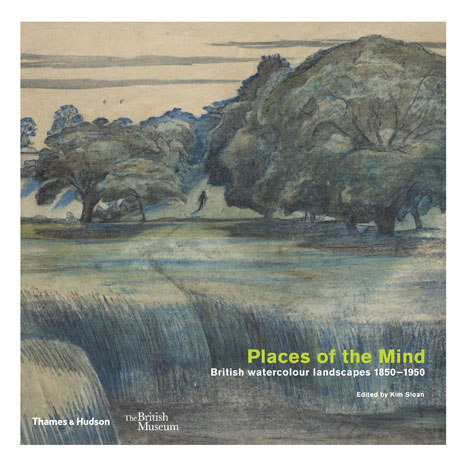
places-of-the-mind-cmc92815_productlarge

Places of the Mind: British Watercolour Landscapes 1850 to 1950

British Museum, 3rd July 2017

Any right thinking Londoner or visitor thereto knows that time spent in the British Museum (or the V and A for that matter) is never wasted. I have remarked before on the rich run of larger scale exhibitions that the British Museum has delivered in the last couple of years (The American Dream at the British Museum review ****) and this small but very satisfying collection of watercolours keeps up the tradition.

it does exactly what it says on the packet assembling top draw, and maybe a few lesser names, from its own collections to chart the path from precise Victorian realism to post war abstraction. Watercolour is obviously an immediately attractive medium but this also offers up plenty of technical surprise and interest as well. And there are some records of adventures abroad mixed in with the iconic British locations.

Best of the bunch. Mackintosh. Nash John and Paul. Ravilious, Whistler, Sargeant, Steer, Sutherland, Minton. But honestly I was even captivated by the Pre-Raphaelites who normally make me gag.

So take a trip up to the 4th floor (Room 90) away from the crowds and breathe this in. Cost to you – nothing at all.

And joy of joys on the way in you will see the Leonardo cartoon. And if you have time head up to the Japan galleries (92 to 94)  – always a joy – or down to the Clocks and Watches (38 and 39). Best of all Rooms 40 and 41, pound for pound the best collection of Medieval and earlier European bits and bobs anywhere. Oh except maybe the V and A.


The Philanthropist at Trafalgar Studios review *

6126-1487766065-thephilanthropistencorebrands500x500px

The Philanthropist

Trafalgar Studios One, 6th July

So the Philanthropist has been and gone. A combination of a visit late in the run, the Tourist’s usual dilatoriness and a holiday meant no review until now. Probably just as well. This wasn’t great I have to say.

I think I just have to accept that where others see a sharp wit in the writing of Christopher Hampton I just see a rather tired, dated smartarsery I am afraid. I seem to remember enjoying Les Liaisons Dangereuses (play and film) all those years ago but the recent Donmar revival left me a bit cold. Same thing apples to some of his screenplay adaptions like The History Man and Atonement for example. But one is supposed to admire him so I thought I would give this a whirl.

In other contexts I am also very partial to the cast on show here notably Simon Bird and Tom Rosenthal in the magnificent Friday Night Dinner and Matt Berry in his various incarnations (with IT Crowd matching FND as a family favourite chez Tourist). Here though they weren’t really up to the task I fear. Simon Bird did an excellent impression of Simon Bird but that wasn’t really what I think the part required. Matt Berry could have got away with a full on Toast performance here playing an arrogant writer, but was curiously underpowered. Tom Rosenthal was better but his performance along with the character just started to grate. Lily Cole was captivately dreadful. Only Charlotte Ritchie as Mr Bird’s put upon girlfriend really gained the measure of the piece.

A bunch of 70’s academic types and hanger ons moping about and behaving carelessly turned out not to be my cup of tea and the jokes were stilted. I am sure director, the lovely Simon Callow, had an idea of what he wanted but it didn’t seem to get through to his cast. I just didn’t care about any of them and barely laughed.

So a lesson for the tourist. when buying think text first, director second and cast last of all. And do not take a punt on novelties. And stay wary of the Trafalgar Studios which seems wedded to such novelty to pull in the audience (and full price, it ain’t cheap).

It isn’t the worst play the Tourist has seen in the last few years. That accolade goes to Jamie Lloyd’s excruciatingly bad Faustus at the Duke of York’s. I know the idea here was to get a new audience into the theatre by getting Kit Harington to flash his bum at them but we had to walk out of this halfway through.

And talking of walkouts we did the same at the Open Air Theatre’s Tale of Two Cities recently. No review as I only managed the first half but you can check out the proper reviews. Believe them. This is a dog’s breakfast where the laudable concept and over complex staging end up grinding the Dickens’s story into the dust. And whilst I pride myself on being as sweary and as confrontational as the next man the Open Air really isn’t the place to do this when you are asking families to part with their cash for a magical evening’s entertainment.