Here’s another smart bit of curating from the team at the Barbican, in collaboration with the Centre Pompidou-Metz here led by Jane Alison. Track the history of modernism in art – not just painting, but sculpture, photography, design, print, literature and architecture, with a nod to the commercial where appropriate – through the couples which created it.
The net has been cast wide, both in terms of the number of artists involved, 46 partnerships in total, the themes that are explored, including love, sex, passion, politics, collaboration, abstraction, communication, and the nature of the relationships, straight, gay, bi, polyamorous, homoerotic, controlling, liberating, disturbing, equal, unequal, conventional, unconventional.
With a few exceptions there isn’t a great deal of material here to map each couple but the quantity, and the clear and direct tone, display and messaging, makes up for that. The private connections are fascinating in themselves but also shed a lot of light on how art and artists have changed society since the turn of the C20.
There are a fair few relationships that you might expect to appear, the Bloomsbury Group permutations, Frieda Kahlo and Diego Rivera, Georgia O’Keefe and Alfred Stieglitz, Ben Nicholson and Winifred Nicholson and then Barbara Hepworth, Alma Mahler and Gustav and Oskar Kokoschka (who really couldn’t let go), Jean Arp and Sophie Tauber, Lucia Moholy and Laszlo Moholy-Nagy, the Delauneys. And then there are a few which I didn’t anticipate. The Aaltos, Gustav Klimt and designer and businesswoman Emilie Floge, Nancy Cunard and Henry Crowder.
It is hard not to be drawn into the stories of those women artists whose contributions, the exhibition argues, may not have been justly recognised in the shadow of their more “famous” partners, Camille Claudel and Rodin, Maria Martins and Duchamp and, arguably, Dorothea Tanning and Leonora Carrington with Max Ernst. The fate of Dora Maar, Picasso’s early muse, and Unica Zurn, the “inspiration” for Hans Bellmer, will likely disturb. A lot of these fellas don’t come across well here.
Most interesting for me. The intense friendship between Lorca and Dali. The portraits of Romaine Brooks, (her lifelong partner, and oft-subject was the writer Natalie Barney), entirely new too me, Lee Miller, during her years with Man Ray and Roland Penrose, she is a cast-iron genius though here, as elsewhere, the submission is unsettling, and, best of all the extraordinary creative partnership of constructivists Varvara Stepanova and Alexander Rodchenko. Now they were the future, and looking at their work, they still are. And as far as I can see they were genuinely equal with no hint of the f*cked up sadism of the surrealist fringe. There they are above in the 1920’s looking pretty cool.
Well worth a look. It may end up being more biography than art and it is probably fair to say, like most of the Barbican’s exhibitions, it is designed for the slighter, and maybe outre, attention span, but, let’s be honest that is sometimes what the head, and feet, requires. Don’t expect to be bowled over by amazing art, but do expect to learn something. Tie it in with something else – it’s not like there isn’t plenty going on at the Barbican.
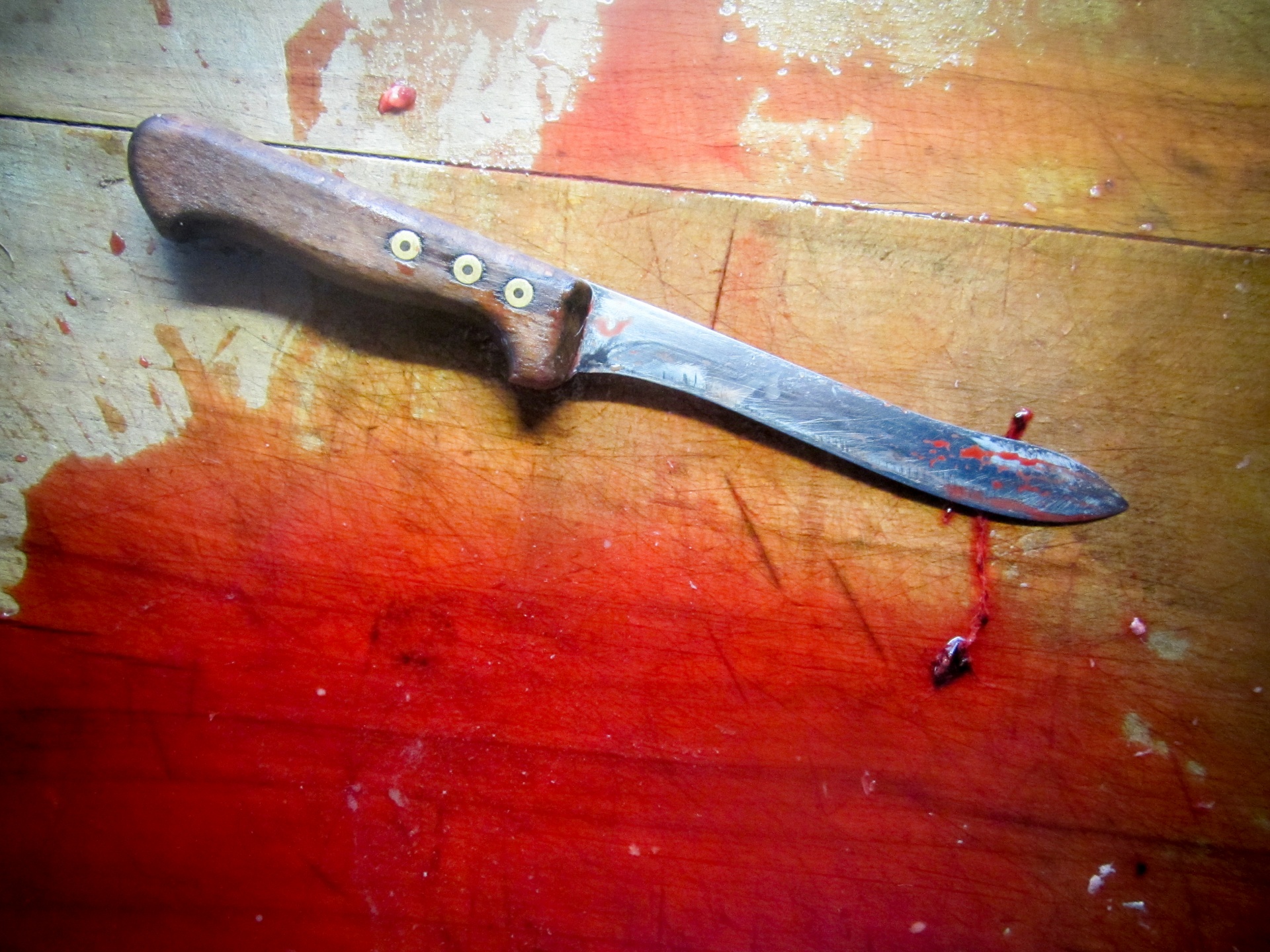
Is this a dagger I see before me … well maybe more of a kitchen knife …
It is pretty tightly plotted (at least if you pare it down). It is quick by comparison to a lot of the Bard – half the length of Hamlet, though that always needs a few nips and tucks – in part perhaps because Thomas Middleton adapted the text that has come down to us. It wastes no time at all in getting going – if anything it is a bit too abrupt at the start I reckon. Other than Macbeth and his lady wife most of the characters don’t get much air time to reveal themselves. It’s language is direct, often shockingly so. It is eminently quotable. There is no welter of arcane classical references. Most interested people know it or know of it (it’s a GCSE set text after all). The themes are easily defined and understood – ambition and patriotism, moral disorder and inversion, violence begetting violence, childlessness and legacy, gender roles and masculinity, the suppression of feeling and equivocation, the supernatural.
It might be built on an edifice of contemporary (when written) conventions, verse speaking, soliloquies, quibbles, audience asides, witches, ghosts, a dumb show, severed heads, but it is the supernatural that gives plenty of scope for coups de theatre. It may also have been intended to massage a royal ego, the patron of the company that first performed it, Jimmy I (of England, No 6 of Scotland) being an expert in the magic field with his best-seller Demonology, and coming just after the failed Roman Catholic plot to blow him up. Yet the supernatural also works on our imagination, (as it works on the power couple), always a good idea in a play, which, together with big Will’s acute psychological insight, and repetitive language – blood, blood and more blood, time, darkness, man – explains why it is so popular.
So why then is it apparently now so difficult to get right? Search me though if I take this somewhat disappointing version, alongside the similarly underwhelming recent NT production, (and plenty more in the last decade), the problem might lie in trying to hang too much on the play. No problem with a clear overarching creative vision but keep it simple. Don’t add all sorts of frills – there are enough interpretative and visual choices to be made from the text itself. Make sure the two leads nail the verse. No mumbling. Ensure they can explain their motivations – remember they are travelling in opposite directions, from normative revulsion to nihilistic emptiness in the case of Macbeth and vice versa for the Lady. The other characters can play it straight. Duncan is a symbol of kingship, Banquo matters because he doesn’t fall for all that weird sister sh*t. (And he can scare us later). The Porter is there to offer ironic commentary, warn against those who say one thing and do another, and, here in this production, very successfully mind the time. Everyone else is pretty much plot collateral.
It works best when we the audience are dragged into the couple’s nightmare. Small space, simple staging, like the landmark Dench/McKellen/Nunn RSC version. Or the Walter/Sher/Doran apparently, which kicked off in darkness. The recent Ninagawa version, though it is different, worked because the Samurai backdrop leant contextual clarity and the age of the couple a desperate poignancy. The 2015 Justin Kurzel film, if you can forgive the accents, also has a clear aesthetic and some very smart interpretative choices. You can add your own to the list.
In this version however, director Deborah Findlay, seems to have focussed on the details of the visual, and on the “horror” to the exclusion of the themes. Some of this works, notably Michael Hodgson’s Geordie Porter, always present, tapping his watch, chalking up the body count, hoovering incessantly, disturbing in his ordinariness, as well as the digital clock countdown, even if it is a big of a cliche, which links to the theme of time passing. Niamh Cusack as Lady Macbeth, clawing and pawing, also has the measure of most of her key lines and David Acton’s Duncan, whilst a little fruity, is what you expect from a man born (rather than compelled) to rule. However Christopher Eccleston, whilst capturing Macbeth’s military bearing, doesn’t, for me, vary the verse sufficiently, such that he comes across as insufficiently tortured by events. The same is true of the Edward Bennett’s Macduff who comes across as more geography teacher than grief stricken revenger. Mr Bennett is an outstanding Shakespearean, especially in comedy, but he looked lost here. Rafael Sowole’s hefty Banquo was more convincing, especially as ghost.
Having the witches played by three girls, dressed in red, Don’t Look Now/Shining style and signifying blood, is initially striking but the novelty soon palls. The jump cut fizzing/flickering lighting from Lizzie Powell, and the “spine-chilling” score from Rupert Cross and sound design of Christopher Shutt leans a little heavily towards the cinematic. Fly Davies’ set, with de rigeur upper level, accommodates the interpretation but doesn’t really wow or command the front of the vast Barbican stage.
Having said all this the production doesn’t drag, it squeezes out a few laughs, not all intended, and its pinball of ideas craves attention. Maybe I should try some of the other current London Macbeth’s, the NYT at the Garrick, or the Michelle Terry/ Paul Ready at the Sam Wanamaker (if it wasn’t so bloody uncomfortable, and more problematically, sold out). Or maybe I’ll just wait. Something wicked will this come again soon.
London Symphony Orchestra, London Symphony Chorus, Francois-Xavier Roth (conductor), Camilla Tilling, Adele Charvet, Julien Behr, Christopher Purves, William Thomas
Barbican Hall, 11th November 2018
Gyorgy Ligeti – Lontano
Bela Bartok – Cantata profana
Haydn – Nelson Mass
Three composers I like. Three works I did not know. A slightly earlier start. A fine end to a fine day.
When I say I don’t know Liget’s Lontano that isn’t strictly true. In fact, even if you are a Ligeti virgin, there is a fair chance you have heard Lontano. For this is the music famously used to signify Jack Nicholson’s descent into full-on barking psychomania in The Shining film. Lontano, along with Atmospheres, is therefore still probably Ligeti’s most famous work, even though, in the five decades that followed their composition, GL went on to explore many other styles and musical ideas.
Lontano, in Italian, means “far away” or “distant” as a performance instruction which about sums it up. For this is as “other worldly” as it gets, from a composer synonymous with the term. It is built up from layers of very quiet sound, initially cellos and flutes, from the smallish orchestra. These lines move in different tempos and to different rhythms but they combine, legato, to create Ligeti’s trademark micropolyphony. The crystallisation of these sounds brings out sustained, but shifting, harmonies that are very different from traditional or atonal composition but the overall effect is ravishing. And something for which horror and sci-fi film composers ever since should be eternally grateful. It is eerie, mysterious but utterly compelling. Take the bit where the high violins, barely audible, pulse against the throb of the low brass and wind. Given the score doesn’t really offer any metre as such Francois-Xavier Roth could only really prompt the orchestra. No matter. All the LSO had to do was trust Ligeti’s ear and F-XR’s experience with the piece. How GL knew all of his innovations, not just in these micropolyphonic pieces, would work is an utter mystery to me. Genius.
It was performed by the National Youth Orchestra at this years Proms so its a fairly frequent concert hall visitor. Don’t let it pass you by.
Bartok’s Cantata profana, which was published in 1930, rarely gets an outing. Lasting only 20 minutes yet still requiring a full chorus and orchestra as well as a bass, (here William Thomas standing in for the indisposed Matthew Rose), and a very challenging high tenor part which pushed Julien Behr close to his limit. It is based on a slightly creepy, coming of age, folk ballad about nine brothers who go out hunting, turn into stags, (which I hope is a rare occurrence even in Transylvania), and then refuse to come home when Father asks them. Heady stuff which Bartok pitches somewhere between his more overtly derived folk driven orchestration and the lusher sound-world of his earlier stage works. The LS Chorus seemed entirely at home with the tricky Hungarian idiom of the text and the awkward contrapuntal textures of Bartok’s score, which divides into 8 parts in the second of the three movements..
That’s the thing with Bartok. It normally takes a few listens for me to get the gist of his music. Like Prokofiev I know there is something there worth working on but it doesn’t always reel me in immediately. I can’t always grasp the line and architecture of the whole work but the rhythms and melodies individually are often arresting. I have more work to do on the popular orchestral pieces, am close to cracking the string quartets, think the solo piano collections are fascinating and would love to see Duke Bluebeard’s Castle. The piano concertos and the rest of his chamber music are bit of mystery. Whether Cantata profana on this listening will be added to the to do list is a moot point.
As an aside if you want a quick burst of Romanian folk filtered through an orchestral lens, look no further than the Concert Romanesc. By none other than Ligeti. A perfect pastiche of a C19 nationalist Romantic tribute. It is really hard to believe this is the same composer as Lontano.
Not knowing the Nelson Mass, as with any Haydn piece, is no handicap. It’s a mass, sung in Latin, so that’s the text nailed down, it is a relatively small orchestra, (just 4 double basses in the strings, trumpets, timpani and a small pipe-organ here played by Bernard Robertson), and, as usual, Papa keeps his textures homophonic and easy to follow. The Gloria ends with a mighty fugue and the Credo kicks off with an extended canon. What’s not to like? That is not to say it isn’t without drama, the LS Chorus letting fly in the Kyrie and Gloria. Julien Behr was persuasive, as was replacement bass, the ever excellent Christopher Purves. Mozart specialist Camilla Tilling’s soprano lost a little of its silky subtlety though newcomer Adele Charvet’s mezzo more than held its own. Even so there might have been a case for reigning in the 130 strong Chorus a little to offer a little light and shade.
The Nelson Mass is the third of six that Haydn composed between 1796 and 1802, appearing just after The Creation in 1798. He titled it Missa in Angustiis, “Mass in difficult circumstances”, a reference to Napoleon’s march across Europe. There is a martial quality about some of the music, in the Kyrie and Benedictus for example, but, as usual Haydn can’t suppress his jolly nature throughout. As it happens a few days before its first performance Admiral Nelson (there he is above) secured a famous victory against the French fleet at Aboukir. A couple of years later Nelson went to visit the Esterhazy court and this was performed for him; hence the nickname.
11th November was turning into a very busy day for the Tourist. Fresh from the heady Edward Burne-Jones phantasmagoria at Tate Britain and a proper Sunday lunch, it was off to the National, now solo, for these Old Masters, before rounding off at the Barbican for a bit of choral pleasure (I realise that sounds a little dubious).
Anyway this double header was everything the Burne-Jones wasn’t. Indisputably, vibrantly, thrillingly, alive. Now I know that endless bible extracts, with Jesus suffering and the Virgin Mary looking beatific might not strike you as the stuff of reality, any more than the silly romantic legends that make up the pre-Raphaelite world, but trust me they are. The religious settings, like the music of the time, were just the templates to tell more human stories as well as create work of astonishing beauty. If the Church is the only patron, or rather religious images are what wealthy patrons require, then that is what artists will provide. Can’t buck the market. For me this very restriction on subject is what creates the conditions for supreme innovation.
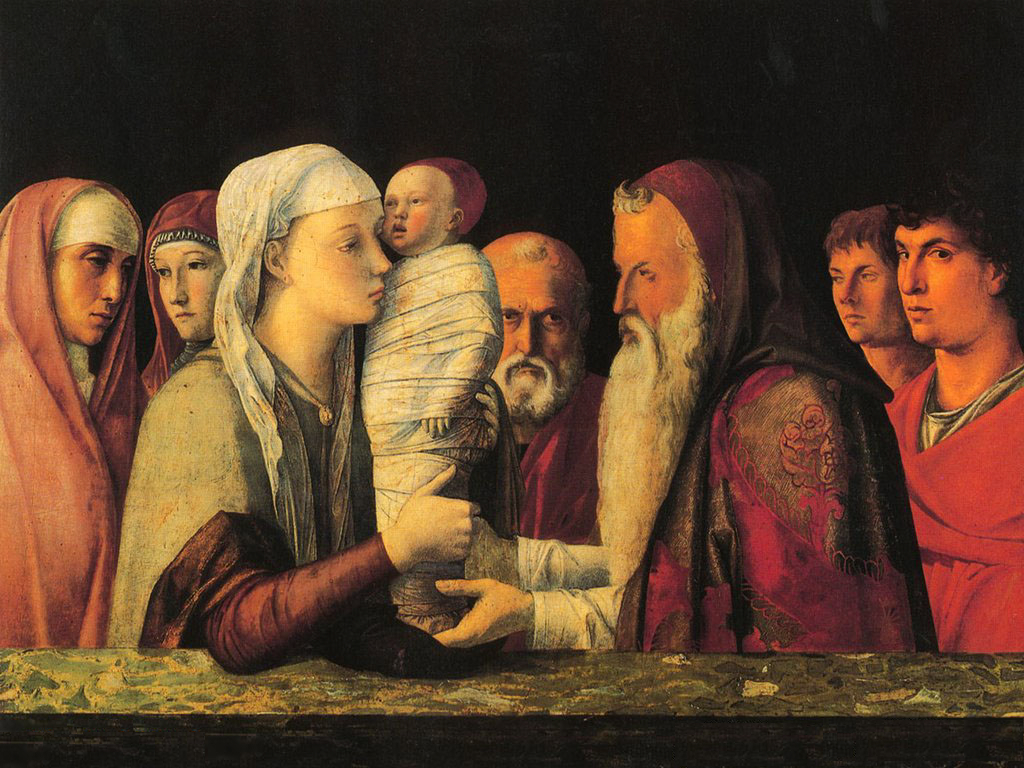
And in this exhibition we get the ultimate BOGOF. In 1453 Andrea Mantegna, already an established painter, trots in to Padua to marry Nicolosia Bellini, daughter of the venerable Jacopo, to become the brother in law of Gentile, and, our subject here, Giovanni. Giovanni, a relative novice, picks up on Andrea’s compositional experimentation and fascination with antiquity, and, in time, for me at least, overtakes him. Mantegna in turn harnesses Bellini’s facility with landscape to produce his greatest works when he moves in 1460 to the Gonzaga court in Mantua. Bellini stays in Venice, but even apart they tread similar paths, though with different results. Mantegna’s precise, flinty, sculptural, sharper, masculine, intellectual work contrasts with Giovanni Bellini’s lighter, softer, airier, more lyrical, enigmatic and emotional output. Same subjects and stories. Radically different ways of seeing and showing them
Guess which is which in the The Presentation of Christ in the Temple above? 20 years separate top from bottom. I’ll leave it to you.
This is not the only direct comparison in this superb exhibition. It would be fascinating just to play that game over a few paintings but here they just keep on coming across the six rooms. Some may be familiar to you (from the National Gallery, British Museum or Berlin museums from which they are drawn) but it doesn’t diminish the wow factor. Saint Sebastian, The Agony in the Garden, Crucifixions. The curators walk you through how and why the brothers-in-law created their own interpretations, which, for the interested layman is insightful, though you have to make sure, post comparison, you take the time to examine each painting individually. However there are enough individual unique subjects to offset the comparisons and avoid being overwhelmed by the scholarship.
The exhibition opens with a book of drawings. Pretty much all that remains of Daddy Jacopo’s art. We have to assume, given the importance of family and patronage in making and selling art in the C15, that Jacopo will have had a big hand in the direction of the business. He certainly kick-started the expanded artistic ideas that would emerge from the extended family. Alas this is the last we hear of him. Still the eye is probably already alighting on the two Presentations and your first starter for ten.
What did Mantegna bequeath the next generation of the Italian Renaissance? The rise of the classical theme. The big picture. Literally in his Triumphs (of Caesar) of which just three are shown here (check them out in Hampton Court Palace when they return). Maybe the birth of the individual in art. That he was a master of perspective following in the footsteps of Masaccio and Uccello, and, in a different way, Donatello, is made pretty clear here.
And Bellini? Colour, back-stories, people you can identify with, even if they were in deserts or on crosses or generally undergoing some sort of taxing trial or trauma. Maybe Mantegna was the more obvious influencer in his day, but Bellini, “the best Venetian painter of the C15”, may have endured for longer. I reckon I can see in him a thread through to Courbet and, eventually, the modernists.
Mantegna imposes his narrative from without. Bellini’s flows from within. Pretentious w*ank. Maybe but fast forward to the end and compare Bellini’s OMG portrait of the Doge Leonardo Loredan, the cerulean background, the gold and silver impasto cloak, the confident, steely gaze. Perfectly lit. A very formal, contemporary portrait, that also looks timeless. In oil. Which Mantegna never used. Look then at his Minerva Expelling the Vices from the Garden of Virtue, painted in his 70’s. A complex, symbolic, Classical allegory. Intellectual to a tee. Painted for private contemplation not public edification.
Warm flesh. Cold marble. Head or heart. Fortunately in this exhibition you don’t have to choose.
Turns out Burne-Jones isn’t quite as awful as I had previously thought. Don’t get me wrong. All that hippy-dippy, fey, dreamy. dusky-toned, doe-eyed, ginger-permed, long-bodied, nymph-y, mannequin-esque, briar-strewn, Arthurian, industrialisation-denying, fake-Medieval, cod-Renaissance daubing is still guaranteed to do my head in. But I will concede that he could draw. Really draw and there are details, even in the worst of the fairy-tale illustrations, that deserve a properly good look.
I can’t change my immediate reaction to art but I can try to explain it to myself. And, if I am honest, with Burne-Jones, and the rest of the original pre-Raphaelites, and their Arts and Crafts and Neo-Gothic mates, it is in part the context in which they produced their art (and design) that winds me up as much as the work itself. As with this exhibition there are elements that I can concede give me pleasure, the colour (when vamped up as in the stained glass for example), the line and form (notably in drawings, textile, church interiors, tapestries) and the belief in the power of the aesthetic. They started off with the right inspiration, the jewels, (and working practices), of the early Flemish and Italian Renaissance, (the clue is in the pre- moniker) and their vaguely humanist intention to eschew purely religious imagery is commendable. But that doesn’t excuse the lifelessness of their subjects and the utter irrelevance of their mythologies. At the end of the day Burne-Jones ended up churning out knights in armour and pretty ladies for the great and good in Victorian society; the fate of many an artist through history for sure, but these chaps ended up as the reactionaries they purported to abjure.
The kindness of strangers, well friends in this case, may also have had an effect on my viewing. We were a big party, with the SO, who inclines to the hyper-real in art, (though understanding that paint on canvas in two dimensions could hardly be more artificial), KCK who is an admirer, BUD the ever-curious and the Blonde Bombshells, who know their artistic onions. Me banging on about the preposterous narratives in the paintings, creepy friends and family who are persistently featured (after raiding the dressing-up box), the cut and pastes from Renaissance masters, the pointlessness, introversion and body fascism of this obsession with “beauty”, the upper-class, biscuit tin sentimentality, the failure to move on or develop his art, the dodgy androgynous eroticism, the all-round sameyness, would clearly have been border-line patronising.
Particularly since I could be found avidly staring at many of the works looking for all the world like some-one who might be enjoying them. And as I discovered that Burne-Jones was not the la-di-dah toff I had assumed but working-class and self-taught. And Jimmy Page has pitched in with his Holy Grail tapestries. Which seems apposite. Led Zep were often musically at their very best (Immigrant Song, Stairway, Achilles Last Stand, No Quarter) just as lyrically they were off with the fairies.
What was most interesting then? The early drawings, Going to the Battle, Buondelmonte’s Wedding, the stained glass from the V&A (if you ignore the pretty faces), the various pencil studies, the bodycolour nymphs enhanced with metallic paints, King Cophetua and the Beggar Maid, The Morning of the Resurrection, Love and the Pilgrim, the Lucien Freud-like portraits, details of the Briar Rose/Sleeping Beauty and Perseus/Medusa series, The Fall of Lucifer and certain of the tapestries, like the Adoration above. Though I can’t say I “liked” these works, admired might better cover it. And much of the rest still annoyed me.
So Burne-Jones. Sublime or ridiculous? You decide. For me he was both. Simultaneously. Conservative Victorian or symbolist visionary? Again a bit of both. Style over substance? Certainly but that is exactly what he and his peers set out to deliver I’ll warrant. I can see why people like Burne-Jones’s art. I just can’t quite see exactly what it is they like. It is, at least in the big, showy, famous works, very, very detached from any reality, yet seems to be prized by many for its verisimilitude. I have a feeling you could use Burne-Jones as the ultimate artist in one of those sociology attitude tests. All that useless beauty as Elvis (C not P) once said.
Me? I would still rather spend a couple of hours with one van Eyck. More beauty. More skill. More reality. More meaning. More life.
I can’t fault the curation though, Surprisingly this is the first full-scale survey in London of EBJ since 1975, amazing given his popularity, and the Tate has built handsomely on its own catalogue to give us the whole shebang. Downstairs in the tomb-like Manton St galleries. Which doesn’t suit every artist but sets EBJ’s sleepy melancholy and false colour palette off to a tee. There is a kind of cumulative surrender in seeing so many, large-scale, paintings hung together.
And can anyone tell me who the bloke with the chiseled features and scary eyes is who keeps cropping up?
B*gger. B*gger. B*gger. B*gger. B*gger. I never saw Mark-Anthony Turnage’s second full scale opera when it was first performed in early 2000 at the ENO. On the basis of this semi-staged performance from the BBCSO as part of the In Remembrance weekend this was a terrible omission on my part for it is an extraordinary work both musically, and, given the strength of Amanda Holden’s libretto, dramatically. It is intensely powerful and moving even without a full set and staging. It beggars belief that it has not been revived since 2002, (and that it missed out on a run in Dallas thanks to political sensitivities).
It is constructed as a symphony in four acts, Home, War, Hospital and Dance. Harry Heegan is about to return to the family flat after a football match with his best mate Barney and girlfriend Jessie. Mum and Dad are intensely proud of their son who is about to head off to the war. Next door neighbour Susie joins the party, banging on about God. Mrs Foran from upstairs also turns up escaping abusive husband Teddy. The Silver Tassie, a cup with much significance appears, the men go to war full of optimism. The War act is primarily choral preceded by the mythic Croucher, representing, I think, the war dead and intoning Old Testament-ish doom. An officer complains at the doctors in the Red Cross station. A football game is delayed as the battle begins. The story then switches to the Hospital where an angry Harry is now paralysed, Teddy blinded and Jessie, who refuses to see Harry, is now coupled up with Barney, who saved Harry’s life. The final act sees Harry and Teddy spit out their pain and bitterness at those who still have their futures at the communal dance.
The opera is based on Sean O’Casey’s eponymous plan and it is therefore we who have to thank for the gripping drama. Whilst it is never made explicit, O’Casey intended that the Heegan family, and the rest of the community, should hail from the East Wall, a working class district of Dublin, adding further pungency to the message of the play (and opera) because, at that time, Ireland was still part of the UK and the republican movement was divided on whether the country should be involved in the war. So as some young men like Harry, Barney and Teddy headed off to war others prepared for insurrection at home.
O’Casey’s play was rejected by WB Yeats, then head honcho at the Abbey Theatre in Dublin, when it was submitted in 1928, reflecting its political sensitivity. This was after the success of his first three major plays, The Shadow of a Gunman, Juno and the Paycock and The Plough and the Stars. So it premiered at the Apollo in London’s West End. There have been a fair few plays which rail at the futility of war and its consequences on the individuals who fight in it, but I doubt many match the raw power of The Silver Tassie.
So Amanda Holden, (to be clear not the airhead judge on BGT), and M-AT had something monumental to work with. Even so, and in no way intending to downplay Ms Holden’s contribution which provides M-AT with multiple opportunities to show off his trademark stylistic jagged juxtapositions, it is the score that takes the breath away. M-AT had already shown his dramatic flair in his first opera Greek, and his compositional skill with orchestral pieces such as Three Screaming Popes, Momentum, Drowned Out, Dispelling the Fears and Silent Cities, especially when it came to percussion and brass, but The Silver Tassie is on another level.
The symphonic structure is inspired by mentor Hans Werner Henze’s The Bassarids, with the first act setting out the main ideas and themes, the second the Adagio slow movement, brought to life by the large scale choral scenes (echoing the more Expressionist feel of the act in SO’C’s play), the third a Scherzo and the last act a “dance” finale with “off stage” band. This structure offers rhythmic backbone and plenty of tunes derived from song, (including Robert Burns’s own Silver Tassie), and dance, as well as repeated motifs, which make it easy to follow and show off MA-T’s uncanny ability to capture the emotional interior of the characters. There are episodes of rich orchestral colour but there are also plenty of more economic orchestration. The score should give the singers plenty of space, but just to make sure the cast were miked, (though M-AT, a couple of rows in front of me, needed to dash up to the sound desk to get the balance right early on). The second and fourth acts are up there with the best I have ever heard on an opera stage. Even allowing for the fact that this wasn’t an opera stage.
Sometimes this semi-staging lark can leave singers looking a little awkward unsure of how much to commit to performance versus voice. Costuming can also, sometimes, appear incongruous. Not here though, at east once the first act go going. There were some outstanding vocal performances, notably for me from Sally Matthews and Claire Booth, and Marcus Farnsworth as Teddy was very persuasive. But baritone Ashley Riches as Harry, even from my two perches (side stalls first half, back of circle second), was bloody marvellous not just in his singing but also in the way, pre and post wheelchair, he projected Harry’s exuberance and then his pain into the whole auditorium.
Now I have nothing to compare it to but, given just how amazing this was, I have to assume that Ryan Wrigglesworth and the BBCSO, and the BBC Singers and Finchley Children’s Music Group (complete with ensemble writhing) got as close as possible to the heart of the music.
You can listen to it for a couple more weeks on BBC Radio Opera on 3. Do yourself a favour and do so.
And can I beg the ENO to find a way and time to revive this. With Mr Wrigglesworth on the podium. I will chip in a few quid if it helps.
I was much taken, if not entirely convinced, by the British East Asian Yellow Earth Theatre company’s version of Tamburlaine at the Arcola 18 months ago. And this co-production, with Moongate, of a new play, Forgotten, by Daniel York Loh, which kicked off at the Theatre Royal Plymouth, sounded like it needed seeing.
Daniel York Loh looks like he is a busy fellow. When he is not writing he is acting, directing films or performing in a folk trio. Busy. Just like this play. It started off as a 5 minute script. It now runs to a couple of hours. Apparently his first draft ran to 300 pages. DYL has a lot to say and he means to say it. Mind you this is a story evidently worth telling. Giving a voice to the 140,000 Chinese labourers who left China to initially assist the French, and then the British, effort in WWI. Largely written out of history.
In trying to cram in as much of his research into these events as he can, the appalling famine and poverty blighting China at the turn into the C20, the hierarchical, violent and patriarchal village society, the volatile political situation and domination by foreign powers, the dream of escape and wealth, the Western view of China, and the Chinese view of the West, and Japan, at the time, the experience of the labourers in France and their shabby treatment, and their legacy, after the War, DYL offers a little too much exposition, a slight overdose of plot and leaves his characters looking a little too one-dimensional. Especially given only a six strong cast, (with some doubling up), the compact Arcola studio space and an experiment in form, namely having his band of villagers putting on a Chinese opera as they embark on their adventure.
So the cast and the creative team, director Kim Pearce, designer Emily Bailey, composer Liz Chi Yen Liew, lighting designer Jessica Hung Han Yun, sound designer Luke Swaffield and movement director Quang Kien Van had their work cut out to make this work.
Work it does though and this I think is largely down to the fact that, weaved into the important history lesson, there is a believable human drama here, especially when the friends get to the Western Front in the second act. The play begins at the end but I’ll keep schtum on that. The cast are performing an opera which tells the tale of a Miraculous Traveller, (I am afraid I know nothing about Chinese classical literature), paralleling the story of the villagers. When all calms down we are in Horse Shoe Village in Shandong province in 1917 where Old Six (Michael Phong Le) and his wife Second Moon (Rebecca Boey) are struggling to earn enough to feed their young child. Big Dog (Camille Mallet de Chauny) is the village outcast, addicted to opium. Eunuch Lin (Zachary Hing) was castrated in a failed attempt to secure a position in the Emperor’s household. All are subject to the cruel whim of foul-mouthed Headman Zhang (Jon Chew). They agree to be recruited into the Chinese Labour Corps (from 1917 China declared war against Germany and Austria-Hungary) meeting the educated Professor (Leo Wan), and when they get to France, Wild Swan (Jon Chew again, equally potty mouthed) along the way.
Whilst there are battlefield scenes DYL wisely cuts these with other encounters and other characters, as well as the highly stylised opera, to offer multiple perspectives on the experience of the friends. This shines a little light on the more universal East Asian diaspora myth, “silent”, “hard-working” but largely disregarded and culturally held at arms length.
A valuable, if slightly awkward epilogue, explains what happened to Shandong province after the war and how the Chinese contribution was, literally, painted over in the now largely Americanised Pantheon de la Guerre. (America has a long history of mocking the contribution of France in global conflict). China was properly shafted at Versailles. Most of the surviving CLC returned home, but a few thousand stayed to build a Chinese community in Paris. The British CLC were given a medal, but it was bronze, not the silver awarded to everyone else who fought. There is a cemetery at Noyelles-sur-Mer on the Somme which honours 842 CLC dead.
So overall Forgotten is an ambitious play, generously and vigorously told by an excellent British East Asian cast (Leo Wan, in particular, is as good here as he was in Tamburlaine and The Great Wave, and I look forward to seeing Michael Phong Le again). Lucy Bailey’s set is effective, Kim Pearce’s direction manages to maintain the momentum even as the scenes jump around. It may not quite be the finished article but it definitely deserves a wider audience. I spy a couple of harsh reviews in the national press. Ignore them.
No one could accuse Friedrich Schiller of holding back in Don Carlos. Goethe inspired Sturm und Drang Romanticism, a Kantian paean to the centrality of personal freedom and democracy, the clash of liberty and tyranny, a stab at the sublime, a (loose) history of a turning point in the Spanish Golden Age, a political thriller chock full of intrigue, an (incestuous) love story, an increasingly intense Renaissance style tragedy lifting directly from Shakespeare, most notably Hamlet and Othello, but also Lear, Julius Caesar and Henry IV, which spills over into melodrama: it is big on passion and big on ideas. Operatic in scope you might say. Which is why Verdi wasn’t the only one who espied its potential.
It took five years to write, finally published in 1787, which might also explain its meandering nature and abrupt tonal shifts, and, if you were unfortunate enough to sit through the original, ostentatious five acts of blank verse in their entirety you wouldn’t get much change out of seven hours. No one ever has mind you. This is kitchen sink drama. As in Freddy chucked the dramatic kitchen sink at it, not as in a pint-sized slice of domestic realism.
This production, in a translation by Robert David MacDonald, clocks in at 3 hours. Schiller was largely ignored by the English speaking world for a couple of centuries. One reason why he no longer is, as well as Goethe, Lermentov, Gogol, Goldoni and Racine, is Mr MacDonald. Fluent in 8 languages he was the brains behind the Glasgow Citizens Theatre as well as an accomplished playwright in his own right.
Nor could one accuse Israeli director Gadi Roll, and actor Tom Burke, whose inaugural production as theatre company Ara this is, of holding back. Ara is intended to bring non-naturalistic theatre to the regional masses (though I am not sure the good people of Kingston, half an hour by train away from the South Bank, qualify as regional). They have started with a bang here. This is stripped back minimalist European auteur theatre which prizes style as well as content. Designer Rosanna Vize, who normally offers just a little more, makes do with the bare Rose stage and a few chairs, and modern dress with a vague Golden Age/Matrix flourish (and a lot of shades). The constantly moving lighting rigs in Jonathan Samuels’s design are dramatic and very effective (he worked with Gadi Roll on the Belgrade Coventry productions of The House of Bernarda Alba and Don Juan Comes Back From The War which is where Tom Burke met Mr Roll). The mingling of the private and public spheres.
The actors move around the stage in stylised straight lines. In the first couple of acts, the cast, notably Samuel Valentine as Don Carlos himself and Alexandra Dowling as the Princess of Eboli, (though with the notable exception of Tom Burke himself as the Marquis of Posa, the cool, calm voice of reason perhaps), spit their lines out with machine gun intensity, requiring the audience to keep ears and brains on their toes as it were. And there is a lot of shouting, notably from Darrell D’Silva’s Philip II. It is very, very, very dark most of the time and black is the dominant fashion. A nod to Velasquez, Ribera, Murillo et al?
I loved it. I see that the proper critics were less enamoured. Maybe the novelty of the play itself has worn off for these cynical hacks? The less than dynamic staging, the delivery of the lines and some of the acting didn’t past muster for many of them. Now I admit that the deliberately non-naturalistic choices made by Gadi Roll, in terms of look, movement and speech, did take a bit of getting used to, but necessary adjustment made, actually helped to see through to the core of Schiller’s text and messages and helpfully circumvent the worst of the melodrama. And it wasn’t just me. The SO, attracted by the history, and Mr TFP, an expert on German literature and culture, and a man who has read Schiller in German, agreed with me. I am guessing though that not all of the audience were as persuaded.
Young Don Carlos, the Infante, has the hots for Elizabeth of Valois (Kelly Gough). The only problem is Dad, Philip II, has married her. Dad also doesn’t trust the hot-headed Prince to get stuck into the affairs of government. And big Phil remember ousted his own Dad to seize the throne. When Carlos’s boyhood chum, the Marquis de Posa, returns to Court he confides his love and de Posa agrees to advance his suit if he in turn will help free the rebellious people of Flanders, oppressed by nasty Spain. Carlos asks Phil if he can go to Flanders (more exactly the Spanish Netherlands). Phil refuses and instead sends the Duke of Alba (Vinita Morgan). Cue bust up between the Duke and Don Carlos. There is a note and a key and Carlos ends up in the Queens bedroom with the Princess de Eboli who fancies him and wants to escape the clutches of the randy King. Thwarted she goes to Domingo (Jason Morell) the King’s Confessor. He plots with Alba to bring down the Queen and Carlos. A trap is laid but the suspicious King enlists de Posa to help uncover it. The Marquis’s enlightened ideas start to persuade the King but tyrants will be, albeit pragmatic, tyrants. There are some letters. misunderstandings, arrests, imprisonments, failed murders, accusations, double crossings, realisations, escapes and then, just when everyone least expects it, the Spanish Inquisition arrives (with Tom Burke doubling up as the Grand Inquisitor). To remind us that in C16 Spain it was ultimately the Catholic Church that held, literally, the whip hand.
Obviously it does get a bit silly but the bare bones of the romantic tragedy are involving and there is a brio to the story which is irresistible. The intellectual set piece between the Marquis and the King, “give men the right to think”, is powerful, affecting stuff, which gets to the heart of the struggle between absolutism and representation, filtered, as it is, through the recognition by Philip that the Marquis, even with his heresies, is the son he really wanted. Especially when you realise that the “real” Don Carlos was an utter f*ckwit. A victim of Hapsburg inbreeding, deformed, mentally unstable even before he underwent a trepanation, he might have blinded all the horses in the Royal stables, and was prone to chucking servants out of windows. Phil eventually locked him up. The despot in Philip is plain to see, but we also see his humanity, and his justifications. And de Posa may have right on his side but boy does he know it and, intoxicated by his own argument, he will manipulate anyone and everyone to get what he wants.
What next for Ara? This was a pretty bold first move. On the assumption that the style, the look, feel and intent of the company is set, I wonder if they might not be better served, at least in terms of critical response, by reviving a more recent play. We shall see. I hope they continue to aim high though.
Now a few words on the “gosh, how did that Greek/Jacobean/Restoration/Spanish Golden Age/French classicist/German romantic playwright create something so uncannily relevant to today” trope. It’s not because they could see into the future or were especially politically prescient. It is because we, as human beings, either individually or collectively, haven’t moved on much. We may have smartphones, good teeth and a colossal amount of debt, but the way we interact with each other in the body politic, and the core of our individual psychologies, haven’t changed much in the pitifully tiny amount of time where we have, to the detriment of other species I fear, “ruled” this planet. So if a playwright can nail these truths, whether in the 5th century BCE or yesterday, we will listen. Don Carlos was first staged two years before the French Revolution: by the time he published the final version in 1805 the dream has collapsed into the Reign of Terror and Napoleon was Emperor. Then Schiller popped his clogs. And you think we live in worrying times.
Having now seen this production, and the Almeida Mary Stuart, I hope to be able to bag another Schiller one day, The Robbers, Intrigue and Love, the Wallenstein Trilogy: all look likely candidates. He makes you work hard for your money, there is a lot, maybe too much, discussion, debate, confrontation and contemplation, but that is what the best dramatists do. And his characters are not just good, bad or indifferent. That is the true test of the playwright, the ability to show us many facets of the human condition, not all of which make sense or stack up. Nuance, ambivalence, enigma, complexity. To be on both sides, and on neither.
Shostakovich – String Quartet No 8 in C minor, Op 110
Beethoven – String Quartet No 7 in F major, Op 59 No 1, “Razumovsky”
You still see some venerable rock (and pop) bands unwisely soldiering on in their 60’s and even 70’s, sometimes with only one original member still in the line-up. Outside of disposable pop the creative force/s, the composer/s if you will, in contemporary popular music are invariably also the performer/s. Not so generally in classical art music, though that isn’t to say that many canonical composers weren’t, or aren’t, also adept performers. Just that composition and performance are more often separated, and that performance is often as important to composition in terms of audience enjoyment or appreciation.
So when rock musicians die, so does the band, if it has managed to get that far without breaking up due to musical differences, substance abuse or fist-fights, in the established rock’n’roll manner. Leaving the audience with a ropey tribute band and recordings to keep the tunes alive.
In the classical world though, with its much longer back catalogue, legacy is the name of the game. And not just in composition. Performers live on. Not just in recordings but also in the name, and sound, of the band. Easy enough to envisage in the context of the orchestra with its link to place and with a constant turnover of personnel. The Royal Danish Orchestra in Copenhagen can trace its lineage back to a bunch of regal trumpeters from 1448 (!), the venerable and still very highly regarded Leipzig Gewandhausorchester to 1743.
The idea that string quartets outlive their members might be a little trickier to get your loaf around though. Yet this is how it works. Members may come and go but the best quartets stick together for life, such is the dedication of performers to their art, and, when one of the four can no longer perform, pearly gates or otherwise, a replacement is drafted in. But this cannot be any old violinist, viola player or cellist. For the sound of a top notch string quartet, is a very particular thing, and continuity, as well as chemistry, needs to be guaranteed.
Now as is normally the case with the development of classical music, form followed technology and demand in bringing the string quartet to the fore. Once modern instruments had been perfected in the C18, notably the viola, (which is tuned a perfect fifth below the violin and an octave above the cello), and with enough patrons who liked the string quartet groove to pay up, composers were all set. As with so much else in classical music it was Papa Haydn who set the ball rolling in the 1750s. His massive output for the ensemble (68 named, 77 or so in total) is still amongst the best ever written IMHO.
The string quartet, in the opinion of the Tourist, is about as “pure” as classical art music gets. Not easy to get right; any paucity of imagination is ruthlessly exposed. Four parts is enough to fashion an argument but not enough to take the foot off the intellectual or aesthetic gas. Plenty of opportunity to vary pitch but only the colour and texture of strings at the composer’s disposal. All of which might explain why not every big name has embraced the genre and why even those that have sometimes don’t always get beyond one effort or a brace.
After Haydn, Mozart obviously churned out a fair few, 23 I think, though they are not all up to snuff. Still as ever with Wolfgang when he nails it he nails it. Then Beethoven with his 16 (and the Grosse Fuge) which, as with the symphonies and piano concertos, have never been bettered. Schubert also walked the talk with his 15 and a few assorted bits and bobs. (Note to Tourist: more work to do on these).
As the fashion for showy-off, Romantic, bullsh*tty bombast gained traction in the C19 so the string quartet took a back seat, but returned with a bang in the C20. For the Tourist’s money the best of the bunch since 1900’ish are Janacek’s pair, Nielsen’s 6, Ravel and, (in a rare thumbs up from me), Debussy’s single shots, Stravinsky’s various musings, and, best of all, Britten’s haunting treble, Bartok’s virtuoso 6 and Shostakovich’s acutely personal 15. Oh and Glass’s 7 (and counting), Reich’s Different Trains, Crumb’s Black Angels, Nyman’s 5, Ligeti’s 2 and Xenakis’s 4. You might have some others to add. Tell me.
The Emerson String Quartet was formed in 1976, and still has two of its founder members in violinists Eugene Drucker and Philip Setzer, alongside the viola of Lawrence Dutton, with cellist Paul Watkins the last in, having joined in 2013. I have recordings of their arrangement of The Art of Fugue and their renowned Bartok cycle. The Bartok is superbly recorded and is very, very precise and very, very intense. This is what they are famous for. Exact and technically brilliant interpretations. Which maybe lack a little emotion. That tends to be my preference but I can understand why others may take a different line (and there are occasions when I would agree).
Anyway this is what the Emersons are famed for. And this is exactly what they delivered at Milton Court. Britten’s Quartet No 3 was pretty much the last thing he composed appearing in the year he died, 1976. With its call-back to the music of his last opera, Death in Venice, in the final passacaglia, and the recitative quotes that precede it, it really is immensely moving. BB was very ill at this time, only able to work in short bursts following a heart bypass operation, and this seems to be reflected in the four condensed movements which precede the final “La Serenissima”. The opening “Duets”, in sonata form, is also haunting and, by virtue of its various permutations of the quartet personnel, as sparse as its title suggests, even when the duets are accompanied. The Ostinato second movement, like the Burlesque fourth movement, is very short, and taken at a fair lick even where it is played pizzicato. The parodic Burlesque could have come from the pen of Shostakovich in one of his more caustic moments, with its weird central spiccato passage. The central Solo is marked very calm with the first violin line, heading higher and higher, seemingly lifted from the mists, and mystery, of Curlew River. Or maybe Aldeburgh Beach, Or Snape. Anyway as with the rise and fall of the Passacaglia it sounds like BB was set to go home. Blub blub.
The Emersons certainly got the measure of BB’s still extraordinary imagination and technique. But it felt a little less haunting than the recording I have from the Endellion Quartet. This was even more true in the Shostakovich. The Eighth was written when DSCH was in a very dark place, contemplating suicide. He went on in his final quartet, 15, to offer up a genuine personal elegy but this comes pretty close. He was supposed to be written a score to accompany a documentary about the bombing of Dresden but, after just a few days, he came up with this, “an ideologically deficient quartet nobody needs”. It was 1960 but DSCH still wasn’t “free” now being forced to join the Party. It has his trademark initial motif in the opening of the Largo on the cello, which is developed, before the main theme from his First Symphony pops up, before this in turn gives way to a repeated rocking motif.
This rocking motif is then pumped up and speeded up to form the basis for the second movement scherzo. This is, even by Dmitry’s high standards, pretty scary stuff. The DSCH motif also crops up again, in contrasting tempi, As it does in the middle movement Allegretto, here transformed into a Waltz which then proceeds to quote his First Cello Concerto. A violin solo links to the first of the final two slow movements. This contains the tune to a Russian song about the victims of fascism, to whom DSCH eventually dedicated the quartet, but which might be aimed at totalitarianism more generally. The final Largo comes full circle with a return to the rocking motif.
The quartet is taken unbroken and with these powerful and dramatic ideas, and stirring emotion, it is easy to see why it is Shostakovich’s most famous and oft-performed quartet. It would be hard to imagine a more expertly crafted and sharp interpretation, these chaps leave nothing to chance, but, as I discovered a couple of weeks later, courtesy of the Brodsky Quartet, it is possible to wring a fair bit more gut-wrenching angst out of the piece. I have recordings by the Borodin Quartet, now in its eighth decade, constantly refreshed by the best of the Moscow Conservatoire, and the original dedicatees for most of DSCH’s quartets, and the English Fitzwilliam Quartet (founded in 1968) who also worked with the composer and were the first to record a complete cycle.
As it turned out it was the Beethoven first Razumovsky which actually showed the Emersons at their very best. Count Razumovsky was an important Russian aristo and diplomat in Naples and then Vienna but his name has gone down in posterity for the three quartets he commissioned from Beethoven in 1806. All are magnificent but the first might just be the best of the bunch. This is altogether jollier music than the two pieces that preceded it, with its intriguing dissonance and implied repeat in the first movement, the rapid passing of the baton from one player to another, underpinned by the one note cello motif in the Allegretto second, the tragic F minor Adagio and then the ebullient finale with its bouncy Russian theme, (as in the other two Razumovsky pieces). The drilled-to-perfection understanding of the Emersons, and the more upbeat tone of the Beethoven was, for me, at least more satisfying.
That is not to say that overall I took very great pleasure in listening to this famous quartet. They are up there with the very best of their peers, some of which I have already mentioned. When it comes to Beethoven I think the Takacs Quartet (founded 1975) might have the edge of those I have heard live, though the Belcea Quartet (1994), who might just be my favourite string band, run them close. As for recordings of the Beethoven quartets have a sniff around the Alban Berg, Quartetto Italiano (for the middle quartets) and unparalleled Vegh (for the mighty last four).
While I am at it, should anyone care, add the Hagen Quartet (1981) to the bucket list when it comes to Mozart, the Quatuor Mosaiques (1987, HIP specialists) for Papa Haydn and the Kronos Quartet (1973), on the rare occasions they leave the US, in contemporary repertoire.
You can stay right next to Juliet’s balcony in Verona. Le Suite de Giulietta. The Tourist, SO, BD and LD can vouch for the lovely decor, the sizeable rooms and the delicious breakfast. The courtyard is closed at night so it is very tranquil and, in the day, it is quite fun watching the crowds do a double take when you exit from the hotel. And Verona itself is a very fine city.
Now I am not a berk. I know it was a window not a balcony. And that this is a story which Will S nicked from William Painter via Arthur Brooke via numerous Italian medieval raconteurs, including Dante, and then all the way back to Ovid and Xenophon. But even this cranky curmudgeon can get swept along by the definitive tale of young love dashed. Though Shakespeare being Shakespeare there is a lot more too it than that, what with the examination of gang violence, pointless vendettas, family loyalty, sexual freedom the curious nature of Mercutio, the expanding eloquence of Romeo, the precocity of Juliet (she’s supposed to be coming up to 14 remember), the constancy of Benvolio, the comic good-naturedness of the Nurse and the misguided and hare-brained intervention of Friar Laurence.
It’s easy to see why R&J is so popular and has been presented in so many ways. The denouement with our two dead teens is always, or should be, a tearjerker, even as we know the outcome, the idiocy of Friar John – all you had to do was deliver a letter, how hard is that numbnut – is always a reason to shake your fist, the reconciliation of the families, (even as you know it won’t last), always stirs, there are some good, often dirty, jokes and some fine, sweet verse.
It can endure a lot of textual and/or directorial abuse, (though it is hard to fathom the happy endings of previous centuries), and, even with the sub-plots is a breeze to follow, even without the Friar’s helpful “brief” summary at the end. What it doesn’t like though, in my book, is less than clear delivery of the verse. You need to hear the clever way WS matches language and form to character, you should clock the sonnets, you ought to grasp the filter of metaphor and religion through the language of love, and hate, you should be left to decide for yourself whether the narrative is driven by “fate”, by “chance” or by character “flaws” or “humours” and you need time to ponder on Shakespeare’s preoccupation with, well, time.
In this respect I wasn’t entirely convinced by director Erica Whyman’s gung-ho interpretation. The youthful cast, in the relevant roles, certainly brings to the fore the recklessness of their behaviours, their strutting self-absorption, their need for peer validation, and the brings out the parallels to contemporary knife crime. Bally Gill’s impetuous, swaggering yet still sensitive, Romeo and Karen Fishwick’s animated, “mature beyond her years”, Juliet could live in any city near you right now. They certainly have the chemistry. Charlotte Josephine brings a whole new dimension to Mercutio’s complexity, his/her relationship with Romeo and exaggerated masculinity. To me there was almost a rap like quality to Mercutio’s wilder flights of linguistic fancy. Josh Finan’s Benvolio offered counsel to Romeo which maybe also sprung from a deeper admiration. The gender fluidity in the Houses of Montague and Capulet also extended to Donna Banya’s timid Gregory.
In the adult roles casting Beth Cordingley as Escalus pays off especially when she spits out “you men, you beasts” and Michael Hodgson is a severe Daddy Capulet who pushes his daughter into disobedience. Ishia Bennison’s Nurse also delivers, offering up her deceptively “simple” verse complete with funny accent. Andrew French’s Friar L relished every syllable. Tom Piper’s set, with oxidised cube, doesn’t really add much, then nor does it detract, (well maybe a bit at the end), and Ayse Tashkiran’s movement seems more in tune with Erica Whyman’s vision than some of the other creatives. As well as time, Will S bangs on about light and dark, night and day, sun and moon/stars, incessantly through the play, and the whole tone lurches to the minor post Mercutio’s slaying by Tybalt, but this contrast didn’t fully emerge. Sophie Cotton’s score similarly veered towards the murky.
Overall then, in trying to explore the “tragedy of youth” and the intricacy of passion in a fresh and recognisably modern setting, to get to the root of “feelings”, the words sometimes ended up grating. The chopping of text wasn’t always helpful. And the delivery was uneven. I want to believe that this unlikely chain of events really could happen, to see the “if-onlys” as exactly that, and not to watch some swooning melodrama, but I also want to hear and digest exactly what everyone is saying. So big picture, this works, in some of the details, it is a little less cogent.





 At Home He Feels Like A Tourist