Vice film review *****

Vice, 30th April 2019

It’s been a shocking year so far in terms of getting to the cinema for the Tourist. No excuses. He has the time, the wherewithal and the desire but the theatre and concert addiction, (there have also been a few notable misses on the exhibition front), have crowded out film. There is also the not insubstantial fact that every time he looks to see what is on offer, most of it looks to be utter sh*te, and that the more intimate, thoughtful art-housey European guff that the Tourist prefers can probably wait until a subscription opportunity presents itself. This is patently a self-con, a great film should be always be seen on a big screen, but the Tourist justifies the primacy of theatre in his cultural life by pointing out that theatre is alive. The same production of the same play will vary, as much because of the reaction of the audience as the performances of the actors, and different productions of the same play ….. well just ask my chum BUD. Film, by contrast, is static. Once committed it never changes.

That doesn’t make film a lesser art form. Far from it. Just, right now, the Tourist cares more about theatre than film. And there is just too much to see and learn about even with the luxury of all the time in the world. Anyone who is able, (not even fit as the Tourist can testify), in retirement and can’t find things to do just isn’t trying hard enough. Anyway, for the moment, cinema is taking a bit of a back seat.

That’s not to say that the Tourist hasn’t racked up a fair few film classics so far this year in the discomfort of his own home. (Never managed to find a chair with the perfect construction to support the Tourist’s generous frame and the rest of the family have selfishly secured a more optimal viewing angle). Moreover, and we shall return to this at some point, the Tourist after years of mocking GoT without ever having seen it has bootcamped almost the entirely Westeros back catalogue in the past few weeks so that he is able to criticise from a position of knowledge. It’s eaten into the available hours mind. For your edification, and the Tourist’s own amusement, here is a list, in reverse chronology of the best of what I have seen since the incident that spared me from incessant wage-slavery. You will see there are a fair few “all time greats” here, as the Tourist values the opinion of experts, is easily impressed and, above all, is keen to show off his cultural “cleverness”. Comments welcome.

(BTW for those who prefer to ignore and belittle the facts expressed by those who know what they are talking about, or see conspiracy to deceive at every turn, may I respectfully suggest they give up on their jobs. After all presumably any skills they might have are either made up or valueless based on their own logic).

  • Roma
  • Strangers On A Train
  • Whatever Happened to Baby Jane
  • Okja
  • Sunset Boulevard
  • Network
  • Marnie
  • Ace in the Hole
  • La Regle de Jeu
  • Mona Lisa
  • I Am Not A Witch
  • Doctor Strangelove
  • Deliverance
  • The German Doctor
  • 13 Assassins
  • Macbeth
  • Baby Driver
  • Don’t Look Now
  • The Piper
  • Sweet Bean (An)
  • Jackie Brown
  • Pulp Fiction
  • Taxi Driver
  • Catch Me If You Can
  • The Player
  • The Last King of Scotland
  • Notes on Blindness
  • The Hunt
  • Casablanca
  • This is England
  • Dazed and Confused
  • Shakespeare in Love
  • Goodfellas
  • Look Who’s Back
  • The Look of Silence
  • Twelve Angry Men
  • A Clockwork Orange
  • Gravity
  • The African Queen
  • Great Expectations
  • King of Comedy
  • The Revenant
  • The Wicker Man
  • Foxcatcher
  • All About Eve
  • The Master
  • The Apartment
  • High Rise
  • Berberian Sound Studio
  • Chinatown
  • A Field in England
  • Elf
  • The Haunting
  • In Bruges
  • The Third Man
  • The Searchers
  • Force Majeure
  • Hidden
  • Citizen Kane
  • Brick Lane
  • Amy
  • Wolf of Wall Street
  • The Birds
  • Beasts of No Nation
  • Hannah and Her Sisters
  • Cinema Paradiso
  • Funny Games
  • The Grand Budapest Hotel
  • A Matter of Life and Death
  • Tokyo Story
  • Hamlet
  • Strictly Ballroom
  • Moon
  • Barton Fink
  • 12 Years A Slave
  • Guess Who’s Coming to Dinner
  • Night of the Hunter
  • Vertigo
  • The Godfather 1, 2 and 3
  • Mad Max 2
  • Gangs of New York
  • Withnail and I
  • Double Indemnity
  • Gladiator
  • The Madness of King George
  • The Lady in the Van
  • Groundhog Day
  • The Last Temptation of Christ
  • Palio
  • American Werewolf in London
  • Dead of Night
  • On the Waterfront
  • The French Connection
  • Rope
  • Audition
  • Blade Runner
  • North by Northwest
  • LA Confidential
  • Babette’s Feast
  • Life of Brian
  • To Catch a Thief
  • The Deerhunter
  • Seven Psychopaths
  • Trollhunter
  • The Crying Game

Right, diversion over, on to Vice then. Whilst this didn’t entirely pass me by when it came out and I must have read some decent reviews, it didn’t leap out at me either. Which is odd given the content, a comic hatchet job on, Dick Cheney (above) one of the architects of the America First doctrine of politics, the director and screenwriter Adam McKay is responsible for two of the funniest films ever made in Anchorman and Talladega Nights, and whose The Big Short I thoroughly enjoyed, and the cast, Christian Bale, Amy Adams, Sam Rockwell and Steve Carell, all of whom can, unlike some of their Hollywood peers, actually act. Still a slot in the diary opened up and £3.75 later (yep that’s the pensioner price, even if you aren’t a pensioner) off I trotted.

I loved it. I can see that half of America, and presumably Blighty, would hate it because of its political stance, and many more because of its breathless construction but this, for me, is what makes it so brilliant. Adam McKay doesn’t f*ck about taking sides when it comes to satirising Cheney’s legacy, even as he questions his own veracity, and he mixes up chronology and technique, (a mystery narrator, documentary footage, fourth wall breaks, a nod to Macbeth, crass symbolism, voice-overs, flash-backs, a meta focus group, even a false ending). A kind of cinematic Brechtian satire, familiar from The Big Short, but here more biting and certainly funnier.

Dick Cheney was the Vice President under George W Bush from 2001 to 2009, probably the most powerful in history, and certainly the least liked on his departure. After studying politics at Yale and the University of Wyoming (his home state), he served as an intern for Donald Rumsfeld in the Nixon administration, rose to became Chief of Staff under Ford from 1975 to 1977, represented Wyoming in the House of Representatives from 1979 to 1989, then became Secretary of State under George HW Bush from 1989 to 1993, overseeing Operation Desert Storm in the First Gulf War. He was Chairman and CEO of Halliburton during the Clinton regime before being chosen as GW’s running mate. He was a key player in the response to 9/11 and the Global War on Terrorism, sanctioning wire-tapping and torture, and promoting the invasion of Iraq. Together with his acolytes, including Secretary of Defence Rumsfeld, “Scooter” Libby, David Addington, John Yu and Karl Rove, he expanded the notion of executive privilege and the unitary executive theory and legitimised enhanced interrogation techniques such as waterboarding.

Now Republican administrations, as far as this laymen can observe, seem to function best when there is a genial chump as front man, letting the machiavellian brains behind the throne crack on with doing the nasty stuff. Cheney is particularly important because he was, as even this satire shows, an extremely intelligent man and gifted political operator. It strikes me that the problem with the current administration is that the chief is anything but genial and that there is, in contrast to the relationship between Cheney and GW, no hint of intelligent design behind him, as the GOP is either consumed by an ideology of opposition or, more prosaically, no-one knows what the POTUS is going to do from one tweet to the next, least of all him. Mind you I suppose the caprice, narcissism, limited attention span and questionable work ethic combine to limit the damage, though others are worryingly taking advantage notably in the composition of the judiciary.

What drives these blokes to behave like this? Money? For sure, though Cheney could have made more sticking with Halliburton, especially after smoothing the path for big oil at home and abroad, (specifically in Iraq as Vice shows). Legacy? That only comes once influence is cemented and, if we are to believe the film, Dick only got going after a kick up the arse from wife-to-be Lynne. Faith? Cheney was a Methodist but his religious belief didn’t seem to be at the core of his identity. Ideology? Of course but, in an early amusing scene, Cheney’s politics only become clear to him after he gets going. Not sure I believe that. Our politics are a function of upbringing and environment shaped by experience. For many the critical faculty that higher education brings leads to a politics based on what one stands for. For some though it simply reinforces what they are against. So “conservatives” like Cheney are against rights for minorities. Against change. Against other ways of thinking about the world. Against global co-operation except where it suits their definition of, in this case, America’s interests. Against the “other”. Against collectivism. Against intervention in the working of “free” markets, ironic since “free” markets always seem to require constant intervention in order to be “free” and to resolve the inefficiencies built into the (still required) price mechanism.

Of course when ideology is confronted by immediate, personal reality we can all become a little unstuck. In Cheney’s case this challenge came in his refusal to back GW and his party on the issue of same sex marriage for the very reason that his younger daughter Mary is a lesbian. The film implies that even this principle was abandoned to offer endorsement to his other daughter, Liz’s, successful campaign to become congresswoman for Wyoming. (US politics being more nepotistic than Ancient Rome it would seem). There is plenty of material which documents Cheney’s more equivocal activities whilst in office, notably the Washington Post’s 2007 appraisal and various documentaries, and DC himself was prone to be candid at times, notably his “so” response to a journalist’s remark that the US people had lost confidence in the Iraq War. He has also published a couple of lengthy memoirs which centre on his doctrine of American exceptionalism and influence and gives his side of this ‘story”.

Still it is up to you how much of Adam McKay’s polemic you wish to believe. That’s the problem with knowledge. Even the bit based on experience and perception can be misleading. And, in an ever complex world of information, we seem to getting into a right pickle when it comes to knowledge based on education, that is what comes to us from third parties, outside our own experience. No wonder we are all so confused and angry.

Anyway back to what drives men like DC, almost always men, who are so convinced of their righteousness that they never seem to question what they do or why they do it. Whether their actions are just or whether they simply serve their interests or beliefs, (generally strongest in the abstract fictions that bind us together: money, nationhood, history, culture, freedom, religion). If you ask me they are most dangerous not when their beliefs and values or being formed, nor when their sense of their rectitude is at its strongest in their urge to lead and save us, but when they exercise power simply because they can. I don’t know anything about the academic literature on power but thinking about this will set me on my way. There is a line early on from Rumsfeld which identifies the young Cheney’s dedication to power, loyalty and discretion (read, hiding stuff). And the scene prior to this where Rumsfeld just collapses into giggles when DC asks him “what we believe in”. That just about sums it up.

Anyway it looks like DC ended up as one of this men, a huge influence on where we are now. And Adam McKay’s film, underneath the laughs, and there are lots of them, serves to highlight this. His early labouring days, the hard drinking which led to a drink driving conviction, twice, the Yale drop-out, draft deferments, votes against sanctions imposed on the apartheid regime in SA and against the early release of Nelson Mandela, Desert Storm and the Panama invasion, cuts to military spending, intervention in Somalia, accounting irregularities at Halliburton, the 2000 election with the contested Florida outcome, the creation of a transition office ahead of the result, claims that Iraq possessed WMD and that Saddam Hussain was linked to al-Qaeda, the genesis of Islamic State, the pressure exerted on Colin Powell at the UN, lobbying for big oil and weakening environmental controls, concealment of documents, the Plame affair, the Taliban’s assassination attempt, his various offices in the House and in the Senate, his heart problems and, amongst all of the above, the event for which he is best known in popular imagination, shooting his mate in the bum on a quail hunt. Mr Kay certainly had plenty to choose from when making his “bio-comedy-drama” and most of it gets in one way or another.

The creative havoc that Adam Kay has unleashed on the material though needed to be balanced by a superb central performance and this he gets from Christian Bale. He has put on the pounds to look the part, with great make-up work, and, I assume, he has captured Cheney’s alarmingly blunt, charmless manner to a tee. Physically slow, mentally quick. Scarily self-possessed even when suffering a heart attack. Most intimidating when pausing mid sentence. Obviously CB was never going to win any meaningful awards given the nature of the film but it’s easy to see why he was nominated. As good as his Patrick Bateman, a nihilist from the previous decade.

Sam Rockwell as GW Bush, Steve Carell as Rumsfeld, Tyler Perry as Colin Powell and scores of others, (even Alfred Molina pops up as a waiter in a fantasy sequence, delivering a menu of euphemisms for atrocity), don’t really get much opportunity to inhabit their characters, but Amy Adams as loyal wife and supporter Lynne is utterly convincing.

Fragmentary, full of holes, partial, wild, high-concept but very funny. As Adam McKay indicates at the outset the creative team here “did its f*cking best”. They certainly did.

Ghost Stories at the Lyric Hammersmith ****

Ghost Stories

Lyric Hammersmith, 18th April 2019

BD, LD, MS and SO joined the Tourist for this.

Here is what we learnt.

A. Don’t see the film version first.

B. If you follow A. You will be sh*tting yourself.

C. if you don’t follow A this is still very, very effective.

I won’t say much. There are three connected stories. It is cleverly written by Jeremy Dyson, (The League of Gentlemen, Funland, Psychobitches amongst others), and Andy Nyman, (versatile actor and Derren Brown collaborator), and brilliantly realised by the creative team of Sean Holmes/Joe Murphy (direction), Jon Bauser (design), James Farncombe (lighting), Nick Manning (sound) and Scott Penrose (special effects), and many more no doubt. The cast here, Garry Cooper, Simon Lipkin, Preston Nyman (yes Andy’s boy) and Richard Sutton, throw themselves into it.

It has been around for nearly a decade now but the Lyric was the theatre that first commissioned it, in fact it was pretty much the first thing Sean Holmes did when he took over. So, if like us, (doh, like you’d see it twice – maybe yes actually), you have never seen it, this seems like the fitting place to go. And, at 20 quid a pop it’s a bargain. And businesslike in duration at just 80 minutes.

So you think you won’t be scared by theatre? Get along to the LH with some mates in the best few weeks and test the proposition.

And, if like me, your youngest lets out an entirely solitary, and very loud, yelp at probably the least scary of the jump-scare moments, you will, also, p*ss yourself laughing.

A German Life at the Bridge Theatre review ****

A German Life

Bridge Theatre, 15th April 2019

It is pretty easy when you spend as much time consuming theatre as the Tourist to go full on luvvie and get well carried away with the “genius” of playwrights, directors, creatives and, especially, actors. So you would probably be wise to ignore all of what follows and the gushing that generally ensues whenever acting royalty treads the boards. But, just for once, this was the real deal.

I see, for example, in today’s Guardian that there is a ranked list of Dame Judi Dench’s film roles. It’s pretty thin pickings, with the exception of some big screen Shakespeare, Iris, Philomena and, especially, Notes on a Scandal. This is not because Dame JD is a poor actress. Nonsense. It is because most films are rubbish. But when a proper text is given to her she is peerless. Which, for anyone who has ever seen her on stage, should be self-evident. I only know her from the recent collaborations with Kenneth Branagh and Michael Grandage, an RSC Mother Courage, Madame de Sade and the Midsummer Night’s Dream at the Rose. Too young and too stupid to have seen her in any major Shakespeare roles unfortunately.

Mind you I had never seen, until now, Dame Maggie Smith, on stage. Never saw The Lady in the Van at the NT or in the West End. Or earlier West End triumphs like Albee’s Three Tall Women and A Delicate Balance, or David Hare’s The Breath of Life. All in the fallow period for the Tourist’s theatre going. So it’s just the film and telly stuff. More often than not DMS stamps her mark on these screen roles so completely that you cannot imagine anyone else playing them. Sardonic, trenchant, caustic, acerbic, take your pick of adjectives, you know what I mean. Yet always something far more profound, revealing and empathetic beyond the natural comic timing.

So I wasn’t going to miss this. Whatever it was. Even if she had read out the telephone directory. As it happens a play based on the testimony of Brunhilde Pomsel, a personal secretary to Joseph Goebbels, the Reich Minister of Propaganda, was always going to be right up my street. Ms Pomsel died in 2017, aged 106, on Holocaust Remembrance Day, having given a series of interviews, aged 102, that formed the basis for a documentary film A German Life, produced and directed by Christian Krones, Olaf Muller, Roland Schrotthofer and Florian Weigensamer. This script in turn formed the basis for a subsequent biography and for Christopher’s Hampton’s translation and adaptation for the Bridge stage.

Ms Pomsel had a relatively unremarkable upbringing, despite the remarkable times, as a child in WWI and in 1920s Germany, and went to work as a stenographer in the late 1920’s for a Jewish lawyer and, soon after, simultaneously, for a right wing insurance broker. In 1933 she moved to a a job in the news department of the Third Reich’s broadcasting department, (having taken up Nazi Party membership), and eventually was posted in 1942 to the Reich Ministry of Public Enlightenment where she was a shorthand writer. Following the fall of Berlin in 1945, and Goebbels’s suicide, she was imprisoned by the Soviet NKVD for 5 years in various concentration camps, escaping to West Germany after her release and working for state broadcasters until her retirement, living in Munich.

Now it is pretty easy to see why the German documentary makers alighted on Brunhilde Pomsel. Yes, her proximity to Goebbels, but also the clarity and honesty of her recollection. Her apparent apolitical stance, she joined the party to get the job and couldn’t quite remember if she voted for the Nazis or the DNVP (the Nationalist party) in the early 1930s, but liked the colours and the meetings, and refusal, even in retrospect to utterly condemn the system she found herself at the heart of, made her a more authentic commentator on what happened to Germany than many others with more pointed conviction in their stories. Her testimony is not concerned with her own personal guilt or innocence and can therefore more credibly get to the heart of the question: what would you have done differently in the same situation?

I am not sure if Mr Hampton had Maggie Smith in mind when he began the process of translating and editing the material from the documentary, though I gather she had plenty of input to the final outcome. I assume that an unbroken monologue, in line with the film, was the only feasible option but I would guess again that Mr Hampton, and the creative team here, Jonathan Kent as director, Anna Fleischle (designer), Jon Clark (lighting), Paul Groothuis (sound), must have had some trepidation at presenting a talking head for near two hours. The set, a naturalistic representation of Ms Pomsel’s apartment, moves gradually towards the front of the thrust stage, Mr Clark’s lighting subtly rings changes and there are a handful of crucial sound interventions, (not least of which is subtle amplification – the Bridge is a brilliant space but not intimate), but otherwise it is just DMS sat in chair.

They shouldn’t have worried (in fact they probably didn’t). From the opening knowing aside “let’s see how this goes”, through Ms Pomsel’s strict childhood, her delight in Weimar Berlin society, the reckoning of Kristallnacht, the fear in Hitler’s bunker, disgust at the Soviets and the search for her Jewish friend post-war (she died in a camp in 1943), DMS is, and this is no exaggeration, spell-binding. You don’t hear and see a German centenarian on stage, it’s still DMS, but this is the vivid, animated story of a real person, conveyed in an entirely naturalistic way, with just hesitant voice, mobile hands and febrile face. Leaving you ample opportunity, as the details build, to reflect on the core question posed above. For it seems to me that any guilt than Ms Pomsel may have carried was actually more the guilt at not feeling guilt, despite all that had happened, and not the guilt of complicity, ignorance or indifference. The banality that lies behind Hannah Arendt’s banality of evil personified. The contradictions about what she did and didn’t know about the concentration camps, or more actually cared to remember about what she knew, especially when contrasted with her own experience in these same camps after the war, are the most pointed passages of testimony and play. “We didn’t want to know about them, we really didn’t”.

This I suppose is why this “evil” is a constant in human history. It’s not lack of resistance or evasive denial that lets this continue. Just “ordinary” people not understanding or caring enough to stop it. This story will never be irrelevant.

I would assume that this will proved to be Dame Maggie’s stage swan song. If so it is a remarkable demonstration of her skill. But beyond that this is a vital story. Powerfully told. It looks like Blackbox Film and Media, the documentary makers, have told, and are telling, other such vital stories. I need to find out more. Not least of which is to see the A German Life documentary. As should you perhaps given the play is sold out.

The Remains of the Day at the Yvonne Arnaud Theatre review *****

The Remains of the Day

Yvonne Arnaud Theatre, Guildford, 13th April 2019

Right all you good citizens of Derby, Salisbury, Cambridge and Bristol. There is still time for you to book tickets to see this excellent adaptation of Kazuo Ishiguro’s celebrated novel The Remains of the Day. A very well crafted script by Barney Norris, (just the fellow to write pensive studies of “Englishness” based on his previous work), in an excellent production from one of our premier touring companies Out of Joint, thoughtfully directed by Christopher Haydon, (latterly of the Gate Theatre), with a pair of sparkling central performances from Stephen Boxer and Niamh Cusack.

Now the Tourist has never been much good at reading. Nothing ever seems to sink in without repeated exposure. Especially with fiction. And especially with fiction he read in his youth. A vague recollection of the big picture, a few specific episodes and a general “I like that author”. Not like the SO who can trot out plot, character, meaning, style, context, like an A* student even for things she read decades ago. Maybe this low level intimidation is what stops the Tourist picking up a book except when on hols. That and spending too much time at the theatre and writing this stupid f*cking blog.

Anyway you probably. like the Tourist. know this work more from the 1993 Merchant-Ivory film with Anthony Hopkins and Emma Thompson as Stevens and Kenton, both quietly upstaged by Peter Vaughan as Stevens Senior. Nominated for 8 Oscars, won none. Mind you that was the year the Academy rewarded Spielberg for Schindler’s List. Fair dos. I see that one Harold Pinter wrote an original screenplay for the film when Mike Nichols was slated to direct. Bits of Harold’s work made it to the end but he removed himself from the credits. Might have been a very different film with him and Mr Nichols in the driving seat.

Instead I remember the central, unrequited, relationship between the stiff Hopkins and the droll Thompson, the look and feel of the thing, (Merchant-Ivory being allowed to film in any toff’s house at the time such was their fame), and the almost elegiac take on the history under examination, the 1950’s and the 1930’s. Yes the politics were there but not as sharply delineated as in this play. Class, deference, knowing one’s place, belief in the wisdom of the elite, are common to both treatments but I was far more struck in this treatment by the desire of many in the aristocratic class in the 1930’s to broker a deal with Hitler, to appease, than I was in the film. And specifically the reasons why, the guilt at having inflicted so much economic misery on Germany post First World War, as well as the memory of the human carnage of that war, and, of course their anti-semitism, which motivated them to pursue this course.

It may just be that, like my reading of the book, I just don’t remember the film very well. Which is salient given that The Remains of the Day is a memory book/film/play. Or maybe more specifically a memory of a history, personal and political, book/film/play. To solve the “problem” of butler Stevens remembering the events at Darlington Hall in the run up to the Second World War, (as he undertakes the road trip in 1958 to pay the visit to the ex-housekeeper, Miss Kenton, prompted by her letter), the film makes generous use of flashbacks. And a cast of thousands.

Well maybe not quite but tons of extras and actors of the calibre of James Fox, Christopher Reeve, Hugh Grant, Michael Lonsdale and Tim Pigott-Smith to fill all the named characters, (trust me, a lot of people found their way to Darlington Hall). Even the minor parts are filled by the likes of Ben Chaplin, Patrick Godfrey, Peter Eyre, Pip Torrens and, the go-to actor for Germans in British films, Wolf Kahler. Blimey even a young Lena Headey, Cersei in you know what, gets a look in. Basically if you could do plummy or gor-blimey, and you weren’t engaged elsewhere, you got a part in the film.

No such technology of budget for Out of Joint and Messrs Haydon and Norris. So a fair bit of character pruning, some adroit exposition to incorporate those written out, and extensive doubling. But this is not just any old “exit Act 1, turn up as someone else in Act 2 with new costume and wig” stagecraft. This is seamlessly executed, on stage choreography, a hat, a coat, a pipe, to turn a cast the cast of 8 into the staff and guests of pre war Darlington Hall and the locals Stevens meets on his pint-sized odyssey of self-discovery. This means that the ghosts of the past are always present. Very clever and very easy to follow.

Stevens devotion to duty even in the face of the shocking demand by Lord Darlington to sack the two Jewish maids, Kenton teasing Stevens about his book, Stevens carrying on his duties even as his father dies and Mme Dupont, (a gender change to accommodate the casting pyrotechnics), whinges about her feet, Reginald’s increasing awareness of what his godfather is up to, Stevens disowning the past in his conversations with Dr Carlisle, the mocking Stevens is forced to undergo from “Sir David” the composite collaborator with Lord D, the radical conservatism, or conservative radicalism, espoused by everyman Morgan in the pub and, of course, the extraordinarily moving scenes between Kenton, or Mrs Benn later on, and Stevens, as the happiness they might might have had slips through their fingers. You flipping noodle Stevens.

All of these scenes are memorable, providing plenty of minor key drama, but the best things about the play are the performances of Mr Boxer and Ms Cusack. I’ll stick my neck out here and say that for me, and remember this is based on my faulty memory, they capture the essence of Stevens and Kenton more that Hopkins and Thompson in the film. The ten year age gap between these actors seems more convincing than the 20 years of the film. Mr Boxer seems to me to bring out more of the interior life of Stevens, the way he buries the emotions that he plainly has in the cause of maintaining the dignified exterior he believes is required of him, the way he is puzzled by, but still craves, Miss Kenton’s attention. Ms Cusack seems more playful as Kenton, holding back the regret until the very end. the structure of the play lends more prominence to the conversations in the pub and the way this changes Stevens’s perspective.

The directness of the political dilemma, and its flawed morality, is far more pointed here than in the film. And the reliability of Steven’s recollection is more nuanced as in the book, (yes I took a quick peep again whilst writing this). In fact generally Mr Norris seems to capture the essence of the book in a, er, more reliable way that the period-drama aesthetic of the film does.

The rest of the cast step up. Miles Richardson captures the naivety, in life as well as politics, of Lord Darlington and the middle class bonhomie of Dr Carlisle. Sadie Shimmin offers us an uncomplicated pub host in Mrs Taylor alongside the hauteur of fascist sympathiser Mme Dupont. Edward Franklin warms to his task as the bespectacled, conscientious godson Reginald, (drawn from the film not the book), Patrick Toomey is the arrogant American politician Lewis (and, I think Farraday, Steven’s current employer) and Pip Donaghy marks out Stevens Senior decline. Top marks to Stephen Critchlow though as he he shifts from Morgan to the real “villain” of the piece the anti-semitic Sir David.

I see a lot of plays but this is one of the more satisfying I have seen so far this year. “Knowing” the content helps of course, and, from a personal geographical perspective a hop to Guildford, and the fine design and accumulated history of the Yvonne Arnaud Theatre, was no inconvenience. I get that Out of Joint rightly values its touring credentials and I am grateful to the Royal and Derngate, (on my list to visit), and the Oxford Playhouse for co-commissioning Barney Norris’s script. But I am stunned that this hasn’t secured, as far as I know, secured a berth in London.

The familiar story, the quality of the acting, the script and the production, (Lily Arnold’s set is another stand-out as is Elena Pena’s sound design), the themes it explores and their contemporary echoes – the dangers of passivity and nostalgia – all would suggest to me that this would pack them in in a mid sized West End venue. There is plenty for the customary theatre demographic to enjoy, (they certainly did on this Saturday afternoon), but, with the right tone, I reckon some younger folk could be persuaded. I know that Out of Joint’s last major production, Rita, Sue and Bob Too, had a false start, understandably, before eventually gathering plaudits as the Royal Court but most of the rest of their historical efforts have popped up in the capital. This, whilst still posing some thorny questions, looks to be a far more commercial proposition than many of those predecessors.

Barney Norris plainly says that “the play must be unlike the book or the film or it shouldn’t exist” in the programme. Fair dos. But, whilst its structure and perspective match his manifesto, there is more than enough of both earlier manifestations to justify your attendance should you know them.

Over to you nice people at ATG.


All About Eve at the Noel Coward Theatre review ****

All About Eve

Noel Coward Theatre, 15th March 2019

Bloody West End theatres. The Noel Coward Theatre is by no means the worst offender, and we went early and cheap in terms of booking, which was probably the right strategy, but even this VFM perch was uncomfortable, tight, too hot and with a trek to the bogs which near required a satnav. Still at least the sight-lines were up to snuff, for me, if not so much the SO.

With this story, this cast and this creative team this was never going to fail though even as I occasionally yearned for the comfort of the Lyttleton. If you can’t, or won’t, pay up (£175 for a premium ticket!!) to get along in person then this is definitely worth seeing when it is broadcast live to cinemas on 11th April. It is, even with the back-stage insight and obligatory on-stage video, a surprisingly naturalistic take on the classic Joseph L. Mankiewicz film from 1950. I can see why some of the proper reviews say it is overly focussed on the theme of ageing to the detriment of the other insights into the sourer side of the human condition, and Gillian Anderson wisely reins in her inner Bette Davies, (there is the mighty BD above), as Margo Channing, but this is still a very smart piece of theatre craft where the 2 hour straight through run time never drags.

Highlights? Monica Dolan as Karen Richards. Now Ms Dolan, even if she turned it down to say 30 watts, just can’t help outshining everyone else on stage. Here she is magnificent. In the scenes at the party, captured on live video, when everyone has abandoned the drunk, maudlin Margo, she continues to build her character whilst others are “rhubarbing” – there is no sound in these scenes bit it matters not a whit to our Monica. Or take the scene in the car where Karen reveals how she has betrayed Margo to give Eve her big break. Not entirely convincing in the hands of Celeste Holm in the film but here you feel Karen’s remorse at what she has done, and see in her eyes the consequences that will flow from it. You will most likely have seen Ms Dolan on the telly but if you ever get the chance to see her self penned one-woman play The B*easts, about the sexualisation of modern culture, do not, repeat do not, turn it down.

Who else? Well Rhashan Stone as Lloyd Richards, Karen’s playwright husband who also falls under Eve’s spell, also turns in a winning performance. As does the twinkly-eyed Sheila Reid as Margo’s droll, and jealous, retainer Birdie and a booming Stanley Townsend does ample justice to the critic, and Eve’s eventual Svengali, Addison DeWitt, the part made famous by Oscar winner George Sanders. (I am surprised that the OED definition of the word acerbic doesn’t contain reference to the said Mr DeWitt). Indeed all the supporting actors turn in sparkling performances, Ian Drysdale as Margo’s producer Max Fabian, Julian Ovenden as her boyfriend Bill Sampson, debutant Jessie Mei Li as the vacuous Claudia Caswell, (the part played in the film by another newcomer who went by the stage name of Marilyn Monroe), and even Tsion Habte who plays Phoebe the apparent ingenue who pitches up in Eve’s dressing room at the end to repeat the story. Ms Habte is, of course, Lily James’s understudy as Eve. What price Ivo van Hove gets tempted to play that particular meta-dramatic card and shove her into the limelight.

The set and lighting design of Jan Versweyveld is predictably memorable. Mid- and side-stage panels move up to reveal the back-stage workings, this is, after all a play based on a film about the theatre, in turn based on a play The Wisdom of Eve by Mary Orr, in turn based on her own short story which she based on the real life experience of actress Elizabeth Bergner. The design allows slick set changes to conjure up Margo’s dressing room in the opening scene where super-fan Eve Harrington first sneaks in and tells her sob story, Margo’s glitzy apartment, front of stage at Aged in Wood, the Stork Club, back-stage at the Shubert Theatre where Eve gets her premiere in Footsteps on the Ceiling, Lloyd’s new play, the awards banquet and finally Eve’s own apartment. There is a sickly pink tinge to much of the design which I shall henceforward imagine is the dominant colour in the film, and which nails the forced grandeur of old-school theatre, set in this grand old-school theatre.

The understated period costumes and the score by PJ Harvey, (finally delivering after a few false starts on other plays recently), with on stage pianist Philip Voyzey, and amplified by Tom Gibbons sound design, complete the ensemble. And this being Ivo van Hove each detail has been thought through and there are some divine moments, not least of which is the, admittedly sledgehammer, video “ageing” of Margo on the projected screen. Of course if one or other, or both, of the leads, were to fall short then so would the whole confection, but Gillian Anderson, with her trademark drawl, is as predictably secure as you might imagine as a tragic heroine despite the bantz and the limpid-exterior-masking-steely-interior of Lily James’s sly Eve is the perfect foil.

So great performances, it looks and sounds spot on and no glaring games played with story or text. But, for me, it doesn’t quite scale the heights of the film. Producer Darryl F. Zanuck famously reined in some of the more excessive characterisation in Mankiewicz’s original script, but there is still a hefty dose of melodrama and the sound of tongue pushing against cheek in many of the lines. No-one comes out well and everyone looks after number one first. There is artifice in life as well as art. Anne Baxter’s Eve is recognisably cut from the same cloth as Bette Davies’s Margo. If anyone of these characters pitched up as plus ones at your party, and I include Karen in that, you would probably be looking to wind things up early. Yes the film is about the primacy of youth and looks for women on stage and screen but the message never subsumes the entertainment. The touch is light and, for good or bad, the creators plainly loved their characters. Ivo van Hove’s version, with all the technical wizardry, is decidedly more serious. Maybe too serious. Network at the NT, even if it did miss out some of my favourite bits, was thrilling theatre that eclipsed the film it was based on. This, like other film adaptations by this creative team, does not.

If I may quote from Billers’s review in the Guardian – “this feels more like a Ingmar Bergman movie than a Mankiewicz satire”. The old boy sums it up perfectly as always, especially since it is Bergman that Mr van Hove is continually drawn to as he seeks out films he can react for theatre. (I imagine, based on his brilliant writing, a couple of interviews, his appearance on University Challenge and the fact that he has been theatre critic for nearly 50 years on the world’s greatest newspaper, that the genial Michael Billington is as far removed from Addison DeWitt as it is possible to be. If this were not true the Tourist may well suffer a kind of total psychic collapse).

Even with these caveats, which frankly any half-interested theatre goer familiar with director and film, might reasonably have seem coming well in advance, this is an event and needs seeing. Next up in London, unless I am very much mistaken, from the van Hove factory, is his take on the Janacek song cycle The Diary of One Who Disappeared with added recitals, music and meaning, at the Royal Opera House, and then, hot on its heels, The Damned at the Barbican, based on Visconti’s coruscating 1969 film, in collaboration with Comedie Francaise, which sounds like in is slap bang in the core of van Hove’s curriculum.

The Talented Mr Ripley at the Vault Festival review ****

The Talented Mr Ripley

The Faction, Vault Festival, 14th March 2019

Having missed this on a couple of previous occasions the Tourist was delighted to see it pop up on the Vault listings and even more delighted that the SO deigned to come. Downfall or The Talented Mr Ripley. The SO’s two contenders for greatest film ever. Worrying you might think for her husband given the nature of the lead characters. Still I admit they are both excellent films, though mind you with, as a minimum, an annual retrospective chez Tourist, I don’t have much choice.

After our last Ripley related entertainment, the somewhat disappointing play Switzerland at the Ambassadors, we were pining for success. From reading reviews of the Faction’s original version of the play from 2015, at their adopted home of the New Diorama Theatre in Euston, I see that it ran to over 150 minutes, which suggests to me that Mark Leipacher’s adaptation may well have clung too closely to Patricia Highsmith’s book and/or film and may not have fully exploited the opportunities of theatre. You couldn’t say that now. Down to just 90 minutes, but with all the key scenes and narrative, of book mostly and not film, moreorless intact, (verified by the SO), this is, even as it slows down fractionally in the second half, an exciting and explosive drama which gets to the heart of Tom Ripley’s dark soul using the bare minimum in terms of ensemble, set and props. Having secured the stage rights from Ms Highsmith’s publishers Diogenes Verlag, Mark Leipacher, who directs, and the seven strong Faction company, have created a play which complements, though doesn’t quite match, Anthony Minghella’s film and the original novel. (I haven’t seen Purple Noon, Rene Clement’s 1960 cinematic take on the story starring Alain Delon, though I see the buffs prefer it).

From the start, back to audience and typing, “have you ever had the feeling you’re being followed”, Christopher’s Hughes’s Ripley, with his presentational asides to the audience, is the unhinged sociopath we know and love, albeit of the tigerrish variety. Making him English and having him bark out his lines takes a bit of adjustment initially but this exaggeration, which is mirrored, albeit less assertively, in Christopher York’s confident Dickie and Natasha Rickman’s wistful Marge, contributes to the energy of the adaptation and allows the audience to quickly get inside the dynamics of the trio.

I am not saying you need to know the story to follow the play but I can see that it would help. With just a raised white plinth, with gap in the centre, rapid on and off stage costume changes, some doubling, no exposition, jump scenes punctuated with cries of “cut/action” to reference the location changes and to re-run scenes, physicality, (every trick in the movement director’s handbook is on show here), it comes together to create a kaleidoscope of images which replay the story but in a very different way from the big budget, location led, close-up cuts, thriller genre and naturalistic acting of the film. We still want Ripley to get away with it but here he is a much bolder incarnation of “evil”, as in the book, trying to stay one step ahed of the game, in contrast to the more inscrutable filmic Matt Damon.

Given the effective economy of Frances Norburn’s design it was left to Chris Withers’ lighting and Max Pappenheim’s sound to assist in taking us from the NYC club where Ripley’s first meets Dickie’s anxious Dad, Herbert (Marcello Walton), through to fictional Italian resort, (I imagine the Neapolitan Riviera), the streets of San Remo, the ill fated boat trip, the Roman apartment, the alley where Ripley dumps the body of caustic Freddie (Vincent Jerome) after battering him to death, Venice, where Ripley, per the film, attaches himself to the guileless Peter (Jason Eddy), and finally to Greece, where Ripley now rich and ostensibly free of his crimes but forever tormented: “have you ever had the feeling you are being followed”. Vincent Jerome doubles as McCarron. the private detective Herbert sends to investigate his son’s disappearance, and Marcello Walton as Roverini, the Columbo-esque Italian policeman who is all but on to Ripley as he dodges across Italy. This just leaves Emma Jay Thomas who takes on the other female roles of Emily and Buffi.

All in all a fine addition to the Ripley industry and an excellent ensemble performance. I see The Faction has previous with even meatier fare. Hopefully there will be a chance to catch this at their Euston home in the not too distant future.

Berberian Sound Studio at the Donmar Warehouse review ****

Berberian Sound Studio

Donmar Warehouse, 14th March 2019

I sort of stumbled across Peter Strickland second full length film by accident. Always keep half an eye on what’s coming up on Film 4. Record anything that I recognise as requiring a watch, (on the basis of pretentious film buff recommendations), probably leave it unwatched for months and then likely dump it. Just occasionally though a bit of research and or plain old fashioned curiosity means I end up watching them before pressing delete. And so one rainy Sunday afternoon on went Berberian Sound Studio. The presence of Toby Jones helped but, five minutes in, laptop and phone were switched off and I sat, bewitched, for the next hour and a half. Have raved about it ever since whenever the chance comes up to raise it in conversation. Which, as those of you that may know it, isn’t really that often.

For the film is a critique, or maybe continuation, of the Italian giallo film genre. Giallo, to quote Wiki, is “a particular Italian thriller-horror genre that has mystery or detective elements and often contains slasher, crime fiction, psychological thriller, psychological horror, exploitation, sexploitation, and, less frequently, supernatural horror elements“. It reached its apogee in the 1970s and stems from the Italian for yellow, the colour of the paperback mystery novels popular in post-WWII Italy which provided th plots for many plots for many of the early cinematic examples.

Now, to be clear, these films wouldn’t be my cup of tea, though, to be fair, I haven’t tried. Mr Strickland’s film though takes the post-production studio for one of these films as the setting for a surreal mediation on the main character’s dislocation and eventual breakdown. Gilderoy has arrived at the studio to work on a film about horses. Or so he believes. He is a Foley artist whose work has come to the attention of the film’s director, Santini, through the soundtrack to a nature made in Gilderoy’s home county of Surrey, Dorking to be exact, where he lives with his Mum. Out of his depth, and plainly shocked by the nature of the film, Gilderoy nonetheless sets to work on mixing the sound effects for the film’s torture scenes and the voice-overs from session actresses, Silvia and Claudia. He is held captive by a mixture of professional pride, bullying by the film’s producer Francesco, failed attempts to get his expenses reimbursed, (it turns out the flight he came over on doesn’t exist), concern for the actresses and, maybe, fascination with the material. The language barrier, his own lack of worldliness and the material he is dealing with leave him increasingly disorientated and unhinged. A new actress arrives Elisa to replace Silvia who has been attacked by Santini. Gilderoy eventually goes full-on gaga mixing up reality and the film. The end.

Now I can’t pretend that there weren’t times when the film became a little frustrating and, well, just a bit weird but it is so atmospheric, so different and so fascinating that I have watched it again and, as with all good art, have occasion to think on it. Toby Jones is brilliant as Gilderoy, (as he is in pretty much anything he does – most recently on stage as Stanley in last year’s Birthday Party revival) ,as are the rest of the Italian, largely based in Britain, cast. The exposure of the mechanics of film-making, specifically the sound-track, composed in the film by Broadcast, the Foley effects and the voice effects from Hungarian performance artist Katalin Ladik is intriguing, especially the horror genre, and the theme of alienation, on many different levels, is intriguingly explored. Strickland himself was brought up in Reading but lives in Eastern Europe.

So how to put this on stage. Well clearly the first thing you need is a convert which is where Tom Scutt comes in. Mr Scutt is a top drawer designer, (Julie, Summer and Smoke, The Lady from the Sea, Woyzeck, Les Liasons Dangereuses, King Charles II, The Deep Blue Sea, Elegy, Constellations – and that’s just what the Tourist has seen), and Associate at the Donmar, but this is first directing gig. He has teamed up with Joel Horwood, (whose work I don’t know but who I see has previously focussed on pantos !!), to adapt BSS for the stage.

And what a very fine job the two of them have done. The adaptation stays close to the original story, with some changes in chronology, for most of the 90 minutes run time but wisely condenses the breakdown of Gilderoy at the end. This shifts the focus more directly to the relationship between him, Francesco and, eventually, Santini, (a confident debut from Luke Pasqualino), and the actresses, where the characters have been mixed up and changed a bit. Elena/Sara is played by Eugenia Caruso who actually played Claudia in the film and starred in Strickland’s next major film The Duke of Burgundy. Sylvia is played by Lara Rossi, (who I remember well from The Writer at the Almeida), Carla by Beatrice Scirocchi and vocal composer Lore Lixenberg takes on the Katalin Ladik part. All clear? Nope. Don’t worry. there is no confusion in the play. Well aside from in Gilderoy’s mind.

It also lays bare the process of creating the sound-track to the film with two on stage Foley artists in the form of the silent Massimo and Massimo, (Tom Espiner, who has form on this as the on-stage Foley for Simon McBurney’s Magic Flute of which more to follow on these very pages shortly), and Hemi Yeroham), brooding janitor Lorenzo (Sidney Kean) and the voice of Giovanni (Stefano Braschi). The distance between the process, squashing a melon say, and the intention, some unspeakable violence, of the sound is as sharp a metaphor for the illusion of theatre, or film, as you could imagine.

However the heart of play lies with the performance of Tom Brooke as Gilderoy. He initially cuts a more confident air than Toby Jones in the film, determined to show his skill, (which also allows us even more insight into the technological processes). However the constant harassment and worse by Francesco, Enzo Cilenti is superb here, and the entreaties from the women, are what push him over the edge, perhaps less than the content of the film. It feels more like he is lashing out rather than disintegrating as he goes round and round trying to create the “perfect” closing torture scene soundtrack. In the end he is complicit as we see him scare Carla into giving the perfect “real”scream . What is clever though is that large swathes of the dialogue between the Italian characters, except where Francesco intervenes ostensibly to help Gilderoy, are spoken in Italian. Leaving the audience, mostly, in the dark alongside our hero.

It also, of course, means that, in a story centred on sound, the sound design had to match the ambition of the adaptation. It did. Thanks to the go-to stage sound designers Ben and Max Ringham, alongside the aforementioned mentioned Tom Espiner’s Foley, (there is a lot of vegetable abuse here), and Lore Lixenberg’s vocals. Lee Curran as lighting designer, Sasha Milavic Davies (who is one of the best in her field methinks), projectionist Mogzi Bromley-Morgans and even the superb studio set of Anna Yates (with Tom Scutt’s input) all had to take a back seat to the brothers Ringham. Pound for pound I doubt you will ever see a more extraordinary manifestation of the technical craft of theatre-making.

Did it work as a play though? Yes definitely. The team has wisely not tried to go for broke with the more surreal visual conceits of the film and to offer more complexity in the relationships between characters, and, I think, to point up, by implication, the misogyny of genre and industry. The idea that creatives have some responsibility for the material they create also comes through even if the individual isolation of Gilderoy is less explicit. Santini’s twisted justification for the film to Gilderoy, and Gilderoy’s own disavowal of, I think, Elena, “I’m just a technician”, are key scenes in this regard.

There is suspense and direction in the story. There are even a couple of jump-scares. The play also expertly captures the slippery meta elision between play and film within a play, (I note that Jamie Lloyd captured the same vibe in his version of The Slight Ache in the Pinter season recently). To be fair it does sort of just end, there is no conclusion, but that is common to the film. I can see exactly why everyone here wanted to bring this project to life and I for one thoroughly enjoyed it. On the other hand if you weren’t familiar with the film, took a punt and are not nerded up by the technical aspects, then I could see this being a little frustrating.

Stones in His Pockets at the Rose Kingston review ***

Stones in His Pockets

Rose Theatre Kingston, 1st March 2019

Like Martin McDonagh’s The Cripple of Inishmaan, and written at the same time, Marie Jones’s Stones in His Pockets is a comedy which examines the impact when a Hollywood film crew descends on a small Irish community. But where one is sharp, dark and intriguing, this, for all of the sorrow at the heart of the play, is a much slighter affair, and can’t seem to make up its mind whether it is satirises or celebrating the outsider view of Ireland it examines. Maybe it was just the production, but the two hander structure, with both actors jumping incessantly between characters, seems to animate the broader, physical humour at the expense of the message about tired stereotyping which, I think, Marie Jones is trying to get across.

Not that it wasn’t funny in places. Though not as funny for me as it seemed to be for others. Some of the audience at the Rose were doubled up in mirth, others sat near stony-faced. Still there was pretty enthusiastic applause at the end for the efforts of Owen Sharpe (Jake) and Kevin Trainor (Charlie), which was very well deserved. Yet I had expected something more given the reception the play was afforded in its early years as it snowballed from its Belfast Lyric premiere, through a community tour, Edinburgh Fringe, the Tricycle and then into the West End for an award winning run of three years. Though perhaps this reflected the combined talents of actors Sean Campion and Conleth Hill (last seen by me steadfastly refusing to be out-acted by no less than Imelda Staunton in Who’s Afraid of Virginia Woolf). It has been revived on numerous occasions in Ireland, the UK and around the world. I even note that Kare Conradi, the AD of the Norwegian Ibsen Theatre (who was over here for The Lady From the Sea a couple of weeks ago), did a stint in a production over there. If it works in the land of Ibsen then who am I to argue.

Charlie Conlon and Jake Quinn are two friends in a rural town in County Kerry who sign up as extras for the Hollywood film. Charlie, on the run from his failed business, has written a script he dreams will be made into a film. Jake has recently returned from NYC, knows everyone in the village, and is besotted by the star of the movie, Caroline. The producers, directors and crew only care about getting the film done on time with plausibility, plot and accents taking a back seat. The “colourful” locals are initially excited at the arrival of Hollywood but soon tire of the glamour, and things take a turn for the worse when one of the villagers, druggie Sean, commits suicide after being humiliated by Caroline in the local pub. The flashpoint is Sean’s funeral. Jake and Charlie get the chance to pitch the script but it is rejected by the film’s for being insufficiently romantic and commercial.

Easy enough to see the tension between the Hollywood view of Ireland and reality. Martin McDonagh takes more direct aim at the liberties taken by Robert J Flaherty in his “documentary” Man of Aran in 1934, but the intent is similar. This touring co-production (with Bath Theatre Royal), is directed by Lindsay Posner, who has delivered it in NYC recently, and is as safe a pair of hands as it is possible to get, whether in classic or lighter theatrical fare (Mamet, Miller, Ben Johnson and Noises Off being particular highlights in my book). Peter McKintosh’s set is your standard Irish outdoorsy caper (see Rae Smith’s bigger budget version for the NT’s Translations last year), with the two actors manipulating a large chest to simulate the indoor scenes.

Moderately entertaining. For sure. Thought provoking. Nope, Fraid not.

Stan and Ollie film review ****

Stan and Ollie, 22nd January 2019

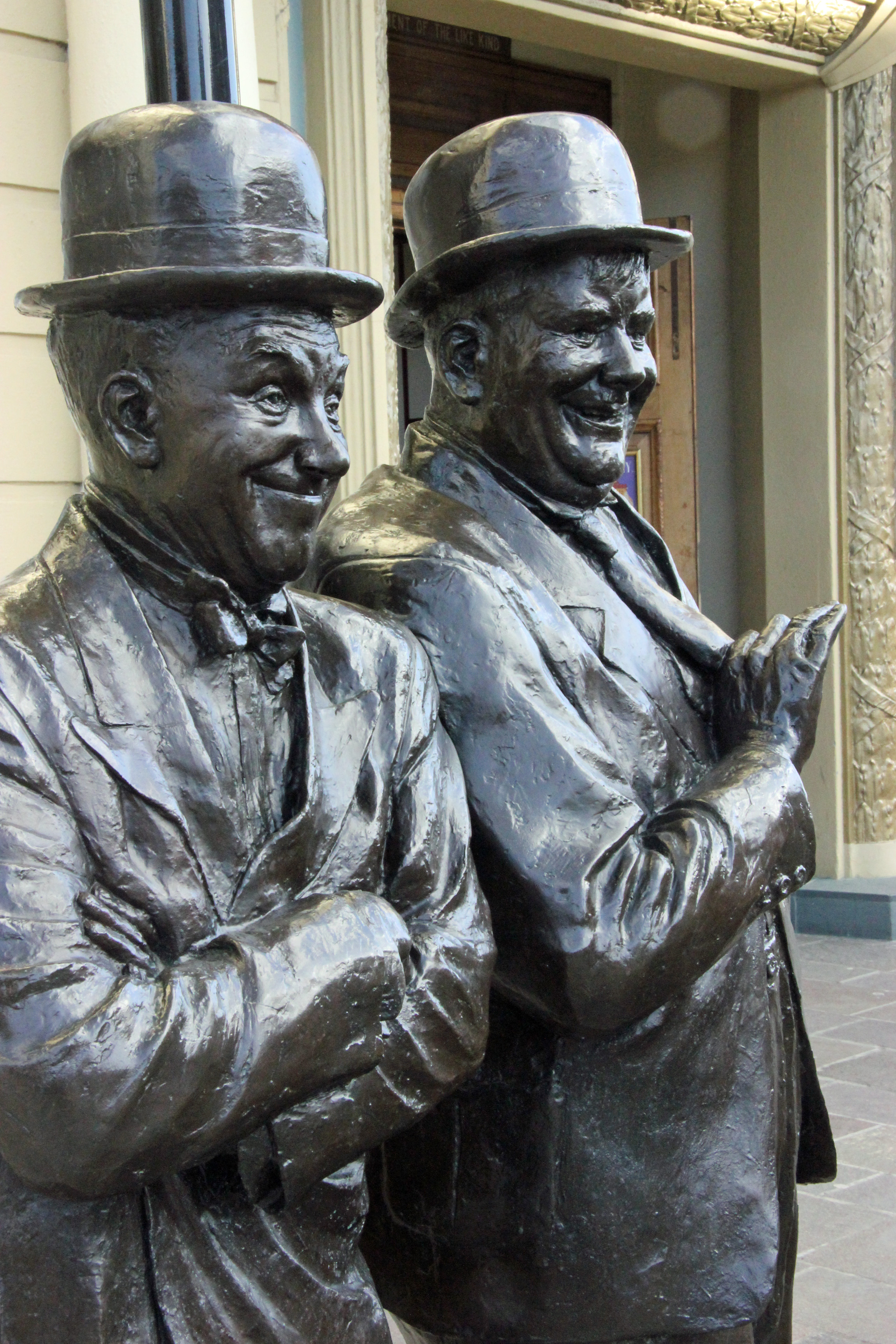
For the avoidance of doubt the two fellas above are not Steve Coogan and John C Reilly, the stars of film Stan and Ollie, nor indeed are they yer actual Stan Laurel and Oliver Hardy. No this, obviously is a statue of the comedy duo, courtesy of artist Graham Ibbesson, propped up against a lamp post outside the Coronation Hall in Ulverston near the seaside in South Lakeland, Cumbria. Where Stan Laurel was born. Pretty good likenesses you’ll warrant. Art initiating life imitating art imitating life …. you get the picture.

For imitation is what the film does best as the two lead actors turn in a couple of memorable, painstakingly detailed, turns as the beloved S&O. The story charts the return of S&O, down on their uppers, to Britain in 1953 to undertake a tour, organised by impresario Bernard Delfont (a well cast Rufus Jones). Only the boys are not offered much in the way of quality venues, (Delfont preferring the questionable comedy talents of one Norman Wisdom), so start off playing to tiny, nostalgic crowds Oop North, with Stan reassuring Ollie that, once in London, he can secure the backing for a new film script, a Robin Hood spoof, that will rehabilitate both reputation and bank balance. Word of mouth, and immortal talent, turns the tour into a massive success, and the lads are joined by wives, the devoted and fiercely protective Lucille H (the ever brilliant Shirley Henderson) and the terse Russian Ida (a pitch perfect Nina Arianda), comically hamming up their own rivalry (“two double acts for the price of one”). Cue a falling out and reconciliation when Ollie’s health takes a turn for the worse.

So cliched you could barely make it up. Except that it is true. And these are about the most lovable pair, as portrayed and in reality, that you could want to watch. There are obviously generations, my age or older, who are familiar with Laurel and Hardy from repeats on the telly. There will be other youngun’s as well, I am sure, who will have discovered them through their own volition or Mum and Dad’s reminiscing. Whatever, there was clearly going to be enough of an audience to make this film a success.

Which may also be why it is played so straight. Not straight as in lacking humour. Like I say Messrs Coogan and Reilly have the routines of S&O down to a tee. As they do when it comes to the more complex off-stage/screen personalities. Vocally and physically the resemblances are uncanny. No, it is just that the way the story is told contains next to no surprises. It isn’t mushily sentimental, but it doesn’t take any risks at all. It is cheesy, sweet and melancholic in all the right places. The two leads, director Jon S Baird and writer Jeff Pope (co-writer on Steve Coogan’s other major big screen success Philomena), all plainly, and rightly adore their subjects but a slightly less decorous tone might have paid dividends.

Still the best bits, the dolly shot opening in the Hollywood back-lot, Stan sticking it to Hal Roach (a cameo from Danny Houston), Newcastle in the rain, the “hospital sketch” repetitions (especially the exchange on Ollie’s actual sickbed), the double door routine, the ladies bitching at the reception, the venue interiors, Stan looking wistfully up at the Abbott and Costello film poster, are undoubtedly effective, laden with pathos, humour and affection. Cinematographer Laurie Rose takes much of the credit and the make-up and prosthetics of Jeremy Woodhead and Mark Coulier, turning John C Reilly into Oliver Hardy, especially in the later scenes, is remarkable.

All in all a very nice, touching and amusing film. Make of that what you will.

True West at the Vaudeville Theatre review ****

True West

Vaudeville Theatre, 10th January 2019

The Tourist’s first viewing of a Sam Shepherd play. A couple of near misses, but this, with Matthew Dunster directing and Johnny Flynn as one of the two brothers was not to be missed. I was less sure about the acting merits of Kit Harington having actively avoided that Game of Thrones and not having seen any of his film work. The only exposure the SO and I have had, (quite literally it turned out with his botty on show), was his Faustus in the lamentable Jamie Lloyd outing a couple of years ago. (BTW Mr Lloyd may not have convinced us in Marlowe but in Pinter, as he is now proving, he is the bee’s knees).

Well as it turns out Mr Harington puts in a more than creditable stint as Austin, the screenwriter younger brother to Johnny Flynn’s maverick petty thief Lee. Or at least we should assume they are brothers. Sam Shepherd’s near-naturalistic text and setting, (apparently he was a right one for stage directions), have led many to conclude that what we are seeing is two sides of Austin’s character which emerge as he is holed up in central California in Mum’s holiday retreat.

As I had anticipated Johnny Flynn, on whom I have a small crush, was magnificent. From Jerusalem, through Twelfth Night, Hangmen, and now this on stage, Lovesick, Genius, his Dobbin in Vanity Fair and his scene stealing Felix in Les Miserables on BBC right now, and then his utterly brilliant Pascal, alongside the equally wonderful Jessie Buckley, (who I also have a similarly sized crush on), everything he does is, well, genius. Can’t vouch for his music, other than the Detectorists score and his contribution in this play, but another sign of his all-round wonderfulness. He has charisma, plainly, but he is able to mould that personality and presence, through speech, expression and movement, to the character he is playing.

Lee is volatile and unpredictable, a restless wanderer, the embodiment of the True West of America, a chancer, but enough of an opportunist to seize his opportunity when Donald Sage Mackay’s film producer, Saul, visits to check on Austin’s progress. Whilst I was a little unconvinced by this plot shift that leads to the inversion of Lee and Austin’s relationship, Austin now getting in the hair of Lee as he tries, hopelessly, to write his own script, as I was by the brawl that follows the arrival of their exasperated Mom, (Madeleine Potter in an underwritten hospital pass of a role), there was plenty in the dialogue and semiotics to keep me gainfully entertained.

Sam Shepherd’s key concerns, the dysfunctionality of family as a metaphor for the dysfunctionality of American society, are common to most of his mature plays. He started off in a more absurdist, comic vein and was a pivotal figure in all that late Sixties, psychedelic, experimental New York artistic scene. However, it is his quintet of plays. created in a decade span from the mid 1970’s, which define his writing legacy. True West (1980), alongside, Curse of the Starving Class (1976) and Buried Child (1979) make up the Family Trilogy, which was followed by Fool For Love (1983) and A Lie of the Mind (1985). These are the plays that generally get revived, (there are a lot more besides), and these are the plays I will now need to hunt out to complete my education. I can see that, without the right cast and direction, they might have the capacity for tedium, fortunately not the case here.

The way Austin initially seeks to calm his elder sibling, (they haven’t seen each other for 5 years), to forestall any conflict, eventually handing over the keys to his car. The guilt Austin feels about their alcoholic father. The golfing one-upmanship. Austin’s dismissal of Lee’s hackneyed plot for his film idea. The admissions of jealously of each other’s lives. Conformity and financial success vs rebellion, freedom and moral ambiguity. Head vs gut. The inversions as Lee calms Austin after Saul drops his script, Lee begging the drunken Austin to let him concentrate. Not the stuff of every brother relationship but enough for anyone similarly blessed, (hello little Bruv), to recognise. I can certainly see why some might want to go beyond the straightforward reading of the play, especially as things get out of control towards the end, and the signifiers of the “vanishing West” pile up, but I was happy enough sticking with the obvious.

If I am scrupulously honest the play worked best when Messrs Flynn and Harrington were bad boys, rather than when they tamed their instincts, and I got a bit peeved by the stilted proceedings later on, which come close to questioning the worth of all that has preceded. Jon Bausor’s set and Joshua Carr’s lighting were effective but a little compromised by the Vaudeville’s proscenium and architecture. All in all though, and if you like either, or better still both, of these lads, well worth the trip.