Othello at Wilton’s Music Hall review ****

othello-collage

Othello

Wilton’s Music Hall, 17th May 2017

I think Othello is my favourite Shakespeare tragedy. And it follows, therefore, that it is my favourite Shakespeare play since the tragedies generally kick the most arse. And it therefore also follows that it is probably my favourite ever play since no-one bests big Will. Mind you I have so much more to explore so lets not be hasty. But to date this is the Daddy.

This means I might not be the most objective judge. Which for this production really helped. I fear that a combination of my hearing which is no longer up to snuff, my seating position up in the gallery, the acoustic at Wilton’s and, perhaps, the sound engineering here meant that I couldn’t clearly hear a lot of the lines. Which is a shame as pretty much everything else about this Othello was mightily impressive as it cut straight to the core of what this play is about.

So what made it so good despite my blinking ears?

Well, first off, the programme is at pains to explores Othello’s “otherness” as a “Moor” in terms of his colour, but also more so his faith, as probably a Muslim who is forced to, or chooses to, embrace Christianity. The production serves to handsomely illuminate this (it starts with Othello on a prayer mat and crucifixes are liberally bandied about), such that it is not just the vitriolic racism that is on show but also the suspicion accorded Othello by the Venetians because of his roots in Islam. This despite his victories over the “Turks”. This may be C16 Venice (and Wilton’s itself does a nice line in atmospheric material decay), but clearly there is plenty of food for thought in this production for our own times.

It also rightly centres on Iago. There are multiple ways to explore why Iago is driven to do what he does but I think this production gets as close as possible to the heart of what drives him.

Of course Iago is disfigured by the racism and misogyny of the society that he lives in. And, as he says, being passed over for preferment in favour of Cassio portends a powerful grudge. His hatred of Othello is certainly borne of envy yes – of his masculinity, his power, his sexual relationship with Desdemona (in contrast to what may be his stagnating marriage to Emilia, look out for the “non-kiss”) – but at its heart is the dissonance between his admiration (and even attraction) to Othello and his incomprehension that this “other” should have everything he can’t have. He loathes himself and cannot, and will not, stop until he has brought this man down. His jealously is so all encompassing that he can justify his actions to himself and, for me, the final vow of silence is a sign that he still believes he was “right” to do what he did in his own mind.

So the “why the f*ck should he get everything when I am better than him” is the bigger lesson here. And this is what Will S nailed as it seems as if it is a permanent feature element of the human condition. It is this deep psychological impulse that lies at the heart of the alienation that pervades neo-liberal capitalism and is what some will always seek to exploit. So the play is relevant in my mind, not just because of the way it explores the “fear of the other”,  but also because it shows the hate people can be driven to by perceived “unfairness”.

Blimey I think I may have got all carried away there. Sorry.

Anyway none of this would work if the players are not up to the task. And here Mark Lockyer as Iago was about as good as it is possible to be. His Iago properly hates himself. Not just in his words but in his movement – pacing, pointing, finger-clicking, advancing and retreating – all in some sort of Prosperian performance to justify his thoughts and actions to himself, as well as hide his intentions from others. Brilliant and horribly plausible.

In contrast I saw a “man-child” Othello who was maybe more open to manipulation than in other productions which perhaps better explains, whilst still condemning, his brutally misogynistic destiny. It is stating the obvious that debutant Abraham Popoola has an extraordinary physical presence, but the way he used this in the scenes with Desdemona, both tender and violent, and especially with Iago, where Iago is winding his jealously up to the max, was remarkable. As Othello oscillates between his disgust at the imagined betrayal by Desdemona and his trust in her true nature, so Iago oscillates between a visible fear that he has pushed Othello too far (he actually physically shrinks when this Othello gets right in his face) and an almost smug satisfaction in what he can do to his “friend” and, always remember, his military superior.

There is also another very fine performance in the form of the diminutive Norma Lopez Holden as a sensual Desdemona. Constantly in motion, tactile and perfect in conveying, even to the end, the sense of disbelief at what has come over her husband. Throughout the sexual attraction between her and Othello pervaded the theatre. This actor will surely go far. To round it off we had a fine, upright Cassio in Piers Hampton and an Emilia in Kate Stephens who is, ultimately, the best side of our nature. In fact the whole ensemble seemed to me to perfectly execute director Richard Twyman’s laser-guided vision.

BTW Mt Twyman s a very important man. As Artistic Director of English Touring Theatre he will have a hand in bringing the best of theatre to venues outside of the London commercial and subsidised venues. A vital role. From what I have seen of their past production and what he has achieved here it is therefore an immense blessing that he is very, very good at his job.

In this directing role, and along with his sound and, especially, lighting team, he has brought a prodigious energy to this Othello and some absolutely first rate scenes with an absolute minimum of props and costume, particularly through Acts 2 to 5. The soldier’s partying and drinking, the big fight scene, the Iago wind up of Othello, the murder of Cassio in the dark, Emilia and Desdemona’s drunken but unswerving dissection of the relationship between the sexes, Desdemona’s murder (a yoga mat replaces the usually crassly symbolic bed and calls back the beginning) – all these scenes were as good as I have seen. And that wretched hanky gets an early look in – as part of the apparently non-Christian wedding ceremony at the start – how brilliant is that.

But if I was to single out one contributor it would be movement director Renaud Wiser. Like I said some of the lines, particularly Othello’s, floundered on the rocks of my dodgy hearing. This, together with the harsh downlighting and fluorescent tubes at the corner of the tight, bare, in-the-round stage, maybe meant I focussed on movement in a way that I might not normally do but here I could see just how vital this ingredient was to the whole.

So, as you may have gathered, I liked this. And this despite the aural handicap without which I might even be prepared to rate it alongside Nicholas Hytner’s NT production in 2013 which, to this day, still leaves me nervous of befriending anyone who comes across like Rory Kinner’s matey Iago.

So please go along. There’s another three weeks or so and it looks like plenty of tickets. Probably best to go downstairs, maybe have a quick snifter beforehand and it will help if you like the play already. But if you do go you will be reminded of just how vital Shakespeare can be. I am pretty sure Mark Lockyer’s Iago will rank as one of the best performances of the year. And all this for 25 quid tops.

This is the first time that I have seen a production by Shakespeare at the Tobacco Factory. If this is what they do then it won’t be the last. Hopefully Wilton’s Music Hall will snap up anything they tour to allow the good burghers of London a chance to enjoy. Otherwise I now have the perfect excuse to go to Bristol. Here is the link to the website. Read it. This is how theatre should be done.

Shakespeare at the Tobacco Factory

Obsession at the Barbican Theatre review ***

15_0

Obsession

Barbican Theatre, 13th May 2017

In retrospect there were warning signs.

This was an adaptation of Luchino Visconti’s 1943 debut film, Obssessione, itself based on a book by James M. Cain, the Postman Always Rings Twice, which in turn was later made into an American film in 1946 (Lana Turner, John Garfield) and 1981 (Jack Nicholson, Jessica Lange with a David Mamet screenplay). There have apparently been 4 other film adataptions, another play and even an opera based on the book. I had seen both US films and Obssessione but I confess my memory of plot and character was more skewed to both of the US films and not Visconti’s “neo-realist’ masterpiece.

So, on this basis, and given the provenance of director and cast here, I got quite excited, so I strong-armed, in so far as that is possible with people of such admirably independent will, the SO and the Blonde Bombshells into coming with me to this performance. In doing so I broke my own golden rule – if a play is an adaptation of a novel or a film, or both, be careful to evaluate the source material before signing up. There have been plenty of recent marvellous adaptations for theatre but, if a play is not written expressly for the theatre then, in my view, the audience is at potentially greater risk of disappointment if the vision of the creative team falls short. A book has description (objective and subjective) and the reader’s imaginations to fill the gaps and film has the ever moving eye of the camera to direct the viewer. A play though needs the text, the things the characters say, to do the heavy lifting. When it works for me at least theatre trumps (see even this word still has some utility) any other artistic form and especially film.

Our director here, the mercurial Ivo van Hove, has a recognisable aesthetic and has used Visconti films as his inspiration before. The story here, on the one hand, is simple, but effective and timeless. A drifter finds himself at a restaurant, falls passionately in love with the trapped wife of her older husband who owns it, and they jointly resolve to do him in. The damaging consequences of this act are then cleverly explored. But Visconti was creating his film against the backdrop of censorship in Fascist Italy and looked to explore issues of agency, power, class, gender and sex in relationship to this backdrop. He also introduced another character, (here named Johnny), to contrast domesticity and control with freedom, both individual and political. There are a lot of lingering long and medium shots of rural Italian landscapes and interiors. The characters don’t say too much. There are dramatic devices (cats, the sound of the sea, guns, car crashes and so on) to heighten the whole confection.

So easy enough to see why Mr van Hove wanted to bring this into the theatre. The problems once again lie in the how he and his key collaborators, designer Jan Versweveld and scriptwriter Simon Stephens, choose to do this, and also, it pains me to say, who they cast to do it. This team is not one for fussy sets. Whilst not as minimalist as their A View from the Bridge or Crucible, there was not much to see, just the bare necessities to symbolise kitchen, bathroom/tap, car and jukebox, with some video close-ups, some video waves, Italian opera, Springsteen, Waits and Iggy on the soundtrack and a few props. Again this is not, of itself, a problem but when combined with a very sparse text, the deliberate eliding of time-frames and the giant Barbican stage, left the production feeling too one-paced and distant for me. In the Visconti film the camera is conveying information even when the characters are not; here we were not afforded that visual insight.

Now as I say I should have been cognisant of the risk. Mr van Hove does ask a lot of his audiences. By stripping back what you see to the bare essentials you are forced to focus on what the characters are saying and doing. When the text comes from the pen of Arthur Miller or Henrik Ibsen (with a bit of polishing up by another playwright in Patrick Marber for the NT Hedda Gabler) then the source material is so rich this can work splendidly. Or, when you have the riches of Shakespeare to play with, you can make it work even after taking a hefty scalpel to the source and translating it. Or indeed when Simon Stephens writes an original play, Songs From far Away for Mr van Hove to get his mitts on.

But if you have less to play with as here, and you are wedded to the notion of bringing this very cinematic film to theatrical life, then it can fall short. What I think we saw, and not just us judging by the reviews, was not, I think, what the creative team saw, in part because they were so immersed in what they were trying to create. And at times I fear it did come disturbingly close to self parody (witness the treadmill and profligate bin emptying).

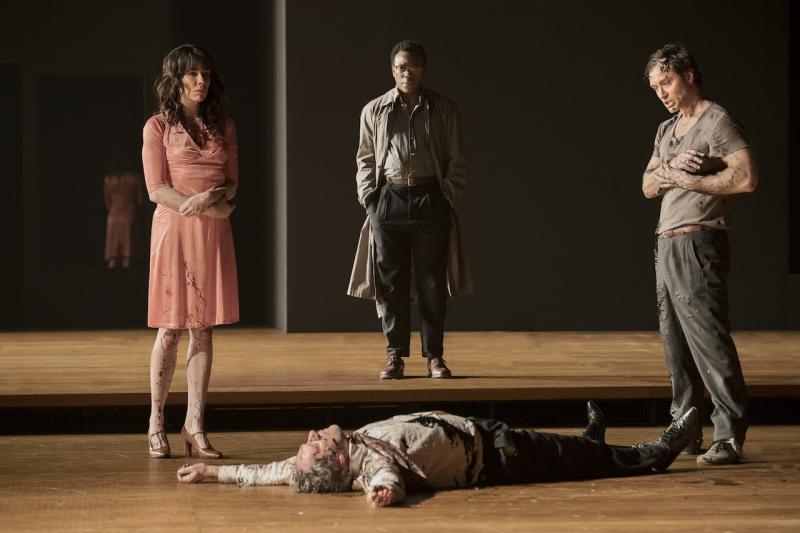
Which brings me to the third issue. I can’t put my finger on it but when I have seen the Dutch members of the cast in the Toneelgroep Amsterdam Shakespeare extravanganzas Kings of War or the Roman Tragedies, they were awesome, as in their performances inspired awe. Here, Gijs Scolten van Aschat and Halina Reijn just seemed more muted. And I had expected so much more of Jude Law playing Gino. He just didn’t look comfortable as a man of passion or of self doubt. It was nowhere near as disappointing as Juliette Binoche in Mr van Hove’s Antigone here in 2015. She was just out of her depth. Mind you that Antigone production also shows that if the words aren’t right (poet Anne Carson’s translation was all over the place) then the minimalist aesthetic cannot deliver.

So all in all a notable let-down. However, despite the elongation of tone and dearth of pace it wasn’t actually dull and there was stuff to chew on. It’s just that I had no opportunity for emotional engagement.

Yet I will not give up on Mr van Hove and his TA team. When it works it cannot be bettered. I just have to be more careful to think about the source. Next year, as an example, they are letting Robert Icke, our own British wunderkind director (Hamlet, Oresteia, 1984), loose on Oedipus. Yes that’s right Sophocles’s tale of f*cking it up big time with Hans Kesting in the lead. Blimey. That cannot possibly fail right?

P.S. I must also work out what this dramaturgy thing is all about as it is now dawning on me that it matters.


Babette’s Feast at the Print Room Coronet review ****

bfbanner

Babette’s Feast

Print Room at the Coronet, 10th May, 2017

Ahh Babette’s Feast. A gently understated but uplifting Oscar winning film directed by Gabriel Axel (it beat Au Revoir Les Enfants to the 1987 foreign film prize !!) that ranks pretty high up on my list of all time faves. Of course being the literary simpleton that I am, I know nothing of the Karen Blixen (pen name Isaak Dinesen) book on which the film was based nor of Ms Blixen herself. Other than, you guessed it, the film version of her memoir Out of Africa. So just as well then that I have the insight of the SO who is on top of (not literally) Ms Blixen’s work though, to my surprise, confessed to not having read Babette’s Feast. She does do a mightily convincing impression of Meryl Streep playing Blixen/Dinesen though.

So we went into this adaptation with high hopes but I confess lowish expectations just in case. The recent adaptations of films/books for the stage that I have seen have been mixed, Red Barn, City of Glass and, it sounds like, Obsession, on the debit side of the ledger, offset by the successes of My Brilliant Friend, The Kid Stays in the Picture and The Plague. Anyway I have to report that I think this Babette’s Feast is a resounding success.

There is a deal of poetry in the source material so getting a poet by trade, Glyn Maxwell, to write the play was inspired. There are a few minutes at the beginning when Babette, played by the striking Sheila Atim (who, along with Leah Harvey and Jade Anouka, blew my socks off in the Donmar Shakespeare trilogy alongside the splendid Harriet Walter, and is now set to star in the Old Vic’s Girl from the North Country), came on a bit strong with the lyricism. But the reasons for all of this became clear as we moved through the story which was told through spare but still elegant prose and with simple but haunting staging.

At its heart this is a tale of an outsider being embraced by a community and she, in turn, showing them that joy can be found here on earth as well as the heaven that they imagine. As well as capturing the harshness and drabness of a life in a village perched at the periphery (Northern Norway in the book, windswept Jutland, beautifully, in the film) it also shows how adherence to strict religious orthodoxy can also limit opportunity and imagination. The two daughters, Martine and Philippa, of an austere, though well meaning pastor father, find joy in love (a man in a uniform) and singing (the sublime Mozart) respectively, but no escape from duty. Babette in turn, is forced to flee Paris as the Commune is suppressed in 1871, and, through a fateful connection, finds sanctuary in the village. The suspicion of the tight-knit villagers, shown with real humour here, turns to love as Babette’s true art is revealed.

Wonderful stuff. And Mr Maxwell’s writing and Bill Buckhurst’s direction really resonant as we come to understand the loss that Babette has endured and as we empathise with the plight of the refugee. We also grasp the redemption that art (here in the form of opera and cuisine) can offer. Yet this is all laid bare without sacrificing the fairy-tale quality of Blixen’s work.

The experienced cast playing the more mature characters are uniformly top notch but, as well as Ms Atim, I would particularly draw attention to the performances of Rachel Winters as young Philippa and Whoopie van Raam as young Martine (in her professional debut – she was one of a collection of tremendously talented female actors I saw in a final year Guildhall School production of Caryl Churchill’s masterpiece, Top Girls).

This was our first visit to the Print Room at the Coronet in Notting Hill. What an absolutely enchanting space. It has the same shabby vibe as Wilton’s Music Hall and the dressing and lighting (you can’t beat a bit of candlelight) in the bar especially is tres romantique. Nice, open stage and a compact, but still airy auditorium. Mind you if you are a big unit beware the seats at the front of the “rear’ stalls where a low wall doubles up as a effective instrument of circulatory torture.

I see there are plenty of tickets left so I really think if you can carve out the time over the next month or so this is a splendid night out and at c. 100mins straight through, hardly demanding.


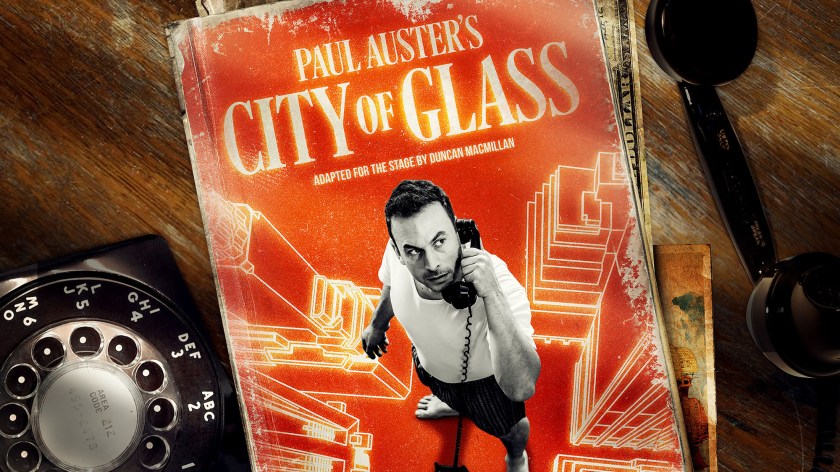
City of Glass at the Lyric Hammersmith review **

city-of-glass-final-image1

City of Glass

Lyric Hammersmith, May 11th 2017

So I remembered too late. I have thumbed copies of Paul Auster’s New York Trilogy so I think I must have read it, or at the very least City of Glass, when it came out in the 1980’s as any young, trendyish, new-to-theworld-of-work-but-still-able-to-go-out, indie man about town type would have done. I may even have professed to like it. But I’m not sure that I actually did. It is, as this adaptation (of orginal novel and a subsequent graphic novel augmentation) reminded me, a bit silly and a bit pleased with itself. No problem with subverting genres and getting all postmodern meta in books but you have to be very careful that you steer well clear of your own back passage or risk the proverbial disappearance.

So, in my view, this incredibly talented team comprised of Duncan MacMillan who did what he could to adapt the book into a suitable work for the stage, a score by Nick Powell, whose music is a vital part of The Ferryman at the Royal Court as we speak, and 59 Productions, including first time director Leo Warner, maybe just picked the wrong starting point. The staging is extraordinary showing just what can be done using cutting edge technology, but this has been employed to so much better effect in other productions by the 59 team (not the least of which was their contribution to the 2012 London Olympics Opening Ceremony).

The opening gambit is promising enough with the telephone call out of the blue to our hero/narrator/writer, Daniel Quinn, (DQ same as Cervantes original meta hero), conjuring up the expectation of a classic noir detective thriller. He then proceeds to find himself drawn into ever more fracturing realities leading him, and us, to question what is real and what is imagined here and ultimately into questioning his own sanity. The production however relies on heavily a narrator to move the “action” such as it is along and to explain “what” is happening, and the characters are more ciphers than individuals with whom we might want to make an emotional investment. The pace is unvarying which only led me to keep on questioning whether this might all have been better left on the pages of the original novel. And as I say the novel itself is, in my view, ultimately an exercise in pretension, though I freely admit my heart and head will always lie with the modernism daddies and not the post-modernist bastard offspring.

So sorry I couldn’t like this, though I recognise the extraordinary technical skill brought to bear on how this looked, and will definitely keep an eye open for 59 Productions next project (hoping they steer clear of Auster). And I continue to think that the Lyric Hammersmith’s ongoing ambition will be rewarded with a home-grown, or bought in, slam dunker at some point and I want to be there when it happens.


The Ferryman at the Royal Court Theatre review *****

379324_770_preview

The Ferryman

Royal Court Theatre, 11th May 2017

Right then. For once the tourist finds himself not seeing a performance near the end of the run, casting off his usual workshy approach to blog posting and sufficiently motivated to rave about something.

So just to say THIS IS FECKING OUTSTANDING. If anything beats this to play of the year it is going to have to work very hard. I confess (and the SO agrees) to not quite sharing the majority opinion on Jez Butterworth’s play Jerusalem. Yes Mark Rylance was off the scale brilliant as your man Rooster, the wealth and layering of ideas was genius and their were plenty of memorable scenes but we might have liked just a peep more of a dramatic story.

Well people you get that here. The set, sound and lighting are immensely detailed, the performances of the expansive cast without exception perfect (though if  had to pick one performance beyond the mighty debutant Paddy Considine it would be Tom Glynn-Carney) and Sam Mendes’s direction exemplary. But at the end of the day it is all about the the writing – and what writing. Since there is a transfer to the West End no plot details here. Let me just say that the way history, family drama and a cracking story with a powerful conclusion, are intertwined is simply magnificent.  There are the connections with distant, mysterious past events and with the land/seasons, (the stuff that informed Jerusalem), but this time set against the backdrop of the Troubles in Ireland. The Republican cause is examined from all angles and the way in which that affects multiple generations is brilliantly illuminated. This is a real family sketched with precision and humour but there is real insight too. And there are stories of love and longing, in major and minor keys, as well.

In the hands of another writer the play might sink under the weight of the material that is brought to bear or just go off into a world of frustrating ellipsis. Not here though. Mr Butterworth word by word, line by line, character by character, scene by scene (with only the deftest of contrivances) builds the whole thing into an immense structure (even weaving in profound understanding from great writers of the past), whilst at the same time giving you a proper edge-of-the-seat, what-is-going-to-happen-next feeling. There are fleeting nods to the likes of Messrs McPherson, Friel and McGuinness but Mr Butterworth is most definitely his own man.

So, my strong advice to you is that, if you wish to avoid the “past continually haunting your own present” like the Carney family here, then you immediately get a ticket for the West End transfer at the Gielgud. There is some critically acclaimed “unmissable” theatre that is eminently missable. This though is the real deal so believe all those proper reviews. and ignore the griping from the realist fringe about excess paddywhackery. So off you toddle now as I do not want to have to come round to your house to make you see sense.

Tim Gill (cellist) at Kings Place review *****

cello-unwrapped-2017_event-page-logo_248-px-wide

London Sinfonietta’s Tim Gill: Avant Cello

Kings Place, 6th May 2017

Tim Gill – cello
Fali Pavri – piano
Sound Intermedia

  • Anton Webern – 3 kleine Stücke, Op. 11,
  • Olivier Messiaen – ‘Louange à l’Éternite du Jesus Christ’ (‘Praise to the eternity of Jesus’) from Quartet for the End of Time,
  • Hans Werner Henze – Serenade for solo cello,
  • Arvo Pärt – Fratres,
  • Iannis Xenakis – Kottos for solo cello,
  • Jonathan Harvey – Ricercare una melodia for solo cello and electronics,
  • Thomas Ades – ‘L’eaux’ from Lieux retrouvés,
  • Anna Clyne – Paint Box for cello and tape,
  • Harrison Birtwistle – Wie Eine Fuga from Bogenstrich

I have a theory. If the C18 was characterised by the rise of the violin (beauty and enlightenment) in Western art music and the C19 the piano (power, expression and romanticism), then the C20 saw the cello come to the fore. If you want to pump up the emotion, eloquence and lyricism in music then the cello is the chap for you. It does profound in a way no other instrument can match and the C20 has much that composers have wished to be profound about. And in the purely musical sense you have 4 strings capable of a such wide variety of sound that it is really easy for the uninformed punter like me to grasp.

So there are some very good, some not so good and some very famous pieces written for cello from the last century. Think the large scale concertos of Elgar, Honegger, Walton, Prokofiev, Britten, Shostakovich, Ligeti, Lutoslawski and Penderecki for starters. There are also plenty of smaller scale works and this is largely the repertoire that the Cello Unwrapped series is exploring at Kings Place this year. Whilst there is a place rightly reserved in the series  for the mighty cello led works of JS Bach and Vivaldi and the earlier Classical composers there are also plenty of C20 cello works to feast upon.

And of those programmes this for me looked the best of the bunch (though I am signed up for a handful later in the year). I can’t pretend I went into this knowing all of these pieces but there were enough hooks and enough interesting sounding composers to get me all of a flutter.

I wasn’t disappointed. The Webern pieces are over in a instant but they pack in a host of new sounds which must have had contemporary listeners in full on WTF mode. I had heard the Messiaen before but on its own it is truly beautiful. Just a simple, unfolding, sonorous (cello trademark) cantilena like Part and Tavener deliver, and with a hint of Britten. Easy peasy to like. Then the first of the solo cello pieces, the Henze serenade. Henze is on my list to do more work on and blimey this was persuasive. Nine little movements each with a clear musical structure and immensely playful but never pastiche. I have heard Part’s Fratres millions of times, in various combinations, but this might have been the best ever. The arpeggiated opening and percussive interludes were played by Tim Gill with real aggression, and in the chorales he and Fali Pavri really attacked the music in a way I never thought possible. The Xenakis piece for solo cello was another one of the works by this composer that sound like they have been pulled out from deep underground with all sorts of exhilarating sounds and rhythms which get us boys all worked up. The Harvey piece involved a live tape delay which meant that Gill’s single cello line turned into a five part canon. The Ades piece was a sweeter affair intended to depict the action of water – I enjoyed this but it wasn’t as immediately exciting as some of the other compositions. As for Paint Box by Anna Clynne, well the mix of recorded voice, breathing  and other sound loops with a sonorous cello line and Mr Gill playing a musical box (I kid you not) was way better than it had any right to be. I love this thing where a piece which frankly I am never likely to hear again sucks you right in and then lodges in your head for days afterwards. We ended with the Birtwhistle piece. What can I say, it is just too much of a stretch for me now but one day, perhaps, I hope to become sufficiently sophisticated so that his work will make sense to me – alas this evening was not it (I am not taking the p*ss here – I really do mean this).

So I take my hat off to Mr Gill. He is principal cellist with the Royal Philharmonic Orchestra as well as the London Sinfonietta so clearly knows his onions. I cannot though imagine a better advocate for this music and with Fali Pavri he had a more than sympathetic partner. Just brilliant. This is the way to listen to contemporary art music.


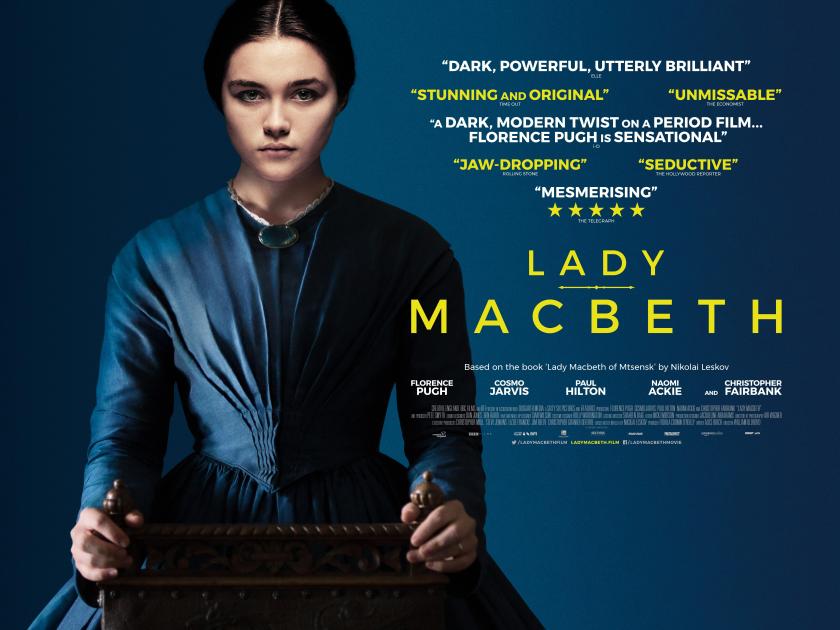
Lady Macbeth film review ****

lady-macbeth-new-poster-1

Lady Macbeth, 3rd May 2017

So a bit of an aside first. Went to see that Sense of an Ending at the cinema but never got round to reviewing it. Bit pointless now as it has probably been and gone from all those arthouse cinemas where it might have got a look in. Anyway, an exemplary cast (jim Broadbent, Harriet Walter, Charlotte Rampling, Michele Dockery) showing all those Hollywood chumps how to act and a screenplay by the marvellous Nick Payne based on the Julian Barnes novel. It could not be more British-class-act if it tried. Loved it (in short the past comes back to haunt our lead – shades of 45 Years – another recent Brit-class-act) until the last few minutes. Now I know there is a clue in the title but I still felt deflated by the open ending. Anyway, if and when it hits Netflix, do the decent thing and watch this and not some idiotic blockbuster.

So off to the next Brit-class-act on general release in the theatrically sculpted form of Lady Macbeth. But this time I was accompanied by the expert eye of the SO who has just read Leskov’s novel Lady Macbeth of the Mtensk District on which this is based. I only know the story from the Shostakovich opera and had to quickly remind myself of plot and characters (despite having seen it as recently as Nov 15 at ENO). BTW I note this is going to be revived at the Royal Opera House in 2018, oooh how exciting is that.

Anyway enough of pseuds corner. What happens here. Well bored, “bought” housewife, Katherine, with useless twat of a husband (played by Paul Hilton) and father in law (Christopher Fairbank with that face) has affair with farmhand. So far, so Madame B-Lady C. But then it all goes t*ts up. The screenplay here is by Alice Birch whose anatomy of a suicide (yes small letters) is about to be brought to the Royal Court stage, no doubt in some controversial way, by Katie Mitchell. It cuts most of the last third of book out which is a shame in some ways as there is plenty of plot, general nastiness and psychological insight to be gained there, but, on the other hand, it brings location (C19 NE of England) and its power relationships to the fore and swings us a little bit closer back to the original source of our (anti)-heroine here in Will Shakespeare’s Mrs Macbeth (“it is done” – wait for it). So play, book, opera, film, film – yep there was a film before this as well – mind you trapped woman who breaks all taboos has always fascinated the mostly blokes who wrote this stuff.

It certainly looks the part. Hard to believe this is William Oldroyd’s feature film debut. Muted Hammershoi (look him up) colours, sparsely furnished house interior, crappy weather, windswept moors, Bronte chic. Camera lingering on our Vermeer like leading lady, the outstanding  Florence Pugh (who I adored in Falling), who is the dictionary definition of stultified. And when she breaks out she is utterly convincing and the scenes with lover Sebastian, played by Cosmo Jarvis, are properly passionate. And he, and the maid Anna, superbly played by Naomi Ackie, bring another racial dimension to time, place and events. Very intelligent. Events then accelerate towards the chilling conclusion, with Pugh once again devastating as she goes properly bad.

So all in all a remarkable effort. No need to spend squillions on a film. Just take a classic story, get a stage writer of talent to rework it, a theatre director of insight to think it all through and an inspired cast to bring plot and characters to life, lights, camera, sound, action. Job done. Seek it out and if you don’t catch it on a big screen, then, when it eventually gets to the small screen, do not miss it.


Bach’s Brandenburg Concertos at St John’s Smith Square review ****

orchestra20of20the20age20of20enlightenment201

Orchestra of the Age of Enlightenment: The Brandenburgs

St John’s Smith Square, 2nd May 2017

Bach Brandenburg Concerto No. 1
Bach Brandenburg Concerto No. 3
Bach Brandenburg Concerto No. 5
Bach Brandenburg Concerto No. 4
Bach Brandenburg Concerto No. 6
Bach Brandenburg Concerto No. 2

JS Bach. Tick. Brandenburg Concertos. Tick. Orchestra of the Age of Enlightenment. Tick. St John’s Smith Square. Tick.

What’s not to like. Might as well just stop there. A superb period ensemble with some of Europe’s finest instrumental specialists playing a series of the finest works of the Baroque age.

However, there is always something new to be found in the Brandenburgs and so it was this evening. With excellent harpsichord (Steven Devine) and cello (Luise Buchberger) continuo lines and a bit of double bass action when required from Ceccelia Bruggemeyer, and with one instrument to each part, we could focus on the key contributions of individual players/instruments: in No 1 Huw Daniel on the violino piccolo (yep that’s a tiddly violin), Katharina Spreckelsen on flute and the two horns of Roger Montgomery and Nicholas Benz: in No 5 on the violin of Huw Daniel now standing in for Pavlo Beznosiuk, and its interplay with the flute of Lisa Beznosiuk  and the harpsichord cadenza of Steven Devine: in No 4 Huw Daniel’s violin again and the recorders of Rebecca Miles and Ian Wilson; and in No 6 the same violinist and recorder with the oboe again played by Katharina Spreckelsen and the F trumpet of David Blackadder (how on earth does he do that – its just a tube of old metal with holes in!!). Nos 3 and 6 are the all string affairs but in No 6, Simone Jandl and Max Mandel made a mighty racket on their violas.

Now I confess I can bounce between period (Pinnock, Hogwood) and modern recorded versions of the Brandenburgs (with a special fondness for Benjamin Britten’s conducting) but in concerts period is best (and pretty much the only option these days). And this was properly raw and thrilling. For those who have never heard a period horn, trumpet or recorder, get up close and embrace the vitality and skill. It is a tricky business making these things do what you want but when it all falls into place the energy is palpable. The quality of the instruments, the skill of the players and the depth of the scholarly advance over the last couple of decades means you are now really hearing all these scores as (probably) they were intended. If I had to pick out a couple of faves it would be No 6 with the aforementioned violas offset by the grumbling gambas and the violone (a little double bass) and the oboe/trumpet/recorder combo in No 2. .

The excellent OAE programme (a numpty like me learns a lot from these which do not assume too much but neither are they patronising or just biographical) reminds us that these now ubiquitous works started as a speculative venture by JSB for a customer, the Margrave of Brandenburg (I would love to be a Margrave if  had to be a Continental European aristo), who never bothered to look at them. What a silly Margrave. The reason why the Brandenburgs are so popular and wonderful is because they have all the brilliant, diverse yet condensed musical ideas that JSB excelled at, but they also deliver the tunes and the visceral, show-offy excitement that the best of the Italian baroque supplies.

So I say if you are a newcomer to the classical world (this blog is aimed at you), ignore all those miseries who would have you listening to the endless droning on from the likes of Strauss, Mahler and Bruckner and get down instead with the funky muthas that are JSB and Vivaldi. And if you are anywhere near Manchester or Cheltenham they will be bringing this to you in the next few days.


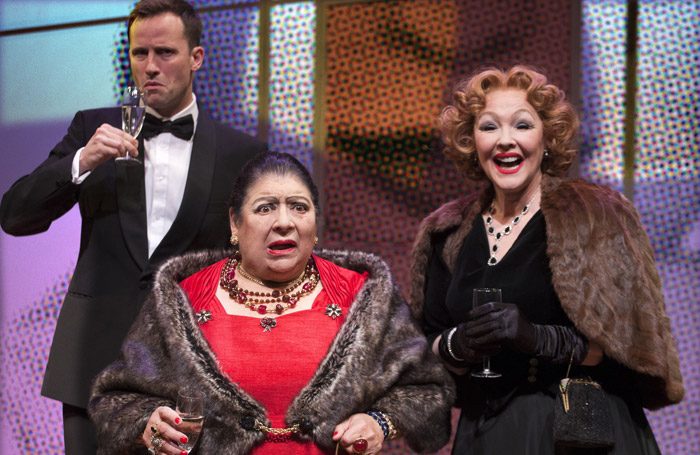
Madame Rubinstein at the Park Theatre review ****

jonathan-forbes-miriam-margolyes-frances-barber-l-r-in-madame-rubinstein-at-park-theatre1-700x455

Madame Rubinstein

Park Theatre, 4th May 2017

Jez Bond and his team at the Park Theatre (with the help and goodwill of assorted North London luvvies I think) are doing an ever more successful job in my view in staging new plays and productions that people want, or should want, to see. Which is ultimately the whole point. If no-one sees a play it is a shame, if people see it but don’t really enjoy it (ponderous Shakespeare or clobber you over the head issue plays spring to mind) then it has similarly failed to deliver.

I am signed up for Twitstorm, Rabbits, Loot, What Shadows, The Retreat and Daisy Pulls it Off in forthcoming seasons here and, in contrast to some of the stuff I get to, have found it a relatively easy task of dragging along a willing chum to many of these. Whether it is the subject, the writer or the cast there is normally a clear hook to make me part with the cash. There is also a nice buzz about the place.

And so it was with Madame Rubinstein. A comedy based on the life of cosmetics magnate Helena Rubinstein, with Miriam Margoyles in the lead, was enough to persuade the SO, BUD and KCK to schlep up to Finsbury Park mid-week. And I think we were all glad we did.

Now it would be pretty easy to knock this play (many of the proper reviews have done just that), written by Australian John Misto and which MM herself was instrumental in bringing to this theatre. There is a sense that Mr Misto has tried to cram all the key events of Ms Rubinstein’s life, biopic style, into a couple of hours to the detriment of any real insight into her character. This also means the messages such as they are –  the barriers that stood in the way of Ms Rubinstein and her rival and nemesis, Elizabeth Arden, their need to re-invent their own pasts in order to sell their dreams to their consumers, the part that cosmetics played in the emancipation or otherwise of women in 1950s America – end up being diluted. And this in turn is not helped by the unrelenting focus on keeping up the gag quotient.

But when it is this funny and entertaining who cares. It is hard to imagine anyone else but Miriam Margoyles delivering the stream of one-liners that she was gifted with. But Frances Barber as Elizabeth Arden and Jonathan Forbes as long suffering assistant, Patrick “Irish’ O’Higgins, gave as good as they got. Yes the jokes are often on the obvious side of stereotypical and yes there is a campiness about the whole affair that some might not welcome. And the multiple scene changes (mostly just shifting of desk and chairs) are distracting. But we laughed. A lot. As did everyone else there.

So a top night out for all. Apparently this is sold out now but if it pops up somewhere else take a look and, as I say, if anything else piques your interest in what is coming up at the Park I think it is worth taking a punt.

David Hockney at Tate Britain review ****

david_hockney3_3579807b

David Hockney

Tate Britain, 2nd May 2017

OK so this is embarrassing so I will get it out of the way. I didn’t really know David Hockey’s works beyond a cursory glance at a handful of works in permanent collections and some mixed exhibitions and didn’t really know what all the fuss was about (this remember is about as popular an exhibition as TB has ever staged I gather). The idea that his fascination with new “ways of seeing” was somehow interesting or insightful felt like a bit of hype to me. I went it to this therefore expecting to be underwhelmed and finally to be able to write a review that wasn’t sycophantly gushing as is my wont.

Well I was wrong. When he wants to be this fella’s a marvel (though by no means consistently). So if there is anyone out there who didn’t know that (or was I the only one), I recommend you get along to this in the next three weeks before it closes.

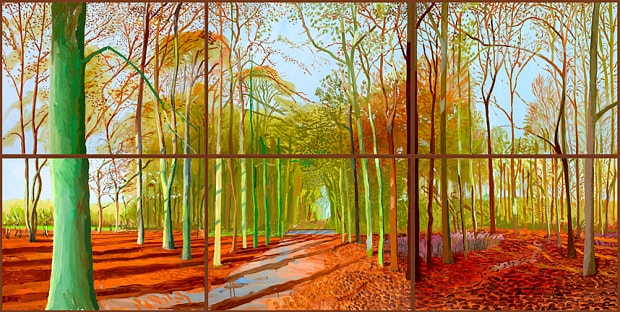
So what turned me on? Well not all the scruffy early stuff though I can see its provocations. Not the first phase of LA swimming pool stuff – this is great yes (especially the buildings) but closer exposure didn’t bring to that WTF moment I look for in art. And not the IPad musings at the end. But the so flat, still, alienating double portraits, the room of amazing drawings, a few of the collaged photos and then the Wolds paintings, those paintings, and I was bowled over. I didn’t leave anything like enough time for those Wolds multiple canvasses so I will have to go back. It is like Van Gogh suddenly got serious with colour and that you are racing towards the vanishing point. So new ways of seeing – I get it now. And acrylic paint – no room for error – and the pure skill of the simplest drawings. There is still some pointless nonsense but this can be forgiven.