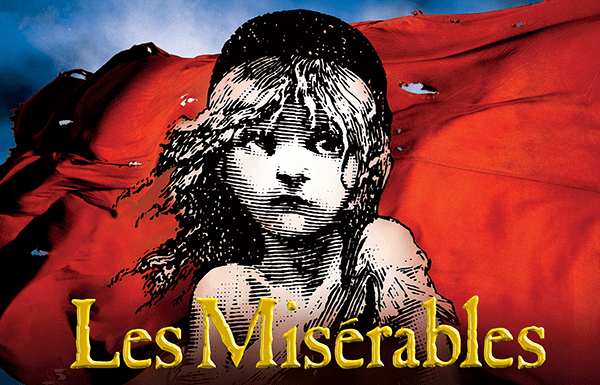
Les Miserables at the Queen’s Theatre review ***

show_lesmiserables

Les Miserables

Queen’s Theatre, 16th September

I first saw Les Mis at the Barbican some three decades ago (gulp). I seem to remember me and TFF were perched up in the gallery and the view was obscured a bit by lighting rigs. To use the vernacular it blew me away. Between now and then, as my cultural elitism ballooned along with my waist, I have become rather sniffy about it, as I am generally with West End musicals. However underneath my snobbish carapace I have always yearned to re-visit just to see what the older me would think. The SO, the D’s and MS had no interest so it was up to LS, with LGN in tow, to provide the excuse.

LS loves this sort of stuff. She dips in to the film at regular intervals and has the soundtrack constantly shuffling on her phone. So, happy faces on, we set off for LS’s belated birthday treat. Now before we get to the show a word about the Queen’s. I have yet to find a West End theatre I like. There are a few I can tolerate. The Queen’s is not one of them. Public spaces are tired, seats are uncomfortable, though legroom was just about OK, and the queue for the ladies was a joke. Indeed the ushers were basically issuing ultimatums to those poor women who didn’t cross the lavatorial threshold before the firm 20 interval, as it were. That’s just b*llocks. You can wait a few minutes and extend the interval. Tut, tut Mr Mackintosh.

Having said that we managed to secure some pretty decent seats near the front of the stalls with my aisle seat, (always an aisle – don’t ask, it’s a long story), losing only a fraction of the action. Prices here are just shy of gouging but I guess this part of the London market can bear it. This though is a show where paying up is worth it, given the set, and a little bit of research pays dividends.

Now the sound (Mick Potter) is very good. Obviously the cast are all miked up to the eyeballs. I see some sweet reviewers complaining about the miking. Trust me if the production team reigned this in, or even, as some suggest, dispensed with it, the poor punters in the gods would be watching a mime show. The lighting (David Hersey) is also dramatic, although all the action does emerge from some dark Stygian gloom, and they are very heavy on the dry ice. I guess we have to assume that France in the first few decades of the C19 had a very long run of bad weather.

I won’t bother with the story. You will know even if you don’t, by which I mean it shamelessly trots out some hoary dramatic staples, (unrequited love, mistaken identities, letting the baddie off the hook, belated realisation by baddie that he is a sh*t). But it does really work. Even if you try your level best to remain unmoved by the tale of Valjean’s redemption, (unless you are one of those blokes who is hard as nails and thinks theatre generally is suspect), you will get sucked in.

I had also forgotten just how simple the score is. That is not a criticism. When you break down Mozart’s operas, (or, if you can stomach them, Wagner’s), you see how the material is pushed and pulled into different shapes throughout. (OK maybe there is a bit more going on in The Marriage of Figaro than Les Mis, but the point still holds up). Ask a musicologist. I counted six or seven repeated melodies that crop up, with little variation, in two or three songs. That though is why the music is so powerfully direct. I had the privilege of LS bobbing about next to me and, just about still inaudibly, singing along in the second act, and she was not the only one. And there were tears aplenty as Eponine, the little cherub, the students and finally big JV himself, popped their clogs. It is nice to see an audience enjoying their theatre though my eyes stayed dry (and I am a perennial blubber).

So what holds the Tourist back. Not the singing. That all appeared up to snuff and what would I know anyway. If I had to highlight a couple of voices it would be Hayden Tee’s Javert and Charlotte Kennedy’s Cosette. No the problem lies in the acting. There are no inadvertent jazz hands but hands definitely get wrung, there are deaths from gunfire worthy of a 1950s cowboy movie, “woe is me” faces abound, legs are manfully thrust and skirts are assertively swished. The choreography and movement are impressive but all is still in service of the big numbers. To be fair this is why I dislike most opera that isn’t from the C20 or contemporary, and avoid most musical theatre. Here though none of the cast really connect with the characters IMHO, with the notable exception of Steven Meo’s Thenardier. Unlike the rest of the cast he seems up to now to have been working in “straight” theatre. It shows. Obviously the character is a preposterous villain straight our of Victorian melodrama, but at least I got a sense of a personality beyond the belters and balladers.

So there you have it. It’s pretty good. I drifted a bit but no more than many operas I have put my self through (for when opera works, as many observe, it is a sublime art form; it is just a shame it is so dull a lot of the time). If you like it you will really like it, but if you are wary of such entertainments, save your money. Hardly helpful advice but that’s the facts, folks.

You may be asking dear reader why such different reactions to the show from first to second viewing. My answer; the passage of time. I have learnt that the theatre can do so much more. Thirty odd years ago I confess to yawning through Othello, having barely any idea what was going on (like so many things you only get out what you put in with big Will) and desperate to get out before the pubs closed. I was, in so many ways, a twat then. The pity is, albeit in different ways, I still am.

Note this review is tardy even by my lax standards. I figured this show ain’t going anywhere.

Final note. I see that some of the supporting cast are termed Urchin/Whore and some Whore/Urchin in the programme. Not sure which is better.
 

Insignificance at the Arcola Theatre review ****

insignificance-arcola-700x455

Insignificance

Arcola Theatre, 21st October 2017

Regular readers of this blog (don’t be shy) will know that I adore the work of Terry Johnson. As do a lot of proper theatre critic types. I also have a very soft spot for the Arcola. With this revival of Insignificance the combination delivers.

However, I see from some other reviews that not all are persuaded. This is par for the course with Terry Johnson. I think the way he mixes high and low culture, and the multiplicity of meaning he inserts into his texts can leave some audience members a bit cold. He is, as my mum would have said, a “clever clogs”  and his humour is “knowing” with a capital K. In this play he is happy to trade ideas and words for the dramatic arc. The comedy, which often leavens Mr Johnson’s work, is less prominent in Insignificance and is downplayed by David Mercatali’s measured direction.

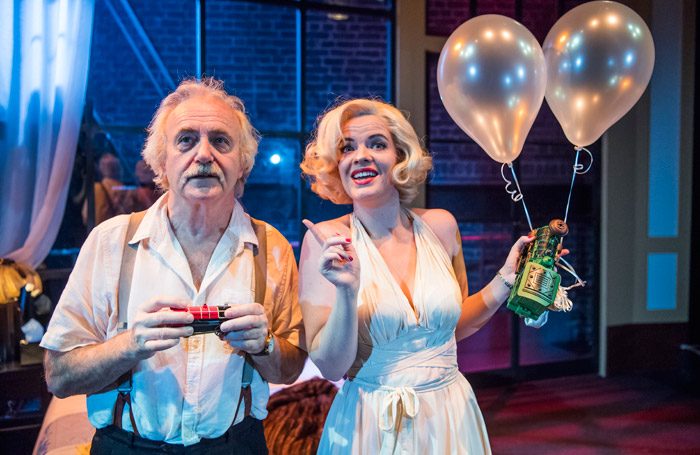
The Professor, played stoically by Simon Rouse, is in a hotel room, (Max Dorey’s utilitarian design copes with the Arcola space), working on the nature of space-time. He is interrupted by the Senator, played by Tom Mannion with increasing venom, who tries to bully him into testifying before the House Committee on Un-American Activities. The Professor refuses. The Senator leaves. The Actress (an excellent Alice Bailey Johnson who just happens to be the playwright’s daughter) appears in a recognisable white dress and, initially, trademark breathless voice. She and the Professor discuss the nature of fame and celebrity, she demonstrates, in ecstatic fashion, the theory of relativity using toy props in the room and then she attempts to seduce the Professor. They are interrupted by the Ball-Player played by Oliver Hembrough, who is not best pleased. The Professor leaves. The Ball-Player sleeps through the Actress’s announcement that she is pregnant. Next morning the Senator returns, mistakes the Actress for a prostitute and hits her. The Professor returns, chucks his work out of the window to thwart the Senator who leaves. the Ball-Player returns. The Actress miscarries and tells the Ball-Player their marriage is over. The Actress and Professor remain. The time approaches 8.15pm. The Professor visualises his recurring nightmare of nuclear destruction.

Now when you put it like I appreciate it doesn’t sound like a barrel of laughs. No so. Also it seems to me there is plenty going on in the play, it is just that it is confined to the one room. (Nic Roeg’s famous film version is obviously less claustrophobic). These characters are, of course, Albert Einstein, Joe McCarthy, Marilyn Monroe and Joe DiMaggio. None of this happened. But it might have done. That is the whole point. I never understand why people get worked up by drama which “strains credulity”. It is a play. It’s not real.

We see the world of science, politics, film and sport collide. These people were about as famous as it was possible to get in 1954 when the play is set. They still were in 1982 when the play was premiered at the Royal Court. And they still are today, notably in the case of Monroe and Einstein. The influence of fame and celebrity on the cultural superstructure is arguably even more profound. There was an actor in the White House when the play was written, there is a clown now. As Mr Johnson observes in a world which worships at the altar of celebrity society will fail to “question the power of the invisible”.

First and foremost the play is a meditation on the nature of fame, as many of Mr Johnson’s plays are. We think we know the public personae of these people and what they represent but we see very different identities in private. The Professor has sexual urges (Ms Monroe allegedly wanted to sleep with him). The Actress reveals a prodigious intellect in sharp contrast to Ms Monroe’s screen image. The Senator is an aggressive ideologue, as we liberal types would presuppose, but we shouldn’t forget that he mobilised an entire legislature to let him pursue his grotesque witch-hunt. The Ball-Player expresses his own renown in the most banal way through the greater number of bubble gum cards with his image when compared to peers. He too is more intelligent than the jock he presents but he sees little advantage in revealing this.

Mr Johnson also has some fun with other mind-bending scientific ideas with an off-stage cat belonging to a certain Mr Schrodinger and the Uncertainty Principle of Heisenberg. Science plays are ten a penny these days, not surprising as dramatists are creatures of wonder, but Terry Johnson was an early protagonist. He also squeezes in a Crucible gag. More moving are the Actress’s sorrow at her own objectification, the Ball-Player’s yearning for domestic normality and an heir and the literal cloud that hung over the Professor’s head in the latter years of his life as he reflected on the destructive power his science unleashed.

So there you have it. I would get it if this doesn’t float your boat but if any of this sounds remotely interesting please give it a go. You might be a convert.

What Shadows at the Park Theatre review ****

header_1264388_16-9-1024x575

What Shadows

Park Theatre, 19th October 2005

The Park Theatre has pulled off a bit of a coup in bringing the Birmingham Rep’s production of What Shadows to London. It has been a deserved sell out. I have some misgivings, there were times when the didactisism verged on the patronising, shared by the SO who I dragged up to North London, but these were more than compensated by the brisk plot and a very fine performance from Ian McDiarmid.

Pretty much everything Mr McDiarmid touches turns to dramatic gold whether as director, (The Almeida bloomed under his joint stewardship with Jonathan Kent), or as actor on stage, large or small screen. He inhabits every character he plays. Let’s be honest he is by some margin the best actor in Star Wars.

What Shadows was no exception. He is Enoch Powell. Worth seeing for the way he captures Powell’s voice and gait alone. In the performance we went to, in the scene where his erstwhile friend, journalist Clem Jones, throws the script of the infamous “Rivers of Blood” speech to the floor in disgust, most of the pages landed on Ian McDiarmid’s shoe. The way he slowly withdrew his foot, as if he relished the content but at the same time knew the sh*tstorm he would create, was masterly. I can’t believe this was deliberately staged. It just happened but he was able to take this serendipitous accident and turn it into a telling detail. Or maybe i just imagined. Either way he was very, very real.

Chris Hannan’s script takes Enoch Powell’s 1968 speech to the General Assembly of the West Midlands Area Conservative Political Centre, which led to his sacking by Ted Heath, as its subject. Powell’s scholarly brilliance, his skills as a rhetorician, his significant contribution in WWII, his trenchant views on the European Union and on free market economics, only appear in passing.  I pretty much disagree with everything he stands for politically but his influence on Conservative, and broader right wing politics, in this country has been undeniably profound (despite, or perhaps because of, the amount of time he spent criticising his own party).

But it is his views on race that turned him into a bogeyman and this is where Chris Hannan is focussed. He cleverly weaves the friendship that Powell and his briskly entitled wife Pamela (Joanne Pearce) had with Clem Jones (Nicholas Le Prevost, last seen by me in the excellent Winter Solstice at the Orange Tree which was a similarly uncomfortable watch) and Quaker wife Grace (Paula Wilcox) into the story. Similarly he takes the character of Marjorie Jones (Paula Wilcox again), the “only white woman” on a street in Birmingham, and the subject of another of Powell’s speeches, and charts her relationship with black woman, Joyce Cruikshank, and her daughter Rose Cruikshank, (both played by Amelia Donkor) as well as second husband Bobby (Waleed Akhtar). Rose herself has become an academic specialising in black history who is looking to probe the now retired Powell as part of her research. We see that she has both suffered and been the cause of past racism. She recruits Sofia (Joanne Pearce again), an older ex-colleague who career was cut short, in part by Rose’s actions, as a result of her own unpalatable opinions on race.

Whilst this set-up looks a bit awkward on paper it just about works in practice, thanks to the actors and to Roxana Silbert’s forthright direction. Having created this web of relationships to explore the politics of race and difference, Mr Hannan is then occasionally guilty of asking his characters to ram the points home which I think would naturally have emerged from the story, particularly in the case of Rose and Sofia.

Having said that though this is still a very fine play with a magnetic central performance. Powell’s own peculiar “otherness” which played a part in the thwarting of his own ambition, and his monumental self-belief, are brilliantly captured by script and actor. In my view this was no prophet but a dangerous demagogue. In his mind though prophet is exactly what he wanted to be. Our society has moved a long way since his heyday, though we seem no closer to bridging the divide between those he look out to the rest of the world and those who think we can close in, cut ourselves off and blame others for our plight.


Wings at the Young Vic review ****

wings-juliet-stevenson-london-theatre-todaytix

Wings

Young Vic Theatre, 18th October 2017

Turns out there are a few tickets left for the final week or so of Wings. You could do worse than snapping one up. I cannot pretend it is a masterpiece, but the performance of the wonderful Juliet Stevenson, under the direction of Natalie Abrahami and with the design of Michael Levine, is astonishing.

Ms Stevenson plays Emily Stilson, whose world has been shattered by a stroke which renders time, place, speech, language and thought meaningless. We see her move from a world of utter incomprehension, hers and those around her, through to partial recovery. The rest of the cast play the various members of the medical team and other stroke victims, though they don’t have much to play with in Arthur Kopit’s script. Mrs Stilson had been a stunt pilot who had stepped out on to the wings of planes in the past and it is this motif than informs the play and production. From the opening, and throughout the 70 minutes of the performance, Juliet Stevenson is rigged up to a harness which allows her to fly above and around the stage. She soars, she twists, she turns, she tumbles, she occasionally comes to the ground. It really is the most remarkable physical tour de force, devised by movement director Anna Morrissey and a team from Freedom Flying. At the same time as delivering this bravura feat, Ms Stevenson delivers a notable vocal performance as she captures Mrs Stilson’s fractured Waspish speech and lapses of memory. She certainly more than earns her fee here.

This striking visual conceit certainly captures the dislocation between what is going on internally in Mrs Stilson’s brain and what is visible to the external world. As an academic theatrical document of the impact of a stroke I am hard pressed to see how it might be improved. The audience moves along a path from total disorientation, through to a qualified understanding of what has happened to our leading character. Yet we don’t really get to see the person that lies beneath the condition. We make no real emotional connection to her. This was originally a radio play and I am guessing the stage version normally involves a rather more static lead. That could be quite wearing I fear.

This production however wins out through the spectacular visuals and the stunning craft of Juliet Stevenson. Whenever, and wherever, she is on stage your eye and ear are drawn to her. She was a tactile Gertrude in Robert Icke’s revelatory Hamlet and a stern Elizabeth in the same director’s Mary Stuart, but in this play, and as Winnie in Beckett’s Happy Days at this venue a couple of years ago, she is peerless. And fearless.

I had a notion the other day that we Brits, wherever we come from, might be better governed by a matriarchy of our greatest stage actresses. Juliet Stevenson would be Foreign Secretary. Surely an improvement on the clown who currently occupies the seat.

The Cherry Orchard at Milton Court Theatre review ***

cherry_orchard_image_only

The Cherry Orchard

Milton Court Theatre, 17th October 2017

I have remarked before on the attractions of the Guildhall School final year productions. Lovely venue, clear interpretations which eschew directorial licence, and the chance to see some potential future stars of stage and screen.

I must say these students are an extraordinarily attractive bunch. I guess an acting factory isn’t that interested in churning out fat uglies like yours truly. Shame since people are a diverse lot. As our leading British thespians bear witness too. This also highlights the other caveat which I would raise about these productions. Obviously if everyone on stage is in their twenties those tasked with playing the more mature characters are presented with a challenge that the age appropriate characters are spared. I have to say though that overall, the entire cast performed admirably, especially in the second half, though for me the standout performances came from Georgina Beedle as Madame Lyubov Andreievna Ranevskaya and Mhairi Gayer as Anya.

The Chekhovian symphony always takes a little time to build as we embrace the characters, both in terms of their individual psychologies, and what they stand for in pre-Revolution Russian society. Director Christian Burgess let each of the actors find their voices without rushing things, which softened some of the slightly uneven casting. This was Tom Stoppard’s translation. Since Chekhov pervades a great deal of his own work it is no surprise that it hits the spot. Any playwright worth his or her salt will take a shot at adapting Chekhov but some are more sympathetic than others. This production (designed by Polly Sullivan) was as historically specific as it is possible to get – ushankas, birch trees, even a samovar I think. A complete contrast to the current Sherman Theatre interpretation from Gary Owen and Rachel O’Riordan which sounds terrific. I see too that Mike Bartlett is not averse to infusing his latest (great) play Albion with the spirit of the Cherry Orchard, both directly in terms of plot and also through the character of Audrey Walters, (Victoria Hamilton turns in one of the best performances of the year – just see it).

For of course there are always plenty of themes in Chekhov’s plays that resonate with today’s world. That is generally because there is just a lot in Chekhov’s plays full stop. Regret about an imagined past is a powerful driver of society in the present and that applies throughout human written history (I may have made that up but you get the point). These regrets and disappointments are played out through the personal, and always with a wry humour in the background.

Overall then a fine production. Not the best you will ever see, but that is unsurprising. And the two actors I mention above have a bright future ahead of them. Mind you, what do I know.

Every Brilliant Thing at the Orange Tree Theatre review ****

ebt201600x915

Every Brilliant Thing

Orange Tree Theatre, 17th October 2017

This jolly looking fellow is Jonny Donahoe. He is currently the latest incumbent in the one man show, Every Brilliant Thing, at the Orange Tree Theatre. The play was originally written by Duncan Macmillan (he of People, Places and Things, Lungs, 2071 and a bunch of masterpieces in German) in 2013, and has basically been travelling round the world, to venues big and small, ever since. This is the last leg of the latest incarnation. It was commissioned by Paines Plough, that wonderful institution, dreamt up in a pub four decades ago, which acts as a national theatre for new plays.

EBT tells the story of a seven year old who begins to make lists of things that make life worth living for in response to his mother’s depression. It charts the relationships between the boy as he moves into adulthood, with his Dad, his Mum, who attempts to take her own life, and, eventually, girlfriend. Jonny Donahoe uses the audience to call out items on the list and, for some lucky punters, to play key characters in the narrative. So those who are shy of audience interaction need to hide in the shadows. What this brings though is intimacy and empathy in buckets. Particularly in the cozy surroundings of the Orange Tree.

Now a story like this isn’t going to work without an actor who is up to the task. Mr Donahoe most certainly is. He is a comedian by trade which partly explains why this is so funny. That, and the expertly crafted writing of Duncan Macmillan. I seem to remember that People, Places and Things also had a few laughs scattered throughout. Its subject, addiction, was also an unlikely candidate for mirth. Having said that, when Mr Donahoe needed to ratchet up the pathos, he was just as adept. There is something of the child still about our Jonny which, even as he ages, ideally fits the character, and it is impossible not to bowled along by his enthusiasm, even for a grumpy old git like the Tourist.

A play about how to deal with depression could easily have been too whimsical or too maudlin. It is not. To call it “life-affirming” risks cliche but it gets pretty close. Should this pop up again in your neck of the woods go see it. Then you can add it to your own list of brilliant things.


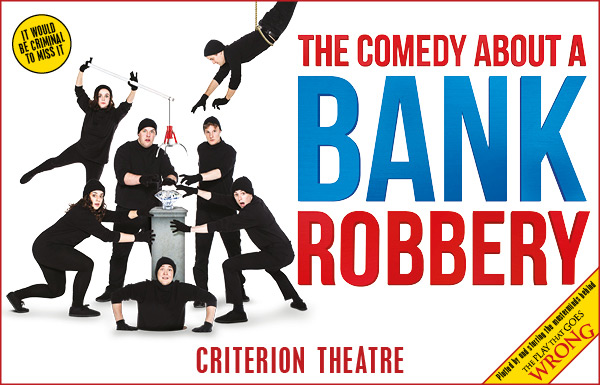
The Comedy About a Bank Robbery at the Criterion Theatre review ****

show_thecomedyaboutabankrobbery

The Comedy About a Bank Robbery

The Criterion Theatre, 15th October 2017

Abandoned by the SO, and with BD now, like MS, deep in academe, LD and I needed entertaining. The solution. A fix of Mischief Theatre. Now it is not the first time we had seen this. The whole family had been to TCAABR before, and we have hoovered up the rest of Mischief’s output with relish.

Why? Because it is very, very funny. We would probably still say The Play That Goes Wrong is the best of the three, and TCAABR works in a very different way, what with its “screwball” feel and American setting, but frankly all three, (assuming Peter Pan Goes Wrong pops up again – maybe courtesy of Auntie Beeb), are must sees. TPTGW is on tour in the UK next year. Do not miss it if it comes anywhere near you.

Comedy in the theatre is tough to pull off. Comedy in the theatre which really makes you laugh is really tough to pull off. Comedy in the theatre which makes a diverse audience laugh is even tougher. TCAABAR takes a surefire plot winner, a bank heist, and, with a combination of unsubtle punnery, farce, slapstick, visual jokes, often spectacularly constructed, and one-liners, the nine strong cast, (the three original MT founders are now in the Broadway runs I think), fair whizz through the action so that the whole thing is done and dusted in a couple of hours. This is an extraordinary physical performance from all concerned as much as anything else.

No plot details here. You will see for yourself if you have any sense. What I will say, and this is where a second viewing, (from stalls vs our original circle perch), really drives it home, is just how flipping clever the whole thing is. Not just in terms of the action, but how this fits together with the set. The proscenium arch stage in the Criterion, which itself is buried underground, is not huge and shifting between the scenes requires precise stagecraft. The eight main characters, and one other actor who takes on all the other roles, also act as a chorus during the transitions which are often accompanied by musical numbers which match the 1958 Minneapolis setting. Adding yet more texture.

My guess is that this is going to run for some time yet but no point in delaying the pleasure. Get the family out for a Christmas treat. It might turn out to be your seasonal highlight.


Victory Condition at the Royal Court Theatre review **

victory2bconditrion

Victory Condition

Royal Court Theatre, 12th October 2017

Apparently the writer of Victory Condition, Chris Thorpe, likes to experiment with the dramatic form. I haven’t seen Confirmation, a one man work in which he also took the lead as a white supremacist, which apparently prodded and provoked its audience. It sounds uncomfortable but fascinating. In other works he has stamped on a mobile phone and set Tory party press statements to death metal tracks. Sounds like a top bloke.

However, I wasn’t entirely enamoured with this Victory Condition. A couple, simply titled Man and Woman, return from a holiday in Greece, to their tasteful, if somewhat bijou, metropolitan flat, (an ingenious design from Chloe Lamford which doubles up for B also showing at the RC – B at the Royal Court Theatre review ***). They unpack, they get changed, have a drink, make a snack, play videogames, get a pizza and generally potter about in choreographed cozy domesticity. They don’t speak to each other. Instead they narrate, through two cut-up independent monologues, an entirely different reality.

Man, played by Jonjo O’Neill, with his lilting Northern Irish voice, tells the story of a government sniper, who falls in love with a person he sees from his position, imagines that person (we don’t know their gender) having a dream about an alien invasion, and eventually shoots the person in order to turn them into a martyr, Sharon Duncan-Brewster, equally eloquent as Woman, recounts a narrative about a person who has a brain haemorrhage on the Tube on their way to work. This person seems to be imagining a meeting at work where time stands still. Then then she opens up to all manner of other, seemingly unconnected events around the world, and maybe a trauma from their own childhood which has caused the clock to stop. Her monologue, memorably, imagines just how mundane our own behaviour would be in the event of increasingly catastrophic events that imperil human existence.

Now this summary is based on reading the text. As you can see I am not sure I fully grasped exactly what the two characters were describing. I also note that the dialogue at the end of the play where Man and Woman discuss their own lives back in an ostensibly “real” world was omitted from this production directed by the RC’s own Vicky Featherstone. There was instead just a few seconds at the end, following a flash, where the couple acknowledged each other. Some of the stage directions which describe a cityscape beyond the flat’s interior, which seems to be succumbing to some sort of disaster or attack, also appear to have been omitted. This means that the enigmatic texture of the play was amplified. Put this together with the cut-up nature of the monologues and the message here was difficult to discern.

Nothing wrong with theatrical elusiveness and formal experimentation. Here though it did make me wonder whether the insight justified the effort involved in following the two monologues. Some of the images which flowed from these monologues were undeniably striking, as was the contrast with this routine of “ordinary” life, but ultimately I just couldn’t engage with the two characters up there on the stage. I closed my eyes a few times. Not through boredom but just to see if this would actually work better as an entirely aural experience. It did.

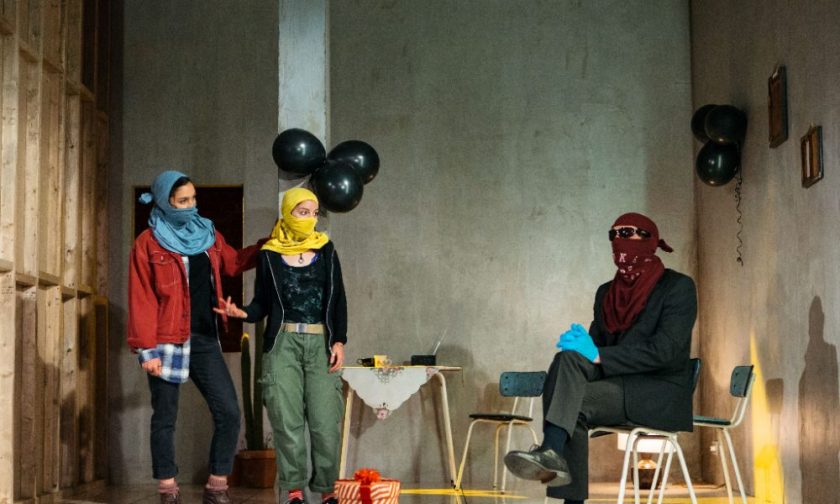
B at the Royal Court Theatre review ***

c2aehelenmurray-b-by-guillermo-calderc2a6n-directed-by-sam-pritchard-royal-court-261-1000x600

B

Royal Court Theatre, 12th October 2017

I wasn’t entirely sure what to see from the plays on offer in this latest season at the Royal Court. I don’t know enough about the writers and the teasers on the website are exactly that, teasers. Seeing too many is an extravagance, but waiting for reviews risks missing out on some outstanding theatre. Sounds like I’ve already ballsed up by missing The Fall if my friend the Captain is to be believed, and she usually is. And now, with this play B and Victory Condition, both of which had their moments, but were not altogether convincing, I am beginning to doubt my picks. Still first world problems. eh.

B was written by Chilean playwright Guillermo Calderon and commissioned by the RC. Chile has a history of impassioned political protest, which has spilled over into violence, with several hundred bombings since the constitutional changes in 2005. “Noise” bombs, intended to cause damage to property and highlight apparent injustice, are prevalent. This play, which concerns a plot to plant just such a bomb, therefore lost a little bit in translation here in the genteel surroundings of Sloane Square.

It is set in a room in a flat where Marcela (Aimee-Ffion Edwards) and Alejandra (Danusia Samal) are being comforted by neighbour Carmen (Sarah Niles). Marcela’s boyfriend has apparently been killed by a terrorist bomb. This turns out to be a ruse as Marcela and Alejandra are hatching their own bomb plot. Jose Miguel (played by the ever watchable Paul Kaye) turns up with the bomb. Cue a nervous run through of the plan which is played, successfully, for comic effect. As the night wears on though the motives behind the plot are exposed with Jose Miguel advocating a more violent approach to protest than the two women. The tone shifts, the black comedy evaporates, and we build to three impassioned monologues from each participant questioning why and what and why they are doing. Carmen the neighbour returns and is not quite what she seemed. There is a dramatic finale.

Sounds good on paper right? I agree. It also reads pretty well in the text. The problem is that the tone oscillates and the tension, which should build to breaking point given the material, just never seems to ratchet up. I suspect this is not the fault of the production under the direction of Sam Pritchard and designer Chloe Lamford, but lies in Mr Calderon’s claustrophobic and phlegmatic plot. I am not sure that enough really happens, or that we find out enough about the three conspirators, early enough in the play. Which leaves the three, admittedly fervent, monologues near the end shouldering much of the interesting and unsettling debate between the unfocussed, politically naive but heartfelt protest of today’s youth, with the more organised, direct and ideologically informed revolutionaries of previous generations.

I went with the SO. She can write the sort of sharp, sarcastic, Pinteresque (sorry its the only word for it) dialogue that this started off with in her sleep. She wasn’t best impressed. Mind you if she had stayed for Victory Condition I reckon I would have been in real trouble. Such is the danger of picking theatre in advance. Ho hum,


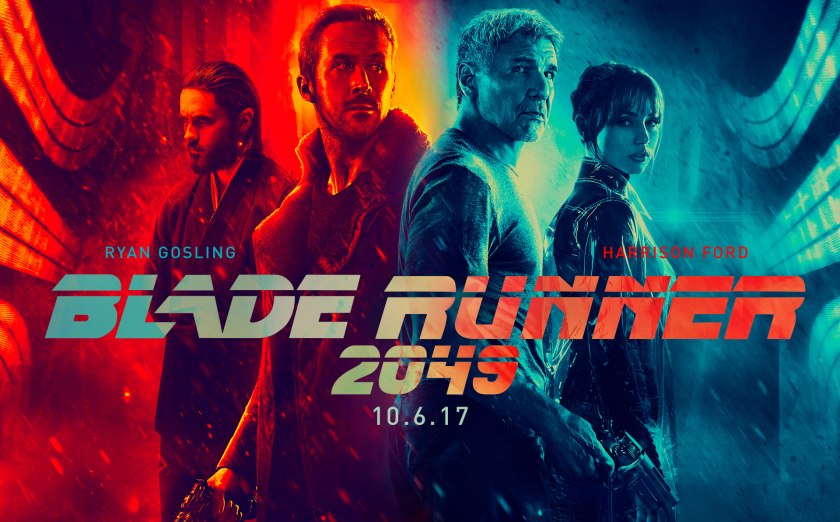
Blade Runner 2049 film review *****

blade-runner

Blade Runner 2049, 12th October 2017

Confession time. I think the original Blade Runner film is OK. Even in all the re-cut versions. Not brilliant, not a great leap forward in the cinematic science fiction genre, not a searing insight into the human condition. Just OK. Worth seeing but just didn’t have much to say. Whisper i,t but a bit like Philip K Dick’s stories; once the central conceit is out it is all a bit predictable.

I also think Harrison Ford, even in American Graffiti and The Conversation (which are brilliant films), right at the beginning of his career, always looks like a small part of him would rather be somewhere else. With this in mind I am always a little chary of any film where he is involved.

However I have to say I was bowled over by Blade Runner 2049 and am even prepared to forgive Mr Ford’s passable impression of a septuagenarian Putin as he puffs his chest out and roars gruffly at the film’s climax. (To be fair his grizzly Deckard was actually pretty good). Of course the film looks superb courtesy of cinematographer Roger Deakins. You will purr inwardly with pleasure at some of the visuals and all the imagined technology. There is surely enough burnt orange sky, acid rain and neon signage to keep afficionados of the original film very happy. I also think I might prefer Vegas in this, rather than its current, look. The score is imposing, an electronic howl which imitates the original Vangelis pulse but wisely nicks a lot from the late C20 masters like Xenakis and Ligeti.

Of course there are also some superb performance: even I, who is very suspicious of all Hollywood actor types until they prove it on stage, have to admit Ryan Gosling is the real deal (even after his inauspicious beginnings, I mean Disney, not Canada). Mr Gosling here is a master of restrained emotion – notably in the scenes with holographic partner Joi (Ana de Armas) – exactly what his character demands. Sylvia Hoeks as Luv, Mackenzie Davies as Mariette and Carla Juri as Dr Ana Stelline, also stood out for me.

And of course the film plays with some big, bold and important ideas, about what it is to be human. Yet it is the way that director Denis Villeneuve, and co-writer Hampton Fancher, allow these ideas to breathe that is most impressive about the whole enterprise. Avoiding too much CGI crash, bang, wallop (though there is plenty of this at the end), and stretching the film out to 160 minutes, all helped but this was no guarantee of metaphysical success though.

The pace is undeniably languid in places, (which I gather is a problem for some), but this means there are plenty of scenes and lines which explore the border between humanity and artificial intelligence, in, er, a very human and intelligent way, if you see what I mean. As it happens, I reckon the meaning of consciousness will increasingly become a feature of everyday discourse. Which will be fun. When neuroscience shows us that we have no free will. Or that there is no such thing as the “mind” or the “soul”. Have a read of that Homo Deus by Yuval Noah Harari to get into the swing of things.

It also helps that there is a decent plot here, albeit as old as the hills with its variation on an “orphan” setting out to uncover his true past. Moreover the nods to Franz Kafka’s novels, with their themes of alienation and helplessness, are inspired and give the film some backbone. In contrast to his namesake Ryan Gosling’s Joe K has agency however, even as he threatens the Wallace Corporation, the inheritor of the Tyrell Corporation’s legacy, headed by the eponymous Niander, played with gnomic gusto by, who else, Jared Leto. We learn very early on that K is not quite what he seems, but how he came to be turns out to be a satisfying detective puzzle. It is only at the end (after a fine homage to Kubrick’s The Shining) that the film lapses into the obvious.

So a marvellous film which is way better than the original. If you want explosions stick with Star Wars. If you are prepared to put a bit more in, (and to cross your legs), then this is infinitely more rewarding. I suspect the whole thing is littered with references which may not have been revealed on first viewing. Thus making it even more appealing to the pretentious, intellectual w*anker like me. Neat.