A Midsummer Night’s Dream at the ENO review *****

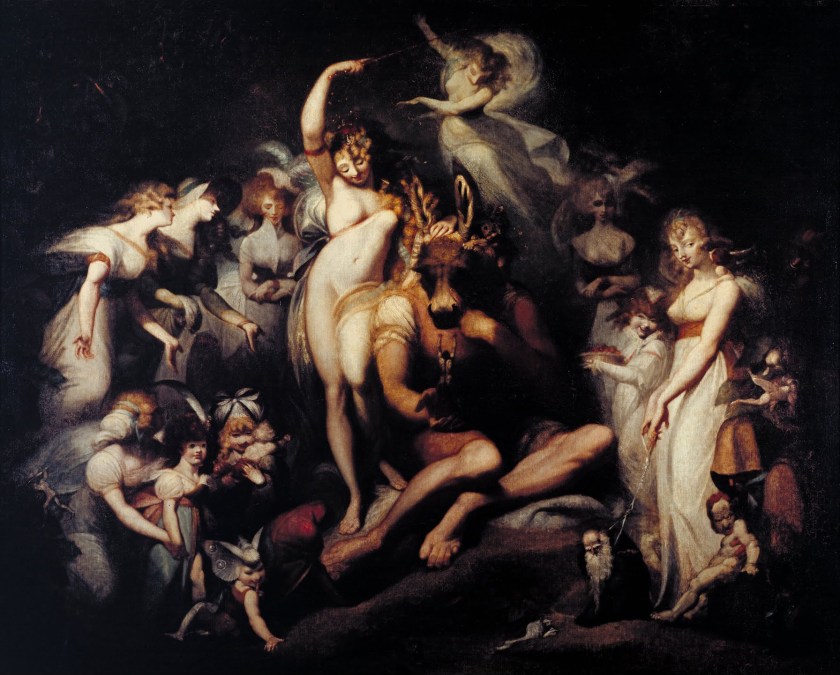
Henry_Fuseli_-_Titania_and_Bottom_-_Google_Art_Project

A Midsummer Night’s Dream

English National Opera, 4th March 2018

Out of a long list of wildly inappropriate events that I dragged BD along to when she was younger perhaps provocateur Christopher Alden’s production of A Midsummer Night’s Dream in this very house was the most egregious. Not because the 14 year old her wasn’t up to the task of taking some pleasure from Britten’s opera; she is a very clever young woman who makes me immensely proud, (as do the other two in the very unlikely event that they read this – “Dad, what exactly do you do with you day now you are no longer working”). No, it was because of the audacious sub-text of public school abuse which underpinned the production. Not that this wasn’t an interesting, and very valid, perspective, just that it maybe wasn’t quite the Dream we were expecting.

ENO has reverted then to the older, 1995, Robert Carsen production of AMND, last revived in 2004, to pull in the punters. Good for me because a) I haven’t seen it and b) it is brilliant. Now my regular reader will likely be aware that I struggle with a lot of opera. Monteverdi, some Baroque, Mozart and some C20, can work for me but it is by no means guaranteed. Contemporary opera is what usually really floats my boat. There is a special place for Britten though. This is because it is English, or more precisely was written in English, so I have half a chance of understanding the words with my dodgy ears and don’t have to flick eyes up and down to sur-titles. Moreover, there is a proper marriage between libretto and music. The music fits the words and the drama and not the other way round. Britten chose stories with real drama and assumed that all of his performers could act. This much is reiterated by the interview with Britten in the programme. I care about the voices but I am not smart enough to know just how good the singers really are. In contrast I can understand why an audience gets all juiced up when the Queen of the Night hits those F6’s in Der Holle Racht … but it doesn’t always make up for an unfunny Papageno, risible plot and all that crass symbolism.

So drama first, music second, voices third. BB was judicious in his choice of source material, whether it be Auden, Crabbe, Maupassant, James, Melville or Mann. And why not turn to the greatest of them all in Shakespeare. But where to cut AMND, to avoid creating a 5 hour extravaganza, and how to shape the music around an already musical text? This is where BB, and Peter Pears, who took full joint credit for the libretto with BB, is so clever. By cutting out all the arranged marriage preamble, with the insertion of just one new line, we jump straight to the forest with Oberon and Titania wrangling. We swiftly get to experience the three different, but interlinked, sound worlds that BB has created for fairies, humans and mechanicals. The chop does mean that when Theseus and Hippolyta finally pitch up it’s a bit of a jolt, but by then we have had so many musically signposted episodes it’s easy enough to apprehend. A little bit of nipping and tucking in the order of the episodes to match text to music does also make for some novel juxtapositions: cheeky BB and PP send the lovers to bed unmarried, for example. Anyhow it’s the Dream so most of the audience will be up to speed on the story..

As ever with BB there a lot of essentially simple musical ideas which mean a numpty like me can feel the structure even if I can’t break the language. These ideas are clothed in innovative execution though. The Balinese influences, the debt to Purcell and Ravel, a bit of unthreatening twelve note serialism, all are audible, for this is the opera where Britten meshes the orchestral coloration and technical precociousness of the early operas and orchestral works with the spare stripped back austerity of his last decade or so. That is why, to me, it always sounds strikingly fresh and approachable whilst still endlessly inventive. The repetitions tell us where we are, and who we are with, in the drama but also allow us to soak up those exquisite sonorities that BB excelled in producing.

Intelligent and beautiful music in the service of the drama, not just a parade of flashy tunes. Which is where director Mr Carsen comes in, or more exactly his assistant, Emmanuele Bastet who supervised this revival. If Will S has provided plot and poetry, BB a crystalline musical structure around it, then the director only has to respond with a few big, bold ideas, and, ta-dah, success. Which is what we have here thanks in large part to Michael Levine’s outstanding designs.. A giant sloping bed fills the stage. Emerald green (Oberon) and a nocturnal blue (Tytania) dominate with occasional flashes of crimson. The Trinity Boys Choir of fairies marches on and off in perfect unison. The mechanicals, look like what they are, and their props in Pyramis and Thisbe, strike the right note of amateurish craft. The humans virginal white is gradually besmirched before they appear, alongside King and Queen, in glittering gold. There is coup de theatre in the suspended beds. Backdrops and lighting follow the same sharp, uncluttered aesthetic. A sort of synthesis of symbolist, minimalist and colour-field art, or maybe child-like Expressionism. Whatever, it it spot on. Any AMND, whether opera or on stage, that gets too floaty and ethereal gets the thumbs down in my book. That is not what dreams are made of.

Our Puck here, in the form of actor Miltos Yerolemou, counterpoints the action with his actions as much as his words. He is a very funny clown, (note he last appeared on stage as the Fool in the Royal Exchange Lear with Don Warrington), with pratfalls and tumbles a plenty, but he is the glue which brings the fairy and human worlds, fleetingly, together. As well as the superb design it is the choreography which enthrals in this production, courtesy of none other than Matthew Bourne and updated here by Daisy May Kemp.

Counter-tenor Christopher Ainslie stood out for me as Oberon, but that’s the way the opera is written, and because he is really, really good. The quartet of Hermia (Clare Presland), Lysander (David Webb), Helena (Eleanor Dennis) and Demetrius (Matthew Durkan) were well matched. The last three of these, along with our Tytania, soprano Soraya Mafi, and Theseus, Andri Bjorn Robertsson are all ENO home-grown talents, whose slight lack of projection was more than compensated by their movement and flair for the drama (and comedy). Joshua Bloom was perhaps an overly grandiloquent Bottom but that mattered less when unmasked/un-assed.

AMND doesn’t require a big orchestra which means ENO newcomer Alexander Snoddy, who is Director of the Nationaltheater Mannheim, could bring out all of BB’s eloquent phrasing and still keep the volume restrained enough to ensure the cast could all be clearly heard.

A perfect opera then based on a near perfect play near perfectly realised. At times like these I can accept, just, that opera trumps theatre as the greatest of art forms.
Lloyd Cole at G Live review ****

Lloyd_Cole,_Paard_Den_Haag_2013_004

Lloyd Cole

G Live, Guildford, 3rd March 2018

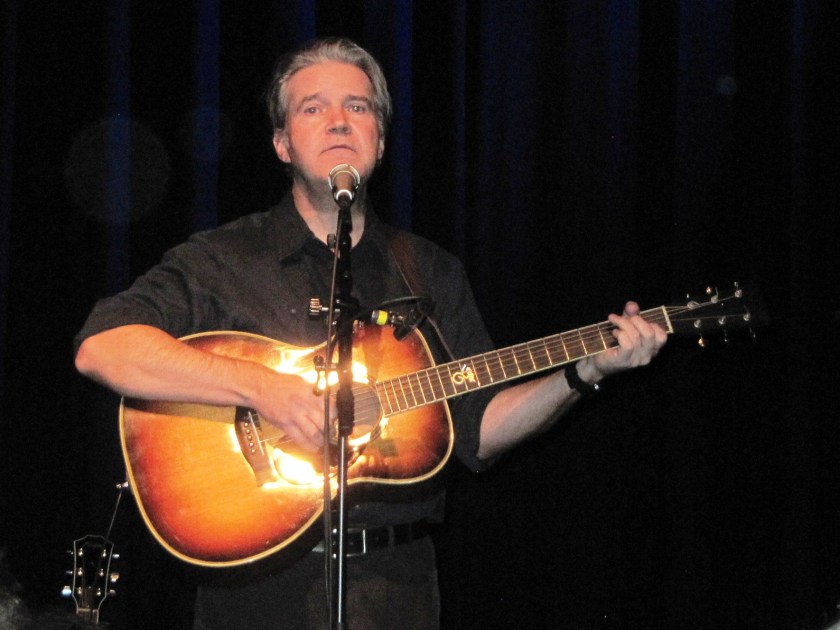
No idea why I like the music of grouchy, arch, wistful, charter of failing relationships,  Lloyd Cole. I have never felt sorry for myself in my life. Well maybe a bit. Oh alright then, practically every day. Here is a man who, at least early on, in the 3 albums with the Commotions and 4 solo albums which span the period of this Retrospective Tour, re-invented the pop music staple love song with indelible melodies, demon hooks and ridiculously clever lyrics.

It has been a very long time since i saw him him live, 1985 I think, Hammersmith, Palais or Odeon, I can’t remember. I should have made more of an effort to renew the acquaintance based on this gig. So what do we get? Stripped back acoustic versions of pretty much all his classic songs, which I detail below thanks to someone with a better memory than me, a marvellous take on Leonard Cohen, one of his heroes I think, and a winning line in self-deprecation. This primarily revolves around his age (he’s now 57) though as he remarks most of these songs written between 1983 and 1996 (bar one, Myrtle and Rose, dedicated to his Mum in the audience – awwh) come from the hand of some-one older than his years.

Now I gather in some gigs in the tour he has been joined on stage in the second half by one of his sons which I can see may have pepped things up a bit. Not a criticism. These arrangements are wonderful and Mr Cole is, and has always been an adept guitarist, but there were one or two moments where I missed some of the complexity of the lines which makes him a genius songwriter. Not the words, they still sound as fresh and inventive as ever, but the instrumental hooks which pepper the songs. On the other hand, I reckon his voice, for the Commotions songs especially, may be better than in his youth. Richer, deeper, more soulful as you’d expect but still absolutely clear and not at all ragged as with some “old” pop stars.

Dragged the SO along. She’s no fan, and this didn’t convert her, but was won over by his humour. He even has special words of recognition for the patient multitude of unwilling partners dragged along here.

So if you are, or were, a fan, a triumph. My favourites? I Din’t Know That You Cared, My Bag, Butterfly/Famous Blue Raincoat, Are You Ready To Be Heartbroken?, No Blue Skies, Perfect Skin and, obviously, Forest Fire (which is one of my favourite songs of all time anyway).

Once again I find myself reviewing an event that is over, by which I mean the tour, unless you happy to be near the Theatre Royal Margate tonight. If he does pop up again anywhere near you, and you are umming and ahhing over going. Don’t. Just go. At the very least you will see loads of fifty-somethings with terrible dress sense from around your area.

  • Patience
  • Perfect Blue
  • Rattlesnakes
  • Loveless
  • I Didn’t Know That You Cared
  • Love Ruins Everything
  • Pretty Gone
  • Charlotte Street
  • My Bag
  • Butterfly
  • Famous Blue Raincoat
  • So You’d Like To Save The World
  • Jennifer She Said
  • Are You Ready To Be Heartbroken?
  • Like Lovers Do
  • Cut Me Down
  • Brand New Friend
  • Why I Love Country Music
  • No Blue Skies
  • 2cv
  • Undressed
  • Don’t Look Back
  • Mr Malcontent
  • No More Love Songs
  • Hey Rusty
  • Perfect Skin
  • Lost Weekend
  • Myrtle and Rose
  • Four Flights Up
  • Forest Fire


The Weir at Richmond Theatre review ****

Marsden_Weir,_Goulburn

The Weir

Richmond Theatre, 2nd March 2018

I am jealous of anyone who has never seen Conor McPherson’s 1997 play The Weir. They have something special to look forward to. I last saw it at the Royal Lyceum in Edinburgh at the beginning of 2016 in a fine production directed by Amanda Gaughan with a wonderful cast of Brian Gleeson, Frank McCusker, Lucianne McEvoy, Gary Lydon and Darragh Kelly. You might think that, given its structure, a series of memorable disclosures over one evening in a pub in Ireland, this was a play which might not warrant repeated viewing. You’d be wrong. I haven’t yet seen any of Conor McPherson’s other plays, bar one, which I hope to correct, but I can guess why this remains the favourite and most oft-performed.

Now Mr McPherson is currently packing them in, and getting award nominations, with Girl From the North Country at the Noel Coward Theatre having transferred from the Old Vic. (Girl From the North Country review ****). He is fortunate in his choice of musical collaborator, a certain Mr B Dylan, and his cast, notably Sheila Atim, Shirley Henderson, Ciaran Hinds and Arinze Kene, but these are his stories, his words and his direction.

For telling stories is what he is good at. Mind you he is in pretty good company. What is it that makes Ireland, per capita, the most talented country in the world when in comes to the dramatic word. This is a wild, unproven assertion, but you take my point. Farquhar, Goldsmith, Sheridan, Synge, Shaw, Wilde, Boucicault, Yeats (he founded the Abbey), Beckett, Behan, Friel, O’Casey, Walsh, Carr, McDonagh (alright he’s not really Irish). And that’s just the ones whose work I have seen. There are tons more.

Maybe it’s the education system, (which champions the word over other art forms), the civil structure, the pub culture, the craic. (I really do not mean to offend with gratuitous paddywhackery here). Maybe its the Catholic Church which tells a lot of lurid stories. Maybe its the long, and deeply held, oral tradition. Maybe it simply reflects past success. Irish writing outside the dramatic form also excels in the short story and the episodic. Maybe its the breadth of the diaspora. If you go round the world you have a lot of stories to tell. But none of this is particular or peculiar to Ireland and, anyway, such generalisations are surely slightly patronising.

Whatever the reason we should all be grateful and The Weir reminds us why. It’s a cold, windy night. Garage owner Jack, (veteran Sean Murray who I think has the juiciest part), comes in to the village pub, (perfectly realised in Madeleine Girling’s set), and pours himself a drink. From a bottle after tetchily discovering the Guinness tap is off. Eventually Brendan, (here charmingly played by Sam O’Mahony), comes from the house behind and officially opens his bar. They chat about their day. They are joined by mild odd-job man Jim (John O’Dowd) and they discuss the arrival of Valerie in the village. Finally local boy made good businessman Finbar (Louis Dempsey) arrives with Valerie herself (Natalie Radmall-Quirke, who is the only member of the cast I had seen before, in Cheek By Jowl Winter’s Tale). Valerie is renting a house and Finbar is showing her around, as she moves from Dublin. Jack and Finbar start verbally sparring with each other, Jack plainly jealous of Finbar’s success and Finbar overly cocky. This is in part a display to impress Valerie. We know these people even before the four mysterious supernatural stories emerge in succession. After the stories, we know them even better.

I’ll stop there in case you haven’t seen the play. Suffice to say all human, and beyond, life is there in the words of the five characters over 100 minutes or so. It is rooted in rural, Irish life, and there is no action to speak of, but at this performance, like I suspect all other performances, the audience is transfixed, so clearly Mr McPherson has tapped into universal truths. Myth is a powerful force in Ireland, and Mr McPherson is not the first of his countrymen to incorporate it into his plays, with Brian Friel an arch exponent for example. Others have also borrowed from the tradition: most recently Jez Butterworth in The Ferryman. Yet The Weir has a kind of special power because the stories are simultaneously extraordinary and day-to-day.

Moreover it isn’t just the monologues that suck you in. The dialogue is also compelling. These are lives lived, funny, sad, tender, sometimes desperate, filled with memory. Drink is an equivocal lubricant, opening the characters up and exaggerating emotions. I haven’t had a drink in years (don’t ask) but The Weir reminds me what I am missing. For despite the intimation of lives that have been blighted by sorrow or frustration these people seem to have had an enjoyable, fruitful evening in each other’s company. Think about it. One way or another your best memories will probably involve having a laugh or a heart to heart with friends. That’s life.

A superb play very well realised by the cast and director Adele Thomas. There were one or two moments where the transitions where a little ticklish, and the fading of the lights into the stories was a bit obvious, but it doesn’t really matter. When a play is this good, and the cast this attuned, then it can only be a success. This English Touring Theatre and Mercury Theatre Colchester co-production is nearly done I am afraid, just a couple more nights in Cambridge, but I see ETT’s next production is A Streetcar Named Desire. If it is coming anywhere near you I would seek it out based on the handful of ETT productions I have seen to date.


Smile Upon Us Lord review at the Barbican Theatre review ***

Здание_Государственного_академического_театра_им._Евг._Вахтангова_01

Smile Upon Us, Lord

Vakhtangov State Academic Theatre of Russia, Barbican Theatre, 1st March 2018

OK. Sometimes you just have to accept that an artistic endeavour is a bit beyond your reach. For whatever reason it just doesn’t click. That is what happened here with Smile Upon Us, Lord. There was much to enjoy visually, there was the bones of an interesting story and there was the rare opportunity to see some of Russia’s finest stage actors perform. But there just wasn’t enough there for me to really engage with so ultimately I was unmoved. Not indifferent. Just unable to fully grasp what I was being shown. No matter.

Turning up to productions at the Barbican performed by renowned theatre companies from around the world, the Netherlands (Toneelgroep Amsterdam), Australia (Malthouse), Germany (Schaubhne Berlin), Japan (Ninagawa), has proved a profitable strategy recently. The Vaktangov State Academic Theatre of Russia was hugely acclaimed last time they popped over to perform an adaption of Pushkin’s Eugene Onegin and, prior to that, an unconstrained Uncle Vanya. Well maybe not popped over given the huge ensemble and tons of kit that comes with them. Anyway I missed both of these because a) I am an idiot and b) it all sounded a bit intimidating. Armed with greater knowledge, more time and a new-found enthusiasm for all things theatrical I wasn’t about to make the same mistake twice/thrice. The house was packed with a welcome contingent of Russian speakers, Russophiles and students of Russian culture, and, maybe, expat Lithuanians as well.

For, as it happens SUUL is actually based on two novels, A Kid for Two Farthings and Smile to Us, O Lord by the pre-eminent Lithuanian writer Grigory Yaakov Kanovich. He was born into a traditional Jewish family in Lithuania. escaped with his parents in WWII seeking refuge in Kazakhstan then Russia, before returning to Vilnius. He has written more than ten novels which document the history of Jewry in Eastern Europe from the C19 through to the present day., as well as stage works and screenplays. He has been awarded numerous prizes, medals and prestigious awards in Lithuania and he now lives in Israel.

Now it transpires the Artistic Director of VSATR is also Lithuanian, Rimas Tuminas. The germination of SULL began in the 1990s with a plan to shoot a film. Presumably the theatrical potential was recognised as certain of the story lines were drawn out and as Mr Tuminas and his creative team worked with his Russian cast to create what we now see. The story starts in a shtetl, “small town” in Yiddish, a part urban, part rural Jewish community which was largely wiped out by the Holocaust. Efraim Dudak, an irascible stone-cutter played by Sergey Makovetskiy on the night I saw it, receives a letter informing his son is to be tried and potentially executed for an attempted political assassination in Vilnius. He resolves to go to see him leaving behind his beloved she-goat played by Yulia Rutberg (yep, that’s right, she played the goat like a slow-waltzing Miss Havisham). He is joined by water-carrier Smule-Sender Lazarek, (Evgeny Knyazev), and eccentric depressive Avner Rosenthal, played by Viktor Sukhorukov, (the pick of the seasoned cast), who has been reduced to penury after his shop burned down. The journey is hazardous, there are wolves, bandits and soldiers, and unpredictable and they meet a fair few rum characters along the way, including a “blind” con-man (Victor Dobronrarov) and an enigmatic “Palestinian” Grigory Antipenko

A kind of jaunty Beckettian road-trip if you will. Without maintained roads, and just a horse and cart, conjured up in a hugely imaginative way by designer Adomas Jacovskis. Now early C20 Jewish life in Lithuania is, it will come as no surprise, a world that is unfamiliar to me, and it was intriguing to see this conjured up on stage. This was overlain with a lyrical, poetic story with much philosophical musing from our heroes. There is humour tinged with despair, magic and banality. It is meandering, discursive and there is not much in the way of plot. Some of this connects, some of it, frankly, does not, there may well have been allusions that went right over my head, but there is just about enough impetus to keep the whole thing trundling on, much like the cart.

Am I glad I saw it? I think so. Would I see it again? I’m not sure. Did I really understand it? No. Is it worth getting wound up about it? Certainly not. Life is too short for low-level regret.


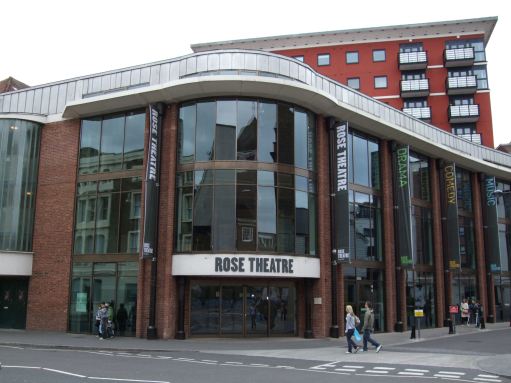
Curtains at the Rose Theatre Kingston review ****

The_Rose_Theatre,_Kingston,_London

Curtains

Rose Theatre Kingston, 1st March 2018

Stage comedies don’t always stand the test of time too well. Comedy is elusive enough in the first place and may often be more rooted than tragedy to specific times, places or events. Comedic fashion chops and changes and what is acceptable shifts with the zeitgeist. Repetition does not always serve it well. This is as true of comedy from the last few decades as it is from hundreds of years ago. If a comedy play wins an award, especially an award for “best newcomer”, than alarm bells should sound for any subsequent revival.

Stephen Bill’s Curtains from 1987 won many just such awards, and repeated the trick when it was revived in New York a decade later. Added to that it’s a comedy about death. Set in the West Midlands. The second comedy about death set in the West Midlands I have seen in the last couple of weeks after the Guildhall’s Schools splendid production of Laura Wade’s Colder Than Here. (Colder Than Here at Guildhall School Milton Court Studio review *****). Maybe this very specific sub-genre holds a special fascination for me. Hm.

So I approached this with trepidation. I shouldn’t have. This is, by and large, a very smart play, directed by Lindsay Posner, who I assume was keen to revive it, which should be playing to packed houses at the Rose. I may be biased, because it is on the doorstep, but I really do think that, despite having no Artistic Director, the Rose is astutely delivering some high quality, uncluttered, proper theatre, sometimes in collaboration, sometimes, as here I think, off its own bat. Maybe not quite matching the Orange Tree in terms of innovation but streets ahead of the safety first pap that the Richmond Theatre largely relies on.

It’s that old Ayckbourn-ian staple, the family gathering, (which didn’t work as well in my last visit here for Sam Holcroft’s novel Rules for Living, another “best newcomer” – Rules For Living review at the Rose Theatre Kingston ***). It’s Ida’s (Sandra Voe) birthday. We are in her threadbare front room, courtesy of designer Peter McKintosh. She is stuck in her wheelchair with advanced dementia, her eyesight and hearing fading, surrounded by her two daughters, a splendidly po-faced Margaret (Wendy Mottingham) and a restless Katherine (Saskia Reeves and their respective husbands, the punctilious Geoffrey (Jonathan Coy) and the candid Douglas (Tim Dutton). Geoffrey and Margaret’s son Michael is also in attendance.

Now the somewhat gauche Michael is played by none other than Leo Bill, the son of the playwright. Do not be alarmed though, there is no nepotism at work here. Mr Bill junior is a fine comic actor as I know from his Bottom in Joe-Hill Gibbons’s characteristically bold Midsummer Night’s Dream (A Midsummer Night’s Dream at the Young Vic review ****). Now Bottom is funny. There is a clue in the name. And Shakespeare, who was good with gags, created him. Yet sometimes once you have done the donkey head and Titania fancying him, the belly-aches can ease up. Not so with Leo Bill who, with body, face and words, and a pair of tights, held the whole of the school-kid contingent in the palm of his hand, not to mention us old grumpers.

Dad Stephen Bill is probably much better known for his TV scripts than his plays, but it seems like he retired some time ago. So I think I can be confident that young Bill is here on merit; his performance certainly suggests so. The birthday party is completed by neighbour Mrs Jackson (Marjorie Yates), who, along with Michael who lives in the house, takes care of Ida, and, subsequently by a third sister, free spirit Susan (Caroline Catz) who is something of a black sheep, and winds Margaret up something rotten.

The fussing around Ida, drinks, sandwiches and cake are served in quick succession, and the importing of her reactions by the sisters, is spot on. It soon become clear though that there are tensions over how Ida should be cared for as she approaches the end, amidst the familiar, familial carping. This is the debate that lies at the heart of the play. How should families deal with with end of life, both practically and emotionally? As the population ages, and the cost of social care rises, this is, in turn, an increasing concern, as we have seen, for society as a whole. Mr Bill is a little guilty of shoe-horning various positions into the mouths of his characters, but the writing is still sufficiently airy to withstand this.

There is a fairly sharp tonal shift at the end of the first which sets up the argument in the second act, and which I shall refrain from describing. Suffice to say it works. There are a couple of incongruous moments which show the age of the play, notably some casual racism, a reminder of the mutability of comedy which I have remarked on above. Overall though this is a very well written play, keenly observed, darkly comic and with some trenchant argument. There is a hint of edgy, Orton-lite about proceedings, which is a very good thing, and Mr Bill has a handy knack of making his dialogue sound natural, often funny, but never “sit-com forced”.

Hats off to whoever thought to revive this.

Julius Caesar at the Bridge Theatre *****

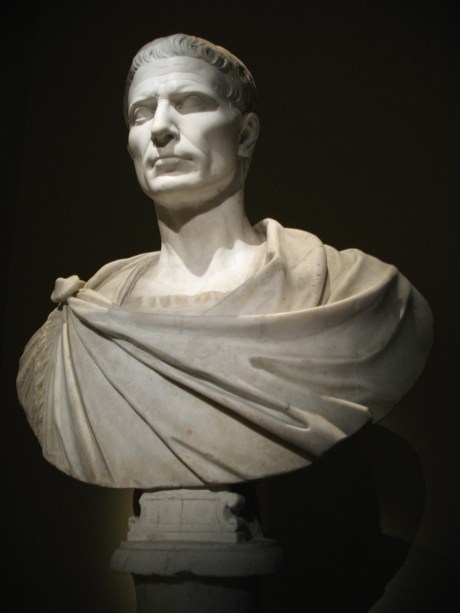
0092_-_Wien_-_Kunsthistorisches_Museum_-_Gaius_Julius_Caesar

Julius Caesar

Bridge Theatre, 28th February 2018

I had really, really been looking forward to this. Julius Caesar is one of my favourite Shakespeare plays. Contemporary relevance of course, but Shakespeare always has relevance. My appetite whetted by the excellent RSC production I saw at the Barbican last month, (Julius Caesar at the Barbican Theatre review ****) and by Phyllida Lloyd’s heady all-female interpretation at the Donmar Kings Cross in 2016. Nicholas Hytner in the director’s chair and Ben Whishaw, David Morrissey, Michelle Fairley and David Calder in the four lead roles.

So a little bit of snow wasn’t going to stop me getting there, and dragging the SO along with me. It didn’t disappoint. Best play I have seen so far this year, along with John at the NT: admittedly we are only a couple of months in, with the NT Macbeth having just opened and, I haven’t yet seen Network at the NT. Still this is a cracker. There are plenty of tickets left in the run, though the cheaper seats have largely gone, (it is hard to believe there is a bad seat anywhere in the Bridge), but it is well worth 50 quid or, if you are a fit young’un snap up a promenade ticket and be part of the action.

The transformation into a promenade space from the straight on staging of Young Marx shows just how marvellous the Bridge space is. The promenaders are shepherded around the pit by stewards, a metaphor for the manipulation of the populus as effective as it is obvious. Bunny Christie’s production design is equally blunt but effective, with a series of plinths rising from the floor as and when scenes change. A massive shout out to production manager Kate West, company stage manager Hetti Curtis and the rest of the team at work for this performance and behind the scenes. To make this intricate production succeed, whilst actually enhancing its dynamism, takes real skill. Watch and see, especially, the floor transformed into a battlefield for the final scenes. The stage management team were rewarded with well deserved applause at the end. Bravo.

Even before Caesar (David Calder) appears in front of the crowd with Mark Anthony (David Morrissey) in tow, we have a treat in storm with a some pumped up rock’n’roll for Lupercal courtesy of a street band made up of Abraham Popoola, Fred Fergus, Zachary Hunt and Kit Young. I already have a high regard for Mr Popoola, having seen his vigorous Tobacco Factory Othello alongside Norah Lopez Holden’s Desdemona and Mark Lockyer’s Iago at Wilton’s Music Hall. (Othello at Wilton’s Music Hall review ****). Turns out he can sing a bit too and he puts in a stint as a plotter in the form of a taciturn Trebonius. Fred Fergus doubles up as a slow-witted Lucius and gets a right kicking as Cinna, in that simple but so effective mistaken identity scene. Kit Young is a crafty Octavius.

David Calder’s Caesar ticks all the right boxes: proud, conceited, vainglorious. Here is a man used to getting his own way. His eventual dismissal of Calpurnia’s (an under-utilised Wendy Kweh) qualms about his visit to the Senate is insouciant but still reveals a hint of underlying unease. Our conspirators are a thoughtful bunch. Michelle Fairley as Cassius is neither bluntly straightforward in her entreaties to Brutus not bitter in her abhorrence of Caesar and what he is turning into. Instead she is logical, using force of argument to persuade Brutus to lead the coup. Books, glasses, a desk and Ben Whishaw’s innate demeanour make him a contemplative, but still determined, Brutus. You can easily see why his belief in his own rectitude might come across as priggish arrogance to the crowd. He seems to be going through the motions in his justification speech. Mind you I can see why he might underestimate David Morrissey’s Mark Antony. He comes across as a duplicitous chancer, making up as he goes along. I don’t recall being as struck by his mendaciousness before in the scene with Octavius at the beginning of the battle when he brusquely withdraws the pay-out to the people in Caesar’s will.

I reckon a woman playing Cassius, (and indeed women playing other of the conspirators), will, and should, become the norm. It creates a shift in the dynamic between Cassius and Brutus which can be profitably mined, both in the early conspiracy scenes and in the bust-up and reconciliation ahead of the battle. I am not sure whether the distance I sensed between Brutus and Portia, (Leaphia Darko who I hope to see in a much bigger role), was intended but it created an interesting ingredient. Every Casca should be as pointedly sardonic as the scene-stealing Adjoa Andoh. I know Ms Andoh has had an illustrious stage career but I couldn’t help thinking, for example, how much better the recent RSC production of Antony and Cleopatra would have been with her in the driving seat. The rest of the cast, Mark Penfold as Lepidus, Ligarius and the Soothsayer, Nick Sampson as Cinna, Leila Farzad as the reluctant Decius Brutus, Hannah Stokely as Mellellus Cimber, Sid Sagar and Rose Ede were all on top form.

Nick Hytner directed the first Shakespeare productions that ever made any sense to me; his RSC productions of King Lear and The Tempest with the incomparable John Wood. This was when I first “got Shakespeare”.. He is the master of modern dress, “contemporary” Shakespeare. Early on at the NT he created a Henry V with Adrian Lester which was the antithesis of jingoistic. All the surveillance stuff in Hamlet that Robert Icke loaded up on at the Almeida. Look no further than Hytner’s 2010 version with a bookish Rory Kinnear as the Dane. His Othello at the NT with, surprise, surprise, Adrian Lester and Rory Kinnear, is possibly the best Shakespeare production I have ever seen. His Timon of Athens with Simon Russell Beale kicked into a cocked hat any notion that this is a difficult, unbalanced play.

His visual language is so complete that, even if you don’t catch every line. (let’s face it that is going to happen with Will S, one reason why you can never see too many productions), you still comprehend pretty much everything in front of you. He takes a view for sure, but always in the service of the universal themes that the plays wrestle with. Every single detail is thought through. For anyone who thinks Shakespeare is not for them, Mr Hytner will change your mind.. It helps that his key collaborators in this production, Bruno Poet (lighting), Christine Cunningham (costume), Nick Powell (music), Kate Waters (fight) and, especially here, Paul Arditti (sound) are so expert in bringing his vision to life.

The Trumpian allusions are not overplayed. No need to. We can see the attraction of Caesar to the crowd, but we also see why the conspirators are so alarmed by his lazy demagoguery. The vacuum that is created after the assassination, a visual twist here, is palpable, as the patronising elitist Brutus and the pragmatic Cassius haven’t thought through what happens next. Sounds familiar eh. Which leaves a yawning gap for the opportunist Mark Antony to unleash those war dogs. The failure of the “liberal’ response to populism hangs heavy in the air.

Finally here is my plea to Mr Hytner. Whilst I absolutely get that Messrs Shakespeare, Bean, Bennett, Hodge and McDonagh are, incontrovertibly, the best of writing collaborators, and I see he has the scoop on Nina Raine’s new play, please can you have another crack at Ben Jonson or Marlowe. Maybe you can make sense out of Bartholomew Fair and pull the punters in. There’s a challenge.

P.S. I note that another play that deals with the had-wringing liberal response to populism, albeit in a very, very different way, Roland Schimmelpfennig’s Winter Solstice, still has a few more legs of its tour left, Plymouth, Edinburgh and Scarborough. Highly recommended.

Satyagraha at English National Opera review ***

01/00/1998. File pictures of Mahatma Gandhi

Satyagraha

English National Opera, 27th February 2018

Finally I have got to see all three of Philip Glass’s seminal operas, Einstein on the Beach (the science-y one), Akhnaten (the religious one) and now this Satyagraha (the political one). Einstein on the Beach was a recreation of the original Robert Wilson production at the Barbican a few years ago. Gruelling in places, daft as well, and it looked pretty lo-fi. Akhnaten, also at the ENO with substantially the same creative  team, looked and sounded sublime, but overall I was middle-whelmed. And so it was with Satyagraha. Improbable’s staging certainly tops the already lofty heights they achieved in Akhnaten, and there was probably more to the story unfolding in Sanskrit, but the pleasure, and marginal pain, derived by this observer was not dissimilar.

Since I can’t really imagine more committed advocates than this creative team for these two operas I think I have to conclude that, if pushed, I prefer my Glass in other formats. Like the string quartets or the works for keyboards. That’s a terrible admission isn’t it. Anyway probably as well I know now as Mr Glass has written a fair few operas, 29 and counting, including the chamber works. Mind you he has been pretty busy across all genres. He’s already snuck in another string quartet this year for example I see. Anyway the profligacy of PG is both joy and curse for the committed fan of minimalism, or, as he terms it, repetitive music.

There is no doubt that there is a unique pleasure in succumbing to its hypnotic effect. Hearing the structures slowly change as the notes are added or subtracted. Melodies, motifs and harmonies appearing, disappearing and reappearing. Wave upon wave of sound, altering, circling, revisiting, but never really getting anywhere. Timeless. Meditative. All transcendent when it’s just you and the music. But with opera the whole point is to witness the music interact with the drama. And this is where the disconnect emerges. If you succumb solely to the music then the visual spectacle risks taking too much of a back seat. There is way too much stagecraft trickery to admire here though to permit drifting off into an hypnotic trance. Who would have thought so much could be done with papier-mache and sellotape? Yet the structure and pace of PG’s score, the episodic structure of the “action”, largely based on key events in the struggle for emancipation by Indians in South Africa, led by Gandhi, and the Sanskrit text, all make for very static human tableaux. And a lot of slow motion shuffling.

A spell is cast but there are times when it might be nice to be snapped out of the soporific contemplation into some high drama. Having influences on Gandhi past, present and future, in the form of Tolstoy, then Rabindranath Tagore, and finally Martin Luther King, lurking at the back of the set isn’t quite enough, and the wow moments as Improbable make newspaper come to life, create gods and monsters before our eyes or bring crowd scenes to life, don’t always articulate with the, you guessed it, non-linear story (based on my reading of the synopsis).

Still admire the parts. The marvellous chorus and orchestra led by Glass expert Karen Kamensek, (as in Akhnaten), moulded PG’s musical shapes effortlessly. I didn’t know that I had seem Improbable’s work before in a very different context, namely Lost Without Words at the National Theatre, improv theatre from a cast of older actors, which worked a bit better than I might have expected. AD’s Phelim McDermott and Lee Simpson, and here associate Julian Crouch, don’t lack for imagination or, based on Satyagraha, brilliance of execution. The go-to team for video design, 59 Productions, also leave their mark. Toby Spence gives us the Gandhi of myth, standing stock still for long periods, then bursting into his sumptuous tenor, but no sign of the man himself. The rest of the cast have even less opportunity to shape characterisation beyond the puppets they share the stage with. They all sounded great to me though, especially soprano Charlotte Beament, as Gandhi’s assistant.

The central message of Satyagraha, a Sanskrit word which Gandhi defined as “holding on to truth”, and which underpinned his theory and praxis of nonviolence, does sort of emerge from the production, but a bit of reading around, before and after, helps. The denial of self, the power of the collective, the effectiveness of planned and self-critical resistance. Think of this as a project. Put a bit of effort in and you might just learn something.

Or just do what I suspect the majority of the packed house at the ENO were doing, (this has been revived thrice, it is so “popular”). Gaze and listen in wonder and don’t get antsy about the fact it is all over the shop. At the end of the day the ENO has its hit and this, with its predecessor, is pulling in all sorts of punters who might, rightly in my view, give a wide berth to Verdi and Puccini.

Mind you I reckon this new generation of Glass converts might draw the line at the 5 hours of hippyish clap-trap that is Einstein on the Beach.


The Shape of Water film review *****

1024px-Logo_The_Shape_of_Water_blau.svg

The Shape of Water, 26th February 2018

I have to confess I wasn’t that interested in seeing The Shape of Water, (I am pleased with my little conceptual joke here). The trailers suggested this was likely in a similar vein to Guillermo Del Toro’s previous gothic horror/romance/fantasy films: lovely to look at but tedious to watch. Yet the reviews were persuasive, Sally Hawkins is a tip-top favourite of mine and I was getting into the swing of seeing all the Oscar nominated films in the manner of a sad armchair critic.

So off I went. Dear reader, I was bewitched. This is not, on the face of it, a complicated fable, but it has a lot to say. Sally Hawkins plays Eliza Esposito, an orphan who has not spoken since being found on a riverbank with scars on her throat. She works as a cleaner at Occam, an aerospace military research facility in Cold War America. Our symbolic “monster”, a merman/amphibian of sorts, direct from the Amazon, arrives. So far, so Del Toro. Class A psycho nutjob, Strickland, played with splenetic relish by the versatile Michael Shannon, is tasked with looking after the creature, which he does, cruelly. Restless scientist Hofstetler, (an austere Michael Stuhlbarg), objects, but, as a Russian spy, he has ulterior motives. Eliza, through that tried and trusted combination of eggs and music, falls in love with the creature and hatches a plan to release him, roping in kindly, gay, commercial artist neighbour Giles (Richard Jenkins) and voluble colleague Zelda (another engaging performance from Octavia Hill). You can guess the rest.

Good triumphs over evil, naturally and there is thrill, if not suspense, in the break-out. This is a timeless story. Beauty and the Beast, set against a world of US-Soviet paranoia. You can feel the references to other classic films, even if, like me, you don’t know what they are. There is an echo of the silent movie greats as well as a nod to the monster movies of the 1950s and 1960s. Indeed Eliza and Giles actually live above a cinema the Orpheum (courtesy of Toronto, as so many of the exterior shots are). It is chock-full of repeated motifs and symbols. Mr Del Toro has a hand in the writing, but has wisely co-opted Vanessa Taylor, who wrote some of the early episodes of Game of Thrones. It shows. There is a hard-edged realism which punctures the fantasy and lends structure to the story.

Unsurprisingly the film looks exquisite with blues and greens predominating and all sorts of arresting images wrung from Mr Del Toro’s box of tricks. Water, water, everywhere. Costumes from Luis Sequeira, Paul Austerberry’s designs, Alexandre Desplat’s inventive score and, especially, Dan Lausten’s cinematography, all coalesce to bring the story to life. Frankly though none of this can work if the two, effectively wordless, performances of the two leads don’t convince. Getting zipped in to a merman/amphibian suit for hours on end and trying to convey emotion through face and body movement alone is a job few can master. Just as well Mr Del Toro has his long time “monster” collaborator, Doug Jones, on hand.

Now it doesn’t take a genius to work out that Sally Hawkins is a gifted actress. I saw her first in 2000 in a pair of Shakespeare productions at the Open Air Theatre. was struck by her performances in the TV adaptions of Tipping the Velvet, Fingersmith and Persuasion, by her collaborations with Mike Leigh and, most impressively, by her performance alongside Rafe Spall in Nick Payne’s Constellations. The two of them turned that into a much better play than it really was, and it was pretty good to start with. Here, as Eliza, she is transcendent. I don’t care how grizzled and cynical you are, this is a love story you should buy into.

So there you have it. I am fortunate to have had the time to see all the Oscar nominated best films, bar Call Me By Your Name. I enjoyed all of them, but only this, Phantom Thread and Three Billboards … really seemed to me to harness the power of cinema. Films where you know the direction of travel or where the camera is just pointed at the action can be satisfying but what I crave is uncertainty and surprise. And insight into the human condition. I see the other films I really liked last year would fail to make the grade because they are either a) “foreign”, b) tiny, in budget, not scope, c) actually from the prior year or d) maybe a bit too full on. I would have shoved Mother!, Detroit and The Florida Project into the list if I where in charge. Mind you, all pointless since Three Billboards … is, unarguably, the best of the chosen bunch but, to my immense surprise, The Shape of Water, runs it close.

I should have realised. Never underestimate a fat bloke born in 1964 (or 1963) with a terrible beard and ill-kempt hair who spends too much time locked in his imagination.

Picnic at Hanging Rock at the Barbican Theatre review ***

HangingRock0005

Picnic at Hanging Rock

Barbican Theatre, 24th February 2018

Picnic at Hanging Rock is an Australian cultural icon. Joan Lindsay’s novel, published in 1967 and Peter Weir’s 1975 film, (and all manner of subsequent examinations, interpretations and meditations), is a metaphor which gets to the very heart of the making of Australia. It is a fictionalised account, purporting to be true, of the disappearance of three students and a teacher, at Hanging Rock in Victoria, from a girls boarding school on St Valentine’s Day 1900. The “rational”, “European” Australia is contrasted with the timeless, “original”, natural Australia. As one character says, “we named things that had not been named”, but it turns out naming isn’t really enough. It doesn’t get any more meta or deconstructed than this.

So no simple attempt to act out the book/film on stage. Mind you that wouldn’t be that simple anyway. Renowned Aussie theatre companies Malthouse, (Shadow King, their take on Lear, was fascinating here last year), and Black Swan State, with writer Tom Wright, came together to create something far more ambitious. Our all-female cast of five appear on stage against a black backdrop, (thus sidestepping the problem of the cavernous Barbican stage for this small scale production), to narrate the story of Picnic at Hanging Rock, in a fragmentary, almost musical fashion. Their uniforms are contemporary – no flouncy Edwardian white frills here – but in that old, fashioned public school way. They inch forward menacingly on the stage. It is not long before they themselves collapse into the characters from the novel, acting out the key scenes. They are, it seems, consumed by the story they are telling.

The staging remains sparse, so text, lighting, soundscapes, and our imaginations, combine to conjure up the settings and, in particular, the mystical, primeval landscape. By having the cast take on the male “roles” and by concentrating on specific parts of the story and of the text, (which are sur-titled for emphasis in each scene), the mystery of the disappearances is downplayed and the colonisers fear of the natural world, the “anti-Eden”, is foregrounded. The sub-text of awakening sexuality is also lent a complexity that was, I seem to remember, more one-dimensional in the film, addressed in particular by the performances of, I think, Elizabeth Nabben, as increasingly beleaguered head Mrs Appleyard, Amber McMahon as the artless English visitor Michael Fitzhubert, who becomes obsessed with finding the girls, and Harriet Gordon-Anderson as the forthright detective set to uncover the “truth”.

There is still a dream-like feeling to events, but not the hot, sun-drenched, woozy “outback” of the film, (though remember this was, even in 1900, a tourist spot a short(ish) hop from Melbourne), but a darker, more nightmarish, fracturing of reality. This does make for a somewhat ardent production, which left me a little puzzled at times, but I guess that is an occupational hazard when trying to unpick a myth, especially in just 90 minutes. Still there was much to enjoy in this bold approach from Matthew Lutton (director), Zoe Atkinson (designer), Paul Jackson (lighting) and J David Franzke (sound). I couldn’t quite work out from the programme who exactly “played” whom but no matter. Harriet Gordon-Anderson, Arielle Gray, Amber McMahon, Elizabeth Nabben and Nikki Shiels made up a uniformly excellent ensemble.


Phantom Thread film review *****

Phantom_Thread_logo

Phantom Thread, 19th February 2018

I saw Daniel Day-Lewis on stage. In Another Country in the early 1980s. That’s why it’s a good idea to buy programmes and stick them in a box. I remember the play a bit but not really his performance. Not sure I would have guessed he would become the “greatest ever actor” and not sure that epithet is entirely justified anyway. Anyway I was lucky since the only other way to have seen him in the theatre was when he was a student in Bristol or early in his ill-fated Hamlet run.

But he is good even if it is just on film. Very good. Brilliant in fact. Always a commanding screen presence. Whatever he does. Up to him but I reckon he is a bit cheeky retiring. His output isn’t what you’d call prodigious. Still he famously leaves nothing on the table when he performs and I guess he has enough to live on.

So we will have to make do with his cinematic legacy. Good for us he didn’t pursue his cabinet-making ambitions. And probably good for cabinet-makers too. He wouldn’t have made very many but they would be best in class.

His work with director Jim Sheridan counts amongst his best obviously as does his Bill the Butcher in Scorsese’s Gangs of New York. But by far his best performance in my view, and that of many others, was as Daniel Plainview in There Will Be Blood, an all time Top 10 film for the Tourist. (Saw a memorable showing with a live performance of the score at the South Bank a few years ago with Jonny Greenwood twiddling his ondes martenot) TWBB was written and directed by none other than Paul Thomas Anderson who also does the necessary here in Phantom Thread.

Mr Anderson is an extraordinary film-maker as the string of awards for his films show. I have seen all his films at least once, with the exception of his feature debut Hard Eight and the documentary Junun, (about the making of Inherent Vice). They are all, by turns, baffling, annoying, claustrophobic, frustrating, stimulating, thoughtful, intense and intriguing. He doesn’t hurry, is not averse to repeating motifs, words or themes, and he asks you to think about the story he is telling. He pushes himself and us the audience. In his “tragic’ films his lead characters are powerful but flawed, cursed by hamartia. In his “comic” films the humour is complex and stylised. His camera never takes a pedestrian position and music and sound is never backgrounded. In short his is a very epic, theatrical approach to film-making. Which is why I like his films I guess.

So what about Phantom Thread? Daniel Day-Lewis plays bachelor Reynolds Woodcock, (I wonder how many other ostentatious names Paul Thomas Anderson mulled over before alighting on this corker), who is an obsessive frock designer for the great and good in early 1950s London. He is a genius with the needle and thread, his clients love him and his sister Cyril, played by the exceptional Lesley Manville. cocoons him and dumps his muses for him when they have outlived their usefulness. He is suave, charming, precise and fastidious, but egocentric, boorish whilst still slightly camp, and prone to childish tantrums if all is not to his liking. He definitely loved his Mummy: his dresses are all ultimately tributes to her. He meets mysterious waitress Alma (Vicky Krieps) whilst away from London and seduces her. She falls for him, and his life, and moves into the London townhouse which also houses the business. He becomes dependent on her. The film charts their intense relationship and the way it affects him and his work. Reynolds has a fair few issues and a masochistic streak: Alma is his match, literally, equally complex and anything but helpless.

Put like this, as a romance, the story sounds commonplace. In the hands of Mr Anderson and the three leads, though, it is riveting and something altogether more rewarding. It looks, (costume designer Mark Bridges must have been in seventh heaven throughout), and sounds, (Jonny Greenwood should get the Oscar for his eclectic score), magical, but what really draws you in is the depth of these characters. There is a lot wrong, sometimes disturbingly so, with both of the lovers. At first you think Reynolds is just going to eat Alma up for breakfast, (breakfast, and specifically the correct way to butter toast, is a key motif here), then cast her aside. She persists, easing Cyril aside, takes on his mores and eventually finds a striking way to control him. This requires Vicky Krieps to match Mr Day-Lewis. The wonder is she succeeds. A stunning performance. PTA must have been ecstatic when she auditioned.

There is a definite Hitchcockian, or Powell/Pressburger, vibe about the whole affair, and not just in the setting. (I was reminded of the opera version of Marnie at the ENO recently). There are allusions to fairy tales here, the Gothic sort where is all goes pear-shaped for the protagonists. It is often very funny. Yet this still feels, even with PTA’s fractured, exaggerated and unpredictable observation, ripe and real.  A triumph which will need another viewing, and another, for sure.