The Swingling Sixties: the LPO at the Royal Festival Hall review *****

London Philharmonic Orchestra, Vladimir Jurowski, The Swingles, London Philharmonic Choir

Royal Festival Hall, 8th December 2018

  • Elizabeth Atherton – soprano
  • Maria Ostroukhova – mezzo-soprano
  • Sam Furness – tenor
  • Joel Williams – tenor
  • Theodore Platt – baritone
  • Joshua Bloom – bass
  • Stravinsky – Variations (Aldous Huxley in Memoriam)
  • Stravinsky – Threni
  • Stravinsky – Tango
  • Luciano Berio – Sinfonia

I cannot describe how excited I was about this concert, and not just because it represented the final instalment of the year long Changing Faces: Stravinsky’s Journey retrospective in which the London Philharmonic Orchestra (amongst others) has performed the vast majority of Stravinsky’s large scale orchestral and choral works, as well as many of the ballets at operas, at the South Bank. Here, in the final instalment, we were treated to a pair of his late “serial” works for orchestra, Variations, and for choir, Threni, as well as a few welcome surprises. Of course Stravinsky being Stravinsky this was not the miserable, astringent, intellectual fare of the Second Viennesers but an altogether more satisfying feast.

However the real reason for the Tourist’s frenzied anticipation, (OK maybe that was a bit of an exaggeration), was the performance of Berio’s masterpiece Sinfonia. The Tourist hopes to soldier on for a few more years yet and pack in a little more exploration and understanding, (though he feels he may have come close to mapping out the boundaries of what he “likes” and “dislikes”), but he is pretty sure that Sinfonia would be a shoe-in for his list of top ten greatest “classical” music works. Actually, just for fun and in festive spirit, here is the current state of play on that work in progress. In no particular order. Only one piece per composer. Oh and there are 14. Like I say a work in progress.

  • Luciano Berio – Sinfonia
  • Ludwig van Beethoven – Symphony No 7
  • Isaac Albeniz – Iberia
  • Antonio Vivaldi – The Four Seasons
  • Arvo Part – Fratres
  • Johann Sebastian Bach – Sonatas and Partitas for Violin
  • Benjamin Britten – Serenade for Tenor, Horn and Strings
  • Gyorgy Ligeti – Etudes
  • Claudio Monteverdi – Vespers
  • Wolfgang Amadeus Mozart – Symphony No 41
  • Steve Reich – Drumming
  • Dmitry Shostakovich – Symphony No 10
  • Igor Stravinsky – The Rite of Spring
  • William Byrd – Mass For 5 Voices

I’ll think you will agree there is nothing intimidating here and, if I say so myself, it contains a fair smattering of “popular” hits. Romantic composers are conspicuous by their absence and, for those of a certain age, in the words of Snap!, Rhythm is a Dancer here. Hopefully though you can see the Tourist is not the type to show off with the obscure or arcane. So, dear reader, if you are “new” to classical music, I say why not take the plunge with a few of these pumping beats.

Anyway back to the business in hand. Sinfonia was originally written for The Swingle Singers, the forerunner of this evening’s revamped ensemble and frankly the only group capable of doing it justice, but Vladimir Jurowski and the LPO still had a lot of work to do to pull this off. I have said before that Mr Jurowski, on his day and in the right repertoire, is as good as any conductor I have ever heard, including Simon Rattle, Bernard Haitink, Claudio Abbado, Nikolaus Harnoncourt, Colin Davies, Mariss Jansons, Georg Solti and John Eliot Gardiner. Any absentees you spot reflects the fact I either haven’t heard them or don’t like them. I have never heard Riccardo Chailly conduct but know I should and that Kirill Petrenko, based on the Beethoven 7 with the BPO at the Proms in September, plainly knows what he is about. F*ck me was that good.

When Mr Jurowski sets up shop permanently in Berlin in a couple of years it will be a blow to London. As will the departure of Esa-Pekka Salonen from the Philharmonia. I imagine there are plenty of people who couldn’t give a flying f*ck about the artistic leadership of London’s classical music ensembles and indeed the future direction of the South Bank but, trust me, culture, even when “highbrow”, really matters. I still have this uncomfortable feeling that olde England is now determined to plough on with making a right b*llocks of everything, from which our abiding advantage, our language, will not be sufficient to save us. We went down the toilet, geopolitically, for most of the Late Middle Ages until a few bright sparks in the C17 and beyond came up with the idea of combining capital, education and technology to travel round the world nicking land, stuff and people. We have been doing the same, that is falling back a little, for a few decades now. We still do many things well but only if we welcome innovation, capital and people. Thus changing who “we” are. Which “we” have always done. Cutting “ourselves” off is not, and has never been, an option.

Jesus what has got into me. Back to Vladimir and the LPO. He is a dab hand in just about anything Russian, and I include Stravinsky in that, but, over the past few years, he, and the orchestra have also sprung a fair few surprises. To which we can now add the Sinfonia. Berio composed the piece in 1968/69 to celebrate the 125th year of the New York Phil. Defiantly post-serial, (old Luciano had a few choice words to say about serial music even when embraced by Stravinsky), post-modern, (that being all the rage then as it still is now), forged in the white heat of the intellectual, and actual, revolutions of the late 1960s, (I realise this is not getting a bit w*anky), you might be forgiven for thinking that Sinfonia will be some arty-farty, hippy inflected guff that hasn’t aged well.

Especially when you start reading about its structure. Originally four movements, which Berio quickly expanded to five with a sort of coda that commented on the previous four, it begins with texts from Le cru et le cuit (The Raw and the Cooked) from French anthropologist Claude Levi-Strauss. Yep that Claude Levi-Strauss. Up there with those other Gallic sorts like Foucault, Derrida, Lacan and Barthes, and worst still those dubious German types like the Frankfurt School, who we Brits are rightly suspicious of. Drinking wine, smoking odd cigarettes, carrying copies of Das Kapital, and, worst of all, thinking and talking all day. Still they, and their descendants, will never infect the stout yeomanry of the English shires with their clever dick mumbo jumbo once we get shot of “Europe”.

Now C L-S had a theory that myths were structured in “musical” form, following either a fugal or a sonata construction. Nope me neither. Anyway apparently there were exceptions to the rule for myths about the origins of water and this is what Berio alighted on for Movement I. Which I guess means it has no form. It is a kind of slow threnody punctuated by all manner of bangs and wallops with the eight amplified voices chiming in with the text. Near the end a piano gets a look in leading a percussive Bugs Bunny scramble. It is a bit nuts. C L-S was baffled by where LB was coming from. So don’t despair if you are too.

But it kind of has a way of drawing you in. Berio saw a sinfonia in a very literal sense, from the ancient Greek, a “sounding together”. A layering of sound, instrumental and vocal, often cacophonous for sure but always individually textured. And most importantly searching for “a balance” which is what distinguishes it from the plink-plonk-fizz of much of the contemporary classical music that preceded it. Thus, in movement II, Berio takes one of his own chamber works O King, for five instruments and mezzo-soprano, and recasts it for the orchestra. It is a kind of lament based on two whole tone scales where the singers gradually build up the name of Martin Luther King. Instrumental and vocal whoops representing the vowels and consonants contrast with a shimmering orchestral backdrop.

All clear. On to Movement III then. “In ruling fliessener Bewegung”. In quiet flowing movement. The sub-title of the third movement scherzo of Mahler’s Resurrection Symphony. For this, cut-up and re-orchestrated, is what, famously, sits behind the movement. Alongside countless other snatches of classical music through history. Debussy, Ravel, Berg, Beethoven, Bach, Stravinsky, Schoenberg, Webern, Hindemith, Strauss, Berlioz, Stockhausen, Boulez and many, many more. And, because I guess it seemed to need it, fragments of Beckett’s The Unnameable are also sung, spoken and stuttered, alongside, behind or over the top of the music. There is also a bit of Joyce, some graffiti quotes, even Berio’s own diary entries.

It is a quite extraordinary experience, unnerving, hilarious, annoying, enigmatic and occasionally sublime, a history of music threaded through what might be someone’s personal history. At first it appears to be a mess, a collage with no structure or pattern. But hang on. Didn’t that musical quotation seem to echo the Mahler? And why did that phrase, which made me laugh out loud, jump out? Once again you are drawn in, looking for something, “keeping going” as Berio would have it, whilst all around “civilisation” is threatened by the forces of repression.

I know, I know. Now I sound like a right dick. And yes, just maybe it is a little bit still of its time, But it is just such a jaw-droopingly extraordinary sound-world, so rich, so un-musical yet so musical., that this must be forgiven. Movement IV returns to the tonality of the second movement with a quotation, again from Mahler’s Resurrection, setting up the voices to wander off into another, choral, world. Had enough of quotation? Berio hasn’t, as Movement V then packs in the mother of self-referencing, meta “analysis” of everything that has gone before. Your ears and brain will be processing the aural information, and telling you things, even if you don’t know how and why it is happening.

Not for one single second of the whole work does any of this feel like hard work. Quite the opposite. There is tension and resolution. It is uplifting even as it is disturbing. And very funny even as it mystifies. And I can’t imagine a better performance than here. I am listening to the recommended recording as I write. The Orchestre National de France under Pierre Boulez with the New Swingle Singers (including founder Ward Swingle himself). The LPO and current Swingles sounded better. And that from somewhere in the back stalls of the Festival Hall. Maybe it was the excitement of it being live but any way up it was tremendous. In the third movement especially the lilt of the Mahler scherzo really was there throughout but it never obscured the other musical phrases. Seating the Swingles behind the first row of strings, though still forcefully amplified, ensured they were both integrated with, and punchily counter-pointed, to the LPO. How so much detail was conjured from so much confusion was, literally, uncanny. I gather there are times when Vladimir Jurowski’s excessive precision can annoy some punters. Not me. And definitely not here.

And a shout out to the sound engineers at work for the performance. I can’t find a reference in the programme. Well done though. Unlike the BBC who managed to nonce up the Radio 3 recording.

So you will have to find another performance but give it a whirl if you can. half an hour of your life that you will never get back. But in a good way. A really, really, really good way.

What about the Stravinsky? Well the appetiser, the Variations in memory of Aldous Huxley who died on the same day that JFK was assassinated, is a twelve note tone row which is subject to a series of eleven mechanical “variations”, inversion, retrograde, and the like, with each variation made up of twelve orchestral parts and each having twelve beats in a metre. It was IS’s last orchestral score. Apparently Huxley himself would have had no truck with such serial musing but, coming in at just five minutes, it was interesting at the time if thereafter, forgettable, apart maybe from the astonishing 12 violin variation – like having Xenakis in da house.

The Threni however is an altogether more substantial affair, IS’s longest serial work, in three parts, each drawing on selected Latin verses from the Book of Lamentations, with the middle section by far the most substantial, It makes much use of sung Hebrew letters. There is no particular narrative, it not being intended for liturgy, and it wheels out a biggish orchestra, (including a sarrusophone and flugelhorn), six soloists and a hefty choir, though tutti are frugally used. It is serial in construction but, and this is where old Igor really shows his musical cunning, it doesn’t really sound like it. It is anchored in the more tonal elements of the twelve note row and regularly allows the dissonance to resolve in consonant highlights. The orchestral and choral textures are distinct and Stravinsky chucks in all manner of single tone chants and antiphonal exchanges such that, on occasion, it really does sound like the high polyphony of Tallis, Byrd and Palestrina, even if it plainly isn’t. Don’t get me wrong. It still has all the necessary austere, other-worldly “tunelessness” you might expect from a twelve tone choral work. It just isn’t ugly. Quite the reverse in many places. Full of drama and contrast. I am not saying you would want to chopping the veg or driving home for Christmas with this in the background, just that it is very different from what you might expect. It is not quite up to the neo-classical Symphony of Psalms from some 30 years earlier but is definitely up there with IS’s swan-song the Requiem Canticles.

IS drew inspiration from an earlier Lamentations of Jeremiah published in 1942 by Czech-Austrian composer Ernst Krenek which more explicitly used twelve tone technique combined with Renaissance modal counterpoint. (Don’t worry Krenek himself spent a couple of years aping Stravinsky’s neo-classicism before he became a disciple of Schoenberg). Whilst the first performance of Threni in Venice in 1958 went off well, the premiere in Paris a couple of months later was a right dog’s dinner with Stravinsky, who conducted, getting into a slanging match of recrimination with his bessie Robert Craft ,who was supposed to have prepared the orchestra, and Piere Boulez who drafted in the woefully under-rehearsed soloists. The chorus probably wasn’t best amused when presented with the original score which was, shall we say, scantily clad in the bar-line department. Mind you given the dynamic range that IS requests of the choir that might have been the least of their problems.

No such shenanigans with the LPO and Mr Jurowski who delivered a beautifully layered interpretation with the LPO chorus, split antiphonally, as persuasive as I had ever heard. In fact they made it look and sound easy which, as the paucity of live interpretations reminds us, it most certainly is not. I would point to Joshua Bloom and late replacement Sam Furness as the pick of the soloists, but then again then had more time to shine in the central passages.

Prior to the Sinfonia the Swingles served up a vocal arrangement of Stravinsky’s Tango, complete with beatbox, which I think improved on the orchestral and piano versions previously heard in this Series. And, after another a cappella treat in the form of the Piazzolla Libertango, the LPO encored with Stravinsky’s Circus Polka to send us on our way with a Yo Ho Ho.

Spare a thought though for Maxim Mikhailov the Russian bass, from a long line of Russian basses, who was booked for the Threni solo part and who sang in the Requiem Canticles here a few weeks ago. He died on 21st November. Seems like he was beaten up on a Moscow street. FFS.
English Chamber Orchestra: Vivaldi at Cadogan Hall review ****

English Chamber Orchestra, Choir of the C21

Cadogan Hall, 2nd December 2018

Raphaela Papadakis (soprano), Lotte Betts-Dean (mezzo-soprano), Stephanie Gonley (violin), Caroline Dale (cello), Harry Winstanley (flute), Michael Collins (conductor)

Antonio Vivaldi

  • Gloria in D RV 589
  • Concerto for Violin in F minor, ‘Winter’ from The Four Seasons, Op 8 No 4, RV 297
  • Concerto for Violin in E flat major (La tempesta di mare), Op 8 No 5, RV 253
  • Concerto for Violin and Cello in B flat major, RV 547
  • Concerto for Flute in D (Il gardellino), Op 10 No 3, RV 428

Vivaldi now is generally the preserve of the specialist Baroque ensembles. With audiences to match. Don’t get me wrong. If you want to hear a performance of the Four Seasons in London and aren’t too sniffy about who performs it you won’t have long to wait. Gloria may not be up their with the Faure or Mozart Requiems or Allegri’s Miserere in the popularity stakes but it still gets a fair few outings. Beyond that though if you, like me, crave repeated fixes of Vivaldi then you normally need to wait for the experts to visit. I can see why Vivaldi’s vast and exquisite output has been hijacked by a just a handful of his pieces. And I can also see why, a la Stravinsky, there are so many classical music buffs who airily dismiss Vivaldi as a lightweight, one-trick pony, before they return to their Wagner or some such other turgid dross.

Well let me tell you they are wrong. I can’t pretend an encyclopaedic knowledge of the RV’s and anyway life, literally, would be too short to “know” all of AV’s music, (even now that so much has been recorded by specialists). The cantatas, much of the sacred music outside the familiar and of course the operas, (with their risibly stereotypical plots) are unknown to me. None of this matters though since Vivaldi’s music is so immediate, so deceptively, but rarely actually, simple that even on the first listen it can be enjoyed. Which means all you need to do, (look away now buffs), is grab some cheap, web regarded collections and switch on your shuffle. Result. Life enhanced. Simple really.

So this all Vivaldi bill by the ECO, under conductor Michael Collins, caught my eye. A Gloria, a Winter, a couple of the best concerti, for respectively violin and flute, outside of you-know-what and then a comparative rarity, one of the handful of double concerti scored for violin and cello. From a chamber ensemble with a fine pedigree; remember their first Patron was Benjamin Britten and some of Britten’s finest recordings of his own music were made in partnership with them. They are not though, and this is in no way intended to be disparaging, experts in the Baroque. In fact they are one of the most versatile of orchestras anywhere on the planet. Look at their immense list of recordings. They will even do weddings. Though it helps if your names are Harry Windsor and Megan Markle.

The Choir of the C21 led by Max Barley is a similarly broad, though still top drawer, church. Our soloists for the Gloria were well matched soprano Raphaela Papadakis and mezzo Lotte Betts-Dean with ECO principals Stephanie Gonley and Caroline Dale taking the instrumental leads along with young flautist Harry Winstanley. Now I can’t pretend that these performances were up there with the best of the Vivaldi interpreters I have heard, La Serenissima under Adrian Chandler, the Concerto Italiano, the Venice Baroque Orchestra, Brecon Baroque and Gli Incognito, but they were still very enjoyable. Especially in the Gloria.

I was particularly taken by the double concerto where Stephanie Gonley and Catherine Dale’s familiarity paid dividends, This is one of only four concertos for this coupling of which one is incomplete. The Allegro comprises arpeggio figures which begin in the ripieno before being taken up by the soloists, offset with more lyrical passages. The slow movement is a conversation between the soloists a la Bach and the final pacey allegro offers more virtuoso opportunity against a triple rhythm accompaniment.

The flute concerto, No 3 of the six which make up Op 10 was likely published in 1728. A cardellino or gardellino is a goldfinch, a popular caged bird in Vivaldi’s Venice, (and in Golden Age Holland, as you will no doubt know from Carel Fabritius’s exquisite painting in the Mauritshuis in The Hague and which inspired Donna Tart’s ambitious novel). The goldfinch often crops up in Renaissance paintings of the Madonna and Child, the little fella symbolising the foreknowledge that mum had about her son’s eventual gory death. No such iconography here though, for Vivaldi the relevance was the wee bird’s song. The tweeting is most obvious in the last movement which allows the flautist to develop ever more extravagant virtuosic tweeting. The first movement isn’t quite so ornithological with the flute offering trills, runs and staccato repeats more in counterpoint to the bouncy riternello dance. The fast movements sandwich a lilting cantabile into which tousle-haired Harry injected a surprising quote of lyricism.

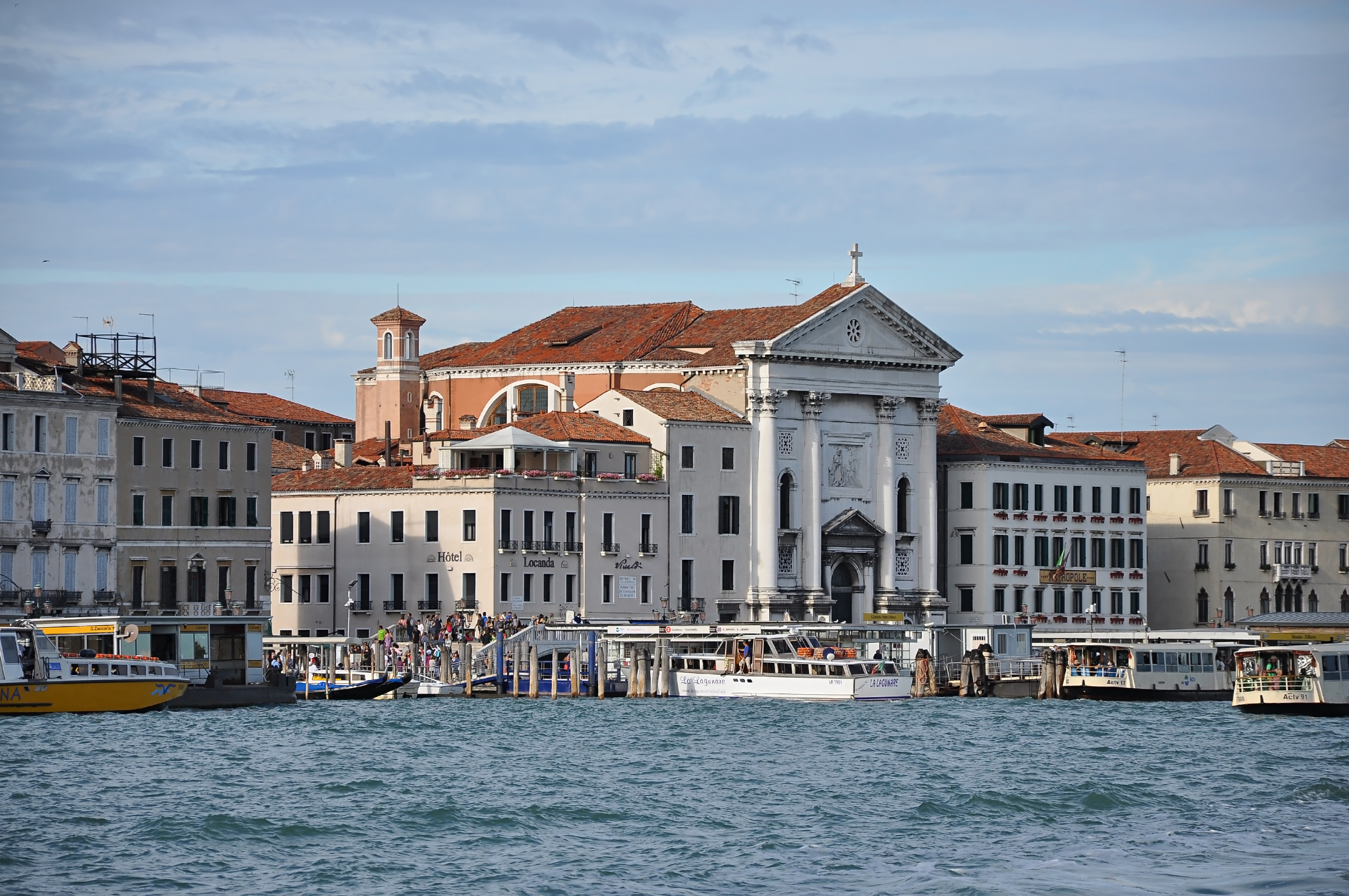
Vivaldi was quite keen on stormy seas. RV 433 is a La tempesta di mare for flute and RV 570 a Concerto grosso with the same sub-title. RV 253 is the violin concerto equivalent, part of the Op 8 twelve titled the Contest Between Harmony and Invention of which the first four are the Seasons. No surprise I guess for a Venetian with a view from the Ospedale della Pieta out over the lagoon to the Lido and beyond to the Adriatic. Now I happen to think that there is as much in the other 8 concertos as there is in the Four Seasons, certainly in terms of tunes, if not in pure rock ‘n’ roll theatricality. An original score for 253 survives in Dresden, probably brought by JG Pisendel the violinist when he returned from studying with Vivaldi. Pisendel was the man who introduced Vivaldi’s music to JS Bach. Diamond geezer.

253’s fast movements are marked Presto not just Allegro so they need to be quick. The central Largo is the three minutes or so of relative calm though even at the end the storm is plainly on its way back. Both storms call for seemingly never-ending (well a few minutes) of descending figurations, the last set against a sort of dotted fanfare rhythm, the first even more frantic arpeggios against a scrubbing ritornello. I enjoyed Stephanie Gonley’s rendition but you probably also need to hear this played at more extreme tempi from one of the big-boned Italian outfits with, say, Federico Guglielmo or Giuliano Carmignola in the hot seat. Same is true of 297 Winter (which has that bit of summer in it just like Summer often feels a bit wintry).

Before the Gloria we were treated to a burst of medieval carol arrangements to beef up the festive quotient. At least those of us not underneath the gallery, where the choir was located, were treated. Still a nice touch. (Now as it happens I have a jolly collection of medieval carols, songs and chants from Pro Cantione Antiqua and the English Medieval Wind ensemble on CD I can recommend). It was as much as MSC and I could do to stop MS popping upstairs and joining in for he is the expert on all things Black Death to the end of the War of the Roses.

I am not actually sure if MS and MSC had heard a recording of the Gloria before but this was certainly their first Vivaldi gig. It is simply not possible for anyone raised in the culture of Western musical tonality not to like Vivaldi’s Gloria. Unless they are dead. And even then it will be on most of the playlists in heaven I would guess. Were that, Pascal’s Wager style, to actually exist. Anyway MS and MSC seemed to like it unless there were being their usual polite selves when it comes to their overly solicitous Dad/Future-Father-In-Law.

The Gloria was composed around 1715 for the residents of the Ospedale. They probably drafted in a few blokes for the tenor and bass lines. The young women of the Ospedale were prodigiously talented, after all Vivaldi composed music for them that even today taxes the very best of musicians (especially for violin), but they probably couldn’t quite get to the gruffer end of the vocal scale. After Vivaldi died in 1741, impoverished after the failed attempt to set up shop in Vienna, the score of Gloria was lost and forgotten until being rediscovered in Turin in the late 1920s. It is a setting of the eponymous section of the Latin Mass divided into twelve sections, all mercifully short and it is resolutely upbeat even as it contrasts keys, moods, tempi, instrumentation and voices.

It is perfect.

Glass and Reich: LSO at the Barbican review ***

Divine Geometry: London Symphony Orchestra, Kristjan Jarvi, Simone Dinnerstein (piano)

Barbican Hall, 29th November 2018

  • Charles Coleman – Drenched
  • Charles Coleman – Bach Inspired
  • Philip Glass – Piano Concerto No 3
  • Kristjan Jarvi – Too Hot to Handel
  • Steve Reich – Music for Ensemble and Orchestra

Funny one this. As part of our project to embrace the classics of minimalism the Tourist, MSBD and MSBDB schlepped off to the Barbican. Primarily to hear the new(wish) Reich piece in its UK premiere, and to catch up with the Glass, similarly making its UK debut. Didn’t really have a Scooby about the other pieces I am afraid.

Now somewhere in Estonia, (actually it relocated to the US) there is a factory which produces conductors. It is family owned and goes by the name of Jarvi and Sons, (in Estonian obvs). For Kristjan, along with older brother Paavo, is son to the veteran, and oft recorded, conductor Neeme. Sister Maarika plays the flute though I have no doubt she too is a dab hand with a baton.

Anyway young Kristjan, who has the gig as the AD of the Baltic Sea Philharmonic which he founded, sees himself as a bit of a musical chameleon and genre-buster. Having got his hands on the LSO again he wasn’t about to waste the opportunity to showcase one of his own works, Too Hot To Handel, nor a couple from his mate Charles Coleman. Drenched takes Handel’s Water Music as its starting point, and Bach Inspired, er, a string-only snatch from the Mighty One’s Well-Tempered Clavier and his “Nun common Der Heiden Helland” chorale, plus a couple of his own movements. Too Hot …. you can work out for yourself. Suffice to say it has pretty much undigested chunks of GF’s Concerto grossi mashed up with KJ’s own Stravinskian, post-minimalism, as well as a lot of running around for the LSO’s three percussionists, Neil Percy, Sam Walton and Jake Brown, and a starring role for Chris Hill on bass guitar (I kid you not).

Worshipping at the altar of the Baroque Gods and drawing the parallels with the Minimalists is self evidently “a good idea” but always better done with the C17 and C18 originals. These pastiches, whilst certainly not dull, and played with gusto by the LSO, ended up as classic classical “classic rock” if you get my drift. Not quite Smashie and Nicey, but skirting awfully close. The Coleman pieces, especially Bach Inspired had a bit more heterogenous invention, and wit, about them but even so it was all a bit weird to be honest. At near 40 minutes and over 13 movements, Jarvi’s own work I am afraid outstayed its welcome, was shown the door but still came back again.

As for the main events, well the Piano Concerto No 3 was a little too close to the pleasant warm waves of swirling arpeggios that Philip Glass can presumably churn out in his sleep and the Steve Reich piece was, guess what, just amazing.

The Concerto was written for this evening’s soloist Simone Dinnerstein and premiered in Boston in 2017. Glass, now 81, has moved a long way from the “hard-core” rhythmic minimalism (“repetitive processes” in his argot) of the 1960s and 1970s. His music now is much more melodic, chromatic, even romantic. When he composes for piano, as with the three concertos, the lovely Etudes and Metamorphosis and the film music transcriptions, he is a right old softie and gets all emotional. It can be moving and occasionally stirring stuff but it is mostly like being immersed in a nice warm metaphorical bath with Brahms and Rachmaninov.

You could be forgiven for thinking popular art-house film soundtracks, which have been, after all, a fair contributor to the old boy’s estate in the last few decades. And one of the reasons, perhaps along with his generosity in collaboration, why his music has been so influential. In fact it is pretty difficult to think of another composer of music in the second half of the C20, and into this millennium, his musical ideas have been quite so pervasive. It will be interesting to see whether Glass’s legacy, like much of post-modernist culture, survives. Whilst love for Schubert, another compositional production line, who I suspect Glass would most liked to be identified with, has pretty much continued to increase year in, year out since his early death, other comparable piece-work composers from the Baroque itself, Bach say, or Vivaldi, spent hundreds of years being ignored. Mind you in the age of digital junk it will be hard to forgot anything ever.

Yet amidst all the familiarity Glass is still capable of surprises and here it comes in the final movement, which is simplicity itself, being a homage of sorts to Arvo Part, he of the “holy minimalism”, with a simple, chiming melody over a bass drone. The introspective concerto, which is essentially three slow to medium paced movements, begins with soft oscillating chords against a processional base-line, which drifts in and out of the similarly paced orchestra. Crotchets become quavers then triplets, rising to a swell and then subsiding. The second chaconne-ish movement is all repeated arpeggios which ends with the unflashiest of cadenzas.

As its dedicatee, and given she is an acknowledged interpreter of Glass’s music, Ms Dinnerstein, who is what you might call a “self-made” performer, more in line with the You Tube pop generation, was unsurprisingly accomplished in her playing, technique, emotion and understanding all present and correct, and if it didn’t wow then that is more the fault of the music than her or the LSO strings. She encored with a Glass Etude. I would have liked more of those.

In less than a month’s time Philip Glass’s 12th Symphony will be premiered in LA under the baton of fellow “minimalist” grandee John Adams. You can’t fault his work ethic.

Music for Ensemble and Orchestra, premiered earlier this year in NYC, is Steve Reich’s first large scale orchestral work for 30 years, following The Four Sections in 1987. Reich is of course as much performer as composer and his ostensible reason for avoiding the orchestra genre was that performers were not really up to the task. Fair enough, but, as he admits, that is no longer true as there are now orchestral players, notably percussionists, but also specialists in the other sections, as well as the latest generation of conductors, who are more than up to the task, and who love and relish the challenge of creating his stunning sound-world. Mr Reich is a year older than his peer Mr Glass but they are chalk and cheese when it comes to productivity, as well as, despite the “minimalist” label, musical style.

SR can go a couple of years without a new piece. This is is no way a criticism for when they do arrive his compositions continue to be works of staggering genius. This, of course, assumes you are predisposed to his marrying of pulse, rhythm and process. Here he has contrasted an “ensemble”, lead strings, principal woodwinds, tuned pianos, vibraphones and keyboards, with an “orchestra” which adds a full string section and brass, in the form of four trumpets, to that ensemble.

The work is made up of five sections/movements, in typical Reich style simply numbered 1 to 5, which together form a Bartokian arch. the tempo is fixed across the sections but the speed varies according to note value: 16ths, 8ths, quarters, then 8ths and 16ths again. The key similarly changes across the movements, a minor third each time, from A to C to E flat to F sharp and back to A. All this remains moreorless gobbledygook to the Tourist but I reckon, as and when a recording appears, the structure that can be felt on first listening, will be understood by this musical dummy after repeated exposure. That is the big picture: second by second though it is the magical intricacy of melodic fragments repeated, echoed, chased and overlapped by different paired members of the ensemble with the rhythmic backbone provided by the rest of the orchestra. A Concerto grossi to match Handel though maybe not quite the Daddy of the form, Corelli.

Mr Jarvi, who likes a lively workout on the rostrum, seemed to have the measure of the piece, though I wouldn’t mind hearing the LSO take it on again under, say, their Conductor the Laureate Michael Tilson Thomas. He is, after all, the expert on great American music of the C20 and there was, I’ll warrant, a Coplandian/Ivesian twinkle in some of Reich’s invention. I see he will be premiering it in San Francisco next year as it revolves around the remaining or the six orchestras that co-commissioned it.

War Requiem at the ENO review ****

War Requiem

English National Opera, London Coliseum, 22nd November 2018

Please probably inevitable that the Tourist, armed with the freedom (and fortunately the budget) to gad about town, his love of Benjamin Britten’s music and his wish to continue to honour those who die in pointless wars was going to end up attending a performance of War Requiem this year. The ENO version, which had the added draw of the Porgy and Bess cast, (augmenting the ENO’s marvellous choir), and the involvement of German photographer artist Wolfgang Tillmans looked the likeliest candidate.

I, or more correctly we, as TMBOAD, a scion of Coventry and admirer of the work, joined me, got way more than we bargained for. I had expected a semi-staged concert performance, with maybe a few arty slides in the background. Instead we got a full scale dramatic interpretation of BB’s oratorio, with the three soloists and choirs telling the story of Wilfred Owen’s war poems, alongside the setting of the Latin Requiem, fully costumed, with very effective lighting from Charles Balfour, augmenting the  and with Mr Tillmans distinctive photographic techniques adding further colour. 

Obviously the War Requiem was not written as an opera but BB being BB it is   naturally dramatic and, up to a point, lends itself to an “operatic” interpretation. Having said that, the very nature and subject of the work, even in its most striking scoring, is steadily paced and having the ENO orchestra, solidly conducted by Martyn Brabbins, in the pit and a chorus constantly in motion, and indeed often prone, inevitably has some impact on what we heard. But this was, moreorless, compensated by what we saw, which was, at times, extremely powerful.

Back to the story. WR was first performed in May 1962 for the consecration of the new Coventry Cathedral, built alongside the ruins of the C14 original destroyed in Luftwaffe bombing raids in November 1940 (see above). BB, a lifelong pacifist, scored the work for soprano, tenor and baritone soloists, chorus, boys’ choir, organ, and two orchestras (a full orchestra and a chamber orchestra). The full orchestrated choirs and soprano are used to accompany the sections of the Latin Requiem. to represent formal, transcendent grief, with the chamber forces and male soloists, representing two opposing soldiers, singing the interspersed English poetry. The children’s choir, accompanied by a chamber organ, present a more distant presence, innocence corrupted, an ever-present BB theme.

BB had originally intended that Peter Pears, an Englishman, sang the tenor role, Dietrich Fischer-Dieskau, a German, the baritone and Galina Vishnevskaya, a Russian, the soprano, but the Soviet authorities prevented the latter from travelling so Heather Harper stepped in. The classic recording with the LSO and Bach Choir conduced by BB, which everyone should own, has the original trio however. (Mind you there are plenty to choose from). 

BB unfortunately couldn’t conduct the CBSO at the premiere but no matter. The performance was a triumph. The Tourist has enjoyed a fair few performances in his time, (and seen the curious Derek Jarman film interpretation which is notable for Sir Larry O’s last ever performance). The music always delivers and so it was here. Now in addition to the contrast provided by the juxtaposition of the poem settings and the six movements of the Requiem itself (Requiem aeternam, Dies irae, Offertorium, Sanctus, Agnus Dei and Libera me, BB apparently uses the interval of a tritone between C and F sharp (an interval of three whole tones, known as the “devil in music”) as a recurring motif to create harmonic distance and then resolution, notably in the Agnus Dei, and thus evoke the notion of conflict and resolution. Elsewhere there are various brass fanfares, string arpeggios, marches and fugues in various three part time signatures, and various repetitions of lines, but the full vocal forces do not combine until the very end. So three is the magic number here.

Even if you don’t know your tritone from your backside your ears will still easily navigate their way through the score even on first hearing, such is the immediacy of B’s orchestration. And there are enough OMG musical moments to pull you up short. And that’s before you even get to the texts. Particular highlights for me are the extract from Anthem for Doomed Youth for tenor in the opening Requiem Aeternam, the soprano and chorus Lacrimosa in the Des irae, the Domine Jesu Christe from the boys’ choir, the Parable of the Old Man and the Young for tenor and baritone, The Sanctus and Benedictus, Strange Meeting with the lilting, poignant lullaby “Let us sleep now ….” and indeed pretty much everything else in the Libera me at the end. 

So, if the music, words and message reliably overwhelm, and get you thinking deeply about the utter horror and pointlessness of war, what is added through a full scale staging. Well, having the chorus on stage, variously signifying troops, refugees, dead bodies, I am assuming, was intriguing. A remarkable choreographic achievement from Ann Yee allied with costume design by Nasir Mazhar. Mr Tillmans most successfully employed close up, sharply exposed photographic images drawn, I believe, from  Coventry Cathedral itself in the three screen back drop to the stage, which dissolved into blocks of muted colour, and there were some fine tableaux (notably a snow/mushroom cloud effect) courtesy of ENO house director Daniel Kramer. Having said that, and despite the remarkable efforts of dramaturg Luc Joosten, carving out a sort of narrative when none is really there, there were a few moments when the various elements didn’t quite gel and the on-stage shuffling, and overt literalism, was more distraction than illumination. 

But no matter. It is one of the finest, acclaimed and most powerful pieces of classical music written in the second half of the C20. The Tourist has seen a fair few performances of impassioned anti-war classical work in the last few weeks, George Crumb’s Black Angels, Shostakovich Eighth String Quartet, Turnage’s The Silver Tassie, but this ranks as the definitive statement. And, with soloists of the calibre of Roderick Williams, David Butt Philip, and, the tremendous Emma Bell as seer/earth mother/angel of death, there was never any real risk of disappointment.

Time Stands Still: Aurora Orchestra at Kings Place review ****

Aurora Principal Players, Iestyn Davies (countertenor), Sally Pryce (harp), John Reid (piano), Nico Muhly

Kings Place, 23rd November 2018

  • Satie – Gymnopédie No. 3
  • Thomas Adès – The Lover in Winter
  • Nico Muhly – Clear Music
  • Debussy – Danse Sacrée et Danse profane
  • Brahms – Gestillte Sehnsucht
  • Nico Muhly – Old Bones (world premiere of ensemble version),
  • Nico Muhly – Motion
  • Thomas Adès – The Four Quarters
  • Dowland (arr. Nico Muhly) – Time Stands Still (world premiere)

A full house, moreorless, for a diverse programme of chamber music and songs anchored by (relatively) well known works from Thomas Ades and Nico Muhly, whose effervescent presence also graced the evening as performer, conductor and even compere. Oh and did I mention he “curated” the event. The evening was part of the year long Kings Place Time Unwrapped season now coming to an end with the pieces ostensibly linked through their meditation on, er, time and music from an earlier age. 

The musical backbone was provided by the graceful pianism of John Reid, with strings and clarinet from Aurora principal players, Alex Wood, Jamie Campbell, Helene Clement, Sebastian van Kuijk and Peter Sparks. Against this a number of the pieces showcased the unusual harmonies of the harp (Sally Price whose playing was certainly not backward in coming forward), celesta (John Reid again) and the ethereal countertenor of Iestyn Davies

There was a world premiere of a new chamber version of Old Bones, a song cycle about the rediscovery of the body of Richard III in a Leicester car park in 2012, (an event which also formed the opening sequence for the Almeida Theatre production of Shakespeare’s play with Ralph Fiennes in the lead). The arioso of Iestyn Davies was originally accompanied only by a lute, which can be discerned in the fragments of poems about Sir Rhys ap Tomas, the alleged killer of the king, which follows the news commentary intro. The momentum builds into a processional as the text, from Philippa Langley of the Richard III society, eloquently connects the infamous monarch to today.  

Muhly’s Motion for string quartet, clarinet and piano takes as its starting point a verse anthem from Orlando Gibbons, See, see the Word, and applies his trademark post-minimalism energy to Gibbons’s complex vocal counterpoint .

In contrast Clear Music is based on just a fragment of a John Taverner motet. Mater Christi Sanctissima, and is scored for cello. harp and celesta with the latter gifted an inventive solo part for an instrument normally reserved for adding orchestral colour. The texture doesn’t change and the piece is locked in a pretty high register, even in the cello line, but, as usual with Mr Muhly, he creates an engaging piece that doesn’t come anywhere outstaying its welcome. 

Thomas Ades’s Four Quarters from 2010 is a string quartet which takes as it subject the ebb and flow of time, in common with the TS Eliot Four Quartets, poems from which it surely drew inspiration. As usual Ades serves up all sorts of striking  sounds, a wide dynamic range rhythmic complexity, beginning with the eerie babble of Nightfall, followed by Morning Dew evoked through pizzicato, the steady pulses of Days and the astounding harmonic complexity of the last movement, the Twenty Fifth Hour, which is measured in an unusual 25/16 time.

The evening’s outstanding piece of me though was The Lover in Winter, written when Ades was only 18. It is made up of 4 very short songs, in Latin drawn from an anonymous text. It has a bleak, brittle, chilly feel, just chiming piano chords and Iestyn Davies’s exquisite countertenor, though the last song fails up the passion. Melismatic with candid word-painting. 

Mr Davies was also superb in Time Stands Still, a Dowland song which Nico Muhly has re-arranged. The melody is defined by the singer, based on an anonymous love song, with the whole band coming together to provide complementary but recognisably contemporary harmonies. 

The programme kicked off with John Reid in Satie’s ubiquitous piano waltz  Gymnopedie 3, blink and you’d miss it, as well as a helping of (to me) an unremarkable Brahms song and Debussy’s showcase for the harp with its “medieval” first part and  bouncy Spanish inflected second “profane” part. At the end we were treated to Messrs Muhly and Davies presenting an aria from Marnie, which has just finished at the Met, and which I bloody loved at the ENO.

For someone who I gather lives in NYC, Nico Muhly seems to spend a lot of time in London. No surprise that to the Tourist. Indeed he will be back at Kings Place on New Years Eve with the Aurora Orchestra. I can think of worst places to be. Mind you I do have a better offer for once. 


Brodsky Quartet at Kings Place review *****

Brodsky Quartet, In Time of War

Kings Place, 18th November 2018

  • Karen Tanaka – At the grave of Beethoven
  • Erwin Schulhoff – String Quartet No 1
  • Shostakovich – String Quartet No 8
  • Dave Brubeck – Regret
  • George Crumb – Black Angels

It’s been donkey’s years since I last saw the Great British Brodsky Quartet. In fact my guess is there has been a couple of line up changes since then, though Ian Belton on violin and Jacqueline Thomas on cello remain from the original founders in 1972, now joined by Daniel Rowland’s violin and Paul Cassidy’s viola. There were famous back in the day for me and my punky mates because they got involved with pop/rock types. They have never lost the spirit of adventure as this programme plainly shows. The centenary of the end of WWI has seen a lot of fine concerts: this idiosyncratic alternative was one of the best.

Now the main reason to turn up here was not, for once, Shostakovich’s No 8. Mind you that would have been worth the entrance money alone. Having heard a sophisticated, smooth version of DSCH’s quartet masterpiece from the Emersons a couple of weeks earlier, it was exhilarating to hear this much darker, plaintive alternative. This really got inside the meaning of the score, dedicated to “the victims of Fascism and War” in a way that the Emerson Quartet only hinted at. The two outer Largo C minor movements, with their famous DSCH musical monograms, were grimly intense here, the second movement scherzo fugue ferociously pungent and the middle movement waltz bitterly sardonic, on the edge of giving up. The slower fourth movement was here properly, brutally, dissonant with the KGB not just at the door as DSCH remarked, but inside the flat rifling through possessions. This is exactly what the Eighth should sound like, vibrato when vibrato, forte when forte, pianissimo when pianissimo. 

Yet like I say this was not the main attraction nor war it the highlight of the evening. That was reserved for George’s Crumb’s Black Angels. It was written in 1973 as a response to the Vietnam War. It is scored for “electric string quartet” and includes a magic box of percussive and other effects, including vocals, and even featuring crystal wine glasses. Subtitled “Thirteen images from the dark land” and inscribed “in time of war”, it is, by turns, startling, frightening, menacing, ritualistic, elegiac, ethereal, mysterious, very loud and very soft. It is divided into three sections, Departure, Absence and Return each of which contains a painful threnody. There are baroque dances buried in here, but don’t expect Lully or Telemann. And then there is just noise. I haven’t the faintest idea how to convey the sheer breadth of its sound world and depth of its emotion. I suggest you go listen to it and see what you think. Probably best not, as the Brodsky’s refrained from doing here. amplify the music to the “threshold of pain” as Crumb instructed. Though it might have been interesting to observe the reaction of the Kings Place crowd to a heyday My Bloody Valentine take on Black Angels. GC is near 90 years old now but I bet he would still turn the dial up to 11. 

Black Angels has rightly secured a pre-eminent place in the modern string quartet repertoire, but it isn’t easy, so fortunately, here, we were in the hands of experts. It is probably the best half hour or so of “music” I have heard this year.

The Karen Tanaka piece was commissioned by the Brodskys to mark the bicentenary of Beethoven’s Op 18 quartets and takes the first few bars of No  as its inspiration. Interesting if not memorable. Erwin Schulhoff’s upbeat first quartet, with its mix of Czech folk rhythms, Stravinskian jazz and agitated dance probably needs further investigation. He was born in Prague, and this piece was written in 1924 when he was 30 but 17 years later he died of TB in the Wulzburg concentration camp. The Dave Brubeck piece. originally composed for string orchestra in the immediate aftermath of 9/11, says it all in its title.

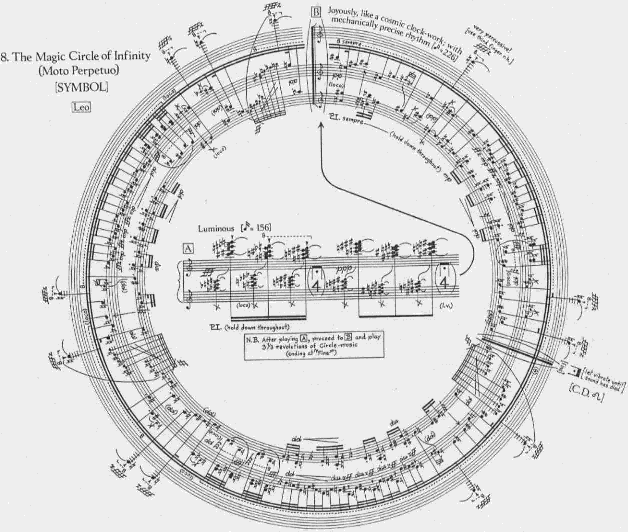
Marvellous stuff. Oh and I caught a glimpse of the score for Black Angels even from my back of the stalls perch. For George Crumb’s scores are almost as intriguing as the extended and innovative techniques in the music itself. The above is not from Black Angels but a moto perpetuo piano piece. Even so see what I mean?

Ligeti, Bartok and Haydn choral works at the Barbican review ****

London Symphony Orchestra, London Symphony Chorus, Francois-Xavier Roth (conductor), Camilla Tilling, Adele Charvet, Julien Behr, Christopher Purves, William Thomas

Barbican Hall, 11th November 2018

  • Gyorgy Ligeti – Lontano
  • Bela Bartok – Cantata profana
  • Haydn – Nelson Mass

Three composers I like. Three works I did not know. A slightly earlier start. A fine end to a fine day.

When I say I don’t know Liget’s Lontano that isn’t strictly true. In fact, even if you are a Ligeti virgin, there is a fair chance you have heard Lontano. For this is the music famously used to signify Jack Nicholson’s descent into full-on barking psychomania in The Shining film. Lontano, along with Atmospheres, is therefore still probably Ligeti’s most famous work, even though, in the five decades that followed their composition, GL went on to explore many other styles and musical ideas. 

Lontano, in Italian, means “far away” or “distant” as a performance instruction which about sums it up. For this is as “other worldly” as it gets, from a composer synonymous with the term. It is built up from layers of very quiet sound, initially cellos and flutes, from the smallish orchestra. These lines move in different tempos and to different rhythms but they combine, legato, to create Ligeti’s trademark micropolyphony. The crystallisation of these sounds brings out sustained, but shifting, harmonies that are very different from traditional or atonal composition but the overall effect is ravishing. And something for which horror and sci-fi film composers ever since should be eternally grateful. It is eerie, mysterious but utterly compelling. Take the bit where the high violins, barely audible, pulse against the throb of the low brass and wind. Given the score doesn’t really offer any metre as such Francois-Xavier Roth could only really prompt the orchestra. No matter. All the LSO had to do was trust Ligeti’s ear and F-XR’s experience with the piece. How GL knew all of his innovations, not just in these micropolyphonic pieces, would work is an utter mystery to me. Genius.

It was performed by the National Youth Orchestra at this years Proms so its a fairly frequent concert hall visitor. Don’t let it pass you by. 

Bartok’s Cantata profana, which was published in 1930, rarely gets an outing. Lasting only 20 minutes yet still requiring a full chorus and orchestra as well as a bass, (here William Thomas standing in for the indisposed Matthew Rose), and a very challenging high tenor part which pushed Julien Behr close to his limit. It is based on a slightly creepy, coming of age, folk ballad about nine brothers who go out hunting, turn into stags, (which I hope is a rare occurrence even in Transylvania), and then refuse to come home when Father asks them. Heady stuff which Bartok pitches somewhere between his more overtly derived folk driven orchestration and the lusher sound-world of his earlier stage works. The LS Chorus seemed entirely at home with the tricky Hungarian idiom of the text and the awkward contrapuntal textures of Bartok’s score, which divides into 8 parts in the second of the three movements..

That’s the thing with Bartok. It normally takes a few listens for me to get the gist of his music. Like Prokofiev I know there is something there worth working on but it doesn’t always reel me in immediately. I can’t always grasp the line and architecture of the whole work but the rhythms and melodies individually are often arresting. I have more work to do on the popular orchestral pieces, am close to cracking the string quartets, think the solo piano collections are fascinating and would love to see Duke Bluebeard’s Castle. The piano concertos and the rest of his chamber music are bit of mystery. Whether Cantata profana on this listening will be added to the to do list is a moot point. 

As an aside if you want a quick burst of Romanian folk filtered through an orchestral lens, look no further than the Concert Romanesc. By none other than Ligeti. A perfect pastiche of a C19 nationalist Romantic tribute. It is really hard to believe this is the same composer as Lontano. 

Not knowing the Nelson Mass, as with any Haydn piece, is no handicap. It’s a mass, sung in Latin, so that’s the text nailed down, it is a relatively small orchestra, (just 4 double basses in the strings, trumpets, timpani and a small pipe-organ here played by Bernard Robertson), and, as usual, Papa keeps his textures homophonic and easy to follow. The Gloria ends with a mighty fugue and the Credo kicks off with an extended canon. What’s not to like? That is not to say it isn’t without drama, the LS Chorus letting fly in the Kyrie and Gloria. Julien Behr was persuasive, as was replacement bass, the ever excellent Christopher Purves. Mozart specialist Camilla Tilling’s soprano lost a little of its silky subtlety though newcomer Adele Charvet’s mezzo more than held its own. Even so there might have been a case for reigning in the 130 strong Chorus a little to offer a little light and shade. 

The Nelson Mass is the third of six that Haydn composed between 1796 and 1802, appearing just after The Creation in 1798. He titled it Missa in Angustiis, “Mass in difficult circumstances”, a reference to Napoleon’s march across Europe. There is a martial quality about some of the music, in the Kyrie and Benedictus for example, but, as usual Haydn can’t suppress his jolly nature throughout. As it happens a few days before its first performance Admiral Nelson (there he is above) secured a famous victory against the French fleet at Aboukir. A couple of years later Nelson went to visit the Esterhazy court and this was performed for him; hence the nickname. 

The Silver Tassie at the Barbican review *****

The Silver Tassie

Barbican Hall, 10th November 2018

  • Mark-Anthony Turnage (composer)
  • Amanda Holden (libretto)
  • Ashley Riches – Harry
  • Sally Matthews – Susie
  • Brindley Sherratt – The Croucher
  • Claire Booth – Mrs Foran
  • Marcus Farnsworth – Teddy
  • Alexander Robin Baker – Barney
  • Louise Alder – Jessie
  • Susan Bickley – Mrs Heegan
  • Mark le Brocq – Sylvester
  • Anthony Gregory – Dr Maxwell/Staff Officer
  • Andre Rupp – Corporal
  • Finchley Children’s Music Group
  • BBC Singers
  • BBC Symphony Orchestra
  • Ryan Wrigglesworth – conductor
  • Kenneth Richardson – stage director

B*gger. B*gger. B*gger. B*gger. B*gger. I never saw Mark-Anthony Turnage’s second full scale opera when it was first performed in early 2000 at the ENO. On the basis of this semi-staged performance from the BBCSO as part of the In Remembrance weekend this was a terrible omission on my part for it is an extraordinary work both musically, and, given the strength of Amanda Holden’s libretto, dramatically. It is intensely powerful and moving even without a full set and staging. It beggars belief that it has not been revived since 2002, (and that it missed out on a run in Dallas thanks to political sensitivities). 

It is constructed as a symphony in four acts, Home, War, Hospital and Dance. Harry Heegan is about to return to the family flat after a football match with his best mate Barney and girlfriend Jessie. Mum and Dad are intensely proud of their son who is about to head off to the war. Next door neighbour Susie joins the party, banging on about God. Mrs Foran from upstairs also turns up escaping abusive husband Teddy. The Silver Tassie, a cup with much significance appears, the men go to war full of optimism. The War act is primarily choral preceded by the mythic Croucher, representing, I think, the war dead and intoning Old Testament-ish doom. An officer complains at the doctors in the Red Cross station. A football game is delayed as the battle begins. The story then switches to the Hospital where an angry Harry is now paralysed, Teddy blinded and Jessie, who refuses to see Harry, is now coupled up with Barney, who saved Harry’s life. The final act sees Harry and Teddy spit out their pain and bitterness at those who still have their futures at the communal dance. 

The opera is based on Sean O’Casey’s eponymous plan and it is therefore we who have to thank for the gripping drama. Whilst it is never made explicit, O’Casey intended that the Heegan family, and the rest of the community, should hail from the East Wall, a working class district of Dublin, adding further pungency to the message of the play (and opera) because, at that time, Ireland was still part of the UK and the republican movement was divided on whether the country should be involved in the war. So as some young men like Harry, Barney and Teddy headed off to war others prepared for insurrection at home. 

O’Casey’s play was rejected by WB Yeats, then head honcho at the Abbey Theatre in Dublin, when it was submitted in 1928, reflecting its political sensitivity. This was after the success of his first three major plays, The Shadow of a Gunman, Juno and the Paycock and The Plough and the Stars. So it premiered at the Apollo in London’s West End. There have been a fair few plays which rail at the futility of war and its consequences on the individuals who fight in it, but I doubt many match the raw power of The Silver Tassie. 

So Amanda Holden, (to be clear not the airhead judge on BGT), and M-AT had something monumental to work with. Even so, and in no way intending to downplay Ms Holden’s contribution which provides M-AT with multiple opportunities to show off his trademark stylistic jagged juxtapositions, it is the score that takes the breath away. M-AT had already shown his dramatic flair in his first opera Greek, and his compositional skill with orchestral pieces such as Three Screaming Popes, Momentum, Drowned Out, Dispelling the Fears and Silent Cities, especially when it came to percussion and brass, but The Silver Tassie is on another level.

The symphonic structure is inspired by mentor Hans Werner Henze’s The Bassarids, with the first act setting out the main ideas and themes, the second the Adagio slow movement, brought to life by the large scale choral scenes (echoing the more Expressionist feel of the act in SO’C’s play), the third a Scherzo and the last act a “dance” finale with “off stage” band. This structure offers rhythmic backbone and plenty of tunes derived from song, (including Robert Burns’s own Silver Tassie), and dance, as well as repeated motifs, which make it easy to follow and show off MA-T’s uncanny ability to capture the emotional interior of the characters. There are episodes of rich orchestral colour but there are also plenty of more economic orchestration.  The score should give the singers plenty of space, but just to make sure the cast were miked, (though M-AT, a couple of rows in front of me, needed to dash up to the sound desk to get the balance right early on).  The second and fourth acts are up there with the best I have ever heard on an opera stage. Even allowing for the fact that this wasn’t an opera stage. 

Sometimes this semi-staging lark can leave singers looking a little awkward unsure of how much to commit to performance versus voice. Costuming can also, sometimes, appear incongruous. Not here though, at east once the first act go going. There were some outstanding vocal performances, notably for me from Sally Matthews and Claire Booth, and Marcus Farnsworth as Teddy was very persuasive. But baritone Ashley Riches as Harry, even from my two perches (side stalls first half, back of circle second), was bloody marvellous not just in his singing but also in the way, pre and post wheelchair, he projected Harry’s exuberance and then his pain into the whole auditorium. 

Now I have nothing to compare it to but, given just how amazing this was, I have to assume that Ryan Wrigglesworth and the BBCSO, and the BBC Singers and Finchley Children’s Music Group (complete with ensemble writhing) got as close as possible to the heart of the music. 

You can listen to it for a couple more weeks on BBC Radio Opera on 3. Do yourself a favour and do so. 

And can I beg the ENO to find a way and time to revive this. With Mr Wrigglesworth on the podium. I will chip in a few quid if it helps. 

Emerson String Quartet at Milton Court review ****

The Emerson String Quartet

Milton Court Concert Hall, 8th November 2018

  • Britten – String Quartet No 3, Op 94
  • Shostakovich – String Quartet No 8 in C minor, Op 110
  • Beethoven – String Quartet No 7 in F major, Op 59 No 1, “Razumovsky”

You still see some venerable rock (and pop) bands unwisely soldiering on in their 60’s and even 70’s, sometimes with only one original member still in the line-up. Outside of disposable pop the creative force/s, the composer/s if you will, in contemporary popular music are invariably also the performer/s. Not so generally in classical art music, though that isn’t to say that many canonical composers weren’t, or aren’t, also adept performers. Just that composition and performance are more often separated, and that performance is often as important to composition in terms of audience enjoyment or appreciation. 

So when rock musicians die, so does the band, if it has managed to get that far without breaking up due to musical differences, substance abuse or fist-fights, in the established rock’n’roll manner. Leaving the audience with a ropey tribute band and recordings to keep the tunes alive.

In the classical world though, with its much longer back catalogue, legacy is the name of the game. And not just in composition. Performers live on. Not just in recordings but also in the name, and sound, of the band. Easy enough to envisage in the context of the orchestra with its link to place and with a constant turnover of personnel. The Royal Danish Orchestra in Copenhagen can trace its lineage back to a bunch of regal trumpeters from 1448 (!), the venerable and still very highly regarded Leipzig Gewandhausorchester to 1743.

The idea that string quartets outlive their members might be a little trickier to get your loaf around though. Yet this is how it works. Members may come and go but the best quartets stick together for life, such is the dedication of performers to their art, and, when one of the four can no longer perform, pearly gates or otherwise, a replacement is drafted in. But this cannot be any old violinist, viola player or cellist. For the sound of a top notch string quartet, is a very particular thing, and continuity, as well as chemistry, needs to be guaranteed.

Now as is normally the case with the development of classical music, form followed technology and demand in bringing the string quartet to the fore. Once modern instruments had been perfected in the C18, notably the viola, (which is tuned a perfect fifth below the violin and an octave above the cello), and with enough patrons who liked the string quartet groove to pay up, composers were all set. As with so much else in classical music it was Papa Haydn who set the ball rolling in the 1750s. His massive output for the ensemble (68 named, 77 or so in total) is still amongst the best ever written IMHO. 

The string quartet, in the opinion of the Tourist, is about as “pure” as classical art music gets. Not easy to get right; any paucity of imagination is ruthlessly exposed. Four parts is enough to fashion an argument but not enough to take the foot off the intellectual or aesthetic gas. Plenty of opportunity to vary pitch but only the colour and texture of strings at the composer’s disposal. All of which might explain why not every big name has embraced the genre and why even those that have sometimes don’t always get beyond one effort or a brace. 

After Haydn, Mozart obviously churned out a fair few, 23 I think, though they are not all up to snuff. Still as ever with Wolfgang when he nails it he nails it. Then Beethoven with his 16 (and the Grosse Fuge) which, as with the symphonies and piano concertos, have never been bettered. Schubert also walked the talk with his 15 and a few assorted bits and bobs. (Note to Tourist: more work to do on these). 

As the fashion for showy-off, Romantic, bullsh*tty bombast gained traction in the C19 so the string quartet took a back seat, but returned with a bang in the C20. For the Tourist’s money the best of the bunch since 1900’ish are Janacek’s pair, Nielsen’s 6, Ravel and, (in a rare thumbs up from me), Debussy’s single shots, Stravinsky’s various musings, and, best of all, Britten’s haunting treble, Bartok’s virtuoso 6 and Shostakovich’s acutely personal 15. Oh and Glass’s 7 (and counting), Reich’s Different Trains, Crumb’s Black Angels, Nyman’s 5, Ligeti’s 2 and Xenakis’s 4. You might have some others to add. Tell me.

The Emerson String Quartet was formed in 1976, and still has two of its founder members in violinists Eugene Drucker and Philip Setzer, alongside the viola of Lawrence Dutton, with cellist Paul Watkins the last in, having joined in 2013. I have recordings of their arrangement of The Art of Fugue and their renowned Bartok cycle. The Bartok is superbly recorded and is very, very precise and very, very intense. This is what they are famous for. Exact and technically brilliant interpretations. Which maybe lack a little emotion. That tends to be my preference but I can understand why others may take a different line (and there are occasions when I would agree).

Anyway this is what the Emersons are famed for. And this is exactly what they delivered at Milton Court. Britten’s Quartet No 3 was pretty much the last thing he composed appearing in the year he died, 1976. With its call-back to the music of his last opera, Death in Venice, in the final passacaglia, and the recitative quotes that precede it, it really is immensely moving. BB was very ill at this time, only able to work in short bursts following a heart bypass operation, and this seems to be reflected in the four condensed movements which precede the final “La Serenissima”. The opening “Duets”, in sonata form, is also haunting and, by virtue of its various permutations of the quartet personnel, as sparse as its title suggests, even when the duets are accompanied. The Ostinato second movement, like the Burlesque fourth movement, is very short, and taken at a fair lick even where it is played pizzicato. The parodic Burlesque could have come from the pen of Shostakovich in one of his more caustic moments, with its weird central spiccato passage. The central Solo is marked very calm with the first violin line, heading higher and higher, seemingly lifted from the mists, and mystery, of Curlew River. Or maybe Aldeburgh Beach, Or Snape. Anyway as with the rise and fall of the Passacaglia it sounds like BB was set to go home. Blub blub. 

The Emersons certainly got the measure of BB’s still extraordinary imagination and technique. But it felt a little less haunting than the recording I have from the Endellion Quartet. This was even more true in the Shostakovich. The Eighth was written when DSCH was in a very dark place, contemplating suicide. He went on in his final quartet, 15, to offer up a genuine personal elegy but this comes pretty close. He was supposed to be written a score to accompany a documentary about the bombing of Dresden but, after just a few days, he came up with this, “an ideologically deficient quartet nobody needs”. It was 1960 but DSCH still wasn’t “free” now being forced to join the Party. It has his trademark initial motif in the opening of the Largo on the cello, which is developed, before the main theme from his First Symphony pops up, before this in turn gives way to a  repeated rocking motif.

This rocking motif is then pumped up and speeded up to form the basis for the second movement scherzo. This is, even by Dmitry’s high standards, pretty scary stuff. The DSCH motif also crops up again, in contrasting tempi, As it does in the middle movement Allegretto, here transformed into a Waltz which then proceeds to quote his First Cello Concerto. A violin solo links to the first of the final two slow movements. This contains the tune to a Russian song about the victims of fascism, to whom DSCH eventually dedicated the quartet, but which might be aimed at totalitarianism more generally. The final Largo comes full circle with a return to the rocking motif.

The quartet is taken unbroken and with these powerful and dramatic ideas, and stirring emotion, it is easy to see why it is Shostakovich’s most famous and oft-performed quartet. It would be hard to imagine a more expertly crafted and sharp interpretation, these chaps leave nothing to chance, but, as I discovered a couple of weeks later, courtesy of the Brodsky Quartet, it is possible to wring a fair bit more gut-wrenching angst out of the piece. I have recordings by the Borodin Quartet, now in its eighth decade, constantly refreshed by the best of the Moscow Conservatoire, and the original dedicatees for most of DSCH’s quartets, and the English Fitzwilliam Quartet (founded in 1968) who also worked with the composer and were the first to record a complete cycle. 

As it turned out it was the Beethoven first Razumovsky which actually showed the Emersons at their very best. Count Razumovsky was an important Russian aristo and diplomat in Naples and then Vienna but his name has gone down in posterity for the three quartets he commissioned from Beethoven in 1806. All are magnificent but the first might just be the best of the bunch. This is altogether jollier music than the two pieces that preceded it, with its intriguing dissonance and implied repeat in the first movement, the rapid passing of the baton from one player to another, underpinned by the one note cello motif in the Allegretto second, the tragic F minor Adagio and then the ebullient finale with its bouncy Russian theme, (as in the other two Razumovsky pieces). The drilled-to-perfection understanding of the Emersons, and the more upbeat tone of the Beethoven was, for me, at least more satisfying.

That is not to say that overall I took very great pleasure in listening to this famous quartet. They are up there with the very best of their peers, some of which I have already mentioned. When it comes to Beethoven I think the Takacs Quartet (founded 1975) might have the edge of those I have heard live, though the Belcea Quartet (1994), who might just be my favourite string band, run them close. As for recordings of the Beethoven quartets have a sniff around the Alban Berg, Quartetto Italiano (for the middle quartets) and unparalleled Vegh (for the mighty last four).

While I am at it, should anyone care, add the Hagen Quartet (1981) to the bucket list when it comes to Mozart, the Quatuor Mosaiques (1987, HIP specialists) for Papa Haydn and the Kronos Quartet (1973), on the rare occasions they leave the US, in contemporary repertoire. 

LSO at the Barbican: Kodaly, McMillan and Shostakovich review ***

peter_moore_28musician29

London Symphony Orchestra, Gianandrea Noseda (conductor), Peter Moore (trombone)

Barbican Hall, 1st November 2018

  • Zoltan Kodaly – Dances of Galanta
  • James MacMillan – Trombone Concerto
  • Dmitry Shostakovitch – Symphony No 4

Now it might be the fact that I was a bit poorly for this performance that accounts for this lukewarm response. No need for any of you to worry. I am in fine fettle now but whatever bug it was prevented me from seeing the evening devoted to the electronic and chamber work of Iannis Xenakis at Kings Place a couple of days later, which was REALLY BLOODY ANNOYING since I am much taken with the composer and the performers, (London Sinfonietta with cellist Tim Gill who was in the hot seat for solo piece Kottos and Phlegra for 11 musicians). There is nothing quite like the sound world of Xenakis. Give him a whirl. YOLO.

Anyway back to the LSO gig. Now LSO guest conductor Gianandrea Noseda, who is recording a symphony cycle wth the LSO of which this evening will be a part, has a way with Shostakovich, witness his fine account of the Eighth earlier in the year (Beethoven and Shostakovich from the LSO at the Barbican review ****). At least I thought he did. This Fourth was quite a bit less convincing. Not up there with the interpretation of Vladimir Ashkenazy and the Philharmonia also earlier this year (Shostakovich from the Philharmonia and Ashkenazy review ****).

The Fourth is a tricky customer. In complete contrast to the more conformist, (though still painful howl of protest), that is the Fifth, this symphony has DSCH still messing around with his avant-garde roots. That is not to say that it isn’t recognisably his voice, just that it is a long way away from the inventive Stravinskian juvenalia of the First and the awful, garish, empty patriotic posturing of the Second and Third. The Fourth is chock full of brilliant, if eccentric, ideas but isn’t too bothered with the usual rules of symphonic structure. It was written in 1936, when he was 30, the year DSCH got his telling off from Stalin. It was rehearsed but then withdrawn to be finally premiered in 1961 when Stalin and Zhdanov were safely in their graves. It has two massive movements embracing a scherzo, a giant 100 plus orchestra, lots of distorted songs and dances, excesses of aggression and pathos. Mahler removed from the mountains and marched at gun-point into the factory.

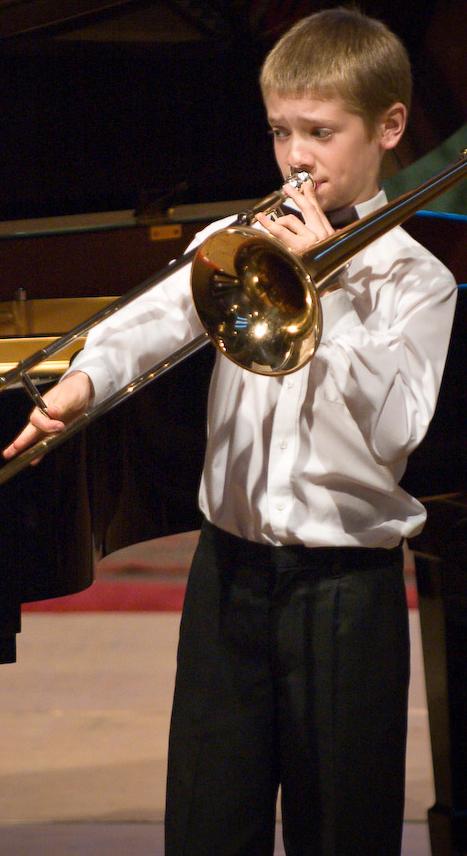
It is very tricky for conductor and composer to knit all of the twist and turns, (and musical cul-de-sacs, of which there are many), together and Mr Noseda didn’t quite find his compass on this evening. This, together with my man-flu, meant I drifted in and out a bit through the 70 minutes of performance, despite the volume. Not so with James MacMillan’s Trombone Concerto. This is the first time I have heard any of his music. surprising given that he is a favourite commissionee with British orchestras. This was the UK premiere of this work with Peter Moore, the Co-Principal trombone in the LSO, as the soloist. Now young Mr Moore, just 22, is something of a prodigy, haven’t taken his chair at just 18. His breakthrough came when he won the BBC Young Musician competition aged just 12, and in a few short years he has become a renowned soloist and is a visiting prof at the RCM. There he is above, winning the BBC contest. Awwh sweet.

Now I am no expert on the trombone, (or on any instrument come to think of it), but I have ears so can tell you that Mr Moore knows what he is about trombone-wise. Wind soloists are generally remarkable people as their technical prowess and control reveals just what their instruments are capable of playing. Mr MacMillan’s concerto is a single movement work which alternates between frenetic activity and “ghostly” passages drawn from the seven note theme which is set out at the start. The soloist’s line is set against this through the slower first passage and again, in bursts, as the pace hots up. A “waltz” of sorts follows, then a rush forward punctuated by the three orchestral trombones joining Mr Moore in a blast alongside, of all things, a siren. There might have been a wind machine as well. A slower, more lyrical swell follows then a kind of mad gigue before a jam from the four trombones again.

As ever, all you can do on hearing a piece of contemporary classical music for the first time is see if it grabs you, and this most certainly did. Maybe it was the novelty of hearing what was possible with a trombone, though Daddy Mozart and Brother Haydn, alongside Berio, Xenakis, Turnage and, of course, Christian Lindberg, have all shown me this in other works, or maybe it was just Peter Moore’s amazing skill, but I do think there was enough here to mean I should look into Mr MacMillan’s back, and in future, front catalogue.

The other piece on the menu was Kodaly’s Dances Of Galanta, a kind of augmented string suite, written in 1933 and based on Hungarian dance tunes. It has its fans I gather but I can now say I am not one of them. Having not really connected with Kodaly’s string quartets I think I can safely say that he is not for me even as his mate, Bela Bartok, especially in his 6 string quartets, most certainly is.