Balm in Gilead at the Guildhall School review ***

milton-court_04

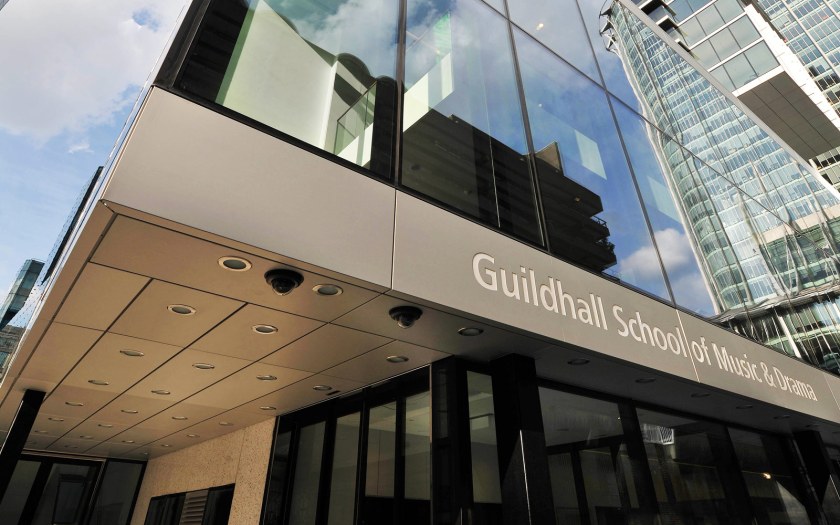
Balm in Gilead

Silk Street Theatre, 27th March 2017

Less a review, more a plug for the terrific music, drama and opera on offer to you, the London public, from the massively talented students (and teachers) at the Guildhall School on the Barbican site. There’s all manner of free stuff and for no more than £10-20 there are plays and operas of the highest quality.

Balm in Gilead was the last play I saw there. Written in the mid 1960s by Lanford Wilson who I didn’t know before this, the play is set in a contemporary New York cafe frequented by assorted prostitutes, addicts and petty criminals. Think Taxi Driver without the Travis nutjob. There are many stories on show but the key narrative is the relationship between Joe, a drug dealer who is in too deep, and Darlene a recent, and naive, arrival in the City.

There are all manner of formal devices employed here. A large cast of largely unsympathetic characters, though sympathetically played, a lot of overlapping dialogue, simultaneous scenes, a fugal song at the beginning and end to highlight the vicious circle in which the characters are trapped, cutaways where characters amplify the plot. The set design was masterful allowing these formal devices to take wing and the cast uniformly strong in putting the case for what I suspect can be a tricky play to convince an audience.

So what else has caught my eye at the School. Well the student’s contribution to the recent Philip Glass days in the Milton Court Concert Hall (which has one of the best acoustics in London I think) was outstanding. Myself and MS thoroughly enjoyed the Tale of Januarie, a new opera by Julian Philips and Stephen Plaice. On the face of it an opera, written in Middle English, based on a bit of Chaucer, with a dense and powerful score, is not an easy sell, but it was pretty much packed out and the kids absolutely nailed it. In the Milton Court Theatre I have also enjoyed a Crucible which exceeded most of the “professional” productions i have seen (this is one of my favourite plays) and a Top Girls (another favourite) which was similarly outstanding. I also had good reports of the recent Great Expectations from TB and partner.

So if you are interested in the future of culture and a cheapskate like me, don’t hesitate to get along to the School’s performances. In the new season I am drawn to The Wager, a contemporary Chinese opera co-produced with the Shanghai Opera, and the Gershwin musical Crazy for You.

Nederlands Kamerkoor at Cadogan Hall review *****

resizedimage600221-schreurs-nkk-totaal-rgb-geel-lr

Nederlands Kamerkoor: Sacred and Profane

Cadogan Hall, 8th March 2017

  • Britten – Hymn to St Cecilia
  • Gabriel Jackson – Ave Regina caelorum
  • Berio – Cries of London
  • Lars Johan Werle – Orpheus
  • Lars Johan Werle – Canzone 126 di Francesco Petrarca
  • Britten – Sacred and Profane

Another bit of a catch up here. This was so good though that I thought I better say something about it.

This was the latest in an ongoing stroll through the best choirs that pop up in London with BUD who knows where he is at with this sort of caper. Any sensible consumer of classical music will likely eventually conclude that the most versatile and approachable instrument of all is the human voice, with a smallish choir the optimal way to hear it. And the genius composers of the past for such limited, but pure, forces, the likes of Taverner, Tallis, Palestrina, Byrd, Gibbons, Monteverdi and Allegri, are now augmented by some greats from the mid C20 and from the ranks of contemporary composers.

Anyway this outfit, conducted by Peter Dijkstra, were outstanding. The likes of The Sixteen, The Tallis Scholars, The Cardinal’s Musick and so on are a delight to hear but somehow these guys seemed even better to my ear (Cadogan Hall, along with Wigmore Hall and Milton Court are perfect venues for choirs I think). They just had such extraordinary control both individually and collectively.

Now I know the Britten pieces pretty well but it was in the second of the Lars Johan Werle pieces, and especially Berio’s the Cries of London, that the dazzling virtuously of our Dutch friends really came to the fore. The Berio piece takes the sounds of a Medieval market and turns it into a quite extraordinary piece, challenging and beautiful. And the Lars Johan Werle Canzone somehow manages to sound both contemporary and an eerie take on Monteverdi at the same time. I was just blown completely away by this. The Gabriel Jackson piece was not quite of the same quality and had a bloke playing a few licks on an electric guitar harmonising with the choir which didn’t entirely work for me.

So I gather these guys are keen to expand the contemporary repertoire and are keen to commission new works. Sounds like the Dutch government rightly invests in them as well. For sure they now have a couple of 50+ blokes as groupies eagerly awaiting their return to London.

For those of you that are not familiar with contemporary or indeed Renaissance choral music I would strongly urge you to take the plunge. I guarantee that within a few seconds of one of these outfits opening their lungs all the s**t that swirls around your head thanks to modern life being rubbish will evaporate. You really don’t need to know anything about the music.

On my radar there are a few Monteverdi Vespers coming up (including 23rd June Barbican Academy of Ancient Music), The Tallis Scholars at St John’s Smith Square on 30th June, The Cardinal’s Musick 18th July Wigmore Hall and an Estonian Choir next January 30th at Milton Court with a bit of Arvo Part action. Go on treat yourself.

Some forthcoming classical music concert ideas (with a bit of nostalgia thrown in)

the-lso-at-symphonic-legends14-1405342381-view-0

Some recommendations – but read the caveats below

So in this post I have tried to draw out some highlights (for me) of the forthcoming classical music seasons at the major London venues.

Remember this blog is for the curious – all you experts out there are permitted to snigger at the below – but we all have to start somewhere. If you are a youngster there are generally lots of ways I gather to blag cheaper tickets. For most venues a bit of forward planning generally helps but is not an essential to get to see what you want to see. Stuff does sell out but rarely immediately (at least the stuff I want to see) in contrast to the best of London’s (non-West End) theatre.

If you are not a massive cognoscenti, like to take a punt on things you don’t know too well, not possessed of perfect hearing or a cheapskate, or, like me, all of the above, then opting for the cheap seats at most of these views turns up what I consider to be an extraordinary bargain. For a tenner or so, and certainly less than a pony (Cockney not equine) you can see and hear two hours of, for example, a world class orchestra, with a world class conductor performing a world class piece of art. Same price as the cinema which is just a shed with a digital print rolling around endlessly. Oh and with all your hard earned cash going to the performers, shareholders and assorted hangers-on, so they can dick about in frocks at the Oscars and expand their already monstrous egos. In the classical music world the performers take way less, the state chips in a bit, there are some rich philanthropists generally subsidising a bit of your visit and there are generally no grasping shareholder types. Who’d have thought … poncey, classical music as a redistributive challenge to the neo-liberal economic orthodoxy.

Right now to the musical caveats. The key thing to bear in mind is that  I cannot abide any of that Romantic, self-indulgent overwrought slush. For me Western classical music stopped around 1830 after your man Beethoven died and then started again in the C20 when Stravinsky pumped up the rhythm. I need to hear a pulse or beat and not get drowned in too much lyricism, melody and expression.

This probably reflects my starting point. When I was a nipper and started listening to music in the mid 1970s our starting point was heavy and progressive rock. Think Led Zeppelin, Black Sabbath, Genesis, Pink Floyd, Yes, Supertramp, Uriah Heep, Deep Purple. There might be some enterprising twists and turns, West Coast rock, Marley, Krautrock, Kraftwerk for example but these were rare. And there was a lot that we considered off limits including to my eternal shame, the likes of Bowie, all soul and disco music, the Velvet Underground and similar ilk. Obviously I eventually saw the error of my ways and have been on a self imposed course of cultural re-education for many years to correct these flaws notably in the case of Bowie. However the heavy/progressive rock DNA cannot be eradicated.

BUT fortunately Punk came to the rescue. Now it took a bit of time to wend its way down to Devon and I can’t deny that shoulder length hair and velvet flares was the look I favoured to attract the ladies until the very end of the 1970s but our music tastes changed substantially for the better. So the golden period for shaping my musical tastes was 1978 to 1985. That is not to say the old order was entirely overthrown (Led Zeppelin at Knebworth in 1979, Pink Floyd The Wall in 1980 were the most obvious aberrations) but a near religious devotion to the NME and especially John Peel for the first few years of that golden age saw a firm shift to the likes of Echo and the Bunnymen, Joy Division, Gang of Four, Talking Heads and the like. I confess that the appreciation of the Fall, Wire and the Wedding Present, now firm favourites, was rather more retrospective and the Smiths too took a bit of time. Anyway hopefully you get the picture. After that life caught up and my appreciation of pop/rock/indie was a more haphazard/measured affair until the last few years. (PS I do realise I just how cliched my musical taste is but unfortunately it probably won’t stop me expanding further on some of these likes in a misty eyed way in future blogs)

The same trajectory applied to my appreciation of classical music. The middle/late 1980s saw the first forays following a bunch of free concerts (oh to be young) which was fairly eclectic but ended up largely centred on Britten, Shostakovich and Beethoven and very little else. And then the ramp up in the past few years. This has meant an expansion into minimalist music (previously it was pretty much Arvo Part and not much else), the beginnings of an understanding of Stravinsky, a reversal from Beethoven into Haydn (but not Mozart), a major Baroque expansion (largely Vivaldi and now other Italians with a bit of Bach) and finally an understanding of the joys of Early Music. I reckon that is enough to keep me going until my time is up.

So those are the parameters around which the recommendations below are made. No doubt some musicologist can make sense of all of this but I will stick with “I know what I like”.

Oh and the final caveat – it’s only going to work if you are based in London. Sorry.

Anyway “hear” you go (ha ha).

  • Barbican Hall – 1st May 2017 7.30pm – Music in 12 Parts by Philip Glass – yep his hallmark piece over the thick end of 4 hours played by a crew of superb musicians – not the easiest way into vintage Glass but maybe the best – looks like some tckets still up for grabs but this will sell out I reckon
  • Barbican Hall – 6th June 2017 7.30pm – a Gerald Barry piece, Chevaux de Frise which I don’t know but sound like a blast, and Beethoven Symphony no 3 – Britten Sinfonia – conductor Thomas Ades – Beethoven 3 is the big shift out of the Classical period – Thomas Ades loves Beethoven and is one of our greatest current composers – as does/is Gerald Barry – they both write contemporary operas people actually want to see  – and the Britten Sinfonia are the top bananas at interpreting contemporary music so sound different to the big orchestras – still loads of tickets here
  • Cadogan Hall – 16th June 2017 7.30pmDebussy’s Prelude, Beethoven’s Violin Concerto and Shostakovich 5th Symphony – Royal Philharmonic Orchestra – two of my favourites here and the Debussy is bearable – but a nice, straightforward programme with a bit of showy stuff – again lots of tickets going here given the plain vanilla nature of the evening
  • Barbican Hall – 23rd June 2017 7.30pmMonteverdi’s Vespers – Academy of Ancient Music – vocal masterpiece of early Baroque – just extraordinary even now – written as a way to drum up business by Monteverdi – I defy you not to lik ethis
  • Wigmore Hall – 29th June 2017 7.30pm – Alte Musik Academie Berlin – Isabelle Faust on the violin – Bach suites and concertos – generally we Brits (sorry for not being sufficiently European) are the period music experts but this bunch are one of the best in the world
  • Barbican Hall – 21st September 7pm and 24th September  2017 6pm so not too late on a Sunday evening – Stravinsky Firebird, Petrushka and The Rite of Spring – London Symphony Orchestra – conducted by Simon Rattle – so here you get all 3 of the classic Stravinsky ballet scores in one evening, conducted by Rattle who is coming home to lead the LSO – and I like his Stravinsky interpretations – this is set to be extraordinary – this will sell out so get your skates on as this is a real highlight
  • Kings Place – 16th December 7.30pm – Tenebrae and Oliver Coates cello – a whole bunch of different composer works, songs, hymns and carols for voices and cello – lovely Christmassy stuff
  • Barbican Hall – 29th March 2018 7.30pm – Evgeny Kissin – Chopin Mazurkas and Etudes selection and Beethoven Hammerklavier Sonata – now I normally avoid the showy pianists like the plague and Kissin definitely fits the bill – but if you want to see a piano recital just like you imagine it to be – think extravagant diva Russian type with bushy hair banging the keys like there is no tomorrow and then hunched gently with the merest of taps on the keys – then he is your man
  • Barbican Hall – 4th May 2018 7.30pm – Los Angeles Philharmonic and London Symphony Chorus– Beethoven Symphony no 9 Choral and Bernstein Chichester Psalms – conducted by Gustavo Dudamel (another curly, long haired fellow) – so this is the pick I think of the visiting orchestras in the 17/18 London season – with the wunderkind Venezuelan Dudamel conducting – he made his name with the Venezuelan Simon Bolivar Orchestra which all the luvvies adore – anyway who knows how this will sound but it is the Choral Symphony and the Bernstein piece is a belter as well – mind you they are charging 30 quid even up in the back of the circle
  • Queen Elizabeth Hall – 11th May 2018 7.30pm – mostly Ligeti chamber music – right this is proper contemporary stuff – no tunes here – but Ligeti was a master – so give it a whirl – YouTube the Trio for Horn. Violin and Piano to see what you think
  • Barbican Hall – 31st May 2018 7.30pm– Academy of Ancient Music – soloist Nicola Benedetti – Telemann and Vivaldi concertos – nice easy way into the masters of Baroque strings with a period instrument band and a soloist who is not however too bound to the period performance tropes

There you have it.

Bryars and Reich, LPO at the RFH review ****

musical_quote

London Philharmonic Orchestra, Synergy Vocals, Sound Intermedia

Royal Festival Hall, 15th March 2017

Now it is a racing certainty that you will be familiar one way or another with the great minimalist composers of the second half of the C20 even if you don’t know it. The sound is ubiquitous in film, television and elsewhere. Driven by clear rhythms and patterns, with simple sonorities and slow harmonic progression, and with loads of repetition, this is a breeze for the punter (like me) born and bred in a pop/rock/soul paradigm.This is why it is justifiably quite “popular” and is bringing in a load of bearded youth into concert halls (a good thing with some minor exceptions).

From this base I have put some effort in and in the last couple of years have expanded exponentially into the minimalist world. The Minimalist series in 2015 at King Place was very helpful (big respect to Kings Place and the way they pull these series together) and I have seen a fair chunk of the major pieces performed in London since then and bought a lot of CDs to boot. So no expert but unlike many things I see I think I have a bit of a jump on most here.

But whisper this. There are times when the repetition can spill over into the plain dull. Fortunately this evening was not one of them.

Gavin Bryars “post-minimalism”, at least in the context of two of his most well known pieces played here, does ask a bit of the listener though to avoid falling into the dull trap. The “Sinking of the Titanic” takes some tape snippets and then sets a score based on what may have been played by the ship’s band as she went down. The lines are long, the harmonies shift slowly and it does go on a bit but overall the “underwater” effect and the varying of the instrumentation was enough to keep me going.

The second Bryars piece I have heard more often. This is Jesus’ Blood Never Failed Me Yet. The tape loop of the tuneful tramp singing will burrow into your brain. However here the slow but palpable building up of the orchestration on top of this makes it easier to follow for a ninny like me. It reminds me a bit of another fave of minimalism for me, Arvo Part’s Cantus in Memoriam Benjamin Britten. Remember all this is my impression, please don’t shout at me if musically this descriptions or comparisons are nonsense.

Then we had arguably Steve’s Reich’s most famous work, Music for 18 Musicians. I own a couple of recordings of this (how fancy is that) and have seen a few performances. This helps as I can now follow the joins (announced by the fella on the mettalaphone no less) so can hear each of the parts in a way I couldn’t at first. But with the rhythm provided by the percussion instruments (love it when the maracas come in – hard work for the players I guess to do that much shaking in one night), and the pianos I defy anyone listening to this not to be drawn in and get the “minimalist trance” thing kicking in.

I can’t put my finger on why but this was the best live performance I can remember of the piece or maybe familiarity is a virtue here. Or most likely the LPO musicians just had a blinder. Anyway I highly recommend anyone taken by this to delve further into this world.

For Steve Reich I recommend the Desert Music and Drumming on top of this pieces, for Philip Glass maybe Glassworks to start(there is an awful lot of Philip Glass music as I am finding out the hard way), for John Adams I think Shaker Loops and Short Ride in a Fast Machine and I would also put a shout in for Michael Nyman’s string quartets and film music. There are tons of compilations (look away now classical music cognoscenti) to get you going.  Oh and you need the grandaddy of them all In C by Terry Riley. I will deal with the “holy’ Minimalists and especially Arvo Part another day.

Anyway all up I genuinely think your life will be a lot better listening to some of this especially for you youngsters who are steeped in rhythm anyway. So get that YouTube working.

Pollini at the RFH review *****

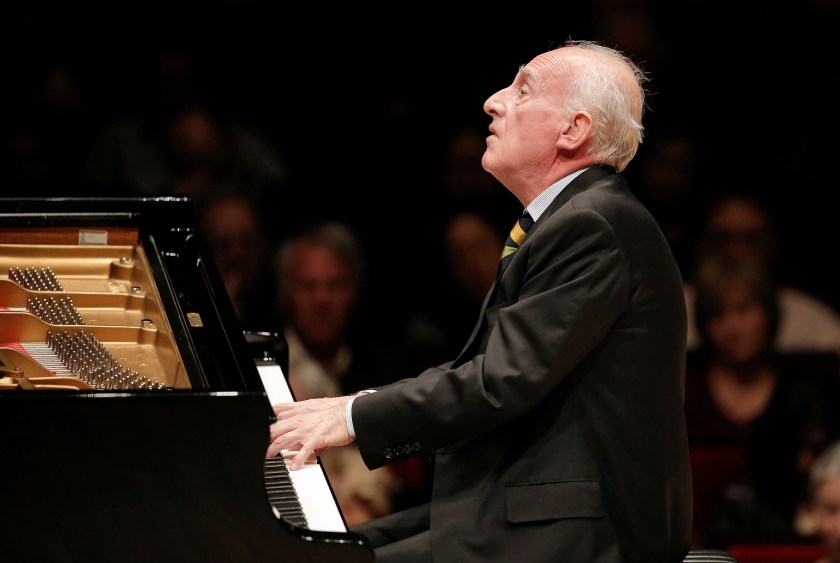
MAURIZIO POLLINI

Maurizio Pollini

Royal Festival Hall, 14th March 2017

Now I am afraid I don’t know much about classical music but I am learning. I can’t read music or play to save my life. There are vast chunks of the classical music canon that I don’t get on with. I have recordings of the composers I do get on with though in only a few cases do I have more than one recording of the same piece.

But I do know what I like (a statement which will need debunking when it comes to culture generally but that is for another time). And what I do like is Maurizio Pollini playing Beethoven. His recordings are my favourites (along with Paul Lewis, Glenn Gould and a bit of Ashkenazy). Now I have no doubt that there are other recordings I should explore but all in good time.

So suffice to say I was bound to like this. However I was not bowled over by his Chopin performances in February at the RFH (and I did not stay for the Debussy – on the list of stuff I don’t get on with I fear). This however was altogether a marvellous experience.

Pollini for me makes sense of the music in a way that I can understand. I gather some think him a bit cold and clinical if I read the reviews correctly but for me I hear the logic of the music laid out with perfect clarity with enough emotion to lift me up as well.

He kicked off with some Schoenberg. Now I know I am supposed to grasp why Schoenberg was so important to the development of C20 music. I am also coming on in leaps and bounds with my appreciation of contemporary classical music and have started (slowly) delving in to the likes of Xenakis and Ligeti for example. And I can genuinely say that I am starting to “get” some of this stuff.

I can also claim to be making progress with the boy Berg having seen and heard Woyzeck, Lulu and the Violin Concerto in recent months. No idea yet why Woyzeck is so clever in terms of musical construction as I can’t hear the structures yet but I think I will get there.

However so far Schoenberg has eluded me. Mind you that may reflect the fact that I have only heard that Verklarte Nacht a couple of times live and that to me is a bit of syrupy romantic tosh that I cannot fathom.

Now I can’t pretend that Mr Pollini has converted me but I did concentrate on the two pieces he played in a way that pleasantly surprised me: 3 Pieces for piano, Op.11 ; 6 Little pieces for piano, Op.19. More work for me to do but I think this may be the way into Schoenberg’s world for me. I still could hear a tonal thread but with enough variety and drama to draw me in.

As for the Beethoven well the stand out in the Op 13 “Pathetique” was the Adagio slow movement (mind you anything chorale like is bound to work for a simpleton like me) and I got a bit lost in the final Rondo but that was probably my fault for not concentrating enough. But after the interval the two movement Op.78 “à Thérèse” (I gather the F sharp major key here is the reason this sounds a bit different) and the Op.57 “Appassionata” (where Beethoven delights in exploiting leaps in piano technology) were simply wonderful.

To me Mr Pollini seems to be a little freer in his interpretations compared to the recordings. Mind you those recordings apparently span much of the career of an artist who has been at it for seven decades now. Imagine that. Going to work every day for nearly 60 years trying to get better at what you do whilst giving pleasure to everyone around you. That is “sticking it to the man”. (Indeed I gather Mr Pollini did indeed pursue a more classically politically engaged stance in the 1960s and 1970s making even more of a hero in my book).

Anyway this was just about perfect – I had the thing that I like about concerts when it works where you are just completely immersed in the music. Seemed to me that was shared by the audience (though there was some ar*e trying to record the Schoenberg on their phone until they were told off – I shall return to this subject in later posts but for me this is a bloody outrage).

So here’s the deal. This blog is generally aimed at the culturally curious armed with only a tiny bit of knowledge. For those who know they like or think they might like Beethoven and want to delve into the piano sonatas then this would have been no better way to start. For just a tenner (assuming you are prepared to compromise a bit on the sound at the back of the stalls and don’t mind not seeing the maestro’s hands at work) you can hear this music played by this man who surely ranks as one of the greatest living pianists.

Of course that is no use now it has been and gone but I highly recommend looking out for the great man’s return next year (March 2018). If Beethoven appears just grab a ticket or two.

And while you are at it treat yourself to the complete recordings of the Beethoven sonatas. it took a bit of time I gather for Mr Pollini to record everything but there they are – for £33 on Amazon you get 8 discs (don’t talk to me about downloads – I don’t understand why you wouldn’t want to own physical copies of this music). Get these and decent complete sets of the symphonies and the strong quartets and you will be well on the way to immersing yourself in probably the greatest music every written (the Fall excepted).