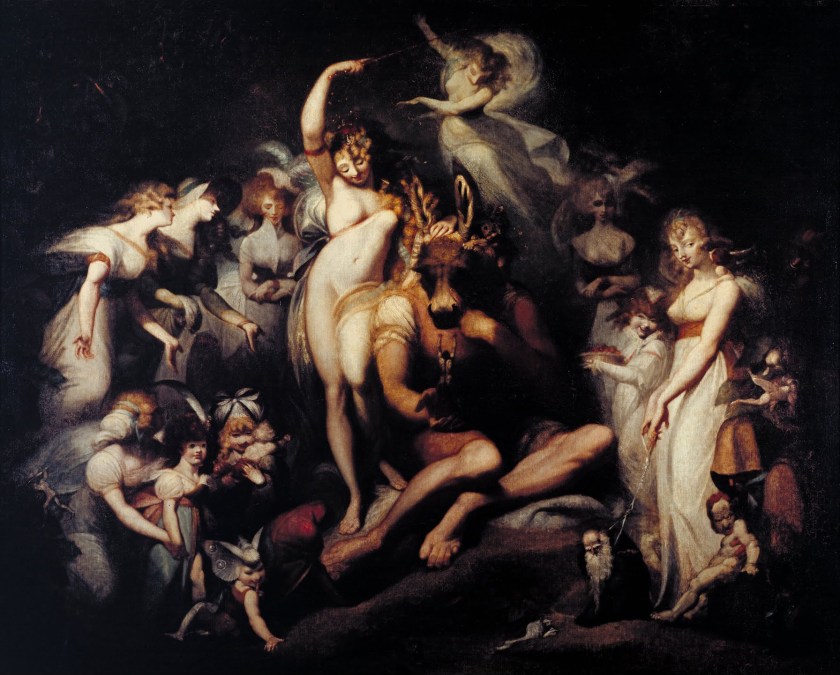
A Midsummer Night’s Dream at the ENO review *****

Henry_Fuseli_-_Titania_and_Bottom_-_Google_Art_Project

A Midsummer Night’s Dream

English National Opera, 4th March 2018

Out of a long list of wildly inappropriate events that I dragged BD along to when she was younger perhaps provocateur Christopher Alden’s production of A Midsummer Night’s Dream in this very house was the most egregious. Not because the 14 year old her wasn’t up to the task of taking some pleasure from Britten’s opera; she is a very clever young woman who makes me immensely proud, (as do the other two in the very unlikely event that they read this – “Dad, what exactly do you do with you day now you are no longer working”). No, it was because of the audacious sub-text of public school abuse which underpinned the production. Not that this wasn’t an interesting, and very valid, perspective, just that it maybe wasn’t quite the Dream we were expecting.

ENO has reverted then to the older, 1995, Robert Carsen production of AMND, last revived in 2004, to pull in the punters. Good for me because a) I haven’t seen it and b) it is brilliant. Now my regular reader will likely be aware that I struggle with a lot of opera. Monteverdi, some Baroque, Mozart and some C20, can work for me but it is by no means guaranteed. Contemporary opera is what usually really floats my boat. There is a special place for Britten though. This is because it is English, or more precisely was written in English, so I have half a chance of understanding the words with my dodgy ears and don’t have to flick eyes up and down to sur-titles. Moreover, there is a proper marriage between libretto and music. The music fits the words and the drama and not the other way round. Britten chose stories with real drama and assumed that all of his performers could act. This much is reiterated by the interview with Britten in the programme. I care about the voices but I am not smart enough to know just how good the singers really are. In contrast I can understand why an audience gets all juiced up when the Queen of the Night hits those F6’s in Der Holle Racht … but it doesn’t always make up for an unfunny Papageno, risible plot and all that crass symbolism.

So drama first, music second, voices third. BB was judicious in his choice of source material, whether it be Auden, Crabbe, Maupassant, James, Melville or Mann. And why not turn to the greatest of them all in Shakespeare. But where to cut AMND, to avoid creating a 5 hour extravaganza, and how to shape the music around an already musical text? This is where BB, and Peter Pears, who took full joint credit for the libretto with BB, is so clever. By cutting out all the arranged marriage preamble, with the insertion of just one new line, we jump straight to the forest with Oberon and Titania wrangling. We swiftly get to experience the three different, but interlinked, sound worlds that BB has created for fairies, humans and mechanicals. The chop does mean that when Theseus and Hippolyta finally pitch up it’s a bit of a jolt, but by then we have had so many musically signposted episodes it’s easy enough to apprehend. A little bit of nipping and tucking in the order of the episodes to match text to music does also make for some novel juxtapositions: cheeky BB and PP send the lovers to bed unmarried, for example. Anyhow it’s the Dream so most of the audience will be up to speed on the story..

As ever with BB there a lot of essentially simple musical ideas which mean a numpty like me can feel the structure even if I can’t break the language. These ideas are clothed in innovative execution though. The Balinese influences, the debt to Purcell and Ravel, a bit of unthreatening twelve note serialism, all are audible, for this is the opera where Britten meshes the orchestral coloration and technical precociousness of the early operas and orchestral works with the spare stripped back austerity of his last decade or so. That is why, to me, it always sounds strikingly fresh and approachable whilst still endlessly inventive. The repetitions tell us where we are, and who we are with, in the drama but also allow us to soak up those exquisite sonorities that BB excelled in producing.

Intelligent and beautiful music in the service of the drama, not just a parade of flashy tunes. Which is where director Mr Carsen comes in, or more exactly his assistant, Emmanuele Bastet who supervised this revival. If Will S has provided plot and poetry, BB a crystalline musical structure around it, then the director only has to respond with a few big, bold ideas, and, ta-dah, success. Which is what we have here thanks in large part to Michael Levine’s outstanding designs.. A giant sloping bed fills the stage. Emerald green (Oberon) and a nocturnal blue (Tytania) dominate with occasional flashes of crimson. The Trinity Boys Choir of fairies marches on and off in perfect unison. The mechanicals, look like what they are, and their props in Pyramis and Thisbe, strike the right note of amateurish craft. The humans virginal white is gradually besmirched before they appear, alongside King and Queen, in glittering gold. There is coup de theatre in the suspended beds. Backdrops and lighting follow the same sharp, uncluttered aesthetic. A sort of synthesis of symbolist, minimalist and colour-field art, or maybe child-like Expressionism. Whatever, it it spot on. Any AMND, whether opera or on stage, that gets too floaty and ethereal gets the thumbs down in my book. That is not what dreams are made of.

Our Puck here, in the form of actor Miltos Yerolemou, counterpoints the action with his actions as much as his words. He is a very funny clown, (note he last appeared on stage as the Fool in the Royal Exchange Lear with Don Warrington), with pratfalls and tumbles a plenty, but he is the glue which brings the fairy and human worlds, fleetingly, together. As well as the superb design it is the choreography which enthrals in this production, courtesy of none other than Matthew Bourne and updated here by Daisy May Kemp.

Counter-tenor Christopher Ainslie stood out for me as Oberon, but that’s the way the opera is written, and because he is really, really good. The quartet of Hermia (Clare Presland), Lysander (David Webb), Helena (Eleanor Dennis) and Demetrius (Matthew Durkan) were well matched. The last three of these, along with our Tytania, soprano Soraya Mafi, and Theseus, Andri Bjorn Robertsson are all ENO home-grown talents, whose slight lack of projection was more than compensated by their movement and flair for the drama (and comedy). Joshua Bloom was perhaps an overly grandiloquent Bottom but that mattered less when unmasked/un-assed.

AMND doesn’t require a big orchestra which means ENO newcomer Alexander Snoddy, who is Director of the Nationaltheater Mannheim, could bring out all of BB’s eloquent phrasing and still keep the volume restrained enough to ensure the cast could all be clearly heard.

A perfect opera then based on a near perfect play near perfectly realised. At times like these I can accept, just, that opera trumps theatre as the greatest of art forms.
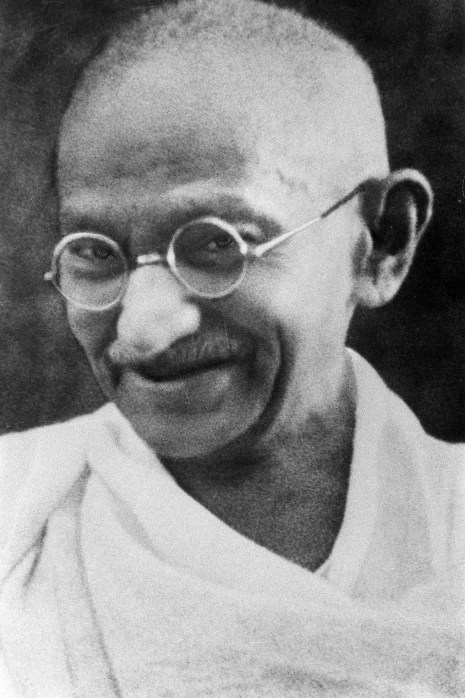
Satyagraha at English National Opera review ***

01/00/1998. File pictures of Mahatma Gandhi

Satyagraha

English National Opera, 27th February 2018

Finally I have got to see all three of Philip Glass’s seminal operas, Einstein on the Beach (the science-y one), Akhnaten (the religious one) and now this Satyagraha (the political one). Einstein on the Beach was a recreation of the original Robert Wilson production at the Barbican a few years ago. Gruelling in places, daft as well, and it looked pretty lo-fi. Akhnaten, also at the ENO with substantially the same creative  team, looked and sounded sublime, but overall I was middle-whelmed. And so it was with Satyagraha. Improbable’s staging certainly tops the already lofty heights they achieved in Akhnaten, and there was probably more to the story unfolding in Sanskrit, but the pleasure, and marginal pain, derived by this observer was not dissimilar.

Since I can’t really imagine more committed advocates than this creative team for these two operas I think I have to conclude that, if pushed, I prefer my Glass in other formats. Like the string quartets or the works for keyboards. That’s a terrible admission isn’t it. Anyway probably as well I know now as Mr Glass has written a fair few operas, 29 and counting, including the chamber works. Mind you he has been pretty busy across all genres. He’s already snuck in another string quartet this year for example I see. Anyway the profligacy of PG is both joy and curse for the committed fan of minimalism, or, as he terms it, repetitive music.

There is no doubt that there is a unique pleasure in succumbing to its hypnotic effect. Hearing the structures slowly change as the notes are added or subtracted. Melodies, motifs and harmonies appearing, disappearing and reappearing. Wave upon wave of sound, altering, circling, revisiting, but never really getting anywhere. Timeless. Meditative. All transcendent when it’s just you and the music. But with opera the whole point is to witness the music interact with the drama. And this is where the disconnect emerges. If you succumb solely to the music then the visual spectacle risks taking too much of a back seat. There is way too much stagecraft trickery to admire here though to permit drifting off into an hypnotic trance. Who would have thought so much could be done with papier-mache and sellotape? Yet the structure and pace of PG’s score, the episodic structure of the “action”, largely based on key events in the struggle for emancipation by Indians in South Africa, led by Gandhi, and the Sanskrit text, all make for very static human tableaux. And a lot of slow motion shuffling.

A spell is cast but there are times when it might be nice to be snapped out of the soporific contemplation into some high drama. Having influences on Gandhi past, present and future, in the form of Tolstoy, then Rabindranath Tagore, and finally Martin Luther King, lurking at the back of the set isn’t quite enough, and the wow moments as Improbable make newspaper come to life, create gods and monsters before our eyes or bring crowd scenes to life, don’t always articulate with the, you guessed it, non-linear story (based on my reading of the synopsis).

Still admire the parts. The marvellous chorus and orchestra led by Glass expert Karen Kamensek, (as in Akhnaten), moulded PG’s musical shapes effortlessly. I didn’t know that I had seem Improbable’s work before in a very different context, namely Lost Without Words at the National Theatre, improv theatre from a cast of older actors, which worked a bit better than I might have expected. AD’s Phelim McDermott and Lee Simpson, and here associate Julian Crouch, don’t lack for imagination or, based on Satyagraha, brilliance of execution. The go-to team for video design, 59 Productions, also leave their mark. Toby Spence gives us the Gandhi of myth, standing stock still for long periods, then bursting into his sumptuous tenor, but no sign of the man himself. The rest of the cast have even less opportunity to shape characterisation beyond the puppets they share the stage with. They all sounded great to me though, especially soprano Charlotte Beament, as Gandhi’s assistant.

The central message of Satyagraha, a Sanskrit word which Gandhi defined as “holding on to truth”, and which underpinned his theory and praxis of nonviolence, does sort of emerge from the production, but a bit of reading around, before and after, helps. The denial of self, the power of the collective, the effectiveness of planned and self-critical resistance. Think of this as a project. Put a bit of effort in and you might just learn something.

Or just do what I suspect the majority of the packed house at the ENO were doing, (this has been revived thrice, it is so “popular”). Gaze and listen in wonder and don’t get antsy about the fact it is all over the shop. At the end of the day the ENO has its hit and this, with its predecessor, is pulling in all sorts of punters who might, rightly in my view, give a wide berth to Verdi and Puccini.

Mind you I reckon this new generation of Glass converts might draw the line at the 5 hours of hippyish clap-trap that is Einstein on the Beach.


Mortal Voices: Academy of Ancient Music at Milton Court review ****

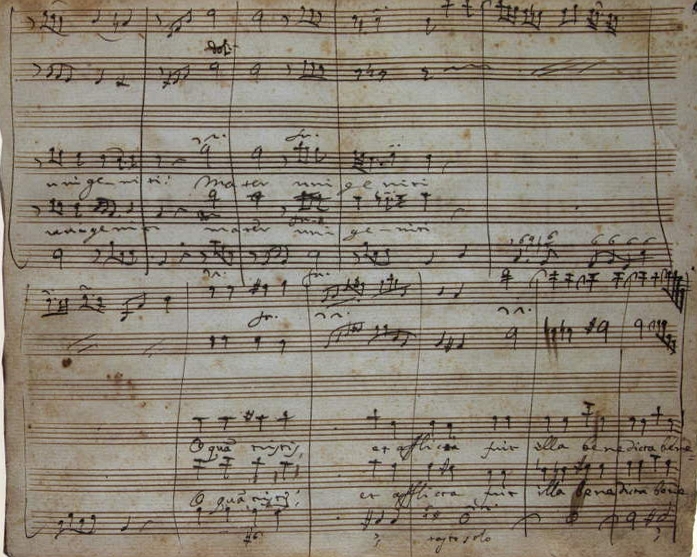
Pergolesi_Stabat_Mater_Autograph

Academy of Ancient Music, Christian Curnyn (director and harpsichord), Keri Fuge (soprano), Tim Mead (counter-tenor)

Milton Court Concert Hall, 15th February 2018

  • Corelli – Concerto grosso Op 6 No 1 in D major
  • Handel – Cantata HWV 230 “Ah! Che troppo inequali”
  • Handel – Cantata HWV 82 “Il Duello Amoroso”
  • Pergolesi – Stabat Mater

As usual after BUD and I had chewed over the big economic, social, philosophical and political questions of the day, and reminded each other just how clever we are, as well as scoffed on some tasty, if evil, fare at the redoubtable Bad Egg in Moorgate, there was minimal time for a preview of the evening’s entertainment. Which meant that BUD got the shock of his life when Tim Mead opened his mouth in the second of the Handel cantatas in the programme. He wasn’t expecting a counter-tenor. Especially from a man who could easily pass as the next James Bond given his rugged good looks and sartorial elegance.

My what a voice though. Now if you are a fully paid up, Baroque, (especially Baroque opera), and, increasingly, Contemporary classical, music enthusiast, you are going to come across a fair few counter-tenors. I think I have heard voices with more power and range than Mr Mead’s but not as much clarity and brilliance. This was apparent in the “Il Duello Amoroso”, a decidedly dodgy tale of unrequited love between a shepherd and a goddess, where the counter-tenor and soprano voices sparred elegantly. It really came to the fore however in Pergolesi’s wham-bam, smash hit Stabat Mater.

Pergolesi didn’t get up to much musically. Dying at 26 from TB didn’t help, and, if I am honest, the bits of his output I’ve heard, (or have recordings of), beyond the Stabat Mater aren’t that memorable. Churning out lightweight, comic operas, for your ADHD aristocratic patrons is not, unsurprisingly, a recipe for a lasting musical legacy. When he hit upon this medieval Latin setting of the Christian staple of Mary lamenting her son’s suffering on the cross, he struck gold though. Just a shame it was only completed a few days before he popped his clogs. Still thanks to Bach, and others, the score was widely disseminated in the C18 and has never gone out of fashion.

That’s because, musically and lyrically, he doesn’t hang around. The 12 verses make a virtue of brevity. None is more than 5 minutes long and the whole comes in at 40 minutes. There is loads of contrast, audible human touches and plainly programmatic twists where text and music are perfectly matched, and the fusion, for that is what it is, of Baroque and early Classical, means it is easy, and very affecting, on the ear. Others have had a stab at setting the Stabat Mater, Vivald and Haydn, come to mind, but this tops the lot.

Obviously the AAM, especially the strings, nailed the score, and gave plenty of space for the two excellent soloists to capture the drama and pathos of the setting. Whether individual aria or in duet both singers seemed to really care about the music and text. Forget the religious mumbo-jumbo, this is the moving story of a Mum’s grief. Best bit. The Fac ut portem Christi mortem from Tim Mead alone. Very moving.

I was less convinced by the Handel. That’s just me and Handel though. It is always a pleasant experience listening to GFH but it never really involves me.  Even 4 hours of his operas. I hope to get lifted up and swept along but always end up earthbound. Even, whisper it, in a Messiah. He’s a flash Harry make no mistake, and all those voices, here, there and everywhere, is proper WOW, but it all feels a bit devoid of emotion. A man can only have so much bouncing bass and celebratory trumpet action. Anyway I was happy enough to go with the pleasant enough flow in these two cantatas.

The programme kicked off with Corelli’s Op 6 No 1 Concerto Grosso. You cannot go wrong with that. The 12 Concerto Grossi are like a Corelli greatest hits collection. There will always be some stunning concertante work, the two violins and the darker cello, beefed up by the ripieno players, the rest of the band. This concerto has some brutally fast semiquavers stuff for the solo cello and his violin mates and some lovely lyrical, slower dances to kick off the first couple of movements. There is plenty of room to blag which Bojan Cicic, (he really is a top violinist), Rebecca Livermore and Joseph Crouch took full advantage of. The whole band though seems to delight in playing together. That is why, even if I am not absolutely sure of all the musical ingredients, I will try to see all their London concerts.

I recommend you try to do the same, especially if you are new to the Baroque. And I also heartily recommend you dip into recordings of Pergolesi’s Stabat Mater and Corelli’s Concertos if you haven’t already. You won’t regret it.

SCO Winds at Wigmore Hall review ****

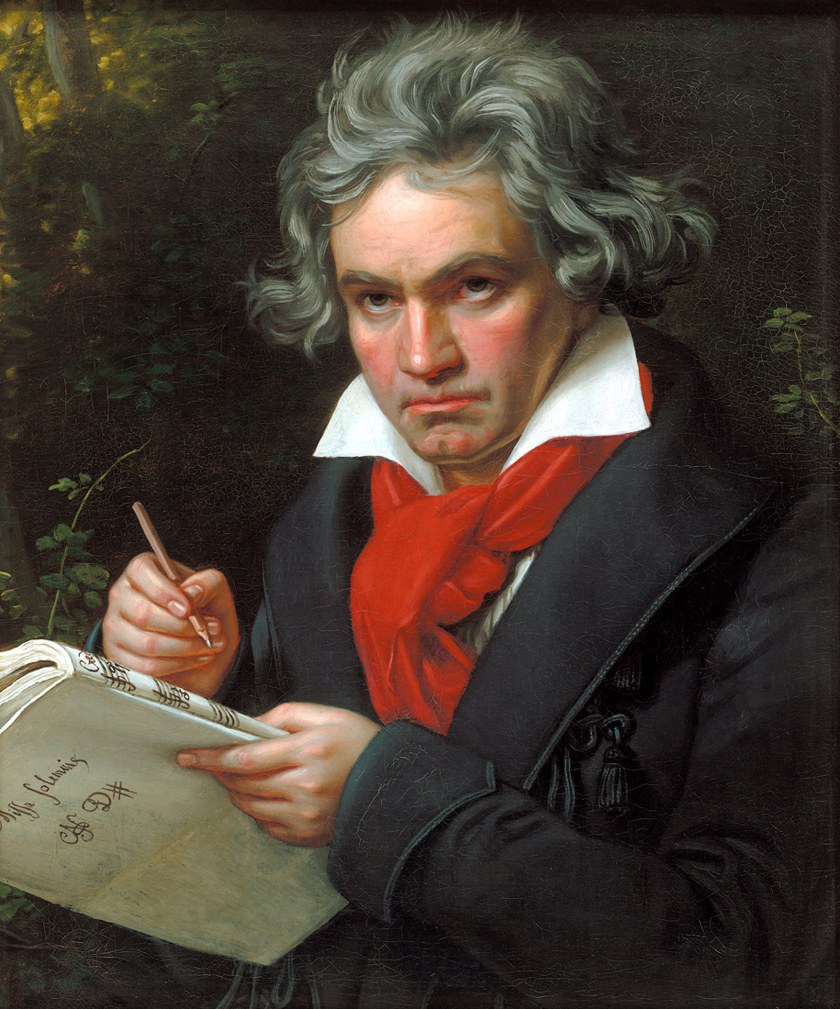
beethoven

Scottish Chamber Orchestra Wind Soloists

Wigmore Hall, 12th February 2018

  • Beethoven – Sextet in E flat, Op 71
  • Poulenc – Sonata for clarinet and bassoon
  • Beethoven – Octet in E flat, Op 103

A rare opportunity for completists to hear performances of Beethoven’s Sextet and Octet written for wind instruments. Now there is enough wind repertoire, (as it were), to keep a few ensembles ticking over on the side but, generally, if you like this sort of stuff, you have to keep a beady eye open and/or hear student performances. There doesn’t seem to be a widely available recording of these works, (there is one from the Chamber Orchestra of Europe but tricky to track down it seems). So to see the specialists from the Scottish Chamber Orchestra turn up at Wigmore Hall, with a new recording in tow, was an appetising prospect, at least for the Tourist.

The Sextet may be numbered Op 71 but it is a very early work from 1796 when the grumpy one was just getting going. He dismissed it later on but he was wrong, as, apart from a few dodgy songs, (never quite mastered that surprisingly), he never wrote a dull note. Scored for two each of clarinets, bassoon and horns, it may not approach the beauty and complexity of the Octet but there is more than enough to sink your teeth (or ears) into here. There is a fascinating syncopation early on from the clarinets in the opening Adagio and a simple four note motif from clarinets and bassoons emerges in the ensuing Allegro, with a second theme coming from first clarinet, before development and recapitulation brings in the bassoons and, properly, the horns. The bassoons then do most of the lifting in the lovely Adagio in B flat major, with horns coming in for the following Menuetto. The final movement is a classic(al) Beethoven foot tapping Rondo, with a march like theme with some horn blasts at the end. It’s not rocket science, it obeys all the rules but it is still inventive given the instrumentation. And the band coped admirably with a poorly chap in the audience. halfway through

I am always momentarily intrigued by Poulenc’s music but it never really turns into much more than this I am afraid. I know you are supposed to get fired up by his choral/vocal/operatic works but it all feels a bit of a trial and suffused with Catholic guilt. And the piano stuff is a bit lightweight. He did though deliver some boppy tunes for wind instruments in his chamber works, including this Sonata for Clarinet and Bassoon, here delivered, I think, by Peter Whelan and Maximiliano Martin. Given the two instruments and Poulenc’s style there is nothing very profound going on here and indeed the audience gets to snigger at the end of the second and final movements. There are echoes of Mozartian divertimenti, Stravinsky’s appropriation of the Classical and some jazzy touches. So correct boxes ticked and some interest in the returning downwards lines in first and second movements. And the boys seemed to be having a good time.

Now the Octet really is a fascinating piece. Published as Op 103, (so near the Hammerklavier for example), it was actually written in 1792, before the Sextet and when Ludwig was only 22. Scored for two each of oboe, clarinet, bassoon and horns it might have been started in Bonn when LvB was circling around the Elector of Cologne. It was finished when he was studying under Haydn, though subsequently revised a bit with the last Presto finale replacing the original ending Rondino WoO25, (which might have been nicely squeezed in to this programme – just saying). He even took it and turned it into the String Quintet in E flat Op 4 to get it a proper audience. It is a remarkably assured piece with the sort of invention you expect in much later Beethoven chamber pieces. The opening motif is given a proper working out in the opening Allegro in a myriad of ways, the following Andante is one of those languid, sing-songy Beethoven melodies that insinuates itself effortlessly into your head. Then he writes a Scherzo. It may be labelled a Menuetto but Scherzo it is, with the influence of mentor Haydn apparent but with some uncanny foreshadowing of the kind of barnstormers Ludwig would create later on, albeit still fairly polite. The final rondo gives the horns their time to shine (though they get fulsome opportunity earlier on) and is a properly upbeat ending.

So there you have it. Music written for instruments favoured by German and Austrian courts from a time when Beethoven had to play the game and before he went all serious artist, look-at-me. But even this is so much more than the kind of burbling, bubbling, babbling wind pieces that these toffs at the time loved. A pleasure to hear, made more pleasurable by these expert interpreters. Chalk up another CD sale ladies and gentlemen of the SCO.

Stravinsky from the LPO at the Royal Festival Hall review ****

homepage_carousel_stravinsky

London Philharmonic Orchestra, Vladimir Jurowski, Alexander Ghindin (piano)

Royal Festival Hall, 7th February 2018

  • Igor Stravinsky – Scherzo fantastique, Op 3
  • Igor Stravinsky – Funeral Song, Op 5
  • Nikolai Rimsky-Korsakov – Piano Concerto in C sharp minor, Op 30
  • Igor Stravinsky – The Firebird (original version)

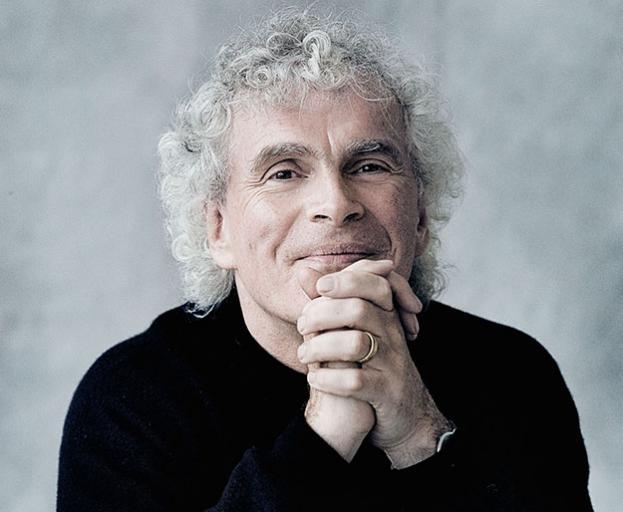
My favourite concert of last year was Sir Simon Rattle and the LSO’s take on the three, culture changing Stravinsky ballets. Just stunning. (My favourite classical concerts of 2017).

Suffice to say that whilst Sir SR’s Petrushka and Rite of Spring were, (predictably), barnstorming it was The Firebird which really made me sit up, listen and think. Firstly because it was the original full ballet score which I do not listen to often enough. (I have recordings by Rattle/CBSO, Dutoit/Montreal SO, Abbado/LSO and Salonen/Philharmonia so its not as if I have an excuse). Secondly because he, and the LSO, were able to show how much of even the Firebird looks forward to the subsequent two ballets and the announcement to the world of Stravinsky’s own, revelatory voice, as well as back to mentor Rimsky-Korsakov’s orchestral colouration. And thirdly because it was just so good, even in the more restrained, colourful first half which was glorious.

Now the LPO are engaged on a year long survey of Stravinsky’s orchestral works (Changing Faces: Stravinsky’s Journey) with Vladimir Jurowski and other conductors, (as did Esa-Pekka Salonen and the Philharmonia in 2016), though many of the headline concerts are mixed up with all sorts of other repertoire. The intention is to show just how profound Stravinsky’s influence has been on the direction of classical music, as well as showing how varied were his own influences. To be an artist who is better than all who came before is a miracle. To be an artist who changes the entire direction of his/her art, whilst still acknowledging the past is mind-blowing. That is what the boy Igor did. Composers are still wrestling with his legacy. So you can’t have too much of Igor’s music I reckon. Especially when each time you listen something new pops up.

Still he had to start somewhere and Mr Jurowski and his band chose to kick off this evening with Scherzo fantastique, which along with Fireworks (Op4) and the Symphony in E flat major (Op 1), is the starting point of Stravinsky’s career. The influence of Rimsky-Korsakov, the other nationalist Russians in and around the Five and the folk-art primitivism which was prevalent pre-, (and even post-Revolution), can be clearly heard, of course. There is something more at work here in terms of ideas though, albeit still melodic, not rhythmic and avowedly late Romantic. After dissing all this “juvenilia” Stravinsky in the 1960s did eventually accept that it wasn’t half bad.

Funeral Song is a proper step forward though. This is getting performed all over the place since it was rediscovered in some broom cupboard in St Petersburg in 2015. Indeed this very band and conductor programmed it with their thunderous Shostakovich Eleventh at last year’s Proms (London Philharmonic Orchestra at the Royal Albert Hall review ****). It was composed in 1908 as a tribute to Rimsky-Korsakov and Stravinsky remembered it as being more advanced in terms of chromatic harmony than any of his previous works. He was right on that score (geddit). The idea is that each of the instruments file past the master’s coffin, though often in ear-catching dialogue. It is a much darker piece than the earlier works and when it gets going there is an undeniable Wagnerian bombast to it which he just about gets away with. Anyway the point is that here some of the sound-world of the Firebird is creeping out for the first time.

Before we heard the LPO take on the Firebird we were treated to N R-K’s Piano Concerto, and treat it was. Now it is pretty easy to get sniffy about all these C19 Russian sound painters. I think I might have done. All this folk tune authenticity is exciting on first hearing but I find the novelty soon wears off. Which means I haven’t really bothered with this part of the repertoire. The chances of coming across this concerto were pretty slim as I gather it is rarely performed. It is a compact piece, one movement running to just 14 minutes though with three distinct sections, fast/slow/fast with a slow opener. For me that was its attraction but I can see that, for soloist and maybe audience, there is not enough grand gesture here to take on the canonic piano concertos. Rachmaninov is your best comparator but where Sergei would have spun out these ideas to 45 minutes, N R-K keeps it tight, with essentially just one theme, based, you guessed it, on a folk tune. The tune was sanctioned by the daddy of Russian nationalistic music Mily Balakirev who apparently gave this the thumbs up, though he became more critical of N R-K’s later work, thinking it veered into the “academic” and “Germanic”. There are plenty of flashy cascades a la Lizst which soloist Alexander Ghindin revelled in and the LPO accompaniment, especially from the woodwinds, was very persuasive. Mr Ghindin encored with the Dance russe from Petrushka to give us another take, though this felt a bit heavy-handed to me, (the playing not the linking). Maybe he had a plane to catch.

This was a clever piece to set up Mr Jurowski and the LPO’s take on The Firebird. Now when they get it right, this band and its conductor can match the best I have heard. It doesn’t always work, sometimes the line gets lost a bit, but tonight it did. Here was Stravinsky’s first real masterpiece, the debt to N R-K still audible, but with all the stunning innovation, which took Diaghilev’s breath away on first hearing, highlighted. From those growling double basses in the intro, though the shimmering strings in that magic garden, the riot of woodwind colour as our Bird takes flight, off stage brass action as Ivan bombs da house and monstrous tuba and percussion as Kastchei’s rave takes off, all sections were given a chance to shine. If I had to pick out specific contributions, well, Juliette Bausor’s flute was terrific, as well as David Pyatt and the other horns, the tuba of Lee Tsarmaklis and the piccolos of Stewart McIlwham and Lindsey Ellis.

I see I have signed up to a number of LPO concerts that have a sprinkling of Stravinsky in the mix. Whether they are part of this Changing Faces season is not entirely clear to me. No matter. You can’t get enough Igor after all.


My favourite classical concerts of 2017

623x512xrattle625_2-pagespeed-ic_-clbnppbu_4_0

Right I know it is a bit late in the day but I wanted to make a list of the concerts I enjoyed most from last year. So everything that got a 5* review based on my entirely subjective criteria is ordered below. Top is Sir Simon and the LSO with their Stravinsky ballets. Like it was going to be anything else.

Anyway no preamble. No waffle. Barely any punctuation. Part record, part boast. Comments welcome.

  • LSO, Simon Rattle – Stravinsky, The Firebird (original ballet), Petrushka (1947 version), The Rite of Spring – Barbican Hall – 24th September
  • Colin Currie Group, Synergy Vocals – Reich Tehillim, Drumming – Royal Festival Hall – 5th May
  • Isabelle Faust, Akademie fur Alte Musik Berlin, Bernhard Forck – JS Bach Suite No 2 in A Minor BWV 1067a, Violin Concerto in E Major BWV 1042, Violin Concerto in A Minor BWV 1041, Concerto for Two Violins in D Minor BWV 1043, CPE Bach String Symphony in B Minor W 182/5 – Wigmore Hall – 29th June
  • Jack Quartet – Iannis Xenakis, Ergma for string quartet, Embellie for solo viola, Mikka ‘S’ for solo violin, Kottos for solo cello, Hunem-Iduhey for violin and cello, ST/4 –1, 080262 for string quartet – Wigmore Hall – 25th February
  • Britten Sinfonia, Thomas Ades – Gerald Barry Chevaux de Frise, Beethoven Symphony No 3 in E Flat Major Eroica – Barbican Hall – 6th June 2017
  • Nederlands Kamerkoor,Peter Dijkstra – Sacred and Profane – Britten Hymn to St Cecilia, Gabriel Jackson Ave Regina caelorum, Berio Cries of London, Lars Johan Werle Orpheus, Canzone 126 di Francesca Petraraca, Britten Sacred and Profane – Cadogan Hall – 8th March
  • Tim Gill cello, Fali Pavri piano, Sound Intermedia – Webern 3 kleine Stücke, Op. 11, Messiaen ‘Louange à l’Éternite du Jesus Christ’ (‘Praise to the eternity of Jesus’) from Quartet for the End of Time, Henze Serenade for solo cello, Arvo Pärt Fratres, Xenakis Kottos for solo cello, Jonathan Harvey Ricercare una melodia for solo cello and electronics, Thomas Ades ‘L’eaux’ from Lieux retrouvés, Anna Clyne Paint Box for cello and tape, Harrison Birtwistle Wie Eine Fuga from Bogenstrich – Kings Place – 6th May
  • Britten Sinfonia, Thomas Ades, Mark Stone – Gerald Barry Beethoven, Beethoven Symphonies Nos 1 and 2 – Barbican Hall – 2nd June
  • Academy of Ancient Music, Robert Howarth – Monteverdi Vespers 1610 – Barbican Hall – 23rd June
  • Academy of St Martin-in-the-Fields, Murray Perahia – Beethoven Coriolan Overture, Piano Concertos No 2 in B flat major and No 4 in G major – Barbican – 20th February
  • London Sinfonietta and students, Lucy Shaufer, Kings Place Choir – Luciano Berio, Lepi Yuro, E si fussi pisci, Duetti: Aldo, Naturale, Duetti: Various, Divertimento, Chamber Music, Sequenza II harp, Autre fois, Lied clarinet, Air, Berceuse for Gyorgy Kurtag, Sequenza I flute, Musica Leggera, O King – Kings Place – 4th November
  • Maurizio Pollini – Schoenberg 3 Pieces for piano, Op.11, 6 Little pieces for piano, Op.19, Beethoven, Piano Sonata in C minor, Op.13 (Pathétique), Piano Sonata in F sharp, Op.78 (à Thérèse), Piano Sonata in F minor, Op.57 (Appassionata) – RFH – 14th March
  • Britten Sinfonia, Thomas Ades, Gerald Barry – Beethoven Septet Op 20, Piano Trio Op 70/2. Gerald Barry Five Chorales from the Intelligence Park – Milton Court Concert Hall – 30th May
  • Bavarian Radio Symphony Orchestra, Mariss Jansons, Yefim Bronfman – Beethoven Piano Concerto No 4, Prokofiev Symphony No 5 – Barbican Hall – 24th November
  • Britten Sinfonia, Helen Grime – Purcell Fantasia upon one note, Oliver Knussen, George Benjamin, Colin Matthew, A Purcell Garland, Helen Grime Into the Faded Air, A Cold Spring, Knussen Cantata, Ades Court Studies from The Tempest, Britten Sinfonietta, Stravinsky Dumbarton Oaks – Milton Court Hall – 20th September


Nicola Benedetti and the Orchestra of the Age of Enlightenment at the Royal Festival Hall

75984-nicola-benedetti-headshot-6-simon-fowler-resized

The Orchestra of the Age of Enlightenment, Marin Alsop, Nicola Benedetti

Royal Festival Hall, 4th February 2018

  • Beethoven Symphony No 4 in B flat
  • Beethoven – Violin Concerto in D major

“Stardom” in the classical music world is a curious thing. To get there ideally you need to be a child prodigy. Then take a prize at your chosen music school. Get taken under the wing of a teacher and mentor, (more than one ideally), who are maestros from prior generations. Win a competition prize, or finish as a creditable runner-up, and secure a few prestigious gigs. A recording of a Romantic staple which tests the previous best recommendations. Set yourself up with your own festival in the middle of nowhere. Teach the kids and the underprivileged and travel. A lot. And, if you are a woman expect a load of airbrushed photos of you exuding grace, or if a bloke, brooding, ideally with a shock of unkempt hair. Make the cut, and there aren’t that many places available, and you are set up, literally, for life.

Obviously though you need talent and a level of dedication far beyond other jobs/professions/vocations. And even if you get to the top of the tree you are still only going to be appreciated by a minority of the population. Ah, but the pleasure you bring them cannot be measured.

Just occasionally though classical musicians break out into the wider consciousness by virtue of their genius, position and/or symbolism. In this concert I would contend we had two such musicians.

It is hard to overstate the importance of Marin Alsop’s rise to the top of the conducting profession. Recently appointed as Artistic Director for the Vienna Radio Symphony Orchestra, alongside her leadership of the Baltimore and Sao Paolo Symphony Orchestras, she is probably best known to the general public from her two recent stints at the Last Night of the Proms. Here at the South Bank, where she is an Artist in Residence, she was given the award from the Association of British Orchestras, the trade body if you will. Let us hope she continues to inspire women to follow her. (I am looking forward to hearing Mirga Gražinytė-Tyla and the CBSO perform the Rite of Spring and Daphnis and Chole later in the year at the Barbican for example). There is a long way to go. Vienna’s other orchestra, the Philharmonic, didn’t permit women until 20 years ago (though they had a secret woman harpist, bloody hypocrites) and the unacceptable behaviour of certain male conductors is now being revealed. Ms Alsop is proving a powerful and eloquent champion and should be roundly supported for her work and her stance.

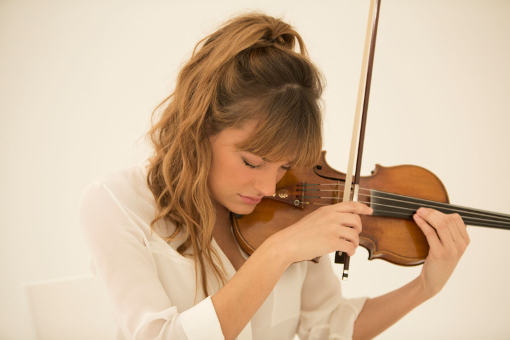
Nicola Benedetti has also proved capable of transcending the usual confines of classical music. Her recordings to date have not fought shy of delivering the popular “compilations” that shifts units. There was a packed house for this concert, and I would venture the majority were here just to see Ms Benedetti. This country is blessed with a rich classical music culture, (though maybe not quite as rich as Central and Eastern Europe), and there are plenty of talented musicians and marvellous composers. But world class soloists are a little thinner on the ground. So it is no wonder that Ms Benedetti, who is still just 30 years old, is so treasured, what with her MBE and Queen’s Medal for Music. Note I am unashamedly claiming her for Britain: she is unequivocally proud to be Scottish.

This was the first time I had heard her play. In a piece I now know well and, obviously, adore. With a band which comprises musicians who are at the top of their period music game. On a period fiddle whose sound I understand. This was Ms Benedetti’s first time with the OAE. (She will be joining the Academy of Ancient Music at the Barbican at the end of May in a programme of Vivaldi and Telemann. BUD and KCK have been signed up). Though not the first time she has played with gut strings. Ballsy then to take on Beethoven, the Daddy of the modern violin concerto, in a period performance.

So I couldn’t tell you what live sound she makes on steel strings, but, on the basis of this, it is probably something special. Here was a sweet, earthy and perfect tone but with a huge dynamic range. Very impressive. Especially in the slow movement Larghetto. And a real treat in the cadenza she has written specially in conjunction with Petr Limonov, what with its jamming with the timpani manned by Adrian Bending, (who also gets his big cameo in the opening and second movements of the Fourth Symphony remember), and its harmonic fantasy culminating in some showy pizzicato. Obviously you wouldn’t turn your back on an old-fashioned, knock ’em out between the eyes rendition, (my favoured recording is the Perlman/Barenboim/BPO which really pumps it up in the last movement), but this was still very satisfying. This is, after all, Beethoven’s least gruff, un-buttoned up orchestral masterpiece, set in its Happy D home key.

I wasn’t quite so persuaded by Marin Alsop’s treatment of the Fourth Symphony. Now I know it is a funny creature, murky and tentative in places, with those stop/starts, and it gets a bad rap compared to the Third and Fifth. But there is still lots to enjoy and explore. The OAE’s brass was in fine fettle but the woodwind was occasionally not quite what I expected and the strings felt a little too polite in the adagio vivace of the first movement, after that mysterious opening, and in the final allegro, which needs that massive contrast into the stalls. Tempi were a little on the slow side for me but then again I get off on John Eliot Gardiner and the Orchestre Revolutionnaire Et Romantique’s Beethoven cycle, especially in this symphony. Here Ms Alsop, as in the Violin Concerto, was most convincing in the slower movement.


Estonian Philharmonic Chamber Choir at Milton Court review ****

estonian20chamber20choir2028c2920kaupo20kikkas

Estonian Philharmonic Chamber Choir, Kaspars Putnins (conductor)

Milton Court Concert Hall, 30th January 2018

Arvo Part

  • Solfeggio
  • Summa
  • Magnificat
  • Zwei Beter
  • The Woman With the Alabaster Box
  • Nunc dimittis
  • Dopo la vittoria

Cyrillus Kreek

  • Onnis on inimene (Blessed is the Man)
  • Psalm 104

Jonathan Harvey

  • Plainsongs for Peace and Light
  • The Angels

Veljo Tormis

  • Kutse jaanitulele from Jaanilaulud (St John’s Day Songs for Midsummer Eve)
  • Raua needmine (Curse Upon Iron)

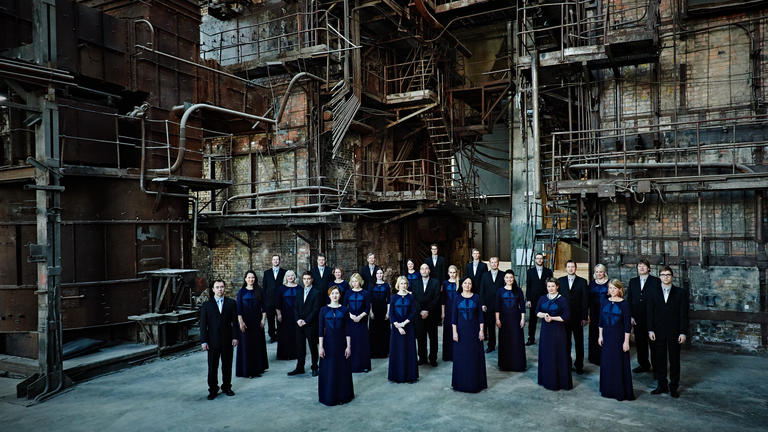
Now I gather that the Estonian people like a sing-song. Choirs are a big deal there and choral singing and national identity are tightly bound together. They even had a Singing Revolution between 1987 and 1991 as they sought independence from the Soviet Union. So this evening was an event and was graced with the presence of no less than Estonia’s Prime Minister Juri Ratas.

Now I am not going to pretend this was the main draw for me. Profound apologies Your Excellency, but what intrigued me was the opportunity to here some of the choral works of the mighty Arvo Part sung by his country men and women. Albeit mostly in Latin, with a German, English and Italian text thrown in for good measure. Now I genuinely believe that the magic of Part’s “holy minimalist” tintinnabuli can work on anyone. I believe I am right in saying he is the most performed living “classical” composer. That doesn’t mean people are whistling Speigel am Speigel on every street corner though. This is still a minority pastime, but I do think there is something in his music, (and the spaces between the notes), which can burrow into the soul of all who come across it. Not that they have souls. That is obviously mumbo-jumbo. Old Arvo might sign up to Orthodox Christianity but not me. But it does something. Even if it is just to clear the head and leave you suspended in the sound for the duration of the piece.

So it was a pleasure to rope in MSBD to the Part party. Now, in retrospect, it might have been better to break him in gently with the usual programmatic device of interspersing Part’s choral works with other contemporary composers who relish the challenge of a choir as well as selected Renaissance masters. Even I have to admit that seven of Part’s choral works back to back can induce a slowing of the heart rate that is difficult to distinguish from slumber.

The opener Solfeggio is particularly interesting. It was originally written in 1964, though I think refined in 1993, which means it actually came before Part announced himself to the world with the bang. crash, wallop of Credo for chorus, orchestra and piano in 1968. This remember was when Part was a paid-up serialist, although Credo for my money is still a cracking piece of music. Solfeggio asks the choir to trot out an ascending C major row in strict serial fashion, singing, would you believe, “do re mi … “, but you’d be hard pressed to tell it apart from the “classic” Part style which emerged in 1977 after the several year hiatus and his personal enlightenment.

Summa is a setting of the Credo from the Latin Mass, though its title conceals its origin,  composed in the pivotal year of 1977. It was, along with Part’s settings of the Magnificat (1989) and Nunc dimitis (2001) for the Anglican evensong, the most entrancing of the evening’s performances. The Estonian Philharmonic Chamber Choir has a bewitching and very exact delivery with clear definition across the parts. This means the intriguing shifts that Part employs here, and the shimmering climaxes, especially in the Nunc, seemed more suited to their style. In contrast the more direct The Woman with the Alabaster Box from 1997, sung in English and which sees adjacent thirds appear under long sustained notes, was less thrilling to me than the Latin texts, which are all based on Part’s “classic” stepwise triads.

Zwei Beter, based on the parable of the Pharisee and the Publican I gather, is a more complex beast, (it’s all relative mind you), with denser harmonies and sung in German. Now one way or another I have recordings of most of Part’s works, (I think some remain unrecorded), but I didn’t know this piece at all. In contrast I am familiar with Dopo la vittoria from 1996 which is also somewhat more “complex” than the Latin texts. Sung in Italian this “piccolo cantata” tells the story of the baptism of Augustine by St Ambrose, (who apparently broke into song whilst doing the necessary), the patron saint of Milan for which city it was written. There is a discernible story with defined sections, including a brisk opening and ending, and some pronounced homophony at crucial, uplifting points. Who said Part all sounds the same.

After the interval we were treated to a pair of psalm settings by Cyrillus Kreek, an Estonian composer from the generation prior to Part, and a man who devoted his life to setting the country’s rich legacy of folk songs into choral arrangements. These songs stem from the wave of Estonian nationalism that stirred in the second half of the C19. These two pieces were very easy on the ear and sung with real conviction by the choir. A pair of works by British composer Jonathan Harvey followed, from the end of his career. Harvey regularly turned to choirs alongside his electronic and chamber pieces. The Angels was set by the Bishop of Winchester to which Harvey adds a hummed accompaniment. Plainsongs is more substantial polyphony with some beautiful, gently dissonant passages across its sixteen parts.

Finally the EPCC treated the audience to two works from Veljo Tormis, who passed away last year, after actually retiring in 2000. Slightly older than Part, but possibly even more renowned in his homeland, with a huge body of choral work to his name. Most of the settings stem from Estonian folk songs and I gather it is fair to say he has inspired multiple generations with his music. He was born during Estonia’s short lived inter-war period of independence, lived through the German and Soviet annexations and the Socialist Republic, and through to independence again. He mixed with all the big names during his musical education in Russia and was “honoured” with his own KGB files.

The first piece belongs to a cycle which describes the important Midsummer celebrations. It starts simply enough but builds into something more sophisticated. The Germanic influence is clear. But this was just a taster for the extraordinary Curse of Iron which followed. Apparently this gets a fair few airings outside Estonia and it isn’t difficult to see why. To the rhythm of a simple drum beat throughout, and with solo bass and tenor parts, Mr Tormis sets a story based on a Finnish epic, but sung in Estonian. It is, like it says, a curse on iron, as you do, and it is very dramatic. A ritual with repeated ostinatos, I have never heard anything like it. Neither had MSBD. Imagine a kind of shamanistic chant which ends up with sopranos warning against nuclear proliferation. Can’t. Well go and hear it then. It’s on I-Player since the concert was recorded for Radio 3.

Estonian Philharmonic Chamber Choir concert recording

A riveting way to end the concert and unsurprisingly the EPCC, and especially their Latvian conductor Kaspars Putnins, were having a ball during it. If I were part of the Estonian guest party I would have found it pretty difficult not to get up and join in. Pride in their country but pride in Europe too methinks. Great stuff.

Britten Sinfonia at Wigmore Hall review *****

jackie-shave-900x900

Britten Sinfonia

Wigmore Hall, 24th January 2018

  • Heinrich Biber – Mystery Sonata No 1 “The Annunciation”
  • Philip Glass – Orbit
  • Leo Chadburn – Five Loops for the Bathyscaphe
  • Arvo Part – Spiegel am Spiegel
  • WA Mozart – Piano Trio No 3 K502

There is something of the spirit of punk about the Britten Sinfonia. They don’t have a principal conductor or director and play with pretty much who they like. They also play pretty much what they like with a refreshingly cavalier attitude to programming. I love them, whether it be a Bach St John Passion, electrifying accounts of the Beethoven symphonies under Thomas Ades, minimalist classics, Stravinsky, Ravel or contemporary British composers, all of which I have heard them perform in the last year or so.

So I was looking forward to this. Leo Chadburn’s new work Five Loops for Bathyscaphe, is scored for piano trio and electronics and runs for 10 minutes or so. So Jacqueline Shave (that’s her above), one of the violin leaders of the BS, Caroline Dearnley, the principal cello, and Huw Watkins, principal piano, had another 50 minutes or so to fill. What to choose? Mozart? Why not. After all his B flat minor trio is pretty much the first piano trio as we know the form, with all three instruments contributing rather than just a piano sonata with a bit of string diddling attached which previously defined the Classical form. And Arvo Part’s Speigel am Speigel? Yep, it’s a slam-dunk crowd-pleaser for violin and piano. But chucking in Philip Glass’s short piece, Orbit, for solo cello. And the first of Biber’s Mystery sonatas? Well as it turned out it all slotted together perfectly.

Now I have been unlucky in my endeavours to hear a performance of Biber’s Mystery, (or Rosary), sonatas for violin and continuo live. There are 15 of these chaps, divided into 3 cycles, Joyful, Sorrowful and Glorious, plus a closing Passacaglia for solo violin. Each one takes as its subject one of the Catholic “rosary”episodes in the life of the Virgin Mary. They were likely written in 1676 but were unknown until 1905 ,and they are one of the earliest and best known examples of “scordatura”, where the violin is tuned in a way that is not standard. This permits all sorts of funky effects. Don’t test me on this but it is pretty straightforward even for a dumbass like me to hear the differences. One of the Vivaldi Op 9 Le Cetra concertos does this, Stravinsky does it at the start of the Firebird and Ligeti’s Violin Concerto is a prime example. Mind you Ligeti chucks so many effects into his concerto I am hard pressed to know where it is.

Biber tests the skill of the violinist to the max so it is a unlikely anyone was up to the job in the C17. What is on the page doesn’t correspond to what hits the ear. Don’t worry it doesn’t get too weird but it does create sounds, chords and harmonies with real drama. Now unfortunately we only got the first instalment here, which is the one which doesn’t arse about with the tuning, but it was still a blinder to open the concert with and Ms Shave delivered. It opens with a virtuoso figuration, being the Angel appearing before  our Mary, and them moves into a gentler sort of theme and variations.

The Glass “sonata” was new to me. The programme notes suggest Glass is referencing Bach’s mighty cello suites. He is. But then again anyone that writes a piece for solo cello is working in the shadow of the master. Even so lots of fancy figuration and double stopping does conjure up Bach’s counterpoint and Glass’s ordered repetitions are redolent of JSB’s own structures. Ms Dearnley is at home here as she is in the Baroque.

Now I have listened to, and seen performed, Part’s Speigel am Speigel, more times than I care to remember. It is one of my favourite pieces of music period. Which probably shows how easily pleased I am. This was one of his first “tintinnabuli” works, along with Fur Alina, from 1978, and it is “minimal” even by his standards. Simple arpeggios in piano and rising, then falling, scales from violin. If you are ever too worked up about anything just pop this on. Hey presto, blood pressure plummets. Now Ms Shave and Mr Watkins seemed to take this at a marginally faster tempo than I am used to, (it is all relative as not much happens), and took a minute of two to get in the groove, but once there it was as good a performance as you will hear.

I tried with the Mozart. Honestly. If I switch off and let it drift around and through me then it is pleasant enough but I still don’t really get it. Just too nice. Obviously there are bits of Mozart, and times when I listen to it, like watching a great Figaro, where it lifts me up and takes me away, but this wasn’t one of them.

Which brings me to the Leo Chadburn premiere, co-commissioned by the BS and Wigmore. I knew nothing about Mr Chadburn but I gather he is one of these new brand of musician/composer who doesn’t give a fig for established boundaries. He writes and performs across genres, releasing three synthpop albums a few years ago as alter ego Simon Bookish, and remixing for the likes of Grizzly Bear. He can certainly sing a bit I gather. This piece takes the classic piano trio instrumentation and hooks in pre-recorded voices from himself and Gemma Sanders, and some sparse electronica. It graphically describes the journey on 23rd January 1963 of oceanographers Jacques Piccard and Don Walsh to the bottom of the ocean. Eleven kms down to be exact in the Mariana trench, in that little ball Bathyscaphe Trieste thing. The idea of the piece is to create a sense of motionlessness in the music, deep and watery I guess, and allow the voices and words to tell the story. It succeeds admirably. There is nothing to scare anyone off in this simple but very effective sound-world. Think eerie harmonics from the strings and muffled chords from both ends of the range for the piano, as well as some theatrical plucking from inside the piano. The whole thing grips from first to last. It deserves a much wider audience. I am sure Mr Chadburn knows how to make that happen.

This whole concert was a joy. Music for everyone. Even if they know absolutely f*ck all about any of it. Still I suppose if they all prefer listening to a little ginger chap who has the temerity to suggest he is the next Van Morrison, then who am I to argue. Just seems a shame. Still that’s your pesky, high/low culture divide in late neo-liberal, capitalist society for you.

Colin Currie Group at Kings Place review ****

colin-currie-group_3_credit-chris-_web-billboard-2000x1125

Colin Currie Group

Kings Place, 20th January 2018

Steve Reich

  • Music for Pieces of Wood
  • New York Counterpoint
  • Mallet Quartet
  • Drumming Part 1
  • Vermont Counterpoint
  • Quartet (2013)

So off to Kings Place for another immersion into the sound world of Steve Reich guided by his finest living advocates (probably), the Colin Currie Group. Having seen the CC Group perform Reich a couple of times in the past couple of years, (at the RFH), I consider myself something of a groupie. I was honoured this time to be accompanied by not one, but two, potential converts to the live, minimalist music cause in the shape of MSBD and MSBDB. And, to emphasise, you really do need to hear this live for the full effect.

I won’t bore you with another hagiography extolling the virtues of Mr Reich. Take a look here if you want that (Steve Reich’s Drumming and Tehillim at the Royal Festival Hall review *****). Suffice to say I urge anyone to give his music a whirl and see what you think. I won’t hold it against you if all that repetition sends you to sleep. Me, I am fascinated by it. Out of apparent rhythmic simplicity emerges music of shimmering and unsettling intensity.

On the subject of repetition in music I promised myself I would not use this blog to eulogise the now departed Mark E Smith. Let’s just say RIP. Hands down the most important creative force in my lifetime.

Anyway this gig kicked off with Music for Pieces of Wood written in 1973. Which is exactly that. Though these are not any old offcuts having been specially selected for their pitches, A, B, C, sharp D sharp and another D sharp an octave higher, and timbre. It is built entirely on patterns of beats and rests over three lengths 6/4, 4/4 then 3/4. That’s it. As so often with Mr Reich the apparent simplicity though belies its careful planning and the subtlety of outcome. There is no place to hide for the players here.

New York Counterpoint from 1985 sees a clarinettist, here Timothy Lines, pre-record ten different parts, including for bass clarinet, which is prominent in the last movement, against which he plays a final, eleventh line, live. Vermont Counterpoint from 1982, here performed by flautist Rowland Sutherland, employs a similar, though to my ear more complex, technique for flute, alto flute and piccolo, across 10 pre-recorded parts and one solo line using each instrument. In both cases, despite the discipline employed in terms of relationships of rhythm, tempo and meter, the effect is of often “melodic” and ambiguous counterpoint, with more than a whiff of Stravinsky’s neo-classical chamber works. Maybe at times in both pieces the solo line could have been brought forward a little “in the mix” but I was persuaded.

Mallet Quartet is a more recent piece from 2009 scored for two vibraphones and two five octave marimbas extending down to cello C apparently. Once again three movements, fast/slow/fast, with some fancy changes of mallets. The marimbas create the rhythmic backdrop linked by a canon structure in the fast movements, with the vibraphones providing the melodies, again largely in canon. In the slow movement it all gets pared back however, and the effect from the vibraphones is of a far more atonal world which I am not sure would be to everyone’s taste and is a fair way from “typical” Reich.

Back on track though with the iconic Drumming, or at least the first of the four movements. This is divided into four clear parts and is for four pairs of tuned bongos. (This makes me think once again of MES with his quip that The Fall was him and your granny on bongoes. Now if your granny could only play bongoes like this ……). Anyway this is quintessential Reich, building from one beat to twelve beats, alternated with rests, and then with the rests replaced with beats until the cycle is completed, and then reversed. This pattern is repeated in the other three movements with the different instruments, and it was a shame not to hear this (see review above), especially the spellbinding third movement with glockenspiels (and whistling !) and the thrilling final movement, where the whole lot gets chucked in. There is so much in the sound created that is it is impossible to believe the structure is so simple. This is Reich at his most hypnotic, made more so in this performance by the strobic effect of the movement of the sticks in the “fastest” passages. MSBD loved it so much he nodded off apparently – trust me that is a compliment. When Reich, (and other minimalist music), succeeds your mind and body can “drain away” leaving just the rhythm. Far out. Sorry for this hippy gibberish but it’s true.

Which brings me to Quartet from 2013. This piece, scored for two pianos and two percussion, which is the building block for many of Reich;s earlier works, shows what he is now up to. This is melodically much more complex than the previous works on show, with multiple key changes, breaks and pauses, frequent gentle dissonance, and shifts into new ideas. In fact more like most contemporary classical music. Fast/slow/fast once again, but the slow movement contains harmonic variety which you won’t find elsewhere in Reich’s compositions, though once or twice it veers towards doodling. Don’t worry, there is still rhythm at the core but this takes the players up a further notch in terms of level of concentration. Which is why is was written for, and dedicated to, this ensemble. I was much taken with it and will need to add it to the list of recordings of Reich’s music I need to lay my hands on. (I see there is one about to be released, And CCG are releasing their own recording of Drumming which will surely be a treat).

Loved it and so did the audience. Kings Place acoustic is terrific, warm and offering up waves of sound, so I doubt I will hear a better treatment of these works.

Next up CCG will play Reich;s Tehillim, based on psalms and reflecting his Jewish heritage, and which uses voices and wide instrumentation to drive melodic invention. Still Reich but this is more minimalism meets Baroque. Annoyingly the BBCSO also takes on Berio’s Sinfonia in this concert but I will be pandering to my new found fascination with Ligeti at the South Bank. Seems like the Barbican and the South Bank are going head to head in competition for the geeks.