Britain’s Renewable Energy Transition: Some Arguments for the Frustrated
Do you get wound up by those who would reject the imperative for us to transition to a clean energy world? Who see the short term costs and sacrifices as more damaging than the long term catastrophic impacts?
So do I. So I asked Claude for a bit of help framing the arguments and pushing back on the concerns. We were interested more in the narratives than the detail of the facts. That reflects the world now. Here is where we got to.
Now I know that this is only part of the debate and that I need to understand what we need to do in Britain to shift away from fossil fuels, notably gas, for our buildings and for our transport, but this post is intended to set out the arguments in favour, and examine the political backdrop, for our energy transition to date. And what might happen on a global scale if we don’t crack on. I’m no expert but I’ll warrant neither are you. But you will have a view. So here’s mine.
As ever this is more for me than anyone else This is my platform and I’ll rant if I want to.
Spoiler Alert: It’s political. Doh.
CONTENTS
Part One: The Political Backdrop
Part Two: The Four Killer Facts
Part Three: The Taxonomy of Bullshit
Part Four: The Smartarse Argument
Part Five: The Left’s Communications Failure
Part Six: The 10 Things — Shareable Arguments
Part Seven: The Dinner Party Cheat Sheet
Part Eight: The IPCC — What Actually Exists
Part Nine: Global Impact The Five Families
Part Ten: A DCF Frame
Part Eleven: The Hail Mary Rebuttal
Part Twelve: The Global Political Economy Imperative
Part One: The Political Backdrop
The context
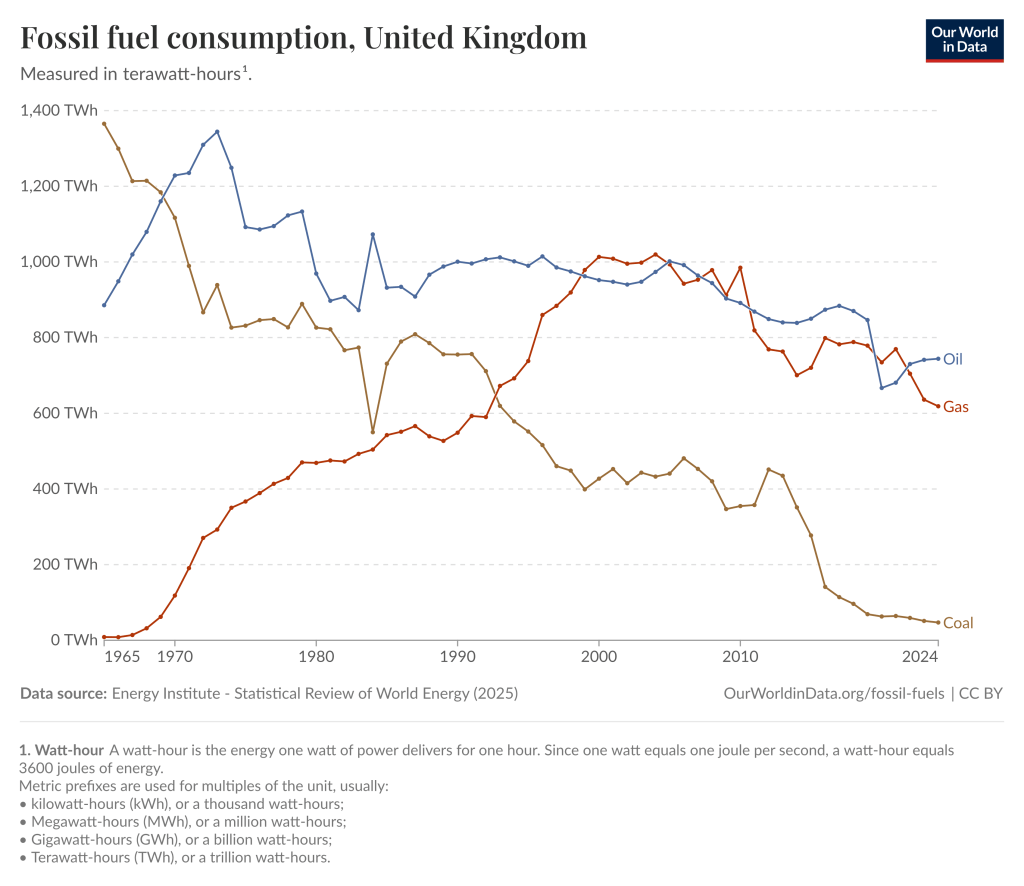
North Sea oil production peaked around 1999 at roughly 2.7 million barrels per day and has been in structural decline for over two decades. Current output is a fraction of that. The economics of new extraction are marginal at best – high extraction costs from mature, complex reservoirs, against a backdrop of volatile oil prices and the capital expenditure required is immense.
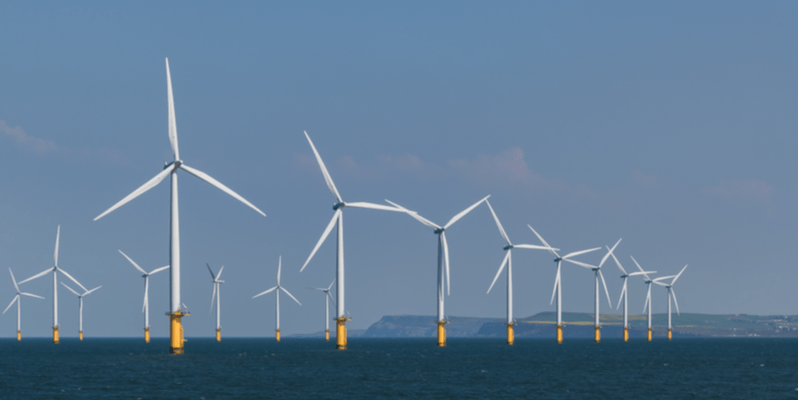
Meanwhile Britain has what may be the best offshore wind resource in the world — shallow continental shelf, consistent Atlantic winds, established industrial base now developing around it. Already generating a substantial proportion of electricity. The trajectory is clear.
The argument for new North Sea drilling is essentially nostalgic and tribal — it maps onto the same emotional geography as Brexit exceptionalism. “We have our own oil” carries a psychological charge entirely disproportionate to its current economic reality. It’s sovereignty theatre.
it’s exactly the architecture of the Edwardian Baroque applied to energy policy, the imperial gesture performed after the imperial reality has dissolved. Insisting on drilling a depleted field as an act of sovereign defiance against physics.
The Government’s reluctance to say plainly “that era is over, here is the new one” is a failure of nerve. They’re running scared of the symbolism rather than engaging the economics.
WAKE UP LABOUR
The protest vote shift from purple to green is more dramatic than a gradual drift. As of early April 2026, a Lord Ashcroft poll of over 5,000 respondents put Reform, the Greens and the Conservatives in a three-way tie at 21% each, with Labour at 17%. This is seismic.
The Greens have a ceiling gap — the proportion of the public who might ever vote Green is 22 points higher than their current voting intention, larger than any other party’s gap. The room to grow is extraordinary. There is a large minority of Reform protest voters who don’t hold with Farage’s cavalier environmental position.
Labour’s own post-mortem analysis of the Gorton and Denton by-elections found it had lost substantial white working-class voters to the Greens — not just the usual progressive young professionals. The Greens are eating into Labour’s base while simultaneously drawing from Reform’s ceiling. This is the political moment.
Rosebank — the legal situation
The Rosebank approval was declared unlawful in early 2025, with the court ruling that the significant emissions from burning the field’s oil should have been factored into its approval by the previous Conservative government. Equinor resubmitted a revised Environmental Impact Assessment in October 2025, acknowledging that nearly 250 million tonnes of emissions would be released but arguing these were ‘not significant.’ The decision on whether to grant approval is now back with the government. The pressure on Ed Miliband is immense.
54% of UK voters think increasing renewables is the best way to ensure energy security, while only 25% favour drilling for new oil and gas.
Part Two: The Four Killer Facts
1. The transformation is real and accelerating
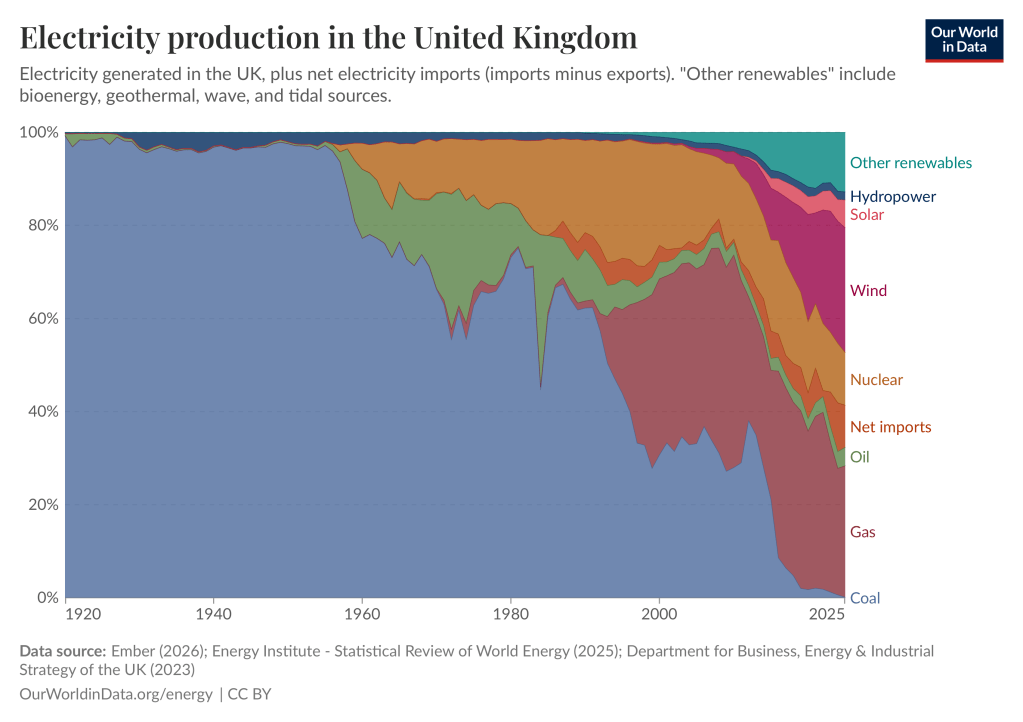
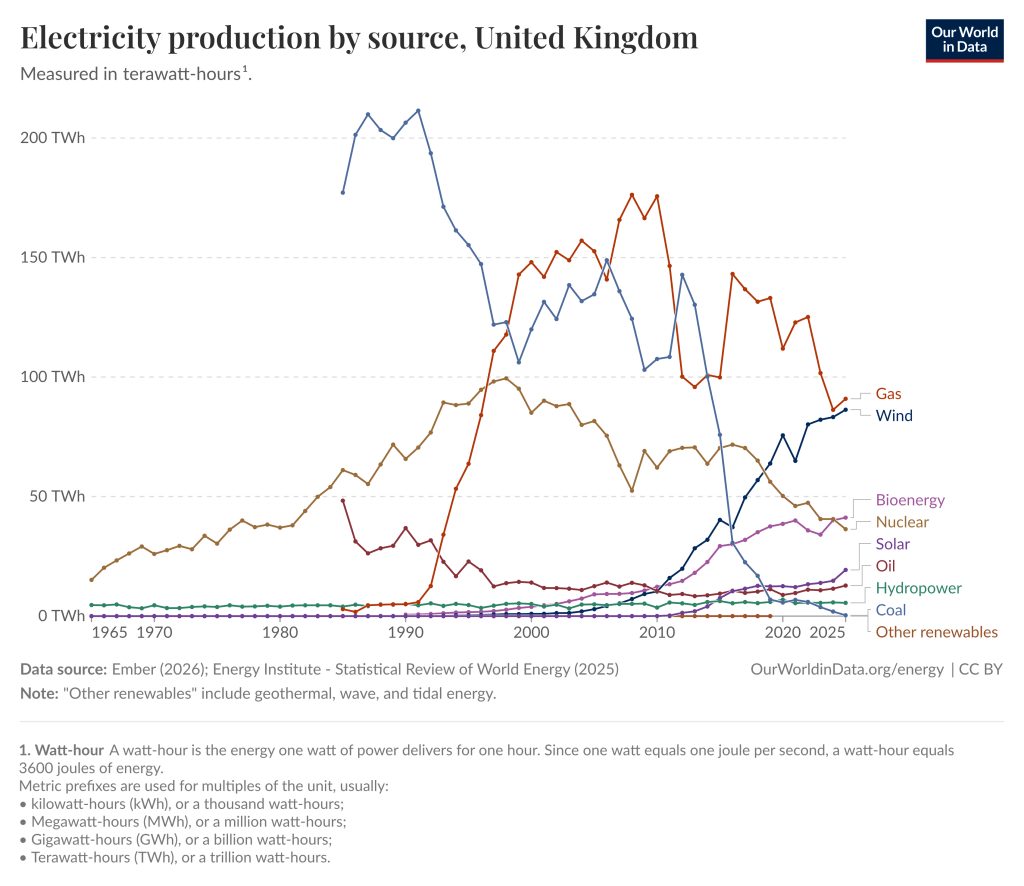
Renewables made up 47% of UK electricity supplies in 2025 — another record high — and the UK had its first full year without any coal power, ending over 140 years of coal generation.
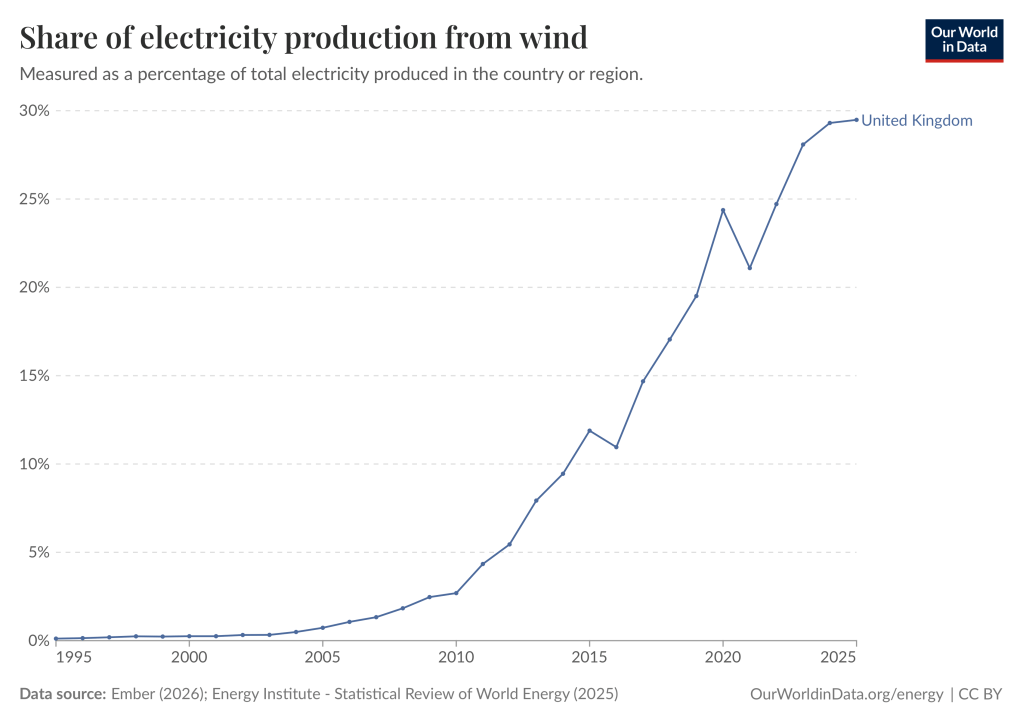
2. Wind capacity has grown 26-fold since 1996
In 2004, wind power contributed less than 0.5% of UK electricity. It now approaches 30%.
3. The subsidy claim runs both ways
Between 2015 and 2023, UK government fossil fuel subsidies exceeded those for renewable energy by more than £20 billion — £80bn to fossil fuels versus £60bn to renewables. Current fossil fuel subsidies run at approximately £17.5 billion every year.
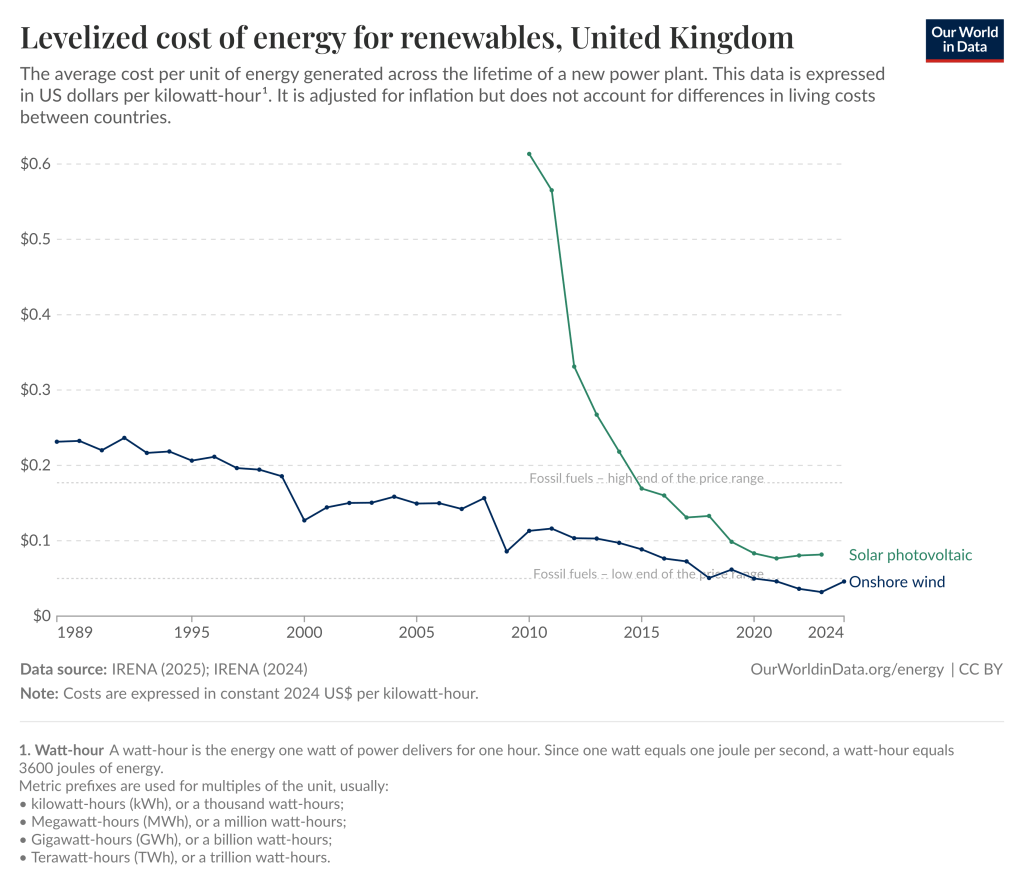
4. The cost collapse in offshore wind
The cost of offshore wind has fallen from £150/MWh in 2012 to £58/MWh for contracts awarded in September 2024, while the number of turbines required to generate equivalent power has more than halved thanks to technological advances.
Part Three: The Taxonomy of Bullshit
The resistance to the energy transition isn’t primarily about facts. It’s about five distinct psychological and cultural structures, each generating its own flavour of misinformation. Getting the diagnosis right matters because each needs different medicine.
1. Betrayal memory — ‘they lied to me before’
This is the most legitimate grievance and the most underestimated. The diesel scandal is real. The government did incentivise diesel cars on the grounds of lower CO2, only for the NOx and particulate story to emerge. It caught me out. The insulation schemes were botched — Green Deal was a shambles, the boiler upgrade scheme is means-tested and bureaucratic. People who followed official advice and got burned have every rational reason to distrust the next round of official advice. This isn’t stupidity. It’s Bayesian updating on a track record.
The answer here isn’t ‘trust us this time.’ It’s institutional accountability and specific, falsifiable guarantees.
2. Complexity weaponised as doubt — the lifecycle argument
‘EVs are just as bad over the lifecycle’ is the sophisticated version of climate denial — it sounds empirical, it’s partially grounded in real debates from 5-10 years ago, and it’s now simply wrong as the grid greens. It’s the tobacco industry’s playbook: manufacture just enough complexity that the reasonable person concludes they can’t know, so they do nothing.
The lifecycle carbon of a new EV on the current UK grid is roughly a third of an equivalent petrol car, falling every year as the grid cleans further. The line here is to turn the complexity back: ‘Yes, it’s complicated — and the complexity overwhelmingly resolves in one direction.’
3. Identity threat — the car as masculinity/freedom/self
For a substantial slice of the electorate — disproportionately male, disproportionately older, disproportionately Reform-adjacent — the internal combustion engine is not a transport technology. It’s a value object. Petrol culture, car modification, the roar of an engine, the self-sufficiency of knowing how your engine works. The EV threatens all of this: it’s software-dependent, it’s silent, it’s subscription-based, it feels managed.
The heat pump does the same thing to the gas boiler — which for many homeowners represents competence, control, warmth-providing agency. You cannot argue someone out of an identity threat. You have to reframe the identity, not the technology. This is where ‘energy independence’ and ‘never paying a fuel bill again’ language does real work.
4. Conspiracy infrastructure — the algorithm-fed beast
The EV fire stories, the ‘they’re putting chips in your car,’ the ‘wind turbines cause cancer,’ the ‘lithium mining is actually worse’ — these aren’t random. They circulate in the same networks as anti-vax content, as 15-minute city paranoia, as ULEZ rage. They share a common grammar: powerful interests are deceiving you, and I have the real truth.
This is impervious to fact-checking — every fact-check becomes evidence of the conspiracy. The only effective response is not refutation but source credibility. Who do you trust? Mechanics who’ve worked on EVs. Farmers who’ve installed heat pumps. People like you who’ve made the switch. Not government. Not academics. Not the BBC.
5. Rational present-bias — the upfront cost problem
The heat pump costs £10-15k to install. The EV costs more upfront than the equivalent ICE car, even with the grant. The payback period is real and requires capital the median household doesn’t have liquid. This is not irrationality. This is correct reasoning under genuine financial constraint.
The policy failure here is not communications — it’s finance. Green mortgages, zero-interest boiler loans, salary sacrifice schemes, social housing retrofit. The argument needs to acknowledge the constraint before proposing the solution.
Part Four: The Smartarse Argument
Here is the thing that almost nobody says: the fossil fuel lobby doesn’t need to win the argument. It only needs to keep it open.
This is the asymmetry at the heart of the communications problem. The pro-transition side has to win on facts, economics, morality and practicality simultaneously. The anti-transition side only has to generate sufficient noise that the reasonable middle-ground voter concludes: ‘it’s all very complicated, there are arguments on both sides, best not to rush.’ Paralysis is the product. Confusion is the business model.
This is why the lifecycle EV argument is so perfectly engineered. It doesn’t need to be true. It needs to be just plausible enough that a busy person with other things to think about files it under ‘contested’ and moves on. Ditto the heat pump horror stories — one viral tweet about a family whose bills doubled is worth a hundred academic papers showing average savings.
The antidote is not more information. It is narrative compression — the ability to say something true, simple and emotionally resonant in the time it takes someone to scroll past.
And here is the structural insight that should sit at the heart of any communications effort: the same people telling you EVs are secretly terrible are the same people making money from petrol. The lifecycle argument, the range anxiety story, the EV fire panic — follow the money and you find, reliably, either fossil fuel interests or their downstream political beneficiaries. This doesn’t make the argument wrong by itself. But it does make it suspicious, and suspicious is all you need to plant in a reader’s mind.
Part Five: The Left’s Communications Failure
The left’s instinct when confronted with complexity is to honour the complexity. To say ‘well, it’s not quite that simple…’ To caveat. To hedge. To add footnotes. To worry about being caught oversimplifying. This is, in a way, an intellectual virtue. But it is a catastrophic political vice, and it comes from a specific class position: the professional-educated left is comfortable with ambiguity and trained to distrust strong claims. The problem is that it then mistakes its own comfort with ambiguity for a universal epistemic virtue, and projects it onto an electorate that is not asking for a seminar — it’s asking for a reason to act.
Meanwhile the right learned 40 years ago that you win by owning the three-word phrase. Take back control. Stop the boats. Drill baby drill. Each of these is a lie, or at minimum a grotesque simplification. But each does something the left’s messaging never does: it tells you what you are for and who your enemy is, in under four seconds.
The “cash card” approach — ‘your bill, not their planet’ — works because it relocates the argument from the terrain of values (where the right can play culture war) to the terrain of self-interest (where the facts are simply on our side). Nobody can accuse you of being woke for wanting cheaper heating. Nobody can call you an elite for not wanting to give BP another £17 billion. The economics of the transition are genuinely populist, but the left keeps presenting them in the language of obligation rather than opportunity.
THREE RULES THE PROGRESSIVE LEFT KEEPS BREAKING
One: lead with the enemy, not the cause. ‘Someone is paying for your confusion’ is more mobilising than ‘here’s why renewables matter.’ People move when they feel manipulated; they tune out when they feel preached at.
Two: the number is the argument. £42 billion in one year bailing out gas. £17.5 billion a year to oil companies right now. £58 per megawatt-hour for offshore wind. These are not illustrations of the argument — they are the argument. One number, repeated, beats a thousand words of explanation.
Three: validate the grievance before making the case. The diesel answer doesn’t say ‘you’re wrong to be angry.’ It says ‘you’re right, and here’s why this time is different and verifiable.’ That’s the only move that works on someone with a legitimate grievance.
Part Six: The 10 Things — Shareable Soundbites
How this works
Each argument: one killer headline. Two or three sentences of backup. One concrete number that sticks. The implicit arc across the 10 moves: you’ve been misled → here’s the real picture → the transition is already happening and working → the only question is whether you’re ahead of it or behind it.
Framing: not ‘here are 10 facts’ (inert). Not ‘here are 10 reasons to change’ (preachy). But ’10 things they don’t want you to know’ — which uses the conspiracy grammar against itself, borrows the emotional charge of revelation, and positions the reader as the smart person seeing through the fog.
ARGUMENT 01 — North Sea oil is nearly gone. New drilling is nostalgia, not energy policy.
North Sea production peaked in 1999 at 2.7 million barrels a day. It’s now a fraction of that, from expensive, complex reservoirs. New fields won’t change your energy bill — the oil gets sold on global markets at global prices. The number: 90% decline in production since peak.
CONSPIRACY PUT-DOWN
‘But it’s our oil’ — no, it’s a commodity sold at world prices to whoever pays. It didn’t protect us from the 2022 gas crisis and it won’t protect us next time.
ARGUMENT 02 — Britain has the best offshore wind resource in the world. We’re throwing it away debating 1970s solutions.
Shallow continental shelf. Consistent Atlantic winds. A coastline built for it. Wind now approaches 30% of our electricity — up from less than 0.5% in 2004. The number: 26-fold increase in wind capacity since 1996.
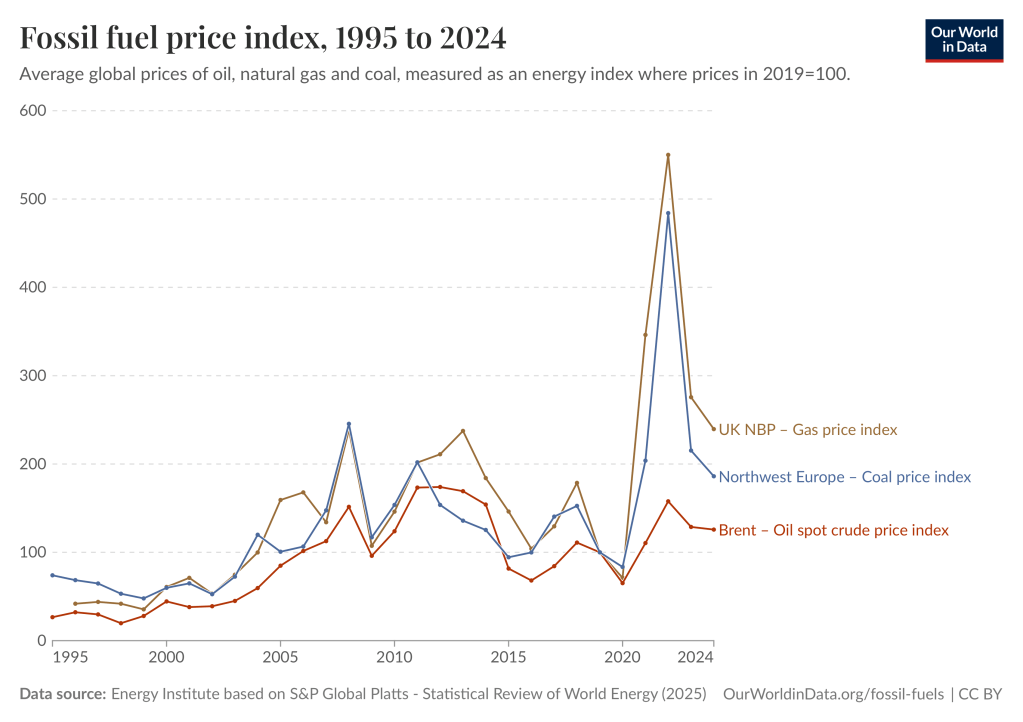
ARGUMENT 03 — Your energy bills spiked because of gas. Not because of renewables.
The 2022 crisis was a gas crisis. Countries with more renewables had smaller bill spikes. Wind and solar, once built, cost almost nothing to run — no Vladimir Putin can turn them off. The number: £1,400 average household energy bill increase in 2022, driven entirely by gas prices.
ARGUMENT 04 — You are subsidising oil companies £17.5 billion every year.
That’s not a green talking point. That’s the government’s own figures. Between 2015 and 2023, fossil fuel subsidies exceeded renewable subsidies by £20 billion. The number: £17.5bn per year, every year, to the industry that caused the crisis.
CONSPIRACY PUT-DOWN
‘Renewables are only viable because of subsidies’ — fossil fuels get more. Always have. And unlike renewables, the cost of fossil fuel subsidies never falls.
ARGUMENT 05 — Offshore wind now costs less than gas. And the price keeps falling.
In 2012, offshore wind cost £150 per megawatt-hour. In 2024, new contracts came in at £58. Gas remains volatile and exposed to global markets. The number: 61% cost reduction in 12 years, still falling.
ARGUMENT 06 — The lifecycle argument is a decade out of date.
‘EVs are just as bad overall’ was a reasonable debate in 2015. On the current UK grid — 47% renewables — a new EV produces roughly one third the lifetime carbon of an equivalent petrol car, and falling every year as the grid cleans. The number: one third the carbon, and dropping.
CONSPIRACY PUT-DOWN
The lifecycle argument is the tobacco industry’s playbook. You don’t need to win the argument. You only need to keep it open long enough for people to do nothing.
ARGUMENT 07 — Yes, they lied about diesel. This is different, and here’s how to check.
The diesel scandal was real. The government did incentivise diesel and got it wrong on NOx. Your anger is legitimate. The difference now: the economics of renewables are verifiable, not policy-dependent. Offshore wind at £58/MWh is cheaper than new gas whether or not the government subsidises it. Check the contracts. They’re public.
ARGUMENT 08 — The jobs are here, not in the North Sea.
North Sea extraction is increasingly automated. Offshore wind construction and maintenance employs far more people, in coastal communities, for longer. The number: the UK offshore wind sector already employs around 30,000 people, projected to reach 100,000 by 2030.
ARGUMENT 09 — The real problem isn’t electricity. It’s your boiler and your car.
UK electricity is now genuinely a success story — 47% renewables, no coal. The remaining emissions are transport (30%) and building heating (21%). Both require electrification. The technology exists. The obstacle is upfront cost — which is a finance problem, not a technology problem.
ARGUMENT 10 — The confusion is a product. Someone is selling it to you.
At COP29, 1,773 fossil fuel lobbyists attended — more than almost any country delegation, outnumbering the delegates from the 10 most climate-vulnerable nations combined. The American Petroleum Institute’s own 1998 internal memo stated their goal was to ensure ‘average citizens understand the uncertainties in climate science.’ Written decades after their own scientists had confirmed those uncertainties didn’t exist. The number: $339 million spent by fossil fuel interests in the 2024 US election cycle alone.
Part Seven: The Dinner Party Cheat Sheet
THE PHYSICAL REALITY — NUMBERS THAT STOP CONVERSATIONS
- 2024 was the first calendar year in which average global temperature exceeded 1.5°C above pre-industrial levels. That’s the threshold everyone has been talking about for a decade. It has been crossed, at least for a year. Now two.
- At current emission rates, there is a 50% chance of permanently exceeding 1.5°C in about six years. It may well be less.
- Global CO2 emissions hit a record high in 2024 — approximately 37.4 billion tonnes. We have not yet peaked.
- The last decade is the warmest in recorded human history. Each of the last 10 years has been among the 10 warmest ever measured.
THE GLOBAL PICTURE
- China produces 32% of global emissions — and is also adding renewable capacity at a scale nobody else matches. Both things are simultaneously true. This is the answer to the most common dinner-party dismissal.
- The US produces 13% of global emissions and has, under Trump, withdrawn from Paris again and rolled back the Inflation Reduction Act.
- Even if all countries achieved their current climate pledges, they would reduce emissions by just 7% from 2019 levels by 2030. The physics requires 43%. That gap — between 7% and 43% — is the entire geopolitical problem in one sentence.
THE UK STORY
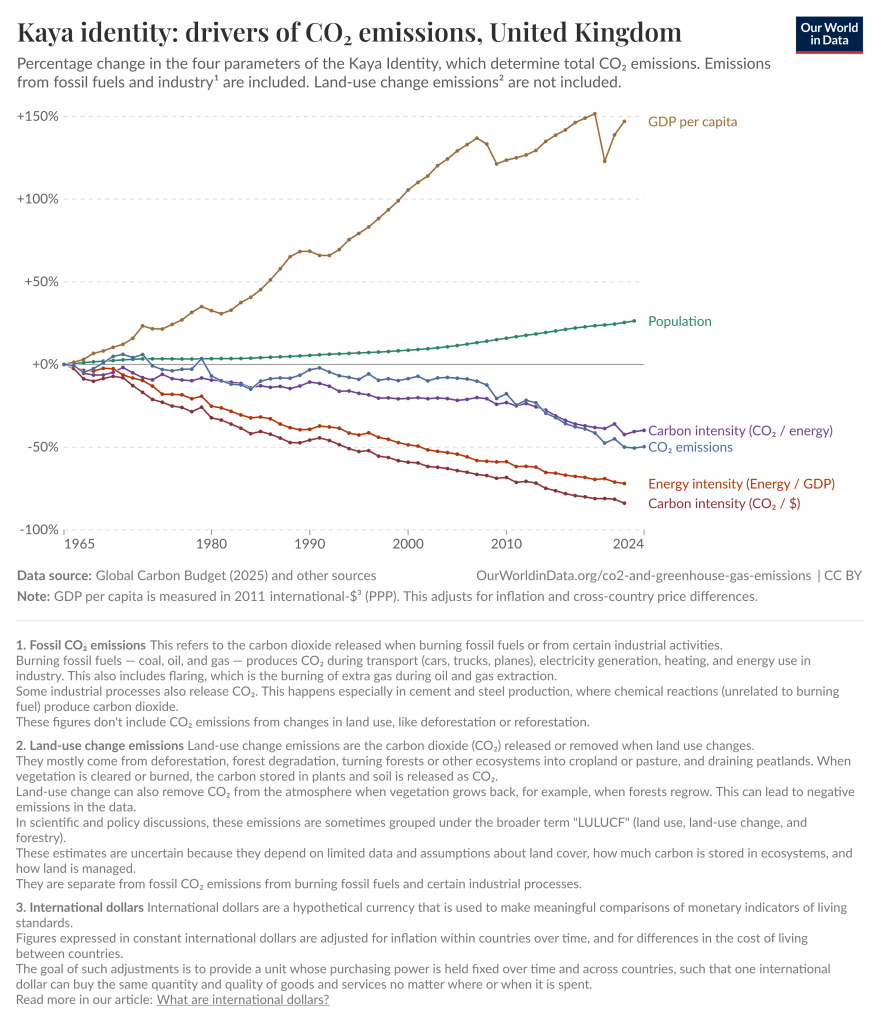
- UK territorial emissions are down 54% from 1990 — faster than any comparable economy. This happened while GDP grew. The decoupling is real.
- Renewables made up 47% of UK electricity in 2025. The UK had its first full year without coal.
- The unsolved problems are transport (30% of remaining emissions) and building heating (21%). Both require electrification.
- Domestic transport emissions actually increased 2% in 2025, driven by more petrol and diesel use. The government talks about North Sea oil when the real fight is about whether people will buy heat pumps and EVs.
SMART RESPONSES TO COMMON OBJECTIONS
‘But what about China?’
China is 32% of global emissions and the world’s largest investor in renewable energy simultaneously. The question isn’t whether China is the problem — it’s whether we want to be ahead or behind them in the technology that will run the next century. Right now they’re winning.
‘The transition will destroy jobs and make us poorer’
Britain has cut emissions 54% since 1990 while growing wealthier. The countries moving fastest on renewables have the most stable energy prices. The countries most exposed to fossil fuel price shocks — Germany in 2022 — are the ones that moved too slowly. The transition is the cheaper option. The status quo is the risk.
‘They told me to buy a diesel car — why should I trust them now?’
You’re right to be angry. The diesel scandal was a genuine policy failure. The difference now: the economics of renewables don’t depend on government incentives. Offshore wind at £58/MWh is cheaper than new gas whether or not the government subsidises it. The numbers are in the public contracts. You can check them.
‘Renewables only work when the wind blows’
Britain’s grid ran without coal for an entire year in 2025. On 1 April 2025, low-carbon sources met 97.7% of demand for half an hour. Intermittency is a real engineering challenge being solved by storage, interconnectors, and grid management. Gas turbines also don’t work when the gas supply is cut off, as we discovered in 2022.
THE ONE PARAGRAPH — IF YOU ONLY REMEMBER ONE THING
We are living through the warmest decade in human history, driven by burning fossil fuels at a rate that has no precedent. Britain has cut its emissions faster than any comparable economy while growing wealthier — proving the transition is possible. The unsolved problems are heating our homes and running our cars, both of which require electrification of things that currently run on gas and petrol. The technology exists and is getting cheaper every year. The obstacles are political, financial and psychological — not physical. The people telling you the transition is impossible or secretly worse than what we have now are, with remarkable consistency, the people profiting from what we have now. The cash argument for the transition is stronger than the moral one: cheaper bills, no exposure to gas market shocks, jobs that can’t be offshored. This is not complicated. It is being made to seem complicated, on purpose, by people with an interest in your confusion.
Part Eight: The IPCC — What Actually Exists
The Intergovernmental Panel on Climate Change (IPCC) reports. Not on everyone’s holiday ready list. So let’s cut it down. Right down.
A clarification that matters, because the confusion is widespread and the IPCC communication is genuinely difficult.
The IPCC doesn’t produce ’10 targets.’ It produces scenarios — pathways — that describe what would have to happen across multiple sectors to keep warming below 1.5°C or 2°C. These aren’t goals set by the IPCC. They’re scientific descriptions of the conditions under which the physics works out. The targets come from the Paris Agreement, which is a political document, and the NDCs — Nationally Determined Contributions — which are what individual countries have pledged.
THE THREE NUMBERS THAT MATTER
- Emissions must peak before 2025 at the latest. Oops.
- Emissions must be reduced by 43% by 2030, with methane reduced by about a third.
- Net zero CO2 by the early 2050s.
Everything else is detail about how.
THE GAP
Even if all countries achieved their current climate pledges, they would reduce emissions by just 7% from 2019 levels by 2030 — against the 43% required for 1.5°C. That gap is the entire geopolitical problem in one sentence.
As of June 2025, only 24 countries had submitted 2035 NDC targets, and only one of those is 1.5°C-aligned.
THE BRIDGE PARAGRAPH — FROM SCIENCE TO POLITICS
The main barriers to meeting climate targets are political, not technological — the IPCC itself says this, quietly, in the technical language of a scientific body that isn’t supposed to say political things. What it means in plain English is: we have most of the tools. We are choosing not to use them at the required scale. That choice is being made by political systems that represent the interests of present voters in wealthy countries over the interests of future generations and present populations in poor ones.
The top 10% of income earners globally produce upwards of 45% of the world’s greenhouse gases, while the bottom 50% account for 15% at most. The people causing the problem are not primarily the people experiencing its worst effects. Until that misalignment between cause, cost and political voice is addressed, the physics and the politics will remain on different trajectories.
Part Nine: Global Impact The Five Families
So what happens if we don’t do this. And how much will it cost if we do. If we all paid a premium now You know, just like insurance. Same principle. Bigger benefits. For us and our children and our grandchildren. Not for big business. Let’s see how that might work by taking 5 families from across the globe.
How this works
Five families, real median incomes, two futures each — action versus inaction. The identified individual beats the statistical aggregate every time.
The Johnson Family — United States
Median household income: $80,000. The ‘insurance premium’ for serious climate action (2% of GDP applied to household income): approximately $1,600 per year.
Action future: Energy bills stabilise as renewables dominate. No more gas price shocks. The Southwest gets hotter but remains liveable. Florida coastline is protected by managed retreat investment made now.
Inaction future: By 2050, climate damages could reduce US household incomes by 10-15% in real terms — roughly $8,000-12,000 per year at today’s incomes. Phoenix summers become regularly life-threatening. Florida property values collapse as insurance disappears. The $1,600 annual premium looks very cheap in retrospect.
The Williams Family — United Kingdom
Median household income: £42,000. Insurance premium: approximately £840 per year.
Action future: Heat pump installed on a green mortgage. EV on salary sacrifice. Energy bills lower and stable. The UK offshore wind sector employs 100,000 people by 2030, including in coastal communities that lost manufacturing.
Inaction future: Continued exposure to gas market volatility. Summer flooding and heat events increase in frequency. The 2022 energy crisis — which cost the average household £1,400 extra — becomes a regular occurrence rather than an exception. The £840 premium looks very cheap.
The Chen Family — China (urban)
Urban median household income: approximately $15,000 (higher in purchasing power terms). Insurance premium: approximately $300 per year.
Action future: China’s massive renewable investment pays off domestically. Air quality in cities improves dramatically — already happening. The clean energy technology China is building becomes the export of the century.
Inaction future: Flooding of the Pearl River Delta and Yangtze basin displaces tens of millions. The North China Plain, which feeds 400 million people, faces severe water stress. Climate damages disproportionately affect the rural poor — the people with least political voice.
The Akhter Family — Bangladesh
Median household income: approximately $3,500. Insurance premium: approximately $70 per year.
Action future: Sea level rise stays below the threshold that triggers mass displacement. The delta remains farmable. Investment in flood management, funded partly by climate finance from wealthy nations, protects the coastal communities.
Inaction future: By 2050, one in seven people in Bangladesh will be displaced by climate change. Up to 18 million people will have to migrate because of sea-level rise alone. Bangladesh’s historical cumulative emissions are effectively negligible. The injustice is structural, not incidental — built into the physics of where warming happens and who caused it.
The Paeniu Family — Tuvalu, Pacific
Median household income: approximately $5,000. Insurance premium: approximately $100 per year.
Action future: Under 1.5°C warming, Tuvalu faces severe economic losses from coastal flooding — but the islands remain above water. International climate finance covers adaptation costs. The Paeniu family’s grandchildren still have a home.
Inaction future: Under higher emissions, annual economic losses from coastal flooding reach 58% of Tuvalu’s GDP by 2100. By 2100, the highest tides could regularly flood 95% of the land area of the national capital Funafuti. These are peer-reviewed projections published in Nature Scientific Reports.
THE SENTENCE THAT MATTERS
The insurance premium is the same percentage of income for everyone. The risk is catastrophically distributed toward those who caused the least of the problem.
Part Ten: A DCF Frame
The discounted cash flow framing is the most intellectually honest and rhetorically powerful approach in the whole argument — and the most underused in public discourse. It is not for the everyday. But we can force out some conclusions.
Every person who says ‘we can’t afford to act on climate change’ is making a claim about discount rates whether they know it or not. They are saying: ‘the welfare of people in 2075 matters so little to me that even catastrophic harm to them is outweighed by modest costs to me today.’ Put that way, most reasonable people recoil from it. The economics is not the problem. The ethics dressed as economics is.
THE NUMBERS
- The Stern Review (2006) estimated the cost of climate inaction at 5-20% of global GDP permanently. Subsequent work has consistently found damages larger than the models predicted, not smaller.
- More recent work finds climate damages could amount to 10-20% of GDP by 2050. The social cost of carbon may exceed $1,000 per tonne — far above the $100-200 used in most policy frameworks.
- The cost of serious climate action is estimated at 1-2% of global GDP per year. The ratio of cost to benefit is approximately 1:10 at minimum.
THE QUESTIONS THE DCF FRAME FORCES
- What discount rate are you applying to your grandchildren’s welfare?
- What is the terminal value of a functioning biosphere?
- If a doctor told you that spending 2% of your income on insurance would prevent a 15% permanent reduction in your family’s living standards, would you buy it?
THE SECTORAL SPECIFICS — COSTS OF INACTION
- Food: The number of people with uncertain access to food will increase from 2 billion to 3.5 billion by 2050 under high-emission scenarios.
- Water: By 2050, 2.7 to 3.2 billion people will face water scarcity for at least one month per year.
- Migration: 216 million people could be forced to move within their own countries by 2050 due to climate impacts.
- Health: Climate change is projected to cause an additional 250,000 deaths per year between 2030 and 2050 from malnutrition, malaria, diarrhoea, and heat stress.
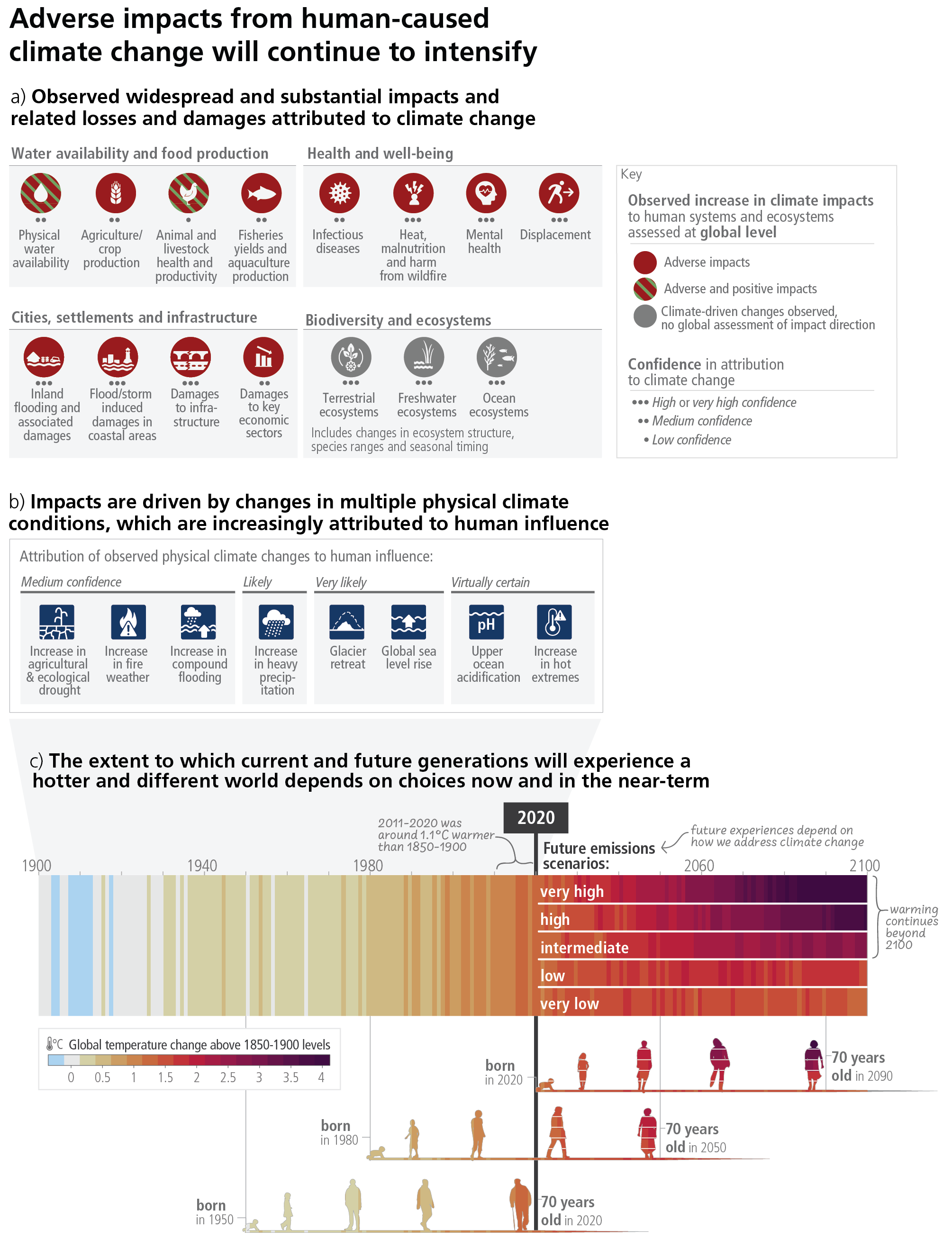
THE STOICAL ARGUMENT — FOR SCEPTICAL CONSERVATIVES
We are not trying to save nature. We are not trying to feel good about ourselves. We are trying to prevent organised human society from collapsing, which is a straightforwardly self-interested argument that requires no particular moral commitments beyond not wanting the lights to go out. The tipping point scenarios — Amazon dieback, permafrost methane release, West Antarctic ice sheet collapse — are not properly priced into any economic model because you cannot run a regression on an event that hasn’t happened yet. They are the tail risk of tail risks. Insuring against them is the most basic risk management. If that doesn’t move you, the conversation has moved from economics into something else entirely.
Part Eleven: The Hail Mary Rebuttal
The Hail Mary technology argument is the most intellectually respectable form of climate delay — it doesn’t deny the problem, it relocates the solution to an indeterminate future point, which conveniently means nothing uncomfortable needs to happen now. It’s the sophisticated person’s version of ‘they’ll think of something.’
Fusion
Most serious analysts now say fusion is a question of when, not if. But while fusion power might enter the grid in a decade, it will be closer to 2050 or beyond when fusion can claim a notable chunk of the grid. The concession from inside the field: ‘If we’re working toward 2050 climate goals, and we’re not beginning the process of actually scaling and deploying these systems until the late 2030s, then it’s basically too late.’ That’s a fusion advocate conceding the timing argument completely.
Carbon Capture and Storage (CCS)
The IEA has been steadily downgrading CCS’s role — from 13% of total carbon removal in its 2021 net zero scenario to below 5% in 2025. CCS currently captures just over 50 million tonnes of CO2 annually, against a net zero requirement of 1,300 million tonnes. The industry must accelerate deployment by 67% annually to meet targets, a pace that seems increasingly unlikely given current project failure rates. The flagship Northern Lights project is jointly owned by Equinor, Shell and TotalEnergies. Make of that what you will.
Direct Air Capture (DAC)
The world’s largest direct air capture plant captures 500,000 tonnes per year. We emit 37 billion tonnes annually. Even at the optimistic $100/tonne target for the 2040s, capturing current annual emissions would cost $3.7 trillion — and that’s just for the ongoing flow, not the backlog already in the atmosphere. It’s not a solution. It’s a very expensive partial cleanup tool for residual mess after we’ve done everything else.
Solar Geoengineering
Stratospheric aerosol injection is cheap, technically simple, and requires no international agreement to start — just one country deciding to do it. The governance vacuum is the problem, not the physics. And the termination shock risk — temperatures snapping back suddenly if the programme stops — is exactly the kind of irreversible non-linear event that the cautious part of the climate argument has always worried about most.
THE KILLER RESPONSE — THE ATMOSPHERE KEEPS SCORE
The CO2 you emit in 2028 waiting for fusion to arrive doesn’t get retroactively cancelled when fusion arrives in 2055. It stays up there, warming things, for centuries. The physics is indifferent to your optimism about future technology.
The Hail Mary argument implicitly dismisses what already works — offshore wind at £58/MWh, solar at record lows, heat pumps, EVs — while placing faith in technologies that don’t yet exist at scale. The question is not ‘what might save us?’ It is ‘why aren’t we using what already works?’
ONE-LINERS
- ‘But surely fusion will solve this?’ — Fusion might work by 2060. The damage we’re trying to avoid happens by 2050. Different timelines, different problem.
- ‘They’ll think of something — they always do.’ — The atmosphere doesn’t wait for the thinking. Every year of waiting is a tonne of CO2 that stays up there for centuries.
- ‘Carbon capture will let us carry on as normal.’ — CCS currently captures 50 million tonnes a year. We emit 37 billion. That’s 1 in 740.
- ‘AI will solve climate change.’ — AI is a tool. Microsoft reopened a coal plant to power it. The question is who points the tool at what problem.
- ‘The technology doesn’t exist yet to do this cheaply.’ — Wind is now the cheapest electricity ever generated in human history. Solar costs have fallen 90% in ten years. The technology exists. The question is whether we deploy it.
Part Twelve: The Global Political Economy Imperative
This is a political economy problem — meaning it is about who has power, whose interests are represented in decisions, and how the costs and benefits of action are distributed across time and across populations who have very different political voice. It is not primarily a technology problem. It is not even primarily a communications problem.
SIX MECHANISMS OF FAILURE
1. Carbon pricing covers almost nothing
Carbon pricing now covers around 28% of global greenhouse gas emissions — but only 20% of those covered emissions are priced at a level economists say drives real change. So effectively only about 6% of global emissions face a meaningful carbon price.
2. Fossil fuel lobbying owns the policy process
At COP29 in Baku, 1,773 fossil fuel lobbyists attended — more than almost every country delegation, and collectively outnumbering the delegates from the 10 most climate-vulnerable nations combined.
In the 2024 US election cycle, fossil fuel groups contributed a record $96 million to Trump and affiliated PACs and spent $243 million lobbying Congress. That $339 million bought the withdrawal from Paris, the rollback of the IRA, and the appointment of fossil fuel executives to energy policy positions. It was, from their perspective, extraordinary value for money.
3. The manufactured doubt playbook
The American Petroleum Institute’s 1998 internal strategy stated that ‘victory will be achieved when average citizens understand the uncertainties in climate science’ — written decades after their own scientists had confirmed those uncertainties didn’t exist. This is not conspiracy theory. It is documented, in their own words, in proceedings introduced as evidence in multiple state-level lawsuits.
4. Short political time horizons vs long physical time horizons
Democratic elections happen every 4-5 years. The worst climate impacts land in 30-80 years. The politician who acts decisively on climate today bears the cost (unpopular policies, vested interest opposition) while the benefits accrue to voters who haven’t been born yet. This is a structural problem with representative democracy, not a failure of individual politicians.
5. The distribution of costs and benefits is globally unjust
The top 10% of income earners globally produce upwards of 45% of the world’s greenhouse gases, while the bottom 50% account for 15% at most. The people causing the problem are not primarily the people experiencing its worst effects. Bangladesh, Tuvalu, the Sahel — negligible emitters, frontline casualties. The US, Europe, China — the largest emitters, the most insulated from near-term physical impacts.
6. Climate finance has not been delivered
Wealthy nations promised $100 billion per year in climate finance to developing countries by 2020. The target was not met until 2022, and much of what was counted was loans rather than grants. The new target agreed at COP29 — $300 billion per year by 2035 — is widely regarded as insufficient and without enforcement mechanisms.
WHAT WOULD ACTUALLY WORK
- A meaningful, rising carbon price with border adjustments — ending the competitive disadvantage for countries that act.
- Public investment in infrastructure at the scale of a wartime mobilisation — which is what the physics actually requires. Borrow it from the future. Like everything else. Only this guarantees a future. The risk premium on this debt should be lower not higher.
- Climate finance that is genuinely additional, in grants not loans, with developing country control over its deployment.
- Reform of fossil fuel subsidies — the $7 trillion per year (IMF estimate, including implicit subsidies) that underwrites the status quo.
- Loss and damage payments to the countries bearing the worst effects of emissions they didn’t cause — the moral prerequisite for global cooperation.
THE BRIDGE BACK TO BRITAIN
Britain’s energy story is actually one of the more instructive examples of what structural change looks like when it happens. The 54% emissions reduction since 1990. The 47% renewable electricity. The offshore wind cost collapse. These happened because of specific policy decisions — the renewables obligation, the contracts for difference scheme, the carbon price floor — which changed the investment landscape sufficiently to attract private capital at scale.
The lesson is not that markets solve climate change. It’s that the right policy architecture — stable long-term contracts, carbon pricing, public investment — can make the market do the right thing. The failure is not that this approach is impossible. It’s that it requires political will to sustain against the opposition of vested interests who benefit from the status quo.
Which brings us back to the 21% polling for the Greens, the 22-point ceiling gap, and the white working-class voters leaving Labour for green politics. The political space for honest energy leadership is opening, not closing.
Links and Sources
- https://assets.publishing.service.gov.uk/media/688890c3a11f859994409132/UK_Energy_in_Brief_2025.pdf
- https://ourworldindata.org/grapher/electricity-mix-uk
- https://www.ipcc.ch/data/
- https://assets.publishing.service.gov.uk/media/69cd1451b5210036050bc625/Energy_Trends_March_2026.pdf
- https://www.gov.uk/search/research-and-statistics?organisations[]=department-for-energy-security-and-net-zero&parent=department-for-energy-security-and-net-zero
- https://www.globaljustice.org.uk/wp-content/uploads/2022/11/Making-Polluters-Pay-web.pdf
- https://lordashcroftpolls.com/2026/04/the-crucial-centrists-who-reject-both-reform-and-the-greens/


Leave a Reply