Blackkklansman film review ****

3508865199_c3c5f53dbb_o

Blackkklansman, 30th August 2018

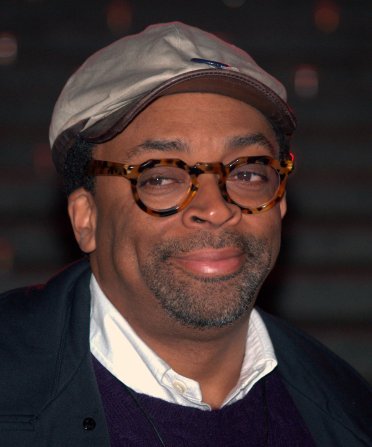
Spike Lee is 61 years old. This photo is a few years old but there is still a twinkle in his eye if you ask me. That twinkle, the eye for mischief, has been in his films from the start. Now I can’t pretend that I have followed his career, after the initial breakthrough in the mid 1980s with She’s Gotta Have It, Do The Right Thing and Malcolm X, but every time I have seen one of his films I have been thoroughly entertained, educated and provoked and made a mental note to see more of his work and revisit the early films. I have failed in this.

However I thoroughly enjoyed Chi-Raq a couple of years ago, with its more than a passing nod to Lysistrata, though the remake of Park Chan-wook’s Oldboy was disappointing, and can add to the acclaim for Blackkklansmen. It is, to its core, a Spike Lee film, the examination of race in the US and the African American experience, the humour, the exaggerated characters, the mixing of fact and fiction, the incorporation of documentary footage, the title sequences, the slick technique, the music, the dolly shots, all in the service of a captivating and extraordinary true-ish story of a black cop in 1970s Colorado Springs who, with the help of a white colleague, penetrates the Ku Klax Klan as they plan a terrorist atrocity.

Mr Lee is a proselytising political film-maker who can, at his best, appear not to be. (I am not talking here about his specifically documentary films such as 4 Little Girls and When the Levees Broke). Political films can, perforce, be a dour watch. Especially if they are about the “business’ of politics, political history, made by directors with an avowedly political agenda or focus on big, global issues, the stuff of international relations. Getting bums on seats with this sort of stuff is not easy. Me Lee here though has managed to incorporate the elements of a thriller, the one sure-fire way to secure an audience for the political, with elements of personal and identity politics in the relationships between the key male characters and the main protagonist, Ron Stallworth, and impassioned student activist girlfriend, Patrice. Best of all the satirical mocking of the KKK and its leader David Duke repeatedly hits the target without diminishing the ugliness of their hate. Remember the criminal fascist Duke is still peddling his sh*te and people are still being emboldened by it.

The period setting is superbly realised. The cast is outstanding. John David Washington’s bone-dry Ron is confident enough to face down face down racist colleagues after joining the force and to persuade boss Chief Bridges (Robert John Burke) to back his plan to infiltrate the KKK. The ever laconic Adam Driver is the perfect foil as Flip Zimmerman, who is sent in undercover to join the KKK cell. We see the political horizons of both expand; Ron after he is sent to monitor a Black rally at the local university, (where Corey Hawkins plays Kwame Ture in a stunning scene), where he meets Laura Harrier’s Patrice, and Flip, as the Jewish heritage he had abandoned is unmasked by the KKK and, specifically, the comically evil Walter (Ryan Eggold). Topher Grace is the spitting image of the young David Duke and brilliantly captures the rhetorical articulacy allied to an idiotic world view. There are some fine cameos on show  from Paul Walter Hauser, following on from his scene stealing performance in I Tonya, from Finnish actor Jaasper Paakkonen as Felix Kendrickson, the leader of the local Klan cell, and from Ashlie Atkinson as his wife Connie, who spews out shocking unthinking vitriol but still ends up as an unwitting victim.

Scene after scene hits home and somehow Spike Lee knits effortlessly knits this all together. Harry Belafonte is immensely moving as Jerome Turner in a scene where he describes the violence meted out to African-Americans in past generations. The Klan meting which ends in a screening of the outrageous DW Griffith’s film Birth of a Nation is properly shocking as is Alec Baldwin playing white supremacist Dr Kennebrew Beauregard. The ending is proper edge of the seat stuff. As if that wasn’t enough Lee leaves us with actual news footage from the Charlottesville rally in 2017. No equivocation here in contrast to some in the US. You will leave the cinema with no doubt what is right and what is wrong.

Blackkklansmen won a price at the Cannes Film Festival. I regret I am not up on these sort of things and have no idea what it was up against, but I am sure the jury here got it right. Mr Lee has packed so much into this film, plot, character, message, tone, spectacle, and the just over 2 hours flies by. Unmissable.
Aftermath at Tate Britain review ****

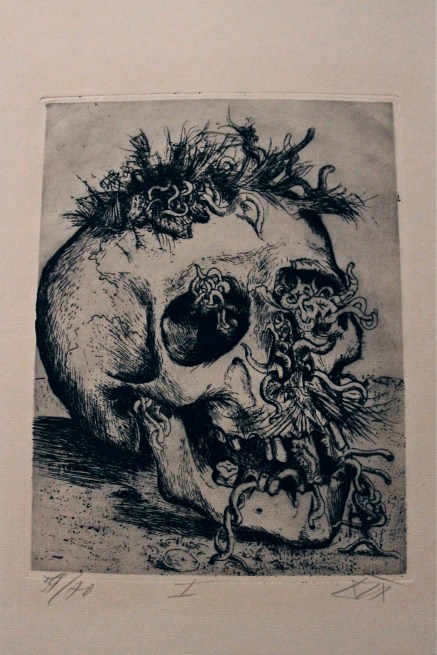
Otto Dix Skull from The War (1924) - http://www.moma.org/collect

Aftermath: Art in the Wake of World War One

Tate Britain, 29th August 2018

Historians abhor teleology these days. It’s a tricky business identifying events that “changed the history of the world”. For us simple layfolk though the First World War must surely mark a defining shift in the human experience. The scale, (over 10 million dead and 20 million wounded worldwide), the use of technology, the commitment of capital, the ideological fallout, the death-knell of empire. Take your pick. Things really changed after that.

We are approaching the centenary of the end of that War. Time to contemplate. And, here, a time to review the interpretation that artists put on this period. Well specifically the period after the war, (the works span 1916 to 1932). A smart idea. There are innumerable works of art that document the war itself, the exhibition kicks off with many of the most striking, but exploring the aftermath allows for insights into the different ways artists responded to the war’s legacy and to the, maybe, new beginnings. It also means the curators, led by Emma Chambers, were able to extend beyond British art and into Europe, primarily Germany and France (London, Paris and Berlin to be more exact). There are some stunning works on show here, a valuable history lesson, and more diversity of message than you might expect. You’d be daft not to take a look. Particularly if you have any interest at all in this period of history. Which, inevitably, you should. Art helps us to remember and understand in a way that words something fail to convey.

Room 1 looks at the devastation wrought by the war. Many of the artists here were participants in the conflict, either as soldiers, or in an official capacity. The polity back home generally didn’t want to know, nor did the authorities want them to see, the full horror of war. The depictions of battlefields, mud, pitted with craters, shorn of vegetation other than twisted tree stumps, eloquently made the point. Before the war many artistic movements, (Futurism, Vorticism), grappled with the impact of fast changing technologies on society. This impulse found its way into their war art.

The experience of war drained their optimism. Some artists could not contain their shock and anger at what they saw and went beyond symbolic representations of death, such as the abandoned helmet, to show actual bodies. The room also contains some fascinating early footage of the devastation in Flanders, filmed from an airship, and, intriguingly, guide books to the battlefields to help those who visited to pay their respects.

The most devastating works of Paul Nash (Wire), CRW Nevinson (Paths of Glory) and, most interesting here, the long neglected and once vilified Irishman William Orpen (Zonnebeke and Blown Up), may be familiar but are still striking, as is Luc-Albert Moreau’s shocking Chemin des Dames Assault. Richard Carline’s painting of a battlefield from the air (Mine Craters At Albert Seen From An Aeroplane) is intriguing but the most prominent works are the two sculptures, Jacob Epstein’s machine man Torso in Metal and Wilhelm Lehmbruck’s The Fallen Man, maybe the most famous loaned artwork here. Lehmbruck never escaped the horror of war: he killed himself in aged 38 in 1919.

This is not an exhibition of specifically war art though and, with so much to choose from both in the Tate’s collection and down the road at the Imperial War Museum, the curators have shown admirable restraint. They make their point though.

Room 2 intelligently moves on to how the WWI has been remembered, specifically through war memorials. Cenotaphs in Paris and London, dedicated to just one of the countless unknown dead, created a focus for remembrance from their inauguration two years after the armistice to this day. No national memorial appeared in Germany until 1931 but, like Britain and France, local memorials were commissioned. These memorials combined the abstract with, often, detailed figurative representations of the men who served. We were struck by Charles Sergeant Jagger’s dramatic, realist figures and by Eric Kennington’s more cubist maquette for the Soissons Memorial. BUD, my accomplice for the afternoon, was also impressed by the monumental lines of Marcel Gromaire’s famous War portrait and I had my first dose of the master Stanley Spencer with Unveiling Cookham War Memorial.

However it is hard not to drawn to Ernst Barlach’s extraordinary angel The Floating One. Barlach’s sculptures, along with Lehmbruck’s, were largely destroyed by the Nazis, who viewed them as “degenerate” but a mould of this piece survived. There is also, in a similar “Expressionist” vein, a sketch for The Parents monument by the genius Kathe Kollwitz (the model for The Floating One we see more of her later in Room 5). Barlach initially supported the Great War: his participation changed this.

Take a good look too at another Orpen painting, To the Unknown British Soldier In France, apparently a coffin draped with a Union Jack at the entrance to the Hall of Mirrors at Versailles, commissioned at the time of the Treat signing. Read its history though. It didn’t start out this way. Lack of respect, censorship, class division. Decide for yourself.

Room 3 offers yet another perspective on the years following the War. In our world, for those of us lucky enough not to live amongst conflict, images of war appear commonplace but the reality of its human impact is still largely concealed. In the 1920s, in Europe, this was not so, as the plight of damaged war veterans, in economies still disordered, was visible to all. The works here are some of the most poignant, and most angry, in the exhibition. In Britain artists were employed to create a medical record of the injuries suffered by the soldiers. The pastel sketches of Henry Tonks from the Hunterian Museum were not originally intended as “art” but they create a powerful impression. In Germany the veterans were the subject of far more explicitly political paintings and drawings from the hands of Otto Dix, George Grosz, Max Beckmann and Kathe Kollwitz.

This is the most powerful art in the exhibition, especially the prints from these artists and Georges Rouault in Room 5. Beckmann’s Hell series of lithographs from 1919, the Der Kreig etchings of Dix from 1924 and Kollwitz’s similarly titled etchings from 1922 and Rouault’s sacred Miserere et Guerre photo-etchings from 1927 demand your attention.

Whilst some of the Dadaist work in Room 4 fails to leap out at me, and the Surrealist painting from the likes of Max Ernst and Andre Masson can be safely ignored in my view, do seek out John Heartfield’s photo-montage, After Twenty Years: Fathers and Sons, and then delve into this astoundingly modern artist’s output (and life) inter- and post- war, but especially from the 1930’s.

In Room 6, “Return to Order”, the curators show how the geometric and mechanised avant-garde forms and processes which dominated Western art before the war gave way to more realism and naturalism and a return to the traditional genres of portraiture, landscape and religion through the late 1920s and early 1930s. This despite the still chaotic economic and political backdrop, Pastoralism and classicism were reborn. I am not entirely convinced by this argument but it does give an opportunity to show off another Spencer, Christ Carrying the Cross, Old Military from Franz Lenk and soothing landscapes from the Nash brothers in sharp contrast to their war paintings.

Room 7, in contrast, shows that all was not necessarily well in inter-war society linking back to the political art of the immediate post war period and highlighting the deep divisions between rich and poor. Artists unsurprisingly sided with the left in the profound idealogical arguments that characterised the period. George Grosz’s Grey Day, which contrasts, once again, a veteran with a privileged capitalist, is one of the best paintings in the exhibitions.

The final room then goes a little bit off-piste by bringing together a diverse collection of responses to the rise of the “New City”. Mind you it does make you think about just how quickly the nascent optimism on show here would be snuffed out again by an even more devastating global conflict.

Overall this is an ambitious, powerful, valuable and often still shocking survey of the artistic response to the “Great War” made especially interesting for me by the rage, fury, sorrow and despair contained in the loans from various collections in Germany, (and the George Economou Collection in Athens). There are more than enough unexpected contributions amongst the big hitters and much genuine, if occasionally, unfocussed insight into the artistic response to the impact of war. If you have any interest at all in this period or subject then I would be mightily surprised if you haven’t already gone, or intend to go. That would be the right thing to do.

The Lieutenant of Inishmore at the Noel Coward Theatre review *****

aidan_turner_28377312040629

The Lieutenant of Inishmore

Noel Coward Theatre, 31st August 2018

My regular reader, (hello), will need no reminding, (OK maybe they will), that I am a massive fan of Mr Martin McDonagh. Hangmen is the best new play I have seen in the last 3 years, indeed one of the best ever, and Three Billboards Outside Ebbing Missouri, amongst the best films. Three Billboards Outside Ebbing, Missouri film review *****). I am massively excited about his new play, A Very, Very, Very Dark Matter, which will open at the Bridge Theatre in October, with Jim Broadbent in the lead as Hans Christian Anderson and Phil Daniels alongside him as Dickens. It sound like it will plough the same dark furrow as 2003’s Pillowman, (which Mr Broadbent originally starred in), where a writer, living in an unspecified totalitarian theocracy, is accused of murders which mimic the plots of his own fairy tales. It is meta, a bit Gothic, it captures the power of literature, there’s some Kafka going on, the ethical dilemma is fascinating if a little forced, of course there is violent imagery and of course there is humour.

Like all of McDonagh’s plays The Pillowman’s morality is slippery, though not really ambiguous; it is normally pretty clear what he is saying, just that its compass is oscillating so rapidly between perspectives of right and wrong that we in turn start to  lose our bearings. That is what makes them thrilling. I would be pretty sure that violence is going to be a theme in the new play, as well as the nature of “story-telling”, based on the intriguing Bridge blurb.

Prior to The Pillowman, The Lieutenant of Inishmore was the last produced of Mr McDonagh’s “Irish” plays, and the second in the Aran Islands trilogy, (named after the three islands in Galway Bay), and was originally produced in 2001 by the RSC. (The final play in the trilogy, The Banshees of Inisheer, is as yet unpublished). Michael Grandage, the director here, revived the first in the trilogy, The Cripple of Inishmaan, to great acclaim, in 2013, at this very theatre, with Daniel Radcliffe in the lead. It is, you guessed it, a black comedy, this time about the impact on the community, and specifically bookish loner Billy, of a Hollywood film crew on neighbouring Inishmore in 1934. The documentary, like the play, was a sort of pastiche on the “remote” west of Ireland, and there are strong echoes of JM Synge’s Playboy of the Western World. McDonagh, with his rapid plot reversals, with his fictions and lies, and with that always slippery morality, again sets out to confuse and offend. Here his target is the whole notion of Irish identity, the creation myths if you will. Set it up, then knock it down, shift it on, that’s the method he employs and that’s why his plays and films are so bloody marvellous.

The ink had been dry for three years or so on the Good Friday agreement when The Lieutenant of Inishmore first appeared on stage. However it was actually written in 1994, and is set in 1993, the year of the Harrods, Warrington, Bishopgate and Shankhill Road bombings. Yet by the end of that year British PM John Major and Taoiseach Albert Reynolds were able to sign the Joint Declaration of Peace, the beginning of the end of the Troubles. Now some halfwit Brexiteers public school jape puts this all at risk, amongst so many other things. Remember it is now near 600 days since the power sharing assembly which forms the Northern Ireland Executive collapsed and the threat of a return to direct rule looms without any agreement. Meanwhile the Northern Ireland Secretary freely admits she knew nothing about politics in the country ahead of being appointed. Anyway, calm down Tourist. Back to the culture.

The Lieutenant of Inishmore, in common with many other of Mr McDonagh’s works, uses extreme violence to show that violence is no solution to argument or injustice, whether personal or political. “A violent play that is whole-heartedly anti-violence” as its author described it. Mad Padraic is a terrorist who is so brutal that he has been booted out of the IRA and even the INLA. We first encounter him torturing a suspected drug dealer until interrupted by the news from back home in Inishmore that his cat Wee Thomas is ill. Let’s just say havoc ensues thereafter. The play is a satire on Irish terrorism, for sure, on political violence more generally, and especially on the kind of beliefs, and the fanatical rhetoric and sanctimonious moral superiority underpinning them, that justify mindless butchery by the believers.

It is brutal, callous but also very funny. The idea of a revenge comedy is hardly new: I think this is the best way to interpret Titus Andronicus and its forebears for example (Titus Andronicus at the Barbican Theatre review ****). Or the films of Quentin Tarantino. To squeeze this many laughs out of the situation though, whilst clearly conveying your message, takes extraordinary writing skill.

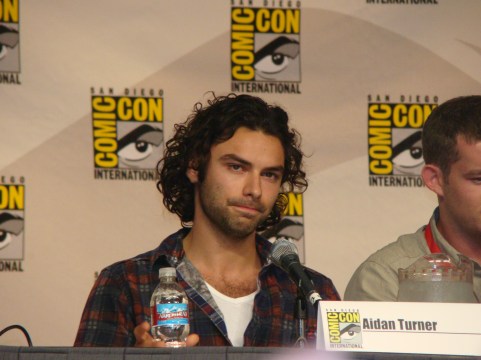
It also needs a skilful cast to strike the right tone and pace. Now I don’t think it will come as much of a surprise when I tell you that I was probably one of the few members of the audience who wasn’t there to gaze upon the undoubted charms of Aidan Turner as Padraic. Indeed, following a late substitution. the SO stood down to be replaced by LD. The LD has not yet been meaningfully exposed to the genius of Mr McDonagh, unlike the rest of the family, nor frankly is she a fan (yet) of that Poldark. But she can see the fella is gorgeous, I assured here it would make her laugh and the political context was right up her academic street. She thought it was brilliant. And that remember from a youth who is very suspicious of both Dad and the “theatre”.

She was right. This is a brilliant production. And that is due in no small part to the charisma of Aidan Turner. Mr Turner’s stage career has been hijacked by the TV roles and this is effectively his first major role outside of Dublin. He is very, very good, toning down Padraic’s sadism and dialling up his childish sentimentality, so I hope we don’t have to wait too long for his next outing. This is not just about him however. Denis Conway as Padraic’s father Donny, Chris Walley in his stage debut as the hapless Davey and Charlie Murphy as Davey’s sister, and budding “freedom-fighter” and Padriac’s soulmate, Mairead, are all mightily impressive. The set from Michael Grandage’s regular collaborator Christopher Oram is revealed to be an exact replica of the family cottage in every detail even as it is splattered with lashings of blood.


Home I’m Darling at the National Theatre review ***

retro-1353267_1920.jpg

Home, I’m Darling

National Theatre Dorfman, 29th August 2018

N.B. Home I’m Darling is transferring to the Duke of York’s Theatre from 26th January 2019 for 11 weeks and then toddles off on tour to Theatre Royal Bath, The Lowry and Theatr Clywd.

Now I have to confess to a slight feeling of disappointment with Home, I’m Darling. Don’t get me wrong. It is a very amusing play, with a fine cast led by Katherine Parkinson, and note-perfect set, costume, lighting and sound designs from Anna Fleischle, Lucy Carter and Tom Gibbons, which, cumulatively makes its points. It’s just that it doesn’t really yield too much in the way of surprises once the initial inversion has played out. It feels like writer Laura Wade, whose work to date has been inspired, notably Posh, had a really good idea and a series of fine scenes in her head, but, in translating them on to the page, some of the fizz seemed to evaporate.

Katherine Parkinson plays Judy, a stay at home housewife, married to Johnny (Richard Harrington), an estate agent. It quickly transpires that they, together, have taken their nostalgic obsession with the 1950s to its logical, (or maybe illogical), conclusion. Their friends Fran (Kathryn Drysdale) and Marcus (Barnaby Kay) share their enthusiasm for the clothes, music and style but not the domestic arrangements, right down to Judy decanting the sugar into 1950s containers and milk into glass bottles. Mum Sylvia, (a trenchant Sian Thomas), who brought up Judy in a commune, finds her daughter’s choice hard to comprehend, this “gingham paradise”. The cast is completed by Alex (Sara Gregory), Johnny’s boss, who Johnny is trying to curry favour with to secure promotion. The set up, with the insertion of an Act 2 flashback, allows Laura Wade to explore all angles of the “debate” about gender roles and choices in contemporary society. What value does that society place on “traditional women’s work”? How to balance “choice” with economic necessity? Who can judge on the choice to stay at home or work? What are the risks in fetishising the past? If this sound like its going to be a dour evening never fear. It is all delivered with the lightest of comic touches as you would expect from this writer and from Tamara Harvey who has directed her work before.

The problem is that having conjured up this admittedly intriguing conceit, and established a sit-com mood, the tone never really wavers, and there are maybe a couple too many plot revolutions jemmied in to cover all the bases, for example when Marcus reveals his true misogynist colours. There are occasions when the play steps out of its self imposed comic straightjacket, when Sylvia delivers an impassioned speech about the sacrifices her generation made to promote feminism in the 1970s and just how materially tougher life was for a child in the 1950s, for example. And Katherine Parkinson, with her ability to convey Judy’s brittle interior nature, (she always sounds the weeniest bit p*ssed to me), shows how she crumples under her own self-imposed contradictions. Having teased out a dramatic explanation for Judy’s decision from her own childhood, the plot seems to go into reverse and the ending is something of a damp squib. We all, the SO, BUD and KCK, came out just a little deflated.

I am thinking maybe I am being a little harsh here, and maybe we were asking too much, but that’s where we came out. There are some priceless lines, (Fran’s “the longest recipe I followed this week was Pierce Film Lid”), and the play will definitely make you think. Given that it has sold out at the NT and, prior to that at Theatr Clywd, and has garnered a slew of 4* reviews, I wouldn’t dream of putting you off but there was just something that held us back. And trust me the 4 of us are usually very easily pleased.

Pericles at the National Theatre review *****

sea_png7

Pericles

National Theatre Olivier, 26th August 2018

So how do you like your theatre? Or more particularly how do your like your Shakespeare? Utterly faithful to the First Folio? Set in the time and place that big Will intended (however baffling)? All blokes in tights? Performed by elite, public school grandees plummily sing-songing the verse?

Of course not. He’s for all time, not just his time, so there’s a million ways to show him off. Yet it seems from some of the reaction to Emily Lim’s three night production of Pericles at the National, the first in the planned large scale, annual, Public Acts initiatives, that some misanthropic types, (who probably weren’t there), have got the right hump with this. “It’s not “proper” Shakespeare”. Well neither is the mangled, reconstructed Pericles text that has been handed down to us with half of it penned by George Wilkins. “Very little of the precious Shakespeare lines make it through the production”. Fair enough but I defy anyone to sit through the whole bonkers story of Pericles without thinking this is a cracking tale that needs fearless pruning to properly emerge. “Adding music and dance scenes cheapens the entertainment”. Who says so. Will Shakespeare was all about entertaining the punters and making money. Chris Bush’s adaptation, with music by Jim Fortune, succeeds admirably in the first aim and, if it were possible, would, I guarantee, deliver on the second. “It is all well and good having these “amateur” types making their family in the audience proud but it gets in the way of the “professionals””. Bollocks. That is not what was intended here and if you can’t grasp that then I respectfully suggest you p*ss off to wherever you think you might find a “correct” performance of this messy play.

So ditch the moaners and pay attention to most of the proper reviewers and, I humbly suggest, me. For this was one of the most uplifting nights I have spent in a theatre. It was a very. very long way from the last Pericles I saw, the Cheek by Jowl production at the Barbican, (in French, heavily chopped, with our Prince of Tyre in a hospital bed, tut, tut, what were they thinking). (Pericles, Prince de Tyr at Silk Street Theatre review *****). But it was just wonderful.

OK so, at first, realising just how far Ms Bush and Ms Lim have deviated from the “original” is a bit of a shock. But once I saw how this allows them, and everyone involved, to incorporate the community performers, whether in dance, in song, in walk-, or wheel-, ons and memorably, in named parts, I just started smiling, and then grinning, so that by the end, (after manfully holding back the tears and trying not to audibly gulp), I was overwhelmed with joy. I know how daft that sounds but I can only offer up my genuine reaction.

The professional cast, led by Ashley Zhangazha as Pericles himself  and Audrey Brisson as daughter Marina, were superb. Mr Zhangazha was as natural as you like, (insofar as you can be natural in such a daft plot), in shifting from the retained verse to the sharper rewrites. This momentum ensured the ensemble set pieces didn’t really get in the way of the story. Not that it would have mattered anyway if they had. Whether it be the marriage scene of Pericles and Thaisa, (here interrupted by a recalcitrant maypole set malfunction which, if anything, made the production even more communal), or transforming the Mytilene brothel into something a bit more family friendly thanks to the ministrations of the effervescently camp Kevin Harvey as Boult, these tableaux were marvellous. All the performances were terrific though, though, and I feel guilty for saying it, the London Bulgarian Choir simply blew me away.

Maybe some of Jm Fortune’s songs were a bit cheesy but who cares when you can clap along within seconds. Maybe the sheer amount of stuff that was thrown at the Oliver stage sometimes bewildered, as one reviewer said, like the biggest am-dram production of all time. Maybe the sheer number of bodies on stage, the cast in total is over 200, occasionally threatened to topple even Robby Graham’s masterly choreography. Yet this was what made it so much shared fun.

If this is what the Public Acts enterprise has kicked off with then I say bring on next year’s. The idea, taken from New York, is to involve an array of community and theatre partners, (here the Queen’s Theatre Hornchurch who will host the next instalment), from the outset in creating a mass participation slice of theatre around the country. Time, patience and, yes all you misery-guts, money will be involved but the benefit to participants, communities and audience surely justify the investment based on this production.

Immense credit must go to NT resident director Emily Lim who has decided in specialise in community productions. To co-ordinate a work of this scale is mind-boggling. To impose a resonant vision, the idea of “finding one’s home”, upon Pericles’s journey, even more so. And to create this much love, (you soppy old git Tourist) deserves our eternal gratitude. I really hope everyone involved gets another opportunity to put this on. If they do please go.

The Silk Road at Trafalgar Studios review ****

the-silk-road-2840198_1920

The Silk Road

Trafalgar Studios 2, 23rd August 2018

The modern day Silk Road was the first major darknet marketplace, closed down in 2013 when the FBI arrested its alleged founder Ross Ulbricht and banged him up for life. I didn’t know that. As far as I was concerned it was the main trading route from West to East through near three millenia until the early 1700’s, (these trade deals can take an awfully long time to set up I fear). I am hoping my confusion poses no surprise to you.

Writer Alex Oates has taken the the modern-day Silk Road as the starting point for his pithy and vivid one-hander, ostensibly a plea for libertarian freedom in a digital world, in reality a sharply observed and very funny coming of age story about Geordie teenager Bruce Blakemore. That it succeeds as well as it does is down to an exhilaratingly dynamic performance by newcomer Josh Barrow. He commits everything, not just in his portrayal of loner Bruce, but in the sweet Nan whose knitting skills he ropes into his ingenious, if illegal, money-making scheme, memorably, the nightclub bouncer and dodgy owner Shaggy who are his, unwitting, accomplices as well as his posh girlfriend who kick starts his habit.

Josh Barrow slips in and out of the distinctive characters in the story, as well as narrating in the first person, at lightning speed. He doesn’t hang about either, constantly on the move in the tiny Trafalgar Studios 2 space. At one point an audience member is briefly press-ganged into the action but, throughout, the constant asides from young Mr Barrow means he engages with all of us. He has bags of charm, natural comic timing and surprising emotional depth. No doubt a lot of hard work went into this performance, along with director Dominic Shaw, but it flows effortlessly. I note that he is not the first actor to take on the role, James Baxter in 2014 in Edinburgh (funded by an anonymous Bitcoin donation it seems, proof that the comedy cryptocurrency can have some value), but I can’t imagine it topped this.

A one hander, coming it at less that an hour, probably didn’t justify the prices that Trafalgar Studios was looking for at the open but, when halved, it became a very attractive proposition. I know everyone involved deserves to be fairly rewarded for their work but I can’t help feeling more realistic pricing at the off would have dragged more punters in to see this excellent play and performance. The SO and I took in a matinee but I can’t help feeling there is a lot of opportunity for a slice of reasonably priced, straight to the point pre-dinner/drinks contemporary theatre in this fair metropolis and TS is perfectly positioned to do it. More like this please.