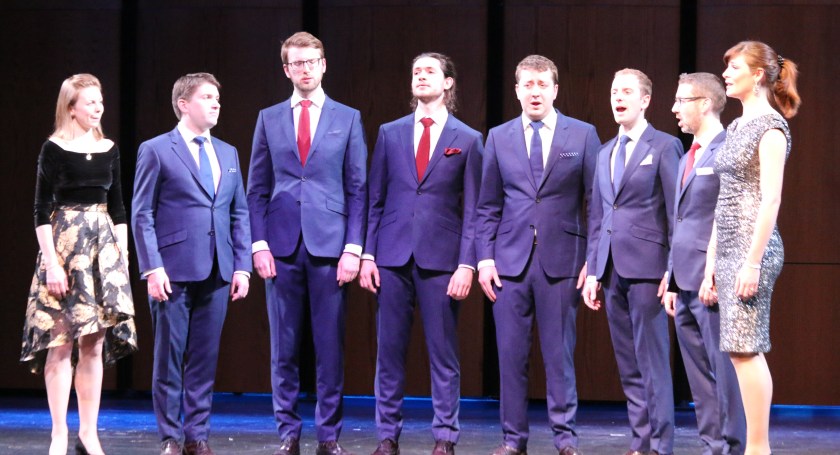
Rachel Podger and VOCES8 at Kings Place review ****

voces8_17feb2017

Rachel Podger, VOCES8 – A Guardian Angel

Kings Place, 28th March 2018

  • Orlando Gibbons – Drop, drop slow tears
  • Plainchant – Pater Noster
  • Heinrich Ignaz Franz Biber – Rosary Sonata No 16 Passacaglia “A Guardian Angel”
  • Jonathan Dove – into thy hands
  • Nicola Matteis – Passaggio rotto, Fantasia, Movimento incognito (from Other Ayrs, Preludes, Allemandes, Sarabandes
  • Mendelssohn – Denn er hat seinen engeln befohlen uber dir
  • Rachmaninov – Bogoroditse Dyevo
  • Tallis – O nata lux
  • James Macmillan – Domine non secundum peccata nostra
  • Thomas Tomkins – When David heard
  • Bach – Partita for flute in A minor BWV 1013
  • Monteverdi – Adoramus te. Christe
  • Orlando Gibbons – Hosanna to the Son of David
  • Giovanni Gabrielli – Angelus Domini descendit
  • Owain Park – Antiphon for the Angels

Blimey. It took almost as long to write out the programme as to listen to some of these pieces.

What do we have here then? Well the undisputed queen of the Baroque violin, (OK maybe not given Isabelle Faust, Monica Huggett, Elizabeth Wallfisch and no doubt a few more I don’t know), has teamed up with the English vocal group VOCES8 to create a programme of violin and vocal works from across the ages all themed around “A Guardian Angel”. Some of these pieces appear on Ms Podger’s 2013 CD of the same name. Rachel Podger creates a big, clear sound with vigorous rhythm which makes it a joy to follow the line of the music. Yet when virtuosity is required, (not so much on this evening), she doesn’t hold back.

Angels being angels in Christian religion they turn up a fair bit in music notably Renaissance, Baroque and the modern composers who seek inspiration from their forbears. Here we have pieces for solo violin, (or flute transposed for violin in the case of the Bach sonata which formed the backbone to the second half), for choir alone and for a combination of the two. Angels watching over you is obviously anathema to my carefully constructed rationalist self-image though maybe all this music and my penchant for early Renaissance art and architecture might cumulatively start to rub off. I was reminded of the world (other-world?) that Annie Baker explored in her latest play John (John at the National Theatre review *****).

The plainchant with the choir perched in the balcony was as meditative as you like and was followed by the Baroque violinists party piece de jour from Biber which seems to be following me around everywhere. It’s title provided the stepping off point for Ms Podger. If you don’t know it, and the genuinely ground-breaking Sonatas that precede it you should. It still sounds cutting edge today. It doesn’t skimp on the bass notes which is probably when it floats my boat. Ms Podger’s recording is the best place to start.

I can take or leave the Mendelssohn, Rachmaninov and Dove pieces though VOCES8 were more convincing than I expected, the Matteis violin extracts were immediately invigorating in that typical Italian baroque way and the MacMillan piece was as spare (echoes of Part) as you might expect from this committed composer. The Tallis was my favourite with Ms Podger’s violin taking the highest line as the Jesus to the choir’s Elijah and Moses and alongside Andrea Halsey’s spellbinding soprano. Her voice is about as good as you will ever hear (says some-one who knows absolutely nothing about singing!!).

The biggest surprise of all was the Thomas Tomkins. New to me, I will need to seek this out. The Bach was obviously wonderful, Ms Podger has made this her own and proved that it could as easily been scored for violin as flute. The Monteverdi, Gibbons and Gabrielli pieces were relatively short but very welcome. Owain Park’s new work was commissioned especially for this collaboration and amalgamates texts by St Ambrose and Hildegard von Bingen sticking to the angel theme. Like so many commissions for choirs it is immediately attractive, it is a real thrill hearing accessible music for the fisr time.

Throughout the concert we had well constructed antiphonal exchanges between violinist and pure toned choir which brought out the best of the exceptional acoustic at Hall One of Kings Place. No clapping between the pieces, a rapt audience, (no phone glows as far as I could see), and discreet but appropriate lighting all combined to maintain the magic.

I can’t pretend I understand the music that was put in front of me. I can’t read music and I am steadfastly failing to learn its language. If you are like me, and I reckon there are a lot of you who are, (obviously I say this in full knowledge of the fact that no-one reads this), then I cannot recommend the combination of Early and/or Baroque music and voices highly enough. Food for brain, heart and soul (not that there is one, but like I say earlier, faith may yet surprise me).



The Square film review *****

_STH0322 - version 2

The Square, 27th March 2018

Ruben Ostlund’s last feature, Force Majeure, is one of my favourite films of the last few years. Now we have The Square to set alongside it. Longer, more ambitious, a bit baggier in places, it once again deals with the nature of embarrassment. This time though there is a healthy dose of satire laid on top. initially at the pretension and contradictions of contemporary art, with Mr Ostlund subsequently taking aim at a lot more targets along the way. It is excruciatingly funny.

The blurbs make a lot of noise about the participation of Elisabeth Moss and Dominic West. Ms Moss, who I only really know from the TV adaptation of the Handmaid’s Tale, has a job to do playing American journalist with whom the lead character, Christian, has a one-night stand. And she is very good in the role. (As an aside my advice to those who want to sample the pungent and vital voice of Margaret Attwood, probably the greatest living English language novelist, should stick to reading her books. I know she gets involved with the TV adaptations but for me they do go on a bit. There. I’ve said it). Dominic West also chips in with some low grade scenery chewing but it’s really just a cameo.

Nope. this film is really about two people. The wonderful Danish actor Claes Bang in front of the camera and our Ruben behind it. It has already garnered a hatful of awards, should have won the Foreign Language Oscar, and will be seen a a classic in decades to come.

Christian is the suave curator of the X-Royal gallery in Stockholm (the real Nationalmuseum, currently being refurbished, offering up its elegant services for the exterior shots). Anne poses some naive questions which flummox him. He is robbed when intervening to help a woman on the street. He and his assistant track his phone and hatch an ill-advised plan to letterbox mildly threatening leaflets to the apartments in the block where his phone apparently lurks. Plot A goes downhill from there. In Plot B the distracted Christian ends up sanctioning a viral campaign to promote the gallery’s latest exhibition. That also ends really badly. Throughout we see Christian’s self-image of progressive liberalism unravel to reveal darker class, intellectual, racial and sexual prejudices. He is a pretty selfish man. A modern, privileged, anxious Everyman.

Ostlund is motivated to explore all those situations where we confront when we should walk away or ignore when we should intervene. There is a sharp dissonance between the way the characters feel they should behave, in polite, liberal society, and the way they actually want to, and do, behave. Consequences flow from banal and absurd decisions. The animal instincts beneath the veneer of sophisticated humanity are revealed, literally in one memorable scene from actor Terry Notary. Ostlund carefully juxtaposes the wealth and lifestyle of the metropolitan elite in Stockholm, the apotheosis of “equality”, with want, in the form of beggars. Civilisation, whether in the form of art, technology, commerce, behaviour, is fragile.

Ostlund claims that some of the episodes are drawn from his own experiences. He and producer Kalle Boman devised an installation, called the Square of course, for an exhibition in 2014. Like its fictional counterpart ,”the Square is a sanctuary of trust and caring. Within it we all share equal rights and obligations.” The installation in the X-Royal gallery bears a striking resemblance to the work of Robert Smithson. The scene where a man with Tourette’s Syndrome interrupts a press conference happened at a Swedish theatre and Ostlund claims he was mugged in the rather ostentatious way in the film’s opening. Ukrainian-Russian artist Oleg Kulik who performs as a dog is the inspiration for one of the scenes.

Now you might reasonably say the film is a little long, but there isn’t one of the carefully crafted scenes that I would remove. You might also say that its doesn’t really go anywhere, and the narrative is unstructured, but that is the point. Characters jump into the plots unannounced heightening the discomfort. There is a surreal quality to the film, but that reflects more the images which Ostlund selects and the way he shoots his scenes, and the breaks between them, rather than any specific quality of ‘unreality”. There is also a link to the best of sit-com for me where the hapless hero, in an attempt to avoid embarrassment digs himself deeper and deeper into a hole. As in Force Majeure Ostlund has an ear for musical motifs which enhance the spectacle. I recognise the Bach setting and the Bobby Ferrin/Yo Yo Ma mash up; you hipsters will be alert to the more modern grooves.

In a failing bid to keep up with BD’s chosen academic specialism, and because it is so interesting, I have found myself delving into idiot’s guides to social psychology. Ruben Ostlund’s extraordinary work seems to mine hte same vital territory. I am going to watch this film again and again.

The Plough and the Stars at the Lyric Hammersmith review ***

sean_o27casey_by_reginald_gray

The Plough and the Stars

Lyric Hammersmith, 26th March 2018

One way or another I see a fair amount of theatre. Making up for lost time I guess. Anyway this requires a reasonable degree of organisation. Nothing a small child couldn’t cope with but I do need to be on top of the diary. Very occasionally there is a system error. I say system. Obviously it’s my stupidity. One casualty was the National Theatre’s revival of The Plough and the Stars in summer 2016. It never got into the diary, I failed to check the fail-safe lists and ended up in Sicily en famille before I realised the mistake. Reviews weren’t great, Sicily was, (even if we found ourselves once again on top of a very steep hill despite strict instructions to the booker, me, to avoid this). And I had only paid £15 for the ticket thanks to that nice Mr Dorfman who uses his Travelex fortune to support the NT. Even so it irked me. Still does. It’s always the little things isn’t it?

Anyway that meant postponing my first exposure to the renowned Irish playwright Sean O’Casey until this production, That’s right. No Juno and the Paycock or The Silver Tassie yet, (though I am signed up for the concert performance of Mark-Anthony Turnage’s opera based on the latter at the Barbican in November).

So I have some catching up to do. First impressions? Well I can see why Mr O’Casey’s work might divide opinion. The mixture of trenchant politics, (all sides come in for a walloping from socialist SO’C), comedy filtered through working class Dublin lives that, with hindsight, teeters perilously close to Oirish cliche, and melodramatic tragedy, takes a bit of getting used to. I see from Michael Billington’s review of the 2016 NT production that it took him a bit of time to get into the swing of things that time round. Same thing happened to me in this production. I also, shamefacedly, have to admit my ears had to adjust a bit to the vernacular accents on display, the drift of SO’C’s prose. Yet once it all got going, and subsequently having thought about, and done a bit more work on, the play, I am starting to see where the advocates of SO’C are coming from. (The programme contains a pair of fine articles on the way in which the Easter Rising, and women’s role in Irish independence, have been interpreted over the years). If it is good enough for the mighty Mr Billington, who should be knighted and canonised for his services to the theatre illiterati like me, then it is good enough for me to sit up and take notice.

This production in its original “anniversary” incarnation at the Abbey Theatre Dublin has a very fine Irish cast which has been brought over to West London largely intact. Now it wouldn’t be Sean Holmes, (don’t be deceived by the name – he’s English), as director if there wasn’t a bit of “auteristic” subversion instituted into proceedings and so it is here. Jon Bauser’s set is low budget but ingenious with scaffolding creating the Dublin tenements, or maybe now tower blocks, and graffitied plywood standing as walls. A fair amount of cheap (I assume) lager spills out on to the stage. Paul Keogan’s lighting is similarly severe. Catherine Fay’s costume design is resolutely modern-day, particularly striking when the British soldiers first appear. This means that the setting, 1916 Dublin at the time of the Easter Rising, can echo across subsequent years in the island of Ireland. I see the point. Patriotism, whether derived from a line on a map or a different shade of god, is an ugly f*cker. And it’s always the least advantaged that lost the most.

The everyday humour which fuels the first act in the living room of the Clitheroe’s flat, and in the pub in the second act, is confidently delivered. Remember this is November 1915, the Nationalists including the trade unionist Irish Citizens Army, are organising. The relationship between Ian Lloyd Anderson’s Jack and Kate Stanley Brennan’s Nora is believably tender, and then strained, when Jack is re-recruited to the cause despite Nora’s desperate intervention. On the other hand whilst individually, Niall Buggy’s buffoonish veteran Uncle Peter, Phelim Drew’s lovable drunkard carpenter Fluther Good, Janet Moran’s effervescent charwoman Mrs Gogan, Ciaran O’Brien sanctimonious Marxist Young Covey, are all individually fine performances they don’t always seem to naturally occupy the same space.

This slightly stilted tone continues through into the pub with Nyree Yergainharsian forthright prostitute Rosie Redmond. However, once the fight between Mrs Gogan and Hilda Fay’s bitter Protestant Bessie Burgess breaks out, the tone shifts, for the better in my view. Now the way external events catch up with the individual characters starts to add texture. SO’C’s critique of the “heroic” telling of this passage in Irish history is manifest even if you know very little about it. The compassion of the women in the play is highlighted, especially Bessie Burgess, the best role here. The fear that violent struggle precipitates, as the soldiers break into Bessie’s attic, is palpable.

I think it might just become a much better play in the second half. I can see that the brazen looting, young Moliser’s death from TB, (some convincing coughing on demand from Julie Maguire decked out in tribal footie shirts), Nora’s stillbirth and delirium and Bessie’s sacrifice create a tonal shift into something as bleakly overblown as the first half was comically pigeonholed. Yet is feels more sedulous, certainly in this production.

It is a hard thing to bring out the complexity of ordinary people living on the periphery of historical change. Weaving a drama from this, whilst still setting out to upset just about everyone involved in creating the narrative which idealised this change, is surely doubly difficult. You can see why the play had such an impact when first performed at the Abbey in 1926. I can also see why its status as “canonic” theatre also makes it a tricky piece to get right. This might not have been the perfect production on first viewing but I suspect I will grow to like SO’C with more exposure.

I took the wrong route home, (bus not tube since you ask), which meant that an earnest  young chap, I suspect gently in his cups, politely asked for my programme lying on the seat. He carefully asked my opinion on the play. I was a little sniffy. I now regret that. I do hope he went.

Final aside. Apparently SO’C lived in Totnes. And died in Torquay. I didn’t know that. Seems like there is more to the Tourist’s birthplace than he ever realised. The more you learn the more the more the connections build.


Murder She Didn’t Write at the Leicester Square Theatre review ****

agatha3

Murder She Didn’t Write, Degrees of Error, Something for the Weekend

Leicester Square Theatre, 25th March 2018

Flushed with success from our previous outing to the LST for a bit of class improv, BD, LD and the Tourist slope off to see Degrees of Error and Something for the Weekend and their commended show Murder She Didn’t Write. If this was as anything like as good as Austentatious we were in with a treat (Austentatious at Leicester Square Theatre review ****).

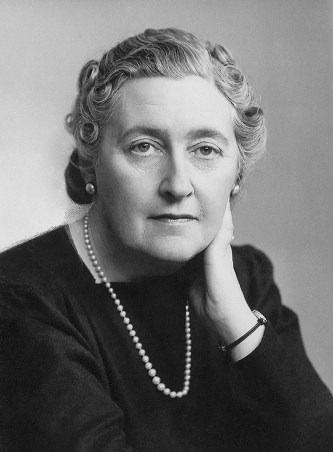
Well, I can report, it is,  and we were. You wouldn’t think to look at kindly Agatha Christie that she could have such a devious and sly mind. For how else to explain how she re-wrote the rules on whodunnit plotting. Which delights in exposing human cruelty. Take a look at Sarah Phelps’s riveting adaptations courtesy of the BBC, Ordeal By Innocence on now, Witness For The Prosecution and And Then There Were None, if you want to see how Christie should be done.

Agatha Christie is, by some margin, the most famous product of Torbay. If the Tourist, who is similarly scion-ed, is to catch her up he needs to come up with something sharpish. This blog, with its still pitiful double digit readership, is not it. Her holiday home, Greenway House, is well worth a visit, and happens to be just down the road from the Tourist’s alma mater.

The classic Christie tropes, the grand locations, the secretive characters, the class divisions, the disguises and assumed identities, the clues and red herrings, the inspired investigator, the big reveal, are as amenable to spoofing as they are to cracking drama. So it’s not really a great surprise to see an improvisation troupe alight on Agatha as a source for its entertainment.

That is not in any way to decry the skill which Degrees of Error bring this to the stage. DoE are an improv theatre company based in Bristol and have been taking Murder She Didn’t Write to Edinburgh and on tour since 2013. So they know what they are about. Even so, as with Austentatious, improv comedy theatre on this scale, (we got around 90 minutes of action for our 15 quid each), is a tough gig. So they wisely help themselves in a number of ways. One of the company, (I think Tom Bridges but with no cribsheet I can’t be sure so forgive me if I am mistaken), plays the detective, who guides us through the “plot” with occasional interjections to give his “acting” colleagues time to pause for breath and to suggest scenarios which might add to the gag quotient. He also recruits a member of the audience to be his sidekick, Jerkins, who picks out both victim and murderer. Our cast is “colour-coded” Cluedo fashion to assist in the process. Jerkins also ultimately decides on the location and event for the murder mystery based on audience suggestions vetted by the Inspector.

All this buys a bit of time for cast to prepare and to fit the classic Christie tropes to their characters. Even so, early on, there are a few awkward diversions and cross-talking, but after the first 20 minutes or so the direction is set and the cast can settle into the flow. Then they start making it look easy. After the interval you would barely know it was improvised.

It is very, very funny. Our setting, a wine tasting, and location, a wine-glass factory worked a treat. I don’t know how much they might have squeezed in from previous improvs but nothing ever feels forced or less than spontaneous. Watching the comic ideas coalesce is delightful and seeing the cast grinning when they hit the comedy jackpot makes the whole thing even funnier. That is the shared joy of improv.

I think the cast was Peter Baker, Lizzy Skrzypiec, Tessa Gaukroger, Caitlin Campbell, Rachel Lane and John Lomas, but I can’t be sure as I say. No point singling out anyone in particular, the whole ensemble was fabulous.

If this even slightly piques your interest I strongly encourage you to take the plunge. The London gigs at the LST are at 4pm on a Sunday. What else are you going to be doing then FFS? This is one of those outings where you absolutely can take your mates along without worrying they won’t enjoy it and you will look like a tit, and there is, for a couple of hours at least, no question of FOMO or phone-withdrawal kicking in.

http://www.degreesoferror.com/tour/


Patricia Kopatchinskaja and the LPO at the Royal Festival Hall review ****

patricia_kopatchinskaja_4_28c29_marco_borggreve

London Philharmonic Orchestra, London Philharmonic Choir, Thierry Fischer, Neville Creed, Patricia Kopatchinskaja (violin), William Davies (treble)

Royal Festival Hall, 24th March 2018

Igor Stravinsky

  • Symphony of Psalms
  • Violin Concerto in D
  • Credo, Ave Maria, Pater Noster

Leonard Bernstein

  • Chichester Psalms

I have banged on before about the virtues of Moldovan-Austrian-Swiss, (forget national borders people), violinist Patricia Kopatchinskaja before, slam-dunking Berg or crossing musical boundaries with cellist pal Sol Gabetta (Kopatchinskaja and Gabetta at the Wigmore Hall review ****). She was at it again, this time with the Stravinsky Violin Concerto, alongside the London Philharmonic Orchestra under the baton of Thierry Fischer a relatively late replacement for Andres Orozco-Estrada.

This was another in the South Bank’s Stravinsky exploration kicking off with Igor’s Symphony of Psalms. Three parts, with Latin settings of psalms 39 (verses 13 and 14), 40 (verses 2,3 and 4) and 150, played without a break, and constructed as a Prelude, a Double Fugue and Symphonic Allegro. Inventive enough for you? Well just to keep you on your toes IS boots out the clarinets, violins and violas from the accompaniment to his four part choir, (kids preferred by IS for the upper two parts but I reckon women, as here, is better). He adds in not one, but two, pianos and a harp to augment his already hefty woodwind, brass (a tuba, lovely), percussion and the big strings.

The first part then is like some mutant Russian/Byzantine/Baroque/Neo-Classical jazzy chorale with ostinatos broken by thick E minor chords. That is the joy of his counterpoint. Then the fugue in C minor kicks off in the woodwind, all heavenly-mysterio, then the chorus kicks in with the second fugue, then we swirl around in heaven with some Mahlerian horns bubbling away in the background until we get some rounding homophonic pronouncements at the end. The final section starts off all stark, austere and hairshirt, like the end not the start, until the propulsive allegro kicks in with a trumpet-harp motive. There is a chordal tune, a bunch of exuberant triplets echoed by the chorus and a striking running tune for horns and pianos. The slow beginning is repeated, with more warmth, and then revisited in the final Haydn-esque coda as we rise up to the stars. There are Allejujas all over the shop. This is the longest section as it incorporates the whole of Psalm 150 and it is remarkably uplifting.

The piece was written, for the Boston Symphony Orchestra, in December 1930. It could only have been written at that time, by that one man, and yet …. so much of it echoes down, and forward through, the centuries. I know how daft that sounds but it is, even by Igor’s standard’s, remarkable music. Now you would normally reckon that the London Symphony Chorus rules the big choral roost in the capital. On this showing you’d be wrong. The London Philharmonic Choir under Neville Creed were on scintillating form. Bravo.

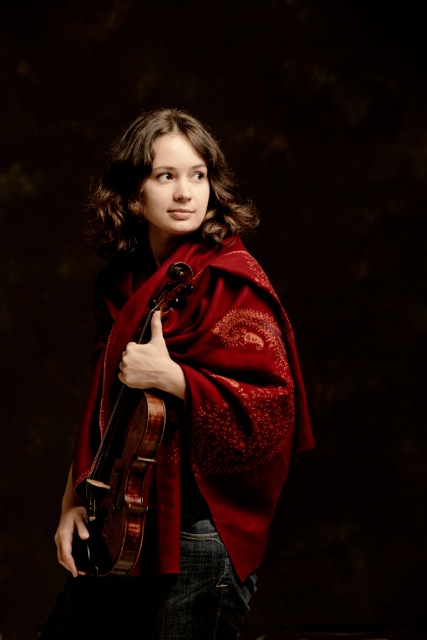
If singing this marvellous work were not enough, (though I appreciate how much work they put in ahead of it), the choir were treated to a sit down and Ms Kopatchinskaja’s astonishing fiddling. Now she certainly has a singular, and confident, performing style. Bare feet, big gown, lots of hopping and skipping about, hair tossing, it is pretty difficult to take your eyes off her. Fortunately Pat Kop, (yep, that’s her own branding), delivers a sound to match the charismatic gypsy schtick. The first movement Toccata is a souped up slab of florid Baroque, the middle two Arias exactly that, the first an upbeat shakedown, the second balladic if you will, and the final movement, Capriccio, lands us back in the heyday of early C18 Venetian virtuosity. The LPO and Mr Fischer were more than a match for their soloist keeping up, and once or twice, spurring on our self-assured diva. IS asked for a big orchestra, though again with constrained strings, but wisely never let it loose collectively, allowing the violin to always shine.. This suited Pat Kop who just about stayed the right side of insistent.

Remember when IS sent this score out to the world in 1931 his dedicatee violinist ,Samuel Dushkin, was a little intimidated by the “unplayable” wide spread three note chords which kicks off each movement. IS told him not to panic, it was a piece of cake. Once again Igor, a piano player not a violinist remember, was right and the received wisdom of the expert was wrong. He writes one violin concerto and no composer since has escaped its influence, in terms of how to relate violin to orchestra. And yet that very concerto is suffused with history. Pat Kop though wrestled with the Baroque to ensure that none of Stravinsky’s sly humour was lost.

Big, bold stuff from a soloist and and orchestra who have mastered the work. The encore was Pat Kop’s own party piece cadenza which draws on material from the Concerto, nods to Bach and ropes in Pieter Schoeman, the LPO’s leader, to act as counterpoint. Her discography shows she isn’t going to be bounced into just churning out the classics.

The Choir then took centre stage, from the rear as it were, with performances of three choral pieces that IS wrote in France after he returned to the Orthodox faith. He was a profoundly religious chap, for all his musical revolutions, and these settings, of the Lord’s Prayer, the Creed and the prayer to the Virgin Mary. Initially set in Church Slavonic he revisited them in later years and transposed them in to Latin texts. The Credo is chanted in devotional harmony, the Pater Noster in similar meditative fashion with a syllable to each note, with the Ave Maria sing-song-y making more extensive use of melisma. IS offered no markings so the choir and its leader have plenty of expressive headroom.

I was pretty sure I wasn’t going to be persuaded by the Chichester Psalms. I wasn’t. I just don’t get on with all that flash Harry (Lenny), sub-West Side Story, Mahlerian heart-tugging. Sorry. Young treble William Davies, understandably initially nervous, stepped up in the middle movement, well done, and the crowd seemed very pleased with the piece so what do I know.

Overall then a fine evening’s entertainment and well done to Mr Fischer and Mr Creed for guiding everyone through it. And sign me up to the Pat Kop fan club.


The Great Wave at the National Theatre review ****

the_great_wave_off_kanagawa

The Great Wave

National Theatre, 24th Mar 2018

Now theatre can do a lot of things. Delve deep into the psychology of characters and shed light on the human condition. Convey a passionate and heartfelt message. Put poetry into the mouths of actors. Dispense shock and awe through sound, light and material. And, of course, tell stories. And sometimes those stories are so fascinating that the rest can take a back seat. So it is with The Great Wave.

Japanese/Northern Irish playwright Francis Turnly has alighted on an absolute belter of a story to tell in his play and he doesn’t let anything get in the way of its telling. Bolshie Hanako, (a performance of great breadth from Kirsty Rider given Hanako has to hide her true feelings for much of the play and age 25 years), is winding up swotty sister Reiko, (Kae Alexander who is rapidly turning into one of my favourite young actors), and putative boyfriend Tetsuo, (Leo Wan, last seen by me in Yellow Earth’s stripped down version of Tamburlaine the Great). She flounces off in a huff to the beach near where they live on a stormy night and disappears. Mum Etsuko (Rosalind Chao), Reiko and Tetsuo won’t accept that she was swept out to sea and  won’t give up on the search for her, badgering police chief Takeshi (who initially suspects Tetsuo), and eventually government minister Jiro, (both played by David Yip,) to find the truth. It transpires that Hanako has been abducted by the North Korean regime so she can train spy Jung Sun (Tuyen Do) to pass as Japanese all under the watchful eye of an Official, (a marvellous turn by Kwong Loke). And there’s more, involving smart performances from Vincent Lai and Frances Mayli McCann.

This really happened, to a handful of Japanese citizens, as you may or not know. That would be enough maybe in itself. Where Mr Turnley is really clever is drawing out the human dramas at the centre of this thriller and, gently, pointing out the political accommodations that allowed it to persist from 1979, before finally, unravelling. in 2002. He also, again without taking a sledgehammer to proceedings, shows how the histories of Japan and Korea are intertwined and paralleled to some degree. Finally, and maybe most importantly, he asks us how identity and self is actually constructed. Why did Hanako “co-operate”? Why do Jung Sun and the Official believe in, and do, what they do? How was this allowed to happen? I won’t answer as there are a few more performances left (grab a ticket) but, rest assured, you will get wrapped up in the journey. You will also, if you are an old softie like me, actually be quite moved at points. And you will, as you should, reflect on today’s geo-politics.

Tom Piper’s set, a simple revolve with uncluttered, but still authentic, cube rooms, means the episodic structure of the play, jumping between Japan and North Korea, flows without interruption. The sound design of Alexander Caplan’s stealthily kicks in to good effect as well. There are some occasions where the economy of Mr Turnley’s prose becomes a little clunky but this can be forgiven as it gets us from A to B quickly, which frankly, with a story this good, is what you want.

With a powerful story, simply told, the last thing you need is a director over-egging the souffle, as it were. Indhu Rubasingham was never going to do that. What she does do though, so deftly you barely notice, is put the right people in the right place at the right time to highlight the emotion of the story. That takes real skill. When she gets her own theatre back, (the Tricycle), after all the investment, expect fireworks.

BD, being a Japano- and Koreano- phile, was never going to be allowed to miss this. Not quite as difficult to please as her mother when it comes to the theatre, she is still a stern critic. Didn’t move a muscle from start to finish. And I am rewarded with multiple future credits.

So a real-life thriller that, like the set it is set upon, revolves around and around until it becomes something more surprisingly profound. I suppose the fine British East Asian cast could have been afforded more lines to show off their class, and bring full complexity to their characters, but, if so, this may well have clocked in at well over 3 hours, and the suspense dissipated. Like I say, sometimes the story is so good it just needs telling.


From the House of the Dead at the Royal Opera House review ****

1024px-leos_janc3a1cek_28192629

From the House of the Dead

Royal Opera House, 22nd March 2018

Now this is it what opera is all about. Not just some portly punters, (though a couple of the chaps here were carrying as much timber as me), parking themselves mid-stage and belting out their arias. No here we get a concept, and some, a detailed design to back it up, lashings of action and even more acting, maybe too much, and a score which fits the prose of the libretto. I see it has wound up a few die-hards who would probably be happier with some Puccini-esque love mush but this is the real deal for me.

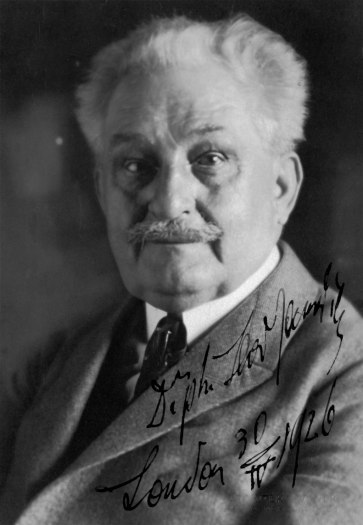
Now Janacek famously never made his life easy when it came to picking the subject matter for his operas. Infanticide, forest animals, adultery and suicide, the delusion of eternal life, a warrior matriarchy, a meta tragic opera. What a bout a feel-good rom-com eh Leos? Anyway From the House of the Dead is drawn from Dostoevsky’s eponymous novel which Janacek translated and adapted in his own libretto and is set in a Siberian labour camp. It has only one assigned female character, a prostitute, though one of the prisoners is normally a soprano, though not here. There is no narrative arc. It is largely episodic and expositional with the main characters steeping out of the ensemble to describe the crimes that led to their incarceration. There is a play within a play which takes up most of the second act. The music is pretty intense, lots of that special Janacek ostinato rhythm, with not much in the way of quiet reflection. There is no ending or resolution to speak of.

It was Janacek’s last opera and was pretty much complete on his death. But a couple of his students decided it wasn’t and that he can’t possibly have meant what he had left on the page or that an unresolved ending was appropriate so they “enhanced” the score significantly and changed the ending. Sounds like Hollywood today. Anyway all this gloss has been cleared out to produce a score much closer to Janacek’s original intentions., here further refined by John Tyrell’s critical edition. Intentions that require a vast orchestra, here spilling out into the side of the stalls. Chains anyone? The Orchestra of the ROH under the baton of Mark Wigglesworth sounded fantastic. I can’t imagine a better conductor of Janacek’s operas.

This though was all about the director though. Krzysztof Warlikowski doesn’t hold back. The overture, which lays out Janacek’s main ideas, which are subject to subtle variations throughout the three acts, is accompanied by a video projection of French philosopher, and winder-up-in chief -of-reactionary-conservatives, Michel Foucault, theorising on the nature of power, punishment and control in the modern prison system. The curtain rises to a solitary basketball player and a brutal modern prison yard. The athlete turns out to be “Eagle” standing in for the bird that represents freedom in a classic staging. Novel huh? A glass box acts as the governor’s office and, later, as the stage for the play within a play. Throughout the whole ensemble is in movement, offering multiple perspectives on the stories. From my perch in the back of the gods it wasn’t always easy to know who was singing but no matter. I’ll gladly swap a bit of narrative confusion for all this visual content. All thanks to designer Malgorzata Szczesniak.

And it isn’t that tricky to work out what’s going on. Gorjancikov, (I’ll refrain from full names or we’ll be here all day), played by the extraordinary Willard White, now in his 70s, pitches up. He’s a political prisoner and toff so the governor (Alexander Vassiliev), as you do, has him beaten up. Skuratov (Ladislav Elgr) talks about his life in Moscow. Luka (Stefan Margita, who was very impressive) tells how he and a crew killed a prison officer. Gorjancikov befriends young Aljeja (Pascal Charbonneau) and teaches him to read and write. Skuratov prefaces the play within a play by telling how he killed the bloke his girlfriend was forced to marry. The two plays are performed in bawdy fashion. The Prostitute (Allison Cook) gets involved. There is a bit of a dust up. Sapkin (Peter Hoare) describes his interrogation, Siskov (Johan Reuter, another excellent performance, though the tattoos help convince) tells of how he killed his wife because she was still in love with the village w*anker Filka, who, sharp intake, turns out to be Luka, who has, second sharp intake, just dropped dead. Antonic (Graham Clark) says he should still be forgiven, the moral of Janacek’s tale. Everyone, however “evil” can be forgiven, we all have the “spark of God” apparently. Gorjancikov is released. The end.

So, as you can see, not much in the way of plot. Yet the stories, which are elaborated through the play within a play structure, are compelling and the atmosphere of tension, claustrophobia, frustration and violence, and yes a bit of confusion, travelled right up to the back of the amphitheatre. The performances of the cast, inside all this action, are powerful enough to bring life to the characters; best of the bunch is Nicky Spence as Nikita who really can act and sing simultaneously. These are men who have done wrong, really wrong, but Mr Warlikowksi, in his dramatic staging, tellingly makes the point that they are victims, of their own warped masculinity if nothing else, as well, who need help not punishment to the point of death. And he does this by sidestepping the religiosity of the source material.

Loved it. More of Mr Warlikowski and Ms Szczesniak artistic partnership please.


Carducci Quartet at St John’s Smith Square review ****


The Carducci Quartet

St John’s Smith Square, 23rd March 2018

This was the second time I had heard the Carduccis perform the first five Philip Glass string quartets, following their performance at Kings Place as part of the marvellous Minimalism Unwrapped year long festival in 2015. They are, along with the Smith Quartet, (whose recording I have), and the Kronos Quartet, the experts in these works. The First Quartet dates from 1966, the next four from 1983, 1985, 1989 and 1991 respectively. Glass has composed a further three quartets in recent years, including one a couple of months ago, as well as a couple of other works for this ensemble drawn from music for films. I need to hear them.

Mind you there are an awful lot of Philip Glass compositions that I have yet to hear. I suspect I won’t. No matter. You’ve heard one, you’ve heard them all. Of course that isn’t true but if you know your Glass you will know what I mean. I do find his chamber and piano music more intriguing than some of the larger scale works and, because I think the string quartet is the sine non qua of Western art music, these babies are my faves. There is more contrast, and therefore drama, than in the larger scale works though it is all relative.

The First Quartet was composed when Glass was in Paris studying under Nadia Boulanger, mixing with arty types and rejecting modernist composers, the likes of Xenakis, Boulez and Stockhausen, not because he couldn’t get on with their vibe but because he wanted to take a different course. He alighted on repetition and rhythm via Ravi Shankar and Indian classical music. Given that this was pretty much his first attempt at this new style it really is an impressive piece. There is still a degree of dissonance and apparent atonality which relates to modernism but the little cells of music in its two untitled movements, and the contrapuntal effects, are recognisably Glassian.

The Second Quartet, titled Company, was commissioned to accompany a monologue written by the master Samuel Beckett. The first and third, and second and fourth, movements are related and the soundworld is the classic harmonic progressions we know and, most of the time, love. The Third Quartet is drawn from the soundtrack that Glass composed for Paul Schrader’s film Mishima, about the eponymous Japanese novelist, though Glass had the quartet in mind throughout. There are six movements in total and they relate to the passages in the film, filmed in black and white, which flashback to Mishima’s childhood. They are varied in colour, playing with metrical accents and harmonic ideas.

The Fourth Quartet is a tribute to artist Brian Buczak and consists of three movements. This is a much more substantial piece than its predecessors and has pronounced elements of the Romantic referring, as it does, to the quartets of Schubert and Dvorak. The first movement moves away from familiar Glass territory into more complex polytonality, there is a yearning lyricism in the slower second movement and the third movement runs close to a chorale. This is surprisingly moving stuff.

The Fifth Quartet again titled Mishima also packs more of an emotional punch than you might expect from a cursory listen to Glass’s music. The very short first movement’s material appears again in the later four movements but we immediately know, with its pizzicato passages and long,melancholic phrases, that this is going to be a bit different. The second movement takes us back to more familiar Glass territory with triadic ostinatos for the lower strings, but even here the surface melodies reveal syncopations and unexpected shifts in phrasing. The pace hots ups a bit in the third movement, with a familiar motoric call and response, but the same elements recur before a shift into minor mode and the train slows down to a stop. The fourth movement starts slower, with a repeated swirl which accelerates, is subjected to some dissonant reworking, before slowing again. The last movement contains a much broader canvas of soaring lines and intricate figurations, interrupted by the slower themes from the first movement, before ending with a single pizzicato line. You would guess that this was “minimalist” but you might think it came from today’s generation and not from Glass himself.

Now I get why revivals of Glass operas can reliably pack out the ENO, terrific singing (especially choral), though not necessarily in an accessible language, a colourful production, a story, (though not much of one), but musically these are built up of big slabs of repetition. In contrast the string quartets never outstay their welcome and, in this particular case, you can see the best possible advocates perform them for not much more than a tenner, in the ever atmospheric SJSS. So it was a shame to see it less than half full.

So come on all you young’uns. If you can reclaim the opera house from us pensioner types you can do the same to the SJSS which, I have to admit, probably needs a dose of diverse blood.


BBC Symphony Orchestra and Vilde Frang at the Barbican Hall review ****

vilde_frang_wikipedia

BBC Symphony Orchestra, Sakari Oramo, Vilde Frang (violin)

Barbican Hall, 21st March 2018

  • Anna Clyne – This Midnight Hour
  • Benjamin Britten – Violin Concerto, Op 15
  • Ludwig van Beethoven – Symphony No 6 in F major “Pastoral”, Op 68

The Violin Concerto is one of those Britten pieces that takes a bit of time to get used to. It was written in 1939 so contains plenty of the youthful flashiness, and debts to Stravinsky, which characterise early BB, but with a more serious intent which reflects his admiration for Alban Berg, whose own Violin Concerto, was the last in a frustratingly thin oeuvre. BB attended the posthumous premiere of Berg’s masterpiece in 1936, in Barcelona in the shadow of the forthcoming Spanish Civil War, as well as two further performances later in the year. Understandably he was mightily impressed.

BB’s own concerto was premiered in New York in March 1940 by the Philharmonic under John Barbirolli, given that he and Peter Pears were stuck there following the outbreak of war. The British premiere was in April 1941 in BB’s absence. Despite BB’s revisions in 1950, 1954 and 1965, which brings a little more of the late Britten’s soundworld to the violin part, the piece has historically been more admired than loved, but it has developed a bit more of a following in recent years.

Which means that some of today’s finest violinists have taken up the BB VC cause. These include Janine Jansen who played the piece with the LSO last year under Semyon Bychkov in this hall last year. This is not a concerto full of showy virtuosity, the soloist works on the ideas with the orchestra, but it does require a formidable technique. Ms Jansen certainly has that but the performance overall was a bit more athletic and weighty than I might have liked (though maybe that was the influence of the Mahler on the bill).

In contrast Vilde Frang, who has also recently recorded the piece, seemed a little bit more delicate, most obviously in the pianissimo sections, and the double stopping, of which there is a surfeit in the Scherzo, more Baroqueish than Modernist. This lighter, though still enthralling touch, made the final coda, constructed in BB’s favourite Passacaglia form, even more irresolute. a good thing in my book. The first movement, in sonata form, opens with a little rumble on the timps, then the bassoon takes up the tune, and then the rest of the orchestra, returning to it ostinato through the movement, whilst the violin moves in and out with its uneasy, song-like lament. The second theme is also martial in intent; there is a link to Shostakovich, but with more elegance and less hectoring. This theme is taken up by the violin, not the orchestra, in the recapitulation which ends with an unsteady coda. The second movement scherzo is spiky and Prokofievian in feel, with a very sinister transition to a tutti before ending with a cadenza, based on the first movement tunes, in which Ms Frang excelled. The ground bass which underpins the variations in the final movement is a bit wobbly in terms of tone, at one point D major triumphs, ending with a simple chant, over which the violin dances around, never quite closing out.

I think it is the uncertain tone, literally and metaphorically, that makes the BB VC seem like harder work than it actually is. Played like this though it is up there with the very best of BB’s works which require a full orchestra, the contemporary Sinfonia da Requiem and the War Requiem. It is a lot less knotty that the Cello Symphony that’s for sure. Having said that BB’s textures always work better for me in the pieces for smaller orchestras. I went back to the benchmark recording I have, the ECO under BB himself with Mark Lubotsky as soloist. Maybe I was just in a good mood at the concert but I reckon Ms Frang and Sakari Oramo gave them a pretty good run for their money, especially in the opening movement, which seemed to get to the point more quickly.

The BB VC was preceded by the London premiere of a 12 minute work written by Anna Clynne, British born now working in NYC. It was written for the Orchestre National d’Ille de France where she was resident composer. It is resolutely tonal and packs a hell of a punch. It is pretty sexy stuff too, as was her intention, based, as it is, on Baudelaire’s poe Harmonie du soir and one line from a poem by a chap called Jimenez about a nude lady running through the night. She packs a lot into the piece, kicking off with a rushing theme low down in the bass and cellos, moving to some sparkling woodwind, a slab of Brucknerian grandeur and then a Ravel like sharp waltz, before the whole thing seems to whirr around again. Apparently Ms Clyne notates her score with mood markings, intimate, melting, ominous, feverish, ferocious, aggressive, skittish, beautiful, eerie, which is easily comprehended. I have got much better at taking in contemporary compositions at the first, (and often only), outing, but this piece doesn’t require too much concentration, so immediate is its impact. Seems like the audience agreed judging by the reaction and deserved applause when Ms Clyne came out of the audience.

Which meant that, unusually, Beethoven took the back seat. Absolutely nothing wrong with Mr Oramo and the BBCSO’s take on the Pastoral but there wasn’t too much to get the pulse racing. The detail was there but the pacing was relaxed and the orchestra didn’t seem as engaged as when they are getting their teeth into unfamiliar repertoire or having to convince the big crowds at the Proms. Brooks babbled, birds sand, peasants partied, lambs gambolled, the storm came and went, but Mr Oramo didn’t seem to find the genuinely symphonic in the way others have. Still it’s Beethoven so pipe down Tourist and be happy with your lot.


The York Realist at the Donmar Warehouse review *****

7718292400_f0b8133a7a_k

The York Realist

Donmar Warehouse, 22nd March 2018

Live in Sheffield? Like theatre? Then you must go see this production of the 2001 play, The York Realist, which is on at the Crucible for the next couple of weeks. Live in Sheffield and no interest in the theatre? Even more reason to go. The family at the centre of this play went to see the York Mystery Plays and they were bowled over by it. The same will happen to you if you see this. Cast iron guarantee.

This is the first time I have seen a play from the pen of Peter Gill and I can’t imagine a more sympathetic production. This revival is a co-production between the Donmar and Sheffield Theatres and, if this is what Artistic Director Robert Hastie, serves up to the good people of Sheffield on a regular basis then I might just have to move there. I see there is a production of Caryl Churchill’s epic, by her standards, Love and Information set for early July. I’ve signed up. For those with the attention span of a gnat this is the play for you.

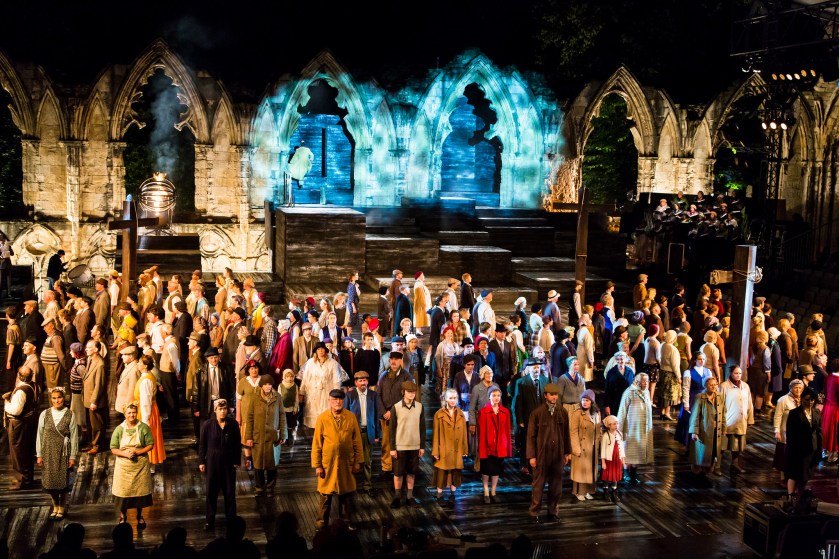
Back to The York Realist. The “York Realist” was, probably, the writer of 8 of the 48 individual plays or pageants which make up the York version of the Medieval Mystery Plays. These were constructed as a way of bringing the Bible stories to the hoi-polloi, both as performers and audience, through the C14, C15 and C16. The 8 plays in question are characterised by the broad, Yorkshire vernacular in the text, lending them an everyday realism. A production of the Mystery Plays is what brings together the protagonists in the play, John and George, in the early 1960s. Peter Gill too has conjured up a completely naturalistic play, over four acts and set entirely in one set, the main room of the tied cottage which agricultural labourer George shares with his unnamed Mother. George’s sister Barbara lives nearby with husband Arthur and son Jack, and nearest neighbour Doreen is a regular visitor.

There is a little formal experimentation in terms of chronology but none of the shenanigans ushered in to British play-writing by the likes of Beckett, Pinter, Osborne, Bond, Churchill and Stoppard. The plays opens with John visiting George after his Mother has died, before we revert to the early days of their relationship. At its heart this is the love story of John and George and it is a very affecting love story indeed, (some parallels with the recent debut film from Francis Lee, God’s Own Country, I gather).

Well-spoken southerner John, a doe-eyed, polite Jonathan Bailey, is the assistant director at the Mystery Plays, (as indeed Peter Gill was in his youth in the 1960s). George is a blunt, muscular, salt of the earth type who can’t commit to sticking with the play. It is hard to imagine anyone else but the excellent Ben Batt playing the part. John has come to persuade him back to the play. Their attraction is obvious from the start and both actors are completely convincing in their relationship. George’s seduction is amusingly direct, John’s coyness easily overcome

Their relationship flounders more on the rocks of class and geography than the reaction of family, who have tacitly accepted George’s sexuality. George feels bound, or maybe chooses, to stay looking after ailing Mother, Downton’s Lesley Nicol, and eventually bows to what seems inevitable by taking up with the humble, attentive Doreen (Katie West), who has been waiting all her life for him despite his identity. With minimal and unforced dialogue, and some very gentle disclosure, we also get to see the ambitions and frustrations of bluff Arthur (Matthew Wilson), indefatigable Barbara (Lucy Black) and Brian Fletcher’s Jack who seems destined, if reluctant, to take up farm labouring.

What is so brilliant about Peter Gill’s writing is the way, within this entirely naturalistic scenario, he draws out the themes he wishes to explore. John’s slightly patronising middle class fascination with the past, the rural and the antique, (though he isn’t prepared to abandon his life and work in London and creature comforts to live in the country), George’s acknowledgement of all that London has to offer but his fear of moving (“I live here”), the denial of identity, the pull of family, gender roles, the allure of self-sacrifice and devotion, the limitations placed on aspiring working class actors, the power of theatre and its appropriation as “high culture”, the inequity of tied farming. None of this is rammed down your throat, and perhaps the biggest dichotomy, the fact that gay relationships were still illegal in the early 1960s, is made more telling by its near absence in the story.

Apparently Peter Gill has a long association with the Donmar as writer and director. Just shows how much I know. I was aware of his guiding hand behind the Riverside Studios in its heyday in the late 1970s and his association with the National Theatre Studio in the 1980s. I see that the new Riverside Studios is close to completion, (passed it on the bus the other day), though I think it will be devoted once again to TV. I only got the bus because I didn’t have time to walk along that part of the Chiswick riverside where Peter Gill lived. That’s one of the joys of culture-vulturism. All the little coincidences and connections.

I can’t imagine Robert Hastie’s direction, Peter McKintosh’s design, Paul Pyant’s lighting and Emma Laxton’s sound being bettered. I do note that some of the proper critics think this has improved on the original production at the Royal Court in 2002. I can tell you it is a very fine play and, if they match this, I hope to see other revivals of Mr Gill’s work. Meanwhile people of Sheffield you know what to do.