Beginning at the National Theatre review ****

beginning-1

Beginning

National Theatre, 30th October 2017

No need for some unseemly outpouring of emotional sharing from the Tourist but let’s just say that the very rare occasions when he has been compelled to confess his regard for another human being have been excruciatingly painful. A handshake is unsettling. Hugging and air kissing, in the absence of drink, promote intense anxiety (maybe this is genetic since MS and BD are exactly the same). Approaching a woman with a view to romance can literally leave the Tourist paralysed with fear. Fortunately the pity reflex seems to have taken hold of certain potential life partners in the past which has allowed the Tourist to deploy, and eke out, his pitiful amounts of charm, and then cling, limpet like, until finally, and rightly, he has been cast off. His strategy of keeping out of the SO’s way has miraculously worked for a couple of decades, but being this useless requires discipline.

Anyway this history meant it was easy to feel sympathy for the characters of Laura and Danny in David Eldridge’s outstanding two hander Beginning. As, judging by the reaction, it was for most everyone in the audience. For the anguish of loneliness and the awkwardness of coming together are feelings that most people (assuming basic needs are satisfied) will experience. I guess there are plenty of other ways to negotiate life but, for most, finding someone to share the journey is a vital goal. Technology cannot change the reality of this negotiation nor negate the risks that come with emotional exposure.

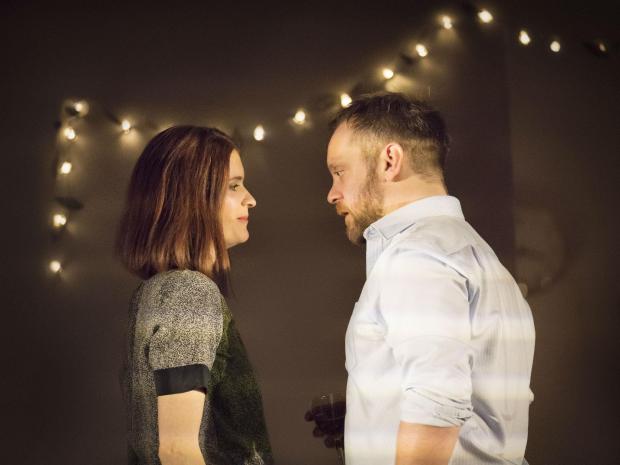
We are in Laura’s flat in Crouch End in the aftermath of a party. Only Danny is left. Both are a little worse for wear drinkwise. Danny halfheartedly says it is time to get a cab. Laura confesses she had wanted him to stay. They talk, they drink a bit more, there’s a bit of music, some tidying at Danny’s behest. They lay open their pasts. And their desires. It is funny, touching and engrossing. The “will they, won’t they” is there but reticence is only a tiny part of what unfolds. This are good people trying to be happy and that is what makes you care.

Now this is not, I am guessing, particularly novel territory for a text to explore. But it is also a subject that is pretty easily turned into inconsequential mush. David Eldridge, who was the leading light in the so-called Monsterist manifesto, is one of our leading playwrights, who has proved he can write at any scale. I am not sure though if he has written at quite such a domestic and personal level before. Whatever. This is still an outstanding text whichever way you look at it. Wry but still affectionate, awkward but not uncomfortable, funny but not played for laughs,.

It can only work though with utterly committed performances to create real characters, and, with Justine Mitchell and Sam Troughton, this is exactly what you get. The ticking of late thirties Laura’s biological clock and the pain of early forties Danny’s separation from his son are universals which could easily lapse into cliches. Not here.

Polly Findlay’s direction doesn’t put a foot wrong, as usual, and Fly Davis’s set, in an end stage Dorfman, is spot on. The movement of the two characters around the set is as revealing as the things they say and the silences and interruptions are perfectly placed.

I see that a handful of tickets pop up on the day. With a bit of luck this will also find its way to another venue to extend the run. If so, go along, and wrap yourself up in their story for 100 minutes or so. You won’t regret it.


The Death of Stalin film review ****

main-tdos-uk-1sheet

The Death of Stalin, 26th October 2017

There have been a lot of clever people born in Scotland. In fact there was a time at in the second half of the C18 when it was the smartest place on Earth, the Scottish Enlightenment. All right maybe I exaggerate a bit but not by much. Certainly, in David Hume, Scotland turned out one of the greatest thinkers of all time. There have been many dazzling intellects since then and I would put the satirist Armando Iannucci up there with them.

Many of AI’s early collaborators, (Chris Morris, Steve Coogan, Patrick Marber and Stewart Lee, all big heroes in my world), have gone on to create some marvellous work but AI is the creative with the greatest reach. After The Day Today, the original Alan Partridge shows, (still the funniest comedies I have ever seen), and his eponymous C4 shows, he went on to the masterly political satires, The Thick of It and Veep. His first film was the Thick of It spin off, In The Loop. The Death of Stalin is his second film as director, and was co-written with David Schneider, (who the Tourist, bizarrely, hung out with many years ago), Ian Martin and Peter Fellows. This might be his best work yet.

Political satire is a tough gig. Especially in a world where, as is oft remarked on a daily basis by the commentariat of both established and social media, our politicians seem bent on acting in a way that defies satire. I suspect that this “oh they all grubby, corrupt, clownish, incompetent shysters”, or whatever variation you want to put on that from whatever your political perspective, is a refrain as familiar as Western style democracy itself. However, it does seem that the behaviour of our current crop of leaders in these democracies is particularly eye catching, reflecting their need to satisfy our own narrowing attention spans and mask their own impotence, in a world where capital and labour are increasingly mobile. Other than creating the conditions for the continued explosion of global credit, and orchestrating the mood music of cultural (in)tolerance, our politicians don’t really get up to much.

That doesn’t mean they aren’t tempted to make things happen and that is where we must be vigilant and prevent them doing anything too silly (let’s be honest we are falling short at the moment in the UK and US). Satire is an important component of that vigilance. Taking the piss is a ruthlessly effective way of drawing attention to the ineptitude (or worse) of our leaders and, if it does its job properly, is generally difficult for subject and audience to ignore. A society without satire is a damaged polity. So this is why AI is such an admirable chap in my book.

The Death of Stalin, (which is based on a French graphic novel), does not, obviously, address the failings of today’s Western democracies. It instead takes the year of Stalin’s death, 1953, and the Soviet Union as its subject. Now this was a dangerous and vital place to be a satirist. Modern day Russia has not escaped this legacy it seems. In an ironic twist it seems that this very film has wound up the Russian authorities whose ambivalence about the reign of Stalin looks somewhat ignoble. Whilst the film is rooted in a specific time and place it is pretty easy to see the universal message. Our rulers are human. They are consumed by petty jealousies and, in moments of crisis, often care more about plotting for their own positions and careers than they do about the good of the people.

The film opens with a radio broadcast of a Mozart piano concerto overseen by Andreyev (a frazzled Paddy Considine, currently wowing punters in The Ferryman in the West End which is A MUST SEE). Stalin (Adrian McLoughlin who captures the capricious bully with minimal screen time) is listening. He demands a recording prompting a farcical repeat of the concert. The soloist Maria Yudina (Olga Kurylenko) slips a note into the recording critical of the regime which pre-empts the brain haemorrhage which kills Stalin. All of this may have happened. Well maybe not the note. And the concert repeat may be apocryphal. Maria Yudina was certainly a critic of the regime.

Anyway we had already seen Stalin having a boozy boys night in with other members of the Central Committee. By this time the Central Committee had only nominal powers with the Politburo under Stalin making all the decisions. Remember too that the Politburo had been purged before WWII, and filled with Stalin’s lackeys’s effectively leaving him in sole control. However after Stalin’s death the Central Committee regained prominence, and we see how Nikita Khrushchev (Steve Buscemi) came to power through manipulating the others members of the Committee and orchestrating the murder of the head of the People’s Commissariat for Internal Affairs, Lavrentiy Beria (Simon Russell Beale), the NKVD, the secret police organisation which had carried out Stalin’s purges.

Those are the facts folks, but the way AI and his collaborators show these events is blackly and bleakly comic. These are powerful men holding the fate of an entire nation, embarked on a massive political experiment, in their hands, but they are utterly out of their depth. Some of them could be running a family carpet company in the Home Counties, such is their charisma.

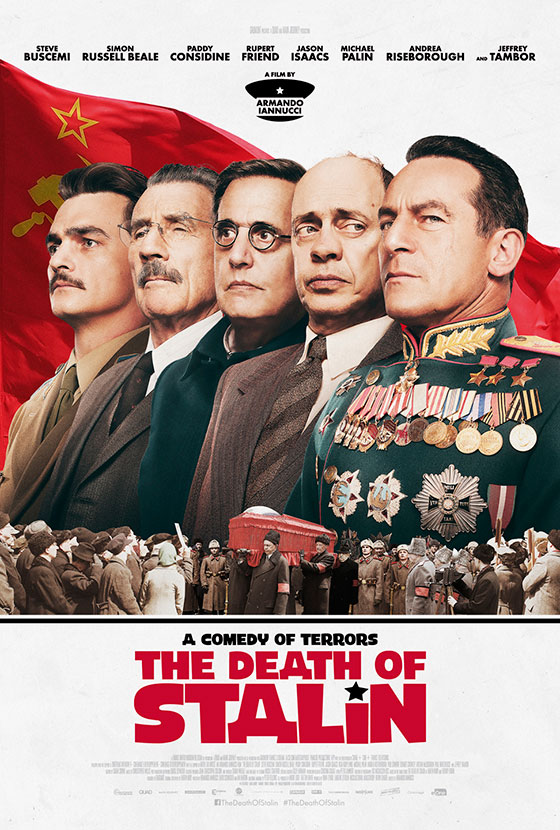
Simon Russell Beale’s Beria is an exception. He is just the personification of the Hannah Arendt’s banality of evil. He is first to the scene of Stalin’s haemorrhage but his first act is to destroy incriminating papers. His cruelty is effortless. As you might expect this is an inspired performance from, in my view, our greatest stage actor (on his day). It takes a bit of time to adjust to Steve Buscemi’s accent as Khrushchev (AI uses natural accents throughout I think) but his paranoid energy and gradual realisation that he can take power are perfectly captured. Jeffrey Tambor plays Georgy Malenkov, the hapless Deputy who easily yields first to Beria, and then to Khrushchev’s, manipulations. The scenes where Michael Palin’s Foreign Affairs Minister Vyacheslav Molotov, the great rhetorician, is unsure whether to condemn or embrace his returning wife, are priceless. The rest of the Committee is made up of Paul Whitehouse’s wideboy Anastas Mikoyan, Paul Chahidi’s effete Nikolai Bulganin and Dermot Crowley’s blunt Lazar Kagonovich. Jason Isaacs’s war hero General Georgy Zhukov is gloriously over the top as is Rupert Friend as Stalin’s embarrassing pisshead son Vasily. Andrea Riseborough plays Svetlana Stalin as manipulative brat.

This is an outstanding cast and a marvellous script. It is not the laugh out loud humour of The Thick of It or Veep, and the grotesquerie is constrained, though very real. It is in some ways a serious satire, in the sense that what you see is utterly believable even if what happens is not historically verified. It is full of detail and beautifully put together. And the ending reminds us that, beyond the vanity and scheming, these people bear collective responsibility for a violence which decimated a proud nation

“Italy in England”, Academy of Ancient Music at Milton Court review ****

mi0002869560

Academy of Ancient Music, Bojan Cicic (director and violin), Frank de Bruine (oboe)

Italy in England: When Handel Met Corelli, Milton Court Concert Hall, 19th October 2017

  • Corelli – Concerto Grosso in D major Op. 6 No. 4
  • Handel – Concerto for Oboe No. 3 in G minor
  • Geminiani – Concerto Grosso Op. 5 No. 3 (after Corelli)
  • Sammartini – Sinfonia in G major
  • Avison – Concerto Grosso in D minor No 3 ‘The garden of harmony’ (after Scarlatti)
  • Sammartini – Concerto for Oboe in E flat major
  • Handel – Concerto Grosso Op. 6 No. 5

We don’t know too much about Arcangelo Corelli (1653-1713). From the late 1670’s through to his death though he was a big noise in Rome, heralding a great leap forward in violin playing and an instrumental (ha ha) influence on the sonata and concerto form. Unless you are a Baroque nutjob, (there are more of them than you might think), you may only be peripherally aware of him. Yet you will certainly have heard snatches of his most famous composition the Op 6 12 Concerto grossi. Odds are if you hear Baroque music on a telly or film soundtrack, (and it isn’t Vivaldi Four Seasons or a blast of Handel), then it will be Corelli.

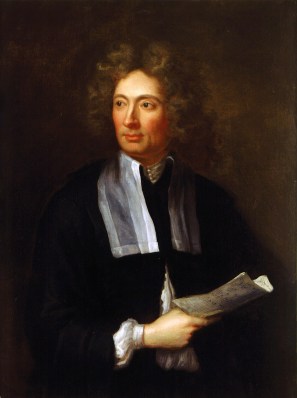
If you are just an occasional dipper-in to the Baroque canon, or just fancy some nice background stuff, get your hands on a recording of his Op 6. You won’t regret it. Here he is. Poodle wig and all. Fine looking fellow.

arcangelo_corelli2c_portrait_by_hugh_howard_28169729

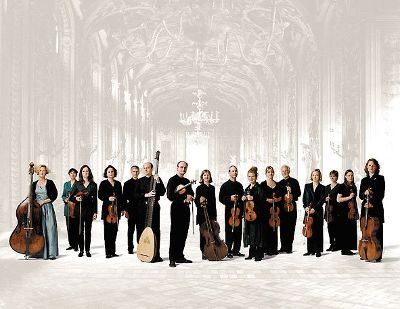
By the late C17 Italy was the bees knees for all things musical, (as it had been in art for a couple of centuries), albeit with stiff competition from the French. Europe was stuffed with on trend Italian musicians and performers. Printed music was now ubiquitous assuming you mixed in the right circles. This concert from the consistently brilliant Academy of Ancient Music under its new(ish) leader Bojan Cicic sought to show how the the Italian Concerto grosso form, perfected by Corelli, and here his compatriots Geminiani and the Sammartini brothers, influenced composers in England, especially the mighty GF Handel. Both Geminiani and the elder Sammartini, Giuseppe, an oboist, ended up living in London, jus as Handel did. Handel had travelled to Italy from 1706 through to 1710  to learn from both Corelli and the other great master (of the keyboard especially) Scarlatti.

The Concerto grosso, as its probably not too complicated to surmise, is a piece of music where a small group of soloists, maybe a couple of violins and another instrument, called the concertino, pass the ideas between themselves and a larger orchestra, the ripieno. Simples. Mind you this is the Baroque so the orchestra is still pretty tiny by later standards. It is the forerunner of the single instrument concerto with orchestra we see today and which developed in the later Classical period. Vivaldi set the ball rolling with his acres of beautiful single violin (and other single instrument) concerti though the musical patterns are similar to his mates elsewhere in Italy.

Here, in addition to the violin led concerti on show from Corelli himself (the very jolly No 4), Geminiani, based on material from one of Corelli’s works, and Handel (No 5 from his own Op 6), we also had the same from Charles Avison, new to me, but I gather a big favourite of the cogniscenti. This was based on some of Scarlatti’s harpsichord sonatas and was really absorbing. The oboe of Frank de Bruine joined the AAM in two other concerti and we had a sinfonia from the younger Sammartini Giovanni, a form that would develop further into the Classical period. Like the Avison I really enjoyed this and will investigate further.

Now I deft anyone now to get perked up by these pieces. They are dramatic, with vibrant rhythms, the typical motoric underpinning from cello and double bass, the continuo underpinning of the harpsichord, and the immediately catchy tunes from the other strings. It is dead easy to follow, the movements are short and sweet and the tempi unwaveringly fast-slow-fast.

The playing of the experienced AAM was pretty much faultless. We even had a moment of high drama (sort of) as Frank de Bruine had to simultaneously play and re-order his music in the Sammartini piece. I could listen to hours of this stuff, especially in this hall. Can’t wait for the next fix.