

Sargent Watercolours at Dulwich Picture Gallery review *****

key-30-palma-majorca

Sargent: The Watercolours

Dulwich Picture Gallery, 5th September 2017

There have been some top drawer exhibitions already this year. The comprehensive survey of American painting in the 1930s at the Orangerie and Royal Academy, the joyous Rauschenberg retrospective at Tate Modern, the astonishing survey of Michael Andrews’s spray painted landscapes at the Gagosian, the journey through modern and contemporary US artists prints at the British Museum and the insight into Giacometti at Tate Modern. There have been others as well which would be equally worthy of a mention.

And there is more to look forward too at the end of the year, notably for me the survey of Monochrome works coming up at the National Gallery, the Cezanne Portraits at the National Portrait Gallery and the Jasper Johns survey at the Royal Academy.

Yet if I take total time spent in an exhibition and total joy derived (tricky to measure I accept) then this bunch of watercolours from the American sophisticate John Singer Sargent, might just beat them all. Though I am a sucker for watercolours – I had a fine time at the recent British Museum splurge of British watercolours – British Watercolour Landscapes at the British Museum review **** – and I would commend you to take in the Turner watercolours at the end of the Clore Gallery in the Tate – if I am honest they are my favourite of all the great man’s works.

Now this apparently is the first time in 100 years or so that we have been able to see a large scale assortment of Mr Sargent’s watercolours. There are a fair few dotted around the place in the UK but to see these eighty or so works together is reason enough to pop along to the Dulwich Picture Gallery if you haven’t already done so. (There is a month of so left of this exhibiton). And best of all the ratio of land- and city- scapes to portraits is skewed firmly in the favour of the former.

JSS made his name as a portrait painter, like his idol Velazquez, with the great and good nouveau riche at the turn of the C19, from the US and Europe, queueing up to offer their patronage. Whilst there is no doubt that having one of his large scale, full length, expressively bold, oil portraits towering over you is a sobering experience, it can get a bit overwhelming. The a la mode frocks and coats of the toffs are all terribly la-di-dah and he could never resist the urge to show off his skill in painting white fabrics. Everyone he painted looked so stylish, thin, pale, with hints of androgyny in the formality. And they pull you up in a gallery. Witness that Carnation, Lily, Lily, Rose in Tate Britain (trust me you have seen an image). Drop dead gorgeous.

But for me it is the watercolours, after he packed in the oil portraits, that is his best stuff. There are many reasons to like JSS, not least his fulsome tache and beard combo and his love of his grub, but the watercolours he painted in Venice top the lot. Now Venice is a popular choice for the artistically inclined, it being the most beautiful place on earth by some margin. And JSS chose to look at the small rather than the big picture here with his watercolours of views seen from the vantage point of a gondola; light, water, colour and architectural feature and texture perfectly captured. Detail not panorama. These are not classic compositions and in some cases the angles take a bit of adjusting to but this, I think, is the way everyone really captures this city in their eye and minds. He had me at the first fragments of Venice in the first room. There is something in the water – literally. I can’t ever recall the play of light on water captured so exactly.

Other cities and other landscapes are fully represented across the exhibition, as are figures and portraits in the final room (with some of his trademark elegant young ladies lolling about in white dresses).

have no idea how to paint in watercolours but to me these looked technically faultless. Big washes of colour, clear confident marks, never overworked, with the paper still present underneath to lend a stunning luminescence and real dynamism. The way he crops the compositions is fascinating. None of that wishy-washy, impression of a landscape, wide-skied, nonsense here. Our man just picked up the brush and “drew” with it. Just like that. 

These paintings generally weren’t commissioned or intended to be exhibited. They were largely painted for his own pleasure, as he jaunted round Europe, and it shows. Some might say they are too pretty, unthreatening, too clean, too urbane. I say poppycock. Take a closer look. Sometimes art doesn’t have to punch you in the face to work. It is OK to feel good.

The cutting edge of artistic endeavour has always been suspicious of JSS. He in turn wasn’t bowled over by the work of his contemporary Modernists. A peripatetic lifestyle, an emigre, siblings who didn’t make it to adulthood and a complex sexual identity. All this, in the minds of the criterati, should lead to dark, emotional stuff which doesn’t seem, on first viewing, seem to be there in his work. So what I say. There is substance here to marry with the style. 

I hasten you to get along to this exhibition. Take your teenage kids, your granny, your aunty or even a mate who professes to have no interest in painting. I promise you they will love this. That or your money back. If you can find me. Mind you I will probably go again so you just might.


Logan Lucky film review ****

logan-lucky-300x300

Logan Lucky, 30th August

Every so often BD and myself settle down to take in one, two, or sometimes all three, of the Ocean’s films (not sure if that is grammatically correct). The pleasure lies in knowing exactly what is going to happen and in the happy feeling it brings on. So boo hoo me as BD will be off soon into the big wide world but I reckon we might still get a few more viewings on her intermittent returns.

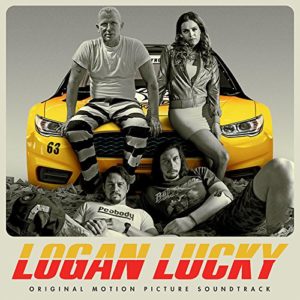
And now we can add Logan Lucky to the stable. It is Steven Soderbergh directing again and once again it is an impossible heist movie that goes right (for the perpetrators), with a cracking twist and no real victims. What’s not to like. Well nothing as it turns out.

Now in contrast to the Ocean’s stable our heroes are not Flash Harrys (or whatever the US equivalent is) and we are a long way from glamorous Las Vegas. West Virginia to be exact complete with John Denver, NASCAR, roadside bar, country fair, beauty pageant, and penitentiary. Divorcee and single dad Jimmy (Channing Tatum sporting a subtle limp) is booted out of his job so turns to brother Clyde (Adam Driver doing the full on wry, droll Adam Driver shtick) and sassy sister (Riley Keough) to pull the heist and get rich quick. To make the plan work they need local big crim Joe Bang to literally provide the bang – trouble is he is in the nick. Daniel Craig as Joe doesn’t hold back. Dyed blonde buzz cut, guns permanently flexed and a ludicrous Southern drawl. (Mind you this is not the worst accent by some margin – cue Seth MacFarlane  as a British drinks entrepreneur – surely the worst mangled Cockaneee since Dick van Dyke). For no particular reason other than comic effect the unlikely Bang brothers are roped in (Brian Gleeson and Jack Quaid – as bozo cliched as you like) and the convoluted plan is set.

And a marvellously entertaining plan it is. No details here. Go see for yourself. What is most heartening though is the affection with which the film treats its characters. This means there is a welcome focus on the lives of, particularly, the Logan siblings, and from this emerges a very gentle morality tale about the fairness of life in modern (in this case white) America.  The Logans have a history of bad luck – hence the title – and this story marks some form of recompense. We laugh with, not at, these characters. Not always laugh out loud but audible chuckles certainly. Lovely stuff.

So the inverse in some ways of the Ocean’s crew. But you will feel the same, if not more, affection for the Logan crew and you will get the same pleasure in seeing how the deed was done. And it is funnier. And, it its own way, as cool. We know Steven Soderbergh is a masterly and versatile film-maker (roll on Ocean’s 8). But I was most impressed here with writer Rebecca Blunt. And I loved the soundtrack. Can’t wait for a second instalment.

Detroit film review *****

detroit_teaser_poster

Detroit, 29th August 2017

I sheepishly admit that, up to now, I had not see a film directed by Kathryn Bigelow in its entirety. I have tried to get going on The Hurt Locker a couple of times but seemed to recall interruptions and general life business got in the way. I mean to correct this omission on the assumption that her previous work is as powerful as Detroit.

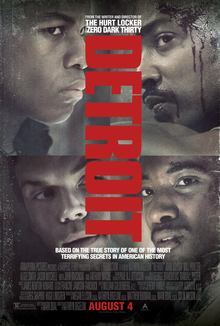
For gut-wrenchingly powerful this is. Ms Bigelow and previous collaborator-writer, Mark Boal, have taken the real life events at the Algiers Motel in July 1967, set against the backdrop of the Detroit race riots, and created a genuinely gripping polemic against racial injustice. Hate, fear and violence are realistically portrayed by a uniformly excellent cast. From the direct historical prologue, through the police raid on the “blind pig” celebration party, which was the catalyst for the 12th Street Riot, and finally the closing scene where one of the survivors, Larry Reed, seeks some closure by returning to a career in singing, I was transfixed. The hand held cinematography of Barry Ackroyd takes you right inside the Algiers Motel during the crucial hours, but the cameras work just as effectively in the “vintage” riot scenes, the courtroom scenes and the scenes in the police station. It seems to me that every shot has been thought through to craft a “realistic” experience. The soundtrack adds to the intensity and the story of soul group, the Dramatics, whose lives changed dramatically that night, adds an agonising poignancy to complement the anger. 

If I had to single out one performance it would be Will Poulter as Philip Krauss, the leader of the Detroit Police Force patrol which raids the Motel. He is up against pretty stiff thespian competition in the form of John Boyega as Melvin Dismukes, the conflicted security guard who gets caught up in the incident, and Algee Smith, as the aforementioned Larry Reed. Poulter captures the matter-of-factness of Krauss’s racism perfectly, but also shows the way he seems to be both addicted and fearful of his own paranoid recklessness. You will hate him but you will recognise him.

I confess I knew nothing of these events and only had a vague knowledge of the Detroit riots. I certainly had no idea as to the scale of the response by the authorities to these riots – National Guard, army, tanks, artillery, snipers – the spectre of Vietnam hangs heavy. I gather Ms Bigelow and Mr Boal have made some fairly significant changes to explain the gaps in the “known” facts of the case, and have collapsed down the investigation and subsequent trials. In a telling construction the black characters in the film largely reflect the real life protagonists but the names of the white characters have been altered. This has served to heighten the drama and the argument. It seems from the extensive Wikipedia entry that the injustices meted out to the victims here were carried through into the subsequent trails of the police perpetrators, and that the events had a profound impact on the nature of race relations in the US.

And yet you will be left with a profound feeling that very little has changed. I am no expert on the nature of racism in the US, and my view is informed by my politics and reading (so damn me as a hand-wringing liberal), but, it seems to me, that by dramatising these events of 50 years ago, the makers of this film have served to underscore what is still so wrong now.

I can see that some might recoil at the graphic way in which events are portrayed or might reject the way in which white police brutality is so absolutely contrasted with black helplessness. But I was left reeling and seething from a very fine piece of film-making. There is enough utter escapist shite on the screens of cinemas everywhere, or indeed, serious films that run scared of taking a view. So those like Ms Bigelow, who get the budget and the cast to make such howls of indignation, should be rewarded by us the audience with our attention in my humble opinion.