
Alexander Melnikov and the Latvian Radio Choir at Cadogan Hall review ****

lrk_janis_deinats

Alexander Melnikov (piano), Latvian Radio Choir, Sigvards Klava

Proms Chamber Music No 5, Cadogan Hall, 14th August 2017

  • Dimitri Shostakovich – Preludes and Fugues Op 87 – Nos 1, 2, 3, 4, 7. 8
  • Dimitri Shostakovich – Ten Poems on Texts by Revolutionary Poets, Op 88 – Nos 5,6,7,8,9

Previous posts will have revealed my passion for Shostakovich’s music despite, or maybe because of, its sometimes disturbing crassness. So what better way than this to spend a birthday. Off I toddled for this lunchtime chamber Prom of which there have been a few this year at Cadogan Hall. An excellent innovation. Oh, and before I get down to business, don’t worry birthday boy’s day turned more social thanks to a welcome surprise from the SO, BD and LD.

Now these pieces are interesting because of their chronology, in the middle of his oeuvre, but still in the uncertain (for DSCH) period before Stalin popped his clogs, and also because of their form. The Ten Poems are a capella for choir, though DSCH makes sure there are proper tunes to be heard, which is a form he used sparingly. He also produced some other weighty piano compositions, notably the Op 34 Preludes and the Sonata No 2 Op 61, but the rest of the piano works are more lightweight (though still interesting). The Op 87 Preludes and Fugues are a full blooded exploration of the piano’s range across 3 hours or so. The recorded version I have is by dedicatee Tatiana Nikolayeva and is an old favourite. Alexander Melnikov’s recording is judged by some as better so I was looking forward to this.

Since the Ten Poems on Texts by Revolutionary Poets are exactly that it is tricky to cast around for the usual DSCH subtext here. These poems are straight up and down descriptions of the suffering of the people at the hands of the Tsarist authorities at the time of the first failed 1905 Revolution. Similarly the structured format of the Preludes and Fugues also precludes too much navel gazing about the “meaning” of the works. So we can just concentrate on the sounds. Now I don’t know the Poem settings as well as I should but this seemed to me a very well crafted performance by the Latvian Radio Choir under director Sigvards Klava (who had been in town primarily to deliver a Rachmaninov Vespers the night before). The five settings on show only run to a few minutes each and the syllabical structures are very straightforward but the delivery was as crisp as you like and sung across the board with real fervour. The programme notes a similarity to Mussorgsky’s operatic choruses: I get it.

However Mr Melnikov was even more convincing. The six Preludes and Fugues he played were very convincing and performed with real authority. In particular those Fugues with fortissimo passages really struck home. I was dead impressed. I think this work is somewhere near the top of the best piano music ever written. I reckon Mr Melnikov agrees. Time to add his version to the collection.

Happy birthday to me then.
Bodies at the Royal Court Theatre review ****

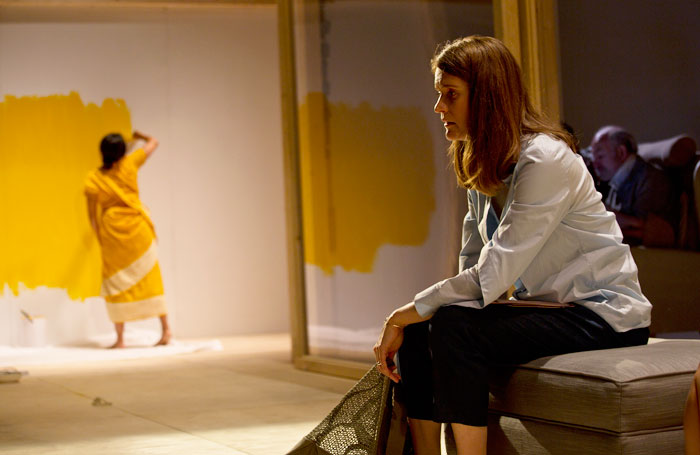
salma-hoque-lakshmi-and-justine-mitchell-in-bodies-photo-bronwen-sharp

Bodies

Royal Court Theatre, 10th August 2017

Bodies is my first exposure to the writing of Vivienne Franzmann and I hope it will not be my last. A few quibbles aside this is overall a thoughtful play which sympathetically explores the issues that it chooses to highlight.

Here’s the set up. Clem (Justine Mitchell) and Josh (Brian Ferguson) cannot have children naturally and have chosen to pay for a surrogate, Lakshmi (Salma Hoque), in India to carry “their” child (via eggs from a ‘mother” in Russia). Clem’s father, David (Philip Goldacre), has motor neurone disease and requires constant care delivered by Oni (Lorna Brown).

Clem’s desperation to have a child is manifest in the conversations she has with an imagined teenage Daughter (Hannah Rae). Justine Mitchell’s performance as Clem is finely drawn and never histrionic. I found the scenes with a confident Hannah Rae as the Daughter very effective, a pointed device to externalise Clem’s fears and wishes. Clem is determined to navigate her way with compassion through the moral maze she has constructed but slowly the threads unravel. Her proud father, very convincingly delivered by Philip Goldacre, is a union man, and thinks what she is doing is plain wrong. Josh the husband, whilst never admitting it to his liberal self, has a more acute sense of the transactional entitlement in their course of action. Oni, whose husband and child are back home, serves to wryly puncture the couple’s bubble and to remind Clem of her obligations to her father. Whilst the couple do initially travel to India to meet Lakshmi, (Selma Hoque’s lines are few and weighted to the end but powerfully conveyed) their “relationship” is mediated at long distance by the clinic’s head Dr Sharma (the voice of Manjinder Virk) which means the couple can accept a convenient pretence about Lakshmi’s situation.

Ms Franzmann is careful to offer a sympathetic take on each character’s actions whilst still very clearly revealing the human costs of “fertility tourism”. Indeed I see from a quick skim through the text that the more overt exposition from some characters has been cut which I think fits the tone of careful examination more effectively The play is an already economic 90 minutes or so but might even have been tighter given the intelligent construction of the scenes. It sometimes felt as if Ms Franzmann needed to underline her already effectively constructed dilemmas. There is no need – the delicate dialogue is consistently revealing. The set is also occasionally ungainly and there are some avian based metaphors which seem a little superfluous.

But these are such minor objections I feel impolite to mention them. This is very rewarding piece of theatre with fine performances and direction from Jude Christian, which is made more powerful in my view by its low-key tone. In fact it is turning into one of those plays which gently gnaws away in my conscience. Examining exploitation, at any scale, whilst still allowing sympathy, is an awkward undertaking. This is more than up to the task.