
Bryars and Reich, LPO at the RFH review ****

musical_quote

London Philharmonic Orchestra, Synergy Vocals, Sound Intermedia

Royal Festival Hall, 15th March 2017

Now it is a racing certainty that you will be familiar one way or another with the great minimalist composers of the second half of the C20 even if you don’t know it. The sound is ubiquitous in film, television and elsewhere. Driven by clear rhythms and patterns, with simple sonorities and slow harmonic progression, and with loads of repetition, this is a breeze for the punter (like me) born and bred in a pop/rock/soul paradigm.This is why it is justifiably quite “popular” and is bringing in a load of bearded youth into concert halls (a good thing with some minor exceptions).

From this base I have put some effort in and in the last couple of years have expanded exponentially into the minimalist world. The Minimalist series in 2015 at King Place was very helpful (big respect to Kings Place and the way they pull these series together) and I have seen a fair chunk of the major pieces performed in London since then and bought a lot of CDs to boot. So no expert but unlike many things I see I think I have a bit of a jump on most here.

But whisper this. There are times when the repetition can spill over into the plain dull. Fortunately this evening was not one of them.

Gavin Bryars “post-minimalism”, at least in the context of two of his most well known pieces played here, does ask a bit of the listener though to avoid falling into the dull trap. The “Sinking of the Titanic” takes some tape snippets and then sets a score based on what may have been played by the ship’s band as she went down. The lines are long, the harmonies shift slowly and it does go on a bit but overall the “underwater” effect and the varying of the instrumentation was enough to keep me going.

The second Bryars piece I have heard more often. This is Jesus’ Blood Never Failed Me Yet. The tape loop of the tuneful tramp singing will burrow into your brain. However here the slow but palpable building up of the orchestration on top of this makes it easier to follow for a ninny like me. It reminds me a bit of another fave of minimalism for me, Arvo Part’s Cantus in Memoriam Benjamin Britten. Remember all this is my impression, please don’t shout at me if musically this descriptions or comparisons are nonsense.

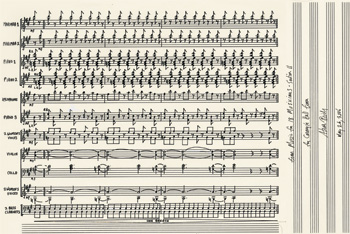
Then we had arguably Steve’s Reich’s most famous work, Music for 18 Musicians. I own a couple of recordings of this (how fancy is that) and have seen a few performances. This helps as I can now follow the joins (announced by the fella on the mettalaphone no less) so can hear each of the parts in a way I couldn’t at first. But with the rhythm provided by the percussion instruments (love it when the maracas come in – hard work for the players I guess to do that much shaking in one night), and the pianos I defy anyone listening to this not to be drawn in and get the “minimalist trance” thing kicking in.

I can’t put my finger on why but this was the best live performance I can remember of the piece or maybe familiarity is a virtue here. Or most likely the LPO musicians just had a blinder. Anyway I highly recommend anyone taken by this to delve further into this world.

For Steve Reich I recommend the Desert Music and Drumming on top of this pieces, for Philip Glass maybe Glassworks to start(there is an awful lot of Philip Glass music as I am finding out the hard way), for John Adams I think Shaker Loops and Short Ride in a Fast Machine and I would also put a shout in for Michael Nyman’s string quartets and film music. There are tons of compilations (look away now classical music cognoscenti) to get you going.  Oh and you need the grandaddy of them all In C by Terry Riley. I will deal with the “holy’ Minimalists and especially Arvo Part another day.

Anyway all up I genuinely think your life will be a lot better listening to some of this especially for you youngsters who are steeped in rhythm anyway. So get that YouTube working.
Travesties at the Apollo Theatre review ****

6005-1484727967-travestiessq

Travesties

Apollo Theatre, 13th March 2017

Right then. I clearly have to up my game. The more theatre I see the better I am at appreciating, understanding and enjoying. This is particularly the case with the great playwrights. With Will Shakespeare given a half decent director and cast I can now follow the plot, hear almost all the language and grasp, albeit in a rudimentary fashion, the dilemmas and tribulations that are presented to the characters. Until the last couple of years I freely admit it was enough just to keep up with what was going on and I was often bored. All my fault.

Elsewhere I have had some revelatory Greek experiences (not sure that came out exactly as intended), Ibsen and especially Chekhov are falling into place and the Americans, O’Neill, Williams, Miller and Albee, are all firmly on the go to list.

As for the great Britons well I am finally seeing that there is more to Pinter that menace and now I understand why Caryl Churchill is perfect in terms of form and content. And of course for we live right now in a golden age for new British theatre which only a numpty would ignore.

However, Stoppard until now has been a mystery. I have not knowingly seen any Stoppard plays in the dim and distant past though as we know (and delightfully Travesties reminds us) memory is an active construct of the present so I could be wrong. Likely though Travesties was my first ever. Obviously bonkers good reviews from the Menier Chocolate Factory run and the fella Hollander drew me in as well as the ubiquitous Patrick Marber directing (in order I would say the draw here being Marber’s previous directing assignments followed by the Partridge connection rather than his plays which I confess I need to see).

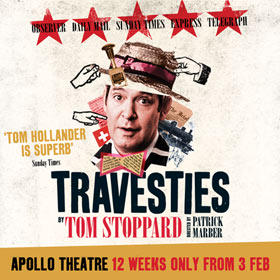
In short Tom Hollander plays Henry Carr some minor British consul type who apparently got into a dispute with James Joyce over payment connected with a performance of The Importance of Being Earnest in Zurich in 1917 where Carr played Algernon. Carr is looking back so a kind of imperfect and comedic “memory play’ is brought to bear. From this Stoppard elides Carr’s interactions with Joyce as well as Lenin and Tristan Tzara (one of the founders of Dada) as well Carr’s butler Bennett, Lenin’s wife (I think) and Cecily and Gwendolen characters. Carr and Bennett I gather are characters in Ulysses (of which I am still massively intimidated so have never read or am likely to read I confess).

So how did I fare? Well I thought I had put some hours in having delved into the history of modernism in C20 culture and with a bit of past, and more recent, boning up on Marxism. But I failed to follow vast chunks of Stoppard’s dazzling brain and wit. I can get the plot crossover into the Importance of Being Earnest (thanks mostly to the 2002 film with Everett, Firth, Witherspoon, Dench etc and the Gerald Barry opera which is a must see should it be revived again). But so much of the direct references to the life and works of Lenin, Joyce and Tzara passed me by. (Mind you I can recommend the Soviet Art exhibition at the Royal Academy for an insight into the rise of Lenin and how he shaped art and literature post the Revolution).

Still all the erudition on show does remind you just how important this time was to the formation of ideas in politics, art and literature and how those ideas have (or in many cases have not) filtered through into later decades. I guess some of the debates on the relationship between art and society, capitalism vs socialism and literary form which are aired in the play were more lively in the late 1960s and early 1970s (Travesties was written in 1974) but I still think there was much to feast on here. I just need to work out what.

But no matter it still made me chuckle where I did get it (Tzara whizzing through the inaugural night at the Cabaret Voltaire in Zurich, Lenin setting out the correct march through socialism to communism, the p*ss takes on street guides to Dublin) and the zip of the whole thing just carries you along. There were multiple shifts in the form and structure of the play which I thoroughly enjoyed such as a scene entirely in limericks, replays as Carr sees events in different ways, lots of punning, music hall parodies, doors opening/closing in a quasi farcical way as well as verbal sparring generally between Carr and the three main characters as well as moving monologues from Carr on the waste of the First World War.

So if you limber up beforehand with a bit of Wiki action, look at the interview in the programme between Marber and Stoppard (obviously I left this until after – doh) and take it easy on all the brain food on offer here then an enjoyable night is on the cards. Tom Hollander’s ability to capture the bemusement and snarkeyness of the British toff anchors the whole thing and the tone of the other characters was ideal. Freddie Fox as Tzara/Jack/Earnest puts a shift in physically, Forbes Masson as Lenin has a bit less to play with but captures it very well and Peter McDonald as Joyce gets to be Stoppard’s favourite methinks (both in terms of his art and as Lady Bracknell). I especially loved Amy Morgan and Clare Foster in the “no I’m engaged to him” parody bit.

Having said that it is, even with a decent pitch in the stalls, a ridiculously uncomfortable theatre for a big unit like me so beware.

But note to self. Put more effort in for the next Stoppard play.

Pollini at the RFH review *****

MAURIZIO POLLINI

Maurizio Pollini

Royal Festival Hall, 14th March 2017

Now I am afraid I don’t know much about classical music but I am learning. I can’t read music or play to save my life. There are vast chunks of the classical music canon that I don’t get on with. I have recordings of the composers I do get on with though in only a few cases do I have more than one recording of the same piece.

But I do know what I like (a statement which will need debunking when it comes to culture generally but that is for another time). And what I do like is Maurizio Pollini playing Beethoven. His recordings are my favourites (along with Paul Lewis, Glenn Gould and a bit of Ashkenazy). Now I have no doubt that there are other recordings I should explore but all in good time.

So suffice to say I was bound to like this. However I was not bowled over by his Chopin performances in February at the RFH (and I did not stay for the Debussy – on the list of stuff I don’t get on with I fear). This however was altogether a marvellous experience.

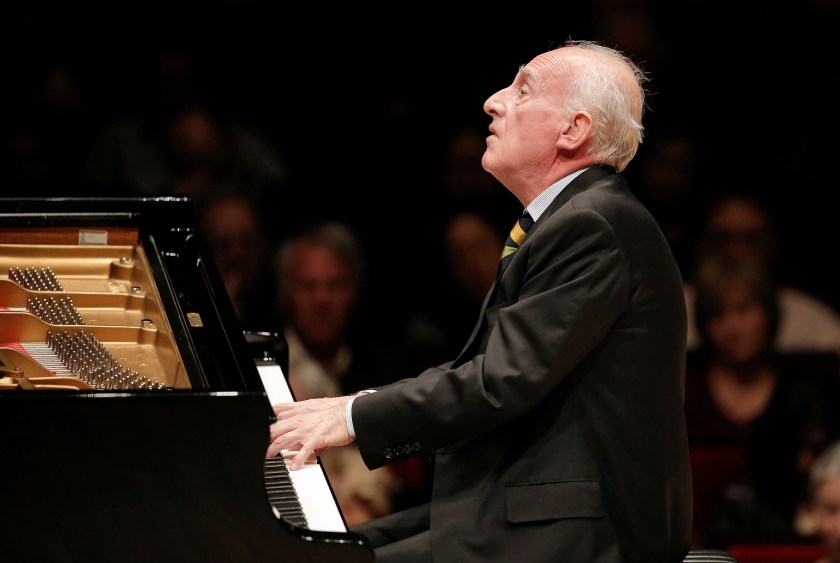
Pollini for me makes sense of the music in a way that I can understand. I gather some think him a bit cold and clinical if I read the reviews correctly but for me I hear the logic of the music laid out with perfect clarity with enough emotion to lift me up as well.

He kicked off with some Schoenberg. Now I know I am supposed to grasp why Schoenberg was so important to the development of C20 music. I am also coming on in leaps and bounds with my appreciation of contemporary classical music and have started (slowly) delving in to the likes of Xenakis and Ligeti for example. And I can genuinely say that I am starting to “get” some of this stuff.

I can also claim to be making progress with the boy Berg having seen and heard Woyzeck, Lulu and the Violin Concerto in recent months. No idea yet why Woyzeck is so clever in terms of musical construction as I can’t hear the structures yet but I think I will get there.

However so far Schoenberg has eluded me. Mind you that may reflect the fact that I have only heard that Verklarte Nacht a couple of times live and that to me is a bit of syrupy romantic tosh that I cannot fathom.

Now I can’t pretend that Mr Pollini has converted me but I did concentrate on the two pieces he played in a way that pleasantly surprised me: 3 Pieces for piano, Op.11 ; 6 Little pieces for piano, Op.19. More work for me to do but I think this may be the way into Schoenberg’s world for me. I still could hear a tonal thread but with enough variety and drama to draw me in.

As for the Beethoven well the stand out in the Op 13 “Pathetique” was the Adagio slow movement (mind you anything chorale like is bound to work for a simpleton like me) and I got a bit lost in the final Rondo but that was probably my fault for not concentrating enough. But after the interval the two movement Op.78 “à Thérèse” (I gather the F sharp major key here is the reason this sounds a bit different) and the Op.57 “Appassionata” (where Beethoven delights in exploiting leaps in piano technology) were simply wonderful.

To me Mr Pollini seems to be a little freer in his interpretations compared to the recordings. Mind you those recordings apparently span much of the career of an artist who has been at it for seven decades now. Imagine that. Going to work every day for nearly 60 years trying to get better at what you do whilst giving pleasure to everyone around you. That is “sticking it to the man”. (Indeed I gather Mr Pollini did indeed pursue a more classically politically engaged stance in the 1960s and 1970s making even more of a hero in my book).

Anyway this was just about perfect – I had the thing that I like about concerts when it works where you are just completely immersed in the music. Seemed to me that was shared by the audience (though there was some ar*e trying to record the Schoenberg on their phone until they were told off – I shall return to this subject in later posts but for me this is a bloody outrage).

So here’s the deal. This blog is generally aimed at the culturally curious armed with only a tiny bit of knowledge. For those who know they like or think they might like Beethoven and want to delve into the piano sonatas then this would have been no better way to start. For just a tenner (assuming you are prepared to compromise a bit on the sound at the back of the stalls and don’t mind not seeing the maestro’s hands at work) you can hear this music played by this man who surely ranks as one of the greatest living pianists.

Of course that is no use now it has been and gone but I highly recommend looking out for the great man’s return next year (March 2018). If Beethoven appears just grab a ticket or two.

And while you are at it treat yourself to the complete recordings of the Beethoven sonatas. it took a bit of time I gather for Mr Pollini to record everything but there they are – for £33 on Amazon you get 8 discs (don’t talk to me about downloads – I don’t understand why you wouldn’t want to own physical copies of this music). Get these and decent complete sets of the symphonies and the strong quartets and you will be well on the way to immersing yourself in probably the greatest music every written (the Fall excepted).