
The Winter’s Tale
Silk Street Theatre, 18th April 2017
Now I have always thought if you just cut out the “pastoral comedy” fourth act from the “comedy” The Winter’s Tale, stopped calling it a “romance” because you can’t think of a better name and reined back the “magic” then you would have a perfectly good tragedy with a partial redemption at the end.
Leontes is a jealous man-child from the off and he just can’t suppress or hide it. It consumes him. Camillo and Paulina can see it and will take steps to try limit the damage. Shove in an oracle to show the truth, ignore it, then pay the consequences with death of Son, Mamillius, and abandonment of pregnant wife, Hermione. Luckily Daughter, Perdita, is subsequently saved by nice peasants and falls in love with spurned friend’s Son, Florizel. All return and discover wife never died in the first place but just to make sure you have learnt your lesson Leontes, create elaborate “statue comes to life” illusion. Happy ever after excepting memory of dead Son which is the punishment for uncontrolled jealously.
No need for shepherds, clowns or, most importantly, annoyingly unfunny pedlars and no real need for magical explanations. Oracle, Bear, Time and Statue just interesting theatrical opportunities to move us on to where we need to be and a bit of fun for designers. No need to keep it real here – those stage directions might just be big WIll having a laugh.
Anyway I have yet to see a production that boots out Act 4 but I guess it has been done. I enjoyed Kenneth Branagh’s version at the Garrick in 2015 (on the big screen not in the theatre) though this was mostly down to him (he really is a very fine actor when he wants to be) and Dame Judi obviously. Wish I had seen it live. I saw the Painkiller with LD as part of that Branagh season, which we thought was hilarious (and again where Branagh was outstanding), but also Harlequinade which didn’t float my boat at all and The Entertainer which, I have to conclude, is just a rubbish play.
So we (SO and I) also enjoyed Cheek By Jowl’s last visit to the Barbican in 2014 with their perennial Tis Pity She’s A Whore (once SO was apprised of the fact that this was a tragedy and not a comedy) which is/was a pretty visceral take on Ford’s everyday tale of incest. deception and murder.
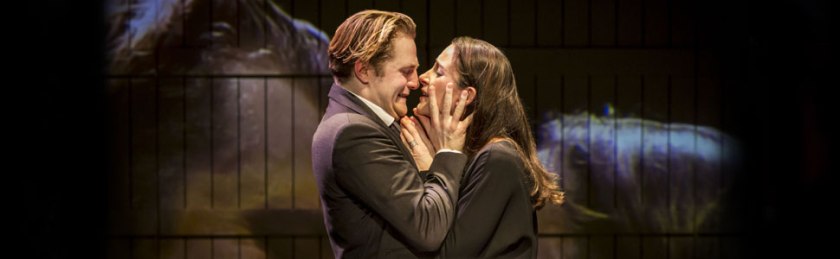
It seems to me that Declan Donnellan and Nick Ormerod, the brains behind CBJ, could never be accused of taking the lazy path and think carefully about all of the classics that they take on. This is no different. Orlando James’s Leontes clearly has a massive temper on him and his irrational and violent behaviour is there from the off. Mamillius (Tom Cawte who really makes a mark) is an unpleasant chip off the old block – witness his full blown tantrum. Hermione, again an excellent performance by Natalie Radmell-Quirke, seems perversely only to wind him up further with her blamelessness. There is that sense that both husband and wife are helpless to stop the worst happening – watch Leontes positioning Hermione and Polixenes to visualise his suspicions. And everyone in the Court looks like they have seen this all before, notably Camillo and Paulina (David Carr and Joy Richardson).
The oracle scene, with the smart use of video to capture the play of emotions on their faces, works very well. Indeed the whole staging, sparse, as is the fashion, with just a white box with collapsing panels to ring the changes of setting, and with dramatic lighting courtesy of Judith Greenwood and music courtesy of Paddy Cunneen, works extremely well in my eyes.
So all good and gripping. And then Act bloody 4. The team throws a lot at this, with knowing verbal and song references to the miserable and comic bits by Ryan Donaldson’s Autolycus, who has a natty wardrobe, and a Kylesque trash TV skit. It is diverting and better than bales of hay, flutes, sheep and morris dancers, but I still found the whole thing a pointless break in the story. When we get back to Sicily things pick up again and the final, statue scene is very fine for being restrained with a Renaissance style tableau created by the cast at the end as Maxillius returns as, I think, a school kid in a gallery.
So I liked it. I can see it might be a bit analytical for some but if you want a clear exposition of what can be a tricky play then take a look. It may be done and dusted in London but you can see the Livestream recording on the CBJ website or on I Player. So on your night in this week why not swap your Game of Thrones or MasterChef for a bit of Shakespeare. And don’t forget, when that Autolycus appears feel free to fast forward.

 At Home He Feels Like A Tourist