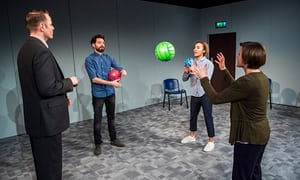
Forgotten at the Arcola Theatre review ****

Forgotten

Arcola Theatre, 10th November 2018

I was much taken, if not entirely convinced, by the British East Asian Yellow Earth Theatre company’s version of Tamburlaine at the Arcola 18 months ago. And this co-production, with Moongate, of a new play, Forgotten, by Daniel York Loh, which kicked off at the Theatre Royal Plymouth, sounded like it needed seeing.

Daniel York Loh looks like he is a busy fellow. When he is not writing he is acting, directing films or performing in a folk trio. Busy. Just like this play. It started off as a 5 minute script. It now runs to a couple of hours. Apparently his first draft ran to 300 pages. DYL has a lot to say and he means to say it. Mind you this is a story evidently worth telling. Giving a voice to the 140,000 Chinese labourers who left China to initially assist the French, and then the British, effort in WWI. Largely written out of history.

In trying to cram in as much of his research into these events as he can, the appalling famine and poverty blighting China at the turn into the C20, the hierarchical, violent and patriarchal village society, the volatile political situation and domination by foreign powers, the dream of escape and wealth, the Western view of China, and the Chinese view of the West, and Japan, at the time, the experience of the labourers in France and their shabby treatment, and their legacy, after the War, DYL offers a little too much exposition, a slight overdose of plot and leaves his characters looking a little too one-dimensional. Especially given only a six strong cast, (with some doubling up), the compact Arcola studio space and an experiment in form, namely having his band of villagers putting on a Chinese opera as they embark on their adventure.

So the cast and the creative team, director Kim Pearce, designer Emily Bailey, composer Liz Chi Yen Liew, lighting designer Jessica Hung Han Yun, sound designer Luke Swaffield and movement director Quang Kien Van had their work cut out to make this work.

Work it does though and this I think is largely down to the fact that, weaved into the important history lesson, there is a believable human drama here, especially when the friends get to the Western Front in the second act. The play begins at the end but I’ll keep schtum on that. The cast are performing an opera which tells the tale of a Miraculous Traveller, (I am afraid I know nothing about Chinese classical literature),  paralleling the story of the villagers. When all calms down we are in Horse Shoe Village in Shandong province in 1917 where Old Six (Michael Phong Le) and his wife Second Moon (Rebecca Boey) are struggling to earn enough to feed their young child. Big Dog (Camille Mallet de Chauny) is the village outcast, addicted to opium. Eunuch Lin (Zachary Hing) was castrated in a failed attempt to secure a position in the Emperor’s household. All are subject to the cruel whim of foul-mouthed Headman Zhang (Jon Chew). They agree to be recruited into the Chinese Labour Corps (from 1917 China declared war against Germany and Austria-Hungary) meeting the educated Professor (Leo Wan), and when they get to France, Wild Swan (Jon Chew again, equally potty mouthed) along the way. 

Whilst there are battlefield scenes DYL wisely cuts these with other encounters and other characters, as well as the highly stylised opera, to offer multiple perspectives on the experience of the friends. This shines a little light on the more universal East Asian diaspora myth, “silent”, “hard-working” but largely disregarded and culturally held at arms length. 

A valuable, if slightly awkward epilogue, explains what happened to Shandong province after the war and how the Chinese contribution was, literally, painted over in the now largely Americanised Pantheon de la Guerre. (America has a long history of mocking the contribution of France in global conflict). China was properly shafted at Versailles. Most of the surviving CLC returned home, but a few thousand stayed to build a Chinese community in Paris. The British CLC were given a medal, but it was bronze, not the silver awarded to everyone else who fought. There is a cemetery at Noyelles-sur-Mer on the Somme which honours 842 CLC dead. 

So overall Forgotten is an ambitious play, generously and vigorously told by an excellent British East Asian cast (Leo Wan, in particular, is as good here as he was in Tamburlaine and The Great Wave, and I look forward to seeing Michael Phong Le again). Lucy Bailey’s set is effective, Kim Pearce’s direction manages to maintain the momentum even as the scenes jump around. It may not quite be the finished article but it definitely deserves a wider audience. I spy a couple of harsh reviews in the national press. Ignore them. 
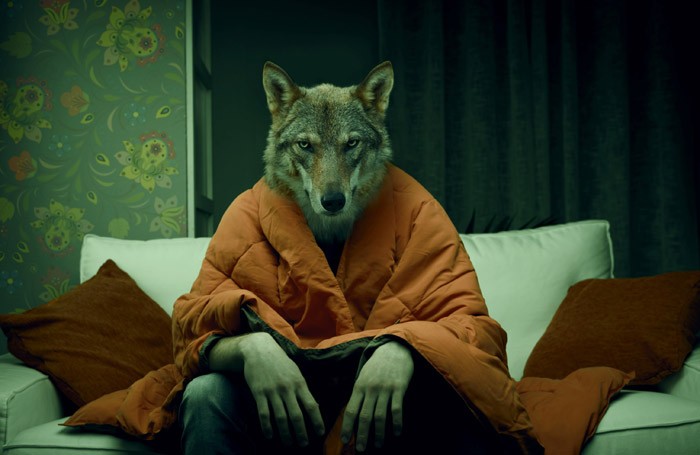
The War Has Not Yet Started at the Southwark Playhouse review ***

the-war-has-not-yet-started-700x455

The War Has Not Yet Started

Southwark Playhouse, 18th January 2018

I don’t really read that much anymore. Which means I take a rather circuitous route to the acquisition of knowledge and satisfaction of curiosity. The page has been replaced by the stage, the museum and gallery, visits, music and my dear friend, Wiki. Books can then fill in the gaps. (Though I must call out the wonderful OUP Very Short Introductions. If I need a way in to something brainy here is where I start. Bite and pocket sized, though a bit variable in tone.)

This means some “stuff” has become more prominent that other “stuff” in my head. Bear in mind the capacity of my head RAM has opened up exponentially now that is is largely free of my work-life specialist subject. I knew a lot about very little. Now I am trying to find out a little about a lot. Which suits me as I am a consummate bullshitter who relies on knowing a tiny bit more than any conversational partner, and a sonorous delivery that bores them into agreeing with me.

One of the things that has crept up on me in the journey has been the modern(ish) history and state of Russia. A bit of Chekhov, too much Shostakovich, a handful of art exhibitions and a couple of conversations, and, to paraphrase Winnie Churchill, the enigma is revealed. Well not revealed but I go from nothing to something. It is a tiny something, but, at the risk of going all epistemological on your ass, it is more than I know about the state of Hounslow, my next door neighbours or our cat.

The point is that the relationship between State, as in the instruments of power, and the individual, has been a fertile one for the Russian/Soviet Artist. In the rapid lurch from backward, pre-revolutionary, feudal autocracy, through Revolution to oligarchical Capitalism, it looks like it has paid to keep things close to your chest.

Which in a roundabout way brings me to TWHNYS. Mikhail Durnenkov is an actor on stage and TV, as well as a playwright, living in Moscow. The Drunks, written with brother Vyacheslav, aired at the RSC a few years ago, in a translation by the marvellous Nina Raine. I didn’t see it but, from the sound of it, it is a satirical comedy, tracing a long line back through to Gogol, that took the unfortunate adventures of an Everyman, a soldier, as a metaphor for modern Russia and its history.

TWHNYS is a more discursive, experimental affair brought to the Southwark Playhouse in a translation by Noah Birksted-Breen, by way of the Theatre Royal Plymouth. Unconnected characters play out 12 seemingly unconnected vignettes, some banal, some more striking, over 80 minutes or so. Apparently they can be played in any order with any number of actors. Here we have three. Sarah Hadland, (Stevie in Miranda, she of the allure!), Mark Quartly, last seem by me as the gymnastic “real” Aerial alongside his real-time holographic doppelganger in the RSC Tempest, and, most strikingly, Hannah Britland. Many of the scenes are set within the family unit or deal with the impact of violence and propaganda. There is black comedy, confusion, menace, little in the way of entry or exit from the scenes and much obfuscation. The scenarios are all recognisable but throughout is an air of mistrust and uncertainty that sort of compels.

It is really tricky to make this sort of writing work and I am not sure how much is lost in translation, not of the language, but from Moscow to London. Whilst much of the contemporary zeitgeist which Mr Durnenkov is trying to capture is universal, it might make just a bit more sense there rather than here. Cultural specificity is a slippery waif and I always try my best to ditch the dangerous fiction of borders when thinking about this sort of entertainment, but I was still struck by how much the mood of the play fitted with what I think I have learnt about the Russian mindset.

Still anxiety is anxiety wherever you live and the cast and director Gordon Anderson, (who has experience of this sort of mood from his League of Gentlemen days), seem to be enjoying it. Andy Purves’s lighting design is noteworthy.

Go see for yourself. I am still making my mind up.


The Here and This and Now at the Southwark Playhouse review ****

4189

The Here and This and Now

Southwark Playhouse, 10th January 2017

OK homo sapiens. Enough with the exceptionalism. There is nothing special about you. Maybe you are more “intelligent” than any species that has inhabited the earth so far but you have only been around for a couple of hundred thousand years. Peanuts. You will likely be just background extinction, likely a consequence of your own selfish, insatiable behaviours. Annoyingly you will take a load more species with you. But your Holocene existence will barely register in earth history terms and you will be soon forgotten. Actually never remembered. And you will have proved pretty rubbish in terms of adapting to your environment for all your boasts if you can’t even manage a million years of existence.

So, whatever dystopian future awaits, no point getting too worked up about it. Worth trying to slow it down a bit but all your technology and institutions won’t prevent the inevitable.

Happy New Year.

Which brings me to THATAN. (I thought the acronym sounded suitably sci-fi and pharmacological, appropriate to the play). Southwark Playhouse has snapped up this and the forthcoming The War Has Not Yet Started from the Theatre Royal Plymouth. Great theatre, great city, great county. And, give or take a couple of flaws, it is well they did. For this latest offering from fashion journalist turned playwright, (and Plymouthian), Glenn Waldron, is, at its best, very, very funny. It kicks off with its four characters, Niall (Simon Darwen), Helen, (Becci Gemmell), Gemma (Tala Gouveia) and Robbie (Andy Rush), at an off-site (or away-day, take your pick, it is still one of modern Western capitalisms most unattractive inventions). It transpires they are sales reps for a pharma company. Niall, the boss, is making a pitch. The script they work from is excruciating but very funny. Newbie Gemma then has a faltering turn, followed by bolshie cynic Robbie, and finally the less assured, turning into hysterical, Helen. Mr Waldron’s observation here is truly acute, and because of this, his satire is bitingly effective. They are selling a useless drug for, prosaically, liver spots with minimal benefits in a desperate, faux-sincere way.

Then the gears switch. First Gemma and Robbie do a “what is life all about” dialogue, with background flirting. Slight but still effective, with its message of savouring the “special moments” in life. And then we roll forward to the 2020’s, post apocalypse, caused by, ta-dah, increased antibiotic resistance which has led to half the population popping its clogs. I won’t spoil the scene. Suffice to say that Mr Waldron gets away with this outrageous leap in tone, because, once again, his writing is laugh out loud funny. And best forget about Bill Paterson’s sonorous contribution at the very end.

The performances are uniformly perfectly pitched, Bob Bailey’s design does just about what it needs to do and Simon Stokes direction shows why his Plymouth stronghold is such a vital hub.

So forgive Glenn Waldron for joining the long list of playwrights wrestling with the “what will wipe us out” schtick and applaud the fact he has, at least, found a new scenario. Forgive the slightly clumsy shift in tone and banish any implausibilities which pop into your head. Just relish the very funny. black comedy that he has served up. And will him to find a way to take the tone he has expertly crafted in the first half of this 80 minute play and inject into another contemporary story. For that might result in something truly magnificent. I can now see I was an utter berk for missing his previous work, Natives, at this very venue. On the strength of this I hope it pops up elsewhere one day soon.