
Three Sisters at the National Theatre review ***

Three Sisters

National Theatre Lyttleton, 9th December 2019

Opportunity partially missed I am afraid. Inua Ellams has come up with a brilliant idea by transporting Chekhov to 1960s Nigeria, specifically during the Biafaran Civil War. Yet his urge to educate and contextualise leaves the dialogue heavy on exposition. And, in deference to the Russian master, his adaptation retains the key elements of AC’s plot, which then leads to a few incongruous shifts in the narrative.

It certainly looks the part with Katrina Lindsay’s mobile set, and especially extensive costumes, along with Peter Mumford’s lighting design, and especially Donato Wharton’s sound design, creating a real sense of time and place. The music, under the direction of Michael Henry, also contributes significantly. The cast is top drawer, with some particular favourites of mine showcasing their talents: Ronke Adekoleuejo (previously The Mountaintop, Cyprus Avenue), Tobi Bamtefa (The Last King of Scotland, Network), Ken Nwosu (An Octoroon, As You Like It, The Alchemist, and Sticks and Stones on the telly recently), Sule Rimi (American Clock, All My Sons, Glass/Kill/Bluebeard/Imp, Sweat, Measure for Measure, Love and Information, The Rolling Stone) and Natalie Simpson (Cymbeline, Hedda Tesman, Honour, The Cardinal). They, and their colleagues, definitely have their moments but in such a broad panorama, with many shifts in pace, action and tone, didn’t really get the opportunity to get under the skin of their characters.

Of course Chekhov’s original play can work in all manner of settings and, as long as translators/adaptors remain true to the tragi-comic timbre, the text can be whatever they want it to be. Inua Ellams’s sisters Onuzo, melancholic but politically aware Lolo (Sarah Niles), restless and resentful Nne Chukwu (Natalie Simpson), who was married at just 12, and initially playful, eventually broken, Udo (Rachael Ofori, who impressed), and brother Dimgba (Tobi Bamtefa), are a long way from where they were brought up, cosmopolitan Lagos, as Igbos returned to the east of the country as war breaks out. Their geographical and psychological separation, and the presence of the Biafran army, fits AC like a glove. Ronke Adekoluejo, as Dimgba’s Yoruba vulgar wife Abosede, adds a bullying edge of superiority to brash comedy, as she takes over the family home. I learnt a lot about modern Nigerian history, the baleful influence once again of the colonising Brits, the coup and counter-coup ahead of Biafra’s declaration of independence in 1967, the ethnic divisions, the war waged through bombing and blockades, the role of women in the war. And I have added Half of a Yellow Sun to my, admittedly thin, holiday reading list. But I didn’t really learn very much about the family, and the attarctions, at the heart of the drama.

Knowing the story made it pretty easy to fill in the gaps and to see how IE had weaved in the key symbols and events in the plot. The birthday party, the fire, here the result of an impressively staged airborne bomb strike, the clock, the photo, the duel. If one were new to Three Sisters I could imagine some of the interactions might have felt a little hazy amidst the spectacle but that didn’t seem to faze the enthusiastic audience at this preview performance. I see that, whilst there are tickets remaining through the rest of the run for the next three weeks (sorry, so far behind), it is been pretty successful and the crowd on our outing, was very enthusiastic, as well as, by NT standards, pretty diverse.

BTW all those dullards taking a pop at Rufus Norris’s tenure at the NT should recognise what he has done to extend the reach of the institution. I appreciate that there is still a way to go but here was a classic play, skilfully adapted by a British-Nigerian artist of immense talent, directed by one of the very best AD’s around right now, Nadia Fall at Theatre Royal Stratford East. Can’t see that would have happened under previous NT regimes. Anything that reduces the proportion of entitled, old, white duffers like me in the NT audience is a good thing.

Though I have to say that, whilst Ms Fall showed her customary energy in the set-piece scenes, and mined the comedy in text and character, even she couldn’t find a way of marrying the big picture events outside the frame and the personal, domestic drama at the core of AC’s masterpiece. Still on the plus side there was none of the sense of ennui that can pervade some productions that are too literal (or, sorry to say, too Russian). I am with those who say that Inua Ellams could have made an even better play by running even further away from the original.

The Mask of Orpheus at the ENO review ****

The Mask of Orpheus

English National Opera, 25th October 2019

No idea where we were in the story for much of the getting on for four hours with with the two intervals. Not helped by Peter Zinovieff’s impenetrable libretto, sung and spoken, the bloated rock star gets lost in early 80’s WAG Club setting courtesy of Lizzie Clachlan’s set and frock-maker Daniel Lismore’s preposterous spangly costumes, the tripartite two singer, one acrobat/dancer, Myth/Hero/Human, casting for our hero, heroine and baddie, and the wilful directing of Daniel Kramer, where spectacle trumps sense.

Who gives a fuck though when you have a score like this. With an ENO orchestra at the top of its game lovingly conducted by Martyn Brabbins, (who has history with this work), and James Henshaw, (yep it takes two). Up to now the Tourist’s exposure to Sir Harrison Birtwhistle has been fleeting. A few chamber pieces. None of the orchestral works bar the latest Donum Simoni MMXVIII, and certainly none of the operas. And, let’s face it, you are not going to sit down and listen to recordings. Nope the full on Sir Harry experience requires a live opera in performance.

Now I get it. As a contrast I don’t know where Xenakis’s music comes from, and I am conscious that I am probably just taking on board all the cultural baggage attached to its interpretation, but it definitely isn’t of this world, (though of course it is, it still being just notes on a page) . Whereas Sir HB’s tunes, for all that “elemental”, “earthy”, “massive”, “mythic”, “ritualistic”, “visceral”, and the like, that is applied to described most definitely does come from this planet, underneath our feet for sure, as many intuit, but also from within our selves. Which made its pairing with the Orpheus myth kind of inevitable. For all the racket that the brass, wind, percussion and electronica, entirely stringless, (well bar plucked like electric guitars and mandolin), that make up the score conjure up, this still very, well, human. The brass and wind is the flow, the percussion the accent.

Right poncey pseud-ery over. I could read the excellent ENO programme over and over, plough through the learned reviews, do the rounds on Wiki, but frankly it would get me no closer to the truth of what I heard and saw. Just impossible to take it all in. You know the story. O&E get it on, marry, snakebite, death, offer to O to go underground …. but don’t whatever you do Mr music man look ba….. oh shit, you did. Various endings depending on who you believe. All four are given a work-out here. In various other permutations and combinations of the whole story . 126 different elements in total. A prologue and epilogue. Act I – 3 scenes, 2 Passing Clouds and an Allegorical Flower. Act II – 17 Arches and the Second Flower. Act III – 8 Episodes and the Final Cloud.

Unstructured time. Flash-backs, flash-forwards, flash-arounds, flash-simultaneity. Contradiction and ambiguity. The antithesis of linear story-telling. With the aforementioned O&E, and the not so blessed cheesemaker randy Aristaeus, done three ways. So if the words don’t grab you, (and they very rarely will though the repetitions and exclamations will start to bite), you can turn to the songs, or the mime, or the dance, or the bath/barbecue/dentist chair/chrysalis/sexy time/funeral parlour/bobbly skin fellas/bee video effects (you can probably work out that I may not quite have fully grasped the messages), or the aerial silks, or the OTT costumes complete with, I forget, billions of Swarovski crystals.

And the cast and creatives really work hard. Matthew Smith and Alfa Marks as the very fit, in both senses, Hero O&E dancers. Tenor Daniel Norman and mezzo Clare Barnett-Jones as the Myth Orpheus/Hades and Myth Eurydice/Persephone respectively, who had the mother of all costume changes and the sweet mezzo tone of Marta Fontanals-Simmons as Woman Eurydice. James Cleverton, Simon Bailey and Leo Hedman as respectively The Man, The Myth/Charon and The Hero Aristaeus. And Claron McFadden as the Oracle, and Hecate, who marshals the crew who make up the three way judges, priests, women and furies.

But for balls out, (well not quite), on stage all night, haring round the stage, holding everything together whilst appearing, as the part demanded, pissed, the star of the show is Peter Hoare. I don’t know if he gets paid anymore for this role compared to his more normal C20 repertoire, but he should. Mind you I see he started off as a percussionist before taking up singing. Which I guess, deep down, makes him connected to the music in a way that maybe others aren’t. Even when said percussion, which Sir Harry explores in every conceivable combination, is drowning him out despite amplification. (Oh and do remember by the time we get to Act III some of the text isn’t even in English anyway).

When all else fails though, as it often did, I just closed by eyes and drowned in the sound. Three is the magic number. Orpheus remember makes sweet music. But when the going gets tough, arch after arch, the music gets bigger and louder with a literally earth shattering 40 minute climax at the end of Act II. The sampled harp chords which create the electronic interludes composed by Barry Anderson at IRCAM. The synthesised voice of Apollo. The scraps of, I hesitate to say, melody that are repeated again and again. Orpheus’s memories. Restless rhythms. The pulses, the marches, the clunks, the shimmers, the drones. The massive, monumental structures. The raw immediacy. Never heard anything like it and when surrendered to whatever it is, ignoring all the guff on or above the stage, I swear I have never felt anything like it.

I gather the original production, on this very stage in 1986, and only now revived, went for a more mythic, indeterminate Greek vibe, with singer, mime and puppet per the score and with masks. I think I might have got on better with this but frankly I can’t blame the much maligned and now departing Daniel Kramer for chucking the camp, surreal kitchen sink at this. If, budget-wise, you’ve got it, then you might as well flaunt it. Maybe it was all clear in his head but I doubt it. David Pountney, the director of the original, had the good grace to say he had no idea what it was all about.

Once in a lifetime experience. In which case I wouldn’t mind another life. Or many lives. For that is what it would take to wrap your ears around it. In the absence of that the memory will suffice and maybe I should relent and try the benchmark (only) recording from the BBCSO under Martyn Brabbins and Andrew Davies. In fact YOLO and its Christmas so I will.

John at the National Theatre review *****

4-john-anneika-rose-as-jenny-and-tom-mothersdale-as-elias-c-stephen-cummiskey

John

National Theatre (Dorfman), 6th February 2018

I would be very wary of playwright Annie Baker if I were you. She will bewitch you. Magical powers. That is the only way to explain John. Nothing really dramatic happens, the setting doesn’t change and the words, initially at least, seem quite ordinary. Yet the longer it goes on, (it clocks in at near 3 hours even stripping out a couple of intervals), the more mesmerised the audience becomes. It is “pregnant with possibilities” you see and turns out to be anything but ordinary. Extraordinary in fact. John goes beyond the exaggerated naturalism of Annie Baker’s previous plays into, well, a theatrical place that I have never quite experienced before.

How she wrote it is beyond me. Conjuring up these voices, and then just letting them speak in the moment, reveals a writer of utter confidence who knows exactly what she is about. If she can see and hear the whole thing before putting pen to paper I am in awe. If she makes it up as she goes along, (I know, she almost certainly didn’t), then frankly I am gobsmacked.

Haunting is the word I have seen elsewhere to encapsulate John and it is a good word both to describe the meanings that Ms Baker seeks to explore, the effects she creates and the memories she delivers beyond initial viewing. The very best plays/productions leave you with a series of pictures in your head that can be recalled long afterwards, (doh – that’s how memory works you numbnut), and it is not always the ones that you might immediately expect. John vividly falls into this category.

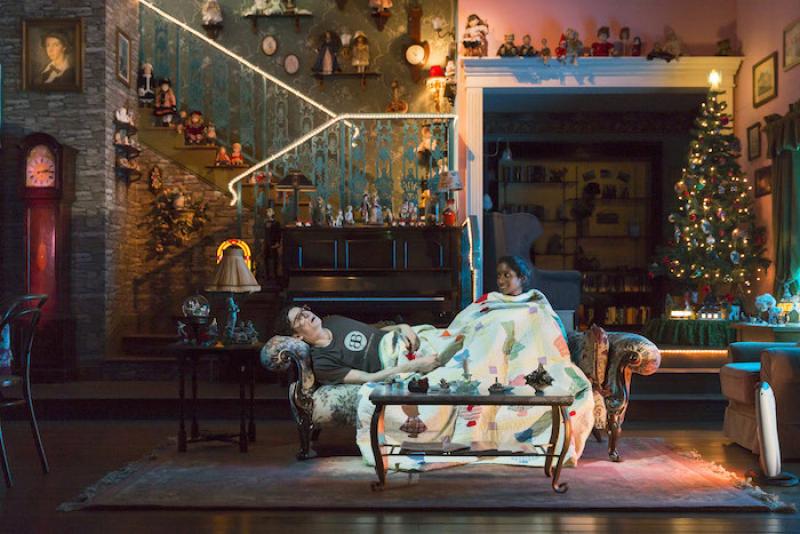
It is the week after Thanksgiving. Jenny (Anneika Rose) and Elias (Tom Mothersdale) arrive at a bed and breakfast in Gettysburg, Pennsylvania run by Mertis (Marylouise Burke). All that follows takes place in the lounge/dining area of the B&B. Chloe Lamford’s set is a thing of wonder and a character in itself. A vintage radio cum juke box seems to be permanently set to Bach. A self-playing piano alarmingly springs to life. The furniture is exactly as you would imagine in a fading but homely B&B. Think dusty chintz. The staircase leads to a handful of unseen bedrooms, (to which Jenny and Elias retreat on occasion), which seem never to be heated. The dining area is, optimistically, named “Paris”. There are knick-knacks a plenty but what is most disturbing are the dolls lining a high shelf. Jenny even recognises one of them as the doll which unsettled her as a child. Peter Mumford’s superb lighting complements the set. The atmosphere which is created is ever so slightly off-kilter from the expected cosy, but still a long way from full-blown, Gothic supernatural.

It was Elias’s idea to come to Gettysburg for a couple of nights after seeing Jenny’s family: she was less sure. (Gettysburg remains the single biggest day, well three days, of slaughter in American history and was the turning point in the Civil War. One for students of semiotics there methinks). Elias is a musician, Jenny writes questions for a TV quiz show. They are three years into their relationship but cracks are appearing. Innocent comments, or texts, can prompt gentle bickering. Moody Elias is always looking to take offence: Jenny predictably counters with textbook passive-aggressiveness. There are silences – Ms Baker really, really understands the importance of silences. Then, just as naturally, they cuddle up on the sofa, (too cold upstairs), with Elias trying to make up “ghost” stories. So, a portrait of an entirely recognisable modern couple, played to perfection by Anneika Rose and Tom Mothersdale.

And so to Mertis, aka Kitty. Marylouise Burke is a veteran of the US stage and this is a remarkable performance. Mertis throughout is sweet, dithery, eccentric, but no cliche. She runs the B&B with second husband George, who is apparently ill and remains unseen. Her blind friend Genevieve, another perfectly pitched performance from June Watson, comes to visit, and, over a few glasses she and Mertis engage Jenny in meaningful conversation, Jenny having stayed behind suffering from menstrual cramps as martyr Elias went off alone to visit the battlefields. Genevieve is a more forthright character than Mertis but both believe they have been accompanied by “watchers” in their lives. This culminates in the idea of love as a haunting, literally in Genevieve case by her ex called, you guessed it, John. Jenny feels something of the same as does Elias when subsequently cornered by Mertis.

This then is what I took to be the central concern of the play. The idea that the uncertainty, loneliness and disappointment of life is what drives the urge to believe in, take comfort from, or be disturbed by, something beyond the immediate and rational. The uncanny stories, (in Act 3 Mertis reads some Lovecraft to Genevieve who then remains in the shadows through Elias and Jenny’s “final” argument), conversations, signs and symbols that abound in the play, as well as the precise naturalism of the lines, are, I think, what Annie Baker has alighted on to force us to think about how this “need” articulates with our interior monologues and our sense of external reality. Alternatively maybe I am just a pseud who thinks too much.

Theatre, at its best, is a shared experience in a way that other art forms cannot replicate. The connection between text and actor, character and actor, audience and actor for sure. But also the connection between members of the audience as text and performance unfold. That was definitely in the air for John. It is subtle but entirely engrossing. It is crammed with detail, and that is just what registered, there was probably loads more that I missed. Oh and did I say it is funny. Because, at times, it really is.

It is no surprise that James Macdonald is the director here. Is there a director working on the UK stage who is more sympathetic to playwrights? I don’t think so. I am pretty sure this will end up being in my top ten plays this year and I will do my level best to see more of Annie Baker’s plays. (I see Circle, Mirror, Transformation is being revived at Home, Manchester shortly).

If you are one of those bellends who feels the need to constantly check your phone then this probably isn’t for you. But if you are at all interested in the possibilities of theatre then you should snap up one of the tickets for the remaining performances, snuggle into a seat at the Dorfman, (not always that easy), and let this evocative play bleed into you.