
Peer Gynt at the National Theatre review ****

Peer Gynt

National Theatre Olivier, 1st October 2019

I know what I need. A bit more Ibsen. There are reasons why theatre-makers keep returning to the master and the slew of high profile productions in London this year alone is a reminder of why. I would probably plump for Ian Rickson’s Rosmersholm as the best of the bunch but there have been others that have captured the great playwright’s unique cocktail of thrilling drama, scathing political and moral critique and meticulous psychological insight.

Right now I crave a John Gabriel Borkman, a play that I have never seen and which I gather offers a challenge to directors in reconciling its melodramatic, symbolic final act to the realism of what has proceeded it. I don’t suppose I will have to wait too long though. In the meantime Peer Gynt, the romance, fantasy, epic, modernist mix of surrealism, poetry, naturalism and confessional, written in Danish verse over five acts, that has been challenging and delighting theatre makers and audiences since it first tore up the rule book in 1867. The last time I saw it was at the Arcola in Theatre an der Ruhr inventive two hander in German, (yep, I know what you are thinking). This could hardly be more different. The full resources of the Edinburgh Festival and National Theatre on the Olivier stage in a new, free adaptation by David Hare (with byline after Henrik Ibsen), directed by the venerable Jonathan Kent with sets and costumes from opera whizz Richard Hudson and with a cast of 25 led by James McArdle.

I confess I am still feeling my way into Peer Gynt and I recognise that David Hare here, whilst sticking closely to Ibsen’s plot, materially updated its content to satirise contemporary issues. I guess we should have expected nothing less from Mr Hare and his gift for the elegant, incisive and amusing turn of phrase remained undimmed. There are times when the exact target of Mr Hare’s ire became a little confused and/or indulgent but generally this is a text to savour.

Peer Gynt is a fantasist who creates his own narratives, his own view of his self, which, it turns out, is a long way from the reality even when he “succeeds”as well as when he “fails”. Pretty easy then to see why Mr Hare and Mr Kent would be attracted to this story of a life built on vacillation, invention and entitlement in our digital world of self-obsession and distortion at both the individual and societal level. As Ibsen trenchantly observed “if you lie, are you real?”. And the message of Peer, here Peter, Gynt is, if you are going to make stuff up and avoid knuckling down, go big. Who knows where you may end up. POTUS even? After all the play itself has generated its own reality with an annual festival, a sculpture park, a prize for best Norwegian thing of the year, numerous films, TV presentations, ballets, operas, musicals, Greig’s music and innumerable professional and amateur productions.

McArdle’s Gynt is a demobbed soldier returning to his Scottish village of Dunoon recounting tales of his bravery that bear and uncanny resemblance to seminal scenes from war movies. His Mum, Ann Louise Ross, puts up with his nonsense but the villagers, as we see at the wedding, are less forgiving. He kidnaps the bride, falls for Sabine (Anya Chalotra), a kind young immigrant woman, is banished, meets some line dancing cowgirls (Lauren Ellis-Steele, Hannah Visocchi, Dani Heron), gets shit-faced, bangs his head, dreams of a troll king (Jonathan Coy) and fathering a child with a his daughter (Tamsin Carroll), meets a gnomic chap called the Boyg (Nabil Shaban), wakes up, rejects a life with the faithful Sabine, movingly watches his Mum pass away, runs off, becomes an evil oligarch, a pilgrim, a fake guru and ends up chatting to the deranged inmates of an asylum. He heads for home, is shipwrecked, meets the aptly named Weird Passenger (Guy Henry) and finally has it out in the philosophical steakhouse with the Boyg and the learned Button-Moulder (Oliver Ford Davies), who teaches him the fundamental difference between self-absorption and self-realisation.

A revamped dream sequence, an inordinate amount of innovation from Richard Hudson, Mark Henderson (lighting), Christopher Shutt (sound), Polly Bennett (movement), Dick Straker (video), Paul Benzing (fight), Chris Fisher (illusions), and all their colleagues, original composition from Paul Englishby and musicians led by Kevin Amos, the discipline imposed by Mr Kent, a couple of intervals and a willing audience all pulled together to make this happen. Was it worth it? For me yes. I am not entirely sure if this Peer Gynt’s reach exceeds its grasp, (come to think of it that is sort of PG himself’s problem), but, thanks to largely to Mr Hare’s script and Mr McArdle’s brobdingnagian performance, (see what I have done there, referencing Swift’s Gulliver’s Travels, another genre-bending fantasy satire to which novelists still look today), I now know what Ibsen was trying to tell us. And, as importantly , I spent 3.5 hours immersed in a bloody good yarn.

Which I see is not an opinion shared by many of the critics who variously seem to have had it in for Mr Hare, the production, the play, the set and the direction. Oh well. It takes all sorts.
Peer Gynt at the Arcola Theatre review ***

solbad_raffelberg_kurpark_-_theater_an_der_ruhr

Peer Gynt

Arcola Theatre, 5th October 2018

I have never seen Ibsen’s Peer Gynt before. In retrospect a minimalist two hander, a “daring realisation”, by “internationally acclaimed” German company Theater an der Ruhr, might have been a somewhat challenging place to start. Still what doesn’t kill you makes you stronger, or whatever the theatrical equivalent of that maxim happens to be.

And there was much of value to take away from this production. But let’s start with the play. Given that he was the “father of realism”, Peer Gynt is a bit of a departure. A sprawling fantasy in Danish verse about an oddball whose grip on reality is far from secure. It is based on a Norwegian fairy tale, though it contains echoes of HI’s own life, with family members written in. It has elements of a romance, like Will Shakespeare’s last outings with Pericles, The Tempest and Cymbeline, lightly concealed satire on Norwegian insularity, strikingly surreal scenes immediately contrasted with natural, contemporary drama. It tracks the life and, presumed death (it isn’t explicit) of our Peer across 40 scenes which utterly disregard the normal conventions of staged theatre. HI saw it as a lyric poem. I bet he would be surprised at just what a hold it has in the canon.

That’s probably the case because, I gather, there are so many ways for creatives to impose meaning on this “masterpiece”. In fact there is just so much “theatre” that can be thrown at this piece of theatre. Peer is a waster and a drunk early on but he can tell stories. There is a persistent, emotional, and maybe futile for Solvieg, love story. There are trolls, and a half human, half troll baby, always a crowd pleaser. There is much philosophising on the nature of existence and reality. there’s all manner of Freudian interpretation. Peer is the ultimate egotist. Who loves Mummy. There is a swipe at capitalism, laced with overt racism. There is a madhouse. A travelogue. A shipwreck. And, at the end, an overtly Christian reckoning and possible epiphany. He might have been dreaming. Or he might have been extravagantly alive.

So you can see HI packed it in. One way to present this is to assemble a wide cast and let the creative minds loose to do their best, or worst. I hope to see such a production. (I see the NT has commissioned a new, contemporary adaptation by David Hare for 2019. There is a man who can do sprawling). Every year in Vinstra in the middle of Norway they stage a giant production as part of the Peer Gynt festival, this being the place where the chap on which the character might be based hails from. Never been there but will add it to the bucket list along with Borgund Stave Church. I remember my first holiday, a cruise along the Norwegian coastline with 600 post pubescent teens on the SS Uganda. We saw Greig’s house, he of the Peer Gynt suites. And in today’s athomehefeelslikeatourist list of cultural coincidences it was Greig’s Holberg Suite that I had the pleasure of listening to last night.

Enough rambling. So I suppose the other, perhaps trickier way, to stage the play is like this. Minimal props, table. chairs, a bed, two actors dressed in the monochrome suits which spell Lutheran phlegm. With the actors, Roberto Ciulii and Maria Neumann, taking on all the parts, and even sharing the role of Peer himself.  Vital then to know your stuff so I was handsomely rewarded for boning up on the plot beforehand. I highly recommend this strategy for the classics. Here it was a life-saver. Well OK maybe that is an exaggeration, it was only 90 minutes after all. But it certainly made for a much clearer understanding as, whilst the plot is pretty much intact, the dialogue has been ruthlessly sharpened, and even more so in translation to sur-titles.

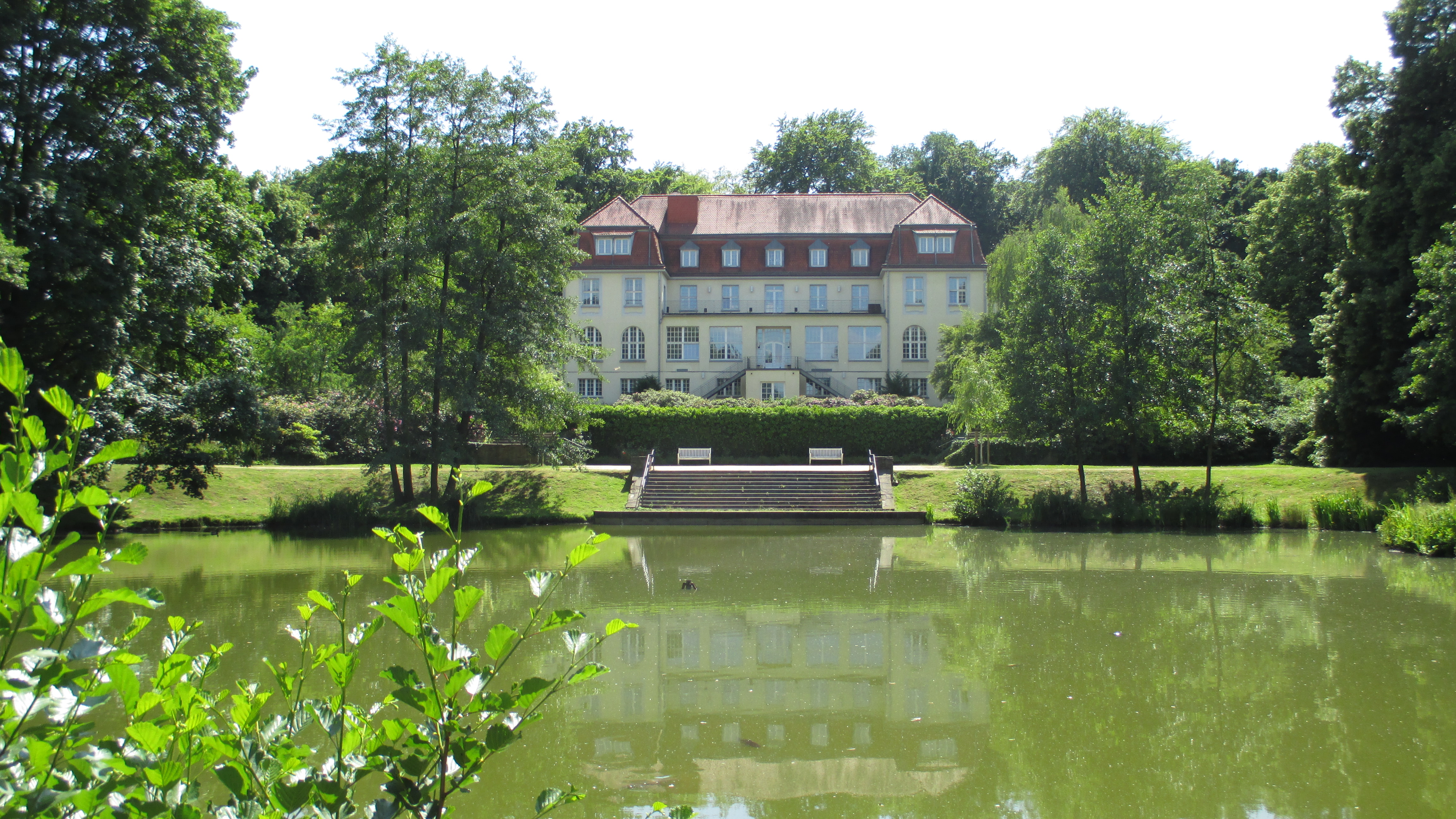
So I kind of worked out where we were, and what was going on. despite the limited display. Not sure everywhere in the audience was so lucky/prepared. You certainly cannot take your eyes off Roberto Ciulii, the Italian founder of Theater an der Ruhr with Helmut Schafer in 1981, and long time ensemble member Maria Neumann. They are mesmeric. Both are possessed of extraordinarily expressive faces, and Ms Neumann in particular is an amazingly physical and tactile presence. Major and minor changes in intonation and body shape indicate character changes. Dialogue, monologue and narrative intermingle. There are a few jokes. But the stripped back aesthetic, the small space, the absence of visual cues and distraction, together with the barrier of translation, however idiomatic Signor Cuilli’s text, can veer towards the monotonous. Not in a dull way. Just in a way that I suspect re-calibrates the dimensions of the play. Mind you this is what TadR sets out to do. A company that sets out to make theatre that can travel and abhors hierarchy. In a lovely looking building in a park in Mulheim near Duisberg (look see above).

The absence of spectacle does allow a focus on exactly how Peer’s identity is constructed. Is his life defined by what has happened to him, or what he has made happen? Is he, with all his obvious flaws, still to be admired, or is he just a bit of a knob? Is reality out there or just what goes on in our heads? See that’s what happens when you go to North London with other culturally aware trendies to watch modernist German theatre. If you are a real pseud, like someone here, you even buy a German programme for no apparent reason.

So a worthwhile journey for me. And for Peer. Whoever he was.