
The Lovely Bones at the Rose Theatre Kingston review *****

The Lovely Bones

Rose Theatre Kingston, 26th October 2019

The Lovely Bones, co-produced by Birmingham Rep, Royal and Derngate, Northern Stage and Liverpool Everyman, is just to wrap up its tour in Chichester. If you saw it good on you. If you didn’t then make sure you sign up for what ever director Melly Still does next. After triumphs such as My Brilliant Friend, which you can catch at the NT as we speak, Captain Corelli’s Mandarin, her RSC Cymbeline, and further back her NT Coram’s Boy, it is plain she is the Queen of physical theatre adaptation. What with her role as Associate at the Rose, and with Christopher Haydon about to arrive as the new Artistic Director, and better seating, things are really looking up for the Tourist’s local theatre.

Now some might recoil from Ms Still’s insistence on the primacy of visual spectacle alongside the text. Not me. And not, based on a spot of vox-popping of neighbours post performance, the audiences. Or it must be said most critics. To which we must give many thanks to adapter Bryony Lavery. Ms Lavery is set for a busy 2020. Her 1997 original play Last Easter will have its London premiere at the Orange Tree, she is adapting Philip Pullman’s La Belle Sauvage for the Bridge Theatre, her adaptation of Oliver Twist with Ramps on the Moon will tour, her adaptation of Oscar and the Pink Lady will take the stage in Sheffield and Theatre Royal Stratford East have chosen her musical version of Red Riding Hood for its Xmas 2020 panto. Not bad for a pensioner.

It is pretty easy to see why collaborators keep returning to her as an adapter of broad appeal theatre. Of course the subject and structure of The Lovely Bones, which is narrated by the now dead Susie Salmon, raped and murdered by a neighbour aged 14, may not quite fall into the category broad appeal. But Alice Sebbold’s 2002 debut book was a best seller and the 2009 film directed by Peter Jackson, whilst generating a mixed critical response, grossed around US$100mn. So safe to say it has “brand recognition”. And, whilst the subject matter is initially, and self evidently, unsettling, the way the story develops, with Susie torn between willing her family and friends to nail her killer and watching them get on with their lives and get over her death, is more compelling. In someone ways it is an unsentimental story told, deliberately, in a sentimental way. There is a Heaven but not that of Christian dogma, her family is broken by her death, but it still celebrates American family and community, it does operate like a slickly paced, artfully plotted thriller, but that was not the real point of its writing, there is some supernatural mumbo-jumbo but, obviously given the initial formal liberty the reader will take it in her stride, and the baddie does get his comeuppance in a melodramatic twist.

So there is enough in the way of event and character to justify a theatrical interpretation. And the mechanism by which Ms Laverty and Ms Still realise this is disarmingly straightforward, In the book Susie narrates whilst looking down on family, friends and the killer from her Heaven. Here Susie walks among them, although of course they cannot see or sense her. Until, of course, they can. Heaven, with its host of other victims, led by Franny (Avita Jay) who becomes Susie’s mentor, appears and disappears at the drop of a jump light, but mostly we are in the world of the living with the brilliant Charlotte Beaumont’s teen Susie as stroppy cheerleader in her own investigation armed only with conviction and banana yellow loons.

Ava Innes Jabares-Pita’s set is overhung with a huge sloping two way mirror, not a new conceit but one that works to great effect here, as we are drawn to see events from two different perspectives. Otherwise we have a bare stage with floor lighting to symbolise house, and with the busy cast carting stuff on and off stage (cornfield, clapboard houses, clothing) to advance the many scenes. As with Ms Still’s previous work, it is lighting (Matt Haskins), sound (Helen Skiera), music (Dave Price, whose playlist guides us efficiently through 70s and 80s) and movement (Mike Ashcroft) which generate the thrills through the brilliantly choreographed ensemble. Scenes begin as quickly as others end so that the whole story is crammed into less than a couple of hours and there are countless moments of theatrical ingenuity.

Of course with all this visual activity theatre-makers run the risk of scrambling the plot and cartooning the characters. Not here though. Ms Laverty gives us as much dialogue as we need, leaning on Susie’s punchy narration, without, as far as I could make out, condensing any of the key plot elements . And the characterisations, Dad Jack’s (Jack Sandle) guilt and grief, Mum Abigail’s (Catrin Aaron) withdrawal, sister Lindsey’s (Fanta Barrie) indefatigability, detective Len Fennerman’s (Huw Parmenter) entanglement, are all sufficiently well sketched to hit home. OK so maybe the various friends, mysterio-goth Ruth Connors (Leigh Lothian), sensitive boyfriend material Ray Singh (Samuel Gosrani), (and his No Nonsense Mum Ruana), and the additional composites created in the form of Sophie (Radhika Aggarwal) and Leah (Leah Haile), only just about stand up to scrutiny, but this is true of the book too. And the less said about hard drinking, homily wielding Grandma Lyn (Lynda Rookie) who comes to look after the family when Abigail leaves, the better.

Nicholas Khan as the killer Harvey screams creepy psycho from the off, but as with the rest of the production, and in keeping with the book, effect and momentum are prioritised over psychological insight. He is convincing mind you. Then again so is Samuel Gosrani doubling up as family dog Holiday who is, in that doggy way, immediately on to Harvey. Those familiar with Melly Still’s Captain Corelli’s Mandolin will know just what the actor as animal routine can bring to this sort of production.

Of course there are times when theatre is best served by two people getting deep and wordy. But its real power lies in its dynamism and in the shared experience, and, in this regard, Melly Still is, in my book, a brilliant practitioner. I am willing to bet that the version of The Lovely Bones on the night that I enjoyed it, (for just a tenner, grab those secret seats people), will have looked different to that presented on the first night in Birmingham. Which is exactly as I would want it to be.

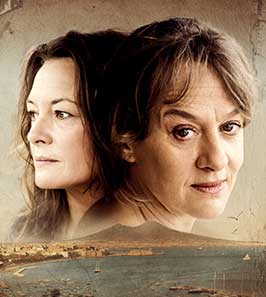
Captain Corelli’s Mandolin at the Rose Kingston review *****

Captain Corelli’s Mandolin

Rose Theatre Kingston, 12th May 2019

WELL F*CK ME. LITERALLY AS I WAS ABOUT TO PUBLISH THIS POST I SEE THAT THE PRODUCTION HAS SECURED A RUN AT THE HAROLD PINTER THEATRE IN JULY AND AUGUST. EXACTLY WHAT I HOPED FOR. YEAH !!!!!!!

Never read the book. Never seen the film. Had no inclination. Assumed it was some soppy love story which would bring no value to my joyless, ascetic life.

Then I saw that Melly Still was directing and that Rona Munro (The James Plays) had adapted Louis de Bernieres’ blockbuster novel. And I am honour bound to support my local theatre which is about to have its funding hacked away by the philistine local council. Whom I support. Doesn’t stop it being anything less than a twattish decision though. Maybe it was a bit ambitious, and vain, to create such a big theatre space here in the first place, but, in the circumstances, and with no AD on the books, the Rose has done a grand job in producing new theatre of the highest quality in recent years.

Grrrrrh. Anyway Melly Still’s last outing here was the adaptation of Elena Ferrante’s My Brilliant Friend. Again a book, (actually a quartet of books), about which I had, (and still have), no knowledge. It was a triumph. She is an Associate Artist at the Rose now. Hence this production of CCM in conjunction with the Birmingham Rep. Hopefully in spite of the above news there will be more opportunities for her to display her talent in many future years. Both of these productions took well loved books, sharpened their focus, highlighted their messages and turned them into exciting, physical dramas using a barrage of theatrical technique.

Now I recognise that this approach risks annoying the super-fan who wants every scene to be played out in full and every character interaction to be carefully drawn. On the other hand all this razzmatazz stagecraft, movement (George Siena, I need to watch out for him), set and costume (Mayou Trikerioti, like George she is Greek, smart call), lighting (Malcolm Rippeth), video (Dom Baker), and, especially, composition (Harry Blake) and sound (Jon Nicholls and Dan Hunt), might leave some of the audience breathless. But that is what makes this production so thrilling.

For me though this is what story-telling is all about. A book is a book and a stage is a stage. If, as here, you have a big story to tell, that crosses time, place and people, then this is as glorious an example of how to make it work within the constraints of the latter as you are ever likely to see. It’s the onset of WWII on the island of Cephalonia. Learned widower Dr Iannis (Joseph Long) lives with his daughter Pelagia (newcomer Madison Clare) who gets engaged to local lad Mandras (Ashley Gayle). But war begins and he goes off to fight. Italian Carlo (Ryan Donaldson) watches his love Francesco (Fred Fergus) die at the hands of the Greeks in Albania. The Italian and German forces pitch up in the village led by the surprisingly, in the circumstances, happy chappy Antonio Corelli (Alex Mugnaioni) who is billeted in the Iannis home. Mandras returns, injured, but Pelagia falls out of love with him. Italy switch sides …. and then …. well it really kicks off.

Love. And War. Doesn’t get much bigger than that. So no surprise that I was carried along by the story. But what I didn’t bargain for, apart from the genius of the staging, (again I will refrain from highlighting any of the exquisite details – they just keep coming), is the way the play examined the specific history of the impact of the war on Greece. On occupier and occupied. And the way music, which pours out of this production, is deployed as the antithesis of the carnage of war. As well as what I had expected. What war does to individuals. And what form love can take.

No programmes left at the Rose, (since, eventually, this filled the house), so I can’t be sure if I had seen any of the cast before but most were new to me. No point picking out any individuals. The whole point is that this is an ensemble. Of cast and creatives. Mind you if you don’t fall for Luisa Guerriero’s character I can only assume you are made of stone. And the sound that is spun out from Eve Polycarpou’s voice is devastating.

Apparently Mr de Bernieres is very happy with the result and sees it as faithful to the intention of his novel. (In contrast, I read, to the film which went off the rails big time). I am not surprised. I loved it. I see that some of the proper reviewers felt that the central love story underwhelmed in comparison to the spectacle of the historical context. Not for me. I can report lump in throat, though I am a lachrymose old bluffer.

Hopefully the Rose and Ms Still can alight next time on a text that will pull in the punters from far and wide as well as titillate the local punters to create something that can be flogged in the West End. Mind you if I were a big shot WE producer I would take this on in a shot. As it stands it has the rest of its run at Birmingham Rep, then the King’s Theatre, Edinburgh and finally the Theatre Royal, Glasgow. Do go and see it.

My Brilliant Friend at the Rose Theatre Kingston review ****

thumbnail-image-sl

My Brilliant Friend Parts 1 and 2

Rose Theatre Kingston, 27th February and 17th March 2017

I had not read the quartet of Elena Ferrante novels coming in to this (though I mean to put this right now). However, as this is a Guardian readers’ and various novelists’ favourite and with the SO having partially read them and given them a qualified thumbs up (she sets the bar pretty high), and with it being the Rose so on the doorstep, we were destined to go. And so we did.

First decision was to split the two parts. For choice I normally wouldn’t do that preferring to take the pain of setting through multi part theatre on the chin, (or more exactly bum), by doing it all in a day where possible. This was a reminder of why that remains the preferred strategy. What you get out of a theatre performance depends in part on what you put in, so different days means different moods and therefore different levels of enjoyment. With these plays, festooned with multiple characters, (and doubling/trebling of parts), an awful lot of sharp, staccato scenes to get through in the 5 or so hours, (to do justice to the novels I gather), and multiple themes to explore, (where I think the adaption was clearly a winner), one sitting would definitely have worked better for me.

A particular attraction was the director Melly Still. I really, really liked her Cymbeline for the RSC. A tricky play but she was unafraid to chuck ideas in, (gender changes for characters, topical issues of national identity, nature vs nurture and so on), which definitely made sense to me in a play where it is very easy to get lost. So a plus there. I had not seen Catherine McCormack (Lila) or, to my eternal shame, Niamh Cusack (Elena/Lenu) on stage before, but felt they were both perfectly cast. In Part 1 Catherine McCormack was outstanding capturing the strength and unpredictability  of Lila, (don’t shout at me I am just using a word to describe a whole gamut of traits), with her movement as well as her speech. In Part 2 Niamh Cusack took centre stage, (and left. right up and down – there was a lot of movement in the production), as her character developed with a determination and a different, egotistical strength.

So I think two cracking complementary performances, a lot of smart stagecraft, the use of set, sound and lighting in a way that the Rose rarely sees, an obviously brilliant story/stories, and breathtaking pace and energy. In fact the pace and energy may just be a little too breathtaking. I gather there is a lot to pack in and this is what the adaption does. This is then multiplied by the character, place and time shifts. So it is all a bit of a whirlwind. No other way to do it and meet the needs of the faithful I suspect but even so there were times when I wanted a bit of air in proceedings (when this did happen, largely in the Lila/Lenu exchanges, I got more meaning I think).

As I said I haven’t read the books which I am guessing is an advantage in seeing this, so no risk of what is in the head clashing with what is on the stage. But overall whilst I thoroughly enjoyed what I was seeing and hearing, and how I was seeing and hearing it, there may just have been a bit too much to take in (compounded I think by my gender – there is a lot of experience for a privileged, white male to take in here given that all the men are – rightly – portrayed as utter c**ks).

I see some reviews of this that are whinging about scenes lost or themes in the novels which don’t come out on stage. Whilst I suspect that the pace of the production did mean some “thinning out” I would, with all due respect, say to these punters that there is a book, and now there is a play (and I believe there will be a TV adaptation). It’s theatre. it’s different, that is the whole point. Let the book take care of interior monologue, invocation of time and place and the clash of ideas. Let the play focus on the character and the drama in a shared experience. Don’t go if you are just going to moan about what isn’t there. Judge what is there. Right rant over. Sorry.

Oh and finally I would come down on the side of those who think there is only really one character here – that make most sense to me. It’s a memory play which to me explores the power of words to shape the past and the experience of women in a grimly patriarchal society (amongst loads of other things). So I only really saw one character through multiple possible experiences.

P.S. I just saw a “review” in Mail Online – yet another reason why I detest everything about that shabby organisation.