

Company at the Gielgud theatre review ****

Company

Gielgud Theatre, 29th November 2018

Regular readers will know that the Tourist doesn’t like musicals. However, with Company now ranking alongside Follies, Caroline, Or Change, Groundhog Day, Gypsy, Girl From the North Country, Junkyard and White Teeth, the list of exceptions to the rule is growing alarmingly long. Looks like I may need to revise my opinion. Maybe I just don’t like crap musicals. Or, in a witlessly circular way, just musicals I don’t like.

Company, as you can read at great length elsewhere, is very far from being crap. It’s Sondheim for a start. With a twist as the, artistically and commercially, gifted Marianne Elliott (Angels in America, Curious Incident, War Horse) has inverted the story casting Bobbie (Rosalie Craig, there she is) as a single, female thirty-something mulling the “attractions’ of a life of domestic, married bliss. All done with the blessing and assistance of Lord Sir Stephen S, (well he would be if he were British), who is notoriously, and rightly, possessive about his work. And a trademark, stunning multi-neon, multi-light box design a la Curious Incident from Bunny Christie that could even accommodate a bigger stage.

Now there were still one or two moments when the Tourist’s anti-musical radar started twitching. A fair few of the c(C)ompany dance routines were a little too slick, with choreographed “leaning in” and the suspicion of jazz hands. The camp quotient meter lurched close to the red on occasions. Some of the dialogue seemed a little workaday in places. I am probably alone in failing to understand why Patti LuPone, playing Joanne, is a legend, or maybe the cliche of hard-bitten Broadway broad is just not my bag.

But the music, here played by a bad-ass band under musical supervisor and conductor Joel Fram, with its motifs, repetitions, parodies, consistent surprises, and the lyrics, intelligent, arch, acerbic, funny, thoughtful, wistful, put it into a different league from the fluffy, zero to hero, musical norm. It’s not Chekhov, but unlike what I think of as most musicals, it does ring true to life. It doesn’t have a plot or chronology to speak of, rehearsing Bobbie’s central dilemma over and over again, with different partners and different couples, it doesn’t resolve and it certainly isn’t any sort of “genre”. In fact I can see why, in its garish expressionism, why some punters think this production is all actually going on inside Bobbie’s head.

SS, together with book-writer George Furth, set their musical in the New York of 1970, and built it around nine linked scenes that Furth had previously created for a play. “The increasing difficulty of making emotional connections in an increasingly dehumanised society”. That was how SS described the theme at that time. Marianne Elliot has stuck with the setting, but by inverting the gender of the protagonist, (and many of the gender roles in the couples who come together to give her a surprise 35th birthday party), she brings it bang up to date. Mind you, given extended single-dom, Tinder and the quest for on-line perfection, maybe the world has moved closer to the theme. Don’t ask me, this sort of caper is miles outside of my comfort zone, but Company still struck chords, and not just musically, ta-dah. Anyway throwing the so-called “biological clock” into the mix is a master-stroke. The personal is still political.

There are some absolutely stunning set pieces, in part due to illusionist Chris Fisher, lighting design of Neil Austin and choreography and dance routines of Liam Steel and Sam Davies. Bobbie’s Tardis of an apartment, the street and subway scenes, Another Hundred People, the party games, Company and What Would I Do Without You, the daily routine of living together and the imagined future, (this is where the babies come in), in instrumental Tick Tock with the procession of Bobby body doubles, Jamie’s (Jonathan Bailey, brilliant, again) altar-jilting of Paul (Alex Gaumond), Getting Married Today, the barbershop trio of You Could Drive A Person Crazy (the three boyfriends now being PJ, Andy and Theo),

That’s All I Can Remember. Oh hang that’s not a song that’s just a remark. Whatever. Not knowing the songs or the story, such as it is, means I am not a particularly reliable correspondent but I can assure you that you can believe the positive reviews.

Now Rosalie Craig can sing. And she can dance. But best of all she can act, as the Tourist knows from her turns as Rosalind in the Polly Findlay NT As You Like It alongside Patsy Ferran, and as Polly in the NT Threepenny Opera. Here she plays Bobbie as a wry, detached, almost observer, of her own life, (is it a dream?), occasionally breaking out into a more impassioned soliloquy, firstly in Marry Me A Little and then, most vehemently, in the finale Being Alive. She humours her friends, accepting their foibles, justifications and disappointments and accepting with good humour their attempts to couple her up. but you always sense her reticence in embracing an unknown future when compared to her spirited past and predictable present. Her red dress, and forgive me for the crass and cliched observation, her flame-red hair, make her the focus of attention even when the action is flowing around her. Bobbie’s ambivalence towards coupledom is always present.

Whilst I may not have been entirely convinced by Joanne as performed I see exactly why the character is necessary. With Bobby now as Bobbie, the forceful and intelligent, if somewhat embittered, older woman serves as both guardian and warning. Gavin Spokes, (I wondered where I has seen him last – as the unfortunate Major Ingram in James Graham’s Quiz), as Harry gives Mel Giedroyc, as wife Sarah, a run for her money in the hamming it up stakes. Both are very funny. I was also struck by Jennifer Saayeng’s uneasy Jenny, Ashley Campbell’s conflicted Peter and Daisy Maywood’s haughty Susan but this really is a fine ensemble.

From what I read Company always wows audiences and critics when it is performed, from its first run through many major revivals. It’s easy to see why. If it wasn’t for that Hamilton caper this Elliott/Harper production would sweep up all the musical awards for 2018. I wonder, when it gets its next major UK or US outing (for it is off, of course, to Broadway next year), whether anyone would dare return to Bobby.

Plenty of seats left for the remainder of the now extended run to end March. The prices they are charging for the best seats are in the category of “you’re sh*tting me” but for once it might be worth it and, if you want to, or have to, go cheaper, the Gielgud is not the worst of the West End theatres for sight-lines and legroom. Whatever you do through, don’t miss it. Even if, like me, you hate musicals!!!
Much Ado About Nothing at the Rose Kingston review ****

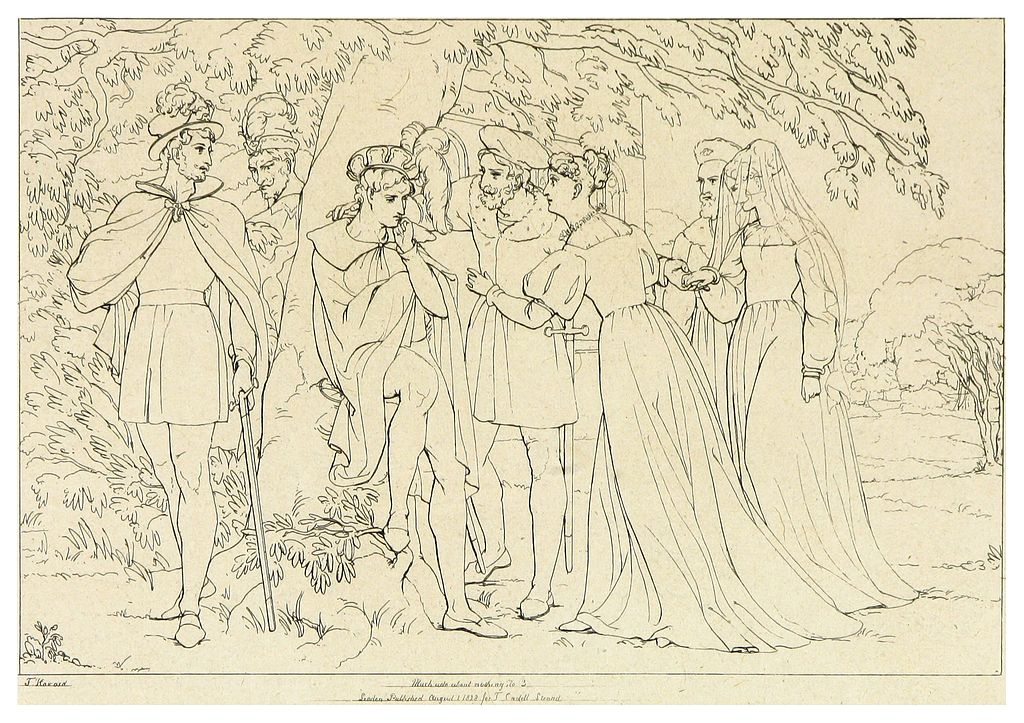
1024px-howard281828-3329_shakspeare2c_much_ado_about_nothing_vol12c_p219

Much Ado About Nothing

Rose Theatre Kingston, 20th April 2018

Come on fellow residents of the Royal Borough of Kingston and London Borough of Richmond – both upon Thames. Get your collective arses over to the Rose Theatre to see this new version of Much Ado About Nothing, celebrating the 10th anniversary of your local theatre. There are plenty of tickets left for the last handful of performances. It is not perfect but when it is funny, it is very funny, the setting is intriguing, there are a handful of strong performances, including the star turn Mel Giedroyc, and, in John Hopkins’s Benedick, there is Shakespearean comic acting to rival the very best.

Now I will admit that the main draw for BD, LD, myself, and latterly MS, was Ms Giedroyc herself. Obviously she is a national treasure and we have collectively seen her memorably translate her inimitable style, arch covers it, to the reading of Agatha Christie. Play, proximity and support for the local theatre was enough justification for me, but LD especially needed the hook of her off the telly. LD is probably a bellwether teen, suspicious of Shakespeare, unless forced to consume at school, and then normally pleasantly surprised when Dad mugs her into coming along, usually through vague subterfuge. And she thoroughly enjoyed this. It doesn’t mean a trip to an uncut Lear is just round the corner. Just saying that if it is good enough to entertain her it is good enough to entertain anyone who might be dubious about the Bard.

Moreover, this production, jointly staged with Granville and Parnham and Antic Face, rattles through the action so that we are all done and dusted in under 150 minutes inc. interval. That’s including a several minute intro as we are, just so we know, introduced to the resort hotel in a set shrewdly realised by Naomi Dawson. This is modern day Sicily and Leonato’s estate is now a luxury spa to which Peter Guinness’s suitably intimidating mafioso Don Pedro and crew have retired for a bit of rest, relaxation and intimidation. Suffice to say it looked nothing like the bucolic MAAN in the drawing above.

Director Simon Dormandy’s ideas do, fitfully, generate some insight, notably in the way that Kate Lamb’s Hero and Calam Lynch’s Claudio are so precipitously thrust together, in the fancy dress party which permits the romantic plotting, in the wedding scenes and, especially, in Hero’s fake funeral. Here the juxtaposition of modern sophistication with older, deeper, paternalistic traditions is most striking. We love Sicily, (well I do especially), but Sicilians are a wary bunch, unsurprising given colonisations by Phoenicians, Greeks, Romans, Vandals, Ostrogoths, Byzantines, Muslims, Vikings, Normans, Germans, French, Spanish, Italians, Mafia and Tourists. Mind you that is what is makes it endlessly fascinating to the outsider.

On the other hand there are times when the hotel set is a limitation, most notably for the Watch, though frankly that never works, even with Stewart Wright doing his very best as Dogberry. And, let’s face it, most people see MAAN for the comedy, specifically Beatrice and Benedick sparring. Mel, as customer services manager for the hotel and Mr Hopkins, as an unlikely consigliere to Don Pedro, deliver. Ms Giedroyc, is funny, we know that, and exactly the right sort of funny, and doesn’t hold back from mugging to the audience. When she needs to show Beatrice’s independence, and specifically her revulsion at the patriarchal conceits around her, she also shows she can seriously act. John Hopkins however is a cut above, the physical humour matches his brilliant delivery of the text. Their early disdain for each other is done snappily enough, with some evidence of their back story, but it is when they get serious about each other that they hit the heights. Mel’s immediate retort of “kill him” when asked by Mr Hopkins what Benedick could do for Beatrice to right the wrong Claudio has inflicted on Hero, got the laugh, but the audience was palpably nervous. It is their respective eavesdropping scenes which still the show: pure farce, but why not if it makes us happy.

We were taken with young Calum Lynch as Claudio on his professional debut, especially LD, and especially when his top came off. There was a harsh streak in him, where required, to balance the skittish wooing. Kate Lamb presented an initially diffident Hero but bristled wth anger as her reputation was impugned. Peter Bray, rather disconcertingly played Don John as a somewhat dim East London thug; in contrast his Clerk was more Home Counties solicitor. David Rintoul as Leonato, now hotel manager, was alternately brutal and oleaginous. Fine support elsewhere includes Nicholas Prassad as Borachio and Victoria Hamnett as Margaret conjuring up a saucy scene involving Hero’s wedding dress that provides a not unreasonable explanation for the mistaken identity window scene which leads to Hero’s “disgrace”.

There have been, and will be, sharper, richer versions of MAAN, Christopher Luscombe’s recent RSC production for example, but if you want some straightforward easy on the ear and eye Shakespeare comedy, Kingston, for the rest of this week, is the place to be.


Rules For Living review at the Rose Theatre Kingston ***

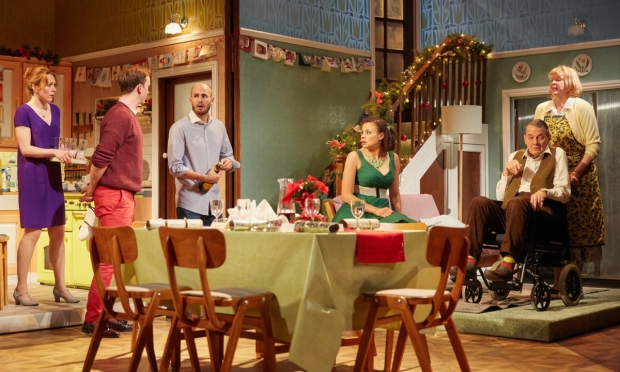
120244

Rules For Living

Rose Theatre Kingston, 13th November 2017

The Tourist loves the Rose Theatre. Admittedly it helps that it is just a hop, skip and a jump, (well brisk walk), away from him. It does serve up some interesting theatre though, in amongst the music and comedy, and it does a grand job for the local community, notably for the young people. Understandably most of the theatre it produces is shared with other venerable regional houses but this makes eminent economic sense. And by and large, when it has nabbed something for itself, the decision has paid off. All this is achieved without an Artistic Director or commissions. Given the size of the place, 900 seats, comparable with the Lyttleton say, or the newly opened Bridge, this seems to me a laudable strategy.

Over the last couple of years we have had the excellent productions of My Brilliant Friend (My Brilliant Friend at the Rose Theatre Kingston review ****) and The Good Canary, the outstanding Junkyard, (Junkyard at the Rose Theatre review *****), which was a massive positive surprise for me and BD, a pretty good recent revival of The Real Thing (The Real Thing at the Rose Theatre Kingston review ****), the ambitious and largely successful Wars of the Roses, a fine All My Sons and decent productions of Toast, The Herbal Bed, The Absence of War and Maxine Peake’s Beryl, (looks like the marvellous Maxine will end as good a writer as she is actor). Oh and we got the Play That Goes Wrong before the West End.

Coming up we have a new production of Much Ado About Nothing with Mel Giedroyc, (which means BD and LD are already signed up), as Beatrice, (dying to know who will be Benny), and a Don Carlos, (shared with the Nuffield Southampton and the Northcott Exeter so LS will be instructed to attend), in which Tom Burke, (you know him off War and Peace), will partner again with the fancy-dan Israeli director Gadi Roll. A bit of Schiller should wake up the good burghers of Kingston.

Right that’s the puff piece over. What about Rules for Living? This play by Sam Holcroft premiered at the National Theatre in 2015 where it was, by and large, well received. Brothers Matthew (Jolyon Coy, last seen by me in the somewhat different Little Eyolf at the Almeida) and Adam (Ed Hughes) have returned to the family home with, respectively, partner Carrie (Carlyss Peer) and wife Nicole (Laura Rodgers), for Christmas Day. Matriarch Edith (Jane Booker) is marshalling the troops ahead of her husband Francis (Paul Shelley) coming home from hospital, after, it transpires, having had a stroke. Last, and probably least since she is off stage in bed until the end, is Emma, the fragile daughter of Adam and Nicole.

So far, so middle class sitcom. Carrie is a flighty actress, who wants successful lawyer Matthew to pop the question. Adam was a cricketer whose career was ignominiously cut short when he froze on his Test debut. He is now a provincial solicitor. Adam and Nicole’s marriage is on the rocks. Dad Francis was a judge and doesn’t suffer fools gladly. Under Edith’s direction the festive activities are run with military precision. 

Now the twist, because, as it stands, this cracker would be more Poundland than Waitrose.  Each of the characters has to follow a rule to govern their behaviour. This flashes up above Lily Arnold’s lovely doll’s house set. The detail of this rule is expanded through the play. So, for example, Matthew has to first sit down, and then eat, when he tells a porkie. I will refrain from trotting out the other rules in case you chance to see this. You get the picture I am sure. Ms Holcroft took learnings from cognitive behavioural therapy as the inspiration for the play and cleverly ensures each of the rules matches the characters faults, frustrations and personalities.

This then is the catalyst for the hilarious goings-on and, initially, at least, there is much humour in this conceit. Having weaved this into the plot though, Ms Holcroft then doesn’t see to entirely know what to do with it, so we veer off into a quasi-farce which ends with a food fight. Amusing yes, and it bears comparison with the master it emulates in Alan Ayckbourn, but it felt to me that the idea was too clever for the execution. The conceit boxed the characters in and didn’t leave enough room for the pathos which was needed to balance the farce.

The cast entered into the spirit of the venture with energetic enthusiasm, even Ed Hughes and Carlyss Peer whose “rule’ was the trickiest to pull off without being annoying. Jane Booker had the pick of some very funny lines and Paul Shelley, with no lines as such and precious little stage time, was a hoot. Laura Rodgers probably dug deepest though her “rule” gave the most opportunity for nuanced development. Director Simon Godwin, who has had some notable successes at the NT, especially his Twelfth Night, chose to anchor proceedings in the family home and play down the “game-show” context of the original production.

All in all then like a game of family charades. A really good idea when it kicks off but wearing after an hour or so. We are going to try doing massive jigsaw maps in silence for Xmas this year. Yo ho ho.

PS. I see that Sam Holcroft is writing a play for the Bridge based on the novel The Black Cloud by astrophysicist Fred Hoyle. Blimey. There will be some big ideas in that for sure.