
The Height of the Storm at Richmond Theatre review ****

Vincent_van_Gogh_-_Houses_at_Auvers_-_Google_Art_Project

The Height of the Storm

Richmond Theatre, 5th September 2018

I can’t deny that Florian Zeller is a gifted playwright. I am just not sure his work is for me. I saw The Father at this very house in 2016 with Kenneth Cranham in the lead role. Centering on an old fella with Alzheimers allowed Mr Zeller acres of space to deploy his trademark philosophical musings and play games with time and memory. Mr Cranham was great but all that deliberating about what you could and could not believe got a bit samey after a while.

Well he, and his translator Christopher Hampton, are at it again in The Height of the Storm. The nature of memory, the effects of ageing, the making of self, the cracks in a family, all are confronted again, but here set against a love story. Jonathan Pryce is Andre, a retired writer, who has been married to Madeleine, played by Eileen Atkins, for five decades. They live in a large country house in provincial France. Divorced daughter Annie (Amanda Drew) arrives for the weekend. It looks like she is pushing for the house to be sold. Later on younger daughter Elise (Anna Madeley) also pitches up with current estate agent boyfriend (James Hillier) in tow.  A bunch of flowers is delivered. A neighbour and apparent long-standing “friend” of Andre played by Lucy Cohu pops in. But it isn’t very long before we begin to wonder if Madeleine is really there or whether disorientated Andre just imagines her presence and whether the cosy conversations they are having are simply the memories of his now dead wife. Or maybe it is the other way round?

Mr Zeller quite rightly recognises that theatre is all about suspending rationality and playing games with “truth”. And Height of the Storm certainly messes with your head. He writes beautifully but presenting such uncertainty made me, well, uncertain about whether this was entirely satisfying. However the play certainly creates an atmosphere. The set design of Anthony Ward, the kitchen of the family home, is exquisite. The lighting and sound designs of Hugh Vanstone and Paul Groothuis respectively are equally ravishing. Obviously director Jonathan Kent is exemplary – this sort of drama is his meat and drink. And I could watch Jonathan Pryce and Eileen Atkins all day. Mr Pryce exactly shows us how Andre is lost without Madeleine and Ms Atkins in turn shows Madeleine’s fortitude. Florian Zeller was inspired to write the play when he saw an elderly couple cling together as they crossed a road from the window of a Paris hotel on the day of his own wedding. They had become “one being” and that is exactly what the play conjures up and these two masterly actors portray. The desolation of losing the one you love.

There is something powerful at work here and if you want to see two outstanding stage actors at the top of their game, (supported by excellent supporting performances), effortlessly directed then this is for you. At 90 minutes it doesn’t outstay its welcome. Just be prepared though for that “what was going on there then” feeling as you leave.
 

Slaves of Solitude at the Hampstead Theatre review ***

slaves-of-solitude-3

Slaves of Solitude

Hampstead Theatre, 8th November 2017

As this blog testifies I spend a lot of time in theatres, (too much I think), but the SO is far more circumspect in her choices. Occasionally, very occasionally, the SO’s desire to see a play, and her enjoyment thereof, outstrips mine. Slaves of Solitude was one such occasion, though we both agreed that this fell a little short of our expectations.

Patrick Hamilton (1904-1962) was a writer and playwright whose star is now very firmly in the ascendant after many years of neglect. His studies of working class London life between the wars, such as Hangover Square and the trilogy Twenty Thousand Streets Under the Sky, (adapted for TV a few years ago), bear comparison with Dickens. They are populated by recognisable characters and shot through with a sardonic wit. Early on he was an actor and his most famous plays, Gaslight and Rope, were both made into successful films (Gaslight twice in the UK and then the US – obviously the UK version is superior). If you know either of these films, especially Hitchcock’s version of Rope, then you will appreciate how skilled Mr Hamilton was at creating gripping thrillers, though these plays are somewhat removed from his novels.

He was not it seems, a happy chappie. Left scarred by a car accident in his twenties, disdainful of the culture around him and a committed Marxist, he sank into alcoholism and died at 58. Despite his heavy drinking he kept writing throughout although the tone of his work darkened through time. Slaves of Solitude is the only one of his novels set during WWII and is apparently a “lighter” work than some of his other novels.

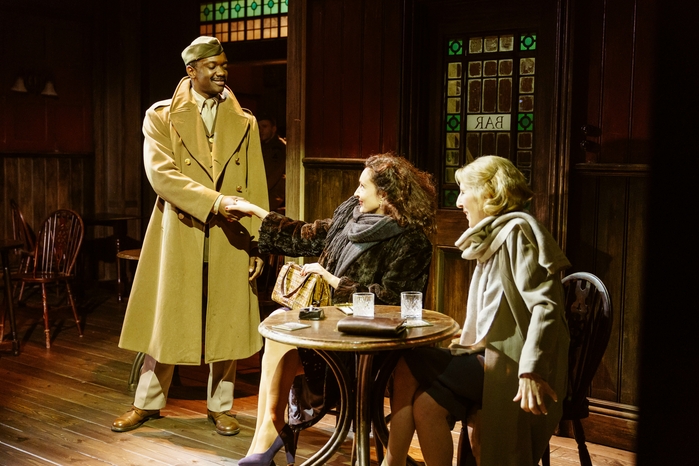
The novel has been adapted for the stage by Nicholas Wright who is a dab hand at this sort of thing and is an admirer of Hamilton, along with master director Jonathan Kent, whose last major outing was the Chichester Young Chekhov Trilogy. The play is set in a genteel boarding house in Henley-on-Thames run by the brisk, but warm-hearted, Mrs Payne (Susan Porrett) and Irish assistant Sheila (a fine professional debut from Eimear O’Neill). It is December 1943. Residents include the redoubtable Mrs Barrett (Gwen Taylor) and the kindly spinster Miss Steele (Amanda Walker) and the bombastic, blazered Mr Thwaites (an authentic Clive Francis relishing the character’s preposterous turns of phrase). There is also the enigmatic Mr Prest (Richard Tate) who spends a lot of time up in London.

Our “heroine” is Miss Roach , a pitch perfect Fenella Woolgar with her prim exterior reserve concealing a more passionate, though buried interior. She works in publishing and has been forced to leave London to escape the Blitz. This is the stiff upper lip England of fading Empire, adapting to the war time privation of ration books, blackouts and the arrival of American troops. We see early on that the women are far more willing than the nasty, misogynistic, bullying Mr Thwaites to sympathise with the plight of individual “enemies” caught up in the war. This is put to the test after Miss Roach meets vivacious German emigre Vicky Kugelmann, (a magnetic performance by Lucy Cohu), who proceeds to move in to the boarding house.

Miss Roach’s afternoons in the pub also contrive for her to meet Lieutenant Dayton Pike (Daon Broni), a friendly American GI, who begins to chat her up. Casting Pike as a black soldier, in contrast to the book, creates a heightened level of interest which Mr Wright’s adaption capably, if not forensically, explores. Roach and Pike’s subsequent affair is complicated by the presence of Vicky and by Pike’s own excessive drinking. An impromptu party at the boarding house gets out of hand with, inevitably, unfortunate consequences. Miss Roach escapes but Pike catches up with her for one final goodbye.

Now Patrick’s Hamilton gift for characterisation and creating atmosphere is splendid. The set and costume design (the Hampstead excels in this) from Tim Hatley is ingenious and puts us right inside the dining room of the boarding house and the saloon bar of the pub. These are emotionally stiff, but still sympathetic, people. The established social order has been thrown into turmoil by the war. Outsiders have arrived. Risks can be taken, particularly by women, leading to behaviour which would have been shunned before the war. Yet there are still consequences.

Unfortunately we see that this precarious world will be shattered via a flash forward at the opening which, for me, was unnecessary. The plot drifts along fairly predictably until a lurch into something more melodramatic in the second half, and the ending, which is intended to offer a modicum of solace is a little abrupt. These shortcomings were broadly compensated by the overall “feel” of the production however. Yet I was left with the nagging doubt that this was one of those subtle stories that might have been better left on the page and not taken to the stage. Whilst I do sometimes find his work annoying and frustrating I can’t help feeling that Terence Rattigan has cornered the market in theatrical British forlornness.