Al Blyth is not your typical playwright. Having studied Econometrics and Mathematical Economics, (disciplines that spend an inordinate amount of time wishing away the presence of us unpredictable humans), he went on to work as a research economist at the Institute for Fiscal Studies, though the urge to dramatize never left him. Mind you I suspect the encouragement of his missus, Sam Holcroft, also a playwright (Rules for Living), helped. Still heartless policy wonking’s loss is our gain and Mr Blyth’s previous life certainly helped shaped The Haystack, his first full length play.
It is a gripper. Easy to say why HT’s new AD, Roxana Silbert, reserved this for her directing debut in her first season. (In fact she had already encountered Al Blyth’s work from her previous tenure at Plaines Plough). AB is, as we all should be, profoundly concerned about the potential for State overreach in our world, but, rather than serving up a ranting polemic to draw attention to this, he has written a thriller anchored in a love story and buddy banter. The setting is GCHQ, (which probably now knows more about you than you do yourself), where a couple of IT geeks, Zef (Enyi Okoronkwo) and Neil (Oliver Johnstone) have been seconded to rustle up some algorithm programmes (or some such) to test the efficacy of the agency’s databases. AB’s point is not that this vast network of information is being used for nefarious purposes, just that the UK, uniquely amongst developed democracies, and thanks to the cobbled together “constitution”, lacks the safeguards to prevent abuse.
We are plunged into the lads’ digital world, brilliantly realised through the kinetic set design of Tom Piper, the lighting of HT regular Rick Fisher, the sound design of the Ringham brothers and the video of Duncan McLean, (a line up more suited to this play is hard to imagine). Gradually it becomes clear to both the no-nonsense boss Hannah (Sarah Woodward) and us the audience that the boys are on to something, but it is when Neil, against Zef’s advice and the rules, starts stalking Cora Preece (Rona Morison) that things really hot up. For bolshie, but somewhat naive, Cora is a Guardian blogger/wannabe journalist, on the rebound from Rob (Oli Higginson), getting her teeth into a story involving Ameera (Sirine Saba), the ex-wife of a really dodgy Saudi businessman type, against the wishes of her seasoned home affairs editor Denise (Lucy Black). Things unsurprisingly turn nasty, as the boys stumble into the story, with much of the story told in flashback or through ingenious use of contiguous conversations (shout to the precise movement mapping of Wayne Parsons).
OK so, even with the pacy direction and invariant dialogue, it does go on a bit, and there are moments of Spooks like cliche, but the twists in the second half, and the multiple issues AB confronts, do ensure we forgive some of the blatancy of the set-up. And Rona Morison, who regular readers will know I have a very high regard for, manages to squeeze out ambiguity in her performance of Cora that simply isn’t there on the page. I can see why some punters might get snide-y about the play, but I was carried along by plot and direction, whilst still thinking about its message.
OK. So I might have oversold this one. It is still Caryl Churchill. With that extraordinary opening act. And that carefully calibrated feminist message, as relevant now as it was when it first appeared in 1982, of how to balance “success” in work and as a mother. The argument between collective and individualistic strands of feminism. To ape the patriarchal norms or to reject them.
But as an introduction to the greatest living playwright in the English language? Maybe this wasn’t the production. So profuse apologies to those most faithful of the Tourist’s recommendation followers, BUD and KCK, who came along. And to the most long suffering of all, in so many ways, the SO, whose previous CC exposure was the brilliant (to me), but admittedly knotty and OTT, production of Light Shining in Buckinghamshire on this very stage in 2015. I hope my chums could see where I was coming from even as the flaws in the production became apparent.
Not that these flaws were substantial. The opening scene here has a cast to die for, Siobhan Redmond as the indomitable Isabella Bird, Amanda Lawrence as the ebullient Pope Joan, Wendy Kweh as the enigmatic Lady Nijo, Ashley McGuire as the laconic Dull Gret and Lucy Ellinson as the most obviously misused Patient Griselda. The way CC takes Marlene’s drunken dinner party celebration and transforms it into a confessional which explosively, hilariously and movingly transcribes the fate of women, real and fictional, across time and geography, and specifically the way the patriarchy determines their roles as mothers, is still, for me about the most riveting half hour of theatre I have ever seen. Especially when the technical challenges of the multiple, simultaneous, conversations are, as here, perfectly realised, not to say the getting pissed part. And all presided over by the dauntless Marlene about to take the top job at the Top Girls employment agency. Katherine Kingsley, who you will probably know best from her musical theatre roles, initially locates Marlene firmly in the 1980’s Thatcherite, “ballsy”, power woman mode. To watch her equivocation, and Suffolk accent, emerge in the later scenes is a measure of just how good a performance this is.
The second scene, (here the usual order is shuffled a little), sees stage debutant Liv Hill, (Three Girls, on the telly, just watch it – though for my money Ria Zmitrowicz is actually the best of the trio of talent on display), initially at least, convincing as the immature Angie, sharing her angst with younger chum Kit (Ashna Rabheru). The two actors are confined to a small box room stage right as the technicians crack on, quietly, with transforming the space behind.
Into ….. the Top Girls agency. Which is where the full glory of the period detail of Ian MacNeil’s set and Merle Hansel’s costumes, (so superb for the dinner party), are revealed. And which also highlights one of those modest flaws is the production. By anchoring the look of the play so firmly in the year when it was written it encouraged the audience to do the same. The universality of the messages were diluted. Those of us who are old enough to recall the period, (all the Tourist’s party I am afraid), were drawn into thinking about the archetypes and behaviour of the period rather than the wider issues examined in the play, and I suspect you younger folk will have been affected more by the story here than its implications.
For it is, especially as we turn into Scene 4, and the not so big reveal, a mightily powerful piece of drama, especially when actors of the calibre of Ms Kingsley, and Lucy Black as her sister Joyce, are charged with delivering CC’s brilliant text. I don’t suppose I will ever tire of the thrill of listening to Ms Churchill’s dialogue. Complex and ambiguous ideas, observations and dilemmas framed in entirely natural dialogue, (even sometimes when how it is framed is formally inventive or even, frankly, a bit weird). There is so much dialectic revealed in Marlene and Joyce’s final argument that it is hard to keep up and yet it also sounds and feels exactly like the kind of set-to that any sisters might have had, at least in the modern world, about family, choices, dreams and disappointments, as well as politics. Family and/or career. Collective and/or individualistic feminism. All in less than half an hour.
And yet, as many critics have observed, this production, because the NT could, by not having actors double up from the first scene into the office scene, loses much of its resonance. CC didn’t specify doubling. That is just the way it has generally been done, a cast of seven for the simple reason of cost. But it certainly, at least when I have seen the play before, has far greater impact as the women that emerge from the interviews, Jeanine, who just want to travel and be with her husband, Louise, who has devoted her life to her job but still watched men promoted over her, and Shona forced to exaggerate her experience, as well as Mrs Kidd, who comes to plead for husband Howard who had expected to get the job Marlene has secured. This pivotal scene loses some impact because of the introduction of new faces, (the SO observed that she was expecting the dinner party guests to reappear in new guises and she has never seen Top Girls before), and maybe because, in an attempt to fill the Lyttleton stage, there is a fair bit of superfluous movement and furniture in this agency scene.
Director Lyndsey Turner, unsurprisingly given her experience in reviving Caryl Churchill’s work, pretty much nails the words, from Marlene’s initial instructions to the waitresses at the restaurant, (of course they are women), through to Angie’s final, plaintive, cries for her Mum at the end. This is such a rich play, just read it, and, with a cast of this distinction, the words can’t help but leap from the page. It is just that the look and feel of the production, even with the solid contributions of Jack Knowles (lighting) and Christopher Shutt (sound), didn’t quite work for me. Still to watch 18 women, (many of whom, in the “lesser” roles, were new to me), line up across the stage at the curtain call was pretty awesome. I doubt I will see that again.
I don’t doubt though that I will get another opportunity to see Top Girls. The programme lists 25 English language productions since the Royal Court premiere. With 6 last year alone, (though its been 8 years since the last major revival in the UK from Out of Joint).
That’s the thing with Caryl Churchill. She changes the game whilst being ahead of it.
Live in Sheffield? Like theatre? Then you must go see this production of the 2001 play, The York Realist, which is on at the Crucible for the next couple of weeks. Live in Sheffield and no interest in the theatre? Even more reason to go. The family at the centre of this play went to see the York Mystery Plays and they were bowled over by it. The same will happen to you if you see this. Cast iron guarantee.
This is the first time I have seen a play from the pen of Peter Gill and I can’t imagine a more sympathetic production. This revival is a co-production between the Donmar and Sheffield Theatres and, if this is what Artistic Director Robert Hastie, serves up to the good people of Sheffield on a regular basis then I might just have to move there. I see there is a production of Caryl Churchill’s epic, by her standards, Love and Information set for early July. I’ve signed up. For those with the attention span of a gnat this is the play for you.
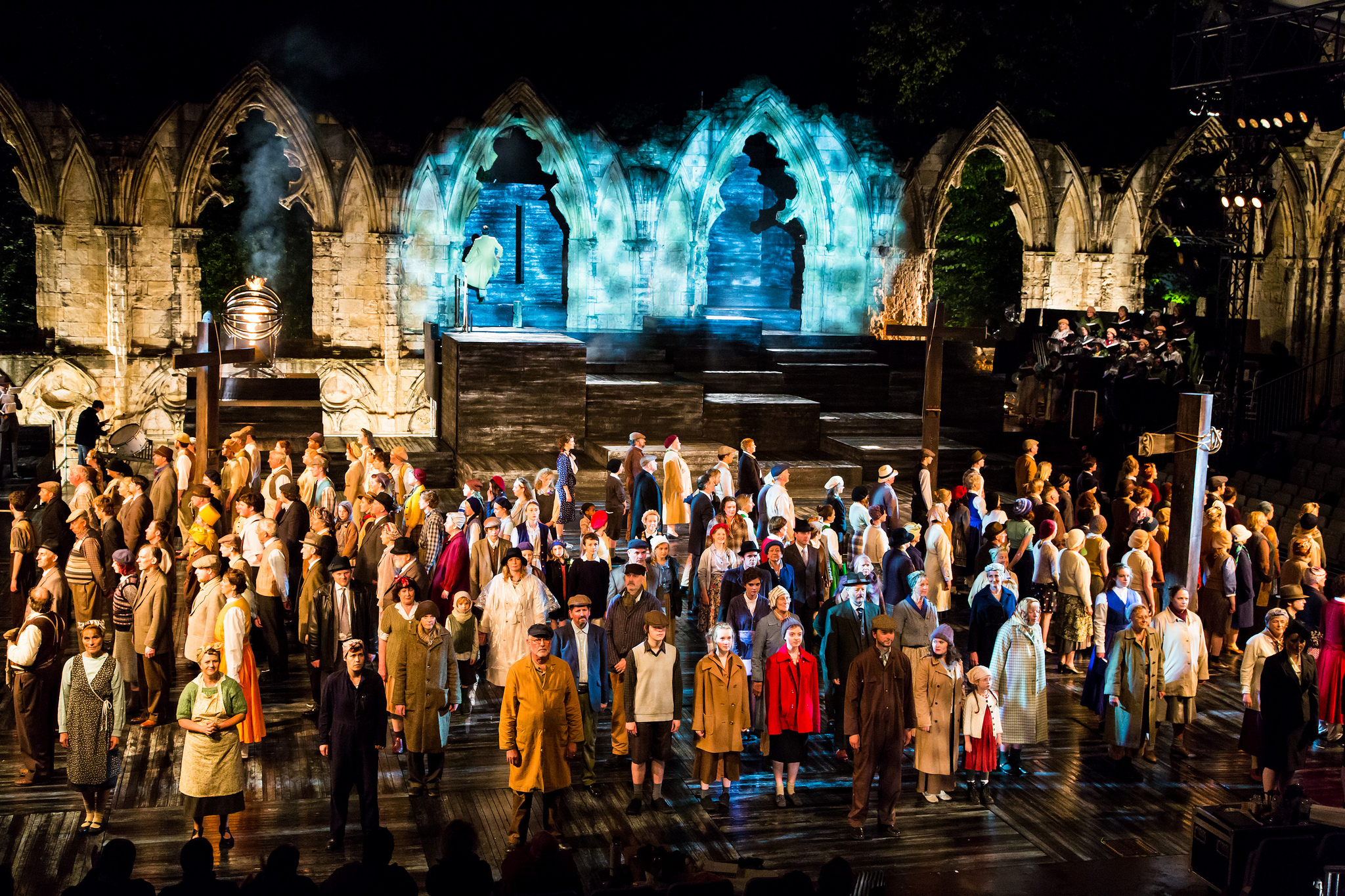
Back to The York Realist. The “York Realist” was, probably, the writer of 8 of the 48 individual plays or pageants which make up the York version of the Medieval Mystery Plays. These were constructed as a way of bringing the Bible stories to the hoi-polloi, both as performers and audience, through the C14, C15 and C16. The 8 plays in question are characterised by the broad, Yorkshire vernacular in the text, lending them an everyday realism. A production of the Mystery Plays is what brings together the protagonists in the play, John and George, in the early 1960s. Peter Gill too has conjured up a completely naturalistic play, over four acts and set entirely in one set, the main room of the tied cottage which agricultural labourer George shares with his unnamed Mother. George’s sister Barbara lives nearby with husband Arthur and son Jack, and nearest neighbour Doreen is a regular visitor.
There is a little formal experimentation in terms of chronology but none of the shenanigans ushered in to British play-writing by the likes of Beckett, Pinter, Osborne, Bond, Churchill and Stoppard. The plays opens with John visiting George after his Mother has died, before we revert to the early days of their relationship. At its heart this is the love story of John and George and it is a very affecting love story indeed, (some parallels with the recent debut film from Francis Lee, God’s Own Country, I gather).
Well-spoken southerner John, a doe-eyed, polite Jonathan Bailey, is the assistant director at the Mystery Plays, (as indeed Peter Gill was in his youth in the 1960s). George is a blunt, muscular, salt of the earth type who can’t commit to sticking with the play. It is hard to imagine anyone else but the excellent Ben Batt playing the part. John has come to persuade him back to the play. Their attraction is obvious from the start and both actors are completely convincing in their relationship. George’s seduction is amusingly direct, John’s coyness easily overcome
Their relationship flounders more on the rocks of class and geography than the reaction of family, who have tacitly accepted George’s sexuality. George feels bound, or maybe chooses, to stay looking after ailing Mother, Downton’s Lesley Nicol, and eventually bows to what seems inevitable by taking up with the humble, attentive Doreen (Katie West), who has been waiting all her life for him despite his identity. With minimal and unforced dialogue, and some very gentle disclosure, we also get to see the ambitions and frustrations of bluff Arthur (Matthew Wilson), indefatigable Barbara (Lucy Black) and Brian Fletcher’s Jack who seems destined, if reluctant, to take up farm labouring.
What is so brilliant about Peter Gill’s writing is the way, within this entirely naturalistic scenario, he draws out the themes he wishes to explore. John’s slightly patronising middle class fascination with the past, the rural and the antique, (though he isn’t prepared to abandon his life and work in London and creature comforts to live in the country), George’s acknowledgement of all that London has to offer but his fear of moving (“I live here”), the denial of identity, the pull of family, gender roles, the allure of self-sacrifice and devotion, the limitations placed on aspiring working class actors, the power of theatre and its appropriation as “high culture”, the inequity of tied farming. None of this is rammed down your throat, and perhaps the biggest dichotomy, the fact that gay relationships were still illegal in the early 1960s, is made more telling by its near absence in the story.
Apparently Peter Gill has a long association with the Donmar as writer and director. Just shows how much I know. I was aware of his guiding hand behind the Riverside Studios in its heyday in the late 1970s and his association with the National Theatre Studio in the 1980s. I see that the new Riverside Studios is close to completion, (passed it on the bus the other day), though I think it will be devoted once again to TV. I only got the bus because I didn’t have time to walk along that part of the Chiswick riverside where Peter Gill lived. That’s one of the joys of culture-vulturism. All the little coincidences and connections.
I can’t imagine Robert Hastie’s direction, Peter McKintosh’s design, Paul Pyant’s lighting and Emma Laxton’s sound being bettered. I do note that some of the proper critics think this has improved on the original production at the Royal Court in 2002. I can tell you it is a very fine play and, if they match this, I hope to see other revivals of Mr Gill’s work. Meanwhile people of Sheffield you know what to do.



 At Home He Feels Like A Tourist